RSS
 

Posts Tagged ‘Dark’

In the Dark: 10 Tips for Street Night Photography

21 Jan
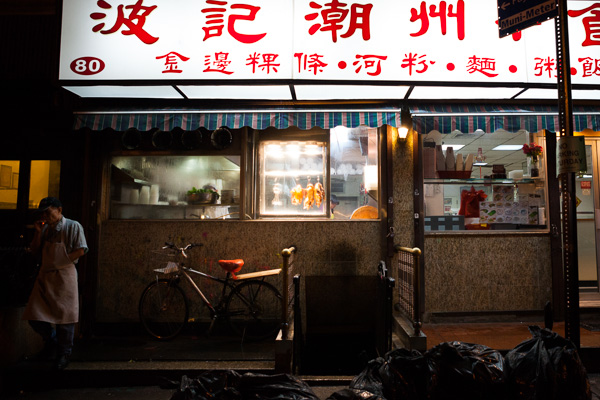
1/80th at F2.8, ISO 1600.

1/80th at f/2.8, ISO 1600

Much is spoken about photographing during the twilight hour, but what about after that?

Night is my favorite time for street photography. Cityscapes are lit with a myriad of interesting and colorful light sources, such as lampposts, neon signs, store windows, car lights, and bare bulbs. People dress in their favorite outfits to go out. Bland scenes by day can suddenly turn ominous and fascinating at night.

Here are 10 tips for night photography to get you thinking about starting your next street photography session at twilight, rather than ending it.

1. Ideal camera settings for sharpness at night

To freeze motion during the day, I prefer to use a shutter speed of 1/320th, with 1/160th as my lower threshold.

At night, this changes. In the brightest areas, you will be able to photograph at 1/250th, but most of the time it will be best to use a shutter speed somewhere between 1/160th and 1/60th. You need to have: steady hands; a wide-angle focal length; and to stop your own motion completely to be able to photograph handheld at speeds around 1/60th, but with some practice it can be done.
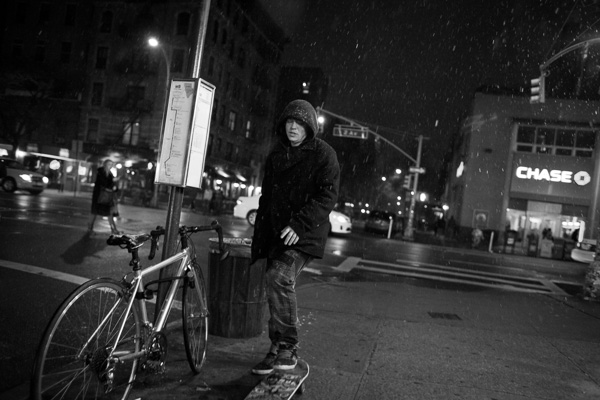
1/125th at F2.5, ISO 6400.

1/125th at f/2.5, ISO 6400

A wide-angle lens is necessary for this type of photography because the longer the focal length, the faster the shutter speed needed to keep an image sharp. With a 28mm or 35mm lens (up to 50mm) it becomes much easier to handhold the camera at slower shutter speeds.

It will also help to use a fast, prime lens, such as a 35mm f/2. It is possible to shoot at f/4 in brighter areas, but being able to shoot at f/2.8, f/2, or even 1.8 will greatly expand your opportunities.

Finally, you will need to raise your ISO significantly. With modern digital cameras you can photograph anywhere from ISO 1600 to 6400 with decent or good quality. It’s just not possible to photograph handheld at night otherwise. I prefer to shoot at ISO 3200 and sometimes at ISO 6400 if needed.

To learn more about photographing with a high ISO, you can read about it here: Reasons to Shoot High ISO Images.

2. Seek out the light sources first
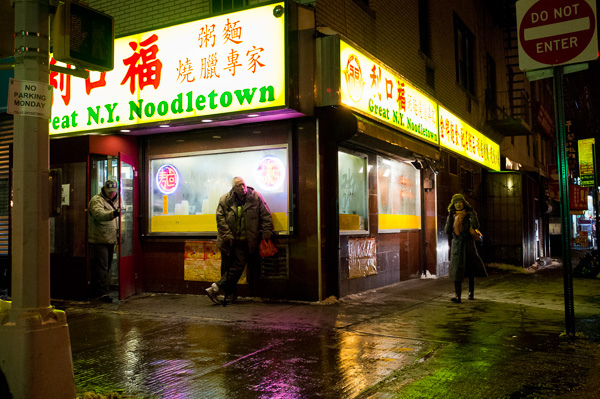
1/60th at F2.8, ISO 3200.

You should always pay attention to the main light sources in a scene, no matter where or when you are photographing, but at night this becomes even more important. Start by finding a beautiful light source, or an area with good lighting, and wait around for something to happen.

Focus on how these light sources hit your subjects. If you are leaning against a shop with a lit sign behind you, like the man in the photograph above, then as subjects pass you they will be lit with a strong light that has a gorgeous color to it. If your lens aperture doesn’t go wider than f/4, this is a fantastic way to get around that limitation.

On the other hand, if you stand in the street and aim the camera at the light source, as I did in the above photo, then the light will be less pronounced on the subjects, however, you will get the beautiful sign in the scene.  Notice the difference between the light on the left and right side of the man’s face in the photo.

3. Photograph nightlife
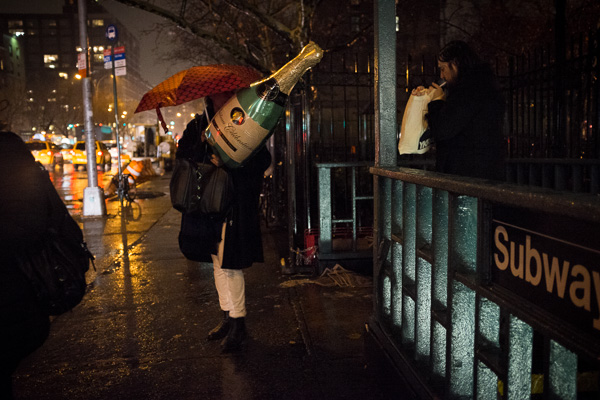
1/125th at F2, ISO 6400.

1/125th at f/2, ISO 6400

Some of the most interesting night street photographs occur where the most people are, and that is often where the nightlife is. A fantastic project to look at for inspiration is Maciej Dakowicz’s Cardiff After Dark.

4. Alternate between getting close and stepping back

I’m a proponent of the Robert Capa advice that, “if your photos aren’t good enough, you’re not close enough.” However, at night I often alter this strategy.

I try to get close to many of my subjects, but I will also try to create scenes where the subjects are small aspects of the overall scene. At night, backgrounds can be much more beautiful than during the day, so it often works to have people become the secondary element to the scene, rather than the primary focus.

The technical advantage to this is that you do not need to use as fast a shutter speed to capture the motion of subjects when you are further away. You can freeze a moving subject at 1/60th of a second from further away, whereas you will need to use at least 1/125th when close.

5. Tripod and crowd blur
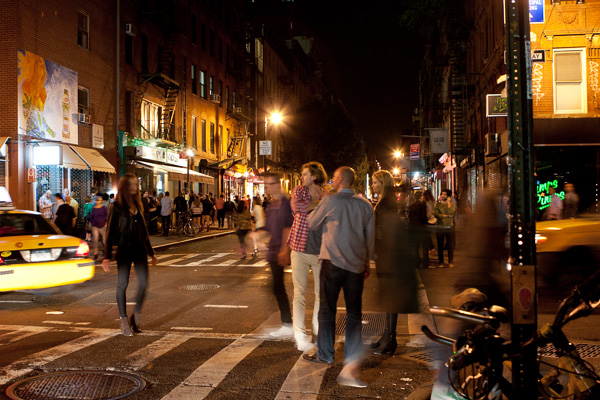
1/8th at F4, ISO 800 (Tripod).

1/8th at f/4, ISO 800 (with tripod)

For street photography, it’s usually best to go handheld since you never know what interesting thing is going to happen, and where it’s going to happen. However, one of the times to use a tripod is when you want to capture a busy scene, with lots of people and motion.

Experiment with slower shutter speeds, such as 1/8th of a second and take a lot of images.  It took me a long time to capture the image above because I wanted the people spread out evenly throughout the entire scene and I also wanted something interesting within the foreground, which is the pose of the woman in the street and the man looking at her. It took some time, and a lot of captures for this to happen.

6. Use a flash

Whether you want to try flash on the street is up to you, but keep in mind that it can easily lead to some confrontations.  I prefer to work with the constraints of the natural light on the street and I also get uncomfortable flashing strangers in the face in dark settings, but many prefer to photograph this way. It creates a fantastic look when done well.

Using a flash means that you are freed from a lot of the constraints of photographing at night. You can use a faster shutter speed and include more depth of field in the photo and less grain (noise).

You can either have the flash do all of the work lighting the scene, where the foreground area within reach of the flash is lit and everything else is dark, or you can set the camera to expose for the scene, similar to what you would do without the flash, and then use the flash to add some fill light to your main subjects in the foreground.

7. Noise and the dreaded underexposed image
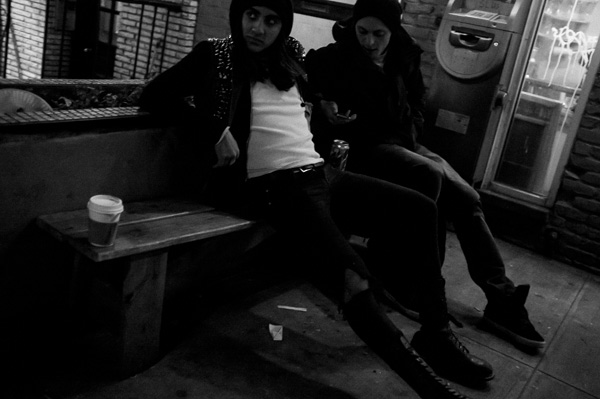
1/250th at F2, ISO 3200.

1/250th at f/2, ISO 3200

Always expose correctly when photographing with a high ISO.

That being said, even with the best settings, some of your images will be taken in areas that are too dark to be exposed correctly. It’s impossible to photograph this way and expose every image perfectly within the camera. For the occasional shots with excellent content that you want to save, you will have no choice but to raise the exposure when editing.

For these photos, I will first ignore the noise and get the exposure and look correct in Lightroom. After I do this, if I’ve had to raise the exposure setting a significant amount, the grain will look terrible. Luckily, there are some keys to saving an image like this as long as you are photographing in RAW.

What I do is to first remove the grain and then I add it back. I want the image to look grainy, but I want the grain to look pleasing.  There are many noise reduction programs, such as PhotoNinja, Topaz DeNoise, and DxO. I like Lightroom’s built in Noise Reduction. If the noise is still bad after noise reduction I will sometimes bring it into Photoshop and add a very slight Gaussian blur.

Then I will use Lightroom’s grain settings to add grain back into the photo. This grain looks much more pleasing to the eye than brightened, extreme digital noise and it can further hide some of the technical deficiencies in underexposed images. The result will not be a perfectly sharp image, but it will still be pleasing and beautiful.

8. Blur and imperfection

On this note, aim to get your photos as sharp as possible when you want sharpness, but know that a photo can still look fantastic even if it’s not tack sharp.

You don’t need to freeze motion perfectly when photographing at night for the image to still look great. I hold my day images to a higher standard than my night images when it comes to sharpness.  They need to be interesting and look good and that’s what counts.

Also, at shutter speeds around 1/60th to 1/30th, you can experiment handheld with slight blur, where your subjects are somewhat sharp but have a little motion to them. It’s a great way to add an energetic feeling of movement into an image.

9. Night images should be dark
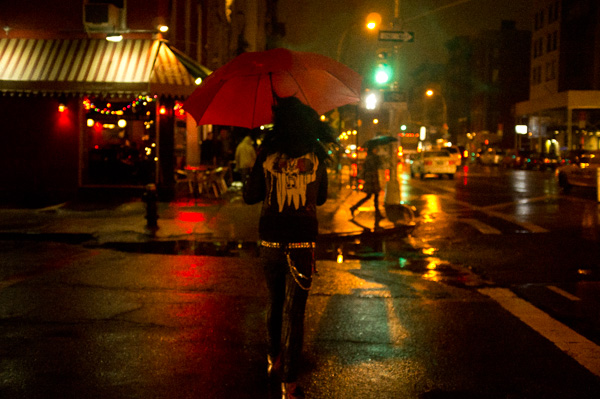
1/250th at F2, ISO 3200.

1/250th at f/2, ISO 3200

This is an overly general statement, so feel free to disagree, but I want to make a point here.

I believe that night shots should look like they were taken at night.  They should be dark, with deep shadows and areas that are hard to see and make out.  When you look at the histogram of a night image it should be further towards the dark end (left) than a day image.

When you expose a night shot, especially on automatic settings, the camera will often misread the scene and overexpose the image.  It will be bright and you will be able to see everything as you would during the day, but it will not feel like a realistic night scene.  In these cases, you will want to lower the exposure compensation on your camera slightly (-).

There are many situations where bright night images are a good thing, but don’t be afraid to make your night images dark and realistic.

10. Be careful

Depending on where you live, going out at night with a camera is not always the safest idea. Travel light with equipment and be careful about where you go. Use your best judgment on who to photograph and think about bringing a friend along. You don’t want to suddenly find yourself in a bad situation.

Do you have any addition tips you’d like to add? Please do so in the comments below.

For more reading on night photography in general check out these:

  • Tips for Photographing Star Trails
  • Nightscapes: Photographing the City at Night
  • How it was Done – Zooming the Exposure
  • Painting with Light in the Landscape
  • 5 Tips for Creating fun Campfire Photos

The post In the Dark: 10 Tips for Street Night Photography by James Maher appeared first on Digital Photography School.


Digital Photography School

 
Comments Off on In the Dark: 10 Tips for Street Night Photography

Posted in Photography


Shooting in The Dark by Dominique Shaw

10 Dec

My brother Liam and I have been shooting weddings without flash for over eight years. The flash equipment is safely in the car boot just in case of an absolute emergency but for the last four years we haven’t had the need to bring out the flash gun at all! We like to let the […]
dslrBlog

 
Comments Off on Shooting in The Dark by Dominique Shaw

Posted in Photography


Dark Tower: Decay Inside Africa’s Tallest Apartment Complex

30 Oct

[ By WebUrbanist in Architecture & Cities & Urbanism. ]

ponte apartment context

Before a long descent into darkness, the cylindrical Ponte City Apartments began life as a luxurious tribute to growth and wealth in Johannesburg , filled with envy-worthy units looking out in all directions. But after years of decline and false restarts, what direction is next for the highest residential skyscraper on the continent?

dark tower spire detail

ponte apartment trash

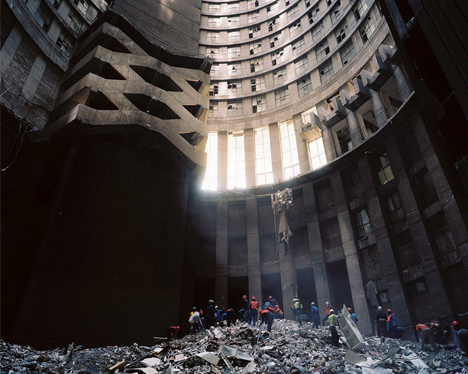
As remarked in the film above by Philip Bloom, the transformation of this iconic 54-story, mixed-use tower in South Africa has been astonishing. “It really was icon of decadence … wealth and exuberance” with three-story units and Jacuzzi tubs – a “premier location in the city” for people “making a lot of cash.” As part of an exodus from the city center, rapid changes took place.

dark tower up down

The center of the circular plan looked excellent in theory – a way for light to enter the back side of apartments looking into the core. There were even plans for an indoor ski slope to accompany the various shops and eateries on the lower levels.

dark interior core views

In practice, it slowly became a kind of black hole filled with three stories of detritus at the bottom and marked by unwashed walls all the way up. It also developed a reputation for defenestrations – accidents, suicides and otherwise.

dark building exterior view

Investors just before the global financial crisis began to re-envision and rehabilitate the structure, but the renovations stopped as abruptly as the market crashed, leaving an ambiguous future for this iconic structure.

Next Page:
Dark Tower Decay Inside Africas Tallest Apartment Complex

Share on Facebook


[ By WebUrbanist in Architecture & Cities & Urbanism. ]

[ WebUrbanist | Archives | Galleries | Privacy | TOS ]


WebUrbanist

 
Comments Off on Dark Tower: Decay Inside Africa’s Tallest Apartment Complex

Posted in Creativity


Glow in the Dark World: 12 Smart Illuminated Inventions

28 Oct

[ By Steph in Conceptual & Futuristic & Technology. ]

Glow in the Dark Tech Applications

Glow in the dark tech doesn’t have to be limited to novelties like glow sticks – it could be used to make the roads safer, provide illumination without the need for electricity, and allow surfers to see each other in dark waters. These 12 applications of luminescence include everything from clothing and pillows to cars and architecture.

Glow in the Dark VW Golf

Glow in the Dark VW Golf Car

Bright green luminescence ensures that nobody has any trouble seeing this VW Golf MK7 at night, which has been covered in a special phosphor-foil 3M wrap. Created by the tuners at Low-Car-Scene and Blackbox-Richter, this glow in the dark car looks white and pink during the day, and green and black at night.

Urban Dwelling by Jiri Prihoda

Glow in the Dark Urban Dwelling

This glow-in-the-dark urban structure is a two-story dwelling with a secret compartment hiding a pull-out bed. The installation, by Czech artist Jiri Prihoda, is built into a reclaimed railway yard and features an outer shell made of Corralit material, a luminescent substance that absorbs daylight and later glows for about eight hours. While this mini dwelling was installed in a very urban location, the idea is that it would make a tranquil place to stay in the woods or by the sea in more private surroundings.

Glow in the Dark Skate Park

Glow in the Dark Skate Park
This sculptural skate park located on Vassiviere Island in France solves a problem of keeping the surrounding woods natural and free of harsh lighting at night by glowing in the dark. Koo Jeong A and Belgian firm L’Escaut Architecture wanted a ‘dreamlike’ setting for skaters at night that would blend into the environment.

Solar Activated Glowing Bike by Pure Fix Cycles

Glow in the Dark Bicycle

Riding a bike at night can be a bit unsafe. ‘Kilo’, a light-activated glow in the dark bicycle frame from Pure Fix Cycles, fixes that problem with highly reflective paint that can be applied either to the frame or the wheels. In addition to being more visible to oncoming traffic, the glow illuminates the road a bit.

Next Page:
Glow In The Dark World 12 Smart Illuminated Inventions

Share on Facebook


[ By Steph in Conceptual & Futuristic & Technology. ]

[ WebUrbanist | Archives | Galleries | Privacy | TOS ]


WebUrbanist

 
Comments Off on Glow in the Dark World: 12 Smart Illuminated Inventions

Posted in Creativity


Dark City: Giant Mirrors Aim to Illuminate Town in Shadows

05 Aug

[ By WebUrbanist in Conceptual & Futuristic & Technology. ]

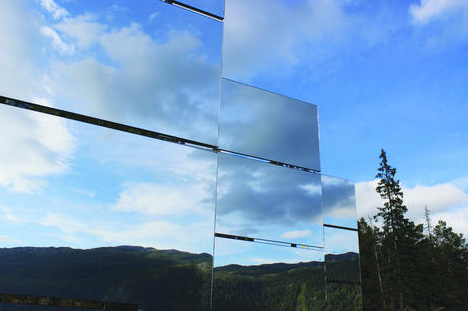
shadow city solar panels

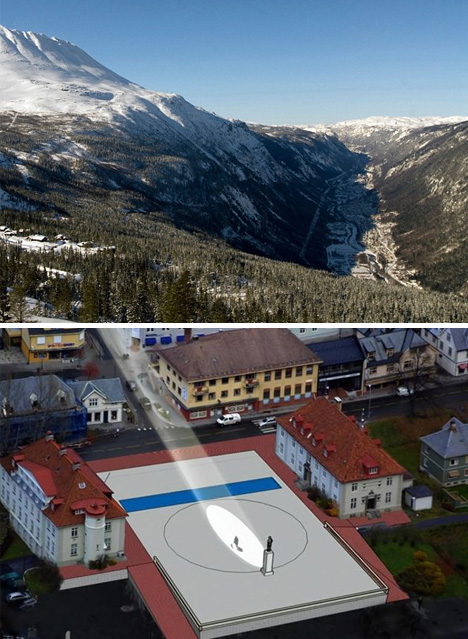
A lovely little settlement in a lush valley of Norway sounds like a slice of paradise – except that the surrounding hills keep it out of sunlight for nearly half of the year. This incredible undertaking aims to change that, illuminating the town square even in the darkest parts of the year.

shadow town mirror project

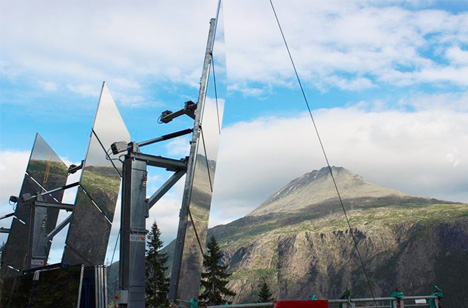
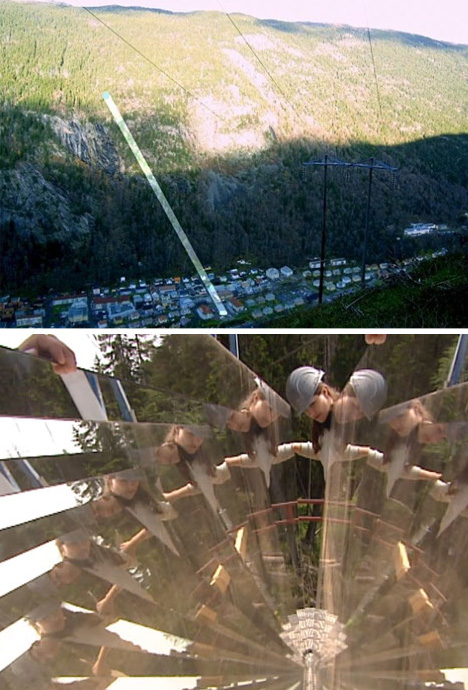
A set of mirrors positioned high above Rjukan will rotate to reflect sunlight into the center of the settlement, which, thanks to being rather predictably bathed in light, will be available to residents and visitors who wish to walk through it. The system will be computer-controlled from the town hall.

shadow valley mirror array

If this sounds far-fetched or even futuristic, consider this: the idea was originally pitched exactly 100 years ago by a local developer in the area, but scrapped at the time due to cost. Its originator went ahead and constructed a cable car instead, to help people in the area climb high enough to get natural light in the winter.

shadow illuminate town square

Even today the installed array will run up a bill of nearly a million dollars and include over 500 square feet of mirrored surface (lighting up over 2000 square feet below). But for residents of this remote and shadowed settlement, who normally have to forsake the sun 5 months of the year, the effect is worth the price.

Share on Facebook


[ By WebUrbanist in Conceptual & Futuristic & Technology. ]

[ WebUrbanist | Archives | Galleries | Privacy | TOS ]


WebUrbanist

 
Comments Off on Dark City: Giant Mirrors Aim to Illuminate Town in Shadows

Posted in Creativity


‘Dark Matter’: Erez Marom takes us behind the picture

08 Jun

Dark_Matter_final_image_1024px.jpg

In this article, photographer Erez Marom explains how he created his image ‘Dark Matter’, which was captured at glacier beach in Iceland earlier this year. Marom sheds light on everything from from composition and gear choice to post-processing, and finally, what to call the final, dramatic picture. Click through for a link to the full article.

News: Digital Photography Review (dpreview.com)

 
Comments Off on ‘Dark Matter’: Erez Marom takes us behind the picture

Posted in Uncategorized


Spectral Studio: 20 Sq M Space Uses Light & Dark as Decor

20 May

[ By WebUrbanist in Design & Fixtures & Interiors. ]

illuminated apartment

In an Paris apartment with just over 200 square feet, it is almost impossible to imagine anything but the more bare essentials resulting a boring space. But that is where illumination enters the equation, flooding in to add depth and complexity to this abode. This, then, is a short story of light.

illumination study axon existing

The architects, Betillon | Dorval?Bory, examined the limited space available architecturally, but also scientifically, testing the type and quality of the natural light to be found (and then suggesting what should be carefully introduced) across the existing interior zones.

illuminate room two tone

A single wall was introduced, dividing the main bedroom area from daytime activity spaces like the kitchen, but not just (nor even primarily) as a visual barrier – it was intentionally and most-importantly designed to be a backdrop for two types of light.

illuminated night sleeping area

On the ‘night’ side: a diffused orange streetlamp glow of the after-hours city that we associate with evening, which washes the walls in a more monochromatic direction (suited for sleeping and showering). On the ‘day’ side, a pure all-purpose white of the kind found in active spaces like offices – one which allows us to see things in black and color as well (suited for cooking and gathering).

illuminated flat natural daylight

Notably, the ‘night’ side lights can also be turned off (or overpowered by daylight), allowing the entire place to ‘open’ into a single space. If there is a lesson to be learned here, it is that physical objects are not the only things that form (or inform) the nature of space. Spatial variety can come via intangible elements like illumination, which in turn can serve equally powerful functions in fleshing out a space – particularly a small place with little room for solid decor.

Share on Facebook


[ By WebUrbanist in Design & Fixtures & Interiors. ]

[ WebUrbanist | Archives | Galleries | Privacy | TOS ]


WebUrbanist

 
Comments Off on Spectral Studio: 20 Sq M Space Uses Light & Dark as Decor

Posted in Creativity


The Dark Knight Chronicles – Episode III Teaser #2

07 Feb

A short teaser for the upcoming 3rd episode of our Dark Knight web series. Episode III will be released on May 16th along with four in depth VFX tutorials and a behind the scenes Production feature. Written, Edited, Composed, and Directed by – Luke Neumann Cinematography – Marika Neumann Sonar Visual Effect – Al Delcy Batarang VFX – Buwaneka Saranga Suit – David Sherman Aerial Camera Operator – Joe Nanoski Aerials provided by Corvallis Aero Services Special Thanks to David Johnson for the Wheelhouse location Batman – Luke Neumann Gordon/Nutria King/Prowler – Pete Dryden April Dawes – Marika Neumann Jorge Miller – Skylar Randklev Canon 5D Mark II Panasonic GH2 Nikkor 28, 50, 80-200mm AIS Music by Luke Neumann – “Nutria King” Follow the production of The Dark Knight Chronicles by liking us on Facebook or Twitter Facebook: www.facebook.com Twitter: twitter.com


The Dark Knight Chronicles – Episode III Teaser #1

11 Jan

A short teaser for the upcoming 3rd episode of our Dark Knight web series. Written, Edited, Composed, and Directed by – Luke Neumann Cinematography – Marika Neumann Sonar Visual Effect – Al Delcy Aerials – Brian Dixon Suit – David Sherman Special Thanks to David Johnson for the Wheelhouse location Batman – Luke Neumann Gordon/Nutria King/Prowler – Pete Dryden April Dawes – Marika Neumann Jorge Miller – Skylar Randklev Batman Stand In – Ben Weintraub Canon 5D Mark II Canon T2i Nikkor 28, 50, 80-200mm AIS Music by One Production Music – “Sanctity” Follow the production of The Dark Knight Chronicles by liking us on Facebook or Twitter Facebook: www.facebook.com Twitter: twitter.com


“GET DARK” Laxcha Bantawa

04 Dec

Laxcha Bantawa’s dance video ‘GET DARK’ produced by Clearcut Production

Patrick Murakami explains how the shoot was done for our NERF Shot of the Week win on Facebook. Also Patrick shares a change in our release schedule. While we are now committed to a video every other Monday, you will likely still see more from us than that on a regular basis!

 
Comments Off on “GET DARK” Laxcha Bantawa

Posted in Nikon Videos