RSS
 

Posts Tagged ‘Cove’

Canadian Travelogue – Nova Scotia – Peggy’s Cove

07 Aug

No location in Canada’s Ocean Playground is more quintessentially Nova Scotian than Peggy’s Cove. It’s all there: a lighthouse, pounding surf on large granite outcroppings and a tranquil working fishing community. And it’s only 50 kilometres from Halifax, the largest city in Atlantic Canada.
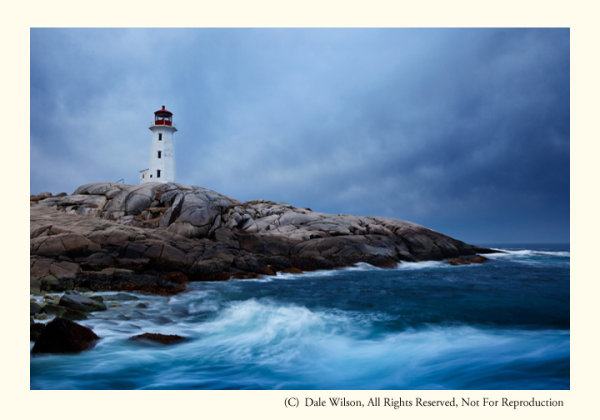
Early spring is a great time to photograph one of the most photographed lighthouses in the world, should you want images without people in the picture

Early spring is a great time to photograph one of the most photographed lighthouses in the world, should you want images without people in the picture

The only land route to Peggy’s Cove is Highway 333, starting at Armdale, and then routes along to coast and eventually joins Highway 103 at Upper Tantallon to the west. You then turn right onto Highway 103 and drive east back to the western reaches of Halifax at Bayers Lake. The coastal drive from Armdale to Peggy’s Cove along Route 333 is by far the most scenic and interesting, offering may little side trips to the not too distant shoreline and coastal communities.  You will have no difficulty locating Peggy’s Cove itself: it’s one of the top tourist destinations in all of Canada, so road signage is abundant.

Photographers who desire images of the lighthouse without people milling about will have their patience taxed to the limit. The task will be almost impossible in the peak tourist season of July and August, and just plain difficult at any other time of the year … except maybe the coldest days of winter. I find April is a good time as most of the snow will have melted and it is still too early for people to be thinking about visiting this Atlantic sentinel. Additionally, what little foliage there is will still be brown and this is typically a good month for storm clouds that create interesting and supportive notions of why a lighthouse is there in the first place.

The best approach to photograph the village and the lighthouse is to arrive in early morning and “play tourist,” making pictures as you meander around the harbour. You can easily spend several hours just following your nose, and there is a large restaurant on site for that moment when the light gets too harsh. Make sure to re-visit in the evening –after a noon-day nap, of course—and leave yourself lots of time to find the perfect location to get the classic lighthouse-against-the-sunset photograph.  Should you stake out a vantage point on the south side of the lighthouse there is a better chance you will be able to eliminate people from the image with creative camera positioning and sight angles. From a low elevation the camera’s line of sight will be just over the heads of the tourists who sit on the rocks enjoying the last rays of the day.  The other classic view is from the water’s edge just to the north of the little cove in front of the lighthouse itself, immediately below the restaurant. Be aware, from here you will almost be guaranteed there will be people in your picture.
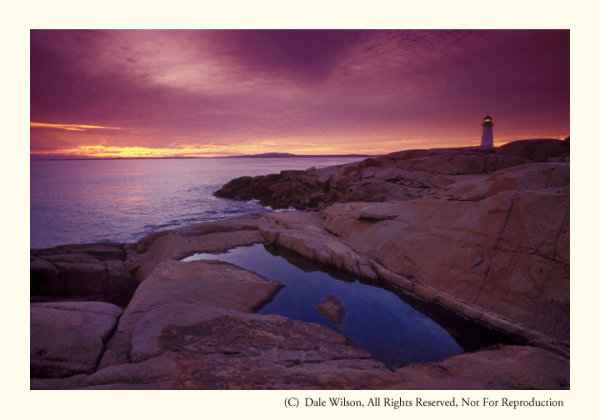
By staying to the south of the light, it is possible to keep the camera low and avoid people from creeping into the frame. Challenge yourself to look for creative images as well as portaits of the light.

By staying to the south of the light, it is possible to keep the camera low and avoid people from creeping into the frame. Challenge yourself to look for creative images as well as portaits of the light.

When travelling along the shoreline anywhere in Atlantic Canada, but especially so in Peggy’s Cove, be astutely aware of your surroundings, rogue waves are common and have called unwary visitors to the depths to dwell with King Neptune. So, please, be careful and mindful of the signage; if those rocks are black or wet you are too close to the water’s edge. The Atlantic Ocean is huge and powerful, and its combers deserve, and demand, your respect.

Now get out there and enjoy one of the most photogenic places in all of Nova Scotia, and Canada. You won’t be disappointed.

Post originally from: Digital Photography Tips.

Check out our more Photography Tips at Photography Tips for Beginners, Portrait Photography Tips and Wedding Photography Tips.

Canadian Travelogue – Nova Scotia – Peggy’s Cove

Digital Photography School

 
Comments Off on Canadian Travelogue – Nova Scotia – Peggy’s Cove
Posted in Photography


Canadian Travelogue – Newfoundland – Spillars Cove

06 Jun

Spillars Cove lies at the tip of Cape Bonavista, with Bonavista Bay behind you and Trinity Bay ahead as you face east awaiting sunrise. For most of my many visits there the weather has been unbelievable: hurricane force-winds, driving rain and sleet — did I mention wind? Only a handful of times have I been blessed with a calm day, with bright sunny skies and temperatures hovering around 20 degrees; you know, the kind of day that is great for mosquitoes. I’ll take the wind, thank you very much.

In fact, the stronger the winds the better. This mean and rugged coastline lies generally northwest to southeast —perfect for photographs of the sunrise—and strong winds only add to the beauty. Use from two to four stops of graduated filter of various colours to add even more drama to the sky, or, alternatively, underexpose your bracketed frames in full-stop increments for masking via several post production techniques.  This incredible shoreline is typically far enough distant to permit lens apertures of f/5.6, to give shutter speeds high enough to keep the crashing waves from blurring while maintaining an acceptable depth of field.

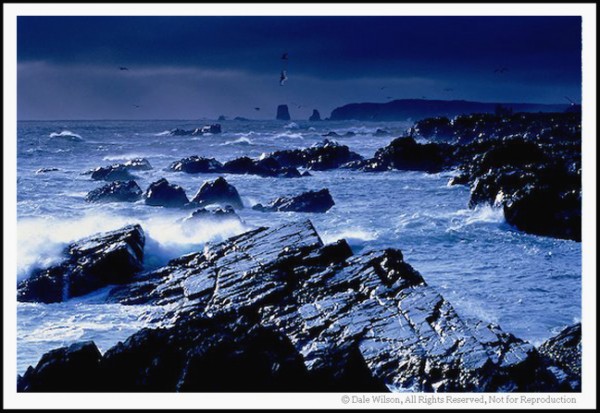
When the light or weather is not cooperating you have to dig deep into that bag of tricks. In this case I have used a tungsten colour correcting filter (80A) to add some colour to an otherwise grey day.

When the light or weather is not cooperating you have to dig deep into that bag of tricks. In this case I have used a tungsten colour correcting filter (80A) to add some colour to an otherwise grey day.

There are several access roads leaving the Trans-Canada Highway between Clarenville and Port Blandford that meander toward Cape Bonavista, and if time is not a concern you should explore the bi-ways that will usually always lead to salt water and a tranquil and quaint fishing village. Once you reach the township of Bonavista be prepared to get lost, planned urban development and ease of transport were unheard of in the 17th century – streets simply followed the coastline and houses were built … wherever. But this is a part of the charm of rural Newfoundland. If you follow your nose and a few scattered signs you should easily find the lighthouse. A few hundred metres before the ocean sentinel there is the gravel Lance Cove Road to your right that leads to “The Dungeon,” a provincial natural attraction. Take this road and drive south east for about two kilometres along the coast and you will see the Spillars Cove shoreline, as seen above, unfold in the distance.

Should the wind be blowing hard—and it often is—keep your tripod as close to the ground as you can, to minimize camera movement. Once you have composed the image in your viewfinder you can use your body as a wind shield during the exposure. Should the wind be particularly aggressive, the coastline here is firm enough that you can drive your vehicle close to the edge and position it as a wind block to ensure the tripod mounted camera is rock steady. Back absolutely certain the marsh is dry enough to support your car first, and stay safely back from the edge of the cliff however by walking it first.

Another great nearby location for incredible seacoast images is Cable John Cove. From the Dungeon continue driving the gravel road south for another ¾ kilometre until you reach the paved Highway 235 (Bonavista Bay Hwy), and turn left, heading east. Simply drive this road for about one kilometre until the road ends, at which time you can walk the additional 200 metres to the shoreline. Once at the water’s edge simply continue walking the coastline to your left and once atop the little knoll you will see a large and impressive sea stack that begs to be photographed. Be careful when walking along this shoreline – the moss and rocks can get slippery if wet, and the fall to the depths below will be unforgiving.

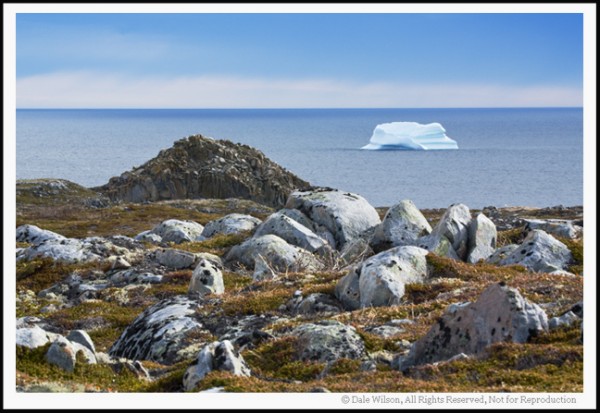
Certainly not an award winning image, but a snapshot to show what can potentially await the adventuring photographer as seen from atop the highlands of Cable John Cove.

Certainly not an award winning image, but a snapshot to show what can potentially await the adventuring photographer.  As seen from atop the highlands of Cable John Cove.

Another great side trip should be to nearby Elliston. Once in the community ask anyone for directions to the puffin site at Elliston Point. There are about 300 nesting pair of Atlantic puffin at this site and if the wind is blowing in the right direction you should easily be able to striking portraits with a 200mm lens.

If you happen to really lucky and are in this area in early summer ask the locals if they know of any icebergs in the area. You shouldn’t be surprised if there are a couple hidden in some cove; you are, after all, on the banks of Iceberg Alley.

Post originally from: Digital Photography Tips.

Check out our more Photography Tips at Photography Tips for Beginners, Portrait Photography Tips and Wedding Photography Tips.

Canadian Travelogue – Newfoundland – Spillars Cove


Digital Photography School

 
Comments Off on Canadian Travelogue – Newfoundland – Spillars Cove

Posted in Photography