RSS
 

Posts Tagged ‘could’

Soylent 3.0: 100K Sq Ft Warehouse Could Feed 4 Million People

09 Aug

[ By WebUrbanist in Conceptual & Futuristic & Technology. ]

Photobioreactor PBR 4000 G IGV Biotech

The first generation of Soylent is a powdered food substitute for all your nutritional needs, the second will be a premixed beverage boasting the addition of algae, but the ultimate target is fully-grown, ultra-efficient food equivalent. An eco-friendly paradigm shift, this would allow vast amounts of healthy calories to be created in very small spaces, a single small factory space supplying enough for to sustain the entire city of Los Angeles.

soylent in a bottle

In just a few years, Soylent went from an experimental substance to the household name in food replacement, but its creator’s endgame is far more ambitious than the current niche product might suggest. Soylent 1.0 remains relatively cost-intensive to produce and expensive to consume – it provides simplicity, but only for those who can afford it. Soylent 2.0 will begin targeting broader markets and introduce algae-grown components, but a future version (3.0, perhaps) could truly revolutionize food production and distribution.

soylent powder

Imagine using just water, sunlight, air and a single algae superorganism to generate the complex nutrients (including carbohydrates, proteins and lipids) needed to sustain life, with applications in rich and poor countries (or in space). Then consider having this substance available on tap, piped right into your home like water or power. Alternatively, you might buy your own household bioreactor, churning out Soylent 3.0 directly in your kitchen on demand. Rob Rhinehart’s vision takes various forms, but it comes down to the same thing: an alternative to conventional food and potential solution to unsustainable agricultural practices, available to all those who wish to take part.

Not everyone will want to subsist partially (let alone entirely) on Soylent, now or ever, but that is also not the point – it can always be used in conjunction with other meals by those so inclined or deployed to places otherwise without sufficient food for subsistence. Meanwhile, for the next round (from Motherboard), “The algae [called AlgaWise] in Soylent 2.0 is grown by the biotech company Solazyme, in a facility owned by the Archer Daniels Midland, the food processing giant. The oil is then pressed out much like olive oil. It’s amazingly efficient. Entire tanks can be filled in days.” Solazyme calls the stuff AlgaWise.”

soylent boxes

More from Rhinehart on current and next steps: “In the interest of building a sustainable business to fund our research we’ve been focused primarily on product improvements and new products, like the launch today, but I’ve also worked on setting up infrastructure including lab building and recruiting and drawn up a roadmap for reaching the goal of cell synthesis, starting with protein. This process has two modules: one strain engineering to develop and optimize the organism that produces, the other bioreactor engineering to make an ideal growth environment for the strain(s).”

Share on Facebook


[ By WebUrbanist in Conceptual & Futuristic & Technology. ]

[ WebUrbanist | Archives | Galleries | Privacy | TOS ]

WebUrbanist

 
Comments Off on Soylent 3.0: 100K Sq Ft Warehouse Could Feed 4 Million People

Posted in Creativity


Retrofuturistic Urbanism: 6 Cities as they Could Have Become

08 May

[ By Delana in Architecture & Cities & Urbanism. ]

future retro city

To people of 100 or even 50 years ago, the metropolises of today would look utterly foreign. Our elevated highways, massive airports, high population density and huge skyscrapers would be breathtaking to someone from a far earlier era. But futurists of the past did their best to imagine the world of tomorrow – otherwise known as our today – and came up with some wild imagery.

San Francisco

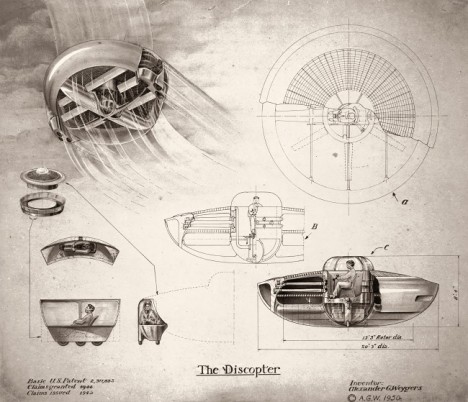
discopter diagrams

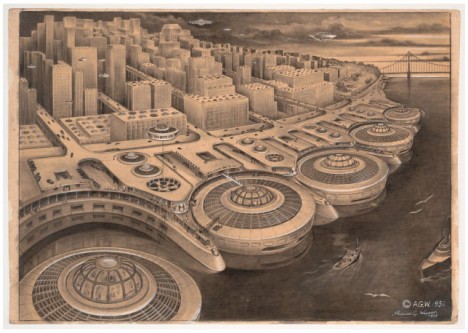
Above (and at top) is ship engineer and inventor Alexander Weygers‘ vision of San Francisco  as he saw it from 1950. The disc-shaped objects near the water are Weygers’ patented flying machine which he dubbed the Discopter. In his visions of future American cities, Weygers imagined large Discopter ports in every city, allowing for safe and convenient travel for the city’s residents.

Los Angeles

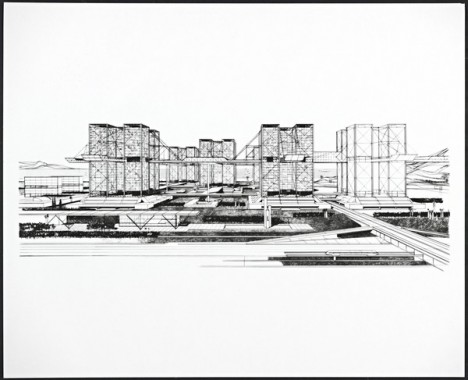
harlan georgescu sky lots

Architect Harlan Georgescu envisioned these sky-high mixed-use buildings becoming an integral part of future downtown Los Angeles. The buildings were meant to be 500 feet tall; Georgescu’s design put living, working, dining, shopping and recreational spaces in each building. Every structure would provide homes for 200 families in the space that would normally only support 12 conventional, ground-level homes. His Sky Lots plan included a suspended freeway running between the buildings – then out to the suburbs – to alleviate some of the city’s terrible traffic problems.

Houston

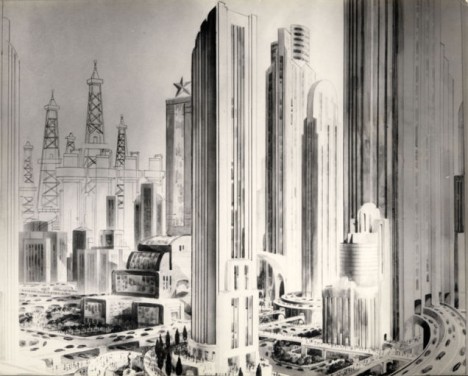
houston skyline

In the 1920s, Houston Post writers took a stab at predicting the city’s skyline in 1980. Note the same type of elevated freeways envisioned for LA, these also leading straight into and through tall buildings. Elevated walkways were also featured in the design, essentially doubling the pedestrian space for Houston residents. Houston did eventually develop a skyline containing plenty of tall, distinctive buildings and elevated roads – it looks like the Houston Post had (mostly) realistic expectations for the future of their city.

Next Page – Click Below to Read More:
Retrofuturistic Urbanism 6 Cities As They Could Have Become

Share on Facebook


[ By Delana in Architecture & Cities & Urbanism. ]

[ WebUrbanist | Archives | Galleries | Privacy | TOS ]


WebUrbanist

 
Comments Off on Retrofuturistic Urbanism: 6 Cities as they Could Have Become

Posted in Creativity


7 Landscape Photography Mistakes That Could be Ruining Your Photos

06 May

If your photos aren’t turning out the way you expect them to, new gear is not necessarily the answer. In fact, chances are you are making one of these seven common mistakes. Don’t be discouraged though; just as a musician needs time to refine their skills, so does a photographer. Once you recognize where the problem lies, it’s easy to make adjustments and achieve better results the next time out.

1) Shooting at the Wrong Time of Day

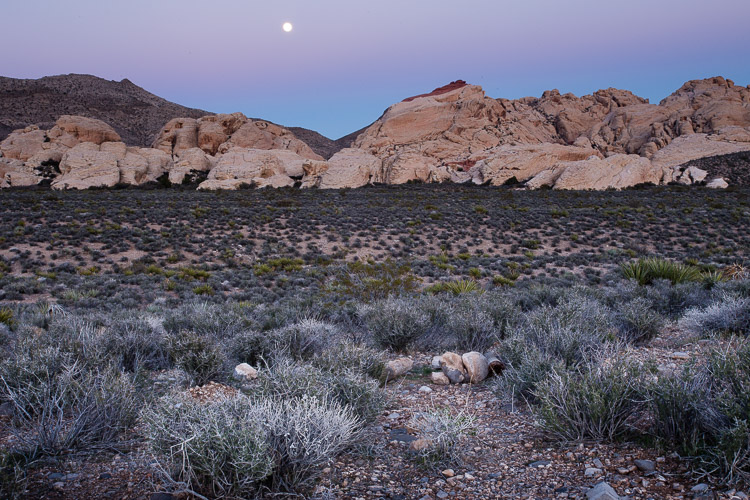
Harsh afternoon sunlight can wreak havoc on a landscape photo. With bright highlights and dark shadows, the contrast makes for especially difficult exposures. For truly dramatic scenic opportunities, dedicate the hours around sunrise and sunset to photography. You’ll be amazed at how few people are there to clutter your composition. With the soft light and colorful skies, your photos will take on a new level of natural beauty.

1_moonrise_red_rocks

2) Your Images Lack a Clear Subject

When you experience something grand, it’s tempting to try and include it all into one frame. The expansive landscape is undeniably beautiful but it’s lacking in any one point of importance. Before pressing the shutter, ask yourself “What is my subject?” If you’re able to provide an answer, you can learn to see like a camera. The human eye interprets a scene differently, heavily influenced by our peripheral vision and ability to scan from left to right. The camera however sees in a much simpler way, only able to record a small portion onto the sensor. By determining what the subject is, you can take the necessary steps to make an effective photo.

2_fire_wave

3) No Foreground

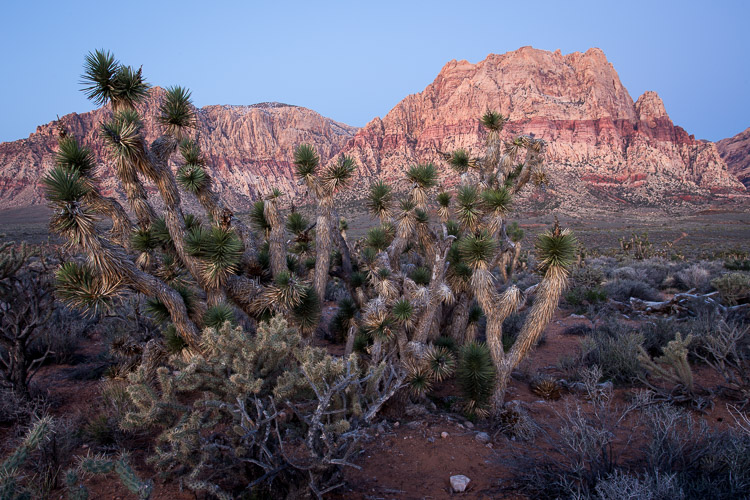
The gentle hues of dawn are worth getting out of bed for, but color alone won’t hold the viewer’s interest. To make a dramatic impact on your scenic and travel images, find a strong foreground element. This can be a field of flowers, a boulder, tree, or even a man-made object. The idea is to add visual interest all the way through the frame. As you explore various options, try several perspectives including ground level. By having this location worked out in advance, you’ll be ready to capture the fleeting light.

3_cactus

4) Lazy Composition

At nearly every scenic vista or photographic landmark, you’ll notice a definitive dirt spot where grass once grew. This well-worn spot is the final destination for scores of tourists who shoot the same photo year after year. Rather than following the crowd, take a quick loop around the area and search for unique perspectives. To more effectively communicate your vision, check all four corners of your viewfinder, and either zoom or physically move to make a stronger image. Do you need the fence in the bottom corner, or the tree that seems to enter the frame from nowhere? This type of attention to detail will help strengthen the composition in-the-camera which saves you time at home trying to clone out unwanted objects.

4_lake_louise

5) It’s Been Done Before

Automatic modes were designed to provide average results under a variety of conditions. While this can be effective on occasion, it’s fundamentally opposite of what you’re trying to achieve with your art. Do you really want your images to be just average? In order to go beyond the safe shot, creative photographers will push the boundaries to explore their own vision. Rather than trying to recreate what’s already been done, find your own twist on it. This may not always be in line with current trends, but who’s to say you’re attempts won’t cause their own stir.

5_brooklyn_bridge

6) There’s Too Much Contrast

One of the most common issues with scenic photos is the huge contrast difference between the foreground and the sky. The solution is not a new camera or complicated software. Actually, a simple tool known as the graduated neutral density filter is all you need. These commonly come in strengths of two (0.6), three (0.9), and four (1.2) stops. While HDR is another effective method, these filters allow you to achieve your vision in the camera at the time of exposure.

Start by manually spot metering the foreground. The goal is to expose in such a way that the foreground is not black, leaving some detail in the shadow areas. This could be at “-1″ on your meter, or “0”, or even “+1″. Of course if you are not sure which foreground looks best, bracket. Take a quick test shot and notice how the foreground looks well exposed but the sky is overexposed. The next step is where the magic happens.

6_without_filter

Get out your graduated neutral density filter and position the dark portion over the top part of the lens. This will darken the bright sky while leaving your foreground properly exposed. You can fine tune the effect by adjusting the filter placement up or down in the mount.

7_with_filter

7) Fear of High ISOs

You may be surprised to learn that a high ISO can be helpful for landscape photography. This is particularly true when shooting without a tripod or including a person in the frame. In these instances, the shutter speed can be no slower than about 1/125 to prevent camera shake and/or subject motion. Then, to achieve great depth of field and keep everything sharp from near to far, your desired aperture would be f/11 or f/16. With these two decisions made, you may take your photo only to find that it’s too dark. This is where the ISO comes into play. Simply double the ISO number and watch as the photo gets brighter.

Many photographers are overly sensitive about high ISO noise and refrain from using anything over 800. Instead they’ll slow down the shutter speed, rely on image stabilizers, or open the aperture wider. The results may look acceptable on the small LCD only to appear soft when viewed or printed larger. Like most aspects of photography, there is always a tradeoff to consider. Would you rather have a blurry, but noise-free photo, or a sharp image with a bit of noise? Considering that most image editing programs now offer terrific noise reduction options, the ISO noise isn’t as harmful as it once was.

8_tunnel

googletag.cmd.push(function() {
tablet_slots.push( googletag.defineSlot( “/1005424/_dPSv4_tab-all-article-bottom_(300×250)”, [300, 250], “pb-ad-78623” ).addService( googletag.pubads() ) ); } );

googletag.cmd.push(function() {
mobile_slots.push( googletag.defineSlot( “/1005424/_dPSv4_mob-all-article-bottom_(300×250)”, [300, 250], “pb-ad-78158” ).addService( googletag.pubads() ) ); } );

The post 7 Landscape Photography Mistakes That Could be Ruining Your Photos by Chris Corradino appeared first on Digital Photography School.


Digital Photography School

 
Comments Off on 7 Landscape Photography Mistakes That Could be Ruining Your Photos

Posted in Photography


Flat elements developed by Harvard could make camera lenses smaller, lighter and better

11 Mar

A team at Harvard School of Engineering has developed a method for making flat lenses that could dramatically reduce the size and weight of camera lenses in the future. The method employs tiny silicon antennas positioned on flat glass components to redirect light when it reaches the surface of the lens instead of relying on refraction and the thickness of glass to bend light in a particular direction. Learn more

Articles: Digital Photography Review (dpreview.com)

 
Comments Off on Flat elements developed by Harvard could make camera lenses smaller, lighter and better

Posted in Uncategorized


Opinion: Why buy a Panasonic LX100 when you could buy a GX7?

01 Oct

What’s so special about the Panasonic Lumix DMC-LX100? It uses the same sensor as the GX7 but is at a distinct disadvantage not being part of an interchangeable lens system. So why would anyone choose the Lumix LX100 with its expensive body over the flexibility of the only-slightly-bigger Lumix DMC-GX7? Has Panasonic shot itself in the foot? Click through to read more

Articles: Digital Photography Review (dpreview.com)

 
Comments Off on Opinion: Why buy a Panasonic LX100 when you could buy a GX7?

Posted in Uncategorized


Photokina 2014: Nikon interview – ‘large-sensor mirrorless could be a solution’

24 Sep

When we visited Photokina last week in Germany we made time to sit down with senior executives from several camera manufacturers. Among them was Toshiaki Akagi, Department Manager in Nikon’s 1st Designing Department. In our conversation we spoke about reaction to the D750, the legacy of the D600 oil problem and the potential for a large-sensor mirrorless camera from Nikon in the future. Click through to read the full interview

Articles: Digital Photography Review (dpreview.com)

 
Comments Off on Photokina 2014: Nikon interview – ‘large-sensor mirrorless could be a solution’

Posted in Uncategorized


Drone lighting could be coming soon to your studio

17 Jul

A flying flash rig that tracks the position of both photographer and subject to maintain consistent lighting angles has been developed by researchers from Massachusetts Institute of Technology and Cornell University. In a project designed to test co-ordination between aerial robots and ground-based targets, researchers programmed a flash-carrying drone to light people in the studio as the subjects and the photographer changed positions. Read more

Articles: Digital Photography Review (dpreview.com)

 
Comments Off on Drone lighting could be coming soon to your studio

Posted in Uncategorized


SkyTran: 2-Person Maglev Monorail Could Replace Cars

01 Jul

[ By Steph in Conceptual & Futuristic & Technology. ]

On Demand Monorail 1

Two-person monorail pods zoom down from the sky at a command from your smart phone in a futuristic commercial transit system set to be installed in Israel. The on-demand system appears to be a realistic answer to the age-old objection lobbed against public transportation by lovers of the personal vehicle: buses, trains and subways don’t work around your own schedule.

On Demand Monorail 2

Not only can you just walk up to the monorail station and hop right onto your own personal pod without having to share your space with strangers – this monorail technology is far more advanced than a vehicle that the average person could ever own. And it’s not just a concept dazzling the internet for a few days before it’s forgotten, destined to someday become a laughable unrealized vision of the retro-future. Or so it seems.

On Demand Monorail 3

On Demand Monorail 4

SkyTran Inc. has signed an agreement to build an actual high-speed levitating monorail system at the Israel Aerospace Industry campus in Lod, Israel. Suspended 20 feet above the ground, the hovering maglev-based monorail handily solves traffic problems by whizzing over the streets at high speeds.

On Demand Monorail 5

On Demand Monorail 6

Of course, the question is, will it catch on? Plenty of cool ideas were constructed as temporary demonstrations, but were never actually reproduced for public use. It’s hard to say, but it’s an interesting compromise, and passive magnetic levitation technology is poised to become an efficient and sustainable way to get around big cities.

Share on Facebook


[ By Steph in Conceptual & Futuristic & Technology. ]

[ WebUrbanist | Archives | Galleries | Privacy | TOS ]

WebUrbanist

 
Comments Off on SkyTran: 2-Person Maglev Monorail Could Replace Cars

Posted in Creativity


If you could only see

20 Apr

Die Serie „If you could only see“ von Andrea Hübner entstand an einem grauen Novembertag. Eine perfekte Atmosphäre für die geplanten Aufnahmen, die an die Bücher von Jane Austen und Charlotte Bronte erinnern. Die Location hatte Andrea bei einem kleinen Spaziergang entdeckt. Leonies Gesicht passte für sie perfekt zu der Idee, die sie im Kopf hatte.

Ich hätte mir kein besseres Modell vorstellen können. Die Kleidung hatten wir vorab zusammen ausgesucht, die Frisur habe ich geflochten, bevor wir uns auf den Weg zur Location gemacht haben. Alles harmonisierte für mich an diesem Tag wunderbar und so ging ich zufrieden und mit vollen Speicherkarten nach Hause.

© Andrea Hübner

© Andrea Hübner

© Andrea Hübner

© Andrea Hübner

© Andrea Hübner

© Andrea Hübner

© Andrea Hübner

Andrea Hübners Bilder begleiten uns schon lange. Bereits 2010 schrieb sie für uns einen Gastartikel und erklärte ausführlich, was die analoge Fotografie für sie bedeutet. Die Serie „If you could only see“ zeigt eine ihrer digitalen Arbeiten.

Mehr von Andrea findet Ihr auf ihrer Homepage, auf Facebook oder auf Flickr.


kwerfeldein – Fotografie Magazin | Fotocommunity

 
Comments Off on If you could only see

Posted in Equipment


Samsung lens production issues could delay Galaxy S5

18 Mar

samsunga53.png

With its 16MP ISOCELL 1/2.6-inch sensor, F2.2 aperture, 4K video, reflector integrated LED-flash, water-resistant body and hybrid AF-system, the recently announced Samsung Galaxy S5 looks like one of 2014’s hottest options for mobile photographers. However problems in the manufacturing process of the S5’s new 6-element lens could delay its release in some markets. Learn more 

News: Digital Photography Review (dpreview.com)

 
Comments Off on Samsung lens production issues could delay Galaxy S5

Posted in Uncategorized