RSS
 

Posts Tagged ‘Cool’

Happy Trailers: 11 Cool Campers & Mobile Home Concepts

08 Nov

[ By Delana in Technology & Vehicles & Mods. ]

Is there anything better than hitting the open road and going wherever the feeling takes you? It’s so much easier to pick up and set off on a spontaneous camping trip when you’ve got a camper or mobile home waiting to haul you and your gear to new surroundings. These mobile homes and rooms-on-wheels have the function and style to make your next camping trip unlike any of those cramped, bug-infested journeys that you probably remember from childhood.

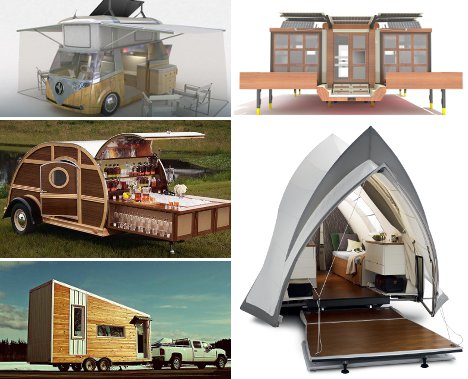
Modern Yukon Tiny Home

(images via: Tiny House Blog)

Yukon resident Laird Herbert built this tiny 160 square foot mobile home as a miniature alternative to a traditional home. The small house is tailored to its harsh environment with features like heavy-duty construction and extra insulation. It contains a surprising amount of storage considering its diminutive footprint, along with a fully functional kitchen and queen-size loft bed.

252-Degree Mobile Home

(images via: Yanko Design)

Designers Stephanie Bellanger, David Dethoor, François Gustin, and Amaury Watine designed their unique mobile home idea with a spaceship in mind. The home opens up like a book, with every “page” revealing a new room. When you arrive at a campsite and decide to set up for the evening, a screen comes around to enclose the entire camper, keeping away the bugs and adding a sense of cohesion to the segmented home.

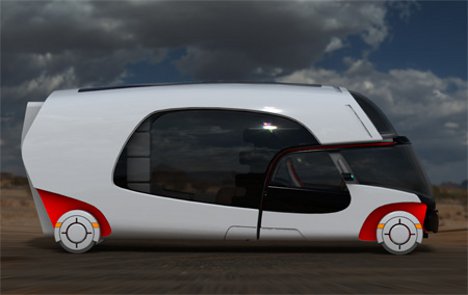
Colim Caravan

(images via: Tuvie)

The Colim Caravan concept gives mobile home dwellers a choice between taking their entire home around with them or simply driving a run of the mill car. The Colim (Colors of Life in Motion, according to the designer, Christian Susana) is a mobile home in two pieces: a tiny, agile car and a large living space. The two are ordinarily attached, allowing the vehicle portion to haul around the living space. But when needed, the two can separate, leaving the living space sitting where it is and letting the vehicle be used to get around unencumbered.

Mehrzeller Multicellular Caravan

(images via: Mehrzeller)

Travelers who have a hard time finding a mobile home or camper that works for them will be pleased to know that the Mehrzeller concept strives to be much more personalized. The Mehrzeller designers say that their plan is to work with customers to figure out exactly what they need, then to build a caravan that is completely personalized and seems as though it developed organically one cell at a time.

VW Westfalia Solar Powered Mobile Home


(images via: My Modern Met)

The Volkswagen Westfalia has been a well-loved symbol of hippie culture and freedom for a very long time. When designer Alexandre Verdier set out to improve the experience of traveling in a Westfalia, he created an eco-friendly and luxurious Volkswagen. The top of the camper van is equipped with solar panels which follow the sun to collect the maximum amount of solar energy. A pneumatic suspension system lowers the van to the ground to increase stability when the camper is parked. Thanks to the pop-up top, the caravan even sports a second story. The camper is very different than the usual Volkswagen camping experience, and at $ 26,000 to $ 69,000 the unique experience it offers comes at a rather steep price.

Eco Capsula

(images via: Nice Architects)

This diminutive trailer doesn’t seek attention from fellow travelers – in fact, it actually blends into its surroundings. The Eco Capsula is meant to be used in a community-type setting, with each unit connecting to the next to form a complete electric system. The units each include either a wind turbine or solar panels up on the roof, providing simple and eco-friendly ways to power the lives of the occupants. The shiny exterior is made from recycled drinks cans that reflect the surroundings, making each capsule blend in to wherever it happens to be at that moment. Meant for two to six people, the entire egg-like unit can open up in nice weather to let in the beauty of nature.

Midget Bushtrekka

(images via: Kamprite)

Travelers looking to go ultra-green might choose to take a bike rather than a motorized vehicle. The Midget Bushtrekka makes that dream practical by putting a rugged trailer behind your bicycle. An optional “tentcot” provides a handy – if rather unconventional – place to sleep while you’re on the road.

The Innovan

(images via: Innovan)

The Innovan line of products redefines just what a camper, caravan or trailer should be. Rather than the bulky, boxy things we are used to, Innovan products are smooth and aerodynamic. When driving, the top of the camper is low to the vehicle to reduce wind resistance. When parked, the top pops up to add an incredible amount of interior space.

Bulleit Frontier Whiskey Woody

(images via: Moore and Giles)

There has probably never been a more stylish or fun-loving trailer than this one. Admittedly, you can’t camp in it or even stash your lawn chairs in its interior. But what it lacks in camping space, it makes up for in pure style. The Whiskey Woody is a full-service bar inside a classic trailer, including fun details like a poker set and lush leather furniture.

Modern Mobile Home

(images via: Yanko Design)

If you were to head out on the highway with this mobile home in tow, passers-by likely would not even realize that you were hauling a small residence. Folded up, the design from Mehdi Hidari Badie looks like one of those mobile storage units. But when you get to your destination, this incredible modern mobile home unfolds into a house that looks nothing like the mobile homes we are used to. The lightweight but sturdy home is made of eco-friendly recycled materials and includes a bank of solar panels on top to keep the home powered up at all times.

The Opera Mobile Suite

(images via: Opera)

Although most of us would refer to camping as “roughing it,” there is no reason to give up on luxury entirely during a camping trip. The Opera Mobile Suite is a gorgeous, elegant mobile home that takes on the shape and style of the iconic Sydney Opera House. It lets campers take a little piece of luxury with them wherever they might be.


Want More? Click for Great Related Content on WebUrbanist:

Bike Campers: 12 Mini Mobile Homes for Nomadic Cyclists

Who says you can’t camp in luxury when taking a bicycle tour? These 12 bike trailers
4 Comments – Click Here to Read More »»


Futuristic Mobile Homes: Trailer Trash or Treasure?

With global warming threatening coastal cities and a new era of mass migration on the horizon, going mobile just might be today’s bright idea – and tomorrow’s way of life. Here are a dozen tech-packed trailers that are full of Win… without the Winnebago.
10 Comments – Click Here to Read More »»


Share on Facebook


[ By Delana in Technology & Vehicles & Mods. ]

[ WebUrbanist | Archives | Galleries | Privacy | TOS ]


WebUrbanist

 
Comments Off on Happy Trailers: 11 Cool Campers & Mobile Home Concepts

Posted in Creativity


Cool Visual Art images

06 Nov

A few nice visual art images I found:

Rain And The Built Environment by William Foley: Sculpture In Context 2012 at the National Botanic Gardens
visual art
Image by infomatique
Sculpture In Context 2012 at the National Botanic Gardens, Glasnevin, Dublin 9.
6th September to 19th October 2012

Sculpture in Context continues to build on 26 years of experience in organising successful exhibitions. It has, over the years staged highly acclaimed visual arts events at venues such as Fernhill Gardens, the Conrad Hotel, Kilmainham Gaol, the Irish Management Institute, Dublin Castle, Farmleigh House and the National Botanic Gardens.

The gardens are not only a botanical haven, and a quiet oasis on the outskirts of a modern European City, they also offer a challenging venue which gives the artist the rare opportunity of realising large scale work. It also gives the visitor an opportunity to ramble and explore, sometimes finding sculptures in the most unusual places. The sculptures are displayed throughout the gardens, ponds, Great Palm House, and Curvilinear Range, with the smaller works exhibited in the gallery above the visitors’ centre.

Pretty Purple by Sarah McGloughlin: Sculpture In Context 2012 at the National Botanic Gardens
visual art
Image by infomatique
Sculpture In Context 2012 at the National Botanic Gardens, Glasnevin, Dublin 9.
6th September to 19th October 2012

Sculpture in Context continues to build on 26 years of experience in organising successful exhibitions. It has, over the years staged highly acclaimed visual arts events at venues such as Fernhill Gardens, the Conrad Hotel, Kilmainham Gaol, the Irish Management Institute, Dublin Castle, Farmleigh House and the National Botanic Gardens.

The gardens are not only a botanical haven, and a quiet oasis on the outskirts of a modern European City, they also offer a challenging venue which gives the artist the rare opportunity of realising large scale work. It also gives the visitor an opportunity to ramble and explore, sometimes finding sculptures in the most unusual places. The sculptures are displayed throughout the gardens, ponds, Great Palm House, and Curvilinear Range, with the smaller works exhibited in the gallery above the visitors’ centre.

The Comfy Cocoon by Brenda Marron: Sculpture In Context 2012 at the National Botanic Gardens
visual art
Image by infomatique
Sculpture In Context 2012 at the National Botanic Gardens, Glasnevin, Dublin 9.
6th September to 19th October 2012

Sculpture in Context continues to build on 26 years of experience in organising successful exhibitions. It has, over the years staged highly acclaimed visual arts events at venues such as Fernhill Gardens, the Conrad Hotel, Kilmainham Gaol, the Irish Management Institute, Dublin Castle, Farmleigh House and the National Botanic Gardens.

The gardens are not only a botanical haven, and a quiet oasis on the outskirts of a modern European City, they also offer a challenging venue which gives the artist the rare opportunity of realising large scale work. It also gives the visitor an opportunity to ramble and explore, sometimes finding sculptures in the most unusual places. The sculptures are displayed throughout the gardens, ponds, Great Palm House, and Curvilinear Range, with the smaller works exhibited in the gallery above the visitors’ centre.

 
Comments Off on Cool Visual Art images

Posted in Photographs


Way Super Cool Sports Cars (Cool School)

06 Nov

Professor Skience introduces multiplication in this Cool School math video about sports cars. If you have 2 way super cool sports cars and you multiply them by 4, how many way super cool sports cars do you have? 2 x 4 = ??? Subscribe for more Cool School! www.youtube.com Learn and play with a cast of crazy teachers and funny cartoons. Dive into a book with Miss Booksy. Solve some math and science problems with Professor Skience and his ridiculous animal friends! And help Ron Gets it Wrong get it right! All this and more! Welcome to Cool School! The Cool School is a safe video network for kids. The School hosts aspirational, educational, and informational videos for kids. TAGS: multiplication “multiplication problem” “multiplication homework” “multiplication tables” “times tables” math problem “math problem” Adding “addition problem” “addition homework” “math homework” “fun math” “make math fun” fun education Mathematics “kids games” “games for kids” “kid friendly entertainment” educational “animation funny” “videos for kids”
Video Rating: 4 / 5

Director’s Youtube: www.youtube.com Director’s Twitter: www.twitter.com PhysinTV Hubs: www.youtube.com www.youtube.com www.youtube.com www.youtube.com www.youtube.com www.youtube.com PhysinTV Website: www.physin.co.cc
Video Rating: 5 / 5

 
Comments Off on Way Super Cool Sports Cars (Cool School)

Posted in Animation Videos


Cool Visual Art images

05 Nov

Check out these visual art images:

Still Life with light scratches
visual art
Image by Roberto Giannotti

Still life with three isotopes
visual art
Image by Roberto Giannotti

 
Comments Off on Cool Visual Art images

Posted in Photographs


Cool Visual Art images

05 Nov

A few nice visual art images I found:

Palace of Fine Arts-San Francisco, California
visual art
Image by OSU Special Collections & Archives : Commons

Original Collection: Visual Instruction Department Lantern Slides

Item Number: P217:set 023 025

You can find this image by searching for the item number by clicking here.

Want more? You can find more digital resources online.

We’re happy for you to share this digital image within the spirit of The Commons; however, certain restrictions on high quality reproductions of the original physical version may apply. To read more about what “no known restrictions” means, please visit the Special Collections & Archives website, or contact staff at the OSU Special Collections & Archives Research Center for details.

Art Above Clonmel
visual art
Image by Irish Typepad
On a misty Saturday while finishing the installation of a large visual arts piece on the hills above Clonmel, County Tipperary, Ireland, we recorded a wind-swept podcast that tells the story.

IMG_0826
visual art
Image by lusciousblopster
They Are Us exhibition – Maser and Damien Dempsey. Graffiti, visual art, prints, photography, video, installation. Smithfield, Dublin, Ireland. 15Th – 17th October 2010.

 
Comments Off on Cool Visual Art images

Posted in Photographs


Cool Visual Art images

02 Nov

Check out these visual art images:

Visual Libraries Project
visual art
Image by Claire_Sambrook
VISUAL LIBRARIES – Leave your Mark.
A collaborative, visual project which encourages you to sign out a Visual Library Book and ‘Leave Your Mark’.

A Visual Library Book is whatever you want it to be, a sketchbook, a journal, a diary, a notepad.
You can ‘Leave Your Mark’ in whatever way you want, ranging from drawing, writing, sewing, adding photographs, markings, printing and sticking. How you make your marks is entirely up to you. All we ask is that you have fun with the different themes. Just borrow it on your library card with other books and materials. If you are not already a member, just ask the staff to help you.

45 Visual Library Books have been placed in Portsmouth Central Library and each has its own theme ranging from; Portsmouth, My City, When I Open My Eyes, Whilst I Was Waiting, Love, What’s in My Pocket and Memories. The intention is for you to feel free to explore the Visual Library Books and choose a theme that you like.
In Association with: Rhodia, Seawhite, Portsmouth City Council, University of Portsmouth, COPIC Pens

www.visuallibraries.com

For Further Details: claire.sambrook@port.ac.uk

Visual Libraries Project
visual art
Image by Claire_Sambrook
VISUAL LIBRARIES – Leave your Mark.
A collaborative, visual project which encourages you to sign out a Visual Library Book and ‘Leave Your Mark’.

A Visual Library Book is whatever you want it to be, a sketchbook, a journal, a diary, a notepad.
You can ‘Leave Your Mark’ in whatever way you want, ranging from drawing, writing, sewing, adding photographs, markings, printing and sticking. How you make your marks is entirely up to you. All we ask is that you have fun with the different themes. Just borrow it on your library card with other books and materials. If you are not already a member, just ask the staff to help you.

45 Visual Library Books have been placed in Portsmouth Central Library and each has its own theme ranging from; Portsmouth, My City, When I Open My Eyes, Whilst I Was Waiting, Love, What’s in My Pocket and Memories. The intention is for you to feel free to explore the Visual Library Books and choose a theme that you like.
In Association with: Rhodia, Seawhite, Portsmouth City Council, University of Portsmouth, COPIC Pens

www.visuallibraries.com

For Further Details: claire.sambrook@port.ac.uk

Visual Libraries Project
visual art
Image by Claire_Sambrook
VISUAL LIBRARIES – Leave your Mark.
A collaborative, visual project which encourages you to sign out a Visual Library Book and ‘Leave Your Mark’.

A Visual Library Book is whatever you want it to be, a sketchbook, a journal, a diary, a notepad.
You can ‘Leave Your Mark’ in whatever way you want, ranging from drawing, writing, sewing, adding photographs, markings, printing and sticking. How you make your marks is entirely up to you. All we ask is that you have fun with the different themes. Just borrow it on your library card with other books and materials. If you are not already a member, just ask the staff to help you.

45 Visual Library Books have been placed in Portsmouth Central Library and each has its own theme ranging from; Portsmouth, My City, When I Open My Eyes, Whilst I Was Waiting, Love, What’s in My Pocket and Memories. The intention is for you to feel free to explore the Visual Library Books and choose a theme that you like.
In Association with: Rhodia, Seawhite, Portsmouth City Council, University of Portsmouth, COPIC Pens

www.visuallibraries.com

For Further Details: claire.sambrook@port.ac.uk

 
Comments Off on Cool Visual Art images

Posted in Photographs


Cool Visual Art images

02 Nov

Check out these visual art images:

Army Photography Contest – 2007 – FMWRC – Arts and Crafts – Only The Strong
visual art
Image by familymwr
Army Photography Contest – 2007 – FMWRC – Arts and Crafts – Only The Strong

Photo By: 1SG Celia Feller

To learn more about the annual U.S. Army Photography Competition, visit us online at www.armymwr.com

U.S. Army Arts and Crafts History

After World War I the reductions to the Army left the United States with a small force. The War Department faced monumental challenges in preparing for World War II. One of those challenges was soldier morale. Recreational activities for off duty time would be important. The arts and crafts program informally evolved to augment the needs of the War Department.
On January 9, 1941, the Secretary of War, Henry L. Stimson, appointed Frederick H. Osborn, a prominent U.S. businessman and philanthropist, Chairman of the War Department Committee on Education, Recreation and Community Service.
In 1940 and 1941, the United States involvement in World War II was more of sympathy and anticipation than of action. However, many different types of institutions were looking for ways to help the war effort. The Museum of Modern Art in New York was one of these institutions. In April, 1941, the Museum announced a poster competition, “Posters for National Defense.” The directors stated “The Museum feels that in a time of national emergency the artists of a country are as important an asset as men skilled in other fields, and that the nation’s first-rate talent should be utilized by the government for its official design work… Discussions have been held with officials of the Army and the Treasury who have expressed remarkable enthusiasm…”
In May 1941, the Museum exhibited “Britain at War”, a show selected by Sir Kenneth Clark, director of the National Gallery in London. The “Prize-Winning Defense Posters” were exhibited in July through September concurrently with “Britain at War.” The enormous overnight growth of the military force meant mobilization type construction at every camp. Construction was fast; facilities were not fancy; rather drab and depressing.
In 1941, the Fort Custer Army Illustrators, while on strenuous war games maneuvers in Tennessee, documented the exercise The Bulletin of the Museum of Modern Art, Vol. 9, No. 3 (Feb. 1942), described their work. “Results were astonishingly good; they showed serious devotion …to the purpose of depicting the Army scene with unvarnished realism and a remarkable ability to capture this scene from the soldier’s viewpoint. Civilian amateur and professional artists had been transformed into soldier-artists. Reality and straightforward documentation had supplanted (replaced) the old romantic glorification and false dramatization of war and the slick suavity (charm) of commercial drawing.”

“In August of last year, Fort Custer Army Illustrators held an exhibition, the first of its kind in the new Army, at the Camp Service Club. Soldiers who saw the exhibition, many of whom had never been inside an art gallery, enjoyed it thoroughly. Civilian visitors, too, came and admired. The work of the group showed them a new aspect of the Army; there were many phases of Army life they had never seen or heard of before. Newspapers made much of it and, most important, the Army approved. Army officials saw that it was not only authentic material, but that here was a source of enlivenment (vitalization) to the Army and a vivid medium for conveying the Army’s purposes and processes to civilians and soldiers.”
Brigadier General Frederick H. Osborn and War Department leaders were concerned because few soldiers were using the off duty recreation areas that were available. Army commanders recognized that efficiency is directly correlated with morale, and that morale is largely determined from the manner in which an individual spends his own free time. Army morale enhancement through positive off duty recreation programs is critical in combat staging areas.
To encourage soldier use of programs, the facilities drab and uninviting environment had to be improved. A program utilizing talented artists and craftsmen to decorate day rooms, mess halls, recreation halls and other places of general assembly was established by the Facilities Section of Special Services. The purpose was to provide an environment that would reflect the military tradition, accomplishments and the high standard of army life. The fact that this work was to be done by the men themselves had the added benefit of contributing to the esprit de corps (teamwork, or group spirit) of the unit.
The plan was first tested in October of 1941, at Camp Davis, North Carolina. A studio workshop was set up and a group of soldier artists were placed on special duty to design and decorate the facilities. Additionally, evening recreation art classes were scheduled three times a week. A second test was established at Fort Belvoir, Virginia a month later. The success of these programs lead to more installations requesting the program.
After Pearl Harbor was bombed, the Museum of Modern Art appointed Mr. James Soby, to the position of Director of the Armed Service Program on January 15, 1942. The subsequent program became a combination of occupational therapy, exhibitions and morale-sustaining activities.
Through the efforts of Mr. Soby, the museum program included; a display of Fort Custer Army Illustrators work from February through April 5, 1942. The museum also included the work of soldier-photographers in this exhibit. On May 6, 1942, Mr. Soby opened an art sale of works donated by museum members. The sale was to raise funds for the Soldier Art Program of Special Services Division. The bulk of these proceeds were to be used to provide facilities and materials for soldier artists in Army camps throughout the country.
Members of the Museum had responded with paintings, sculptures, watercolors, gouaches, drawings, etchings and lithographs. Hundreds of works were received, including oils by Winslow Homer, Orozco, John Kane, Speicher, Eilshemius, de Chirico; watercolors by Burchfield and Dufy; drawings by Augustus John, Forain and Berman, and prints by Cezanne, Lautrec, Matisse and Bellows. The War Department plan using soldier-artists to decorate and improve buildings and grounds worked. Many artists who had been drafted into the Army volunteered to paint murals in waiting rooms and clubs, to decorate dayrooms, and to landscape grounds. For each artist at work there were a thousand troops who watched. These bystanders clamored to participate, and classes in drawing, painting, sculpture and photography were offered. Larger working space and more instructors were required to meet the growing demand. Civilian art instructors and local communities helped to meet this cultural need, by providing volunteer instruction and facilities.
Some proceeds from the Modern Museum of Art sale were used to print 25,000 booklets called “Interior Design and Soldier Art.” The booklet showed examples of soldier-artist murals that decorated places of general assembly. It was a guide to organizing, planning and executing the soldier-artist program. The balance of the art sale proceeds were used to purchase the initial arts and crafts furnishings for 350 Army installations in the USA.
In November, 1942, General Somervell directed that a group of artists be selected and dispatched to active theaters to paint war scenes with the stipulation that soldier artists would not paint in lieu of military duties.
Aileen Osborn Webb, sister of Brigadier General Frederick H. Osborn, launched the American Crafts Council in 1943. She was an early champion of the Army program.
While soldiers were participating in fixed facilities in the USA, many troops were being shipped overseas to Europe and the Pacific (1942-1945). They had long periods of idleness and waiting in staging areas. At that time the wounded were lying in hospitals, both on land and in ships at sea. The War Department and Red Cross responded by purchasing kits of arts and crafts tools and supplies to distribute to “these restless personnel.” A variety of small “Handicraft Kits” were distributed free of charge. Leathercraft, celluloid etching, knotting and braiding, metal tooling, drawing and clay modeling are examples of the types of kits sent.
In January, 1944, the Interior Design Soldier Artist program was more appropriately named the “Arts and Crafts Section” of Special Services. The mission was “to fulfill the natural human desire to create, provide opportunities for self-expression, serve old skills and develop new ones, and assist the entire recreation program through construction work, publicity, and decoration.”
The National Army Art Contest was planned for the late fall of 1944. In June of 1945, the National Gallery of Art in Washington D.C., for the first time in its history opened its facilities for the exhibition of the soldier art and photography submitted to this contest. The “Infantry Journal, Inc.” printed a small paperback booklet containing 215 photographs of pictures exhibited in the National Gallery of Art.
In August of 1944, the Museum of Modern Art, Armed Forces Program, organized an art center for veterans. Abby Rockefeller, in particular, had a strong interest in this project. Soldiers were invited to sketch, paint, or model under the guidance of skilled artists and craftsmen. Victor d’Amico, who was in charge of the Museum’s Education Department, was quoted in Russell Lynes book, Good Old Modern: An Intimate Portrait of the Museum of Modern Art. “I asked one fellow why he had taken up art and he said, Well, I just came back from destroying everything. I made up my mind that if I ever got out of the Army and out of the war I was never going to destroy another thing in my life, and I decided that art was the thing that I would do.” Another man said to d’Amico, “Art is like a good night’s sleep. You come away refreshed and at peace.”
In late October, 1944, an Arts and Crafts Branch of Special Services Division, Headquarters, European Theater of Operations was established. A versatile program of handcrafts flourished among the Army occupation troops.
The increased interest in crafts, rather than fine arts, at this time lead to a new name for the program: The “Handicrafts Branch.”
In 1945, the War Department published a new manual, “Soldier Handicrafts”, to help implement this new emphasis. The manual contained instructions for setting up crafts facilities, selecting as well as improvising tools and equipment, and basic information on a variety of arts and crafts.
As the Army moved from a combat to a peacetime role, the majority of crafts shops in the United States were equipped with woodworking power machinery for construction of furnishings and objects for personal living. Based on this new trend, in 1946 the program was again renamed, this time as “Manual Arts.”
At the same time, overseas programs were now employing local artists and craftsmen to operate the crafts facilities and instruct in a variety of arts and crafts. These highly skilled, indigenous instructors helped to stimulate the soldiers’ interest in the respective native cultures and artifacts. Thousands of troops overseas were encouraged to record their experiences on film. These photographs provided an invaluable means of communication between troops and their families back home.
When the war ended, the Navy had a firm of architects and draftsmen on contract to design ships. Since there was no longer a need for more ships, they were given a new assignment: To develop a series of instructional guides for arts and crafts. These were called “Hobby Manuals.” The Army was impressed with the quality of the Navy manuals and had them reprinted and adopted for use by Army troops. By 1948, the arts and crafts practiced throughout the Army were so varied and diverse that the program was renamed “Hobby Shops.” The first “Interservice Photography Contest” was held in 1948. Each service is eligible to send two years of their winning entries forward for the bi-annual interservice contest. In 1949, the first All Army Crafts Contest was also held. Once again, it was clear that the program title, “Hobby Shops” was misleading and overlapped into other forms of recreation.
In January, 1951, the program was designated as “The Army Crafts Program.” The program was recognized as an essential Army recreation activity along with sports, libraries, service clubs, soldier shows and soldier music. In the official statement of mission, professional leadership was emphasized to insure a balanced, progressive schedule of arts and crafts would be conducted in well-equipped, attractive facilities on all Army installations.
The program was now defined in terms of a “Basic Seven Program” which included: drawing and painting; ceramics and sculpture; metal work; leathercrafts; model building; photography and woodworking. These programs were to be conducted regularly in facilities known as the “multiple-type crafts shop.” For functional reasons, these facilities were divided into three separate technical areas for woodworking, photography and the arts and crafts.
During the Korean Conflict, the Army Crafts program utilized the personnel and shops in Japan to train soldiers to instruct crafts in Korea.
The mid-1950s saw more soldiers with cars and the need to repair their vehicles was recognized at Fort Carson, Colorado, by the craft director. Soldiers familiar with crafts shops knew that they had tools and so automotive crafts were established. By 1958, the Engineers published an Official Design Guide on Crafts Shops and Auto Crafts Shops. In 1959, the first All Army Art Contest was held. Once more, the Army Crafts Program responded to the needs of soldiers.
In the 1960’s, the war in Vietnam was a new challenge for the Army Crafts Program. The program had three levels of support; fixed facilities, mobile trailers designed as portable photo labs, and once again a “Kit Program.” The kit program originated at Headquarters, Department of Army, and it proved to be very popular with soldiers.
Tom Turner, today a well-known studio potter, was a soldier at Ft. Jackson, South Carolina in the 1960s. In the December 1990 / January 1991 “American Crafts” magazine, Turner, who had been a graduate student in art school when he was drafted, said the program was “a godsend.”
The Army Artist Program was re-initiated in cooperation with the Office of Military History to document the war in Vietnam. Soldier-artists were identified and teams were formed to draw and paint the events of this combat. Exhibitions of these soldier-artist works were produced and toured throughout the USA.
In 1970, the original name of the program, “Arts and Crafts”, was restored. In 1971, the “Arts and Crafts/Skills Development Program” was established for budget presentations and construction projects.
After the Vietnam demobilization, a new emphasis was placed on service to families and children of soldiers. To meet this new challenge in an environment of funding constraints the arts and crafts program began charging fees for classes. More part-time personnel were used to teach formal classes. Additionally, a need for more technical-vocational skills training for military personnel was met by close coordination with Army Education Programs. Army arts and crafts directors worked with soldiers during “Project Transition” to develop soldier skills for new careers in the public sector.
The main challenge in the 1980s and 90s was, and is, to become “self-sustaining.” Directors have been forced to find more ways to generate increased revenue to help defray the loss of appropriated funds and to cover the non-appropriated funds expenses of the program. Programs have added and increased emphasis on services such as, picture framing, gallery sales, engraving and trophy sales, etc… New programs such as multi-media computer graphics appeal to customers of the 1990’s.
The Gulf War presented the Army with some familiar challenges such as personnel off duty time in staging areas. Department of Army volunteer civilian recreation specialists were sent to Saudi Arabia in January, 1991, to organize recreation programs. Arts and crafts supplies were sent to the theater. An Army Humor Cartoon Contest was conducted for the soldiers in the Gulf, and arts and crafts programs were set up to meet soldier interests.
The increased operations tempo of the ‘90’s Army has once again placed emphasis on meeting the “recreation needs of deployed soldiers.” Arts and crafts activities and a variety of programs are assets commanders must have to meet the deployment challenges of these very different scenarios.
The Army arts and crafts program, no matter what it has been titled, has made some unique contributions for the military and our society in general. Army arts and crafts does not fit the narrow definition of drawing and painting or making ceramics, but the much larger sense of arts and crafts. It is painting and drawing. It also encompasses:
* all forms of design. (fabric, clothes, household appliances, dishes, vases, houses, automobiles, landscapes, computers, copy machines, desks, industrial machines, weapon systems, air crafts, roads, etc…)
* applied technology (photography, graphics, woodworking, sculpture, metal smithing, weaving and textiles, sewing, advertising, enameling, stained glass, pottery, charts, graphs, visual aides and even formats for correspondence…)
* a way of making learning fun, practical and meaningful (through the process of designing and making an object the creator must decide which materials and techniques to use, thereby engaging in creative problem solving and discovery) skills taught have military applications.
* a way to acquire quality items and save money by doing-it-yourself (making furniture, gifts, repairing things …).
* a way to pursue college credit, through on post classes.
* a universal and non-verbal language (a picture is worth a thousand words).
* food for the human psyche, an element of morale that allows for individual expression (freedom).
* the celebration of human spirit and excellence (our highest form of public recognition is through a dedicated monument).
* physical and mental therapy (motor skill development, stress reduction, etc…).
* an activity that promotes self-reliance and self-esteem.
* the record of mankind, and in this case, of the Army.
What would the world be like today if this generally unknown program had not existed? To quantitatively state the overall impact of this program on the world is impossible. Millions of soldier citizens have been directly and indirectly exposed to arts and crafts because this program existed. One activity, photography can provide a clue to its impact. Soldiers encouraged to take pictures, beginning with WW II, have shared those images with family and friends. Classes in “How to Use a Camera” to “How to Develop Film and Print Pictures” were instrumental in soldiers seeing the results of using quality equipment. A good camera and lens could make a big difference in the quality of the print. They bought the top of the line equipment. When they were discharged from the Army or home on leave this new equipment was showed to the family and friends. Without this encouragement and exposure to photography many would not have recorded their personal experiences or known the difference quality equipment could make. Families and friends would not have had the opportunity to “see” the environment their soldier was living in without these photos. Germany, Italy, Korea, Japan, Panama, etc… were far away places that most had not visited.
As the twenty first century approaches, the predictions for an arts renaissance by Megatrends 2000 seem realistic based on the Army Arts and Crafts Program practical experience. In the April ‘95 issue of “American Demographics” magazine, an article titled “Generation X” fully supports that this is indeed the case today. Television and computers have greatly contributed to “Generation X” being more interested in the visual arts and crafts.
Connect with us:
www.Facebook.com/FamilyMWR
www.Twitter.com/FamilyMWR
www.YouTube.com/FamilyMWR

Still Life with light scratches
visual art
Image by Roberto Giannotti

 
Comments Off on Cool Visual Art images

Posted in Photographs


Cool Visual Art images

30 Oct

A few nice visual art images I found:

Quad Public Art Project – Film and Media Studies
visual art
Image by Lafayette College
Seminar Class, Art 335: Studio Theory & Practice, created a public art project. on the quad. Working with archival images and texts, the students developed these stories into full fledged audio-visual presentations that were projected onto Pardee Hall. There was also a live music at the event, which took place on May 3, 2011.

The seminar class poses for a photo with their professor. They are, left to right: Hannah Rhadigan’11, Christine Reynolds ’11, Elenie Chung ’12. Nina Horowitz ’11, Joel Bargas ’14, Kayo Yamada ’12, Professor Karina Skvirsky, Imogen Cain ’12, and Ben Herchenroether ’12.

atelier
visual art
Image by lanier67
There are three forms of visual art: Painting is art to look at, sculpture is art you can walk around, and architecture is art you can walk through.
– Dan Rice

ART_WET_023
visual art
Image by rafeejewell
Artists swarm the grid with music, fine art, visual art, performing art and scripting.

 
Comments Off on Cool Visual Art images

Posted in Photographs


Wallpaper Paint Rollers: Cool & Classic Patterns, DIY Style

30 Oct

[ By WebUrbanist in Design & Furniture & Decor. ]

Applying wallpaper is nothing if not frustrating – you have to line everything up just right, and if you ever want to take it down, it is nowhere near as easy as painting over an existing color on primed drywall.

But what might be more amazing than this nifty do-it-yourself patterned paint roller tool is that it is nothing new, as explained on The Painted House: “When I stumbled across these paint rollers in a market in Romania I was so excited ….”

“They have been used there for the last 100 years or so as an alternative to wallpaper. As an ardent upcycler I have been using them ever since to bring unloved fabrics and wonky old walls back to life.“ The resulting new-version rollers can put patterns to paper, walls and fabrics, adding substantive decor to more than just mere walls.

The company is beyond enthusiastic about their product and its various applications: “So far we have made metres of fabric, curtains, bunting, cushions, stationary, lampshades and wrapping paper, covered books and furniture, printed on walls, and someone is in the process of rollering the inside of their bell tent!”


Want More? Click for Great Related Content on WebUrbanist:

Wild Wallpaper: Interactive Decor You Can Rip & Color

Hanging wallpaper is made much more fun when you get to paint and peel it, revealing intricate geometric patterns that won’t be found on any other wall.
Click Here to Read More »»


Inside Out: Print-Crazy Wallpaper Made for Exterior Surfaces

Outdoor wallpaper brings bright colors and bold prints out to exterior walls in an eye-popping series by Italian design company Wall & Decó.
Click Here to Read More »»


Share on Facebook


[ By WebUrbanist in Design & Furniture & Decor. ]

[ WebUrbanist | Archives | Galleries | Privacy | TOS ]


WebUrbanist

 
Comments Off on Wallpaper Paint Rollers: Cool & Classic Patterns, DIY Style

Posted in Creativity


Cool Visual Art images

29 Oct

Some cool visual art images:

USPS & Frist Museum – Nashville
visual art
Image by ktylerconk
This museum was next door to our hotel.

Date Constructed: 1934
Address: Nashville, Tennessee
Current Building Name: Frist Museum
Earlier Building Names: U.S. Post Office
Architect: Marr and Holman (restoration architects: Tuck Hinton, Inc.)
Builder: Unknown at this time
Current Status: In use.
Designation (if applicable): National Register of Historic Places

Visited October 2006.
Gorgeous old post office building, now restored as the Frist Center for the Visual Arts.

See also: www.fristcenter.org/site/about/building.aspx

Velasquez
visual art
Image by Martin Beek
The Museum of Fine Arts of Seville or Museo de Bellas Artes de Sevilla is a museum in Seville, Spain, a collection of mainly Spanish visual arts from medieval period to the early 20th century, including a choice selection of works from the so-called Golden Age of Sevillian painting during the 17th century, such as Murillo, Zurbarán, Francisco de Herrera the younger, and Valdés Leal.
The museum was founded in 1839, after the desamortizacion or shuttering of religious monasteries and convents, collecting works from across the city and region. Originally, the site held the convent of the Order of the Merced Calzada de la Asunción, founded by St. Peter Nolasco during the reign of King Ferdinand III of Castile. Extensive remodeling in the early 17th century was led by the architect Juan de Oviedo y de la Bandera.

Frist Museum – Nashville
visual art
Image by ktylerconk
This museum was next door to our hotel.

Date Constructed: 1934
Address: Nashville, Tennessee
Current Building Name: Frist Museum
Earlier Building Names: U.S. Post Office
Architect: Marr and Holman (restoration architects: Tuck Hinton, Inc.)
Builder: Unknown at this time
Current Status: In use.
Designation (if applicable): National Register of Historic Places

Visited October 2006.
Gorgeous old post office building, now restored as the Frist Center for the Visual Arts.

See also: www.fristcenter.org/site/about/building.aspx

 
Comments Off on Cool Visual Art images

Posted in Photographs