RSS
 

Posts Tagged ‘compact’

Nikon introduces Coolpix W100 waterproof compact with Snapbridge

02 Aug

$ (document).ready(function() { SampleGalleryV2({“containerId”:”embeddedSampleGallery_5889324935″,”galleryId”:”5889324935″,”isEmbeddedWidget”:true,”standalone”:false,”selectedImageIndex”:0,”startInCommentsView”:false,”isMobile”:false}) });

Nikon has announced the Coolpix W100, a waterproof compact with SnapBridge connectivity, in select Asian and European markets. The W100 appears to be a variation of the Coolpix S33 announced last February for North America, providing the same smartphone-size 13.2MP sensor, 3X optical zoom lens (30-90mm equiv.) and durability – the W100 is waterproof to 32ft/10m, shockproof to 5.9ft/1.8m and freezeproof to +14F/-10C. Full 1080p HD video is also included.

Touted for its kid-friendly ergonomics, the W100 adds connectivity to the mix in the form of its Wi-Fi and Bluetooth 4.1 LE SnapBridge system. Other additions include the ability to add cartoon effects and stamps to images, as well as an ‘add Light Trails’ mode that uses multiple exposures to capture light trails.

Press release:

Reliable, easy-to-use weatherproof camera with a specially designed menu and additional creative options for every member of the family

TOKYO – Nikon Corporation is pleased to announce the release of the COOLPIX W100, a tough waterproof and shockproof compact digital camera that offers reliable, worry-free use with leisure activities.

The COOLPIX W100 combines reliable image quality with a simple, easy-to-use, animated menu option of Variety Menu, and an ergonomic design for everyone in the family to enjoy fun moments effortlessly. Its compact rounded design, large buttons and intelligent features such as Underwater Face Framing, enable users to capture high quality images and full HD*1 videos easily at the press of a button. New creative options including the Add Cartoon Effects and the Stamp function also aid in cultivating an interest amongst younger users. What’s more, the COOLPIX W100 supports SnapBridge, which establishes a connection between the camera and a smart device, allowing users to easily share the photos they have taken via SNSs and the like, without removing and reinserting the SD memory card.

*1 “Full-HD” indicates recording capability in the 1920 x 1080 format.

COOLPIX W100 primary features

  1. Worry-free performance for use by every member of the family 
    The camera is dustproof, waterproof to 10 m, shockproof to withstand falls from as high as 1.8 m, and freezeproof to -10°C. It has a tough body that allows it to be used with a wide variety of leisure activities, whether at the pool or the park sandbox, the beach or the ski slopes.
  2. Functions and a level of performance that make capturing beautiful photos easy
    The camera has an effective pixel count of 13.2 megapixels*1, and is equipped with a 3x optical zoom NIKKOR lens. It is also equipped with Dynamic Fine Zoom*2, that can be used to achieve approximately 6x zoom with which resolution is preserved in the digital zoom range. In addition, the camera offers a number of functions that make capturing beautiful photos easy, including Underwater Face Framing, which detects and automatically photographs human faces when the camera is in the water, and Target Finding AF*3, with which the camera detects and focuses on the primary subject. What’s more, the camera is equipped with a new Add Light Trails (Multiple Exp. Lighten) mode for photo recording that enables beautiful recording of once difficult light trails made by stars or airplanes.

    *1 May be reduced with image processing.
    *2 The zoom ratio indicated for Dynamic Fine Zoom is the combined ratio of optical zoom from the maximum wide-angle position and digital zoom.
    *3 With shooting in point and shoot mode.

  3. Support for SnapBridge, which expands the ways in which photos are enjoyed
    The camera supports SnapBridge, which uses Bluetooth® low energy (BLE) technology to establish a connection between the camera and a smart device. Photos taken with the camera can be automatically transferred*1 to a smart device, and if uploaded from SnapBridge, an unlimited number of thumbnail images can be automatically uploaded*2 from the smart device to Nikon’s photo sharing service, NIKON IMAGE SPACE. Because photos can be transferred via the Internet or shared using an SNS the moment they are taken, sharing the exciting and dramatic moments that occur at leisure destinations is easy.

    *1 Original size images or images reduced to 2-megapixel equivalent (JPEG) can be transferred automatically. RAW/TIFF data cannot be transferred. Movies can be transferred by switching to Wi-Fi®, then selecting files manually. Download is not available with AVI files.
    *2 To upload images automatically to NIKON IMAGE SPACE, Nikon ID registration (free) is required, which can be easily setup via [Nikon ID registration/change] menu on the SnapBridge application. Only when uploading to NIKON IMAGE SPACE via SnapBridge, JPEG data reduced to 2-megapixel equivalent can be uploaded unlimitedly in number and capacity.

    – The camera’s built-in Wi-Fi®, Bluetooth® and/or NFC® capability can only be used when it is connected to smart devices with the SnapBridge application installed.
    – SnapBridge application is available for a compatible iPhone®, iPad® and/or iPod touch® or smart devices running on the Android™ operating system. The application download is free from Apple App Store® and GooglePlay™
    – The iOS application release date from Apple App Store® will be announced on SnapBridge Microsite as soon as it is determined.

  4. A multitude of shooting and retouch functions that make taking pictures more fun
    The camera allows users to express themselves in a variety of ways with effects and frames that can be added with shooting, the ability to change colors and apply effects to images after they are taken, and much more. New creative options such as the Stamp and the Add Cartoon Effects have been introduced. After images are captured, they can be decorated with hearts, stars, or other stamps using the Stamp function, and the Add Cartoon Effects function can be used to make the image look like a panel from a comic by drawing lines. The cameras functions have been greatly enriched to enable greater enjoyment of images.
  5. A function for recording full-HD*1 movies with stereo sound that can be used to preserve high-quality movies of memories
    The camera is equipped with a full-HD movie recording function that enables recording of high-quality movies by simply pressing the movie-record button. The effects of camera shake can be effectively reduced with the electronic vibration reduction (VR) function.

    *1″Full-HD” indicates recording capability in the 1920 x 1080 format.

  6. Additional features
    – A Variety Menu setting that allows the user to control camera functions according to the user or situation
    – A welcome screen with which the characters and background change according to the time of day, how often the camera is used, the number of pictures taken with the camera, etc., and to which new characters have been added
    – Easy to hold and use, even for children with small hands, designed with a rounded form for a superior grip, and available in five colors, one of which is a new marine pattern
    – An Exchange Messages function that allows users to communicate by recording voice messages
    – An Image Lock function that allows users to restrict image deletion by simply holding down two of the buttons on the back of the camera at the same time

Nikon Coolpix W100

Body type
Body type Ultracompact
Body material Composite
Sensor
Max resolution 4160 x 3120
Other resolutions 2272 x 1704, 1600 x 1200
Image ratio w:h 4:3
Effective pixels 13 megapixels
Sensor photo detectors 14 megapixels
Sensor size 1/3.1" (4.7 x 3.5 mm)
Sensor type CMOS
Color space sRGB
Color filter array Primary color filter
Image
ISO Auto, 125-1600
Image stabilization Digital only
Uncompressed format No
File format
  • JPEG (Exif v2.3)
Optics & Focus
Focal length (equiv.) 30–90 mm
Optical zoom 3×
Maximum aperture F3.3
Autofocus
  • Contrast Detect (sensor)
  • Multi-area
  • Center
  • Tracking
  • Single
  • Face Detection
  • Live View
Autofocus assist lamp Yes
Digital zoom Yes (4x)
Normal focus range 5 cm (1.97)
Macro focus range 5 cm (1.97)
Screen / viewfinder
Articulated LCD Fixed
Screen size 2.7
Screen dots 230,000
Touch screen No
Screen type TFT LCD
Live view Yes
Viewfinder type None
Photography features
Minimum shutter speed 1 sec
Maximum shutter speed 1/2000 sec
Built-in flash Yes
Flash range 3.10 m
External flash No
Self-timer Yes
Metering modes
  • Multi
  • Center-weighted
  • Spot
Exposure compensation ±2 (at 1 EV steps)
Videography features
Resolutions 1920 x 1080
Format MPEG-4, H.264
Microphone Stereo
Speaker Mono
Storage
Storage types SD/SDHC/SDXC card
Storage included 22MB
Connectivity
USB USB 2.0 (480 Mbit/sec)
HDMI Yes (micro-HDMI)
Microphone port No
Headphone port No
Wireless Built-In
Wireless notes 802.11b/g/n with Bluetooth 4.1 LE
Remote control Yes (via smartphone)
Physical
Environmentally sealed Yes
Battery Battery Pack
Battery description EN-EL19 lithium-ion battery & USB charger
Battery Life (CIPA) 220
Weight (inc. batteries) 177 g (0.39 lb / 6.24 oz)
Dimensions 110 x 67 x 38 mm (4.31 x 2.64 x 1.5)
Other features
Orientation sensor Yes
GPS None

Articles: Digital Photography Review (dpreview.com)

 
Comments Off on Nikon introduces Coolpix W100 waterproof compact with Snapbridge

Posted in Uncategorized


Urban Human Habitats: 13 Compact Concepts for Growing Cities

07 Jun

[ By SA Rogers in Architecture & Cities & Urbanism. ]

compact cities coastal cliffs 1


How will various cities around the world adapt to rapid population growth while maintaining quality of life and responding to their unique environments and cultural context? In some cases, new ideas for maximizing urban density require building new cities from the ground up, while others reclaim industrial areas and depressed suburbs or simply keep building higher and higher into the sky. These proposals – some fanciful, others currently under construction or completed – represent a diverse variety of urban growth solutions, each with its own pros and cons.

Lush Pedestrian-Oriented Vision for Singapore

PARKROYALonPickering_Ext-ViewofSkyTerraceFromClubLounge02_(c)PatrickBingham-Hall

ParkRoyal_Dwg-GardenDown_(c)WOHA


PARKROYALonPickering_Ext-DistanceStreetViewFromAcrossUrbanPark_(c)PatrickBingham-Hall

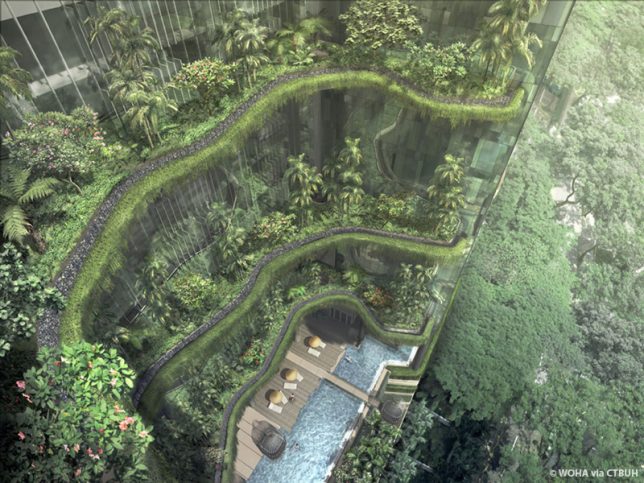
The ‘PARKROYAL on Pickering’ is a pedestrian-oriented elevated neighborhood for Singapore with lush greenery planted on nearly every level and a porous layout encouraging daylight, cross-breezes and free circulation between the various elements of the structure. The 2015 winner of the Urban Habitat Award by the Council on Tall Buildings and Urban Habitat (CTBUH), the Parkroyal was praised for being “intelligently influenced by both its environmental and cultural context.” A contoured podium draws inspiration from terraced landscapes like rice paddies, and a series of columns resembling trees makes the entire building seem to hover above the street, establishing a shaded pedestrian thoroughfare on the ground level. By stretching upward, the building design with all of its integrated greenery adds 215% new green space to the plot area, proving that increasing density in cities doesn’t have to mean losing parks and gardens.

Cities Carved Into Coastal Cliffs

compact cities coastal cliffs 1

compact cities coastal cliffs 2

copact cities coastal cliffs 3

The ‘Living on the Edge’ project imagines building new cities right into coastal cliffs around the world, forming new urban environments. While it would seem like expanding human developments into areas that are currently in their natural state isn’t exactly desirable (not to mention the threat of rising seas), the designers contend that making use of these spaces high above the water level would be better than allowing currently-existing cities to keep sprawling outside their urban boundaries into surrounding forests and agricultural land.

Shop-Top Neighborhood in Beverly Hills

compact cities MAD 1

compact cities MAD 2

compact cities MAD 3

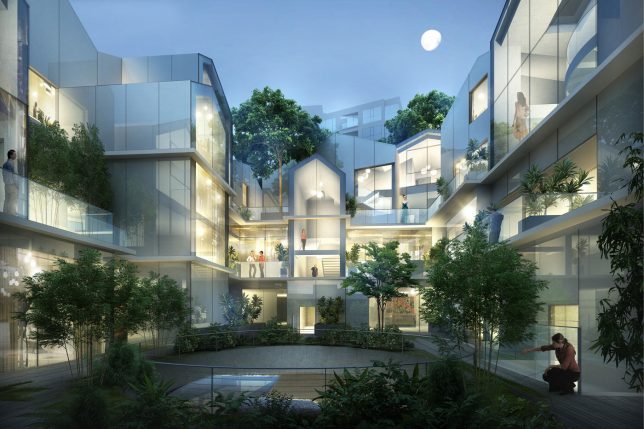
As multiple functions compete for space in crowded cities, the answer is often to build tall structures full of apartments that sacrifice the classic suburban neighborhood feel for density and walkability. But what if we could have both? 8600 Wilshire by MAD Architects places a relatively traditional neighborhood complete with green spaces and trees right on top of a retail block in Beverly Hills. The clustered white glass villas offer 18 residential units in the form of a ‘hillside village,’ with the houses appearing opaque from the street but facing the inner courtyard with transparent facades.

High-Density Urban Development Inspired by Chinese Mountains

compact cities shanshui 1

compact cities shanshui 2

compact cities shanshui 3

Another MAD project “treats architecture as a landscape,” integrating waterfalls, trees and gardens into a high-density urban development with curvaceous structures mimicking traditional Chinese paintings of mountain ranges. ‘Shan-shui City’ is a concept that can be applied to all sorts of building projects, and MAD aims to make use of it in both all-new construction projects in China and as supplements to existing cities. They will apply it to a mixed-use urban development that’s half a million square meters in size, and new plaza development in Beijing’s central business district.

Next Page – Click Below to Read More:
Urban Human Habitats 13 Compact Concepts For Growing Cities

Share on Facebook


[ By SA Rogers in Architecture & Cities & Urbanism. ]

[ WebUrbanist | Archives | Galleries | Privacy | TOS ]


WebUrbanist

 
Comments Off on Urban Human Habitats: 13 Compact Concepts for Growing Cities

Posted in Creativity


2016 Roundup: Compact Enthusiast Zoom Cameras

29 Apr

The enthusiast compact market has exploded over the last couple of years, with almost every manufacturer offering a product with a 1″-type sensors. Most of those cameras are small (and sometimes pocketable) and feature fast (but short) lenses. They also vary in terms of design, control points, video specs and whether they have an EVF, so you’ll have some decisions to make. In this roundup, we’ll try to help.

Here are the cameras that we’ll be covering in this article:

  • Canon PowerShot G1 X Mark II
  • Canon PowerShot G5 X
  • Canon PowerShot G7 X
  • Canon PowerShot G9 X
  • Fujifilm X30
  • Fujifilm XQ2
  • Panasonic Lumix DMC-LX100
  • Panasonic Lumix DMC-ZS100/TZ100
  • Sony Cyber-shot RX100
  • Sony Cyber-shot RX100 II
  • Sony Cyber-shot RX100 III
  • Sony Cyber-shot RX100 IV

As mentioned above, the majority of offerings in this category utilize 1″-type sensor, however two cameras offer even larger sensors. The Canon PowerShot G1 X Mark II is built around the largest sensor of the bunch at 1.5″, while the Panasonic Lumix DMC-LX100 uses a slightly smaller Micro Four Thirds chip.

On the opposite end of the spectrum, the two Fujifilm options use significantly smaller 2/3″ sensors, which is important, because sensor size can be a major indicator of potential – particularly lowlight – image quality. Also, cameras with larger sensors will generally allow for much more control over depth of field.

To further help you pick the right camera in this class, we’ve also created the chart below, which breaks down the equivalent aperture for each camera, as you work your way through the zoom range. Our article here explains the concept of equivalence, but at a high level all you need to know is that the lower the line is on the graph below, the blurrier the backgrounds you’ll be able to get and typically, though not always, the better the overall low-light performance.

This graph plots equivalent focal length against equivalent aperture – with both axes taking sensor size into account so that they can be compared on a common basis. Equivalent focal lengths offer the same field-of-view and equivalent apertures give the same depth-of-field and similar total light capture. For more information, click here.

On the following pages, you’ll find what we liked and didn’t like about each camera, links to our test scenes for image quality comparisons, and real-world galleries to give you a sense of how each performs outside the lab.

Articles: Digital Photography Review (dpreview.com)

 
Comments Off on 2016 Roundup: Compact Enthusiast Zoom Cameras

Posted in Uncategorized


Canon PowerShot SX720 HS boasts new 40x zoom lens with a compact form factor

20 Feb

$ (document).ready(function() { SampleGalleryV2({“containerId”:”embeddedSampleGallery_4085564708″,”galleryId”:”4085564708″,”isEmbeddedWidget”:true,”standalone”:false,”selectedImageIndex”:0,”startInCommentsView”:false,”isMobile”:false}) });

Canon has released a new long-zoom compact dubbed the PowerShot SX720 HS. New for this model is a lens with a wider zoom range compared to its predecessor, offering a 35mm-equivalent of 24-960mm at F3.3-6.9. The sensor remains a 20.3MP 1/2.3″ BSI CMOS unit with a DIGIC 6 image processor.

In addition to the new lens, the SX720 HS has a redesigned grip, and battery life has increased to a CIPA-rated 250 shots (355 in ECO mode). Photos can be composed on a 3″ LCD display with 922k dots. The camera carries over Canon’s Zoom Framing Assist system to automatically zoom in or out to follow subject movement and more accurately keep focus, and also comes with the Story Highlight feature to automatically compile images and videos from a day or event into a highlight reel with music and effects. Speaking of video, the SX720 can capture 1080/60p clips with stereo sound.

The SX720 HS will be available in March 2016 with an MSRP of $ 379.99.

Press release:

TAKE THAT CAMERA TO GO!  CANON U.S.A LAUNCHES COMPACT POWERSHOT G7 X MARK II AND POWERSHOT SX720 HS DIGITAL CAMERAS

Newest Canon PowerShot Digital Cameras Offer Outstanding Quality in Convenient Compact Size 

MELVILLE, N.Y., February 17, 2016 – Ideal for both advanced amateur and pro photographers looking for a convenient, high performance compact camera with the ability to connect to compatible digital devices, Canon U.S.A. Inc., a leader in digital imaging solutions, proudly introduces the compact PowerShot G7 X Mark II1 and lightweight PowerShot SX720 HS digital cameras.

Canon’s new PowerShot G7 X Mark II digital camera pairs a 1.0-inch, 20.1 Megapixel* CMOS sensor with Canon’s new DIGIC 7 Image Processor to help reduce noise and deliver outstanding image quality, even in low light shooting situations. The PowerShot SX720HS digital camera boasts a new 40x Optical Zoom lens (equivalent to 24-960mm), providing outstanding performance, reach and resolution for everyday use and when shooting memorable family events, while easily slipping into a pocket or purse.

“In today’s world, compact cameras must work well with other devices and still offer superb quality. The PowerShot G7 X Mark II and PowerShot SX720 HS cameras both provide outstanding image quality with amazing optical zoom lenses and they easily connect with compatible phones, tablets and other smart devices so great images can be shared and enjoyed” stated Yuichi Ishizuka, president and COO, Canon U.S.A., Inc.  

Sleek and Sophisticated 
The first Canon camera to feature Canon’s new high-speed DIGIC 7 Image Processor, the 

PowerShot G7 X Mark II digital camera is a model of compact sophistication and speed with a high-quality sleek body and optimum comfort grip. Building on the success of Canon’s PowerShot G7 X digital camera, the PowerShot G7 X Mark II digital camera features a fast startup and improved RAW continuous shooting speed of up to eight frames per second (fps) with short intervals between shots. Additional features include: 

  • Bright f/1.8 (W) – f/2.8 (T), 4.2x (24–100mm equivalent) optical zoom lens with Canon’s Intelligent Image Stabilizer (IS) and a 9-blade iris diaphragm;
  • Multi-angle 3.0-inch capacitive touch panel LCD with a screen resolution of 1.04 million dots and tilt options of 180° up and 45° down;
  • Ability to capture 1080p Full HD video in MP4 format with stereo sound;
  • Built-in Wi-Fi®** and Near Field Communications (NFC™)*** capability with a dedicated Wi-Fi button for easy sharing and transferring of images and videos;
  • Picture Style function that offers superb command of in-camera color, contrast, and sharpness;
  • In-camera RAW conversion, making it possible to preview customized image processing modifications on the camera, without the use of a computer;
  • Convenient control ring lever that enables users to quickly switch between stepped and continuous ring movement; 
  • Time-Lapse Movie feature to help capture images at preset intervals and combine them to create a short movie clip;
  • Panning feature that allows the camera to lock onto the main subject using Canon’s Intelligent IS technology to automatically adjust the shutter speed for beautiful background blur.

The Canon PowerShot G7 X Mark II digital camera is currently scheduled to be available in May 2016 for an estimated retail price of $ 699.992.

Powerful Zoom Delivers Virtually Shake-Free Images
The Canon PowerShot SX720 HS digital camera is equipped with a new powerful zoom lens and is the ideal choice for amateur photographers looking to take a step up from a smartphone or entry-level digital camera to a lightweight, compact camera. The PowerShot SX720 HS digital camera’s new 40x Optical Zoom lens (24-960mm equivalent focal length range) uses one Hi-UD, three UD and three aspheric lens elements to help achieve high image quality and high magnification, while also utilizing Canon’s Intelligent Imaging Stabilizing (IS) technology for greater optical performance. 

As the successor to Canon’s PowerShot SX710 HS digital compact camera, the PowerShot SX720 HS digital camera features increases its zoom range while maintaining compact size for maximum convenience. Additional features include:

  • A dedicated Wi-Fi® button for easy sharing and transferring of images and videos utilizing the camera’s built-in WiFi and NFCtechnology;
  • 20.3 Megapixel* CMOS sensor with Canon’s DIGIC 6 Image Processor to help deliver outstanding image quality, even in low light;
  • 1080p/60 Full HD video capture with stereo sound;
  • 3.0-inch LCD (approx. 922,000 dots) to allow for easy viewing, even from a wide angle;
  • Zoom Framing Assist that allows the lens to automatically zoom in or out while the camera follows subject movement  and helps keep it in focus;
  • Story Highlight feature that enables the camera to automatically compile images and videos3 from a certain day or event into a mini-highlight reel with music and effects;
  • Creative Shot mode that uses composition, color and lighting from an original image to create artistic images.
  • Canon’s PowerShot SX720 HS digital camera is currently scheduled to be available in March 2016 for an estimated retail price of $ 379.992.  

1 This device has not been authorized as required by the rules of the Federal Communications Commission. This device is not, and may not be offered for sale or lease, or sold or leased, until authorization is obtained.

2 Availability, pricing and specifications are subject to change without notice.  Actual prices are set by individual dealers and may vary.

3 Videos must be shot in Hybrid Auto or Short Clip.

* Image processing may cause a decrease in the number of pixels.

** Compatible with iOS® versions 7.1/8.4/9.0, AndroidTM smartphone and tablet versions  4.0/4.1/4.2/4.3/4.4/5.0/5.1.  Data charges may apply with the download of the free Canon Camera Connect app. This app helps enable you to upload images to social media services. Please note that image files may contain personally identifiable information that may implicate privacy laws. Canon disclaims and has no responsibility for your use of such images. Canon does not obtain, collect or use such images or any information included in such images through this app.

*** Compatible with Android smartphone and tablet versions 4.0/4.1/4.2/4.3/4.4/5.0/5.1.

Canon PowerShot SX720 HS specifications

Price
MSRP $ 379
Body type
Body type Compact
Sensor
Max resolution 5184 x 3888
Image ratio w:h 1:1, 4:3, 3:2, 16:9
Effective pixels 20 megapixels
Sensor photo detectors 21 megapixels
Sensor size 1/2.3" (6.17 x 4.55 mm)
Sensor type BSI-CMOS
Processor DIGIC 6
Color space sRGB
Color filter array Primary color filter
Image
ISO Auto, 100-3200
White balance presets 5
Custom white balance Yes
Image stabilization Optical
Uncompressed format No
JPEG quality levels Superfine, fine
File format
  • JPEG (Exif v2.3)
Optics & Focus
Focal length (equiv.) 24–960 mm
Optical zoom 40×
Maximum aperture F3.3 – F6.9
Autofocus
  • Contrast Detect (sensor)
  • Multi-area
  • Center
  • Tracking
  • Single
  • Continuous
  • Face Detection
  • Live View
Autofocus assist lamp Yes
Digital zoom Yes (4X)
Manual focus Yes
Normal focus range 5 cm (1.97)
Macro focus range 1 cm (0.39)
Number of focus points 9
Screen / viewfinder
Articulated LCD Fixed
Screen size 3
Screen dots 922,000
Touch screen No
Screen type TFT LCD
Live view Yes
Viewfinder type None
Photography features
Minimum shutter speed 15 sec
Maximum shutter speed 1/3200 sec
Exposure modes
  • Hybrid Auto
  • Auto
  • Program
  • Shutter priority
  • Aperture priority
  • Manual
Scene modes
  • Sports
  • Portrait
  • Smile
  • Wink Self-Timer
  • Face Self-Timer
  • Handheld Night Scene
  • Low Light
  • Fireworks
Built-in flash Yes
Flash range 4.00 m
External flash No
Flash modes Auto, on, off, slow synchro
Continuous drive 5.9 fps
Self-timer Yes (2 or 10 secs, custom)
Metering modes
  • Multi
  • Center-weighted
  • Spot
Exposure compensation ±2 (at 1/3 EV steps)
Videography features
Resolutions 1920 x 1080 (60p, 30p), 1280 x 720 (30p), 640 x 480 (30 fps)
Format MPEG-4, H.264
Microphone Stereo
Speaker Mono
Storage
Storage types SD/SDHC/SDXC card
Connectivity
USB USB 2.0 (480 Mbit/sec)
HDMI Yes (micro-HDMI)
Microphone port No
Headphone port No
Wireless Built-In
Wireless notes 802.11b/g/n with NFC
Remote control Yes (via smartphone)
Physical
Environmentally sealed No
Battery Battery Pack
Battery description NB-13L lithium-ion battery & charger
Battery Life (CIPA) 250
Weight (inc. batteries) 270 g (0.60 lb / 9.52 oz)
Dimensions 110 x 64 x 36 mm (4.33 x 2.52 x 1.42)
Other features
Orientation sensor Yes
GPS None

Articles: Digital Photography Review (dpreview.com)

 
Comments Off on Canon PowerShot SX720 HS boasts new 40x zoom lens with a compact form factor

Posted in Uncategorized


Leica launches its first rugged camera with the X-U (Typ 113) underwater compact

21 Jan

$ (document).ready(function() { SampleGalleryV2({“targetContainerClass”:”sampleGalleryImageViewerContainer”,”galleryId”:”5760715033″,”isEmbeddedWidget”:true,”selectedImageIndex”:0,”startInCommentsView”:false,”isMobile”:false}) });

German camera manufacturer Leica has announced it has produced a waterproof, shock-proof and dust-proof compact camera that uses an APS-C sensor. The Leica X-U (Typ 113) joins the X family of compacts, but offers waterproofing to 15m / 50ft and a body that is designed to be used both beneath and above the waves.

The camera uses a 16.3MP CMOS sensor like the other models in the X series, but sports a 23mm F1.7 Summilux ASPH lens that delivers the same angle of view as a 35mm lens would on a full-frame camera. The lens can focus down to 20cm and features a flash housing directly above the axis of the front element that reduces the distance between the flash and the subject – which will be useful underwater, as illumination drops off quickly. The flash has a guide number of only 5m at ISO 100, and according to Leica has an operating range of 0.3-2m at that ISO setting. 

The camera shoots both Raw and JPEG files, and has a movie mode that records at 30 fps in 1080 HD resolution. When used underwater a press of the UW button activates Underwater mode, which adjusts the white balance accordingly and sets distortion correction to suit the conditions.

Leica says the camera was designed in collaboration with Audi Design, and that the top plate is made from high grade aluminum and the body coated in ‘high-grip TPE armoring’. 

The camera is available now, and costs £2400 / $ 2,950. A floating neck strap is available for £50 / $ 95 and a wrist strap for £32 / $ 65. Correct me if I’m wrong, but I think this is Leica’s first ever commercially available underwater camera.

For more information see the Leica website. 


Press release:

Built for the challenge – born for adventure: Introducing the Leica X-U

New outdoor camera from Leica delivers outstanding picture quality in the harshest conditions   

Leica Camera has unveiled its first camera designed specifically for outdoor and underwater photography – the Leica X-U (Typ 113).  

Incorporating a fast Leica Summilux 23mm f/1.7 ASPH. lens (equivalent to 35mm in 35mm format) with underwater protection filter, and a large APS-C CMOS sensor, this fully waterproofed member of the Leica X family delivers images with exceptional brightness and clarity, even in the harshest of conditions.  

Created for the adventurous photographer, the Leica X-U allows the user to capture breathtaking underwater moments in perfect detail, at depths of up to 15 metres. Shock-resistant, dust-sealed and shatter-proof, this rugged camera is the ideal companion for any outdoor expedition or adventure – whether it’s action or underwater shooting, extreme sports, travel, architectural or landscape photography – and also offers video capture in full HD quality.  

Optimum picture performance is guaranteed, thanks to the cutting-edge technology the X-U shares with all models in the Leica X range. Combined with its professional 16.5 MP (16.2 MP effective) APSC CMOS sensor, the Leica X-U’s premium Summilux 23 mm f/1.7 ASPH. lens ensures natural colour reproduction and outstanding resolution, even at the closest focusing distance of 20 centimetres. Its fast f/1.7 maximum aperture also offers the freedom to explore the creativity of selective focusing. In addition, due to the camera’s excellent resistance to stray light and flare, the Leica X-U is the perfect choice for an extensive range of indoor and outdoor lighting conditions – at any time of day or night.  

Made in Germany in collaboration with Audi Design, the stylish yet minimal Leica X-U focuses on the essential features: simple and intuitive operation, as well as ultimate precision. With a top plate made from premium aluminium and high-grip TPE armouring, the body ensures exceptional usability, handling and durability, as well as water resistance to a depth of up to 15 metres.  

Designed to embrace the elements, and for the most ambitious photography projects, the Leica X-U incorporates a non-slip body, a toughened monitor screen cover, and a failsafe double locking system for the battery compartment and memory card slot. These robust protective features ensure that photographers can concentrate fully on their subject, with full confidence in the camera’s durability.  

Furthermore, the minimal, intuitive design of the Leica X-U puts the most important creative tools directly at the photographer’s fingertips. Aperture and shutter speed can be set quickly and easily using the straightforward, typical ’Leica-style’ dials, while a practical underwater snapshot button ensures the camera is ready to capture the wonders of the underwater world immediately – without the need to search through menus. Thanks to the camera’s high resolution three inch screen and a wide range of useful automatic features, it takes just seconds to find the precise settings the photographer requires to capture their decisive moment.

Additionally, with its anodised aluminium control dials and an integrated flash above the lens, the Leica X-U is a perfect example of exceptional quality and attention to detail.

For those on a challenging professional assignment or a magical holiday of a lifetime, important moments can also be recorded in full HD, cinema-quality video – with a choice of 1920×1080 or 1280×720 pixel resolution, at 30 full frames per second in MP4 format. And whether the footage is intended for a professional production or a home movie to share with friends and family, the Leica X-U delivers high quality results that perfectly capture that special adventure.

Leica X-U (Typ 113) specifications

Price
MSRP $ 2950
Body type
Body type Large sensor compact
Body material Aluminum
Sensor
Max resolution 4928 x 3264
Image ratio w:h 3:2
Effective pixels 16 megapixels
Sensor photo detectors 17 megapixels
Sensor size APS-C (23.6 x 15.7 mm)
Sensor type CMOS
Color space sRGB
Color filter array Primary color filter
Image
ISO Auto, 100-12500
White balance presets 5
Custom white balance Yes (2 spots)
Image stabilization No
Uncompressed format RAW
JPEG quality levels Super fine, fine
File format
  • JPEG (Exif v2.3)
  • Raw (DNG)
Optics & Focus
Focal length (equiv.) 35 mm
Optical zoom 1×
Maximum aperture F1.7 – F16.0
Autofocus
  • Contrast Detect (sensor)
  • Multi-area
  • Center
  • Selective single-point
  • Single
  • Continuous
  • Live View
Autofocus assist lamp Yes
Normal focus range 20 cm (7.87)
Number of focus points 11
Screen / viewfinder
Articulated LCD Fully articulated
Screen size 3
Screen dots 920,000
Touch screen No
Screen type TFT LCD
Live view Yes
Viewfinder type None
Photography features
Minimum shutter speed 30 sec
Maximum shutter speed 1/2000 sec
Exposure modes
  • Program
  • Aperture priority
  • Shutter priority
  • Manual
Built-in flash Yes
Flash range 2.00 m (at ISO 100)
External flash Yes
Flash modes Automatic, automatic/red eye reduction, on, on/red eye reduction, long-term synchronization/red eye reduction, off
Drive modes
  • Single
  • Continuous
Continuous drive 5.0 fps
Self-timer Yes
Metering modes
  • Multi
  • Center-weighted
  • Spot
Exposure compensation ±3 (at 1/3 EV steps)
AE Bracketing ±3 (3 frames at 1/3 EV steps)
Videography features
Resolutions 1920 x 1080 (30p), 1280 x 720 (30p)
Format MPEG-4
Microphone Stereo
Speaker Mono
Storage
Storage types SD/SDHC/SDXC
Connectivity
USB USB 2.0 (480 Mbit/sec)
HDMI No
Microphone port No
Headphone port No
Remote control No
Physical
Environmentally sealed Yes
Battery Battery Pack
Battery description BP-DC8 lithium-ion battery & charger
Battery Life (CIPA) 450
Weight (inc. batteries) 635 g (1.40 lb / 22.40 oz)
Dimensions 140 x 79 x 88 mm (5.51 x 3.11 x 3.46)
Other features
Orientation sensor Yes
GPS None

Articles: Digital Photography Review (dpreview.com)

 
Comments Off on Leica launches its first rugged camera with the X-U (Typ 113) underwater compact

Posted in Uncategorized


Fujifilm X70 puts 28mm equivalent F2.8 lens into compact X100-style body

17 Jan

$ (document).ready(function() { SampleGalleryV2({“targetContainerClass”:”sampleGalleryImageViewerContainer”,”galleryId”:”0302545666″,”isEmbeddedWidget”:true,”selectedImageIndex”:0,”startInCommentsView”:false,”isMobile”:false}) });

Fujifilm has announced the X70, a fixed-lens compact camera designed in the spirit of the company’s X100-series.

The X70 takes the design of the X100, shrinks it down, and adds a 28mm equivalent F2.8 lens (compared to the 35mm equiv. F2 optics on the X100). The cool hybrid viewfinder from the X100 is gone, but in exchange users get Fujifilm’s first touchscreen LCD (3″ in size), which can also tilt 180 degrees. The X70 has direct controls for aperture, shutter speed and exposure compensation, just like its big brother.

The guts of the camera are similar to that of the X-T10, meaning that the X70 has a 16.3MP X-Trans CMOS II sensor and Hybrid AF system. The AF system offers 49 points in single-point mode and 77 in zone and wide/tracking modes. The lens itself has nine rounded aperture blades and a minimum focus distance of 10cm. The mechanical shutter stops at 1/4000 sec but the electronic shutter goes all the way to 1/32000 sec.

The X70 has a standard ISO range of 200-6400, which expands to 100-51200. It can shoot continuously at 8 frames per second, though only for ten photos. Naturally, it has the full set of Film Simulation Modes, save for the new ACROS mode on the X-Pro2. Video can be recorded at 1080/60p, with a maximum bitrate of 36Mbps. As one would expect, the X70 also has built-in Wi-Fi with remote control from your smartphone.

The X70 will be available in all-black or silver and black in February at a price of $ 699.95.

Online resellers are selling the X70 for $ 799 – Fujifilm tells us that the $ 699 price in the press release is indeed correct.

FUJIFILM ANNOUNCES NEW ADDITIONS TO THE X-SERIES LINE OF CAMERAS AND LENSES

X-Pro2, X-E2S, X70 and XF100-400mmF4.5-5.6 R LM OIS WR join the X-Series; all-weather FinePix XP90 gets the shot from sand to slopes

Valhalla, N.Y., January 14, 2016 FUJIFILM North America Corporation, a leader in digital imaging, today announced new additions to the award-winning X-Series line of premium fixed and mirrorless cameras, and ultra-high quality lenses, including: the FUJIFILM X-Pro2, FUJIFILM X-E2S, FUJIFILM X70 and FUJINON XF100-400mmF4.5-5.6 R LM OIS WR.  Fujifilm also introduced the new rugged and waterproof FinePix XP90, perfect for capturing amazing images everywhere, from underwater to mountain tops.

FUJIFILM X70

The FUJIFILM X70 is a newly designed premium fixed lens digital camera that features a FUJINON 18.5mmF2.8 lens (28mm in 35mm format equivalent), suitable for a range of applications from landscapes to everyday snapshots. The new X70 elegantly combines simple manual operation with superior image quality and versatile picture-taking functions, and is the first X-Series camera to offer a touchscreen display that rotates 180 degrees, enabling users to shoot from up high, down low and capture selfies.

The compact FUJIFILM X70 uses a 16.3MP APS-C X-Trans CMOS II Sensor for extraordinary image resolution, and gives photographers milled aluminum dial controls, as well as aperture settings in 1/3 stop increments, and the new Auto Mode Switch lever for selecting its fully automatic Advanced SR Auto mode. In this mode, the camera automatically chooses the optimum settings for great results on any scene.

The new FUJIFILM X70 features a responsive touchscreen – a first for the X-Series. Now, photo enthusiasts can use the Touch Panel for operations during shooting and playback modes. For shooting, users can select their focus area and touch-to-shoot. During playback, users can swipe their finger to scroll through images, double-tab to enlarge images, and drag to view different points on the picture, and pinch-out and pinch-in to enlarge and reduce the image view.
Users can also disable the touchscreen functions at any time by turning the Touch Panel Settings to “off.”

FUJIFILM X70 key features:

  • 16.3MP APS-C X-Trans CMOS II Sensor
    • Fast AF of up to 0.06 seconds
    • Start-up time of 0.5 seconds
    • Shutter time lag of 0.05 seconds
    • Shooting interval of 0.5 seconds
  • Uses the FUJINON 18.5mm F2.8 lens with 7 elements in 5 groups, and  2 high-performance aspherical elements
    • 9 blade aperture
    • FUJINON’s unique HT-EBC coating
  • High-definition, touchscreen 3” tilting (180o) LCD display with 1.04 million dots
  • Maximum ISO performance up to 51200 sensitivity
  • New  AF system offers the 49-point Single Point mode for fast, precise focusing, and a  new Zone and Wide/Tracking modes with a 77-point area to capture moving subjects
  • Up to ±3 stops of exposure compensation on the top-plate dial
  • 8 function buttons (1 customizable)
  • Latest CLASSIC CHROME Film Simulation mode that delivers muted tones and deep colors
  • Interval timer for shooting time-lapse sequences of one second to 24 hours, up to 999 frames
  • Completely silent electronic shutter capable of exposures up to 1/32,000 second
  • Digital teleconverter offers additional focal ranges of 35mm and 50mm
  • Full HD video 1080p at 60fps; bit rate of 36Mbps for clear capture of delicate movements; frame rates of 60 fps, 50fps, 30fps, 25fps and 24fps, supporting worldwide motion picture formats
  • Free FUJIFILM Camera Remote application and Wireless Communication function allows users to remotely shoot images from smartphones and tablets via WiFi
  • Photos can be sent to the INSTAX Share Printer using the free INSTAX Share App (iOS and Android) SHARE Smartphone Printer
  • Advanced creative filters


The FUJIFILM X70 will be available in February 2016 for USD $ 699.95 and CAD $ 899.99.

Fujifilm X70 specifications

Price
MSRP $ 799/£549
Body type
Body type Large sensor compact
Sensor
Max resolution 4896 x 3264
Other resolutions 3:2 (3456 x 2304, 2496 x 1664), 16:9 (4896 x 2760, 3456 x 1944, 2496 x 1408), 1:1 (3264 x 3264, 2304 x 2304, 1664 x 1664)
Image ratio w:h 1:1, 3:2, 16:9
Effective pixels 16 megapixels
Sensor photo detectors 17 megapixels
Sensor size APS-C (23.6 x 15.6 mm)
Sensor type CMOS
Processor EXR Processor II
Color space sRGB
Color filter array X-Trans
Image
ISO Auto, 200-6400 (expandable to 100-51200)
Boosted ISO (minimum) 100
Boosted ISO (maximum) 51200
White balance presets 7
Custom white balance Yes
Image stabilization Unknown
Uncompressed format RAW
JPEG quality levels Fine, standard
File format
  • JPEG (Exif v2.3)
  • Raw (RAF format, 14-bit lossless compressed or uncompressed)
Optics & Focus
Maximum aperture F2.8 – F16.0
Autofocus
  • Contrast Detect (sensor)
  • Phase Detect
  • Multi-area
  • Center
  • Selective single-point
  • Tracking
  • Single
  • Continuous
  • Touch
  • Face Detection
  • Live View
Autofocus assist lamp Yes
Digital zoom Yes (35mm, 50mm digital teleconverter)
Manual focus Yes
Normal focus range 10 cm (3.94)
Number of focus points 77
Screen / viewfinder
Articulated LCD Tilting
Screen size 3
Screen dots 1,040,000
Touch screen Yes
Screen type TFT LCD
Live view Yes
Viewfinder type None
Photography features
Minimum shutter speed 30 sec
Maximum shutter speed 1/4000 sec
Maximum shutter speed (electronic) 1/32000 sec
Exposure modes
  • Program
  • Shutter priority
  • Aperture priority
  • Manual
Built-in flash Yes
Flash range 7.90 m (at ISO 1600 (5.5m at ISO 100))
External flash Yes
Flash modes Auto, Forced Flash, Slow Synchro , Suppressed Flash, Commander
Drive modes
  • Single
  • Continuous (hi/lo)
  • Self-timer
  • Interval
Continuous drive 8.0 fps
Self-timer Yes (2 or 10 secs)
Metering modes
  • Multi
  • Center-weighted
  • Spot
Exposure compensation ±3 (at 1/3 EV steps)
AE Bracketing ±1 (at 1/3 EV, 2/3 EV, 1 EV steps)
WB Bracketing Yes
Videography features
Resolutions 1920 x 1080 (60p, 50p, 30p, 25p, 24p), 1280 x 720 (60p, 50p, 30p, 25p, 24p)
Format MPEG-4, H.264
Microphone None
Speaker None
Storage
Storage types SD/SDHC/SDXC
Connectivity
USB USB 2.0 (480 Mbit/sec)
HDMI Yes (micro-HDMI)
Microphone port No
Headphone port No
Wireless Built-In
Wireless notes 802.11b/g/n
Remote control Yes (Wired or via smartphone)
Physical
Environmentally sealed No
Battery Battery Pack
Battery description NP-95 lithium-ion battery & charger
Battery Life (CIPA) 330
Weight (inc. batteries) 340 g (0.75 lb / 11.99 oz)
Dimensions 113 x 64 x 44 mm (4.45 x 2.52 x 1.73)
Other features
Orientation sensor Yes
Timelapse recording Yes
GPS None

Articles: Digital Photography Review (dpreview.com)

 
Comments Off on Fujifilm X70 puts 28mm equivalent F2.8 lens into compact X100-style body

Posted in Uncategorized


Olympus Stylus Tough TG-870 brings next-generation GPS to familiar rugged compact

06 Jan

$ (document).ready(function() { SampleGalleryV2({“targetContainerClass”:”sampleGalleryImageViewerContainer”,”galleryId”:”1182601807″,”isEmbeddedWidget”:true,”selectedImageIndex”:0,”startInCommentsView”:false,”isMobile”:false}) });

Olympus has updated its rugged compact lineup with the Stylus Tough TG-870, a modest update to last year’s model offering next-generation GPS and a brighter, higher-resolution screen. Still sporting a 16MP BSI CMOS chip and a 21-105mm equivalent zoom, the TG-870 provides a 920k-dot 180 degree flip-up LCD that claims to be 1.1x brighter than its predecessor’s screen. While the Wi-Fi features are unchanged the GPS feature has enhanced, claiming positioning in under 10 seconds. Also new to this model is Live Composite mode as well as low light Nightscape Movie and Nightscape Mode options.

The Olympus Stylus Tough TG-870 will be offered in April 2016 for $ 279.99. 


Press release:

ACTION FROM EVERY ANGLE: THE NEW OLYMPUS STYLUS TOUGH® TG-870

Bright 180-Degree Tilting LCD, Ultra Wide-Angle 5x Zoom Lens, Built-in Wi-Fi®, Next-Generation GPS and Expanded Shooting Capabilities with Nighttime Live Composite in a Compact, Rugged Camera 

CENTER VALLEY, Pa., January 5, 2016 — Olympus adds to the versatility and creativity of its renowned Stylus Tough lineup with the new Stylus Tough TG-870, a premium rugged camera built to capture high-quality photos and video in the most challenging situations. This compact, take-anywhere camera is packed with features, including a class-leading ultra wide-angle 21mm (equivalent) lens with 5x optical zoom, allowing users the ability to effortlessly frame everything from dramatic landscapes to group shots. Together with its high-resolution 180-degree tilting LCD monitor, customizable front button, Sportcam Modes with full HD 1080/60p video, built-in Wi-Fi, next-generation GPS, and an ever-expanding wealth of expressive features, the Stylus Tough TG-870 is ready to capture stunning images anytime, in any environment.

In the tradition of the Olympus Tough series of rugged compact cameras, the Stylus Tough TG-870 is built to withstand extreme conditions: the camera is waterproof to depths of 50 feet (15 m), freezeproof to 14°F (-10°C), shockproof from 7 feet (2.1 m), crushproof to 220 pounds of force (100 kgf) and dustproof. The 21mm–105mm (35mm equivalent) f3.5–5.7 zoom lens is the widest lens in the rugged compact category, perfect for ultra-wide group selfie shots. The TruePic™ VII image processor, the same found in Olympus’s award-winning OM-D series of interchangeable lens cameras, is paired with a 16.0 megapixel backlit CMOS sensor to capture incredibly clear images with sharp details and true-to-life colors, even underwater.

The Stylus Tough TG-870’s 180-degree tilting 920,000-dot high-resolution LCD monitor has double the resolution and is 1.1x brighter than that of its predecessor, enabling the user to see more detail while shooting outdoors or underwater. The customizable button on the front of the camera can be programmed for several functions, including shutter release, video recording, monitor boost, LED assist and Super Macro Mode. The TG-870 also detects the orientation in which it’s being held to assist the user in capturing the perfect selfie, point-of-view action video or over-under shot.

The free Olympus Image Share app synchronizes a user’s iOS or Android mobile device with the Stylus Tough TG-870 via the camera’s built-in Wi-Fi, enabling instant image and movie transfers and direct uploading to websites and social media. A live view of the camera’s lens appears on the smart device display. Users can control the camera remotely by touching the smart device display as if it were the camera itself. The next-generation GPS boasts fast positioning in under 10 seconds via three satellite systems and helps users track precisely where they are in the world. The Olympus Image Track (OI.Track) smartphone app allows users to update the camera’s GPS assist data and transfer GPS logs and images from the camera to a smartphone for simplified viewing and management. 

An impressive variety of shooting modes and 13 Art Filters, including 6 new filters (Vintage, Key Line, Watercolor, Light Tone, Cross Process and Gentle Sepia), help the user capture distinctive images. The Stylus Tough TG-870 is equipped with nighttime Live Composite Mode, which automatically combines the brightest areas of multiple images taken with interval shooting for dramatic photos of cityscapes, star trails and light painting. Sportcam Mode puts four video options right at the user’s fingertips. With 60p Movie, the camera captures full HD 1080p video at 60 frames per second (fps), with 720/60p and 480/60p options also available. With High-Speed Movie, the Stylus Tough TG-870 can record slow-motion video at 120 fps at 854×480 (16:9) or 640×480 (4:3) resolution, or 240 fps at 640×360 (16:9) or 480×360 (4:3) resolution. Time Lapse Movie compresses hours of action into a short movie, and Sport Burst allows photographers to capture sequential images with a shutter interval of 0.05 to 60 seconds. For video capture after dark, camera settings are automatically optimized for low light with Nightscape Movie or Nightscape Mode.

The Stylus Tough TG-870’s rugged construction can be further reinforced with the CSCH-124 Silicone Jacket, which shields the camera from surface damage. The CSCH-123 Tough Sport Holder supports hands-free photography and video recording, allowing users to attach the camera to backpack straps or a chest harness during intensive activities like rock climbing or snowboarding. The PT-057 Underwater Case or Housing lets users dive deeper, increasing the camera’s underwater capability to 147 feet (45 m), and the elective UFL-3 Underwater Strobe Flash facilitates genuine underwater flash photography. A second tripod base plate on the camera offers the added benefit of vertical mounting, and the F-5AC compact high-capacity AC adapter reduces charging time, getting users back to the action faster. 

U.S. Pricing and Availability

The Olympus Stylus Tough TG-870 will be available in April 2016 in Gunmetal Metallic, Metallic Green and Pure White for $ 279.99 (US) and $ 329.99 (CA).

Olympus Stylus Tough TG-870 specifications

Price
MSRP $ 279
Body type
Body type Ultracompact
Body material Aluminum
Sensor
Max resolution 4608 x 3456
Image ratio w:h 1:1, 4:3, 3:2, 16:9
Effective pixels 16 megapixels
Sensor photo detectors 17 megapixels
Sensor size 1/2.3" (6.17 x 4.55 mm)
Sensor type BSI-CMOS
Processor TruePic VII
Color space sRGB
Color filter array Primary color filter
Image
ISO Auto, 125-6400 (expands to 12800)
White balance presets 6
Custom white balance Yes
Image stabilization Optical
Uncompressed format No
File format
  • JPEG (Exif v2.3)
Optics & Focus
Focal length (equiv.) 21–105 mm
Optical zoom 5×
Maximum aperture F3.5 – F5.7
Autofocus
  • Contrast Detect (sensor)
  • Multi-area
  • Center
  • Tracking
  • Single
  • Continuous
  • Face Detection
  • Live View
Autofocus assist lamp Yes
Digital zoom Yes (4x)
Manual focus No
Normal focus range 10 cm (3.94)
Macro focus range 1 cm (0.39)
Screen / viewfinder
Articulated LCD Tilting
Screen size 3
Screen dots 921,000
Touch screen No
Screen type TFT LCD
Live view Yes (Display tilts upward 180 degrees)
Viewfinder type None
Photography features
Minimum shutter speed 4 sec
Maximum shutter speed 1/2000 sec
Scene modes
  • Portrait
  • ePortrait
  • Landscape
  • Interval shooting
  • Live composite
  • Handheld star light
  • Night scene
  • Night + portrait
  • Sport
  • Indoor
  • Sunset
  • Fireworks
  • Cuisine
  • Documents
  • Beach & snow
  • Underwater snapshot
  • Underwater wide
  • Underwater macro
  • Backlight HDR
  • Self portrait
Built-in flash Yes
Flash range 4.00 m (at ISO 1600)
External flash No
Flash modes Auto, redeye reduction, fill flash, off, LED illuminator
Drive modes
  • Program
  • iAuto
Continuous drive 7.0 fps
Self-timer Yes (2 or 10 sec, custom)
Metering modes
  • Multi
  • Center-weighted
  • Spot
Exposure compensation ±2 (at 1/3 EV steps)
WB Bracketing No
Videography features
Resolutions 1920 x 1080 (60p), 1280 x 720 (60p), 640 x 480 (60p)
Format MPEG-4, H.264
Videography notes 5-axis (optical+digital) image stabilization
Microphone Stereo
Speaker Mono
Storage
Storage types SD/SDHC/SDXC, Internal
Storage included 37MB
Connectivity
USB USB 2.0 (480 Mbit/sec)
HDMI Yes (micro-HDMI)
Microphone port No
Headphone port No
Wireless Built-In
Remote control Yes (via smartphone)
Physical
Environmentally sealed Yes (waterproof to 15m/50ft, crushproof to 100kgf/220lbf, shockproof from 2.1m/7ft, freezeproof to -10C/+14F)
Battery Battery Pack
Battery description Li-50B lithium-ion battery & charger
Battery Life (CIPA) 300
Weight (inc. batteries) 221 g (0.49 lb / 7.80 oz)
Dimensions 113 x 64 x 28 mm (4.45 x 2.52 x 1.1)
Other features
Orientation sensor Yes
Timelapse recording Yes
GPS BuiltIn

Articles: Digital Photography Review (dpreview.com)

 
Comments Off on Olympus Stylus Tough TG-870 brings next-generation GPS to familiar rugged compact

Posted in Uncategorized


DPReview Recommends: Best compact cameras for travel 2015

23 Dec

Whether you’re traveling the world or the next town over, having the right camera at your side makes all the difference. We’ve picked out our best picks for the photographer who wants to keep things simple by carrying a compact camera rather than one with interchangeable lenses. If you fall into that category, we’ve got great news for you – there are more high quality cameras with attached lenses than ever before, brimming with features tailored to your needs. 

Fujifilm X100T

$ 1099 | 16MP APS-C sensor | 35mm equiv F2 lens | Hybrid electronic / optical viewfinder | 3″ LCD

Few cameras in recent history have attracted as much of a cult following as Fujifilm’s X100 series. They’re the photographer’s darling – not just a good-looking camera, but a beautifully effective machine. The X100T is small and light, and won’t burden a weary traveler, and its low-profile lends itself to street shooting. If you don’t mind zooming with your feet, its 35mm F2 equivalent lens and 16MP X-Trans APS-C sensor will serve you well.

In addition to its travel-friendly size, the X100T offers a hybrid viewfinder with optical and digital views. That’s especially handy when the sun is high in the sky and the 1.04M-dot 3″ LCD becomes harder to see. Having been on the market over a year (at time of publication), its 16 megapixels are starting to feel quite low in comparison to some of its peers, but it also means that the price has dropped slightly since its launch. It is worth noting though that its movie mode, which was far from class-leading at launch, is now well behind the competition in terms of quality and 4K support.

With obviously classic design cues, the X100T’s controls and handling are timeless. Though it doesn’t offer the cutting-edge modern features of its newer peers, it won’t go out of style anytime soon. 

Also consider…

Ricoh GR II
Not a revolutionary update to the original by any means, but the Ricoh GR II’s 16MP APS-C sensor and 28mm F2.8 make the camera one of the best bargains on the market for under $ 600.

Panasonic Lumix FZ1000

$ 750 | 20MP 1″-type sensor | 4K video | 25-400mm equiv. focal range | XGA OLED viewfinder

You can zoom with your feet all day long, but some situations and shooting styles call for real zoom. The Panasonic Lumix FZ1000 doesn’t top its class in terms of massive zoom reach, but its 25-400mm equivalent zoom opens up plenty of options, and an F2.8-4.0 aperture is brighter than most of its peers. With a 1″-type 20.1MP CMOS sensor, it borrows some tech from the GH4 including 4K video recording at 30 fps. Its DSLR-style build includes a fully articulated 921k-dot 3″ LCD and a 2.4M-dot OLED viewfinder.

Also consider… 

Nikon Coolpix P900 
On the seventh day, the Nikon Coolpix P900 was created. And there was much zoom. An incredible 24-2000mm equivalent range, in fact. The P900 uses a considerably smaller 16MP sensor than the FZ1000, but its lens is impressive considering what it has to do, the image stabilization is amazing, and the built-in GPS won’t let you forget where you’ve been.

Sony Cyber-shot DSC-RX100 IV

$ 950 | 20MP 1″-type sensor | F1.8-2.8 24-70mm equiv. lens | Pop-up EVF | 4K video

It’s hard not to recommend the Sony RX100 IV to anyone buying a compact. It’s by no means a budget-friendly option, but it’s among the most capable pocket-sized cameras we’ve ever tested. Sony’s excellent 20MP 1″-type sensor is bigger than your garden-variety compact camera sensor with lots of dynamic range, and a 24-70mm equiv. F1.8-2.8 lens is much brighter than most of its competition. The camera’s tiny pop-up EVF is higher resolution than that of it predecessor and comes in very handy in bright outdoor light.

The RX100 IV really shines when you set the mode dial to movie mode. 4K/UHD recording is available, and at lower resolutions (upscaled to 1080p) high frame rates of 240, 480 and 960 fps can be used. Slow motion video is an awful lot of fun.

If you want to take control over your settings, shoot high quality video and make the most of your vacation Raw files, the RX100 IV is a solid choice. Of course, if you can live without 4K and high frame rates, the RX100 III will save you a couple hundred dollars and get you much of the same excellent image quality. Neither will get you a lot of zoom if that’s what you’re after, but their image quality is at the top of their class.

Also consider…

Panasonic Lumix DMC-ZS50 
Before there were fancy Sony point-and-shoots with 1″ sensors, Panasonic had the market cornered on premium zoom compacts for travelers. While its 12MP 1/2.3″ sensor looks a bit pedestrian in comparison, there’s something to be said for a 24-720mm equiv. zoom that just about fits in your pocket. And for under $ 300, it’s pretty much a steal for full manual controls, Raw support and Wi-Fi with NFC.

Panasonic Lumix DMC-LX100

$ 700 | 13MP Four Thirds sensor | 24-75mm equiv. F1.7-2.8 lens | Electronic viewfinder | 4K video

Why stop at a 1″-type sensor? That’s the question Panasonic engineers must have asked themselves, and lo and behold, the Lumix LX100 was born. It uses a cropped 13MP Four Thirds sensor coupled with a very fast 24-75mm equiv. F1.7-2.8 lens and offers great ergonomics and handling for the kind of photographer who wants quick access to exposure settings. It’s not as pocket-friendly as the RX100 IV, but its solid handgrip gives it a steady feel and its responsive user experience is one of the best we’ve encountered in a compact.

In addition to recording 4K video, the LX100 also offers a useful 4K Photo Mode, which lets you extract a high quality 8MB still from your clip. Its time-lapse and stop motion animation modes are also a lot of fun. Its zoom is certainly on the shorter side, and for someone who plans to stay in Auto mode the camera’s controls and customization will verge on overkill. But for the seasoned photographer wanting to give her shoulders a break from the big camera, the LX100 is a joy to carry and shoot with.

Also consider…

Canon PowerShot G5 X 
If you want just a bit more zoom (100mm at the top end) and a more traditional SLR-style body you may want to consider the Canon PowerShot G5 X. It sports a 20MP 1″-type BSI CMOS sensor (likely the same as in the RX100 III) and a 24-100mm equiv. F1.8-2.8 lens, along with a fully articulating LCD, high resolution EVF, and full set of manual controls. It’s not great for action shooting and it lacks 4K video, but the G5 X is still worth a look.

Olympus Tough TG-4

$ 350 | 16MP 1/2.3″ BSI CMOS sensor | 25-100mm equiv. F2.0-4.9 lens | Everything-proof

Nothing spoils a vacation like spilling a Mai Tai on your fancy new camera. The Olympus TG-4 isn’t just sealed against spills, its fully waterproof to 15m/50ft, as well as shockproof from 2.1m/7ft, crushproof to 100kg/220lbf and freezeproof to -10C/14F. Wherever your travels may take you, the TG-4 is up to the challenge.

Outside of its rugged specs, we like the TG-4’s ability to shoot Raw, making it possible to get very nice image quality with a little time invested in post-processing. Its moderate 25-100mm equiv. zoom, which is fast at its wide end, will get you a little closer to the action, and optional accessories like a macro LED ring light and waterproof fisheye lens open up more possibilities. It also provides the peace of mind of knowing your camera will survive just about anything your vacation throws at it.

Also consider…

Olympus Tough TG-860
The Stylus TG-860 is the TG-4’s more casual sibling, lacking buttoned-up features like Raw capture and Aperture priority mode, but provides identical rugged specifications with a flip-up selfie-friendly LCD. If you don’t anticipate doing extensive editing to your snapshots, the TG-860 is good, clean fun for a significantly cheaper price.

Articles: Digital Photography Review (dpreview.com)

 
Comments Off on DPReview Recommends: Best compact cameras for travel 2015

Posted in Uncategorized


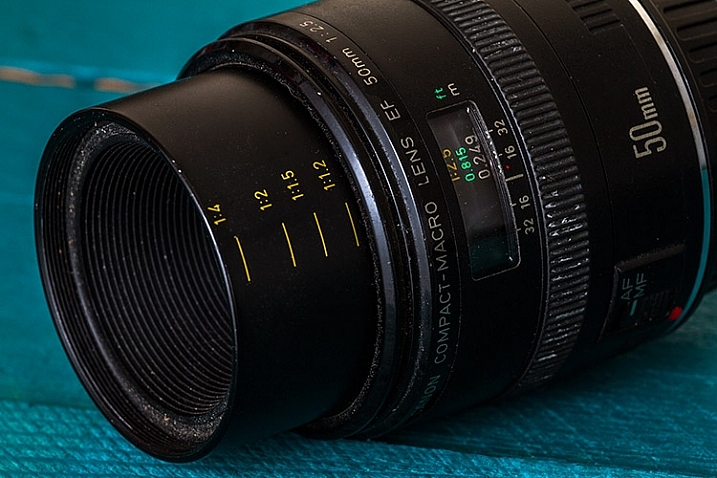
Writer’s Favorite Lens – Canon 50mm f/2.5 Compact Macro

20 Dec

Canon 50mm f/2.5 Compact Macro

Sometimes, picking a favorite is hard. If you ask me to choose a favorite song or movie, it just can’t be done. Lenses; however, are different beasts. Ask most photographers what their favorite lens is, and you’ll probably get little hesitation before they start gushing and waxing lyrical.

At least that’s how I am, and when it comes to picking my favorite, all you have to do is ask which lens is probably on my camera body right now. That is almost always the Canon 50mm f/2.5 Compact Macro.

This lens is a gem that offers great quality in terms of sharpness, ease of use, durability and versatility, and even though I’ve acquired some fairly serious glass since I bought it 12 years ago, it’s still my go-to lens.

Making the choice

Regarding lens choice, one of the most common things new photographers are told is to start with a 50mm f/1.8, often referred to as “thrifty fifties”. The logic here is more or less irrefutable. These lenses are cheap, reliable, versatile, and their large aperture makes them much faster than anything else in that price range. Their versatility makes them perfect for portraits and most other subjects outside of the extremes such as landscapes, which favor wide-angle lenses, and sports, which favor telephoto lenses.

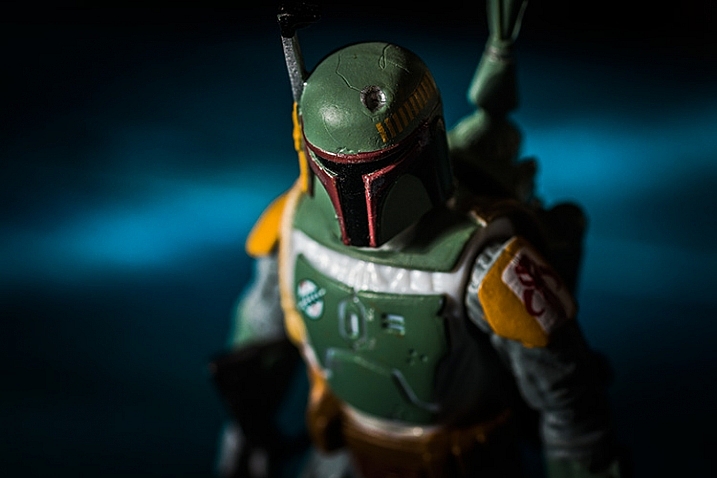
Boba

When I was starting out, I spent a lot of time photographing things like food, flowers, toys, and other small things with fine details. I had little interest in other types of photography, and no interest in portraiture.
As such, the biggest limitation I got from my kit lenses was the focusing distance. I was forever trying to get closer to my subjects using the long end of kit lenses, and falling short every time.

When it was time to consider upgrading that first lens, research made it clear that neither the thrifty fifty nor the 85mm f/1.8 would do much good towards those aims. On the other hand, a dedicated 100mm macro lens was far out of my price range. Because of all this, I put off upgrading my kit lenses for a long time.

It was only by chance that I eventually found the 50mm Compact Macro while browsing through Canon lenses on a retailer’s site. To be honest, there wasn’t a lot of research involved. I saw the lens, the price, and the focusing distance of nine inches, and I bought it within the week.

Pros and cons

The Canon 50mm Compact Macro is the workhorse of my camera bag and it’s certainly been put through its paces over the past decade. For my purposes, there are no flaws; however, it does have a few qualities that may make it unsuitable for some photographers.

Pro – Build quality

It can’t be helped that the first thing you notice about this lens is the build quality. This is particularly true if your previous experiences are with kit lenses. The solid metal casing makes it feel sturdy and the extra weight feels great in your hand.

It may be worth mentioning that when I did get to use a 50mm f/1.8 a few years ago, I thought that I was being handed a Holga lens. This isn’t in any way an attempt the demean the 50mm f/1.8, but rather as an illustration of how far apart these lenses are in terms of build quality.

Pro – Durability

favourite-lens-canon-50mm-macro-2081

Durability may fall under build quality, but experience makes me feel it’s worth mentioning separately.

This lens has been dropped on concrete, cobble stone, and Tarmac, and it has been in the ocean. It has been in ash storms, torrential rain, hail storms, and there was one terrifying incident where it was left to stew in a half litre puddle of shower gel for a few hours. Despite all of this, this lens has not once shown any performance issues.

Pro – Sharpness

As should be expected from a lens created for the purpose of macro photography, the Canon 50mm f/2.5 Compact Macro cannot be faulted in terms of sharpness. While I’m unable to compare it to the other 50mm offerings from Canon, I can compare it with the excellent 85mm f/1.8 and 70-200 f/4 L IS USM. The differences are almost indistinguishable.

Pro – Large aperture

The compact Macro may have a smaller aperture than Canon’s other 50mm lenses, but it is still a fast lens and works well in all but the dimmest of settings.

In terms of background blur, if you take into account that depth of field is also affected by the distance of the camera from the subject (the closer you are, the shallower the depth of field) you can see that you will achieve a comparable amount of blur to the faster lenses.

Pro – Focusing

Whether it’s in auto focus or manual focus, it’s really hard to find fault with this lens. In normal situations, the auto-focus is fast and accurate. The large aperture of f/2.5 allows for a bright image in the viewfinder, making manual focus easy and quick.

Pro – Focus distance

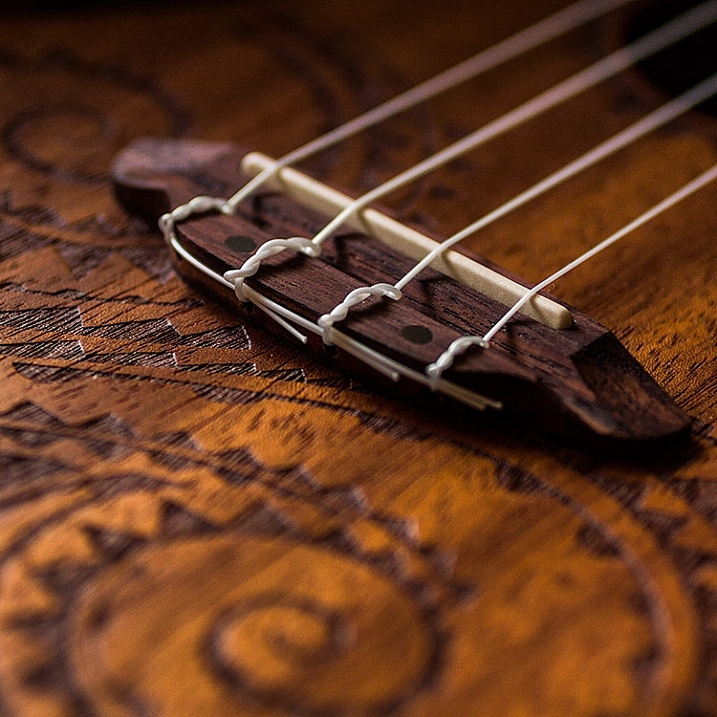
Uke

With a focusing distance of just nine inches (23cm), you can get extremely close to your subjects. Yes, this may be the sole reason for this lens’ existence, but the versatility this adds is wonderful. For example, you are able to take a close-up of someone’s eye, then move a few steps back and take a normal 50mm portrait seconds later.

Cons

As mentioned, it wasn’t easy to come up with any negative aspects of this lens. There are; however, a few considerations that could mean this may not fit your specific photographic needs.

Con – Weight

At 9.88 ounces (280 grams), the Compact Macro weighs more than twice as much as Canon’s 50mm f/1.8 lens (4.6 ounces/ 130g). If you’re trying to keep your kit bag as light as possible, and the macro functionality isn’t that important, then you may want to consider the alternatives.

Con – Price

While I will attest that this lens offers tremendous value for the money, at $ 299 it is a big jump in price from the 50mm f/1.8 at $ 125. If you’re just starting out, and do not yet know what subjects you’re interested in, or whether or not you will stick with photography for long, it may be worth considering a more wallet friendly option.

Editor’s note: at the time of this article the 50mm f/2.5 Compact Macro lens is listed on Canon’s site as Out of Stock. You may be able to find it used on Amazon.com or go for the even higher priced 60mm f/2.8 Macro at $ 419 USD.

Con – Light

There is a slight downside to the lens’ closest focusing distance. When you’re standing that close to your subject, you and the camera effectively block any light coming from the front. Often, this is easily countered with side lighting techniques, or by using a dedicated macro ring flash, but it can be tricky to overcome at other times.

Con – Magnification

What may be considered as a deal breaker for a lot of photographers is that the 50mm f/2.5 Compact Macro is not a true macro lens. With a magnification ratio of 1:2, it only creates images at half life-size. This can be rectified with a converter that allows for 1:1 magnification.

favourite-lens-canon-50mm-macro-5347

In the end

I know I’ve been gushing quite a bit, but my experiences with this lens have been outstanding, despite the heavy use and torture I put it through. If you’re in a position where you’re deciding to buy a 50mm, and you like the idea of getting really close your subjects, do consider the Canon 50mm f/2.5 Compact Macro. It really is a treat.

googletag.cmd.push(function() {
tablet_slots.push( googletag.defineSlot( “/1005424/_dPSv4_tab-all-article-bottom_(300×250)”, [300, 250], “pb-ad-78623” ).addService( googletag.pubads() ) ); } );

googletag.cmd.push(function() {
mobile_slots.push( googletag.defineSlot( “/1005424/_dPSv4_mob-all-article-bottom_(300×250)”, [300, 250], “pb-ad-78158” ).addService( googletag.pubads() ) ); } );

The post Writer’s Favorite Lens – Canon 50mm f/2.5 Compact Macro by John McIntire appeared first on Digital Photography School.


Digital Photography School

 
Comments Off on Writer’s Favorite Lens – Canon 50mm f/2.5 Compact Macro

Posted in Photography


DPReview Recommends: Best compact cameras for travel 2015

18 Dec

Whether you’re traveling the world or the next town over, having the right camera at your side makes all the difference. We’ve picked out our best picks for the photographer who wants to keep things simple by carrying a compact camera rather than one with interchangeable lenses. If you fall into that category, we’ve got great news for you – there are more high quality cameras with attached lenses than ever before, brimming with features tailored to your needs. 

Fujifilm X100T

$ 1099 | 16MP APS-C sensor | 35mm equiv F2 lens | Hybrid electronic / optical viewfinder | 3″ LCD

Few cameras in recent history have attracted as much of a cult following as Fujifilm’s X100 series. They’re the photographer’s darling – not just a good-looking camera, but a beautifully effective machine. The X100T is small and light, and won’t burden a weary traveler, and its low-profile lends itself to street shooting. If you don’t mind zooming with your feet, its 35mm F2 equivalent lens and 16MP X-Trans APS-C sensor will serve you well.

In addition to its travel-friendly size, the X100T offers a hybrid viewfinder with optical and digital views. That’s especially handy when the sun is high in the sky and the 1.04M-dot 3″ LCD becomes harder to see. Having been on the market over a year (at time of publication), its 16 megapixels are starting to feel quite low in comparison to some of its peers, but it also means that the price has dropped slightly since its launch. It is worth noting though that its movie mode, which was far from class-leading at launch, is now well behind the competition in terms of quality and 4K support.

With obviously classic design cues, the X100T’s controls and handling are timeless. Though it doesn’t offer the cutting-edge modern features of its newer peers, it won’t go out of style anytime soon. 

Also consider…

Ricoh GR II
Not a revolutionary update to the original by any means, but the Ricoh GR II’s 16MP APS-C sensor and 28mm F2.8 make the camera one of the best bargains on the market for under $ 600.

Panasonic Lumix FZ1000

$ 750 | 20MP 1″-type sensor | 4K video | 25-400mm equiv. focal range | XGA OLED viewfinder

You can zoom with your feet all day long, but some situations and shooting styles call for real zoom. The Panasonic Lumix FZ1000 doesn’t top its class in terms of massive zoom reach, but its 25-400mm equivalent zoom opens up plenty of options, and an F2.8-4.0 aperture is brighter than most of its peers. With a 1″-type 20.1MP CMOS sensor, it borrows some tech from the GH4 including 4K video recording at 30 fps. Its DSLR-style build includes a fully articulated 921k-dot 3″ LCD and a 2.4M-dot OLED viewfinder.

Also consider… 

Nikon Coolpix P900 
On the seventh day, the Nikon Coolpix P900 was created. And there was much zoom. An incredible 24-2000mm equivalent range, in fact. The P900 uses a considerably smaller 16MP sensor than the FZ1000, but its lens is impressive considering what it has to do, the image stabilization is amazing, and the built-in GPS won’t let you forget where you’ve been.

Sony Cyber-shot DSC-RX100 IV

$ 950 | 20MP 1″-type sensor | F1.8-2.8 24-70mm equiv. lens | Pop-up EVF | 4K video

It’s hard not to recommend the Sony RX100 IV to anyone buying a compact. It’s by no means a budget-friendly option, but it’s among the most capable pocket-sized cameras we’ve ever tested. Sony’s excellent 20MP 1″-type sensor is bigger than your garden-variety compact camera sensor with lots of dynamic range, and a 24-70mm equiv. F1.8-2.8 lens is much brighter than most of its competition. The camera’s tiny pop-up EVF is higher resolution than that of it predecessor and comes in very handy in bright outdoor light.

The RX100 IV really shines when you set the mode dial to movie mode. 4K/UHD recording is available, and at lower resolutions (upscaled to 1080p) high frame rates of 240, 480 and 960 fps can be used. Slow motion video is an awful lot of fun.

If you want to take control over your settings, shoot high quality video and make the most of your vacation Raw files, the RX100 IV is a solid choice. Of course, if you can live without 4K and high frame rates, the RX100 III will save you a couple hundred dollars and get you much of the same excellent image quality. Neither will get you a lot of zoom if that’s what you’re after, but their image quality is at the top of their class.

Also consider…

Panasonic Lumix DMC-ZS50 
Before there were fancy Sony point-and-shoots with 1″ sensors, Panasonic had the market cornered on premium zoom compacts for travelers. While its 12MP 1/2.3″ sensor looks a bit pedestrian in comparison, there’s something to be said for a 24-720mm equiv. zoom that just about fits in your pocket. And for under $ 300, it’s pretty much a steal for full manual controls, Raw support and Wi-Fi with NFC.

Panasonic Lumix DMC-LX100

$ 700 | 13MP Four Thirds sensor | 24-75mm equiv. F1.7-2.8 lens | Electronic viewfinder | 4K video

Why stop at a 1″-type sensor? That’s the question Panasonic engineers must have asked themselves, and lo and behold, the Lumix LX100 was born. It uses a cropped 13MP Four Thirds sensor coupled with a very fast 24-75mm equiv. F1.7-2.8 lens and offers great ergonomics and handling for the kind of photographer who wants quick access to exposure settings. It’s not as pocket-friendly as the RX100 IV, but its solid handgrip gives it a steady feel and its responsive user experience is one of the best we’ve encountered in a compact.

In addition to recording 4K video, the LX100 also offers a useful 4K Photo Mode, which lets you extract a high quality 8MB still from your clip. Its time-lapse and stop motion animation modes are also a lot of fun. Its zoom is certainly on the shorter side, and for someone who plans to stay in Auto mode the camera’s controls and customization will verge on overkill. But for the seasoned photographer wanting to give her shoulders a break from the big camera, the LX100 is a joy to carry and shoot with.

Also consider…

Canon PowerShot G5 X 
If you want just a bit more zoom (100mm at the top end) and a more traditional SLR-style body you may want to consider the Canon PowerShot G5 X. It sports a 20MP 1″-type BSI CMOS sensor (likely the same as in the RX100 III) and a 24-100mm equiv. F1.8-2.8 lens, along with a fully articulating LCD, high resolution EVF, and full set of manual controls. It’s not great for action shooting and it lacks 4K video, but the G5 X is still worth a look.

Olympus Tough TG-4

$ 350 | 16MP 1/2.3″ BSI CMOS sensor | 25-100mm equiv. F2.0-4.9 lens | Everything-proof

Nothing spoils a vacation like spilling a Mai Tai on your fancy new camera. The Olympus TG-4 isn’t just sealed against spills, its fully waterproof to 15m/50ft, as well as shockproof from 2.1m/7ft, crushproof to 100kg/220lbf and freezeproof to -10C/14F. Wherever your travels may take you, the TG-4 is up to the challenge.

Outside of its rugged specs, we like the TG-4’s ability to shoot Raw, making it possible to get very nice image quality with a little time invested in post-processing. Its moderate 25-100mm equiv. zoom, which is fast at its wide end, will get you a little closer to the action, and optional accessories like a macro LED ring light and waterproof fisheye lens open up more possibilities. It also provides the peace of mind of knowing your camera will survive just about anything your vacation throws at it.

Also consider…

Olympus Tough TG-860
The Stylus TG-860 is the TG-4’s more casual sibling, lacking buttoned-up features like Raw capture and Aperture priority mode, but provides identical rugged specifications with a flip-up selfie-friendly LCD. If you don’t anticipate doing extensive editing to your snapshots, the TG-860 is good, clean fun for a significantly cheaper price.

Articles: Digital Photography Review (dpreview.com)

 
Comments Off on DPReview Recommends: Best compact cameras for travel 2015

Posted in Uncategorized