RSS
 

Posts Tagged ‘choice’

DPReview Gear of the Year Part 3: Sam’s Choice – The Fujifilm Instax SP-1

14 Dec

On the face of it the SP-1 seems costly and pointless; it costs $ 0.75/shot to use, which is a unit of measurement long forgotten by hobbyist digital photographers who already share their images digitally. Plus, the prints are smaller than the venerable square Polaroids that have been nearly beaten to death in the fine art photography world. Even with their higher-quality origin, the digital files end up printing at a similar not-very-sharp quality that an instant camera would produce. And compared to an instant camera, the SP-1 printer requires more steps to produce the final result. It all sounds a bit fussy, expensive, and with little reward.

However, after using the SP-1, I believe it to be a unique little bridge between the digital and analog worlds that can be just as useful as it is nostalgic.

It can be used it to print one’s phone images with the Wi-Fi app, but I don’t believe that’s the real way to get the most from the printer. At that point, a better choice would be skipping the phone and printer and buying a dedicated instant camera, like Fujifilm’s Instax Mini. The real joys of the SP-1 come with a prerequisite; a Wi-Fi enabled Fujifilm X-mount camera. When paired together they become a digital instant camera with interchangeable lenses, which is a big deal, especially when considering the X system takes its lenses seriously. Additionally, the printer takes up very little bag space and weighs a negligible amount. While the process could be improved, printing is relatively quick and easy through a Fujifilm X-T1 or X100T. Plus, the initial cost is the same as a cheap lens but produces results that aren’t limited to the rear LCD out in the field.

Admittedly, there is plenty of room for growth in terms of image quality and consistency. Sharpness is never perfect and leaves a bit to be desired, and sometimes a JPEG will need a quick re-process in the in-camera raw converter to get it looking right in instant format. With that said, I don’t think the Instax Mini format is meant for a photographer to print images with for themselves, and looking at the prints with a pixel-peepers fine-toothed comb is going about it the wrong way. These images are best for what made the square format inspired Instagram popular in the first place: sharing.

When was the last time most people have had an instant image taken of them? Sure, there are ways of doing it if you look. Photo booths, for example, still offer that immediate tangible souvenir. People don’t expect results like that from a photographer using a digital camera these days, as I learned when I brought an XT-1, X100T and the SP-1 to my sister’s wedding in March.

After the ceremony there was a little lull in mandatory precious wedding moments as tables and chairs were re-configured from ceremonial purposes to a more social setup. I took the time to shoot and print a handful of candid images before doing groups. When the images were completely developed, I made a couple duplicates and handed them to their corresponding subjects.

Those exchanges were priceless. At first there would be a perplexed look on their face as they realized I wasn’t showing them an image on the back of a camera. That moment then led to even more confusion as I handed them a credit-card looking sort of thing. Then, after a closer look, eyes widened, smiles grew, hugs were exchanged, and ‘brownie points’ were earned. I had my party piece, and the shoot was in the bag.  Plus, people left the wedding with tangible mementos tied to a happy memory.  Isn’t that what a photographer’s job is? Also, my thrilled sister had 40 or so prints in her hand to hold her off until I could finish editing, which took a little pressure off me.

This writer is joining the ranks of X fans that are begging for an Instax Wide format instant printer, just for the extra bit of size and quality to possibly match those venerable Polaroid Land Camera square images.  Either way, Fujifilm is on the right track with the SP-1 and the Instax printer lineup deserves all the R&D money they can throw at it, if only to make the output slightly sharper. For now, it is doing a great job of freeing photography from the screen and bringing us back to a tangible medium, digitally.

Articles: Digital Photography Review (dpreview.com)

 
Comments Off on DPReview Gear of the Year Part 3: Sam’s Choice – The Fujifilm Instax SP-1

Posted in Uncategorized


DPReview Gear of the Year part 2: Carey’s choice – Fujifilm X-A2

10 Dec

Since joining the team at DPReview a few months ago, I’ve been doing my best to borrow and get my hands on as much gear as I possibly can. Like most working photographers, I am heavily invested in a single system, and beyond obsessive review-reading across far corners of the Internet, I didn’t come to DPReview with too much hands-on experience with other brands and their respective systems. In the process of trying to familiarize myself with all the cameras and systems I could, it’s the Fujifilm X-A2 that has surprised me the most and has become my personal pick for Gear of the Year.

What I love

  • 16MP Bayer APS-C sensor promises great clarity, color and ISO performance
  • Full X-mount compatibility for those wanting a system to grow into
  • Twin control dials for rapid changing of settings
  • Tilting screen with good visibility
  • Cheap.

Fujifilm’s X-system is filled with fast lenses and quality bodies: the company knows how to make great cameras. But I’ll admit, even with the possibility of putting some gorgeous Fuji glass on the X-A2, I had pretty low expectations because the camera just feels so cheap. My fixed-lens X100 is made of metal, and it feels like it. By contrast, the X-A2 is made almost entirely of plastic, and… it feels like it. The surface is fairly slick and hard to get a good grip on, the controls have nowhere near the satisfyingly dense and damped action as those on higher-end Fuji’s, and while I appreciate a tilting display more than the average Joe, this one hangs somewhat loosely when it should be secure against the back of the camera.

So here comes the surprise: I don’t really care so much that this camera feels so cheap, simply because it is so cheap. It is among the lowest-priced interchangeable lens cameras, and yet, still packs a 16MP APS-C sensor that produces absolutely stellar files.

ISO 500, F5.6, 1/60 at 16mm on the kit lens. If not for the articulating screen, this would have been much more of a ‘spray and pray’ situation. Processed to taste from Raw.

Glance over the spec list and you’ll note that this is the only Fujifilm camera in its current lineup that lacks an X-Trans sensor. Given that Fujifilm has put X-Trans at the heart of almost all of the X-series models, this also served to temper my expectations a bit. But make no mistake, the Bayer sensor in the X-A2 may not have a pixel-level detail advantage over an X-Trans, but I found that it still produces excellent colors and controls noise very well all the way through ISO 3200 (6400 is usable in a pinch). An added bonus: Raw file support is wider, thanks to the near-ubiquity of the Bayer pattern.

The included kit lens also feels very cheap, right down to the plastic mount, but as with the body, its build and appearance bely the ultimate results it’s capable of. It is pleasantly sharp for a kit zoom, offers swift, silent and accurate focusing in good light, and includes effective image stabilization. When you pair the X-A2 with one of Fuji’s compact primes, such as the 18mm F2 R or the 27mm F2.8, the setup is coat-pocketable and remains light enough to be handled with only a wrist-strap.

ISO 6400, F2.8, 1/56 on the Fujifilm 27mm F2.8 lens. Straight-out-of-camera JPEG.

So while the large sensor and sharp kit lens are big selling points for most people looking at a new and affordable ILC, this little camera keeps on going with additional features that only serve to further enrich the shooting experience, even for seasoned DSLR shooters. Integrated Wi-Fi, above-average battery life, twin control dials, a tilting screen and a bounce-capable pop-up flash make for a camera that is both flexible and responsive for a wide variety of shooting scenarios. There’s also incredibly useful one-button 100% magnification feature during playback, something that is annoyingly omitted on many competing entry-level models.

The X-A2 is kind of like that kid that skipped a grade in school. He’s the odd one out, maybe a little immature and doesn’t quite belong, but hey, he keeps up with the bigger kids just fine. So yes, the camera and bundled lens are built more cheaply than I’d like and it lacks the X-Trans sensor, but the Bayer sensor is still a treat.

Shooting with the X-A2 reminded me a lot of shooting with my X100, which is a good thing (yes, I have the latest firmware). As long as you don’t often drop or abuse your cameras too heavily, the X-A2 represents a solid investment in the Fuji X-system, and its image quality can easily hang with its bigger and pricier brethren. With its well-implemented controls, it’s also a great choice for those who are considering taking more manual control over their photography, and is an excellent camera to grow into. 

ISO 800, F2, 1/60 on the Fujifilm 18mm F2 R lens. Straight-out-of-camera JPEG.

Articles: Digital Photography Review (dpreview.com)

 
Comments Off on DPReview Gear of the Year part 2: Carey’s choice – Fujifilm X-A2

Posted in Uncategorized


Readers’ Choice Awards 2014: The Winners

04 Feb

After tens of thousands of votes over two rounds, the results are in. Late last year we asked you to vote for your favorite gear of 2014 in several categories, and last month we put the winners of those categories to an overall vote to find the best product of last year in your – our readers’ – opinion. The voting was extremely tight, but we’ve counted up the votes and we’re ready to announce the winners. Click through to see the results

Articles: Digital Photography Review (dpreview.com)

 
Comments Off on Readers’ Choice Awards 2014: The Winners

Posted in Uncategorized


Why Aperture Priority Mode Isn’t Always the Best Choice

03 Jul

There are a lot of common mistakes to make in photography, but possibly the most frequent is to shoot in Aperture Priority mode when it’s not the best choice.

There are many situations where shooting in Aperture Priority is ideal, such as when you are using a tripod and your shutter speed does not matter, when you are in strong sunlight, when you are shooting a scene with a wide-angle lens and nothing is moving, or when you want a very shallow depth of field for aesthetic purposes.

However, in most other situations it is beneficial to shoot in Shutter Priority mode (or manual mode).

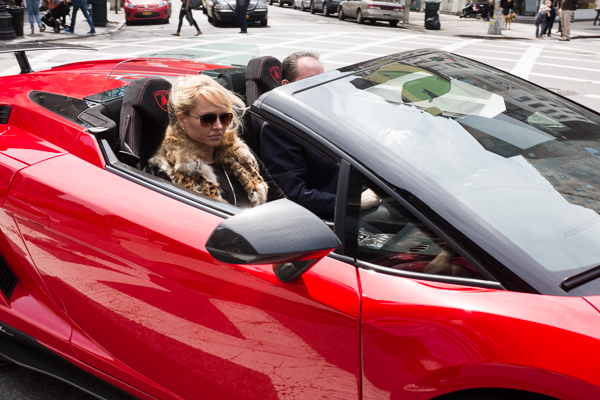
Lamborghini, SoHo

Lamborghini, SoHo – Shutter Speed priority can be much more effective for Street Photography, where spontaneous shots occur frequently, and freezing motion is very important.

I see this problem most often when people are traveling. They will stick their camera on Aperture Priority for the entire day, forgetting that the light sometimes will not be strong enough to yield a shutter speed fast enough to offset camera shake or to freeze moving subjects, particularly if their lens aperture does not go below f/4 or f/3.5.

The result is that they will come home and many of their images will be blurry, when they didn’t have to be.

Your shutter speed is the first line of defense for creating a sharp image. The rule of thumb is that the shutter speed should be at least one over the focal length of the lens to offset handheld camera shake. I like to add a little extra speed to that to be safe, so if you are shooting at 50mm on a full frame camera, I would keep the shutter speed at least at 1/80th. On a cropped sensor however, such as an APS-C camera, a 50mm might be the equivalent of an 80mm view, so I would shoot at least at 1/100th of a second.

You can see, especially if you are using a telephoto focal length, how quickly and easily your shutter speed can go below this threshold when on Aperture Priority and not in strong, direct light.

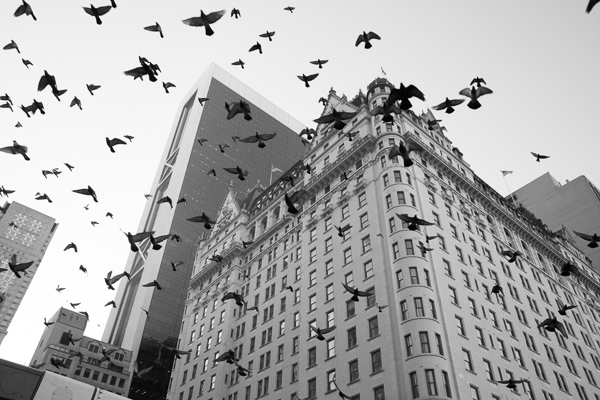
Plaza Hotel

The Birds and Plaza Hotel. A spontaneous shot on Shutter Priority at 1/500th and ISO 800.  On Aperture Priority there is a much stronger chance that I would have yielded too slow of a shutter speed, especially since it was overcast and late in the day.

When there are moving subjects in a scene such as people, 1/320th or 1/250th is often a good shutter speed to freeze their motion. So when traveling, I use 1/320th as my baseline shutter speed and will lower it for the situations where there is no motion or when the light is extremely low. This guarantees that no matter what I capture, it will be sharp, including the spontaneous moments. Often, because I shoot this way and prefer to also shoot with an aperture of f/8 or above, I will raise the ISO to 800, 1600, or even 3200 in areas with very low light. This will add more grain/noise to the image, but especially on the newer digital cameras you will quickly notice that the technical quality and sharpness of your images will actually be improved, despite this grain.

Now you might be saying that you are able to shoot in Aperture Priority mode (or Manual mode) all of the time and can pay attention to the corresponding shutter speeds so you never have a problem. That’s great, and in that case, please keep shooting in Aperture Priority. I do not want to stop you from shooting in a way that works well for you. If you know your camera settings well then you can effectively shoot in any situation with any of these modes.

However, I teach a good amount of students and I would guess that about 80 percent of them come in shooting in Aperture Priority. Then, when I look at their photos, for a good portion of these students, way too many of their photos turn out blurry, or have some sharpness issues. They will pay attention to their aperture but then zoom for a shot and not notice that the shutter speed is lower than their focal length, or not notice that is too low to freeze the motion of a subject. I find that switching them over to Shutter Priority for these situations puts the shutter speed in their mind first and then they can pay attention to the corresponding aperture to achieve the largest depth of field possible (if you are purposely looking to create a shot with a shallow depth of field, then Aperture Priority would be ideal.)

Particularly for travel photography in cities or in areas with people, often when I explain to students to try photographing around 1/320th of a second and a higher ISO, they quickly remark about how much sharper their photos become.

Give it a try and see if yours do too.

The post Why Aperture Priority Mode Isn’t Always the Best Choice by James Maher appeared first on Digital Photography School.


Digital Photography School

 
Comments Off on Why Aperture Priority Mode Isn’t Always the Best Choice

Posted in Photography


Readers’ Choice: Best Gear of 2013 Awards

03 Feb

awardsrosette.jpg

Before Christmas, we asked you to vote for your favorite cameras and lenses in five categories. We announced the category winners earlier this year and created a final poll to find what – in your opinion – was the single standout product of 2013. Click through for a reminder of the category winners and to find out which of the winning products was your choice for 2013 product of the year!

News: Digital Photography Review (dpreview.com)

 
Comments Off on Readers’ Choice: Best Gear of 2013 Awards

Posted in Uncategorized


Voting open for Smithsonian Magazine 2012 Reader’s Choice Award

23 Mar

bp21.jpg

The Smithsonian Magazine is calling on readers to vote in its 10th annual Reader’s Choice Award. Voters can select their favorite photo from among 50 finalists. This year’s contest received 37,600 entries from 112 countries. The Magazine’s editors will also select winners for five additional categories – Altered Images, American Experience, Natural World, People and Travel. Voting is open through March 29, 2013. Click through for the link and to view some of the finalist’s images.

News: Digital Photography Review (dpreview.com)

 
Comments Off on Voting open for Smithsonian Magazine 2012 Reader’s Choice Award

Posted in Uncategorized


A Perfectly Valid Choice: Light That Isn’t There

14 Dec

I'm as guilty as the next guy when it comes to over-the-top lighting. And why not? It's fun, it's cool and it can amp up an otherwise boring scene.

But that kinda stuff is not always necessarily the best choice. Often the best light is light that doesn't call attention to itself, but rather allows your camera to see a scene the way your eye would normally see it.

Take this biz portrait for example, which looks pretty natural but in fact is lit by three different sources. Read more »


Strobist

 
Comments Off on A Perfectly Valid Choice: Light That Isn’t There

Posted in Photography


My choice is you; this love is ours -[9500]-

24 Nov

AUDIO MADE BY ME, YOU CAN USE IT IF YOU CREDIT ME IN THE DESCRIPTION. “People throw rocks at things that shine” – one of the truest statements I’ve ever heard. “They’ll judge it like they know about me and you” – the story of my life. I actually adore this video, mostly because of the message but also because it has clips from the last 2 years in it. -Ellen&Mario. SONG: Taylor Swift – Ours MARIO: 14.2hh, 9yo, Irish Sports Horse x Irish Draught. EDITING: Sony Vegas Pro 10. CAMERA: Nikon D3100 w/ Nikkor 70-300mm lens & Kit Lens.
Video Rating: 4 / 5

NIKON FE2 SLR CAMERA OVERVIEW see my photos here: www.flickr.com Here are photos taken with the FE2 www.flickr.com
Video Rating: 4 / 5

 
Comments Off on My choice is you; this love is ours -[9500]-

Posted in Nikon Videos


Best DSLR Choice for Video from Nikon and Canon for Under $1000 – Viewer Question

20 Nov

www.artoftheimage.com – Best DSLR Choice for Video from Nikon and Canon for Under 00 (Viewer Question)Check out the new Art of the Image Recommended Photography Gear List at http PS If you have kids or know someone with kids, check out my latest online book, “Diary of a Nerd King” at www.nerdkingdiary.com. It’s funny and it’s FREE! Please pass it along… thanks! PSS If you have toddlers or small children, check out http for my children’s ebooks for Kindle, iPad, iPod, iPhone, laptops, etc! Please pass it along… thanks!
Video Rating: 0 / 5

 
Comments Off on Best DSLR Choice for Video from Nikon and Canon for Under $1000 – Viewer Question

Posted in Nikon Videos


Babar – Series 1 – Episode 6 – Babar’s Choice

01 Feb

Babar is the king of elephants in the city of Celesteville. In each episode he tells his children a story of his adventures and of the quandries he faced when he was a boy, especially a boy who was also the king. Based on the books by Jean de Brunhoff and Laurent de Brunhoff ©1989/1990 Laurent de Brunhoff and Nelvana Limited.
Video Rating: 0 / 5

 
Comments Off on Babar – Series 1 – Episode 6 – Babar’s Choice

Posted in Animation Videos