RSS
 

Posts Tagged ‘challenge’

Weekly Photography Challenge – Spring

28 Apr

It must be nice enough in your area to get out shooting again – so this week’s photography challenge is to go and photograph spring. What does it mean to you?

Spring is a good time to try a new technique or practice something you want to perfect or improve. Here are a few spring photography ideas to get you started:

  • Tips for Taking Better Flower Photos
  • How to Use Natural Light for Macro Photography
  • Intentional Blur- How to Create it and Why it’s Awesome
  • Tips for Better Forest Photography

Try some intentional camera movement.

Or practice with a depth of field exercise or shooting some macro photography.

Weekly Photography Challenge – Spring

Simply upload your shot into the comment field (look for the little camera icon in the Disqus comments section) and they’ll get embedded for us all to see or if you’d prefer, upload them to your favorite photo-sharing site and leave the link to them. Show me your best images in this week’s challenge. Sometimes it takes a while for an image to appear so be patient and try not to post the same image twice.

Share in the dPS Facebook Group

You can also share your images in the dPS Facebook group as the challenge is posted there each week as well.

The post Weekly Photography Challenge – Spring appeared first on Digital Photography School.


Digital Photography School

 
Comments Off on Weekly Photography Challenge – Spring

Posted in Photography


Weekly Photography Challenge – Panning

21 Apr

Panning is a great way to add a feeling of motion and movement to your images. It works well with street photography to isolate your subject and add a little drama.

Need more help? Read these dPS articles:

  • Panning and Tips for Adding Motion to Your Street Photography
  • 6 Tips to Master Panning Photography
  • Showing Speed: Using Panning When Shooting Action
  • How to Have Fun with Shutter Speed and Added Motion Blur

Weekly Photography Challenge – Panning

Here the subject and background were both frozen using a faster shutter speed.

In this image, a slower shutter speed like 1/30th was used to blur the background, while keeping the car sharp. This is called panning. You use a slower shutter speed and move your camera to match the speed of the subject to achieve this kind of image.

Simply upload your shot into the comment field (look for the little camera icon in the Disqus comments section) and they’ll get embedded for us all to see or if you’d prefer, upload them to your favorite photo-sharing site and leave the link to them. Show me your best images in this week’s challenge. Sometimes it takes a while for an image to appear so be patient and try not to post the same image twice.

Share in the dPS Facebook Group

You can also share your images in the dPS Facebook group as the challenge is posted there each week as well.

The post Weekly Photography Challenge – Panning appeared first on Digital Photography School.


Digital Photography School

 
Comments Off on Weekly Photography Challenge – Panning

Posted in Photography


5 Ways to Challenge Yourself as a Wildlife Photographer

16 Apr

As a wildlife photographer, often it can seem challenging enough just to find your subjects out in the field, let alone get close enough to take that perfect image. However, to develop as a photographer, constantly challenging yourself is a key ingredient to learning and growing, helping you to tell stories in a more meaningful and creative way through your images.

In this article, I will give you a few ideas to explore when you next head out on a nature photography shoot, to keep you challenged and growing as a photographer.

1 – Take one lens

One lens - wildlife photographer

Restricting yourself is often a great way to encourage creativity. Working with constraints can help you to think outside the box and explore ideas or ways of working that you might have missed in other cases. As photographers, having a boatload of lenses at our disposal means we have options to capture the world in a multitude of ways. Yet still, within this, we often become restricted within our view, choosing to consistently work with convention rather than explore creative options.

For example, if you are going to work with birds you will likely select your long telephoto, whereas, for insects or flowers, the obvious choice is a macro lens. However, if you decide to restrict yourself to a certain lens or focal length you have to use that in order to explore and create a photograph. That means that sometimes you’ll have to work in a new way, choose a different composition, or go for a different type of image than you would normally attempt.

For example, taking a macro lens out for a full day of shooting you might feel restricted. But the 100mm focal length (common for most macro lenses) is actually highly adaptable for working with a variety of subjects from landscapes to tiny insects, or even people and street images. Prime lenses further enhance this restriction, forcing you to zoom with your feet.

However, after a number of days solely focused on each lens in your bag, you’ll have a much greater appreciation for the wide variety of subjects and images it can produce. Thus helping you to be more creative with your choices in the future.

2 – Work wide
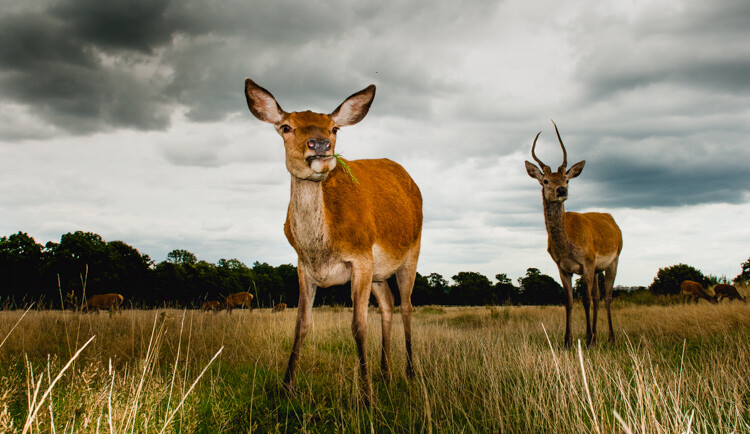
Shooting wide two deer in a field - wildlife photographer

For most wildlife photographers, the long telephoto is our safe haven. We know that when using a 300mm, 500mm or 600mm lens we can frame up our subjects and get wonderful clean portrait images. Allowing us to concentrate on our subjects and not necessarily needing to worry about the other elements in the landscape.

The thing is that, although telephotos are fantastic for filling the frame and showing close details of distant creatures, they don’t give an impression of scale. Images show with a long lens almost seem less immersive than shots taken with shorter focal lengths.

Of course, one of the biggest problems is that shooting wildlife with a wide lens is often a lot harder, (depending on the subject) than your traditional long lens wildlife photography. But this is a great learning curve. Yes, the complexities of predicting animal behavior, working out positioning for remote cameras and triggering them at the perfect time without always being able to look through the viewfinder is difficult. But the struggles will certainly push you to be a better wildlife photographer in the long run.

Try working with a wireless remote in the garden to get started. A simple bird feeder or setup for urban mammals is a great way to hone your skills, to add another string to your photographic bow.

Remote camera triggers - wildlife photographer

Remote camera setup

Remote triggered wideangle

Remote-triggered wide-angle shot.

3 – Add movement

Often, I hear wildlife photographers talking about always getting the image tack sharp. But in reality, how much in nature ever freezes dead still? Adding motion to your images is a great way to explore and develop your shooting style, adding drama to images and also helping the wildlife you’re recording to come alive in your frames.

When working in the field it can be tempting to always have that 1/1000 of a second shutter speed dialed in. Learning how and when to slow your shutter to display movement is a great skill, but it takes practice to get it right.

Often I find that for large moving creatures, such as deer, a shutter speed of 1/15th of a second allows enough movement into the frame to make great panning shots. In contrast, birds with their fast-moving nature mean that often 1/100th or 1/60th easily provides enough movement within the frame for lovely streaking effects.

a deer running - wildlife photographer

Birds in flight - wildlife photographer

Of course, in addition to panning with slow shutter speeds, keeping your camera dead steady and allowing the creatures to move is another effective technique for creating unique and captivating images of nature’s patterns and movements.

4 – Pick a theme and stick to it

Another way to challenge yourself as a nature photographer is to set yourself a theme to work on. This could be a practical theme like birds in flight, animal portraits, or in the landscape images. Another option is exploring a certain location or place with a geographical theme or even delving a little deeper to explore emotions or feelings as a base for a set of images.

The reason for shooting around a theme is to train yourself how to showcase and express your ideas through images more effectively. As a photographer, you are a visual storyteller. So being able to draw from inspirations, ideas, and emotions and express them photographically helps you to tell better and more powerful stories through your images.

Aim to develop a couple of small bodies of work, maybe three sets of three images, each with a different focus as a training exercise. It’s a great way to focus on areas where you’re less confident and give yourself a mini-assignment to develop and shoot to keep you focused on improving your work.

Shooting a set of images (3 images of deer)

5 – Shoot like you have one roll of film

A final way to challenge yourself is to go out on a shoot and pretend that you only have 36 images or a single roll of film. This is to force yourself to be more critical and picky with your images, choosing the perfect moment to get a shot rather than just taking a number to be sure one will be okay.

Shooting with a limit slows you down and makes you consider things more intently, thinking through your exposure, composition, and technique before shooting. The idea is that you only shoot one frame per subject, aiming to get it perfect on every image.

You can do this even more strictly by getting hold of an old school 1gb or 2GB memory card, the modern equivalent of a single roll of film. You can pick them up cheap on eBay and they are great training aids.

Small SD and film

Of course, if you want even more of a challenge why not try shooting an actual roll of film. With each frame literally costing you money, you will soon focus your shooting in order to make sure you nail it out on location. It’s good fun and a really great learning tool!

Conclusion

So there you have it, a quick rundown of five ways to challenge yourself as a nature or wildlife photographer to help develop your photography.

By focusing on specific challenges and setting yourself goals and tasks, you’ll certainly see your photography improve. As well, you will have more confidence going for those creative images when you’re on your next shoot.

The post 5 Ways to Challenge Yourself as a Wildlife Photographer appeared first on Digital Photography School.


Digital Photography School

 
Comments Off on 5 Ways to Challenge Yourself as a Wildlife Photographer

Posted in Photography


Weekly Photography Challenge – Architecture

14 Apr

Earlier I shared a few videos with images and tips for doing architecture photography, here.

Hassan II Mosque in Casablanca, Morocco.

If you need some additional help with this one, check out these dPS articles:

  • 6 Helpful Tips for Doing Interior Architecture Photography
  • 4 Beginner Tips for Doing Architecture Photography
  • How to Create Stunning Architecture Photography by Painting with Light
  • Tips for Different Approaches to Architecture Photography
  • 6 Tips to Take Your Architecture Photography to the Next Level
  • How to Use a Tilt-Shift Lens Creatively and for Perspective Control

Look for details and interesting lines and shapes in the architecture.

Look for lighting that highlights the features or textures of the building.

Weekly Photography Challenge – Architecture

Simply upload your shot into the comment field (look for the little camera icon in the Disqus comments section) and they’ll get embedded for us all to see or if you’d prefer, upload them to your favorite photo-sharing site and leave the link to them. Show me your best images in this week’s challenge. Sometimes it takes a while for an image to appear so be patient and try not to post the same image twice.

Share in the dPS Facebook Group

You can also share your images in the dPS Facebook group as the challenge is posted there each week as well.

Try a different camera angle by looking up!

Look for interesting lighting and textures.

Wait for all the elements to come together.

The post Weekly Photography Challenge – Architecture appeared first on Digital Photography School.


Digital Photography School

 
Comments Off on Weekly Photography Challenge – Architecture

Posted in Photography


Weekly Photography Challenge – Cats

07 Apr

Whether you’re a cat or a dog person we’ve got you covered. Last week’s photography challenge “went to the dogs” and now it’s time for the kitties!

My girls, Munchkin (Munch) on the left and Fuzz on the right.

Need some help? Try these dPS articles:

  • 9 Tips for Taking Better Photos of Cats
  • Your Essential Guide to Photographing Cats and Dogs: Snapn Paws
  • 6 Tips for Working with Unruly Animals in Pet Photography
  • 8 Tips for Better Pet Photography

Weekly Photography Challenge – Cats

Simply upload your shot into the comment field (look for the little camera icon in the Disqus comments section) and they’ll get embedded for us all to see or if you’d prefer, upload them to your favorite photo-sharing site and leave the link to them. Show me your best images in this week’s challenge. Sometimes it takes a while for an image to appear so be patient and try not to post the same image twice.

Share in the dPS Facebook Group

You can also share your images in the dPS Facebook group as the challenge is posted there each week as well.

The post Weekly Photography Challenge – Cats appeared first on Digital Photography School.


Digital Photography School

 
Comments Off on Weekly Photography Challenge – Cats

Posted in Photography


Weekly Photography Challenge – Dogs and Puppies

31 Mar

Last week we photographed our feathered friends, how about some furry ones this week?

Weekly Photography Challenge – Dogs and Puppies

Need some help? Try these articles:

  • How to Take Better Action Photos of Dogs
  • Pros and Cons of Photographing Dogs with a Prime Lens
  • 10 Amazing Camera Hacks for Better Dog Photography
  • How to Photograph Agility Events and Other Dog Sports
  • 5 Good Reasons to Take Your Dog on Photography Walks
  • 6 Tips for Working with Unruly Animals in Pet Photography

Simply upload your shot into the comment field (look for the little camera icon in the Disqus comments section) and they’ll get embedded for us all to see or if you’d prefer, upload them to your favorite photo-sharing site and leave the link to them. Show me your best images in this week’s challenge. Sometimes it takes a while for an image to appear so be patient and try not to post the same image twice.

Share in the dPS Facebook Group

You can also share your images in the dPS Facebook group as the challenge is posted there each week as well.

The post Weekly Photography Challenge – Dogs and Puppies appeared first on Digital Photography School.


Digital Photography School

 
Comments Off on Weekly Photography Challenge – Dogs and Puppies

Posted in Photography


Weekly Photography Challenge – Birds

24 Mar

Our fine feathered friends, the birds, make great photography subjects. They can be challenging to photograph though, hence why this week’s photography challenge is – you guessed it – birds!

If you struggle to capture images of the fast ones in mid-air, try to find a bird closer to the ground like this peacock I found at the Auckland zoo strutting his stuff. Chickens, emus, and penguins are all a bit slower and easier to photograph – although you may not have any penguins in your area.

If you need some tips for photographing birds try these dPS articles:

  • 10 Surefire Tips for Photographing Birds in Flight
  • 10 Must-Use Bird Photography Camera Settings for Beginners
  • 10 Common Bird Photography Mistakes and Their Solutions
  • How to Photograph Hummingbirds

Weekly Photography Challenge – Birds

Simply upload your shot into the comment field (look for the little camera icon in the Disqus comments section) and they’ll get embedded for us all to see or if you’d prefer, upload them to your favorite photo-sharing site and leave the link to them. Show me your best images in this week’s challenge. Sometimes it takes a while for an image to appear so be patient and try not to post the same image twice.

Share in the dPS Facebook Group

You can also share your images in the dPS Facebook group as the challenge is posted there each week as well.

The post Weekly Photography Challenge – Birds by Darlene Hildebrandt appeared first on Digital Photography School.


Digital Photography School

 
Comments Off on Weekly Photography Challenge – Birds

Posted in Photography


Weekly Photography Challenge – New Things

17 Mar

Last week your challenge was antiques or old things. So let’s change it up and do the opposite this week.

I photographed my new Fuji X00F when I first got it.

Weekly Photography Challenge – New Things

Simply upload your shot into the comment field (look for the little camera icon in the Disqus comments section) and they’ll get embedded for us all to see or if you’d prefer, upload them to your favorite photo-sharing site and leave the link to them. Show me your best images in this week’s challenge. Sometimes it takes a while for an image to appear so be patient and try not to post the same image twice.

Image by dPS writer Meredith Clarke.

Share in the dPS Facebook Group

You can also share your images in the dPS Facebook group as the challenge is posted there each week as well.

The post Weekly Photography Challenge – New Things by Darlene Hildebrandt appeared first on Digital Photography School.


Digital Photography School

 
Comments Off on Weekly Photography Challenge – New Things

Posted in Photography


Week Photography Challenge – Antiques

10 Mar

This week it’s time to dig out all your old stuff, or get out and look for some antiques. Things that are aged and beautiful – look for old buildings, your old shoes, rotting wood of an old window, antique cars, clocks, books, etc., yes even people. Remember these old things have great value, especially our senior citizens – so photograph them with the respect they deserve.

Textured wall of an old building in Havana, Cuba.


If you want to add a few tricks to your images of antiques try these techniques:

  • How to Create an Antique Photo Look Using a Lemon and Layer Masks in Photoshop
  • How to Apply a Texture Overlay to Your Images to Create an Antique Look
  • How to Create a Retro Faded Look Using Lightroom or Photoshop
  • How to Add Vintage Frame Overlays Using Alien Skin Exposure X
  • How to Use Split Toning to Make Your Photos Stand Out

Split toning to make it look like an antique photo.

Antique cars of Havana.

Even try your hand at some light painting as was done here to “turn on” the car’s headlights.

An old typewriter makes a great subject. Simplify your composition for maximum impact.

Weekly Photography Challenge – Antiques

Simply upload your shot into the comment field (look for the little camera icon in the Disqus comments section) and they’ll get embedded for us all to see or if you’d prefer, upload them to your favorite photo-sharing site and leave the link to them. Show me your best images in this week’s challenge. Sometimes it takes a while for an image to appear so be patient and try not to post the same image twice.

Share in the dPS Facebook Group

You can also share your images in the dPS Facebook group as the challenge is posted there each week as well.

The post Week Photography Challenge – Antiques by Darlene Hildebrandt appeared first on Digital Photography School.


Digital Photography School

 
Comments Off on Week Photography Challenge – Antiques

Posted in Photography


Weekly Photography Challenge – Water

03 Mar

Water, water, everywhere. Your challenge this week it to photograph water in some way – it could be the liquid form or frozen in the form of ice. Pick flowing water or still water. Capture it frozen in time or with motion. The choice is yours.

Water droplet photography and refraction make for great images.

As it’s spring in many places now you might want to photograph the rain, or kids jumping in a puddle. Or raindrops on the window and some stunning bokeh. Or try some refraction in a water droplet. It’s time to get creative.

Photo by Daiga Ellaby on Unsplash

Weekly Photography Challenge – Water

Here are some ideas on photographing water:

  • 5 Fun Tips for Photographing Water
  • 6 Tips for How to Photograph Waterfalls
  • 9 Water Photography Ideas to Make a Splash
  • Water Splash Photography Made Easy
  • How to Create Abstract Photos with Oil and Water and a Little Dish Soap
  • How to do Photography of Frozen Flowers
  • How to do Frozen Object Photography at Home
  • Tips for Doing Macro Underwater Photography

Oil and water and a bit of color make for a fun afternoon photography project. Image by Ramakant – see how to do this here.

Simply upload your shot into the comment field (look for the little camera icon in the Disqus comments section) and they’ll get embedded for us all to see or if you’d prefer, upload them to your favorite photo-sharing site and leave the link to them. Show me your best images in this week’s challenge. Sometimes it takes a while for an image to appear so be patient and try not to post the same image twice.

Share in the dPS Facebook Group

You can also share your images in the dPS Facebook group as the challenge is posted there each week as well.

The post Weekly Photography Challenge – Water by Darlene Hildebrandt appeared first on Digital Photography School.


Digital Photography School

 
Comments Off on Weekly Photography Challenge – Water

Posted in Photography