Canon has announced the upcoming release of its second-generation EOS C100 Mark II digital video camera. The device houses a Super 35mm 8.3 megapixel CMOS sensor, and is positioned as an affordable solution for film and video production, providing a variety of new design and performance upgrades. Read more
Tag: Canon
-
My Favorite Lens of All, the Sharp, Smooth, Feel of the Canon EF 135mm f/2L USM

For those of you who know me or follow my work, you probably already know about my love affair with the Canon EF 135mm f/2L USM telephoto lens. Simply put, this is my favorite lens I have ever used in my life. It’s also the lens I use for probably 70% of the photographs which I produce. This is a workhorse lens and I believe it is the sharpest lens that Canon makes. If I could only own a single Canon prime lens, this would be it.

Professional grade Canon L series lenses are not cheap. Canon’s L series represent their top of the line optics. They are what almost all Canon professional photographers shoot with. That said, I think the EF 135mm f/2L USM is one of the best values as far as Canon L series lenses go. The lens costs a little over $ 1,000 and is amongst the most economical L series lenses you can buy.
I probably shoot this lens at f/2 the majority of the time. This gives you a super clean point of focus, with the beautiful out of focus bokeh away from your primary point of interest. For those low light shallow depth of field photos, it does not get better than this lens in my opinion. The portraits you can make with this lens are beautiful — sharp as tack but with the subtle bokeh around the edges that a lens like this can produce.

The autofocus on this lens is the most responsive of any lens I’ve ever used. It autofocuses so lightning fast and allows you to quickly lock in on the action that you want to see. It’s a very quiet and very smooth feel when you hit your focal point perfectly on the mark.
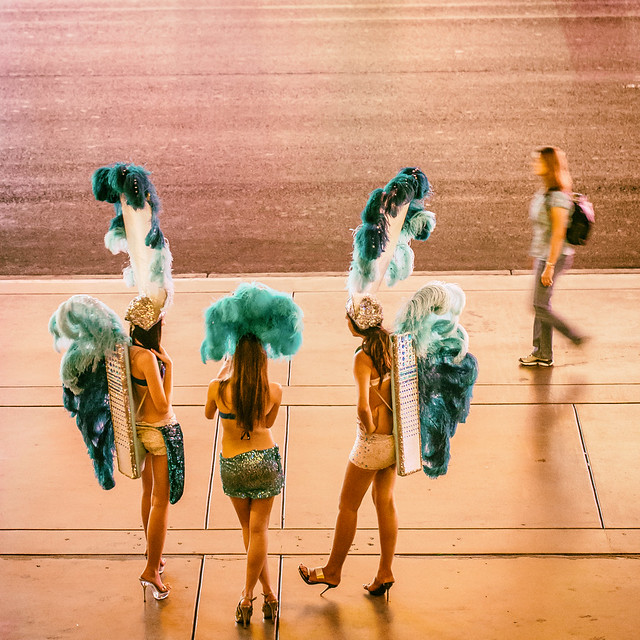
The photos in this blog post were all taken on my recent trip to Vegas with this lens. I cannot recommend this lens strongly enough. An example of why I like this lens so much can be seen in the first photo in this post. Forget about it as it appears in this post, click here to see it in full high res glory. Look at how sharp the details are on that photo. Notice the individual neon tubes as visible in the Harrahs and Flamingo signs. I took this photo from the balcony of the Cosmopolitan of Las Vegas, a great distance away. The 135mm EF f/2L USM gave me the distance I needed to shoot down with such clarity on the neon signs in the photo.
The photo of the roulette wheel and the mannequin in the post show how great the bokeh and depth of field is around an isolated focus point. This is another of my favorite characteristics of this lens. Shooting portraits at f/2 on this lens feels just perfect to me.
In addition to portraits, this lens is great for street photography, sports, concerts, abstracts, and so many other types of photography.
As a reminder, my analysis of my Canon gear is being done in partnership with Canon and I am receiving compensation for this work with them. More on Canon telephoto lenses here.



-
Canon patents lens designs with variable and glass elements
It’s not uncommon for a company to patent technologies that might be incorporated into products at some point, though the company might not have any plans to use it in the immediate future. Such a business move appears to be the case with a recent Canon patent, which details the use of variable lens elements in combination with traditional glass elements. Read more
-
Canon EOS 7D Mark II studio samples added to first impressions
The Canon EOS 7D II is the long-awaited follow up to the 7D, offering a 20.2MP APS-C sensor, dual-pixel AF with a 65-point phase detect system and continuous shooting at 10 fps. It’s also equipped with 1080/60p HD video capture and a number of compression options, as well as microphone and headphone ports. We put the 7D II (and its predecessor, the 7D) through its paces in our studio and have updated our first impressions review with the results. Read more
-
Time to Go Macro With the Canon EF 100mm f/2.8L Macro IS USM Lens

While the EF 135mm f/2L USM is my favorite Canon L Series lens, one thing it does not do is macro photography.
With a minimum focus distance of 3 feet, the EF 135mm lens can do a great job with a lot of flowers or other traditional macro subjects, but it really cannot do traditional macro work.
If you want a very high quality portrait lens that can also do macro work, the EF 100mm f/2.8L Macro IS USM is the lens for you. Like the EF 135mm lens, this lens is an Image Stabilization lens which is helpful to minimize camera shake when you take those super close very precise macro shots. This is my favorite lens to make abstract macros of flowers with. If you are into shooting insects or flowers or a close up of the human eyeball or really anything macro you can imagine you will love this lens.
What I like most about this lens though is that it is not *just* a macro lens. It takes such nice portraits and is great to use for all other sorts of photography. This makes this lens suitable for use as a primary prime lens for just about every type of photography that can also produce stunning macro work.

Shooting food is one of my favorite subjects these days. I shot the photo of caviar in this post with this lens at Michael Minna’s excellent spot in the Bellagio hotel. Be sure to try the tasting menu there on your next visit to Vegas, it’s worth it!
I also own the earlier non-L series generation of this lens and I’ll say that I’m so much more impressed with the results I get out of the newer L series version.
As a reminder, my analysis of my Canon gear is being done in partnership with Canon and I am receiving compensation for this work with them. More on Canon macro lenses here.



-
Raw conversions added to Canon EOS 7D Mark II: Real-world samples (beta)
The Canon EOS 7D Mark II is the long-awaited replacement to the 7D, which was launched in 2009. It features a 20.2MP APS-C CMOS sensor and dual DIGIC 6 image processors. It has a new 65-point, all cross-type autofocus system as well as an updated version of Canon’s Dual Pixel CMOS AF system. We’ve just been provided with an early build of ACR 8.7 and we’ve taken the opportunity to add seven Raw conversions to our previously-published gallery of real-world samples. Click through to take a look
-
Canon PowerShot G7 X and Panasonic Lumix DMC-LX100 added to studio comparison
We’ve just added a trio of cameras to our studio comparison tool: the Canon PowerShot G7 X, Panasonic Lumix DMC-LX100 and the Sony Alpha a5100. The Canon G7 X and Panasonic LX100 were two of the most talked-about cameras to emerge from Photokina 2014, both managing to squeeze large sensors into compact camera bodies. Read more
-
Optics Matter — Camera and Lens Guide for the New Canon DSLR Shooter

Last month I spent four glorious days shooting the lights and sights of fabulous Las Vegas. As always, I packed my camera bag full of my favorite lenses and other accessories. I haven’t done a “what’s in my bag,” type post in a while, so I thought I’d use this trip to talk about what camera/lens combinations I used on this trip and why.
In today’s day and age, I hear many photographers talk about ditching their DSLRs for other sorts of setups. I am not one of those photographers. Simply put, I believe that optics matter. I believe that there are things you can do with a DSLR and lens that simply cannot be done as well with other setups. There are unique qualities and characteristics of a well made piece of glass that cannot be replicated with micro compact software based algorithms.
The light going through the glass is primary and fundamental in my opinion, and I refuse to give up the high quality I demand for the convenience of something tiny that I can fit in my shirt pocket, text my friends with or strap to my helmet.
Each photographer must find their own way when it comes to what works best for them, but for me the glass is what matters most of all and there is just no substitute for high quality Canon lenses.
I’ve been shooting Canon digital SLR cameras for over 10 years now and it’s the lenses that allow me to get the shots that I need to get and that allow me to accomplish what I need to accomplish photographically speaking. Like everyone else these days, I’ll snap off mobile shots and post them to Instagram, but what I feel is my more important body of work comes from my DSLR.
To start with, I’ll inventory what I brought with me on my recent Las Vegas Trip — what’s in my bag:
1 Canon EOS 70D camera body
1 Canon EOS 5D Mark III camera body
1 Canon EF-S 18-135mm f/3.5-5.6 IS STM lens
1 Canon EF 135mm f/2L USM lens
1 Canon EF 50mm f/1.2L USM lens
1 Canon EF 100mm f/2.8 Macro USM lens
1 Canon EF 8-15mm f/4 Fisheye USM lens
1 Benro Carbon Fiber Tripod
1 Sandisk 64GB SDXC Extreme Pro Flash Memory card
1 Sandisk 32GB SDHC Extreme Plus Flash Memory card
1 MacBook Pro
1 Drobo MiniAll of my camera gear fits comfortably into my LowePro CompuDaypack bag. I keep the MacBook Pro in the hotel room and it is where I dump my photos to at the end of each day of shooting. The Drobo Mini is used as backup, so that I always have two copies of my image files before clearing off my memory card. It easily fits in the hotel room safe, while I am out shooting during the day and night and connects via Thunderbolt so backup copies are quickly made.
So this is my system, but what’s right for you may be a different story.
The number one question I get from people on social networks is, “what camera should I buy?” The advice I give is pretty much always the same — some sort of Canon DSLR set up, depending on your budget.
Part of why I recommend Canon, is because that’s the gear that I love, use and know. I am simply blown away with the high quality I personally get out of the system. For the life of me, I cannot imagine living without the crisp, sharp perfection of my EF 135mm f/2L USM lens (my favorite lens).
While there are other systems out there, this is the system that I’ve adopted and mastered. It does a remarkable job of getting me the images that I want and need.
There are lots of other reasons why I recommend Canon as well though.
When you are a new DSLR user, I believe one of the best things you can do is try lots of different lenses. Because there are more DSLR Canon shooters out there than any other kind, I find that borrowing friends’ lenses is a great way to stretch your experience, then learn and try new approaches.
Over the years I’ve lent my own lenses on photo walks to hundreds of different people and am always pleased when someone gets to try one of mine out. Likewise when I’m out shooting, I always like running across a different Canon lens and being able to swap with a friend for a few hours to try something new. Chances are if you are going to get into photography you will end up with photographer friends, and chances are that more of them will be shooting with a Canon DSLR system than any other.
For example, this past year at Coachella I shot with some very serious high end professional lenses that my pal Robert Scoble got from a lens rental site, the Canon EF 200mm f/2L IS USM and the Canon EF 400mm f/2.8L IS II USM.
If I wasn’t a Canon shooter, the fact that my buddy Robert Scoble brought those really nice lenses would have been worthless to me. As it was though, I was able to borrow these great lenses just like Robert was able to borrow my EF 8-15mm fisheye lens too to get some awesome crowd shots.
Canon’s range of lenses is remarkable and unmatched. There is a reason why the pros primarily shoot Canon. Even if you can’t afford many of the most expensive professional grade lenses, you can borrow them or even rent them from many places online. Their line up is unmatched, which is optimal for expanding your work with new lenses or renting specialty lenses from time to time.
Another positive about Canon is their great service and support. Many times I’ve sent my Canon bodies in for cleaning, my overworked lenses in for minor repairs, the service has always been quick and top notch. Although I’m more self taught and don’t have as much patience for training and education, Canon does have some great resources for the new DSLR user with the Canon Live Learning Center and Canon Live Learning.
These days I usually recommend new users go one of two ways when they want to take the next step with their photography and invest in a DSLR system.
For those on a bit tighter budget, I recommend getting the Canon EOS 70D Digital SLR Camera with the EF-S 18-135mm STM Lens. This is a perfect starter combo and runs around $ 1,500. While there are other cheaper Canon set ups, I think the EOS 70D provides significantly better quality for a little bit more in cost. This camera holds its value well and is a great camera to learn on. If you decide you want to spend more, you can always sell it back on eBay or somewhere else and upgrade to my next recommendation, the Canon EOS 5D Mark III.
The Canon EOS 5D Mark III, is the camera that I personally use the most. It is the workhorse of digital SLRs. It is the best camera I have ever owned. It also costs around $ 3,400 for the body alone though — so this camera is either for people who have that sort of money to spend, who are very committed to honing their DSLR skills (and maybe even selling photos to offset the cost), or who have tried another Canon system, like the EOS 70D and are ready to take the next step up.
Over the course of the next few weeks, I am going to give more detailed reports on the gear that I use in 5 different blog posts, one on the EOS 70D EFS 18-135mm STM lens set up for starters, and then one each on the four professional grade lenses I took on my Vegas Trip. I’ll provide photographic examples from these different set ups and talk about why I would recommend you consider each.
Although I’ve written several “what’s in my bag” type posts before, by way of full disclosure, I want to disclose that part of the reason for my writing this post now is because Canon recently contacted me about working closer with me as a Canon photographer. They have agreed to sponsor this post and I’m receiving compensation from them.
While I’ve turned down many sponsored type posts from other products in the past, because I’ve been such a passionate Canon user for so many years prior to being approached, I had no problem saying yes to this sort of arrangement with them. When I love a product I’m happy to endorse it. It’s exciting to me to be working closer with Canon and especially exciting to me that Canon is interested in the various social networks and what social photographers working on the web are doing today.
I’m also very open to this post being a conversation about the current state of photography gear — so feel free to give your own input on what works best for you and why. I’m happy to consider your input and also to answer any questions you may have about my gear or recommendations from my perspective.
-
Canon PowerShot G7 X real-world samples gallery posted
There’s a lot of excitement surrounding Canon’s recently announced PowerShot G7 X. This compact camera features a 1″ BSI-CMOS sensor and fast 24-100mm F1.8-2.8 lens. We’ve been using a production G7 X for a few days and ahead of our usual round of studio tests and hands-on assessment, we’ve created a quick gallery of real-world photos. See gallery
-
‘See Impossible’: Canon counts down to… something.
Canon is counting down to something, offering by way of a clue a 1990s-era Apple-style series of veiled half-references to ‘excuses, distractions, procrastination, inertia, critics, cynics, realists, pessimists, resistance, conventional wisdom […] the easy way out, the snooze button, the panic button, and to that little voice in the back of your head that says, “It can’t be done.”’. What the company is referring to is entirely unclear, but Canon’s obscurometer runs down tomorrow October 7th, 6am Eastern time. Click through for (very little) more