RSS
 

Posts Tagged ‘Camera’

Think Tank releases three accessories for camera bags

02 Mar

THINKTANK-LOGO-1.png

Think Tank has announced three new accessories for their camera bag line-up. The Low Rider Strap with a split-pad design attaches a second bag to one’s main rolling luggage and is available for $ 29.75. The Pro DSLR Battery Holder, priced at $ 17.50 accommodates two full-sized DSLR battery packs. A limited edition Pixel Pocket Rocket holds CF and QXD memory cards. Priced at $ 18.75, this memory card holder was manufactured in just one production run and will be unavailable once the stocks runs out. European prices and availability information to be confirmed.

News: Digital Photography Review (dpreview.com)

 
Comments Off on Think Tank releases three accessories for camera bags

Posted in Uncategorized


PocketWizard PlusX transceiver for wireless flash and camera triggering

01 Mar

PlusX_1.png

PocketWizard has added a budget model to its camera/flash radio trigger line: the PlusX ‘auto-sensing’ transceiver, that automatically switches between transmit and receive as needed. The PlusX offers the ability to trigger cameras and flashes over 10 radio channels. It features a side-profile design, backlit display, an internal antenna, and a dual-function LED indicating connection status plus battery life. PocketWizard PlusX will be available towards the end of March at a suggested retail price of $ 99. There is currently no information about the European price and availability.

News: Digital Photography Review (dpreview.com)

 
Comments Off on PocketWizard PlusX transceiver for wireless flash and camera triggering

Posted in Uncategorized


DIY: How to Make a Waxed Canvas Camera Bag

28 Feb

Extra photos for bloggers: 1, 2, 3

A night tour of Madame Tussauds is heck-of-scary, but here’s one thing more petrifying than that: damaged camera gear.

That same stuff Miss T uses will calm all your photo fears!

A DIY waxed camera bag will keep your lenses and camera bodies safe, sound, *and* dry.

Our buddy Allen Mowery put together this fantastic tutorial on how to make a water-resistant camera bag with grocery store wax, a messenger bag, and a camera bag insert.

The waxed canvas will add to that rugged mountain-man/lady look you pull off so well!

Make a DIY Waxed Camera Bag!

p.s. Today’s the last day to join Phoneography 101 before it starts mañana. Hop to it or you’ll have to wait until April!

(…)
Read the rest of DIY: How to Make a Waxed Canvas Camera Bag (674 words)


© lisbeth for Photojojo, 2013. |
Permalink |
No comment |
Add to
del.icio.us

Post tags:


Photojojo

 
Comments Off on DIY: How to Make a Waxed Canvas Camera Bag

Posted in Equipment


Pentax Ricoh discontinues K-01 K-mount mirrorless camera

26 Feb

pentax_k01.png

Pentax Ricoh has moved its K-01 K-mount mirrorless camera to the ‘discontinued’ section of its website after just 12 months on the market. The unconventional-looking K-01 used a full-depth Pentax K lens mount but relied on contrast-detection AF, rather than the phase-detection systems for which all autofocus K-mount lenses have been primarily designed. Designed by Marc Newson, the K-01 was one of the most unusual-looking cameras we’ve ever tested. Click through for more details. 

News: Digital Photography Review (dpreview.com)

 
Comments Off on Pentax Ricoh discontinues K-01 K-mount mirrorless camera

Posted in Uncategorized


Meet the Look Lock: Bringing Your Camera and Your Phone Closer Together

25 Feb

Extra photos for bloggers: 1, 2, 3

You, your smartphone and your DSLR are about to become the very best of friends. Like one teeny tiny gang.

It’s all thanks to the Look Lock,
an adjustable arm that mounts to your camera’s hot shoe and grabs onto your phone with a strong clamp.

When your camera and phone join forces you can really grab your subject’s attention, make a video of your photoshoot, or even set up a teleprompter.

Who needs an assistant when these pals have got your back?

Check out the Look Lock
$ 75 at the Photojojo Store

%20http%3A%2F%2Fphotojojo.com%2Fstore%2Fawesomeness%2Flook-lock%2F”>


%20http%3A%2F%2Fphotojojo.com%2Fstore%2Fawesomeness%2Flook-lock%2F”>Tweet it!

     Share

Related posts:

  1. Meet Mr. Digital Clover, A Keychain Camera with Film Camera Appeal Extra photos for bloggers: 1, 2, 3 Bus rides can…
  2. Attachable Lenses for Your Camera-Phone, Fisheye & Macro/Wide Angle Phone Lenses Extra photos for bloggers: 1, 2, 3 Camera-phones. They’re a…
  3. The Phlash: Camera Phone Super Flash Every photographer knows that the key to the art is…


Photojojo

 
Comments Off on Meet the Look Lock: Bringing Your Camera and Your Phone Closer Together

Posted in Equipment


Why does your camera see things differently than you?

23 Feb

Do you ever see a beautiful scene, take out your camera, take the shot and then wonder what went wrong? Why doesn’t the display on the LCD screen look at all like the scene in front of you?

Do you ever stand next to another photographer and wonder how they made an image that is better than the scene you see with your own eyes?

Understanding how the camera “sees” is the key to figuring out why this happens and what you need to do to take charge of your camera and make the images you envision.

If you’re already dreading the mathematical calculations, don’t worry! I’m not going to start measuring my eyeballs and pupils and trying to figure out what kind of lens my eyes are equivalent to in focal length, f/stops, and ISO, or how many megapixels my eyes see. That’s not what this is about.

It’s just about understanding how a camera works differently than our eyes.

When the camera’s “eye” is better than our own

Sometimes the best images show the very thing that we cannot see with our own eyes.

Low Light Levels

At low light levels our eyes are less sensitive to colour than normal. Camera sensors, on the other hand, always have the same sensitivity. That’s why photographs taken in low light appear to have more colour than what we remember.

The Legislature in Victoria, British Columbia

When I made this image of the Legislature in Victoria, British Columbia, the sky was much darker and less blue to my eye.

Long Exposures

The longer the shutter remains open the more light can enter the camera and hit the sensor. Therefore long exposures can bring out objects that are faint in the sky whereas our eyes will perceive no extra detail by looking at something longer.

Starry Night at Joshua Tree National Park, California

The 30 second exposure in this image, made at Joshua Tree National Park in California, picked up more stars than I could see with the naked eye.

Long exposures also allow us to see the passing of time in a way we cannot with our eyes.

Star Trails in Guadalupe National Park, Texas

In Guadalupe National Park, Texas, I was able to capture the movement of the stars around Polaris, the north star, by leaving the shutter open for 30 minutes.

Fallingwater Cascades along the Blue Ridge Parkway, Virginia.

At Fallingwater Cascades along the Blue Ridge Parkway in Virginia, the movement of the water caused the maple leaves to swirl around in a circle. By using a 15 second exposure I was able to capture the movement of the leaves.

Short Exposures

On the other end of the scale, high speed photography can freeze motion and allow us to see something that would otherwise pass by too fast for our eyes to retain any detail.

Egret at Ding Darling Wildlife Refuge, Florida.

By using a shutter speed of 1/5000 second, I was able to freeze the water droplets as they swirled around the egret’s beak as he caught a fish.

Depth of Field

One thing that is somewhat similar between a camera and a human eye is aperture, but only if you hold it steady. For example, if you stare at one word in the middle of the this sentence and do not move your eyes, you can perceive that the other words are there but they are not clear. The part that is in focus is only the centre portion of your field of view.

That is the same as a camera with a small aperture. The difference is that you can’t actually look at the out-of-focus part. As soon as your eye moves to the out-of-focus words they instantly become in-focus.

Whereas if you are looking at a print or an image on your screen you can look at the out-of-focus part which is something we cannot do with our eyes. That’s why shallow depth of field images are so interesting to us.

Dandelion Seed

Colour

Most of us see in colour. Others see limited colours. But either way we are stuck with what we have. Maybe that’s why some people like or dislike black and white photography. For a long time colour was considered a limitation in photography and the human eye was obviously better. But now photographs give us the option of viewing things in a different way.
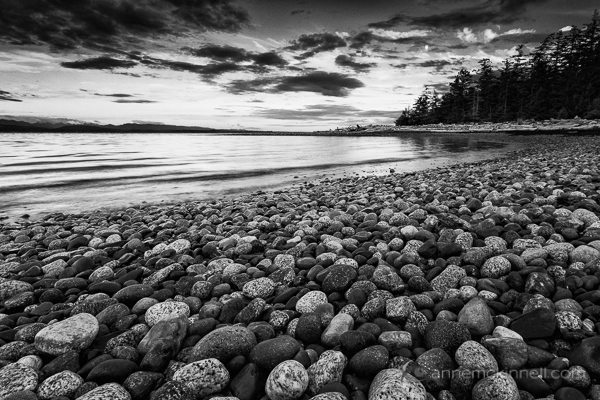
Rocks on the beach at Rebecca Spit, Quadra Island, British Columbia.

Rocks on the beach at Rebecca Spit, Quadra Island, British Columbia.

When the human eye (or brain) is better

Dynamic Range

One thing to keep in mind is that when we see something with our eyes, our brain is involved too. Think of optical illusions where you perceive something that isn’t actually there.

As we look around a scene our eyes quickly adjust to changing light. Take a scene with dark shadows and bright highlights for example. As your eye moves from one area to another it quickly adjusts so our eyes take in the right amount of light and we see detail in all parts of the scene. When we look at a scene it is like our brain takes numerous snapshots and what we perceive is the combination of those snapshots.

Your camera cannot do that. It simply records the light that hits the sensor at one aperture setting. It can only have one exposure for the whole scene.

That is where exposure blending, or high-dynamic-range (HDR) photography, can sometimes make a scene look more like what we perceived at the time.

On the other hand, depending on how you blend your images, HDR photographs can show us a lot more detail than what our eyes saw and then they don’t look realistic. Not that there’s anything wrong with that! It depends on whether you want your images to be realistic or not.
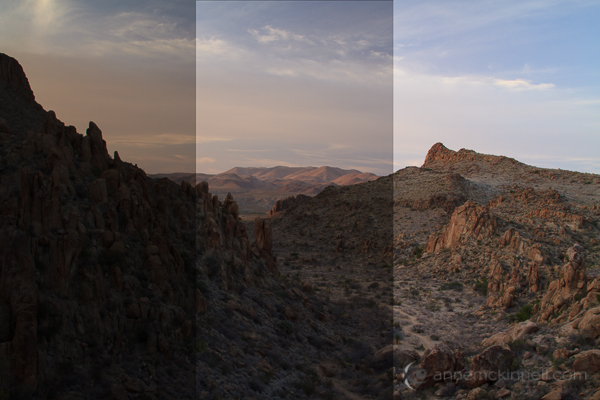
Grapevine Hills HDR Brackets

The image above represents the same scene taken at three different exposures. One exposure is for the shadows, another for the mid-tones and the other for the highlights.

Grapevine Hills, Big Bend National Park, Texas.

Grapevine Hills, Big Bend National Park, Texas.

I can blend those images together in photoshop and end up with an image like this. Our brain does that all by itself!! This more closely represents the image I remember in my mind.

Conclusion

The kinds of images that are considered good differ from person to person. It’s subjective.

Some people like images that are just like what their eyes saw or are capable of seeing — the realistic images.

Other people prefer images that show them what they cannot see such as black and white, long exposures, or HDR with tons of detail.

Either way, understanding why the camera “sees” things differently than you will put you well on your way to creating the kind of images you want to make.

Post originally from: Digital Photography Tips.

Check out our more Photography Tips at Photography Tips for Beginners, Portrait Photography Tips and Wedding Photography Tips.

Why does your camera see things differently than you?


Digital Photography School

 
Comments Off on Why does your camera see things differently than you?

Posted in Photography


Nikon and Microsoft sign an Android-based camera patent deal

22 Feb

shared:MSFT_logo.png

Nikon has signed a licensing deal with Microsoft to cover the use of patented technologies in its Android-based cameras. The deal is the latest instance of Microsoft pursuing makers of Android devices, claiming patent infringement. Despite free access being one of the founding ideas of Google’s Android operating system, Microsoft has been increasingly successful in convincing manufacturers of Android devices that they need to strike licensing deals for some of its technologies.

News: Digital Photography Review (dpreview.com)

 
Comments Off on Nikon and Microsoft sign an Android-based camera patent deal

Posted in Uncategorized


Nikon Europe releases Coolpix S3500 compact camera

21 Feb

nikon_cps3500.png

Nikon Europe has announced the Coolpix S3500. Available in multiple colors, the entry-level compact features a 20MP CCD sensor, 2.7″ LCD, 720p HD recording and is compatible with Eye-Fi wireless memory cards. It will be available from the end of this month at a retail price of £129.99. Click through to read the press release.

News: Digital Photography Review (dpreview.com)

 
Comments Off on Nikon Europe releases Coolpix S3500 compact camera

Posted in Uncategorized


What is the Perfect Compact Camera for 2013?

21 Feb

Good DSLRs are fine in the studio, but sometimes a camera that takes great pictures and fits in your pocket is your best asset. If your favorite camera spent most of your last vacation in the hotel room because you didn’t want to lug it around all day, you understand why they say the best camera is the one that’s Continue Reading

The post What is the Perfect Compact Camera for 2013? appeared first on Photodoto.


Photodoto

 
Comments Off on What is the Perfect Compact Camera for 2013?

Posted in Photography


Google demonstrates view behind the Glass wearable camera

21 Feb

R0~TS520x0~cms_posts_8520361839_Screen_Shot_2013-02-20_at_10.22.50_AM.png

Google has announced that its ‘Glass’ interactive head-mounted camera is now available for beta testing. Users who want to get their hands on an early version of the augmented eyewear can apply on social media channels, Google+ or Twitter. The company released a video today to promote the technology, showing what the world looks like through its camera. Read more about the Google Glass and instructions to sign up for beta testing on connect.dpreview.com

News: Digital Photography Review (dpreview.com)

 
Comments Off on Google demonstrates view behind the Glass wearable camera

Posted in Uncategorized