RSS
 

Posts Tagged ‘Bring’

What to Bring to Photograph a Wedding Besides Your Photo Gear

12 Mar

Our main job as wedding photographers is to create beautiful images for our clients. But our job is also to provide a phenomenal customer service experience from beginning to end. Throughout the last decade as a wedding photographer, I’ve developed this list of non-gear related items to bring along when you photograph a wedding.

What to Bring to Photograph a Wedding Besides Your Photo Gear

Wedding Day Essentials

The Wedding Timeline

Six weeks before the wedding, send the bride and groom a questionnaire requesting details about the timeline, addresses, wedding party, their families and vendors. Not only will this help the bride and groom think through any details they may have overlooked in their busyness, but their answers will help you foresee any timeline delays or issues.

Some important questions to ask:

  • At what address will the bride be getting ready?
  • At what address is the groom getting ready?
  • Ceremony start time and address.
  • Reception start time and address.
  • When would you like photo coverage to begin?
  • Based on the number of hours purchased, what time would you like photography coverage to end?
  • Will you be having a First Look?
  • Please provide the timeline for your wedding day, so far.
  • Are there any specific locations you have in mind for your wedding day portraits?
  • Will you be exchanging gifts with your spouse or family members?
  • What mailing address should I use for you after the wedding?
  • How many bridesmaids do you have and what are their names?
  • How many groomsmen do you have and what are their names?

What to Bring to Photograph a Wedding Besides Your Photo Gear

Family Photo List

Under no circumstance should you show up to a wedding without a list of family photos, created and approved in advance by the bride and groom. Attempting to focus the bride and groom minutes after they’ve been pronounced husband and wife, in front of a room full of family and friends eager to talk to them, is a recipe for disaster!

Having a list you can work from, and check off each grouping with a pen, will save valuable time.

What to Bring to Photograph a Wedding Besides Your Photo Gear

On the wedding questionnaire, request the following information about family:

  • Please list immediate family of the bride
  • Please list immediate family of the groom
  • Please provide a list of family photos you’d like and please note the names of each person in the grouping.
  • Are there any divorces/deaths I should be aware of so as to not embarrass anyone on either side of the family?

Review and take charge of the list

Review the information received about each immediate family before the wedding. Throughout the hours you’re photographing, you’ll meet at least 40 people by name! Don’t rely on your own memory. By having everything written down, you can check your timeline and remember the bride has two brothers named Matt and Joseph. Now, all you need to do is figure out which brother you met was Matt and which was Joseph. Magic!

Usually, the family photo list that the couple returns is perfect. I may re-arrange groupings for ease of the photo time (starting with the largest groupings first and peeling people away as needed) but very minimal change is usually required.

What to Bring to Wedding Days 7

However, sometimes the list may include large group after large group of extended family. When this situation happens, send the couple a warm and polite email confirming the list. Review the timeline and see how much time is needed capture the family photos requested.

Let the couple know you are happy to capture whatever images they would like, but you may have to steal 30 minutes from another portion of the day. When you present the options this way, many couples will choose to forego large groupings for family photos and enjoy their cocktail hour instead.

Verify Addresses and Phone Numbers

You can never be too careful when it comes to details, so leave no stone unturned. Even if the couple provided the name of the venue, request the specific address to eliminate all room for error. It’s important to have addresses for the bride’s house, groom’s house, photo locations and the reception.

Basically, anywhere you need to visit on the wedding day, have an exact location and meeting spot if the location is a park, for example.

What to Bring to Photograph a Wedding Besides Your Photo Gear

Phone numbers are a key piece of wedding day communication. Have the bride and groom’s phone numbers on file, but also request the phone numbers of the Maid of Honour and the Best Man and confirm they will have their phones with them. It’s quite common for a bride and a groom to not have their personal phones on them, and rightly so.

Have the wedding coordinator’s name and phone number printed on your timeline for easy access. It is also not a bad idea to have phone numbers of a few other key vendors. Always be more prepared than necessary.

Step up Your Experience with These Items

What to Bring to Wedding Days 8

If you only remember half of this article, stop reading now and remember the first part. But if you want to step up your “photography game” and look like a wedding day hero, keep reading. Make gathering the following items a goal for your next wedding season.

Parking Payment

Depending on your city’s parking meter structure, a credit card may be all you need — but some cities require coins. Stock your wallet with five dollars worth of coins for parking in a time crunch. Additionally, research if your city has an iPhone app for easy parking with your credit card.

Set of Umbrellas

Purchase a set of matching umbrellas in either a solid black or a clear color so they match any wedding party — your brides will be thankful. Keep the umbrellas in the trunk of your car at all times so you’re never left out in the rain.

What to Bring to Photograph a Wedding Besides Your Photo Gear

Extra Clothing

Wedding days can be long and weather can be inconsistent. Prepare for everything with a rain jacket or parka (depending on the season), sweater or cardigan for the reception (if the AC starts up) and my favorite – a change of shoes for tired feet halfway through the day.

Business Cards

Don’t be caught repeating your name to a potential customer over and over again so they can memorize it and find you on Instagram. Have business cards in your bag at all times.

Laptop and Card Reader

For slower receptions, you could download your memory cards to a laptop for immediate back-up. Also handy for downloading your second shooter’s images before driving separate ways at the end of the workday.

Water, Snacks, and Gum

Working on an empty stomach isn’t fun. Pack more snacks than you think you’ll need — you can keep some in your camera bag and the rest in the car for an emergency. Having gum or breath mints nearby is a bonus while talking with guests and, of course, a water bottle and staying hydrated is a must.

Wooden Hanger for Dress

What to Bring to Photograph a Wedding Besides Your Photo Gear

I have yet to add a wooden hanger to my wedding day list, but it’s a good idea. You’ll save 3-5 minutes at the bride’s house looking for a wooden hanger to replace the flimsy clear plastic one.

Emergency Kit

Photographer to the rescue! Pack a small bag with bobby pins, band-aids, tide-to-go, Tylenol, a sewing kit, a lint brush packs of Kleenex and anything else you think a bride or bridesmaid or family member may want at some point in the day. You’ll be the hero when the bride stains her dress and you whip out the tide-to-go or hand the mother of the bride some Tylenol.

If you photograph weddings, what else do you take along besides your photo gear? Please share in the comments below.

The post What to Bring to Photograph a Wedding Besides Your Photo Gear by Jamie Delaine Watson appeared first on Digital Photography School.


Digital Photography School

 
Comments Off on What to Bring to Photograph a Wedding Besides Your Photo Gear

Posted in Photography


Fujifilm X-H1 versus X-T2: what does the new camera bring?

24 Feb

Introduction

The Fujifilm X-H1 sits at the top of the company’s APS-C lineup, lifting expectations and capabilities beyond what was offered by the X-T2 that previously held the position.

The price and feature set, as much as Fujifilm’s claims, make clear that it’s an additional model, rather than a replacement. So just what’s changed? What’s been added and who does the new model make sense for?

Video

The X-T2 offers 4K video, but the X-H1 takes things to a different level.
Virtually every aspect of the X-H1’s video feature set is upgraded compared to the X-T2. Thanks to its larger internal volume it can shoot 4K for longer (15 mins compared to 10), and while the two cameras both impose a modest 1.17X crop, the X-H1 boasts a maximum bitrate of 200Mbps and the option to shoot F-Log internally.
The X-H1’s new ‘Eterna’ film simulation preset is intended to provide a quick and easy way to shoot gradeable, wide dynamic range video footage. For the first time, you can apply dynamic range ‘DR’ expansion settings in video mode on the X-H1, too. When combined with the DR400%, setting, footage shot using the Eterna preset, Fujifilm says it should deliver a total of 12EV of dynamic range.

Video

Less obvious improvements, but equally significant to serious videographers include a video-specific shutter speed of 1/48sec, which will give a 360, 180 and 90 degree shutter angle for 24, 30 and 60p footage. If you don’t know what that means, don’t worry about it. But if you do, you’ll appreciate it. Likewise support for time code display, and silent touch operation, which enables exposure control via the rear touch-screen.

Missing are any kind of exposure warnings, which (we’re told) would put too much stress on the X-H1’s processor.

Revamped AF system

While it uses the same 24MP APS-C X-Trans sensor as the X-T2, the X-H1’s on-sensor phase-detection autofocus system has been seriously upgraded. The most obvious improvements are to low-light sensitivity and focus tracking. The X-H1 can now focus down to -1EV (compared to the X-T2’s limit of 0.5EV) and phase-detection AF should work even at effective apertures as small as F11 – i.e. when shooting at the long end of the XF100-400mm F4.5-5.6 zoom, when combined with a 2X tele-converter.

In terms of tracking, Fujifilm quotes a substantial increase in autofocus hit-rate when faced with low contrast subjects and more reliable tracking during continuous bursts of images. Unlike the X-T2, the X-H1 can also continuously focus while zooming. Both the X-T2 and X-H1’s autofocus systems look for horizontal, vertical and high-frequency detail, but whereas in the X-T2, this information is processed in series, the X-H1’s AF system benefits from parallel data processing. Quite how Fujifilm has managed this without upgrading the X-H1’s processor (which is the same as the one used in the X-T2) is a mystery to us, but it’s impressive.

New body design

In terms of its external appearance, the X-H1 looks like a mid-point between the X-T2 and the medium-format GFX 50S. And in a sense (apart from the APS-C sensor) that’s exactly what it is. Fuji intends the X-H1 to be more ‘friendly’ to DSLR users, hence the larger grip and top-plate mounted LCD. The LCD squeezed out the traditional Fujifilm exposure compensation dial, but exposure compensation (if applied) is permanently displayed on the LCD, even when the X-H1 is turned off.

Bigger, heavier, tougher

The X-H1 is a bigger camera than the X-T2 (140 x 97 x 86mm versus 132 x 92 x 49mm) and substantially heavier (673g versus 507g – with a card and battery). The magnesium-alloy body shell of the X-H1 is 25% thicker than the X-T2, too. It’s also more scratch-resistant, and substantially stronger. As well as being physically stronger, the X-H1’s body is well sealed against the elements, with 68 seals around body seams and control points.

Quiet mechanical shutter

The X-H1’s shutter has been redesigned to offer a damped mechanical shutter mode, and electronic first-curtain (EFC) to reduce any risk of shutter shock.

The other advantage is that this makes the shutter itself quieter. In use, both the X-T2 and X-H1 are pretty discreet cameras, but the X-H1 definitely has the edge in situations where the click of a shutter would be unwelcome.

Improved EVF

The X-T2’s electronic viewfinder is excellent, and the X-H1’s EVF is even better. It’s fractionally smaller than the X-T2’s finder (0.75X magnification compared to 0.77X) but brighter, and it offers a higher resolution of 3.69 million dots (compared to 2.36 million). A subtle but welcome improvement is the increased responsiveness of the eye-sensor, too. The X-H1’s eye sensor can react in as little as 0.15sec, when your eye is raised to the finder (compared to the X-T2’s 0.4sec).

Touch-sensitive rear LCD

The X-H1 features the same articulating 1.04 million-dot rear LCD as the X-T2, but it’s touch-sensitive, allowing you to do all kinds of things, including place your desired AF point by touch, and quickly review and zoom into captured images with a fingertip.

The touchscreen also enables the X-H1’s silent movie shooting operation, which is intended to avoid the vibration and potential for operational noise associated with mechanical click dials and buttons.

In-body stabilization

Despite claiming in the past that it couldn’t be done, Fujifilm has added a 5-axis in-body stabilization system to the X-H1. In general, Fujifilm’s faster primes – without OI.S. – should offer slightly better stabilization as a result of their larger imaging circle, but ~5EV of correction will be achievable with almost all XF lenses. The X-H1’s IBIS also works in video mode, which makes it more useful for ‘run and gun’ shooting, for example with the company’s excellent new MKX cine zooms.

Flickr reduction

New in the X-series is flicker reduction for stills shooting. We’ve seen this function before in high-end DSLRs, and it works very similarly here: analyzing the fluctuation in brightness of certain artificial light-sources and timing exposure for the peak brightness. This avoids constantly fluctuating brightness when images shot in the same continuous burst. Continuous shooting speed is capped at 7fps in this mode with electronic first-curtain shutter, and 5.5fps with conventional mechanical shutter.

Most useful when shooting indoor sports, flicker reduction is another feature that either you need it or you don’t, but if you do, you really do.

Dynamic Range Priority mode

Fujifilm has been putting ‘DR’ dynamic range expansion settings in its mirrorless and compact cameras for years, but the X-H1 expands on this (no pun intended) with a ‘Dynamic Range Priority’ mode.

This has two settings: weak and strong, which use the camera’s existing DR modes in combination with flattening of the highlight and shadow ends of the tone curve. This gives a flatter, wider DR version of DR200 and DR400% modes, respectively. There’s also an ‘Auto’ setting that selects which level to apply.

Bluetooth + Wi-Fi

As well as built-in Wi-Fi, the X-H1 also includes low energy Bluetooth (BLE) for full-time connection to a smart device. This can either be used to auto-transfer all the images to your smartphone (either at full resolution or as 3MP downsized versions), when you turn the camera off.

Alternatively the Bluetooth connection should make it faster to reconnect the Wi-Fi if you want to choose which files to send.

Same sized battery

The X-H1 has been beefed-up in many respects, compared to the X-T2, but it still features the same battery. In one sense this is great news for X-T2 owners who might be thinking about upgrading to the X-H1, or adding one to their kit. However, the additional demands of the IS system sees the battery life take a small hit, compared to the older model. The X-H1’s CIPA rated battery life is 310 exposures per charge, compared to 340 from the X-T2.

Overall

The additional video features mean the X-H1 has even greater appeal to stills/video shooters than the already capable X-T2. However, the in-body image stabilization is in itself going to make the X-H1 look more attractive to some stills-only shooters.

As we’ve already seen in the comments, the increased size of the X-H1 is somewhat divisive. There are certainly ergonomic benefits to the larger grip but does mean the camera as a whole is substantially larger than previous X-series models. That said, Fujifilm’s range of APS-C specific lenses mean the combination of lens and camera is still smaller than the (often more basic) full frame models available around the same price.

Articles: Digital Photography Review (dpreview.com)

 
Comments Off on Fujifilm X-H1 versus X-T2: what does the new camera bring?

Posted in Uncategorized


Fujifilm’s MKX lenses bring affordable cinema glass to X-mount

15 Feb

$ (document).ready(function() { SampleGalleryV2({“containerId”:”embeddedSampleGallery_5834389364″,”galleryId”:”5834389364″,”isEmbeddedWidget”:true,”selectedImageIndex”:0,”isMobile”:false}) });

Fujifilm has announced its Fujinon MKX 18-55mm T2.9 and MKX 50-135mm T2.9 cinema lenses for X-mount. These are essentially the same Super 35 lenses that Fujifilm released about a year ago in E-mount and are now available to users of the company’s own X-mount mirrorless system.

Combined, the two lenses provide coverage between 18mm and 135mm, a very useful range for video production. Based on the company’s much more expensive Cabrio line of cinema optics, the MKX series include properties typically found on much more expensive cine lenses.

Those features include little to no lens breathing, a phenomenon which causes a lens’s field of view to change slightly as it’s focused, a parfocal design, meaning that the lens will maintain precise focus while zooming and 200 degrees of focus rotation with hard stops in order to work well with a follow focus setup.

The Fujinon MKX18-55mm T2.9 and MKX 50-135mm T2.9 cinema lenses are X-mount versions of the MK series lenses released about a year ago for E-mount (shown here on a Sony FS7 camera).

Additionally, the MKX lenses are also matched to have the same exact weight, dimensions, gearing and 82mm filter threads, meaning that it’s possible to switch between the two lenses easily without making any modifications to your rigging, such as the position of tools like a follow-focus or matte box.

We provided a hands-on look at both the MK18-55mm T2.9 and MK50-135mm T2.9 lenses in E-mount when they were released, and since they’re the same lenses (except for the mount) those articles can give you a more detailed overview of both lenses.

The MKX 18-55mm T2.9 and lens will cost $ 3,999, while the MKX 50-135mm T2.9 will cost $ 4,299. Both lenses are expected to be available in spring or summer 2018.

Press release:

FUJIFILM ANNOUNCES NEW ULTRA-COMPACTCINEMA LENSES, FUJINON MKX18-55MMT2.9 AND FUJINON MKX50-135MMT2.9 FOR X MOUNT

High Performance, Lightweight Cinema Lenses for the X Series Line of Mirrorless Interchangeable Lens Digital Cameras

Valhalla, N.Y., February 15, 2018 – FUJIFILM North America Corporation today announced the launch of FUJINON MKX18-55mmT2.9 and FUJINON MKX50-135mmT2.9 cinema lenses for X Mount, new additions to the X Series line of interchangeable lenses.

Available in June 2018, these cinema lenses offer a lightweight and compact design with the same optical performance and operability as larger cinema lenses in their class. They cover 18-135mm–the most frequently used focal length in video production–and achieve a constant T2.9 aperture across the entire zoom range, enabling a shallow depth of field and beautiful bokeh effect. With an enhanced optical and mechanical design, the MKX18-55mm and MKX50-135mm suppress focus shifts while zooming and reduce lens breathing, ensuring continuous sharp output. In line with the optical performance of the XF16-55mm and XF50-140mm lenses, these new MKX lenses offer a range of features that enable ease-of-use for capture in a wide array of shooting situations.

“The growth of video production has created a large demand among videographers and cinematographers for compact and easy-to-use lenses,” said Yuji Igarashi, General Manager of the Electronic Imaging Division & Optical Devices Division at FUJIFILM North America Corporation. “In keeping with our commitment to deliver innovative products and solutions, Fujifilm has recognized this need and has introduced the MKX18-55mm and MKX50-135mm lenses, offering a lightweight design and affordable price point, while delivering great optical performance and operability as other professional cinema lenses.”

Advanced Optical Performance in a Compact, Lightweight Lens Barrel

The MKX18-55mm and MKX50-135mm are lightweight and compact; achieving advanced optical performance utilizing the short flange focal distance of X Mount. This feature reduces the number of people needed for the shooting process, ideal for small budget productions.

In addition, the lenses offer advanced optical performance across the entire zoom range. Achieving T2.9 aperture, they facilitate the bokeh effect with shallow depth-of-field eliminating the need to readjust lighting. Combined, these features not only lead to beautiful videos, but also shorten shooting time, making the MKX lenses a very economical choice for movie production. Further adding to its superior output, contact with an X Series camera corrects distortion, color, brightness and achieves Fujifilm’s various Film Simulation modes.

Featuring an Optical and Mechanical Design Ideal for Video Shooting

The optical and mechanical approach employed in these new MKX lenses allows for elimination of time lag that is usually experienced with electrical control systems. Manufacturing technology developed for conventional FUJINON cinema lenses was applied to control the optical axis shift while zooming. The front inner-focusing system controls lens breathing, allowing for smooth focus over an entire scene. Additionally, when zooming, focus shift is suppressed by independently driving the front focusing group and zooming group of lens elements away from each other.

Comfortable Operability Provided Through Dedicated Cinema Lenses

The MKX18-55mm and MKX50-135mm feature three fully manual rings for independent adjustment of focus, zoom and aperture, allowing for intuitive operation. The focus ring offers a rotation of a full 200 degrees to facilitate precise focusing even when shooting with a shallow depth-of-field where a high degree of precision is required. Further, all operation rings have a gear pitch of 0.8 m, allowing the use of all standard third party accessories for video production. With an iris that supports seamless adjustment, precise and silent exposure is achieved while preventing camera shake caused by clicking, making these lenses perfect for a wide array of shooting situations.

Standardized Design for Ease of Operation

Adding to their high quality video production, these MKX lenses are designed for ease-of-use. The gears for all three rings are positioned in the same place eliminating the need to re-position accessories when switching lenses. Only one matte box with an 85mm front diameter and one filter size with a filter thread of 82mm are needed between the two lenses. Equipped with a macro function that allows shooting close-ups to broaden the range of scenes that can be covered with one lens, optimum performance is achieved.

FUJINON MKX18-55mmT2.9 Key Features

  • Compatible with all FUJIFILM X Series interchangeable system cameras
  • Compact, lightweight lens weighing just 1,080g with external dimensions (maximum diameter x length) of 87mm x 206.6mm
  • Comprised of 22 glass elements in 17 groups with 6 super extra low dispersion lens elements and 2 extra low dispersion lens elements
  • Achieves maximum aperture of F2.8 and minimum aperture of F22 for close-up shots
  • Focus range of 0.85m/2ft 9” with wide macro function and 0.38m/1ft 2.9” at wide end and angle of view at 76.5° – 29.0°

FUJINON MKX50-135mmT2.9 Key Features

  • Compatible with all FUJIFILM X Series interchangeable system cameras
  • Compact, lightweight lens weighing just 1,080g with external dimensions (maximum diameter x length) of 87mm x 206.6mm
  • Comprised of 22 glass elements in 17 groups with 2 extra low dispersion lens elements and 2 super extra low dispersion lens elements
  • Achieves maximum aperture of F2.8 and minimum aperture of F22 for close-up shots
  • Focus range of 1.2 m/3 ft. 11” with wide macro function and 0.85 m/2 ft. 9” at wide end and angle of view at 31.7° – 12.0°

Accessories Included in Both Lenses

  • Tripod collar foot
  • Support foot
  • Zoom lever
  • Lens cap
  • Lens rear cap
  • Lens hood
  • Wrapping cloth

Availability and Pricing

The FUJINON MKX18-55mmT2.9 and cinema lens will be available in Spring/Summer 2018 in the U.S. and Canada for USD $ 3,999.95.

The FUJINON MKX50-135mmT2.9 cinema lens will also be available in Spring/Summer 2018 in the U.S. and Canada for USD $ 4,299.95.

Fujinon MKX 18-55 T2.9 / MKX 50-135mm T2.9 specifications

  Fujifilm Fujinon MKX 18-55mm T2.9 Fujifilm Fujinon MKX 50-135mm T2.9
Principal specifications
Lens type Zoom lens
Max Format size 35mm FF
Focal length 18–55 mm 50–135 mm
Image stabilization No
Lens mount Fujifilm X
Aperture
Maximum aperture F2.8
Minimum aperture F22
Aperture ring Yes
Number of diaphragm blades 9
Aperture notes Seamless iris mechanism
Optics
Elements 22
Groups 17
Special elements / coatings 6 super ELD + 2 ELD elements 6 Super ED + 2 ELD elements
Focus
Minimum focus 0.38 m (14.96) 0.85 m (33.46)
Autofocus No
Full time manual Yes
Focus method Internal
Distance scale Yes
DoF scale No
Physical
Weight 1080 g (2.38 lb)
Diameter 87 mm (3.43)
Length 207 mm (8.15)
Sealing No
Colour Black
Zoom method Rotary (internal)
Power zoom No
Filter thread 82 mm
Hood supplied Yes
Tripod collar Yes

Articles: Digital Photography Review (dpreview.com)

 
Comments Off on Fujifilm’s MKX lenses bring affordable cinema glass to X-mount

Posted in Uncategorized


Samsung’s new ISOCELL Dual module will bring dual-cameras to budget smartphones

08 Feb

Dual-camera setups that allow for better zooming and a background-blurring fake bokeh effect have become pretty much a standard feature on flagship smartphones; however, they are still far less common on cheaper ‘budget’ devices. That’s all about to change. The image sensor division of device maker Samsung just launched the new ISOCELL Dual camera module, which was specifically designed for use in budget devices.

The new module comes with a built-in set of algorithms and functions and can be configured two ways: either for low-light performance by combining image data from two sensor, or to provide a bokeh effect feature. For the low-light setup, Samsung couples two 8MP sensors; for the bokeh effect, the module is assembled with a 13MP and 5MP image sensor combination.

Samsung will likely use the module in its own entry-level devices but, like it does with its sensors, RAM modules and other components, the company is also offering the technology to other OEMs. This will allow smaller companies to integrate dual-cam technology into their products without the need for large R&D budgets and software optimization.

We should see the first production smartphones using the ISOCELL Dual module sometime later this year.

Articles: Digital Photography Review (dpreview.com)

 
Comments Off on Samsung’s new ISOCELL Dual module will bring dual-cameras to budget smartphones

Posted in Uncategorized


Snapdragon 845 will bring 10-bit color, faster burst and more to next year’s smartphones

07 Dec

With smartphones, image processing is as important—if not more important—than the camera hardware components themselves, which is why the chipset is a crucial element in the imaging pipeline. Most Android smartphones come equipped with Qualcomm’s Snapdragon chipsets, and the company has just unveiled its latest top-end product, the Snapdragon 845.

We will probably see the Snapdragon 845 in many of 2018’s high-end devices, and that’s a very good thing for the camera system.

As you’d expect from any new chipset, it’s faster than the predecessor Snapdragon 835, comes with more integrated AI processing power and supports higher data speeds. However, the Snapdragon 845 also offers a range of important improvements in the imaging department.

Images can now be captured in 10-bit color with a Rec. 2020 gamut, offering a wider range of tones and hues than the previous 8-bit color. While that’s impressive, the 845’s capability to shoot 60 frames per second at 16MP is even more important when you consider image stacking applications, such as HDR modes or low-light modes that combine several frames to average out noise and improve overall quality.

Another area of improvement is slow-motion video. Next year’s Android flagships will be able to record an impressive 480fps slow motion at 720p in HDR—unfortunately, 1080p resolution will still be limited to 120 fps, lagging behind the current iPhones’ 240 fps capability. Qualcomm is catching up with Apple in terms of video frame rates, though. Like the iPhones 8, 8Plus and X, Snapdragon 845-equipped phones will be able to record 4K footage at 60 fps.

The Xaomi Mi 7 will be the first 2018 model to come with the new chipset, but it’s also expected to be installed on the Samsung Galaxy S9 (which may also come with a variable aperture…). Other brands will likely follow soon after, giving mobile photographers a lot to look forward to in 2018.

Articles: Digital Photography Review (dpreview.com)

 
Comments Off on Snapdragon 845 will bring 10-bit color, faster burst and more to next year’s smartphones

Posted in Uncategorized


Kodak will bring back Ektachrome film this year, start selling it in 2018

13 Sep

Kodak first announced its plans to bring Ektachrome 35mm film back from the dead in January at CES. But if you were worried that the announcement was just a lot of marketing hype, you have nothing to fear: it seems the resurrection of Ektachrome is proceeding apace, with full production scheduled for 2018.

This news broke over Twitter, of all places, thanks to an inquisitive Kodak fan named Karen Wink. She asked Kodak what the ETA on the Ektachrome comeback was, to which Kodak replied:

If you’re a fan of the old film, it won’t be long before you can get your hands on a fresh roll of 36 exposures in the 35mm format.

Articles: Digital Photography Review (dpreview.com)

 
Comments Off on Kodak will bring back Ektachrome film this year, start selling it in 2018

Posted in Uncategorized


Light Capsules: Projections Bring Building-Side ‘Ghost Signs’ Back to Life

22 Aug

[ By WebUrbanist in Art & Drawing & Digital. ]

Exposed to the elements, hand-painted signs on building exteriors chip, crack and fade over time, but one artist is shining a spotlight on these historic illustrations, restoring them through animated and layered projections.

Craig Winslow is meticulous about his work on “Light Capsules,” digging through archived newspapers, magazines and photographs to find ads showing what these signs and their typogrophies originally looked like (in some cases over 100 years ago). The result of one such search recently helped him project over an ad in Winnipeg, Canada for Porter & Co., crockery, china, glassware, lamps, silverware, cutlery, which then switched to another projection for The Home of Milady Chocolates on the same spot.

And it isn’t just about recreation, but also spectacle and preservation. People passing by, used to ignoring faded signs, suddenly stop, look up and start thinking about them and the histories they represent as well as their historic value to a city.

In the last few years, Winslow has brought his projections to cities around the world including Detroit, London and Los Angeles. A lot of the advertisements he projects over provide insights into what was popular in the early 1900s when hand-painted signs were common.

His projections are often layered, cycling through to highlight different stages of ads (or overlapping ones) that have evolved and changed over the decades. Importing digital images, Winslow uses a suite of editing tools to fill in the gaps and create animations.

And while some argue for restoring them outright (using paint), that can be problematic — critics say repainting ruins the authenticity, plus new paints tend to be more vibrant and would be unlikely to represent the original. In a way, Winslow has found a middle ground — his method lets people get a sense of what they looked like without putting the originals at risk.

More from the artist’s website: “There’s an extra element of excitement in signs that are incredibly worn or have multiple layers—The best ghostsigns candidates to become Light Capsules have multiple layers, called palimpsests, providing a compelling canvas which digital recreations can bring a focus to specific layer in time. Projection is ephemeral, non-damaging, and non-invasive, providing a strong preservation solution that traditional mediums can’t provide. Using light as a medium, we can visually explore the stories of every layer, seeing how a building changed throughout the years.”

Share on Facebook


[ By WebUrbanist in Art & Drawing & Digital. ]

[ WebUrbanist | Archives | Galleries | Privacy | TOS ]


WebUrbanist

 
Comments Off on Light Capsules: Projections Bring Building-Side ‘Ghost Signs’ Back to Life

Posted in Creativity


Photo of the week: Drone portraits bring healing and awareness after wildfire

19 Aug

On November 23, 2016, a fire started along the Chimney Tops 2 that would spread throughout Gatlinburg and become the worst fire in Tennessee of the last 100 years. It claimed 14 lives and over 2,000 homes and businesses.

As the devastation became apparent, I had an idea to use my camera to bring healing and awareness to the region’s victims in a series of photos. From December 14-20, 2016, I photographed as many individuals and families as I could. There were already lots of photographers and drone enthusiasts there but I don’t find that more cameras help in times of need. There has to be a specific idea or angle to tell the story in a different, emotionally-compelling way.

As story-tellers, we have to use the creative director parts of our minds to think differently.

So I had the idea to place a stark white mattress in the middle of these blackened, charred homes and then place the homeowners on the mattress and photograph it from a drone. I had never used drones before but I knew it was the right solution for this project. And I was hopeful that it would be a bit therapeutic for the homeowners to lay down one last time in their former home… a moment of quiet remembrance in a time of distress.

This is the very first photo I took for the project, a portrait of a new friend named Kirk Fleta. He’s a famous musician and had built his home himself, with his own hands.

We had him lay down and then started flying the drone. As soon as I took this first photo, I started crying. I’ve never cried in my entire career, upon seeing one of my images for the first time. But this one got me on every level. Not only was it a successful vision but it uniquely displayed Kirk’s loss and it seemed to represent such a vulnerable moment for him… the end of one chapter and the beginning of a new one.

We used a variety of different drones and DSLRs to capture the aerial shots and portraits for the project, respectively. For this shot, we were using a DJI Inspire Pro (X5). You can see the entire project here.


Jeremy Cowart is an award-winning photographer, artist, and entrepreneur whose mission in life is to “explore the intersection of creativity and empathy.” His work ranges from celebrity portraiture to deeply personal projects like the Gatlinburg portraits. To see more of his work, visit his website or follow him on Facebook and Instagram.

Articles: Digital Photography Review (dpreview.com)

 
Comments Off on Photo of the week: Drone portraits bring healing and awareness after wildfire

Posted in Uncategorized


Inflatable Interventions: Soft Spikes Bring Roofless Ruins Back to Life

16 Aug

[ By WebUrbanist in Art & Installation & Sound. ]

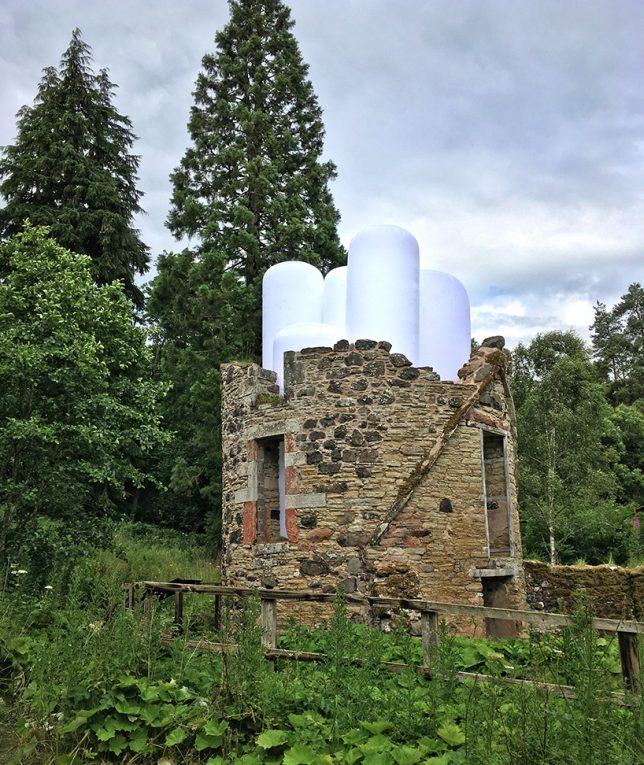
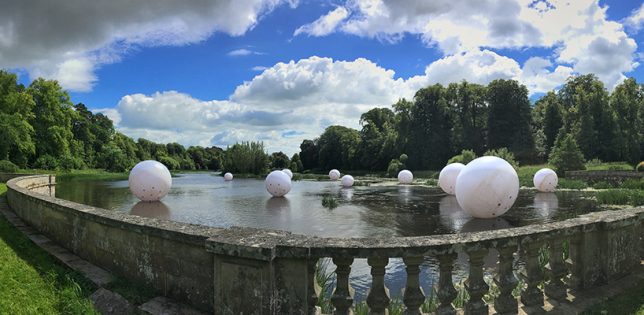
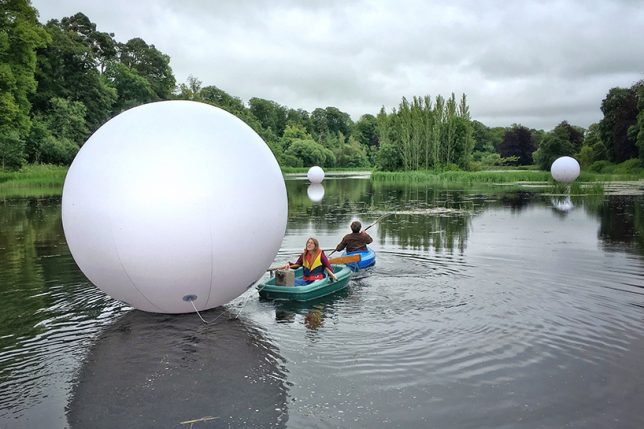
A series of architectural installations in Scotland contrast sharply with the centuries-old stone architecture and natural landscapes, featuring spiky white inflatables filling in aged cracks and gaps.

Titled XXX, these designs by Steven Messam add movement to Mellerstain’s House and the surrounding gardens — they are the first part of a series of contemporary exhibitions planned for the Borders Sculpture Park on this historic estate. The white inflatables refer abstractly to old marble sculptures that were originally to adorn the grounds.

“Pointed” emerges from an old gatehouse; “Scattered” is spread across the lake, comprised of floating bubbles; and “Towered” pokes out of an aged laundry column. Each one invites interaction and exploration of the site.

“In the use of historical buildings and the designed landscape, XXX draws on the architectural significance” of the estate, says Messam. “As interventions, the sculptures speak the language of scale – all three are bigger than a house. As studies in scale and form, these artworks have to be directly experienced in the environment to be fully appreciated, so i hope they will encourage even more people to visit this wonderful architectural gem in the Scottish borders.”

Share on Facebook


[ By WebUrbanist in Art & Installation & Sound. ]

[ WebUrbanist | Archives | Galleries | Privacy | TOS ]


WebUrbanist

 
Comments Off on Inflatable Interventions: Soft Spikes Bring Roofless Ruins Back to Life

Posted in Creativity


Canon EOS Rebel T7i / 800D bring Dual Pixel AF to entry-level series

15 Feb

$ (document).ready(function() { SampleGalleryV2({“containerId”:”embeddedSampleGallery_0880699806″,”galleryId”:”0880699806″,”isEmbeddedWidget”:true,”standalone”:false,”selectedImageIndex”:0,”startInCommentsView”:false,”isMobile”:false}) });

Canon is taking the wraps off its latest entry-level DSLR, the EOS Rebel T7i (known as the EOS 800D in most regions and the Kiss X9i in Japan). It’s the highest specified of the beginner-friendly line and maintains the same 24.4MP resolution CMOS sensor as its T6i predecessor. What is new is a 45-point all cross-type autofocus system used for viewfinder shooting, and Dual Pixel AF in live view, a pretty serious upgrade over the T6i’s 19-point system. 

The T7i is the first Rebel to use Canon’s Digic 7 image processor, and provides a slightly faster 6 fps burst rate. Wi-Fi and NFC are now complemented by Bluetooth, making it compatible with Canon’s first-ever Bluetooth wireless remote as well as smartphones. A 3″ 1.04 million-dot touchscreen is offered, as is a new interface designed to guide beginning photographers and help them get the shots they want.

The Canon EOS Rebel T7i will go on sale in April for $ 750 body-only, $ 900 with the new EF-S 18-55mm F4-5.6 IS STM and $ 1300 with EF-S 18-135mm F3.5-5.6 IS STM. 

NEW CANON EOS REBEL T7i AND EOS 77D CAMERAS POSSESS STUNNING AUTOFOCUS CAPABILITIES

New DSLR Additions are Joined by New Compact EF-S Lens and Canon’s First-Ever Remote Utilizing Bluetooth® Technology3

MELVILLE, N.Y., February 14, 2017 – Developed and designed to meet the varying needs of entry-level and advanced amateur photographers, Canon U.S.A., Inc., a leader in digital imaging solutions, today announced two new additions to the celebrated EOS system – the EOS Rebel T7i DSLR camera, which adds to the popular Rebel series of entry-level DSLR cameras, and the EOS 77D DLSR camera, which represents a new category of cameras for advanced amateur photographers. Canon also introduced today the new EF-S 18-55mm f/4-5.6 IS STM lens and Wireless Remote Control BR-E1, as well as added functionality for the Canon Connect Station CS100. “In what marks the 30th year since the introduction of the Canon EOS System, the announcement today of these two new DSLR cameras exhibits Canon’s commitment to providing our customers with the tools they need to grow their passion for capturing the best possible pictures of the moments in time that mean the most to them, or inspire them to one day shoot professionally,” said Yuichi Ishizuka, president and COO, Canon U.S.A.

Focused on Innovation

The EOS Rebel T7i and EOS 77D both feature an optical viewfinder with a 45-point All Cross-type AF system* to help enable more precise focusing. In live view mode, both cameras utilize Canon’s Dual Pixel CMOS AF to deliver the world’s fastest AF focusing speed of 0.03 seconds.1 This technical achievement allows users to find their subject, focus accurately, and capture the shot more quickly than ever before. Both models also have built-in Wi-Fi®2, NFC3 and Bluetooth®4 technology for easy transfer of images.

In addition to the focusing enhancements, common features of the EOS Rebel T7i and EOS 77D cameras include:

  • Optical Viewfinder with a 45-point All Cross-type AF System*
  • Fast and accurate Dual Pixel CMOS AF with Phase-detection
  • 24.2 Megapixel CMOS (APS-C) Sensor
  • DIGIC 7 Image Processor, ISO 100–25600
  • Built-in Wi-Fi®2, NFC3 and Bluetooth®4 technology
  • Vari-angle Touch Screen, 3.0-inch LCD
  • Movie Electronic IS
  • HDR Movie & Time-Lapse Movie
  • High-speed Continuous Shooting at up to 6.0 frames per second (fps)

Canon EOS Rebel T7i Camera

The EOS Rebel T7i is the first camera in the EOS Rebel series with a 45-point, all cross-type AF system* within the Optical Viewfinder. It is also the first in the series with Dual Pixel CMOS AF with Phase-detection and the first with a DIGIC 7 Image Processor. Creative filters for both still images and video will allow users to customize the look and feel of their content in new and imaginative ways.

When designing the new EOS Rebel T7i, Canon took into consideration feedback from entry-level photographers who expressed interest in learning to go beyond the program mode of a DSLR camera. Users will now be able to see on-screen how switching modes on the mode dial or tweaking settings can alter the image they are about to capture, guiding photographers on their way to capturing more compelling images, such as ones with a shallower depth-of-field or being able to give moving-subjects a frozen or flowing look.

The Canon EOS Rebel T7i is scheduled to be available in April 2017 for an estimated retail price $ 749.99** for the body only, $ 899.99** with the new EF-S 18-55mm f/4-5.6 IS STM lens and $ 1,299.00** with the EF-S 18-135mm f/3.5-5.6 IS STM lens respectively. For more information please visit, usa.canon.com/eosrebelt7i.

Canon EOS 77D Camera

For advanced amateur photographers looking to expand their knowledge and experience with DSLR cameras, Canon’s new EOS 77D is the ideal next step camera for them. The EOS 77D represents a new category of advanced amateur EOS cameras, a step above the Rebel series. Users of the EOS 77D DSLR camera will benefit from features like the 7650-pixel RBG+IR Metering Sensor, similar to the one found in the EOS 80D camera and Anti-Flicker shooting mode to help combat the on-and-off repetitive flickering from artificial lights found in high-school gyms or auditoriums. The EOS 77D also features a top LCD panel and quick control dial for photographers who desire quicker and easier access to changing and controlling settings on the camera.

The Canon EOS 77D is scheduled to be available in April 2017 for an estimated retail price $ 899.99** for the body only, $ 1,049.00** with the new EF-S 18-55mm f/4-5.6 IS STM lens and $ 1,499.00** with the EF-S 18-135mm f/3.5-5.6 IS USM lens respectively. For more information please visit, usa.canon.com/eos77d.

EF-S Lens and Remote Accessory Utilizing Bluetooth® Technology

The new Canon EF-S 18-55mm f/4-5.6 IS STM lens is nearly 20 percent smaller than the EF-S 18-55mm f/3.5-5.6 IS STM lens, without sacrificing image quality. Features of the lens include:

  • Compact-size, Standard Zoom Lens with High Image Quality
  • Lead Screw-type STM
  • Image Stabilization at up to 45 Stops of Shake Correction
  • Stylish Design

The Canon EF-S 18-55mm f/4-5.6 IS STM lens is scheduled to be available in early April 2017 for an estimated retail price of $ 249.99**. For more information please visit, usa.canon.com/efs1855stm.

In addition, Canon is introducing it’s first-ever remote utilizing Bluetooth® technology3, the Wireless Remote Control BR-E1. This new remote allows photographers to capture images from within a 16-foot radius of the camera. This camera accessory is useful for photographers who are looking to capture images remotely in situations where there could be issues with signal reception or line-of-sight to the camera. The Canon Wireless Remote Control BR-E1 will be compatible with both the EOS Rebel T7i and EOS 77D cameras. The Canon BR-E1 is schedule to be available in April 2017 for an estimated retail price of $ 50.00**.

CS100 Firmware Update
Both the EOS Rebel T7i and EOS 77D cameras are compatible with the Canon Connect Station CS100 device, a go-to-photo and video hub that allows family and friends a way to quickly and easily store, manage view and share unforgettable memorable moment’s wirelessly6. Canon is also announcing today a firmware update to the Canon Connect Station CS100 device and mobile application. The firmware update includes the following improvements:

  • Compatibility for select Canon and non-Canon cameras, with a wider range of supported file formats7
  • Support for video playback of computer-edited movies8
  • Improved smartphone connectivity and compatibility

For more information about the Canon Connect Station firmware update, please visit usa.canon.com/cs100mobile.

* The number of AF points, cross-type AF points and Dual cross-type AF points vary depending on the lens used

** Availability, prices and specifications subject to change without notice. Actual prices are set be individual dealers and may vary.

1 Among all the interchangeable lens digital cameras incorporating the APS-C size image sensors with phase-difference detection AF on the image plane As of February 14th, 2017 (Researched by Canon). Calculated based on the resulting AF speed measured according to the CIPA guidelines. (Varies depending on the shooting conditions and the lenses used.) Internal measurement method. [Measurement conditions] Focusing brightness: EV 12 (room temperature, ISO 100) Shooting mode: M Lens used: EF-S18-55mm f/4-5.6 IS STM (at focal length of 55mm) Live View shooting AF method: Live 1-point AF (with Center AF point) AF operation: One-Shot AF

2 Compatible with iOS® versions 8.0/8.1/8.2/8.3/8.4/9.0/9.1/9.2/9.3/10.0, Android™ smartphone and tablet versions 4.1/4.2/4.3/4.4/5.0/5.1/6.0/7.0. Data charges may apply with the download of the free Canon Camera Connect app. This app helps enable you to upload images to social media services. Please note that image files may contain personally identifiable information that may implicate privacy laws. Canon disclaims and has no responsibility for your use of such images. Canon does not obtain, collect or use such images or any information included in such images through this app.

3 Compatible with Android™ smartphone and tablet versions 4.0/4.1/4.2/4.3/4.4/5.0/5.1/6.0/7.0. 4Compatible with select smartphone and tablet devices (AndroidTM version 5.0 or later and the following iOS® devices: iPhone 4s or later, iPad 3rd gen. or later, iPod Touch 5th gen. or later) equipped with Bluetooth® version 4.0 or later and the Camera Connect App Ver. 1.3.20 or above. This application is not guaranteed to operate on all listed devices, even if minimum requirements are met.

5 Based on CIPA (Camera & Imaging Products Association) standards. Testing performed using the EOS 7D Mark II digital SLR camera at a focal length of 55mm, 35mm-equivalent 88mm. The number of stops may vary based on the camera model used.

6 Compatible with iOS® versions 8.4x/9.2.x, Android™ Smartphone and tablet versions 4.4.x, 5.0.x/5.1.x, 6.0.x. Data charges may apply with the download of the free Canon Connect Station app. The application is available in the apple app store or google play store.

7 Support for playback of all images on this device cannot be guaranteed.

8 JPEG and RAW (CR2) still images, and MOV/MP4 and AVCHD movies are supported.

Canon EOS Rebel T7i / 800D / Kiss X9i specifications

Price
MSRP $ 749 (body only), $ 899 (w/18-55 F4-5.6 IS STM lens), $ 1299 (w/18-135mm F3.5-5.6 IS STM lens)
Body type
Body type Mid-size SLR
Body material Composite
Sensor
Max resolution 6000 x 4000
Image ratio w:h 1:1, 4:3, 3:2, 16:9
Effective pixels 24 megapixels
Sensor photo detectors 26 megapixels
Sensor size APS-C (22.3 x 14.9 mm)
Sensor type CMOS
Processor DIGIC 7
Color space sRGB, Adobe RGB
Color filter array Primary color filter
Image
ISO Auto, 100-25600 (expands to 51200)
Boosted ISO (maximum) 51200
White balance presets 6
Custom white balance Yes
Image stabilization No
Uncompressed format RAW
JPEG quality levels Fine, normal
File format
  • JPEG (Exif v2.3)
  • Raw (14-bit Canon CR2)
Optics & Focus
Autofocus
  • Contrast Detect (sensor)
  • Phase Detect
  • Multi-area
  • Center
  • Selective single-point
  • Tracking
  • Single
  • Continuous
  • Touch
  • Face Detection
  • Live View
Autofocus assist lamp Yes (flash)
Digital zoom No
Manual focus Yes
Number of focus points 45
Lens mount Canon EF/EF-S
Focal length multiplier 1.6×
Screen / viewfinder
Articulated LCD Fully articulated
Screen size 3
Screen dots 1,040,000
Touch screen Yes
Screen type TFT LCD
Live view Yes
Viewfinder type Optical (pentamirror)
Viewfinder coverage 95%
Viewfinder magnification 0.82×
Photography features
Minimum shutter speed 30 sec
Maximum shutter speed 1/4000 sec
Exposure modes
  • Program
  • Shutter priority
  • Aperture priority
  • Manual
Scene modes
  • Group Photo
  • Kids
  • Food
  • Candlelight
  • Night Portrait
  • Handheld Night Scene
  • HDR Backlight Control
  • Portrait
  • Landscape
  • Close-up
  • Sports
Built-in flash Yes
External flash Yes (via hot shoe)
Flash X sync speed 1/200 sec
Drive modes
  • Single
  • High-speed continuous
  • Low-speed continuous
  • Self-timer
  • Self-timer + continuous
Continuous drive 6.0 fps
Self-timer Yes (2 or 10 sec)
Metering modes
  • Multi
  • Average
  • Spot
  • Partial
Exposure compensation ±5 (at 1/3 EV, 1/2 EV steps)
AE Bracketing ±3 (3 frames at 1/3 EV, 1/2 EV steps)
Videography features
Format MPEG-4, H.264
Modes
  • 1920 x 1080 @ 60p / 60 Mbps, MOV, H.264, Linear PCM
  • 1920 x 1080 @ 30p / 30 Mbps, MOV, H.264, Linear PCM
  • 1920 x 1080 @ 30p / 12 Mbps, MOV, H.264, Linear PCM
  • 1920 x 1080 @ 23.98p / 30 Mbps, MOV, H.264, Linear PCM
  • 1280 x 720 @ 60p / 26 Mbps, MOV, H.264, Linear PCM
  • 1280 x 720 @ 30p / 4 Mbps, MOV, H.264, Linear PCM
Microphone Stereo
Speaker Mono
Storage
Storage types SD/SDHC/SDXC (UHS-I compatible)
Connectivity
USB USB 2.0 (480 Mbit/sec)
HDMI Yes
Microphone port Yes
Headphone port No
Wireless Built-In
Wireless notes Includes Bluetooth LE and NFC
Remote control Yes (via smartphone or Bluetooth remote)
Physical
Environmentally sealed No
Battery Battery Pack
Battery description LP-E17 lithium-ion battery & charger
Battery Life (CIPA) 600
Weight (inc. batteries) 532 g (1.17 lb / 18.77 oz)
Dimensions 131 x 100 x 76 mm (5.16 x 3.94 x 2.99)
Other features
Orientation sensor Yes
Timelapse recording Yes
GPS Optional

Articles: Digital Photography Review (dpreview.com)

 
Comments Off on Canon EOS Rebel T7i / 800D bring Dual Pixel AF to entry-level series

Posted in Uncategorized