RSS
 

Posts Tagged ‘Around’

High-Elevation Dining: 12 Sky-Scraping Restaurants Around the World

17 Jan

[ By SA Rogers in Destinations & Sights & Travel. ]

dinner-in-teh-sky-main-2

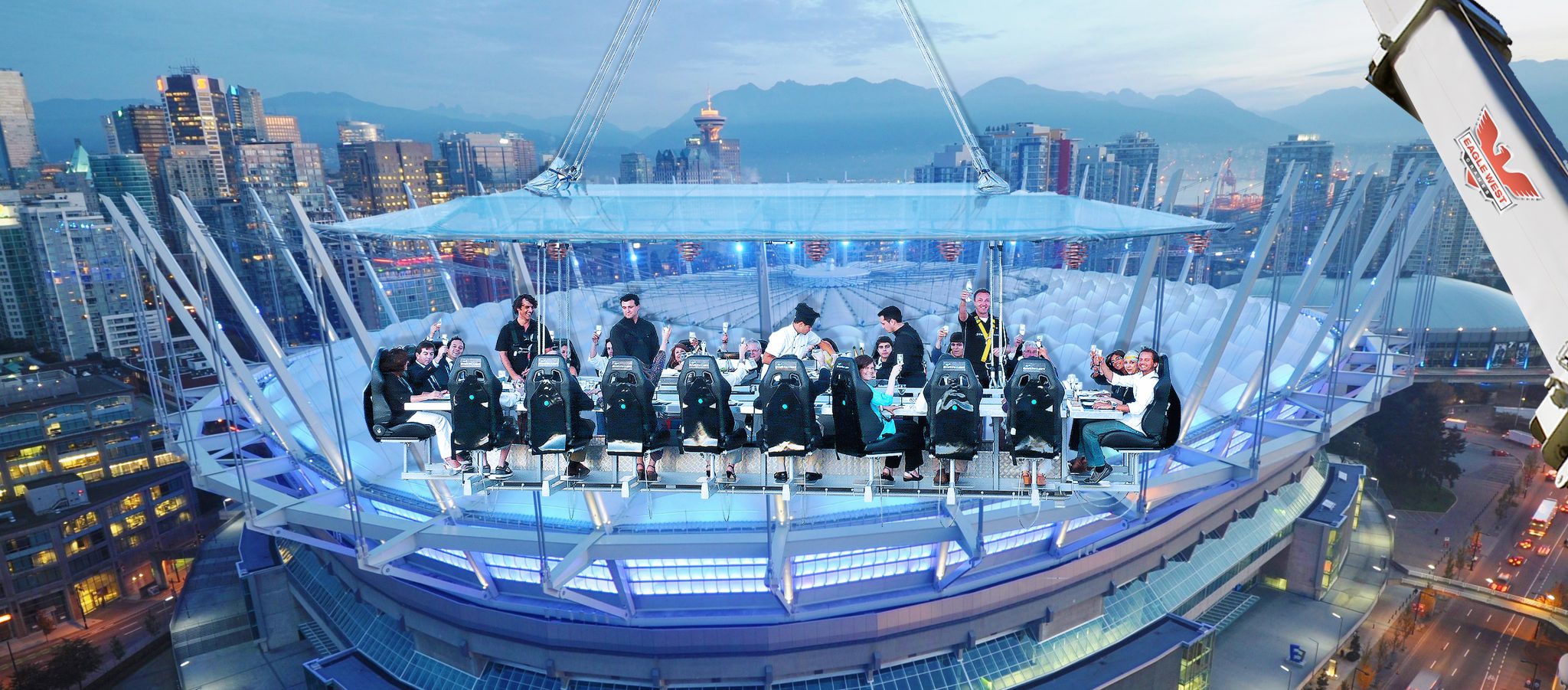
As long as heights don’t make you queasy, you could enjoy one of the best meals of your life from as high as 1,350 feet above street level, gazing out onto bustling cities like Dubai, Tokyo, Toronto, Shanghai and Chicago. Or, take a higher altitude approach at a restaurant that’s not just tucked into a mountain range in France, but also located almost 9,000 feet above sea level. These dining establishments are the closest you’ll ever get to eating meals in the clouds, outside of an airplane (unless, of course, you’re an astronaut, in which case, congratulations.)

Catch: Guangzhou International Finance Center, China

ifc-guangzhou-2

ifc-quangzhou-3

ifc-guangzhou-4

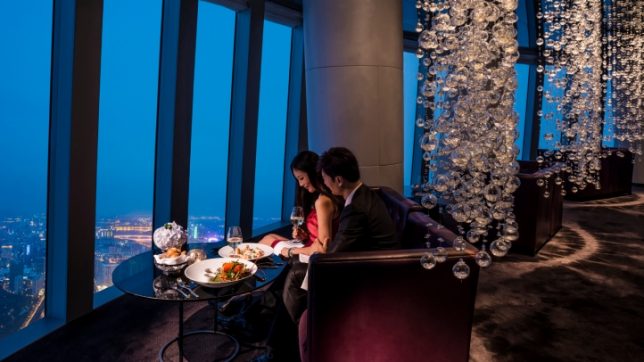
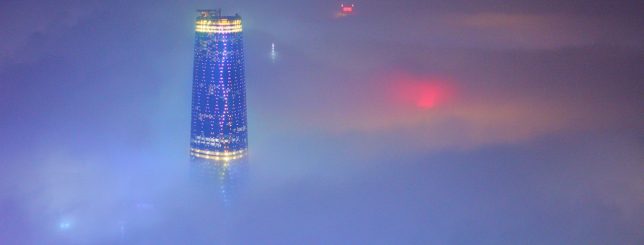
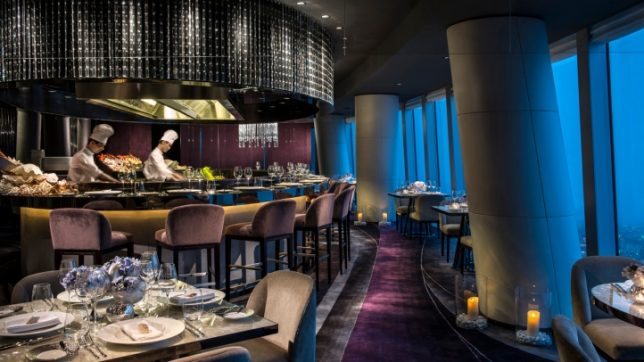
100 floors above ground level in the Four Seasons Hotel at Guangzhou’s International Finance Center, seafood restaurant ‘Catch’ looks down onto the city from an astonishing 1,312 feet in the sky through floor-to-ceiling glass windows. The 103-story building is the 15th tallest in the world, and opened in 2010.

At.Mosphere: Burj Khalifa, Dubai

atmosphere-dubai

atmosphere-dubai-2

atmosphere-dubai-3

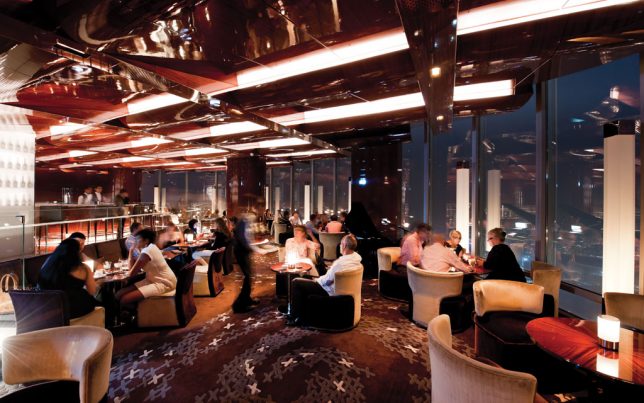
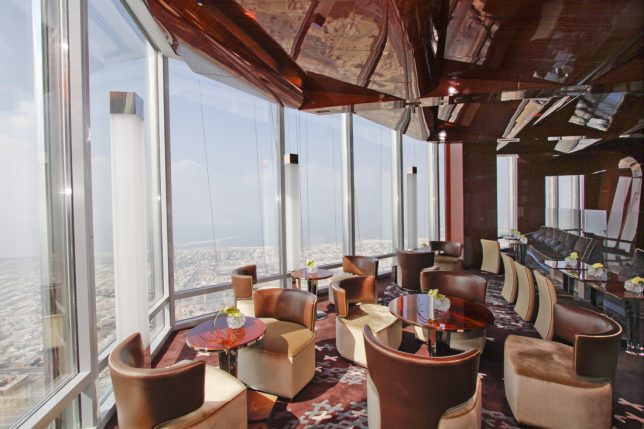
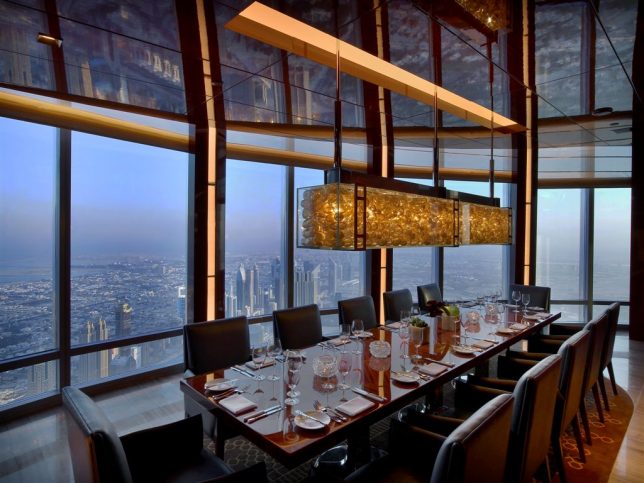
The highest restaurant in the world crowns the top of the tallest tower, the Burj Dubai. Located on the 122nd floor, At.Mosphere is a 200-seat French restaurant set 1,350 feet above the ground. From your dining table, you can watch the frenetic pace of Dubai life or get a bird’s eye view of various ongoing construction projects.

Top of the World: Stratosphere Hotel and Tower, Las Vegas

top-of-the-world-vegas-1

top-of-the-world-vegas-2

top-of-the-world-3

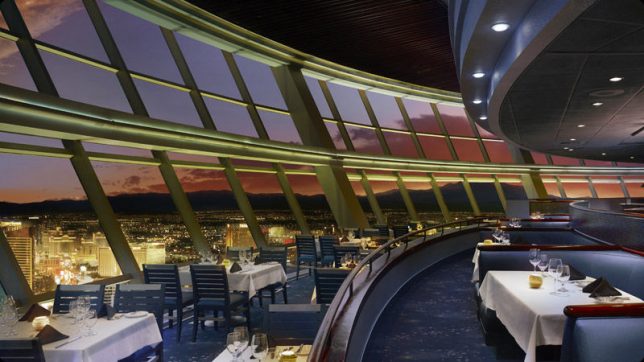
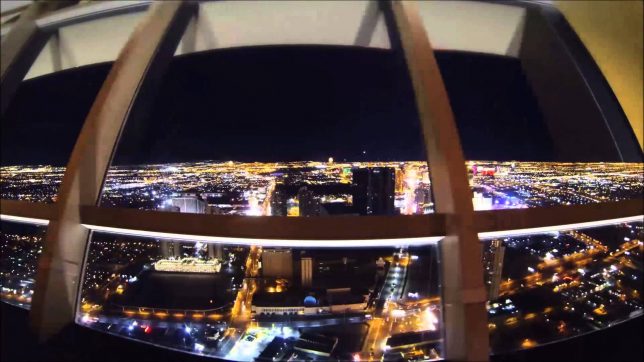
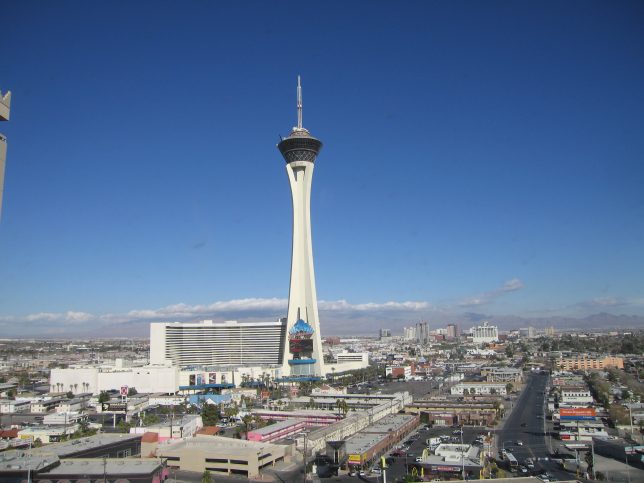
800 feet above the Las Vegas Strip, ‘Top of the World’ is tucked into the highest floor of the Stratosphere Casino, Hotel & Tower and revolves 360 degrees every 80 minutes.

Club Jin Mao: Grand Hyatt, Shanghai

club-jin-mao-1

club-jin-mao-2

club-jin-mao-3

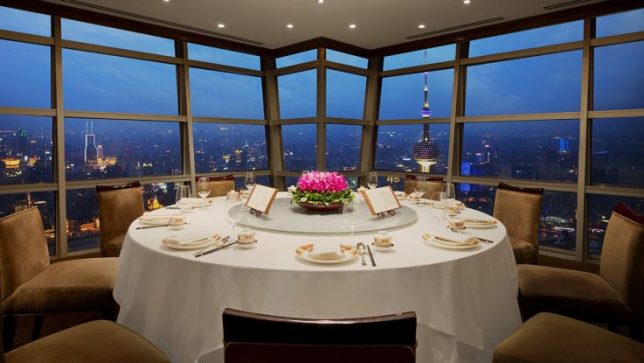
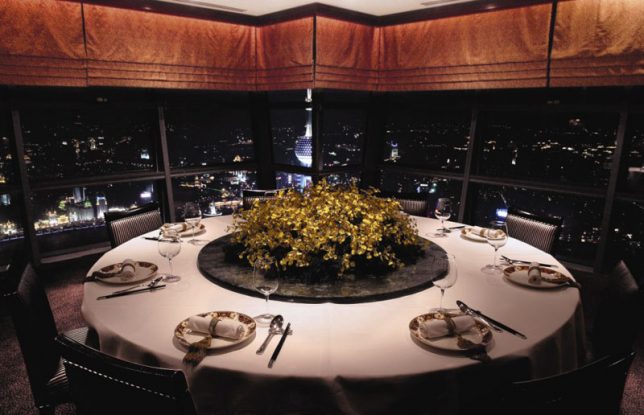
Gaze out at the Shanghai skyline from an unusual angle at Club Jin Mao, a showcase of classic Shanghainese cuisine on the 86th floor of the Jin Mao Tower at Grand Hyatt Shanghai. There’s seating for up to 40 guests, and six private rooms.

The Metropolitan Club: Willis Tower, Chicago

metropolitan-club

metropolitan-club-2

willis-tower-2

willis-tower-3

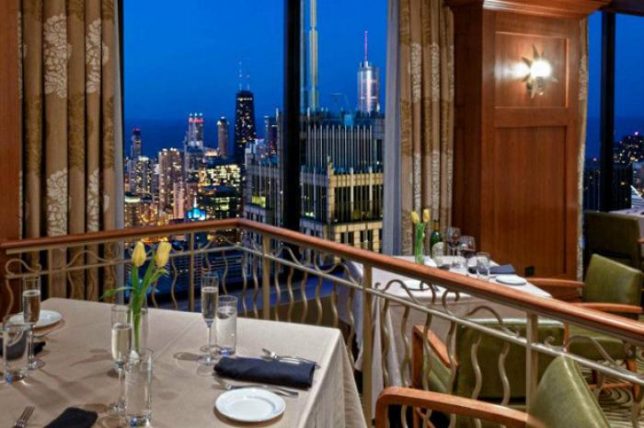
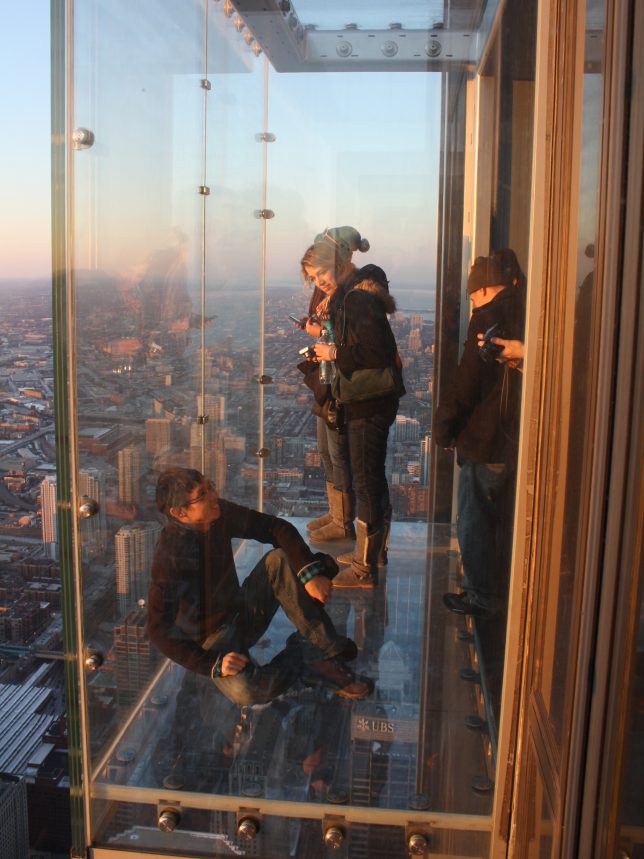
Chicago is actually packed full of sky-high restaurants, many notable enough to make it onto lists of the world’s highest. That means there are plenty of opportunities to dine with an amazing view of the city, the Chicago River or Lake Michigan. The Metropolitan Club is a classic, located on the 66th and 67th floors of the famous Willis Tower (which has 110 stories in total.) The Club has long been open to members only, but recently invited the public to dine as well.

Next Page – Click Below to Read More:
High Elevation Dining 12 Sky Scraping Restaurants Around The World

Share on Facebook


[ By SA Rogers in Destinations & Sights & Travel. ]

[ WebUrbanist | Archives | Galleries | Privacy | TOS ]


WebUrbanist

 
Comments Off on High-Elevation Dining: 12 Sky-Scraping Restaurants Around the World

Posted in Creativity


Around the world in 10 videos: 2016 Field Tests

02 Jan
DPReview’s Carey Rose, doing what he does best. Staring at women. In this case, rodeo Queens at a rodeo in Nyssa, Oregon, during a DPReview Field Test of the Canon EOS-1D X Mark II.

DPReview has been around the world in 2016, from the deserts of the Southwest to the lush jungles of Mexico’s Yucatan Peninsular. We’ve used everything from enthusiast compacts to high-end professional DSLRs, and along the way we’ve met some amazing photographers. 

Click here to See our full series of Field Test videos

You can check out the full series at the ^ link ^ right ^ there ^ but in this article, I want to take you back through the ten videos that we’ve published this year, and hopefully in the process, let you share a little in some of the sights, the sounds and the smells of DPReview’s Year in Field Tests. OK, not the smells, but definitely the other things.

Before we continue, I am legally obligated to let you know that all of the videos featured on this page are sponsored content, made possible with the support of Amazon and the manufactures featured in the videos. Click here for more information about DPReview sponsored content.

All clear? OK then – let’s watch some videos!

February: Sony Cyber-shot RX100 IV in the Yucatan

Shot at the end of last year, this Field Test, featuring Sony’s Cyber-shot RX100 IV was one of our most ambitious. Mexico’s Yucatan Peninsular is a beautiful place, full of amazing scenery, vivid history, and corner shops that sell antibiotics over the counter to weak-stomached gringos. 

We took advantage of all of these things during our trip, and as a bonus, you get to see me try to speak Spanish. Just be grateful for what you don’t get to see me doing.

March: Canon PowerShot G5 X on the Olympic Peninsula

Even on a grey weekend in early spring, the Olympic Peninsular is still a stunningly beautiful place. In this video, featuring the Canon PowerShot G5 X, DPReview writer Carey Rose spent a couple of days bro-ing down hard with local photographer and keen fisherman Kyle Johnson.

A little bit of trivia for you – this video actually breaks the world record for most amount of plaid featured in the least amount of screen-time. If you have trouble telling some of the men in this video apart from one another, don’t worry – so do I, and I know all of them.

April: Claire Bangser and the Olympus PEN-F

In April, we headed to Mississippi with the Olympus PEN-F, where Editorial Manager Wenmei Hill joined New Orleans-based photographer Claire Bangser on the Blues Trail. Claire and Wenmei spent a couple of days on the trail, photographing the local sights and people of the area. And yes – they used all the Art Filters. 

May: Shooting stars with the Nikon D810 & D810A

In May, we cast our eyes skywards. In this Field Test, DPReview’s Dale Baskin joined astrophotographer José Francisco Salgado in Death Valley, for a celestial shoot with Nikon’s D810 and D810A. One of the things I like most about this video is the way that José says ‘stars’. It’s hard to explain – you’ll just have to watch it.

May: Building a kayak with the Canon EOS 80D

While Dale was star-gazing in Death Valley, I was closer to home, learning how to make a traditional Greenland-style skin-on-frame kayak, in Seattle. I documented the entire process using the Canon EOS 80D. I’m proud to say that despite the countless mistakes, including several holes drilled in the wrong place, Aril still floats.  

July: DPReview goes to the rodeo with the Canon EOS-1D X Mark II

From slow, methodical action to fast, energetic action. In July, we drove down to Nyssa Oregon, with Canon’s professional flagship DSLR, the EOS-1D X Mark II, to cover the annual ‘Nite Rodeo’. This one is worth watching just for the sight of me and Carey wearing cowboy hats. Quote of the trip, from a rodeo spectator: ‘Y’all sure as hell don’t look like cowboys’. 

September: Shooting Action with the Nikon D5

DPReview’s Technical Editor Rishi Sanyal is a super-nerd. Given a chance, he’ll talk your ear off about everything from signal-to-noise ratio to smart lightbulbs. But what he’s probably most nerdy about is autofocus. In this video, featuring the Nikon D5, Rishi gets to indulge his AF obsession for almost 15 minutes. You’re welcome, Internet.

October: Birds in flight with the Nikon D500

In October, we traveled to Montana with the Nikon D500, to join wildlife photographer and friend to the wolves Ronan Donovan, at a nature reserve. It was a short, packed shoot, the dubious highlight of which was when I got dive-bombed by a hawk.

Fun fact: this is the only DPReview Field Test to feature a moose.

Wedding photography with the Fujifilm X-T2

Guemas Island is a tiny dot on a map of the Pacific Northwest, but it’s one of the most beautiful spots for a daytrip, weekend getaway, or a wedding. In this Field Test, Carey and Wenmei took the Fujifilm X-T2 to Guemas Island to document a very special day. Carey really covered himself in glory on this one, by forgetting to shoot Raw.

Dog Portraits with the Sony a6300

They say that dogs are man’s best friend. They also say you should never work with animals. Who are ‘they’ anyway, and where do they get their sayings? We may never know. In this video, Sam Spencer took Sony’s a6300 to a dog adoption shelter, to shoot some professional portraits of their canine residents. I’ll remember this shoot because it was the closest I’ve ever come to adopting an animal. See if you can spot which dog melted my heart.

Anyway – this video is cute. You should show it to your mum.

Subscribe to DPReview on YouTube, and never miss a new video


All of the videos featured on this page are sponsored content, made possible with the support of Amazon and the manufactures featured in the videos. What does this mean?

Articles: Digital Photography Review (dpreview.com)
 
Comments Off on Around the world in 10 videos: 2016 Field Tests

Posted in Uncategorized


Second Time Around: Canon PowerShot G7 X Mark II Review

20 Jul

Key Features

  • 20MP 1″-type BSI CMOS sensor
  • 24-100mm F1.8-F2.8 lens
  • 3″ tilting touchscreen LCD
  • Click/click-less front dial
  • 8 fps continuous shooting
  • 1080/60p video capture

For nearly two and a half years, Sony had the 1″-type sensor compact camera segment all to itself with its RX100 series. While Canon had its PowerShot G1 X (and the Mark II that followed), they were anything but pocketable. In September 2014 Canon joined Sony, offering up its PowerShot G7 X. From a pure specifications point of view, the G7 X was toe-to-toe with the Sony RX100 II and RX100 III (the current models at the time it was announced) in most respects, especially in terms of focal range and usability.

Despite being so promising on paper, the G7 X proved a disappointment in a few areas. Performance in Raw mode was sluggish, battery life wasn’t great and, its lens wasn’t as good as those on some of its competitors. Canon has addressed most of those problems on the Mark II, due in large part to its Digic 7 processor, which makes its debut in the G7 X II.

From a performance perspective, the Mark II has faster burst shooting, especially when shooting Raw files, which was a big disappointment on the original model. Where the Mark I shot continuous Raw bursts at just 1 fps, the Mark II can now shoot Raws, JPEGs or both at 8 fps. Canon also claims improvements in subject recognition and tracking, which wasn’t a strong point of the original model, either.

The G7 X II offers what Canon calls ‘Dual Sensing IS’, which uses data from the image sensor (in addition to gyro-scoping sensors) to reduce blur caused by camera shake. The company claims that this system is more effective than on the G7 X, with the ability to reduce shake by four stops. There’s also a new panning IS mode that will adjust the shutter speed to ensure that your subject is ‘frozen.’

In the image quality department, the Digic 7 processor brings improved sharpening and high ISO noise reduction algorithms. We’ll see the results of that later in the review.

Perhaps the G7 X’s biggest problem was battery life, which has been boosted by 25% to 265 shots per charge (CIPA standard). Even with that increase, though, the Canon still lags behind the Sony RX100s and Panasonic Lumix ZS100/TZ100.

The G7 X II uses the same lens and 1″-type sensor as its predecessor.  As you can see, the main difference on the front is a much-needed grip. It’s also slightly ‘chunkier’ in general.
Canon has moved the display hinge from the top to the bottom, which allows the screen to tilt downward by 45 degrees, something that the original G7 X could not do.

Cosmetically, the Mark II boasts three major changes. First is the addition of a much-needed grip, as the finish on the camera is quite slippery. Second, while it’s a bit subtle, Canon has moved the hinge on the tilting LCD to the bottom, which allows the screen to tilt downward, itself of just up. Finally, those who can’t decide whether they want the control ring around the lens to be ‘clicky’ or ‘smooth’ can now have both via a toggle switch to the lower-right of the lens.

Spec Comparison

Below is a look at how the key specs vary between the PowerShot G7 X I and II as well as the Sony Cyber-shot DSC-RX100 III, which is arguably the Mk II’s closest competitor.

   Canon G7 X  Canon G7 X II  Sony RX100 III
Sensor 20MP 1″-type BSI CMOS 20MP 1″-type BSI CMOS 20MP 1″-type BSI CMOS
Lens focal range 24-100mm equiv. 24-100mm equiv. 24-70mm equiv.
Max aperture F1.8 – F2.8 F1.8 – F2.8 F1.8 – F2.8
LCD size/type 3″ tilting (180° up) 3″ tilting (180° up, 45° down) 3″ tilting (180° up, 45° down)
Touchscreen Yes Yes No
Built-in EVF No No Yes
Max burst rate
(w/AF lock)
6.5 fps JPEG
1 fps Raw 
8 fps JPEG/Raw 10 fps JPEG
6.5 fps Raw
Video 1080/60p/30p

1080/60p/30p/24p

1080/60p/30p/24p
In-camera Raw conversion No Yes No
Battery life (CIPA) 210 shots 265 shots 320 shots
In-camera charging No Yes Yes
Dimensions 103 x 60 x 40mm 106 x 61 x 42mm  102 x 58 x 41mm
Weight (CIPA) 304 g 319 g 290 g

As you can see, lens focal range, touchscreen and battery life are what separate the G7 X II from its competition.

Lens Comparison

The chart below breaks down the equivalent aperture for each camera, as you work your way through the zoom range. Our article here explains the concept of equivalence, but at a high level all you need to know is that the lower the line is on the graph below, the blurrier the backgrounds you’ll be able to get and, typically, the better the overall low-light performance.

As you can see, the G7 X II and RX100 III start off at the same spot, but up until about 50mm the former has a slight equivalent aperture advantage. The two cameras are matched until the RX100 III’s focal range ends up 70mm. The G7 X continues on to 100mm at F2.8 (~F7.6 equiv.), which is one of its big selling points.

Articles: Digital Photography Review (dpreview.com)
 
Comments Off on Second Time Around: Canon PowerShot G7 X Mark II Review

Posted in Uncategorized


Take a look around: traditional stills versus VR in Iceland

13 Jul

Introduction

Time to relax – does VR capture lower the barrier for creating memorable vacation content? Let’s take a look. Nikon D810 + Nikon AF-S 35mm F1.4G @ F2 | 1/8000 sec | ISO 200. Photo by Carey Rose

Back in April, two friends and I took a trip to Iceland, spending eight days circumnavigating the island via its famous ring road. Happily, around that time we were looking for some updated content for our review of the Nikon D810, so I took one along and wrote up a shooting experience.

In general, though, I enjoy documenting my travels even when I’m just traveling for fun. I find it to be a nice creative recharge, simply photographing for myself, in my style, with my choice of equipment. Of course, the D810 I borrowed wasn’t my personal equipment, but it was near-ideal for the sorts of situations I found myself in (plus, handling-wise, it isn’t quite so different from the D700 I was originally planning on bringing).

But now we’ve got VR technology beginning to make waves in the consumer electronics industry. What’s more, capture devices are getting more accessible: the Ricoh Theta S retails for just $ 349, making it a cheaper proposition than most DSLRs, as well as my secondhand X100 and Ricoh GR, which are my usual go-to cameras for casual photography.

The Ricoh Theta S carries an MSRP of $ 349, and offers full 360 stills and video capture as well as smartphone integration.

At its core, the act of taking a photograph requires some translation of the 360-degree setting in which the photographer stands into a two-dimensional window, for viewing on the web or in print. But 360-degree VR capture changes that. When you’re literally just capturing the entirety of a scene around you, is there value in it for other viewers? When you’ve removed one of the most basic creative tenets of capturing a photograph, what are you left with?

During our time in Iceland, my friends and I were lucky enough to have the opportunity to borrow a Ricoh Theta S as well. Without any prior experience, we tried to use it as we did our DSLRs – to see if and how it could offer value to us above and beyond our traditional camera kits.

Click-and-drag on a desktop or laptop to view the 360 footage. All ‘traditional’ photographs by Carey Rose, and all Theta S 360 images by Jordan Stead.

360-degree viewing methods

Spoiler alert – when viewing the Theta S footage on a 2D viewing device, such as a laptop or smartphone, I find the results somewhat underwhelming. And throughout this article, you will, of course, notice that the files from the Ricoh are a little low-res, and lack some ‘pop’ that you can see in files from the D810. This shouldn’t really be a surprise given the dramatic differences in hardware, so I’ll be focusing on the viewing experience concerning the 360-stills rather than outright image quality.

Here’s a collection of stills captured on a D810 from a black sand beach outside Vik, in southern Iceland.

The top two images are shot with a 35mm prime, and the bottom two with an 80-200mm F2.8 zoom. Now, as I alluded to in my shooting experience, these may not be your standard picture-perfect postcard images from this setting. But that’s okay, because that’s not generally how I shoot when I’m shooting for myself. I like to use several different photos to focus on several different aspects of a scene, as opposed to shooting wider-angle ‘overall’ photos that get more of a sense of place in a single image. Something approaching the latter is what you get when you use the Theta S. 

I find viewing the 360 as you see it above in a web browser or on a mobile phone to be somewhat ‘distant.’ The distortion is strong, and therefore distorts the sense of place, even though you can see everything in the scene. Everything also feels very far away, which ties in with an overall sense of detachment I feel looking at it, even though I know that I’m just a little ways down the beach in the image. You can zoom into the 360 image to reduce the distortion somewhat, but then the experience becomes even less immersive.

The overall feeling I get is of a person quickly taking an eye-level wide-angle photograph of something in front of them (not a criticism of my friend Jordan who was shooting with the Theta – the 360’s I took on this trip also had the same feel). Also, if you happen to view it on a phone, by default you ‘look’ around the scene by reorienting your phone in 3D space, which makes you look very silly if you are looking at it in public.

But then I looked at it through a Galaxy Gear VR headset, and everything changed.

Articles: Digital Photography Review (dpreview.com)
 
Comments Off on Take a look around: traditional stills versus VR in Iceland

Posted in Uncategorized


2016 Roundup: Interchangeable Lens Cameras around $500

20 May

While they aren’t cameras that make headlines, one thing is for certain: entry-level interchangeable lens cameras sell by the truckload. The majority of them are stripped-down versions of their midrange siblings, with things like newer sensors, advanced autofocus systems, customizable controls and ‘premium’ build quality being left out. That doesn’t mean that these aren’t capable cameras – quite the contrary, actually.

All of these cameras – both mirrored and mirrorless – produce good image quality, offer respectable performance and can record Full HD video. The majority have Wi-Fi. Many of them are targeted toward beginners, with ‘help’ systems that point out the best settings to use for various shooting situations.

Those unfamiliar with DSLR and mirrorless cameras may be wondering what advantages and disadvantages each brings to the table. DSLRs are larger cameras, with a more ‘traditional’ shape and control layout, as well as an optical viewfinder. While they’re great for shooting stills, they’re not as well suited to video capture, and focusing using live view can be sluggish. Mirrorless cameras are typically smaller and are very capable video shooters, since live view focusing is much faster than most DSLRs. Two negatives about mirrorless cameras are that battery life isn’t nearly as good as a DSLR and – especially true in this class – they often lack a viewfinder.

Let’s take a look at several entry-level ILCs, with US MSRPs in the $ 500 region, kit lens included. 

  • Canon EOS M10
  • Canon EOS Rebel T6
  • Fujifilm X-A2
  • Nikon 1 J5
  • Nikon D3300
  • Olympus PEN E-PL7
  • Sony Alpha a5100

Articles: Digital Photography Review (dpreview.com)
 
Comments Off on 2016 Roundup: Interchangeable Lens Cameras around $500

Posted in Uncategorized


27 Images Around the World of Circles

28 Nov

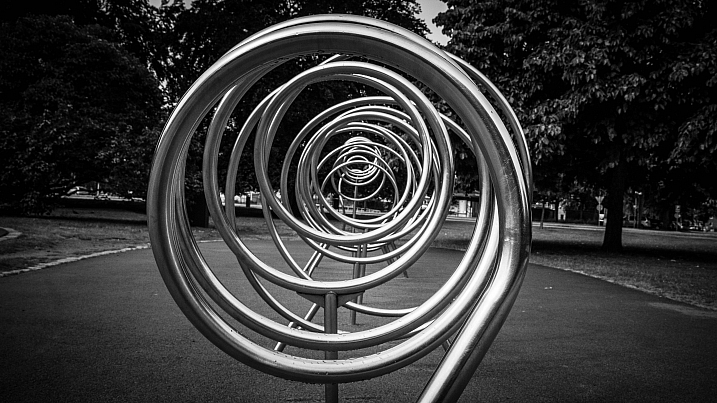
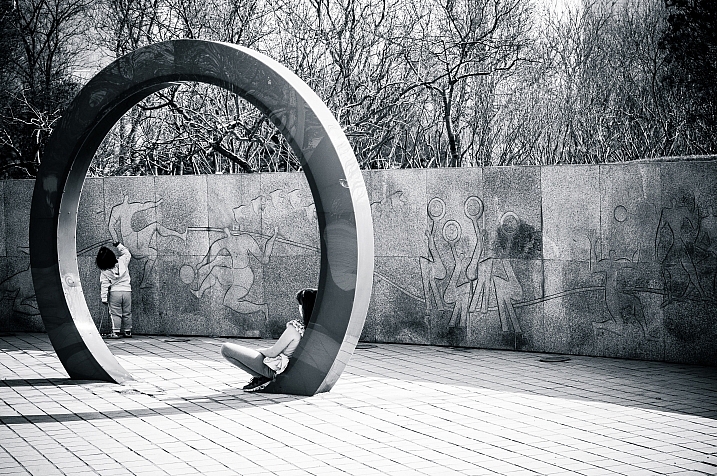
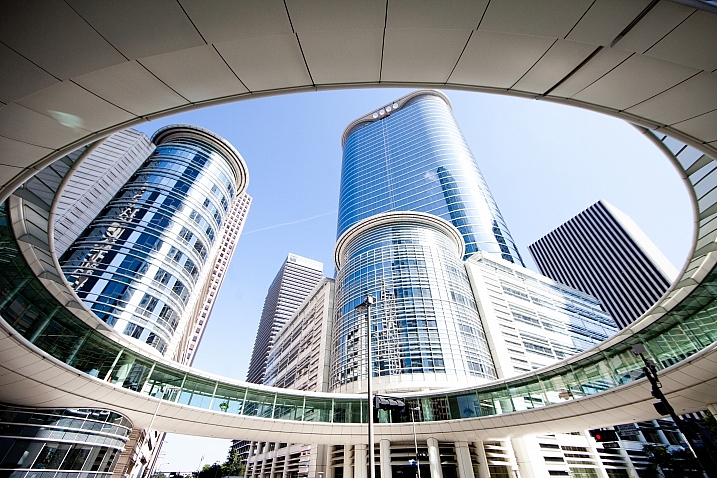
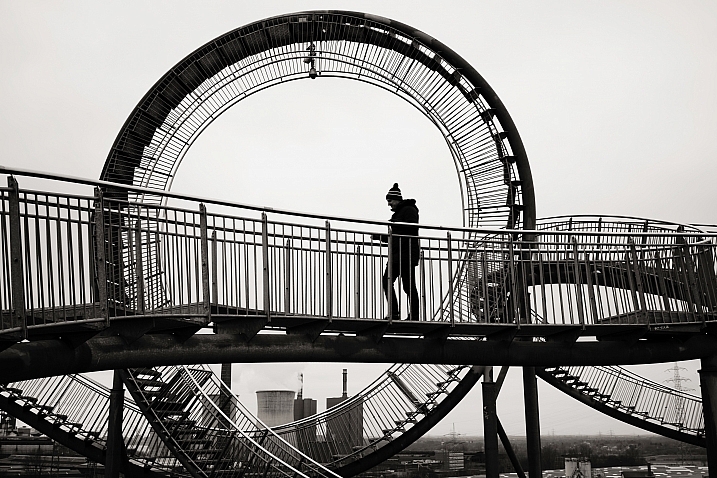
Shapes can be seen everywhere, in everything. Look closer to find the circles in these images:

Sama093

By sama093

Michael Orth

By Michael Orth

Novofotoo

By novofotoo

Abbey Hambright

By Abbey Hambright

Richard Walker

By Richard Walker

Steve Johnson

By Steve Johnson

Magdalena

By magdalena

Joakim Berndes

By Joakim Berndes

Yamanaka Tamaki

By Yamanaka Tamaki

J J

By J J

Bob Farrell

By Bob Farrell

Wasile

By Wasile

Simon Harrod

By Simon Harrod

Fleetingpix

By fleetingpix

Ben O'Bryan

By Ben O’Bryan

Catface27

By Catface27

Davide D'Amico

By Davide D’Amico

Sonny Abesamis

By Sonny Abesamis

Darlene Hildebrandt

By Darlene Hildebrandt

Tanakawho

By tanakawho

William Warby

By William Warby

Hernán Piñera

By Hernán Piñera

Susanne Nilsson

By Susanne Nilsson

Bryon Lippincott

By Bryon Lippincott

Thomas Hawk

By Thomas Hawk

TheGiantVermin

By TheGiantVermin

Karl Reif

By Karl Reif

googletag.cmd.push(function() {
tablet_slots.push( googletag.defineSlot( “/1005424/_dPSv4_tab-all-article-bottom_(300×250)”, [300, 250], “pb-ad-78623” ).addService( googletag.pubads() ) ); } );

googletag.cmd.push(function() {
mobile_slots.push( googletag.defineSlot( “/1005424/_dPSv4_mob-all-article-bottom_(300×250)”, [300, 250], “pb-ad-78158” ).addService( googletag.pubads() ) ); } );

The post 27 Images Around the World of Circles by Darlene Hildebrandt appeared first on Digital Photography School.


Digital Photography School

 
Comments Off on 27 Images Around the World of Circles

Posted in Photography


Arboreal Architecture: 14 Houses Built Around & Within Trees

21 Jul

[ By Steph in Architecture & Houses & Residential. ]

corallo house 6

Tree houses aren’t just rustic wooden huts slapped together around a living trunk – they also come in the form of elegant modern residences incorporating the forest into their design, whether by building around existing trees or integrating them right into the floor plan. These 14 modern tree house designs blend into their forest environments and make vegetal views top priority.

Casa Vogue by Alessandro Sartore
tree houses brazilian 1

tree houses brazilian 2

tree houses brazilian 3

tree houses brazilian 4

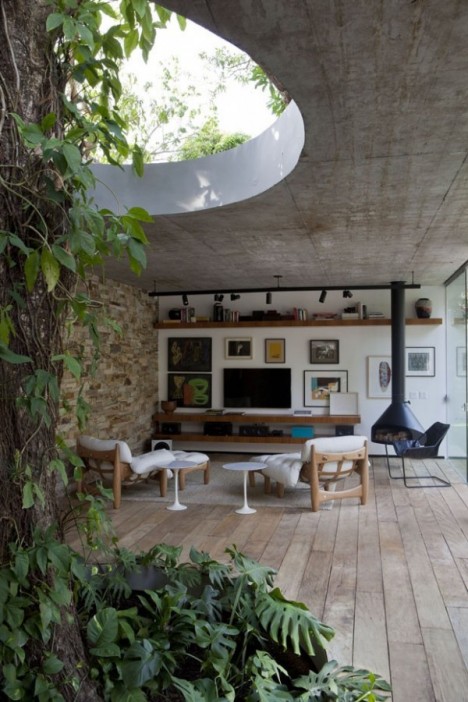
A tree called ‘Bethany’ is the centerpiece of this home in Rio de Janeiro, Brazil, passing through a three-meter hole in the floor slab and up through the ceiling of the living room. Casa Vogue by architect Alessandro Sartore also accommodates a second tree in the garage, keeping as much of the original landscape intact as possible and bringing the natural landscape indoors.

The Urban Treehouse by Baumraum
tree houses urban 1

tree houses urban 2

tree houses urban 3

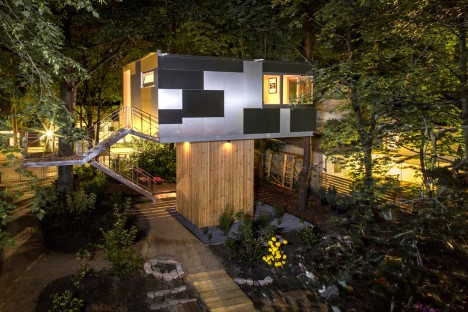
German architecture firm Baumraum is responsible for many of the world’s coolest modern treehouses, including a pair in Berlin that function as a mini-hotel. The Urban Treehouse preserves the trees on a 650-square-meter privately owned wooded property within the city limits, integrating nature and architecture.

Between the Trees by Sebo-Lichy
tree houses between 1

tree houses between 2

tree houses between 3

The design of ‘Between the Trees’ by Sebo-Lichy mimics the look of natural tree trunk supports, elevating a portion of the home to work with the steep terrain. It’s built around three chestnut trees and overlooks a forest, with floor-to-ceiling windows and a rooftop terrace blurring the lines between outdoors and in. The house was inspired by Mies van der Rohe’s famous Tugendhat Villa in Czech Republic.

Modern Austin Treehouse by MF Architecture
austin tree house 1

austin tree house 2

austin tree house 3

austin tree house 4

This entire Austin home was essentially designed around views of trees in the front yard and on the back terrace. Each of the rooms of the house by MF Architecture look out onto the oak in the backyard, which shelters the entire outdoor area.

Urban Treehouse Apartment Complex by Luciano Pia
tree house urban torino

tree house urban torino 2

tree house urban torino 4

tree house urban torino 5

The last place you’d expect to find a treehouse is in the middle of an urban Italian city – let alone an entire apartment building planted with dozens of trees on every level. 25 Verde by Luciano Pia has a load-bearing steel structure shaped like tree trunks as its base, with 63 wooden-shingled dwellings staggered around 50 trees. In addition to looking really cool, the trees help reduce air and noise pollution for the residents.

Next Page – Click Below to Read More:
Arboreal Architecture 14 Houses Built Around Within Trees

Share on Facebook


[ By Steph in Architecture & Houses & Residential. ]

[ WebUrbanist | Archives | Galleries | Privacy | TOS ]


WebUrbanist

 
Comments Off on Arboreal Architecture: 14 Houses Built Around & Within Trees

Posted in Creativity


NYC Comes Alive Around Massive Mural in Time Lapse Video

09 May

[ By Steph in Art & Street Art & Graffiti. ]

Screen Shot 2015-05-08 at 9.49.43 AM

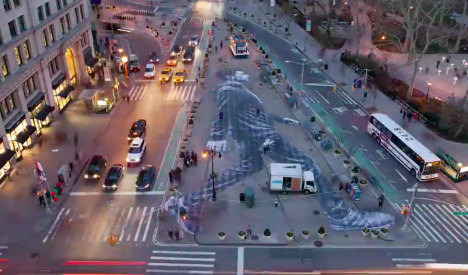
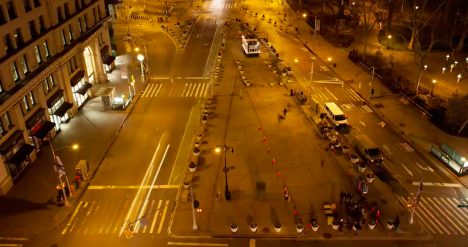
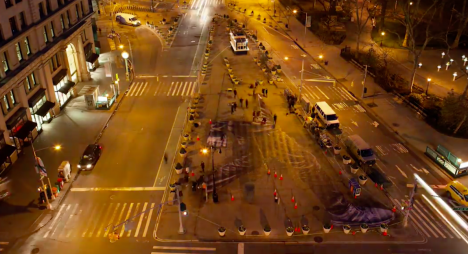
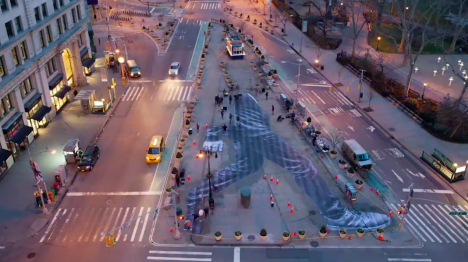
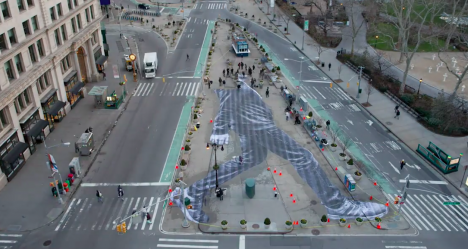
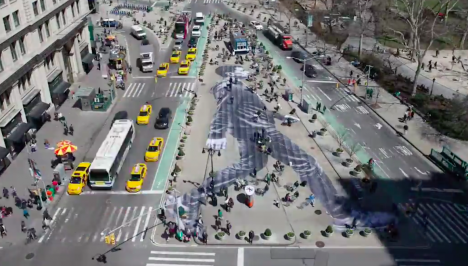
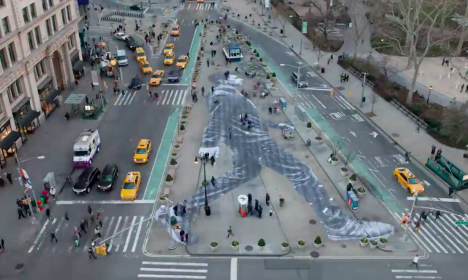
A 150-foot-tall figure of a man walking materializes on a Manhattan sidewalk, slowly coming into focus as the city awakens around it, in a new time-lapse video. French photographer and street artist JR directs a team of workers who can be seen scrambling around the piece like worker bees as the hours pass, the sun arcs over the site and thousands of people mill by.

Screen Shot 2015-05-08 at 9.46.23 AM
Screen Shot 2015-05-08 at 9.47.03 AM

The New York Times commissioned JR to create the piece for an accompanying story on walking in the city, and produced the video. A camera perched atop the adjacent Flatiron building captures the action as the team wets the pavement before dawn, preparing to adhere the giant paste-up.

Screen Shot 2015-05-08 at 9.47.20 AM

Screen Shot 2015-05-08 at 9.47.33 AM

It’s cool to see the process behind installing a wheat paste project this big, and the time lapse shows just how much work goes into it despite the fact that it’s not being hand-painted onsite.

Screen Shot 2015-05-08 at 9.48.41 AM

Screen Shot 2015-05-08 at 9.49.19 AM

JR is known for journalistic murals made of his own photography, putting giant faces all over urban structures like walls, roofs, streets and train cars. The photo-realism is especially effective when it’s paired with aging, deteriorating surfaces.

Share on Facebook


[ By Steph in Art & Street Art & Graffiti. ]

[ WebUrbanist | Archives | Galleries | Privacy | TOS ]


WebUrbanist

 
Comments Off on NYC Comes Alive Around Massive Mural in Time Lapse Video

Posted in Creativity


Your Basic Lighting Kit: A Spin Around the Block

13 Apr

So you bit the bullet and spent ~$ 100 for the stuff needed to turn your hot shoe flash into a mini portable studio lighting system. What do you with the box of stuff the UPS guy just dropped onto your dorstep? Where do you start?

That is exactly the gap we explore whenever I teach a beginner's lighting class. So today we are going to walk through a "first steps" exercise.

Read more »
Strobist

 
Comments Off on Your Basic Lighting Kit: A Spin Around the Block

Posted in Photography


What goes around: 6 mid-sized ball heads put to the test

08 Apr

One of the most important parts of a tripod is the head that connects the camera to the legs. Continuing where our previous ball head roundup left off, we’ve collected six ball-type heads for review that are in the medium-to-large size class. These heads are suitable for most large cameras and lenses, with only the truly gigantic or heavy devices requiring something larger. Find out which ones earn our recommendation. Read more

Articles: Digital Photography Review (dpreview.com)
 
Comments Off on What goes around: 6 mid-sized ball heads put to the test

Posted in Uncategorized