RSS
 

Posts Tagged ‘Architecture’

7 Abandoned Wonders of Institutional Architecture

14 Jan

[ By Steph in Abandoned Places & Architecture. ]

Abandoned Institutional Buildings Main

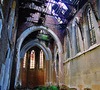
Churches, prisons, psychiatric hospitals and courthouses given over to the elements can sometimes taken on a mythic significance, given a haunting, creepy beauty by the passage of time. Removed from their former functions, these institutional buildings become both architectural skeletons and snapshots of human activity, frozen in time. In their emptiness, the echoes of past patients, prisoners and parishioners seem louder than ever.

Carabanchel Prison, Spain

Abandoned Carcel Prison Spain

Abandoned Carcel Prison Spain 2

(images via: alex//berlin_alexander stübner)

One of the biggest prisons in Europe until its closure in 1998, Madrid’s Carabanchel Prison was built by political prisoners after the Spanish Civil War between 1940 and 1944. During the ten years of its abandonment, the prison was inhabited by homeless people and other marginal groups, and covered in elaborate graffiti. Despite its historical significance and the protests of many locals, the prison was demolished in 2008.

It represented one of the most impressive examples of the repressive panopticon design, which allows a watchman to observe all inmates without them knowing when they’re being watched. The panopticon arrangement was initially envisioned not just for prisons, but also for hospitals, sanitariums and daycares.

St. Agnes Church, Detroit
Abandoned St. Agnes Church Detroit 1

Abandoned St. Agnes Church Detroit 2

(images via: memories_by_mike 1 2, erik_mauer)

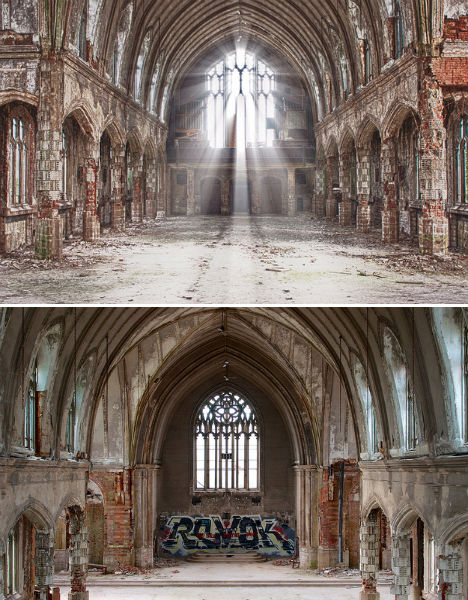
Abandoned in 2006 due to financial troubles, Detroit’s St. Agnes church remained in fairly good condition for three years, though it had been stripped to its bare bones. Even once all of the organ pipes, chandeliers and stained glass windows were gone, the church displayed much of its old grandeur.

But the structure underwent a striking transformation in 2009, when leaks in the roof led to extensive water damage and mold, causing the masonry to crumble. Textural details are revealed in stark contrast by a black grime of dirt and mold. Today, the church looks like much of the rest of Detroit; it has been looted and vandalized to the point of being unrecognizable.

Gartloch Mental Hospital, Scotland

Abandoned Gartloch Hospital Scotland 2

Abandoned Gartloch Hospital Scotland 1

Abandoned Gartloch Hospital Scotland 3

(images via: strike4th, bigcagwell, justified sinner, skin-ubx 1 + 2)

In service for over a century, Gartloch Hospital is a sprawling Victorian complex located just outside the city of Glasgow, Scotland. From the time of its opening in 1889, it served as an asylum for the poor people of the city. Though its primary purpose was as a psychiatric hospital, it temporarily served as an emergency medical facility during World War II. It was the subject of many a Scottish ghost story long before it closed in 1996, and today its dark, empty hallways feel more haunted than ever.

Hellingly Asylum, Sussex

Abandoned Hellingly Asylum 1

Abandoned Hellingly Asylum 2

Abandoned Hellingly Asylum 3

(images via: howzey)

Has any creepy old mental hospital ever been more fittingly named? Hellingly Asylum in Sussex, England opened in 1903 to relieve overcrowding at other institutions during a time in which people could be thrown into hospitals for the rest of their lives for being gay or having a child out of wedlock. Located on 400 acres, the complex included sex-separated wards, a villa for ‘mentally defective’ children, and a small isolation hospital for infectious diseases, which stood in the woods at some distance from the rest of the buildings. The hospital even had its own electric tramway.

Hellingly closed in 1994 and most of its buildings fell into rapid decline. Fires, vandalism and theft took their toll. Medical equipment and furniture could still be seen among the ruins during the years in which the only people who ever entered were urban explorers, graffiti artists, photographers and people with questionable intentions.

Today, only a few buildings remain. Most have been demolished to make way for new housing.

Next – Pripyat Schools, Bronx Borough Courthouse and Gary, Indiana’s City Methodist Church

Next Page:
7 Abandoned Wonders Of Institutional Architecture

Share on Facebook


[ By Steph in Abandoned Places & Architecture. ]

[ WebUrbanist | Archives | Galleries | Privacy | TOS ]


WebUrbanist

 
Comments Off on 7 Abandoned Wonders of Institutional Architecture

Posted in Creativity


14 January, 2013 – Architecture of a New Landscape

14 Jan

Many observers (myself included) see the mainstream of photography as somewhat constipated, endlessly self-referential, and boringly repetitious.

Today, one of our finest contemporary photographers, Eric Meola, looks at the use of colour in photography and explores The Architecture of a New Landscape.


 "Every time I go back to a module I had already seen, I learn additional things.  I have never seen tutorials that have the excellent mix of what the features are, 
how to use them, enough of the under-the-hood information 
and concepts so that I can utilize the features creatively and efficiently, 
and just enough humor to keep the motivation level high.  Wow!"


The Luminous Landscape – What’s New

 
Comments Off on 14 January, 2013 – Architecture of a New Landscape

Posted in News


7 Abandoned Wonders of Commercial & Industrial Architecture

07 Jan

[ By Steph in Abandoned Places & Architecture. ]

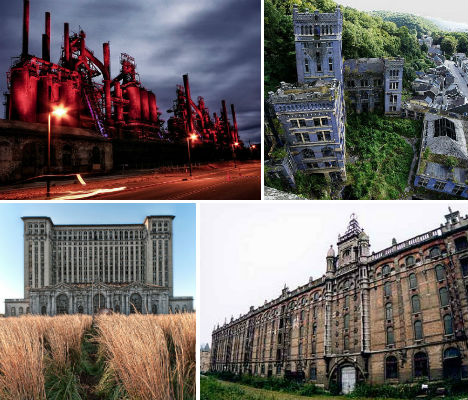
Abandoned Commercial buildings main

These castle-like structures, skeletal high-rises and rusting remains of the golden age of industry are monuments to themselves, still standing despite decades of neglect. Formerly factories, offices, corporate headquarters and industrial facilities, these 7 commercial and industrial sites contain clues to their former purposes among all the rubble, overgrown greenery, peeling paint and other effects of abandonment.

Abandoned High-Rises and Factories of Detroit, Michigan

Abandoned Detroit Factories Skyscrapers Buildings

Abandoned Detroit Mills Factories

Abandoned Detroit Factory

(images via: bob jagendorf, meeshypants, nitram242, davescaglione, joguldi 1 + 2)

When it comes to Detroit, how can you choose just one standout abandonment? The city is, in and of itself, a jaw-dropping wonder of architectural decay. Once it lost its identity as a manufacturing mecca, Detroit also lost a large number of its residents, leaving block after block abandoned, with few signs of life in between. Once the fourth-largest city in the United States, Detroit is now filled with towering structures that have been left as they were when last used, often full of the ephemera of life. These include a number of high-rises – the most notable being Michigan Grand Terminal, pictured above with an overgrown lawn – and burned-out factories.

In 1950, Detroit had a population of nearly two million; today, while similar cities have grown exponentially, this one is down to less than 900,000. The fact that the city has become something of an urban Wild West doesn’t exactly encourage new residents to purchase decrepit properties and return them to their former glory. The number of abandoned buildings standing in the city currently numbers around 70,000.

Bethlehem Steel Factory, Pennsylvania

Abandoned Bethlehem Factory

Abandoned Places Bethlehem Steel Factory 1

Abandoned Bethlehem Steel Factory 2

(images via: bob jagendorf, a.strakey, dandeluca, the seafarer, dave scaglione)

Once the second-largest steel producer in the United States, Bethlehem Steel began work on a large facility in Bethlehem, Pennsylvania in the 1860s that was at the forefront of manufacturing innovation at the time. Its towering facilities made it a symbol of the industrialized future of America. During World Wars I and II, it was a major supplier of armor plate to the U.S. Armed Forces, making components of weapons like large-caliber guns. But by the 1990s, America’s steel industry began to decline, and companies like this could no longer compete with cheap foreign labor.

When Bethlehem Steel closed its local operations, it laid out a plan for its 163-acre site for cultural, recreational, educational, entertainment and retail development, to reduce economic impacts on a city that had long relied on steel manufacturing for prosperity. However, the company went out of business and the land was sold to a developer that has turned it into a casino. Ironically, the casino had difficulty coming up with the 16,000 tons of steel needed to build its new $ 600 million complex, so it only finished one building. Some of Bethlehem Steel’s old manufacturing structures were demolished, but furnaces and gas blowing engine house still stand.

Hasard Cheratte Abandoned Coal Mine, Belgium

Abandoned Hasard Cheratte Coal Mine 1

Abandoned Hasard Cheratte Coal Mine 2

(images via: wikimedia commons, intermayer 1 + 2)

One of the most popular abandoned sites in Europe among urban explorers, the Hasard Cheratte Coal Mine in Belgium looks a bit like a crumbling castle. The facility dates to the 1860s, and was formerly one of many such mines in the coal basin of Liege. Make your way inside and you’ll find the hulking remains of industrial equipment and heavy mining machinery and lots of long, dark brick-lined passageways. Abandoned since 1977 and now a protected heritage site, the complex still contains such small items as books and work gloves. The largest ‘castle tower’ sits over the deepest mine shaft at the facility, which plunges a mind-boggling 1,574 feet into the ground. See photos of the interior at 28 Days Later.

Abandoned Chemical Factory, Poland

Abandoned Chemical Factory Poland 1

Abandoned Chemical Factory Poland 2

(images via: mlociny)

You probably don’t want to go inside this complex. The abandoned fluorescent light factory in Warsaw, Poland once manufactured mercury lamps; it was in the midst of renovation when astronomic mercury contamination levels put its modernization to a halt. Pools of mercury had collected under the floors, poisoning many workers. The factory was also occupied by the Nazis during World War II and used to produce transceiver equipment for submarines, tanks, and aircraft. During the Warsaw Uprising in 1944, Polish insurgents took it back.

As dangerous as it is, urban explorers have still made their way inside to photograph the peeling paint, rusted fixtures, rotting wood and broken glass. Documents, blueprints and bottles still full of chemicals are still scattered all over the building’s ten floors and basement level. The more valuable items, like toilets and sinks, are long gone.

Szkieletor Tower, Poland

Abandoned Skyscraper Szkieletor

(images via: joannaj, wikimedia commons)

Named after the He-Man villain Skeletor for its skeletal and arguably sort of evil appearance, Szkieletor Tower in Krakow, Poland has stood like a bleak lookout over the city since 1981. Construction began in 1975 on what was supposed to be the regional office of the Main Technical Organization, but halted six years later due to economic constraints, political unrest and the imposition of martial law in Poland. This history combined with its looks give Szkieletor an ominous feel. Though little more than a shell, it remains the tallest building in the city at 24 stories.

This tower was supposed to have a twin, and together they would have acted as a gateway to a skyscraper district in Krakow known as ‘Polish Manhattan.’ The original deadline for the entire project of Polish skyscrapers was 2005, but hopes for its future glory faded in the 1980s. Passing from one owner to the next, the building never seems to get past planning stages for renovation. A 2010 plan to turn it into a hotel has fallen flat. Instead, the building remains covered in massive billboards, a ham-fisted attempt to improve its looks and capitalize on its continued existence.

Warehouse B, Brussels, Belgium

Abandoned Warehouse B Brussels

Abandoned Warehouse B Brussels 2

(images via: abandoned-places.com)

Known locally as ‘The Prison’, Brussels’ Warehouse B is just one part of a sprawling multi-purpose transport center that was built in the early 20th century to house the Customs Administration, a railway station and a number of companies trading goods like tobacco, wine and beer. While some of these buildings are still maintained and occupied, Warehouse B has remained empty despite its beauty and historical worth. Serving as a warehouse for customs, the brick and stone building was used until 1987 for Customs storage, including confiscated goods.

The looks of the interior, including courtyards, metal security grates and many small, dark rooms, made it look a bit like a prison – so perhaps it’s no surprise that it was temporary used for this purpose by the Germans during World War II.

The Domes, Casa Grande, Arizona

Abandoned Domes 1

Abandoned Domes 2

Today, ‘The Domes’ of Casa Grande, Arizona look like the remains of some sort of sci-fi movie set. Any one of these round buildings could suddenly lift off the ground and zoom away into the atmosphere like a UFO. Built for computer manufacturing in the early 1980s for a facility that was never completed, they’ve just sort of been left to rot in the desert. InnerConn planned to build circuit boards here, and spent about $ 150,000 on each of the polyurethane and concrete domes. The idea was that they’d be more insulated in the desert climate, leading to lower maintenance costs.

According to local wisdom, you just shouldn’t go out there – cue obligatory whispers about ghosts and Satanic rituals – but judging by all the graffiti, many people go anyway. Many of the ceilings are falling in, and The Domes were an illegal dump site for years, making them a pretty dangerous site.

Share on Facebook


[ By Steph in Abandoned Places & Architecture. ]

[ WebUrbanist | Archives | Galleries | Privacy | TOS ]


WebUrbanist

 
Comments Off on 7 Abandoned Wonders of Commercial & Industrial Architecture

Posted in Creativity


Architecture Meets Fashion: Shoes by Hadid, Gehry & More

03 Jan

[ By Steph in Design & Products & Packaging. ]

Architect Shoes Main

How would the architectural styles of Zaha Hadid, Frank Gehry and Santiago Calatrava translate to shoes? As these 6 collaborations prove, sometimes the results are just as you’d imagine, and sometimes they’re completely unexpected. These architect-designed and inspired shoes range from the practical and wearable to sculptural art objects.

Zaha Hadid for Melissa

Architect Shoes Hadid Melissa

Brazilian brand Melissa offered the ideal medium with which architect Zaha Hadid could indulge her creativity: moulded plastic, which makes it easy to create shapes that can’t really be achieved with more traditional shoemaking materials. Says Hadid, “The design engages with the ?uid organic contours of the body. The shoes asymmetric quality conveys an inherent sense of move-ment to the design, evoking continuous transformation. The concept addresses the perception of wearing the shoe in motion rather than a static display on a shopping window.”

Frank Gehry for J.M. Weston

Architect Shoes Frank Gehry

Would you ever imagine that shoes designed by Frank Gehry would be so… conventional? The architect known for flashy, amorphous metallic structures designed these six-buttoned black-and-white leather boots for the 2009 collection of shoe company J.M. Weston.  “You shouldn’t have to differentiate between disciplines, shoes are very architectural and always have been, and even more recently there are new shoes… (that are) buildings.”

Zaha Hadid for Lacoste

Architect Shoes Hadid Lacoste

Zaha Hadid designed a series of limited edition shoes available in quantities of just 1,000. According to Hadid, the shoes were designed “utilizing dynamic fluid grids, which when wrapped around the foot, expand and contract to negotiate the body ergonomically – creating a unique undulating and radiating landscape, ultimately translated to shoes in fine calf leather.”

Julian Hakes for Mojito

Architect Shoes Julian Hakes

Architect Shoes Julian Hakes 2

The Mojito shoe by architect Julian Hakes wraps around the foot in a continuous ribbon, and lacks the footplate that one might say is the most essential part of the shoe. As with most of these creations, however, Hakes’ design is more about form than function.

Rem D. Koolhaas for United Nude

Architect Shoes Rem Koolhaas

The nephew of famed architect Rem Koolhaas, and an architect himself, Rem D. Koolhaas teamed up with British shoemaker Galahad Clark to create a line of architectural shoes for their brand United Nude. United Nude designs has also been inspired by other art forms, like furniture – they have a shoe that honors designers Charles and Ray Eames.

Santiago Calatrava-Inspired Shoes by Tea Petrovic

Architect Shoes Calatrava

The architecture of Santiago Calatrava is captured flawlessly in a series of cutting-edge shoes by Tea Petrovic  for a project at the Academy of Fine Arts in Sarajevo. “I have created a shoe collection, as my graduating project, that is centered around the idea that each shoe is an sculptural-architectural structured form. To underline their sculptural form, the shoes are kept white, which on the other hand emphasis the artistic language, present in the entire collection.”

Share on Facebook


[ By Steph in Design & Products & Packaging. ]

[ WebUrbanist | Archives | Galleries | Privacy | TOS ]


WebUrbanist

 
Comments Off on Architecture Meets Fashion: Shoes by Hadid, Gehry & More

Posted in Creativity


Architecture for the Apocalypse: NYC as a Heritage Site

25 Dec

[ By Steph in Architecture & Cities & Urbanism. ]

NYC Heritage site 1

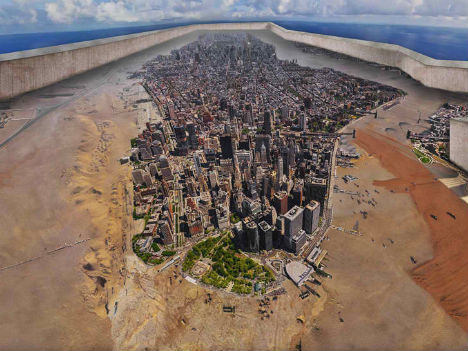
New York City is one of America’s greatest man-made achievements, but how can we protect and preserve it for future generations with inevitably rising seas and increasingly frequent weather catastrophes? A trio of designers has proposed a surprising solution: building up an earth barrier around the entire island and surrounding it with a concrete wall, turning it into a heritage site that could either remain a vibrant center of humanity, or turn into tomorrow’s Pompeii.

NYC Heritage site 2

The proposal, by designers Enrico Pieraccioli and Claudio Granato of Italy, won second prize in the New York CityVision competition. The contest invited designers to imagine New York in the future as the city itself and its inhabitants are affected by “space and time.”

NYC Heritage site 3

Rather than modifying it with elevated streets and walkways, lifting the inhabitable parts of the city well above the area that is currently vulnerable to rising seas, the heritage site concept preserves it exactly as it is, frozen in the time before potential climate calamity.

NYC Heritage site 4

NYC Heritage site 5

“Following this, New York is an open monument, global urbanism paradigm of the twentieth century, urban assemblage of events and phenomena, so it must be preserved. Crib of the whims of man, of consumerism and entertainment, it cannot be erased and forgotten, but is stored as a chip in our DNA. A document on how we were. Atlas of civilization and of archaeological as Pompeii and Herculaneum were examples of civilization of a people.”

Share on Facebook


[ By Steph in Architecture & Cities & Urbanism. ]

[ WebUrbanist | Archives | Galleries | Privacy | TOS ]


WebUrbanist

 
Comments Off on Architecture for the Apocalypse: NYC as a Heritage Site

Posted in Creativity


14 Designer Dog Houses: Curating Posh Pup Architecture

04 Dec

[ By WebUrbanist in Design & Furniture & Decor. ]

Famous architects have been known to dabble in other design disciplines, from furniture and interiors to products and packaging, but what happens when you task international icons like MVRDV and Toyo Ito with creating buildings for man’s best friend?

Beyond the cute facade of these canine dwellings, organized by Kenya Hara (images by Hiroshi Yoda), is a broader purpose: to provide free plans to pet owners who wish to replicate these structures in their own home.

Konstantin Grcic also plays to a particular breed – the poodle, famous for identifying its own reflection (and popularly known as a posh bread of puppy – perhaps reflecting the vanity of certain owners), gets its own light-up, dressing-room-style mirror to bask by.

Shigeru Ban, ever the fan of corrugated cardboard, has scaled down his approach to make a series of dog-sized space dividers.

Atelier Bow-Wow also had a specific species in mind for their creation: a ramp for smaller dogs that have difficulty walking up stairs or steep slopes, and which leads up to a level that allows them to sit face to face with their owner.

Other designs include mobile shelters, or roofs that serve as climbable landscapes, some patterned around a given type of dog and others based on the broader nature of the species.


Want More? Click for Great Related Content on WebUrbanist:

Amazing Designer Plays with Perspective for Decades

Swiss artist Felice Varini’s geometric painting calls into question our ideas about complex art pieces and the interaction between art and viewer.
2 Comments – Click Here to Read More »»


7 (More) Amazing Adaptive Reuse Architecture Projects: From Ship Houses to Chapel Bookstores

Know of other recycled design or amazing architecture projects? Be sure to list them in the comments below!
36 Comments – Click Here to Read More »»


Share on Facebook


[ By WebUrbanist in Design & Furniture & Decor. ]

[ WebUrbanist | Archives | Galleries | Privacy | TOS ]


WebUrbanist

 
Comments Off on 14 Designer Dog Houses: Curating Posh Pup Architecture

Posted in Creativity


Home Mathematics: 12 Fractal Furniture & Architecture Designs

29 Oct

[ By Steph in Design & Furniture & Decor. ]

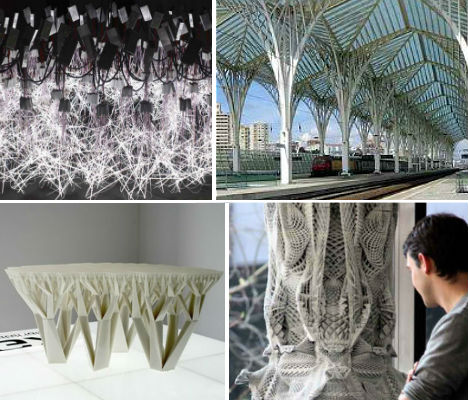
Geometry lies at the core of every design process, and as computer-aided design becomes more common, the patterns that can be found in architecture, furniture and home decor grow increasingly complex. The use of fractal geometry, in which a geometric pattern is repeated at smaller and smaller scales to produce irregular shapes and surfaces, is among the most visually interesting. Here are 12 fractal (and fractal-inspired) designs, from tables to the canopy over a train station.

Fractal Table by Platform Wertel Oberfell

(images via: platform-net.com)

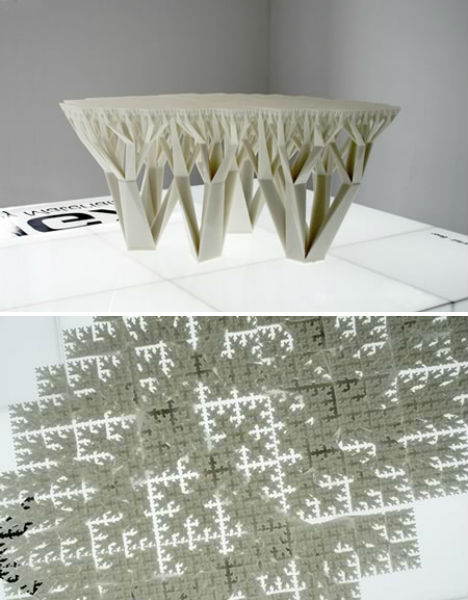
Mimicking fractal growth patterns found in nature, the Fractal Table by Platform Wertel Oberfell features legs that resemble tree trunks that divide over and over again until they’re dense enough to form a patterned surface.

Homune Table by Michael Young

(images via: design boom)

36 individual hand-blown glass fractals – six forms repeating six times – come together in this amber-colored geometric table by Michael Young. Says the designer, “over the years we have experimented with fractal structures creating endless constructions, not art but design experimentation,  studies into the unknown and transpired this research into the new lasvit glass table. we discovered that by blowing glass into only one metal tool and cutting it at different lengths, we could make logical and functional structures, the first thing being this special edition table.”

Ornamented Columns by Michael Hansmeyer

(images via:  design boom)

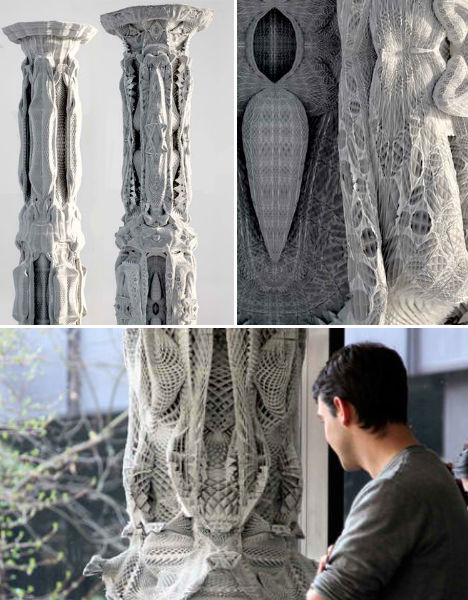
These columns are so complex, at first they don’t seem as if they could possibly be real. Michael Hansmeyer first designed his ‘ornamented columns’ using algorithms and subdivision processes that result in incredibly varied topographies. The designs were then created in three dimensions using 1mm grey board sheets that were individually cut using a mill or laser, then stacked together on poles that run through the core.

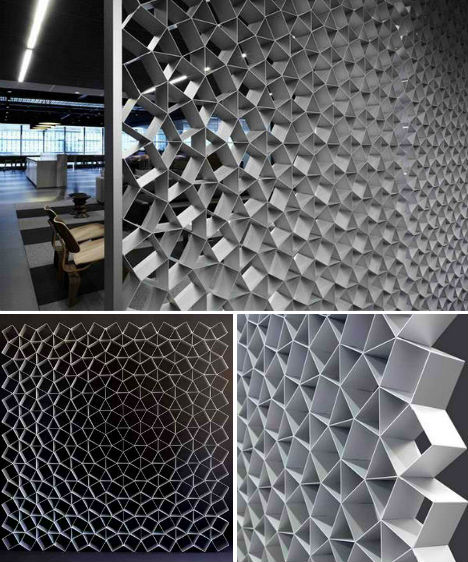
>Cellscreen by Korban/Flaubert

(images via: korbanflaubert)

Made of anodized aluminum, this room screen by Korban/Flaubert takes its inspiration from the fractal shapes of honeycomb.

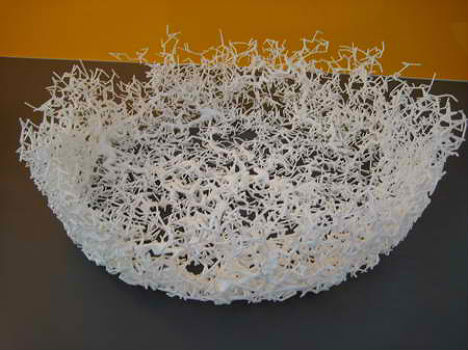
Diffusion Vessels by David Sutton

(images via: dezeen)

These unusual vessels were created by digitally fabricating the fractal growth patterns of natural phenomena like lightning and snowflakes through a process called ‘Diffusion Limited Aggregation’.

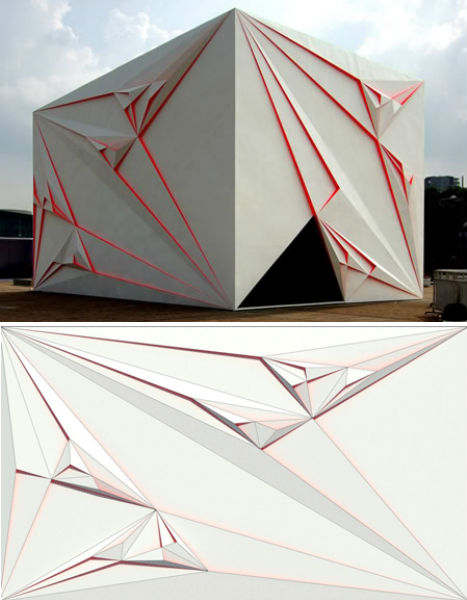
Embedded Project by HHD_FUN<

(images via: hddfun)

Architecture firm HHD_FUN created a pavilion in Beijing that features a pattern based upon a triangular fractal pattern. The faces of the pavilion were designed using a recursion algorithm, sub-dividing or ‘cracking’ each triangle into smaller and smaller triangles. At each ‘cracking’, new triangles are raised from the surface to create a three-dimensional pattern.

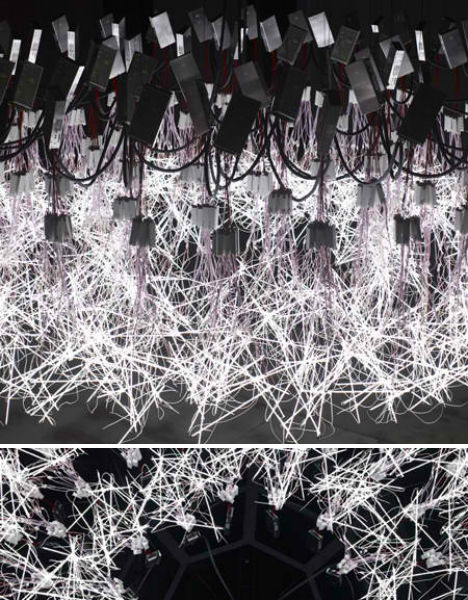
Absent Nature by Arik Levy

(images via: dezeen)

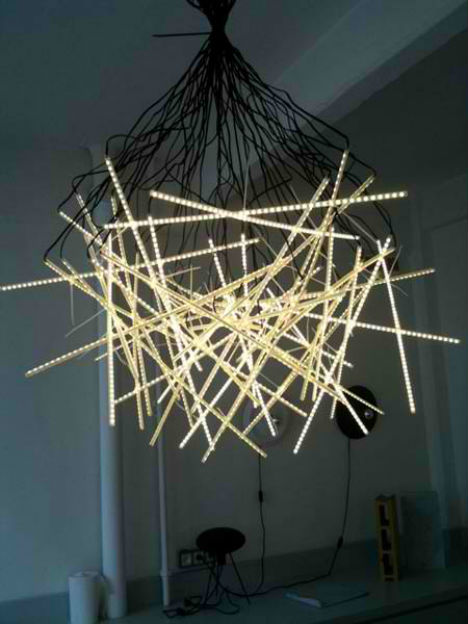
More than a thousand light tubes make up ‘Fractal Cloud’, a light installation by Arik Levy. “In the shadow of the Fractal Cloud light an enormous hexagonal ring of powerful light has been created from over one thousand light tubes woven onto another to become a single light-emitting textile projecting two small ricochets, one in colour and one in warmer white light.”

Fractal LED by Arik Levy

(images via: dezeen)

Arik Levy also completed this ‘Fractal LED’, another in his fractal LED light series.

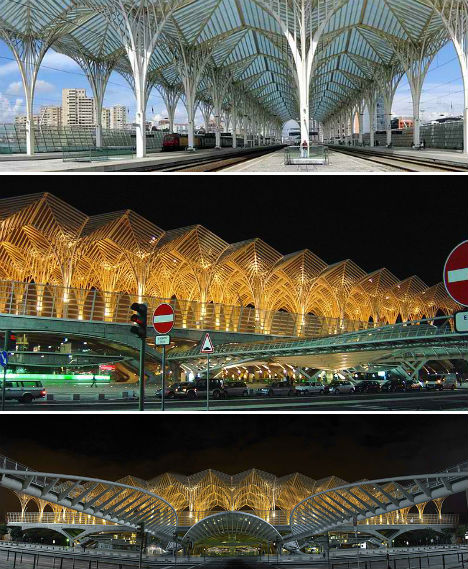
Lisbon Oriente Station by Santiago Calatrava

(images via: wikimedia commons)

Lisbon’s Oriente Station by Santiago Calatrava is a dazzling example of mathematically inspired architecture. Calatrava is known for designs that are often rooted in natural patterns and forms, particularly sea life and birds.

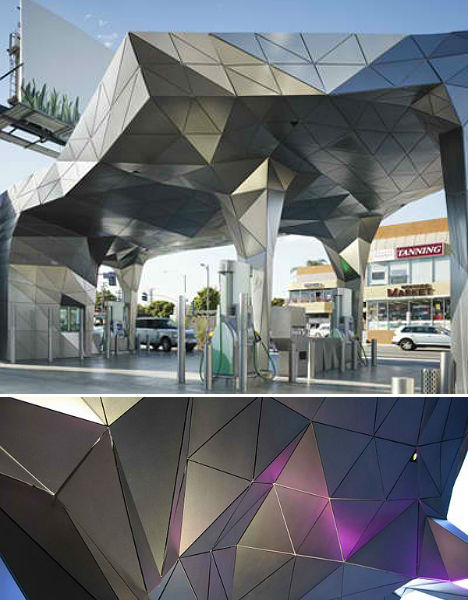
Helios House

(images via: wikimedia commons)

Its design may not technically be fractal, but the Helios House gas station in Los Angeles definitely has the look of a mathematical pattern to it, with its faceted stainless steel facade.

Fractal LiveBook

(image via: design boom)

This unusual design is a notebook computer that can be broken into smaller pieces, each of which is a reduced-scale copy of the whole. Says designer Pedro Calle, “Fractal LIVEBOOK is everything you need, it can be split into pieces each of which can work individually as laptops, pads, music players and tweak them with apps and widgets. It also can work together as a console with different touch-screens with programs, menus, tools, palettes, brushes and audio samplers, separating physically the workspace. Find all the fun on customizing your LIVEBOOK’s fractals, share them with your friends and enjoy making the digital realm a more analogous experience.”

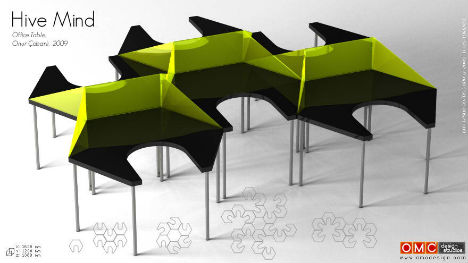
Hive Mind Office Table


(images via: omcdesign)

Offering more privacy and adaptability, and certainly better looks, the ‘Hive Mind’ office desk system is an alternative to conventional cubicles that can create fractal working spaces in various configurations.


Want More? Click for Great Related Content on WebUrbanist:

Flat-Pack Furniture: 3 Modern Designs from Noon Studio

Three designs from Noon Studio prove that simple is beautiful including a flat-pack cantilevered table, an oak and steel stool and an A-shaped leaning lamp.
Click Here to Read More »»


Art of Design: Amazing Artistic Furniture Designs

These 15 incredibly creative furniture designs are as much fine art and entertainment as they are functional seating, tables, beds and storage.
20 Comments – Click Here to Read More »»


Share on Facebook


[ By Steph in Design & Furniture & Decor. ]

[ WebUrbanist | Archives | Galleries | Privacy | TOS ]

WebUrbanist

 
Comments Off on Home Mathematics: 12 Fractal Furniture & Architecture Designs

Posted in Creativity


Architecture Photographers On Holiday (Part 1)

23 Oct

Hands up guilty ones! Who here gets itchy feet after about 2 months and needs to travel? Worse still, do you need to have a holiday reserved as if you are trapped without this planned escape? My hand is most definitely reaching for the skies but I did just get back from Italy. I travel a lot.

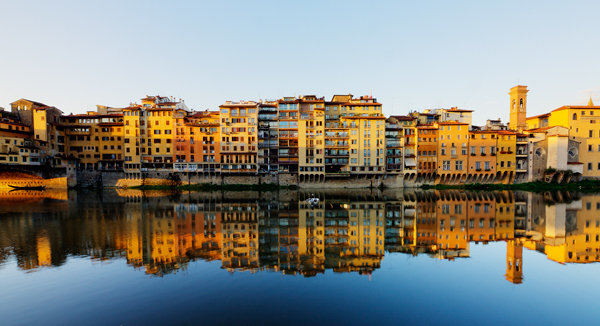
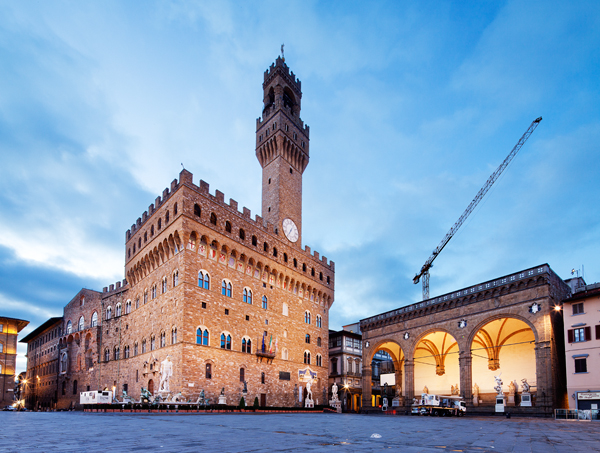
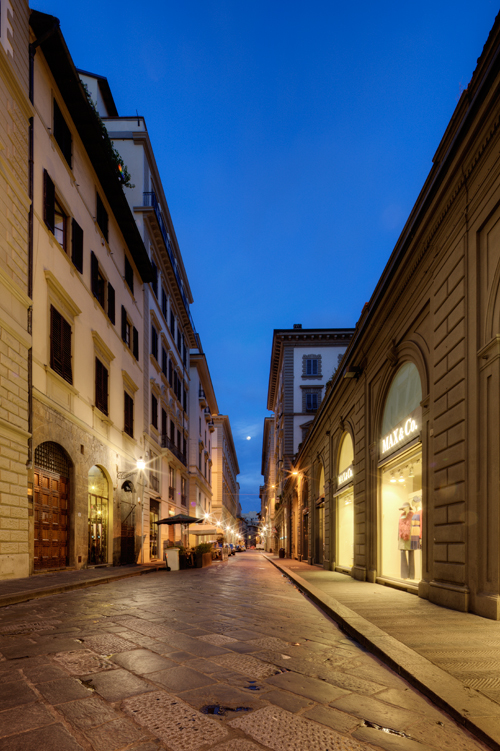
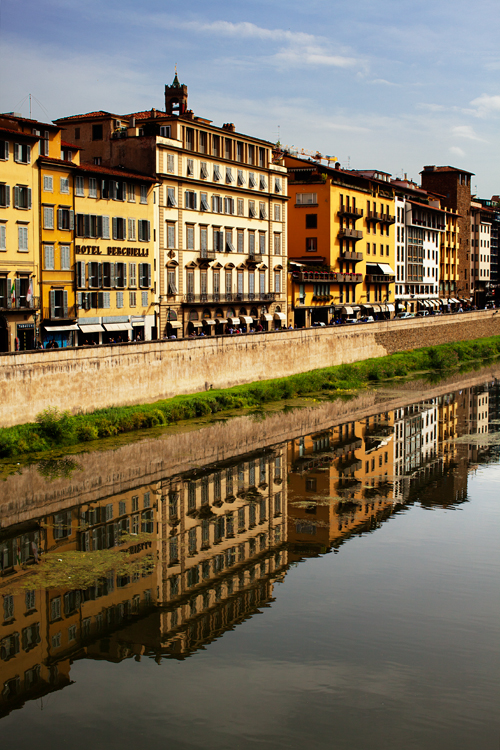
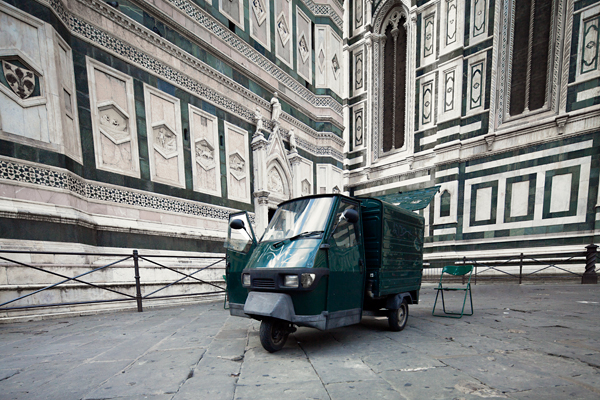
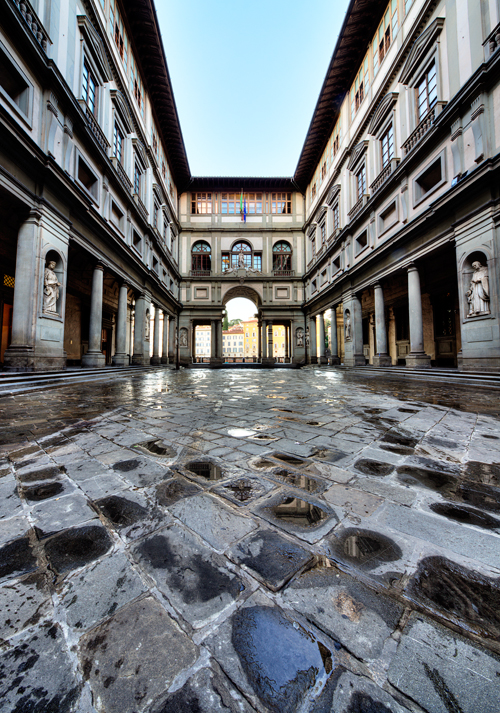
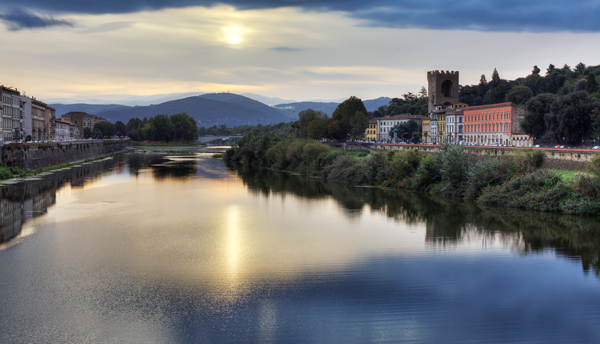
In the past I have been less than prepared and, all too late on my return, it was obvious in the quality of my images. For this article, I will highlight some of my tips and tricks to make the most from a photo trip away. In addition, I have restricted the images in this article to my recent destination, Florence, to further illustrate a little planning ahead can yield great results.

I am principally interested in architecture and landscape so my planning revolves around the light and the aversion of as many tourists as I can reasonably manage. People are good for scale but a 2 storey high statue of an intensely staring God, Neptune, surrounded by balloons and a massive throng of blue shirted people will not make an impressive image.

Not having visited Florence previously, I go straight to Flickr, Wikipedia and Google. Searching Flickr, ordering by ‘most interesting’ does seem a little like cheating, but I only had 3 dawns and 4 sun sets to play with. I doubt I would have found any undiscovered Florence in such a small time scale!

Utilizing image sites like Flickr, Google and Wikipedia will net you interesting buildings and scenes to photograph. It will be obvious where the good light is coming from and , on checking the timestamps in the EXIFs, what time of day too.

A slight digression on the importance of not losing images. I always take a laptop, 2 portable hard drives and spare Compact Flash cards. A drive that will directly take a CF/SD card, if your laptop fails, is also a good precaution. Also remember large capacity cards are very useful, but how many images are you prepared to lose in one go?

Dawn and dusk are the obvious times to be outside however I will use the time in between to venture inside buildings. If Europe is anything to go by each place of interest is closed on at least one day in the week and when they are open, access is potentially restricted to specific times. There may also be the requirement to book ahead. Did you notice all these lovely Italian scenes are outside? Guess who forgot to book tickets to indoor attractions?! Ahem. Many sites, open to the public, will have a policy on bags and tripods. You can pretty much always get away with a monopod, but I do get a little stressed when I find out I have to check in my back pack.

I encourage photographers to get somewhat lost in new places; there’s no quicker way to find and get a real sense of the local ‘scene’, but do take a guide book. My partner gets excited about trips and buys several. Lonely Planet and Rough Guide are great examples. Check they are recent editions.

As soon as you get to your destination scout your locations ahead of Sun up and Sun down. The internet got you to this point and you know the buildings and scenes to capture, but this is an opportunity to cultivate your own shooting style so take the time to look around each scene. There are some useful compositional tips in my previous post, Photographing Buildings.

The light will dictate the main aspects of your compositions, but there are many factors you can influence.

Balance your positive and negative space. Do the surroundings complement or weaken the main subject or building? Don’t be afraid to get closer – in Namibia, I spent hours literally 8 feet from a tall tree to get a ‘solitary imposing tree in a desert’ shot.

Do you need to emphasize the depth of field or the sheer scale of the scene. Setting your tripod low for a wide angle will help. You can force perspective by shooting a multiple shot panorama with a longer focal length.

When you prepare to go out ensure you can cover focal lengths to at least 100mm. I don’t use filters, but you might. Take a spare card or 2 – they do corrupt. Spare batteries, especially if cold outside and/or using live view. Does your remote trigger use batteries also? I actually use a wired shutter release, for this very reason. Take cleaning cloths, times two, lens wipes – the ones that come soaked in lens cleaner. Also take water, food, a torch and several plastic bags in case of heavy rain. Finally, in the field, who else has forgotten the tripod adapter was not already screwed to the base of the camera body?!

On location, and for each composition, I will shoot close focus images in addition to the main exposures. Not entirely trusting of histograms, I will pretty much always shoot a set of bracketed shots.

Be the humble photographer and don’t assume you have captured the best scene. Here’s the test when you think you’re done – ask yourself, “Am I coming back to shoot this scene properly?”.

Make best use of the light. Use your feet and shoot from somewhere else. Countless times I have berated myself for not taking an additional set of images 30 feet to the left or right, or closer. And for such simple mistakes too, like clutter I simply didn’t see or vertices that are obscured or just look weird with my chosen perspective.

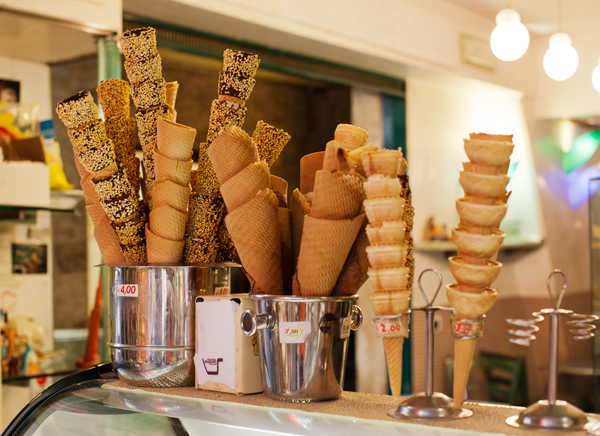
Don’t forget you’re on holiday! After the dawn shoot is the perfect time for a local breakfast. Camera straps were also invented to solve the problem of free hands to hold pizza and ice cream whilst walking!

Use the busy and touristy day times to walk light with a camera and lens and capture the faces and details on the street. I confess I am a bit ‘old school’ and will just attach my 50mm f/1.2. Walk, shoot and eat. It is your holiday, after all!

You’ll notice this is a Part 1. As you head home, if you’re anything like me, you’ll be keen to process and publish those images. My camera settings are perpetually in a neutral state, so I definitely have work to do in front of the monitor. In Part 2, along with some sample Photoshop files, I will reveal my image editing workflow; how I process my images for screen and print.

Post originally from: Digital Photography Tips.

Check out our more Photography Tips at Photography Tips for Beginners, Portrait Photography Tips and Wedding Photography Tips.

Architecture Photographers On Holiday (Part 1)


Digital Photography School

 
Comments Off on Architecture Photographers On Holiday (Part 1)

Posted in Photography


Architecture Gets Graphic: 13 Ornamental Building Designs

22 Oct

[ By Steph in Architecture & Public & Institutional. ]

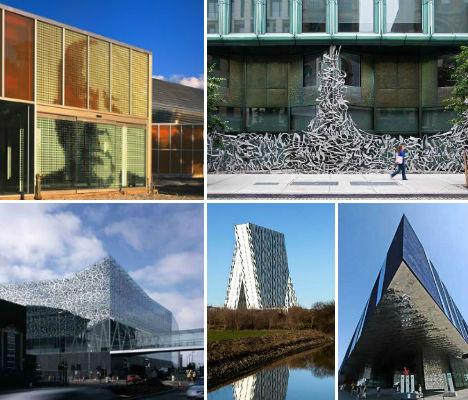
Modern architecture is not exactly known for being ornamental, but some architecture firms are beginning to pick away at the close association of modernism and minimalism. Led by Herzog & De Meuron, many practices have begun pulling bold, graphic and sometimes typographic elements into their building designs. Here are 13 examples of ornamental modern architecture.

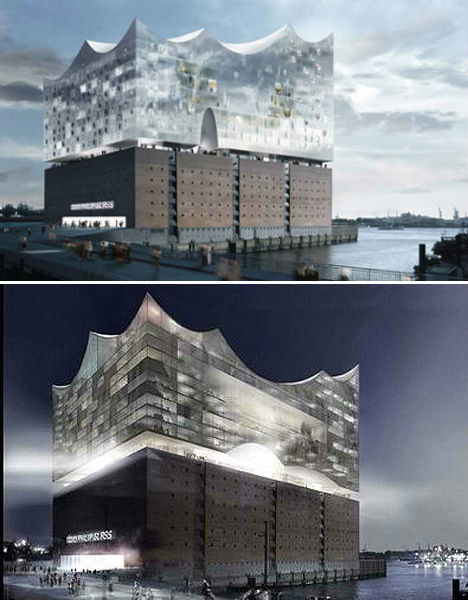
Elbe Philharmonic Hall by Herzog & De Meuron

(images via: design boom)

Architecture firm Herzog & De Meuron is one of the main forces bringing some ornamentation back into modern architecture, and the Elbe Philarmonic Hall is a prime example. This concert hall, hotel and apartment complex in Hamburg, Germany looks like a wave shooting up out of the river, blending with its surroundings yet at the same time, standing out as a dramatic glassy pinnacle in the landscape. The building is currently under construction and expected to be completed soon.

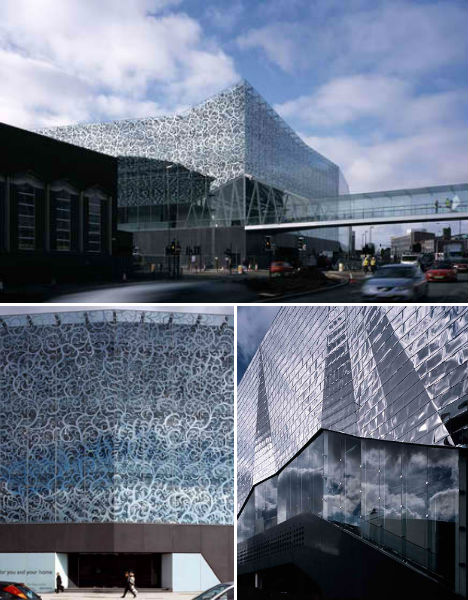
John Lewis Department Store and Cineplex, UK

(images via: archinect)

A shimmering geometric silver facade meets glass printed with a beautiful abstracted vine print at the John Lewis Department Store and Cineplex by Foreign Office Architects. The glass allows light to stream into the store section of the building, while the monolithic back end keeps the theaters dark. The design on the glass pays tribute to Leicester’s textile heritage as well as that of the department store.

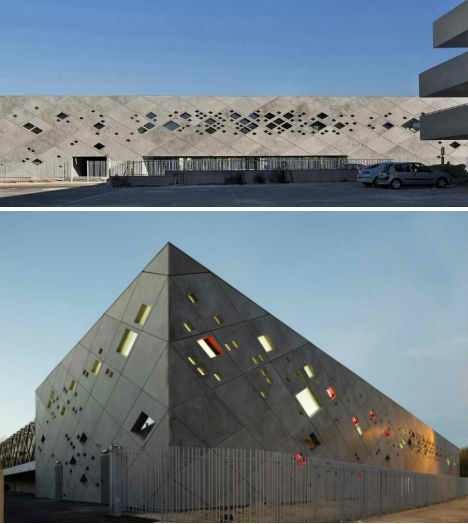
Lycee Louis Bleriot Extension, France

(images via: archdaily)

What could be an extraordinarily harsh, brutalist concrete rectangle is livened up considerably by a perforation of small diamond-shaped windows. The Lycee Louis Bleriot Extension by Christphe Gulizzi is a gymnasium that had to fit into a very limiting plot.

Scottish Parliament Building by Miralles Tagliabue EMBT, UK

(images via: galinksy)

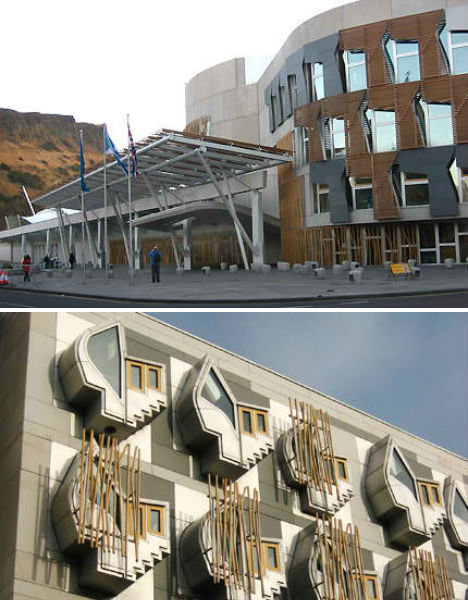
Divisive and eclectic, the Scottish Parliament Building certainly doesn’t shy away from complexity. Designed by EMBT (Enric Miralles and Benedetta Tagliabue), the building cost an astonishing $ 750 million to construct and is ‘metaphorical’ in design. Explains Miralles, “The Parliament sits in the land. We have the feeling that the building should be land, built out of land. To carve in the land the form of gathering people together… Scotland is a land… The land itself will be a material, a physical building material…”

Tate Modern Expansion by Herzog & De Meuron, UK

(images via: dezeen)

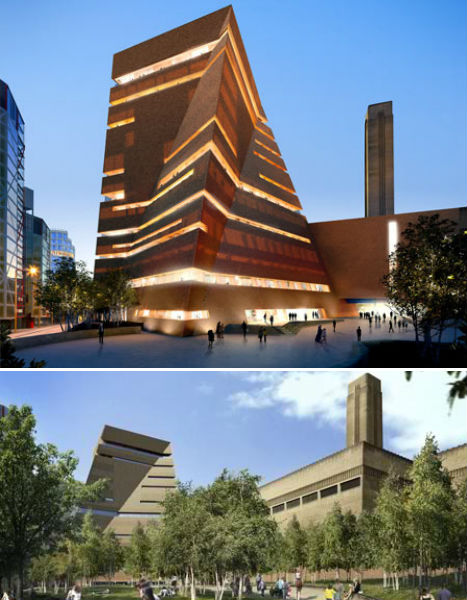
Herzog & De Meuron’s extension to the Tate Modern art museum in London will add a new wing, as well as converting underground tanks previously used to store oil for a former power station into new gallery space. The main volume of the extension resembles a conventional rectangular building shape that has been twisted and skewed.

Art’otel Hoxton by Squire and Partners, UK

(images via: archiscene)

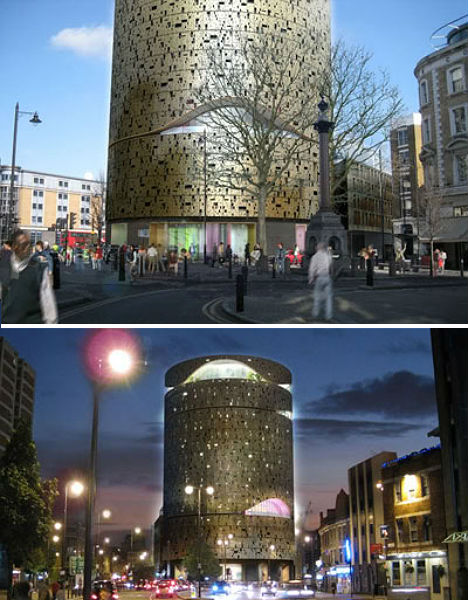
Squire and Partners designed the flagship hotel of Art’otel in London as a gold column covered in a perforated facade full of abstract patterns and rounded cut-outs that make the whole structure shimmer at night.

Forum by Herzog & De Meuron, Spain

(images via: arcspace)

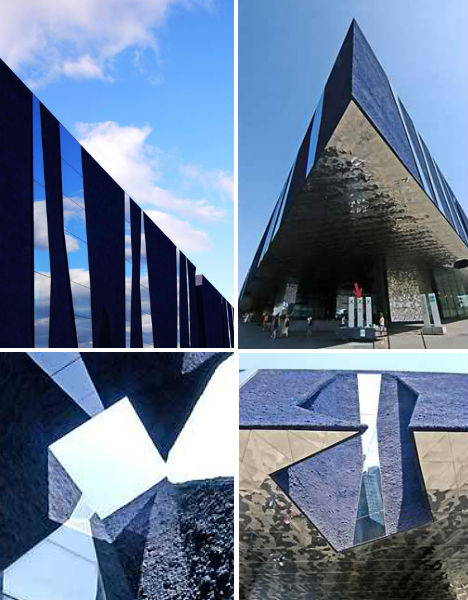
Jutting above a public square like the bow of a massive ship, ‘Forum’ is an elevated triangular structure in Barcelona that invites the public into its reflective silver underbelly. Though the building looks darka nd intimidating approach, it holds a series of courtyards open to the sky that bring in light.

Bella Sky Hotel by 3XN Architects, Denmark

(images via: design boom)

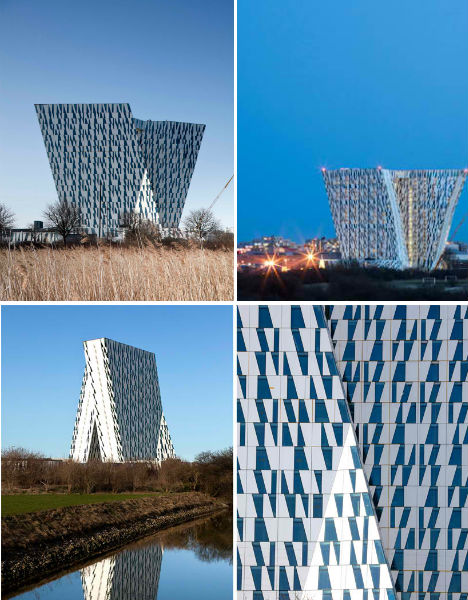
In both its shape and in the complimentary pattern of windows on its exterior, the Bella Sky Hotel by 3XN Architects looks almost typographic. Newly open in Copenhagen, the hotel consists of two asymmetrical towers and looks entirely different depending on your vantage point.

40 Bond by Herzog & De Meuron, NYC

(images via: archdaily)

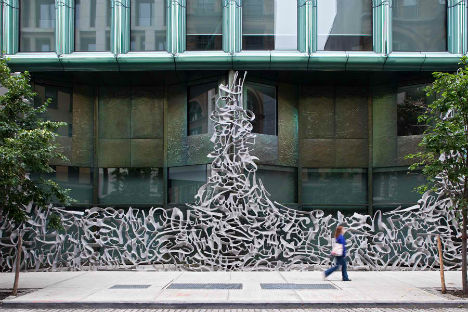
The standout feature on Herzog & De Meuron’s 40 Bond luxury residence in New York City is unquestionably this graffiti-inspired gate. A one-bedroom apartment in this building reportedly costs $ 18,000 a month.

C42 Citroen Flagship Showroom by Manuelle Gautrand Architecture, France

(images via: openbuildings)

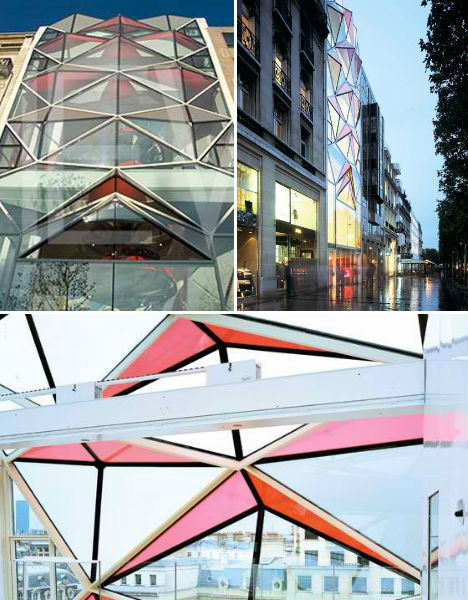
Diamond-shaped glass in soft shades of pastel pink that compliment the golden light streaming out of the interior characterize the new Citroën showroom on Champs Elysées in Paris. Once inside, that pink turns to red. Say the architects, “We originally conceived the use of red, the brand’s signature colour, in the glass panels but we decided it would be too bright from the outside. There were some concerns about the building not harmonising with its neighbours on the Champs Elysées, so we’ve created a filter that on first sight, masks the red colour from the exterior. This totally original filter, which is cleverly constructed inside the finished glass, also minimises the heat of the sun passing through, and will also create a diaphanous pearly white atmosphere inside the building.”

Sint Lucas Art Academy by Fashion Architecture Taste, Netherlands

(images via: dezeen)

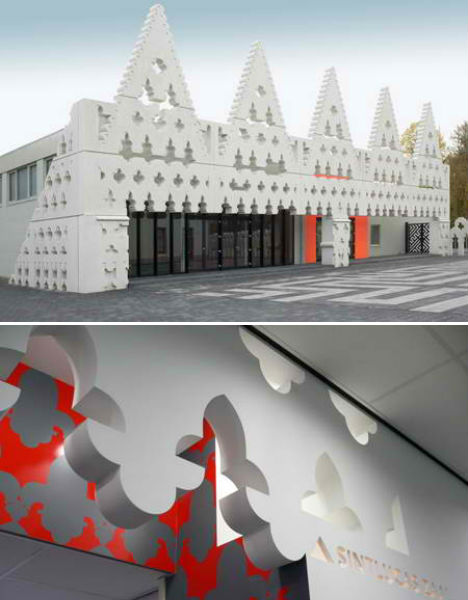
A 1960s building was given a dramatic makeover with a decorative facade inspired by both Dutch gables and the Doge’s palace in Venice, Italy. Architecture firm ‘Fashion Architecture Taste’ gave the Sint Lucas Art Academy an entirely new visual identity.

McCormick Tribune Campus Center by OMA, U.S.

(images via: arcspace)

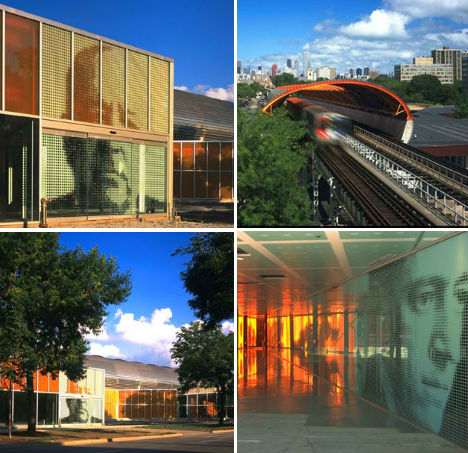
Working around a pre-existing elevated railway, OMA/Rem Koolhaas created a sound-isolating stainless steel tube that would form the basis of the McCormick Tribune Campus Center expansion at the Illinois Institute of Technology. The campus was originally designed by Mies Van der Rohe, whose portrait is emblazoned large on exterior and interior walls.

Midrash by Isay Weinfeld, Brazil

(images via: openbuildings)

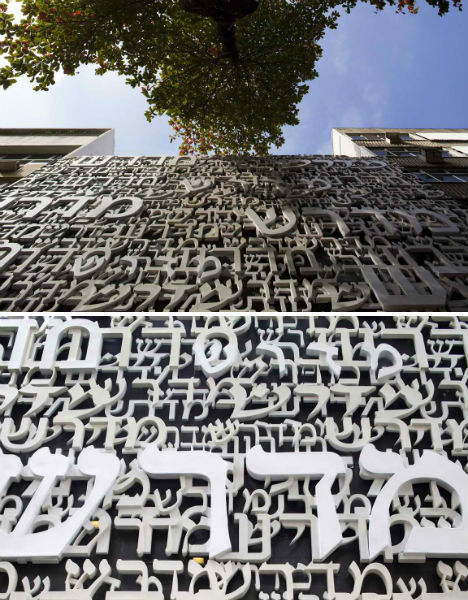
Designed to house the Jewish Congregation of Brazil, the Midrash Building by Isay Weinfeld in Rio de Janeiro has a fiberglass mesh facade made up of Hebrew words.

Placebo Pharmacy by Klab Architects, Greece

(images via: archdaily)

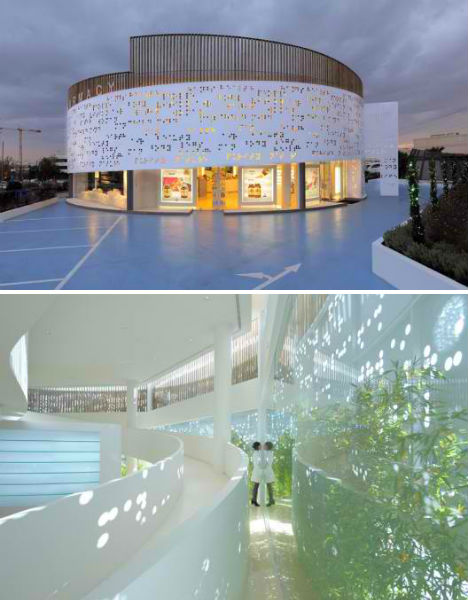
The shape and decorative elements of Placebo Pharmacy by KLab is about as far from Walgreens as you can get. In this case, the perforated mesh facade on the exterior is covered in braille.


Want More? Click for Great Related Content on WebUrbanist:

15 Cool High School, College and University Building Designs

If only more school buildings were as creatively designed as these 15, perhaps attendance rates would be higher.
32 Comments – Click Here to Read More »»


Black Buildings: 15 Examples of Monochromatic Architecture

These 15 buildings are brave and bold in solid black, from modern private residences to museums and offices.
Click Here to Read More »»


Share on Facebook


[ By Steph in Architecture & Public & Institutional. ]

[ WebUrbanist | Archives | Galleries | Privacy | TOS ]


WebUrbanist

 
Comments Off on Architecture Gets Graphic: 13 Ornamental Building Designs

Posted in Creativity


Nikon tutorial for photographing architecture

20 Sep

Here is a Nikon tutorial for photographing architecture. For more tutorials please visit www.nikon-is-different.com