RSS
 

Posts Tagged ‘ahead’’

Sony full-frame CineAlta 4K motion picture camera teased ahead of launch

28 Jul

Sony has teased its video-focused customers with news of an upcoming announcement: it will soon take the wraps off a new CineAlta motion picture camera, one sporting a 36x24mm sensor. There’s still a bunch details forthcoming, but thus far Sony has revealed that the new CineAlta model will be capable of multiple aspect ratios and will be compatible with many existing CineAlta accessories.

Sony has only revealed a handful of details about the camera at this time (below), explaining that it is developing the model ‘through careful research and close collaboration with creative professionals.’ The company doesn’t state when the camera will be available, nor when the full announcement will be made.

Technology highlights and key benefits:

  • Full Frame 36x24mm sensor exclusively designed for this Digital Motion Picture Camera
  • Aspect ratio-agnostic – including Full Frame, Super35 4K 4-perf 4:3 Anamorphic and 4K spherical 3-perf 17:9
  • New image sensor enabling exceptional picture quality
  • Maintains the workflow established with Sony’s 16bit RAW/X-OCN and XAVC
  • Compatible with current and upcoming hardware accessories for CineAlta cameras (DVF-EL200 Full HD OLED Viewfinder, AXS-R7 recorder, AXS-CR1 and AR1 card reader, AXS and SxS memory cards).

Via: DIYPhotography

Articles: Digital Photography Review (dpreview.com)

 
Comments Off on Sony full-frame CineAlta 4K motion picture camera teased ahead of launch

Posted in Uncategorized


Yi 4K+ action camera and Carbon Fiber Drone announced ahead of CES 2017 debut

29 Dec

Chinese company YI Technology, maker of the Yi Action Camera, and the YI M1, which we reviewed earlier this year, has announced the YI 4K+, an update to the company’s previous YI 4K model. This is the third action camera in YI Technology’s lineup, and it improves upon the previous model with 4K recording at 60fps rather than 30fps. Yi plans to unveil the camera at the Consumer Electronics Show (CES) 2017 next month.

In addition to the YI 4K+ unveiling, YI Technology also plans to demonstrate its YI Erida smart drone at CES, marking the model’s first demonstration in the U.S.

The YI Erida is described as a full-carbon ‘smart drone’ with a three-rotor design and support for the Yi 4K action camera. This drone has a top speed up to 75MPH and flight time rated up to 40 minutes per charge.

Via: BusinessWire

Articles: Digital Photography Review (dpreview.com)

 
Comments Off on Yi 4K+ action camera and Carbon Fiber Drone announced ahead of CES 2017 debut

Posted in Uncategorized


Leica Sofort instant camera officially announced ahead of Photokina debut

16 Sep

Following speculation that such an announcement was imminent, Leica has taken the wraps off its new Sofort instant camera, something photographers can use to ‘create small, haptic works of art and lasting memories,’ according to the company. The Leica Sofort features a fixed 60mm (34mm equivalent) lens with an F12.7 aperture, an integrated flash, eight operation modes, 1/8 to 1/400s mechanical shutter and a rear optical 0.37x viewfinder. In other words, it’s more than likely to be a re-badged Fujifilm Instax Mini 90.

The Sofort, which is set to make its first public debut at Photokina, will be available in mint, white, and orange colors. Users have eight operation modes to choose from: Automatic, Selfie, People & Party, Action & Sport, Bulb, Macro, Self-Timer, and Double Exposure. The integrated electronic flash includes the following four modes: Auto, Forced On, Forced Off, and Forced On w/Red-Eye Reduction.

The Sofort will launch this upcoming November alongside three different instant film pack options: a color film pack with 10 exposures, a color film double pack with 20 exposures, and a monochrome film pack with 10 exposures. The camera will also accept Fujifilm’s Instax mini film.

Several accessories will also be offered, including a range of carrying straps in black & white, mint, and orange colors; soft carrying cases in brown or black; the Sofort Photo Presenter for presenting photographs; Sofort Postcards 3-packs with support for attaching pictures; the Sofort Photo Album; and, finally, the Sofort Storage Boxes, which will be offered in sets of three with the following color combinations: white & black, orange & black, and mint & black.

Pricing information hasn’t yet been revealed.

Source: Leica

Articles: Digital Photography Review (dpreview.com)

 
Comments Off on Leica Sofort instant camera officially announced ahead of Photokina debut

Posted in Uncategorized


Getting the Right Timing for Great Outdoor Photographs by Planning Ahead

09 Sep

There is more to taking great outdoor photographs than a pleasing composition and the correct exposure. There is another important aspect. One that is too often overlooked when trying to capture a beautiful scenic subject or vista. The right timing is required to get great photographs.

Often on social media sites, images are posted that show ideal composition and exposure. But they are not photographed at the best time of day to capture the most attractive and interesting image. Some say that taking the most eye-catching photos is only about luck; being in the right place at the right time. But with the proper preparation, the odds of creating an exceptional photo can be increased. Certainly, without any pre-planning, you may be able to create “okay” images on a regular basis, but let’s examine the role timing takes in capturing more stunning images.

Here shooting toward the east in the evening produced some nice light on this image.

Shooting toward the east in the evening produced some detail-revealing light on this image.

Research

Much preparation for an outdoor photo shoot can be done from your computer, before even leaving the house. Listed here are three very effective tools that can help you find great shots. They can show you where you want to be, and when you want to be there:

  • Google Earth: The Google Earth software provides street views of any location on earth. This is very useful, as you can literally see and plan a shot from your computer before leaving to shoot. Google Earth gives you the ability to determine the best location, and its ideal angle to capture before even arriving!
  • GPS: Use GPS devices to help navigate to the exact location where you plan to shoot.
  • The Photographer’s Ephemeris: TPE is a very useful on-line tool to help plan outdoor photography. Its maps show how natural light falls on the earth both day and night for any location on earth, and for any time or day in the future!
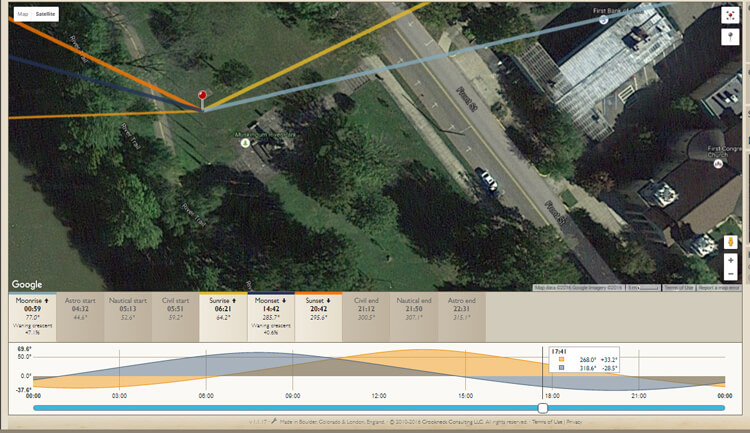
    Screen capture from TPE showing the direction of the sun at the time the image of the statue and church was captured.

    A screen capture from TPE shows the direction of the sun when the above image of the statue and church was captured.

Time of day

Photographing at the right time of day is a big factor to getting the right light for a special image. It is a well-known fact among serious art-driven photographers, that some of the best light for making great outdoor images, happens early in the morning and late in the afternoon. These are called the “golden hours”.

But in addition to shooting during those times, notice should be taken as to where the sun is casting its light. Shooting into the light will mean that your subject will be in the shadows, or even silhouetted. Yes, the exposure can be compensated in this situation, but watch what happens to the sky in the image. It will be blown out and colorless. There are times when this shot may work, but the point here is to always be aware of the direction of light.

 

Same location as above, but this time it was shot in the morning. Notice how the sky is completely blown out when getting the exposure on the statue. Even tho this is nearly the same image as above, it doesn't have near the impact.

Same location as above, but taken facing into the morning sun. Notice how the sky is completely blown out when the exposure is set for the statue. Even though this is almost the same image as above, it doesn’t make near the same visual impact.

Don’t leave this factor to luck. When planning a trip, try to schedule the day around good light. Shoot westward in the morning, and toward the east in the late afternoon and early evening. Midday light in most cases is very harsh, and produces very contrasty images and deep shadows. Again, producing arresting images in this light is possible, but is also definitely more challenging.

So what does one with a camera do in the middle of the day? Rest or travel! The bottom line is, that if you are on vacation, with an open agenda, and are looking to take great photos of the sights, plan around the light to get the best results.

Using TPE I was able to determine the exact day that the sunrise would aline with the bridge to capture a one of a kind image.

Using TPE I was able to determine the exact day that the sunrise would aline with the bridge to capture a one of a kind image.

Season

Considering the season of the year can make a great difference in your photos. The angle of the sun changes from season to season. For instance, photographing a deep canyon in the winter will produce a much different image than one taken in the summer. Because of the lower angle of winter sun, light won’t reach the canyon floor as it would in summer.

Besides the change in light, there is the obvious a variation of foliage colors (or the absence thereof) from one season to the next, that can completely change the image captured at a given location. Sometimes it is fun to capture a four-season image of the same subject and location.

Weather

Weather conditions are a great factor when it comes to capturing the perfect scene. They should always be considered, even though they can’t be planned.

Overcast days, while not great for sky images, often produce very nice even lighting. This is ideal for shooting things like waterfalls. Bright sunlight can make it almost impossible to capture the scene without blowing out the water, and making it necessary to use a Neutral Density filter. Don’t look at dreary weather as always being a negative; rather, turn those negative conditions into a positive result. For instance, a foggy morning may mess with a pre-visualized image in one location, but an alternative location nearby may be perfect for foggy conditions.
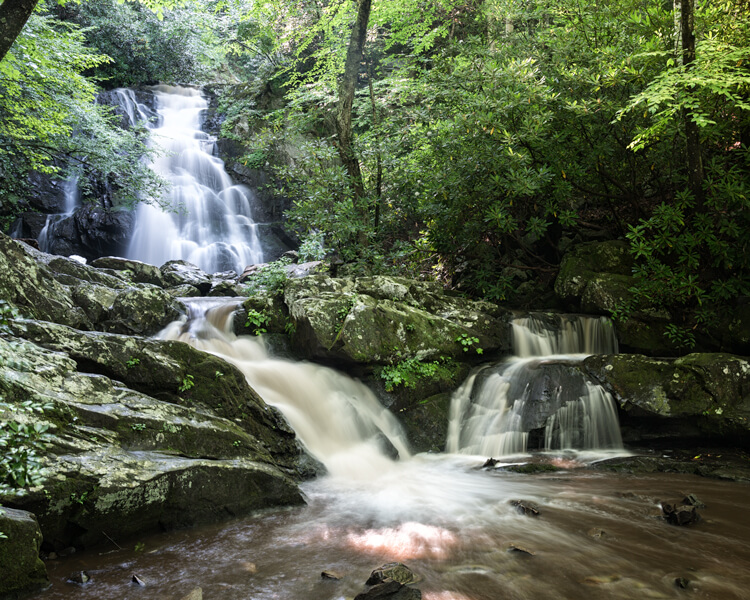
This waterfalls was captured while the sun was shining. Notice the hot spots created by the sun on the water.

These waterfalls were captured while the sun was shining. Notice the hot spots created by the sun on the water.
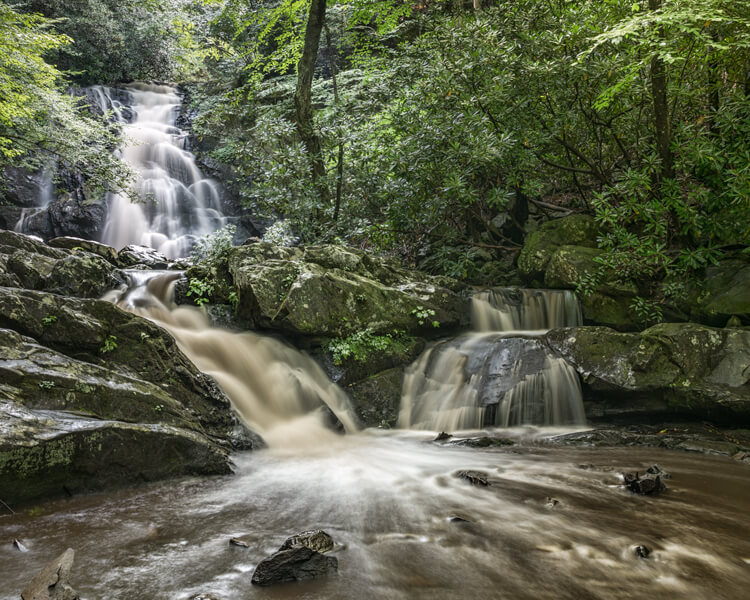
Same waterfalls as above by this time captured in cloudy conditions allowed for a long exposure with out the hot spots or a ND filter.

Cloudy, overcast conditions allowed for a long exposure of the same waterfalls, removing the hot spots or need for an ND filter.

Rainy conditions may also produce pleasing effects on the subjects being photographed, darkening bright rocks and saturating foliage. However, it may be necessary to use a polarizing filter to reduce glare.  Also, when faced with unexpected weather conditions, be patient! Some rather fantastic shooting conditions occur following storms. Watching and waiting for just the right weather-related effects can provide an opportunity to capture a unique image, of even the most commonly photographed locations.

Special Occurrences

You could be out all night. Your tripod and camera all set up to watch the skies to photograph a meteor shower, and not see a single streak of light!  But with a little research you can ascertain when the next large meteor shower will occur. Thus the chance to capture the desired photos will be increased. To take the meteor shower experience one step farther, look for a night without a moon. This will help the stars to appear more vividly in the photographs. Use The Photographer’s Ephemeris to find special occurrences of the moon or sun, or look for times when the sun or moon rise or set may be in line with a special location. This a fun and creative way to produce a fascinating image, instead of an ordinary one.

Using TPE to reseach is image I knew the exact time an location of the full moon rising. What really made this image was the sunset at my back that was casting some fantastic light on the city. Knowing this facts allowed me to create a one of a kind image of Marietta Ohio. One that I have sold many times.

Knowing when and where the moon would rise allowed me to plan and be ready to capture a unique image of Marietta, Ohio. Using TPE to research this image, I knew the exact time and location of the full moon rising. The sunset light behind me cast fantastic light on the city, that absolutely defined the shot, prints of which I have successfully marketed.

Day of the week

Every photo event timing factor considered so far has had something to do with light and lighting. But timing also includes the aspect of planning a less stressful, more convenient, and possibly more productive photo shoot. The day of the week is one such factor.

Time off from day-to-day activities often happen for many individuals and families on the weekends. Many are out visiting popular locales en force on those days. High traffic photo sites are best visited mid-week. There will be a better chance of having more room to work, free of other photographers attempting to get the same shot.

Conclusion

To wrap up this article on timing and preparation, remember the five P’s of capturing that great image:

Proper Planning Prevents Poor Photographs

Whether just taking a day trip or a long vacation, planning your photographs around the best available light will increase your chances of capturing a memorable image.

Do you have any tips for planning for the best light? Please leave them in the comments below.

googletag.cmd.push(function() {
tablet_slots.push( googletag.defineSlot( “/1005424/_dPSv4_tab-all-article-bottom_(300×250)”, [300, 250], “pb-ad-78623” ).addService( googletag.pubads() ) ); } );

googletag.cmd.push(function() {
mobile_slots.push( googletag.defineSlot( “/1005424/_dPSv4_mob-all-article-bottom_(300×250)”, [300, 250], “pb-ad-78158” ).addService( googletag.pubads() ) ); } );

The post Getting the Right Timing for Great Outdoor Photographs by Planning Ahead by Bruce Wunderlich appeared first on Digital Photography School.


Digital Photography School

 
Comments Off on Getting the Right Timing for Great Outdoor Photographs by Planning Ahead

Posted in Photography


Metz teases 30 percent smaller flash ahead of Photokina

07 Sep

German company Metz has teased a new generation of flash products ahead of Photokina, where it plans to launch the first flash model in this new product line. According to a post on the company’s Facebook page, the new flash will be 30% smaller than previous models thanks to ‘new developed technologies and construction.’ Metz says it will post more details about the flash on its Facebook in the days leading up to Photokina.

Via: Photo Rumors

Articles: Digital Photography Review (dpreview.com)

 
Comments Off on Metz teases 30 percent smaller flash ahead of Photokina

Posted in Uncategorized


Don’t get ahead of yourself: Canon EOS 5D Mark IV rolling shutter test

27 Aug

Much of the initial concern about the EOS 5D Mark IV’s video has been about its substantial 1.64x crop (relative to the full width of the sensor, 1.74x compared to the 3:2 region) and its use of the inefficient Motion JPEG compression system (which limits the ability to use SD cards with any dependability).

However, upon shooting with the camera we found it to have significant rolling shutter. We’ve demonstrated the effect alongside the EOS-1D X Mark II, which reads out its sensor fast enough to exhibit pretty low levels of rolling shutter, and the Sony a6300, which shows a relatively high level of rolling shutter.

Obviously we’ve panned faster than you ever sensibly would, to make the difference clearer. If you’re careful with the way you move the camera, this rolling shutter effect may not be too apparent however, for some kinds of shooting, it can be distracting.

Articles: Digital Photography Review (dpreview.com)

 
Comments Off on Don’t get ahead of yourself: Canon EOS 5D Mark IV rolling shutter test

Posted in Uncategorized


Affinity Photo 1.5 update detailed ahead of autumn release

24 Jul

Affinity Photo, software maker Serif’s non-destructive photo editing alternative to Photoshop, is set to receive its fifth major update this fall. The company has published a video detailing features arriving in Affinity Photo v1.5 for Mac, saying it expects the same features to be made available in the upcoming Windows version of the software, as well.

Affinity Photo 1.5 will bring the following features, says Serif:

  • Advanced HDR merge producing full 32-bit linear colour space images
  • An entirely new workspace for tone mapping
  • Focus stacking to bring depth to multiple combined images
  • Batch processing for smoother, faster workflow
  • Macros to record and replay a set of commands
  • An all-new way to edit 360 degree images

The 1.5 update will be available to existing Affinity Photo customers for free. New customers can get the software with a 20% discount today at $ 39.99/€39.99/£29.99. The price will revert back to its regular $ 49.99/€49.99/£39.99 price starting tomorrow. Windows users can sign up to be alerted when the Windows beta version is available here.

Articles: Digital Photography Review (dpreview.com)

 
Comments Off on Affinity Photo 1.5 update detailed ahead of autumn release

Posted in Uncategorized


3 Tips For Getting Ahead In The Photography Industry

06 Sep

Photography Industry Leaders Share Their Top 3 Tips For Getting Ahead In The IndustryTop 3 Tips For Getting Ahead In The Photography Industry

Hey there FashionPhotographyBlog.com readers. Our friends from the Dots return to join us on our site to share great tips they have uncovered from their recent masterclass in London, UK. The Dots is a community of creative professionals, designed to connect creatives with collaborators, companies and commercial opportunities. They are just as passionate about collectively building a stronger, more profitable and diverse creative sector as we are and we are very excited to have them featured here again.


For those of you who may not know, The Dots hosted a Photography Portfolio Masterclass at the incredible Spring Studios to give talented emerging Photographers the chance to have their work reviewed by some of the UK’s most prominent Picture Editors and Photographic Agents.


With such a wealth of experience in the room, The Dots team took the opportunity to ask a few questions on how to get ahead in the hugely competitive Photography industry. Here’s what the industry representatives had to say:


Getting Ahead In The Industry – 3 Top Tips


  1. Be original


Photography industry leaders are primarily on the hunt for originality and a unique perspective because, “in the end if you’re presenting a book that looks like someone else, you better be a cheaper version of them, because there’s no reason to hire you just to be a copycat” (Robin Derrick, Executive Creative Director, Spring Studios).


Matt Davey (Co-Founder & Director, Probation London) told us that he looks for “ originality – an ability to express ideas in their work and create something other than just a pretty picture.”


  1. Have a ‘Can-Do’ attitude


Never underestimate the importance of having an upbeat and ‘go-getting’ character. If someone thinks you’re going to respond to a difficult brief with enthusiasm, they’re more likely going to want to work with you.


Dalia Nassimi (Deputy Picture Editor, WIRED) told us “If they have that easy going, very can-do personality and are up for a bit of an adventure you get real magic.”


Similarly, the main thing Jamie Klingler (Publishing Manager, Shortlist/Stylist Magazine) looks for in a photographer is “someone that will do anything and that are part of my team on the day. These are the people who I wanna work with again and again and I wanna have a drink with, and who I’ll hire a million times over.”


  1. Be personable


You’re going to have to work with lots of people throughout a shoot and if you’re unpleasant to be around, chances are noone is going to want to work with you again. “You need to be personable, you need to get on with people, you need to be able to chat and work around an idea.” (Steve Peck, Picture Editor, WIRED Magazine).


It may not seem that important, but as Nicola Kavanagh (Editor in Chief, Glass Magazine) points out, if it’s a toss up between two photographers, “and they both have a really strong portfolio, I’m gonna go with the one that’s easier to get along with, because everyone likes a nice, easy life!”


So it seems that being nice really can help you finish first, hurrah!


To find out  more about The Dots’ next Photography Portfolio Masterclasses here: https://the-dots.co.uk/about/portfolio-masterclasses


You can also check out The Dots’ Vimeo channel for video interviews, tips & highlights from the Photography Portfolio Masterclass here:  https://vimeo.com/album/3444505


Finally, if you have any tips for getting ahead in the industry that you want to share, that hasn’t been mentioned in this post, feel free to share them in the comment section below. 


Fashion Photography Blog

 
Comments Off on 3 Tips For Getting Ahead In The Photography Industry

Posted in Uncategorized


Go Ahead And Call Yourself A Photographer, It’s All Right

01 Sep

In the short time since I went pro (read: started making money) with my creative work, I’ve experienced a truly disheartening amount of judgment — snobbish judgment, most of it full of contradictions designed to place some creatives above others based on entirely arbitrary criteria that benefit the speaker and put up a wall of mystery and privilege between people Continue Reading

The post Go Ahead And Call Yourself A Photographer, It’s All Right appeared first on Photodoto.


Photodoto

 
Comments Off on Go Ahead And Call Yourself A Photographer, It’s All Right

Posted in Photography


One step ahead: Nikon 1 V3 Review

16 Jul

We’ve just completed our full review of the Nikon 1 V3, that manufacturer’s enthusiast mirrorless camera. The V3 offers an 18.4 megapixel 1″-type CMOS sensor, a significant gain in resolution over its 14.2 megapixel V2 predecessor. Since its introduction the 1 system has offered impressive auto focus and burst shooting capabilities – see just how well it performed in our testing. Read review

Articles: Digital Photography Review (dpreview.com)

 
Comments Off on One step ahead: Nikon 1 V3 Review

Posted in Uncategorized