RSS
 

Posts Tagged ‘adapter’

The Nikon D850 can scan film using the new ES-2 digitizing adapter

25 Aug

There’s a neat trick baked into the new Nikon D850 that you may not have noticed yet. Hidden away among the many features broken down in the D850 announcement is this line:

Negative/Positive Scanning: With the optional ES-2 Film Digitizing Adapter and compatible Micro-NIKKOR lens, the camera enables super high-resolution digitizing of 35mm slides or negatives and converts them in-camera to positives

For Nikon shooters who occasionally get their film photography on, this is actually a pretty interesting and useful feature. Basically, the D850 allows you to eschew the film scanner, pop a Nikkor macro lens onto your DSLR—Nikon recommends the AF-S Micro NIKKOR 60mm f/2.8G ED—and take pictures of your negatives or slides using the FH-4 Strip Film Holder or FH-5 Slide Mount Holder.

The camera will then convert these into positives in-camera and save them as JPEGs. Sure, you’ll still want to use some sort of light table or flash to light the film up for the shot, but it’s quite convenient and definitely quicker than scanning.

The ES-2 was announced quietly alongside the D850 last night, will retail for $ 150, and is already available for pre-order on the Nikon website.

Articles: Digital Photography Review (dpreview.com)

 
Comments Off on The Nikon D850 can scan film using the new ES-2 digitizing adapter

Posted in Uncategorized


Sigma updates MC-11 Sony adapter, adds support for 24-70mm Art lens and more

10 Jul

Sigma continues to add compatibility to its MC-11 adapter, allowing more Sigma SA and EOS mount Sigma lenses to be used on Sony E-mount cameras. And the latest round of updates adds compatibility with one of Sigma’s most anticipated and exciting Art lenses.

The MC-11 comes in two variations—the MC-11 SA-E for Sigma-mount lenses, and the MC-11 EF-E for Canon mount lenses. The new firmware makes the converters compatible with Sigma’s new 14mm f/1.8 HD HSM | Art and the long-awaited 24-70mm f/2.8 DG OS HSM | Art lenses. The MC-11 EF-E also becomes compatible with Sigma’s Cine Lens 14mm T2 FF and 135mm T2 FF in the Canon EF mount.

The company has also released new firmware for its 100-400mm f/5-6.3 FG OS HSM | Contemporary telephoto zoom lens. The update improves AF speed in all cases, but it also improves functionality when mounted via MC-11 SA-E adapter. According to Sigma, focusing features are enhanced in the adapter-mounted lens, and the optical stabilization system becomes operational more quickly.

All firmware can be downloaded for free from Sigma’s download page, or through the Sigma USB dock. To update the MC-11 mount converter, simply plug it in to your PC and run the SIGMA Optimization Pro app.

Articles: Digital Photography Review (dpreview.com)

 
Comments Off on Sigma updates MC-11 Sony adapter, adds support for 24-70mm Art lens and more

Posted in Uncategorized


Beastgrip launches Kickstarter to fund next generation DSLR lens adapter for smartphones

31 May

Beastgrip has created a Kickstarter campaign to fund its latest series of adapters that allow smartphone photographers to shoot through SLR lenses and achieve the associated shallow depth of field. The company has not only officially launched the Mk2 model of its existing DOF Adapter but is also offering the new Pro Series 1.33x Anamorphic Lens and the Beastrail to attach focusing aids when using cinema lenses.

Beastgrip says that it has redesigned some of the build and handling aspects of the DOF MK2 but has also given it new optics that are said to reduce the occurrence of aberrations while at the same time making the system compatible with a wider range of lenses – including zooms.

$ (document).ready(function() { SampleGalleryV2({“containerId”:”embeddedSampleGallery_6367553279″,”galleryId”:”6367553279″,”isEmbeddedWidget”:true,”standalone”:false,”selectedImageIndex”:0,”startInCommentsView”:false,”isMobile”:false}) });

The new anamorphic lens compresses a wider view onto the smartphone’s sensor which can then be worked in post-production to create videos with a 2.4:1 aspect ratio and stills in the 16:9 format. The lens has a 58mm filter thread on the front and is prone to ‘cool horizontal lens flare that you get when the lens is pointed towards a bright light source.’

$ (document).ready(function() { SampleGalleryV2({“containerId”:”embeddedSampleGallery_2240018419″,”galleryId”:”2240018419″,”isEmbeddedWidget”:true,”standalone”:false,”selectedImageIndex”:0,”startInCommentsView”:false,”isMobile”:false}) });

The Beastgrip DOF MK2 will cost $ 269.99 on its own or $ 409.98 with the Beastgrip Pro housing, while the 1.33x Anamorphic Lens will cost $ 175 or $ 314.99 with the Beastgrip Pro. The Beastrail will be $ 159.99. Each of the items, and various kit combinations, will be offered at a discount on the Kickstarter page for ‘early bird’ investors. 

For more information see the Beastgrip DOF MK2 Kickstarter page or the Beastgrip website.

Press Release

Beastgrip is Releasing New Gear to Turn Your Smartphone Into a Pro Camera Rig

Beastgrip is proud to announce the DOF Adapter MK2, the next generation of the best-selling DOF Adapter that allows photographers and filmmakers to mount a real SLR or DSLR lens to a smartphone for a stunning bokeh, shallow depth of field and manual focus control.

“Smartphone cameras are great, but they have substantial limitations. Without true depth of field, larger sensors and/or the option to add lenses or camera gear, most photos/videos that are shot with one all look the same,” said CEO Vadym Chalenko. “We’re here to change that.”

“Using lenses and depth of field adapters with your smartphone give you an entirely new look, by changing the focal length, perspective, and emotion of your shot so you can focus the viewer’s attention on what’s most important,” VP of Business Development Sean Lawrence explains.

The original DOF Adapter has been a monumental advancement in “phoneography.” Since it was released on Kickstarter back in 2015, professional filmmakers have been pushing it to its fullest potential with films like Ghost Digital Cinema’s “MALTO,” Edward Sharpe and the Magnetic Zeros’ “No Love Like Yours,” National Geographic’s “Wasfia,” and Boat Magazine’s “Of Land and Sea.”

“We couldn’t be happier to be a part of these projects, but we knew that the DOF Adapter could be – and should be – better, so that creators of any skill level can harness its power in their workflow,” added Chalenko.

New Features for the DOF Adapter MK2

  • The new design dramatically improves the image quality from the first version and provides a simple, user-friendly experience. The MK2 also boasts the following new features:
  • Custom optics that dramatically reduce vignetting/hotspotting, chromatic aberration and distortion.
  • Compatibility with a much wider range of full-frame SLR/DSLR lenses, such as zoom lenses.
  • Sealed focusing screen and components for a maintence-free user experience.
  • Durable, black anodized aluminum casing with a rotating barrel that aligns the focusing screen and bayonet mount in one simple motion.

Beastrail

Beastgrip also created a rail support for attaching additional accessories like a follow focus to the DOF Adapter MK2 for a complete filmmaking system with the same features found on professional camera rigs.

Pro Series 1.33X Anamorphic Lens

Following the recent release of the Beastgrip x Kenko Pro Series .75X Wide Angle lens, Beastgrip is adding a 1.33X Anamorphic Lens to the Pro Series Lens Collection as well. This lens transforms videos into a widescreen 2.4:1 aspect ratio and adds a more dramatic perspective without the need to crop, resulting in a high resolution, cinematic look and creative lens flares like seen in Hollywood film

Articles: Digital Photography Review (dpreview.com)

 
Comments Off on Beastgrip launches Kickstarter to fund next generation DSLR lens adapter for smartphones

Posted in Uncategorized


Sony provides firmware updates for ten E-mount lenses and LA-EA3 adapter

25 May

Sony has issued firmware updates for ten of its E-mount lenses and the LA-EA3 adapter. The updates address a variety of bugs and stability issues. You can view details and download the update for your operating system by clicking on the Drivers & Software button on the linked product pages below:

  • 70-200mm GM 
  • 70-200mm G 
  • 24-240mm G 
  • 28-70mm G 
  • 24-70mm Zeiss 
  • 16-35mm Zeiss 
  • 50mm f/1.8 
  • 24-70mm GM 
  • 50mm Zeiss 
  • 85mm GM 
  • LA-EA3 adapter

Articles: Digital Photography Review (dpreview.com)

 
Comments Off on Sony provides firmware updates for ten E-mount lenses and LA-EA3 adapter

Posted in Uncategorized


Mitakon launches Mk ll Nikon to Fuji X Turbo adapter that maintains angle of view

17 Mar

Chinese optical manufacturer Zhong Yi Optics has announced availability of a new version of its Turbo adapter that allows full-frame Nikon lenses to be mounted on Fujifilm X series compact system cameras while retaining the intended field of view.

The Lens Turbo ll N/G-FX uses a lens construction that reduces the effective focal length of the mounted lens by 0.726x, which compensates for the crop factor encountered when full frame lenses are used in front of an APS-C sensor – such as those used in the Fujifilm X series bodies. The compensation doesn’t work out exactly though, as a 50mm lens will end up acting as a 55mm would (it’s a net 1.09x crop). The focal length reduction also has the side-effect of increasing the maximum aperture of the lens by one stop.

Mitakon says that the new 4-element version of the Nikon adapter, which is also available for Canon and M42 lens uses, has improved optics which bring better resolution and aberration correction in the corners of the frame. The adapter is 32mm deep, has a diameter of 63mm and weighs 165g/5.82oz, and costs ¥21,000 plus tax/$ 150. For more information see the Mitakon website.

Manufacturer information

The Fuji X Camera Lens Turbo Adapter (Ver II) from Mitakon allows lenses to be mounted to APS-C format Fuji cameras, increasing the angle of view by 0.726x and the maximum aperture of the lens by 1 f-stop.

The four optical elements of the Lens Turbo adapter condense light from the full frame lens and project it onto the camera’s sensor allowing the sensor to capture all of the transmitted light, negating the crop factor and effectively producing full-frame coverage on non-full-frame sensors. A corresponding increase in the maximum aperture of 1 f-stop makes the lens more effective in low-light situations.

This adapter features 4 optical elements including one extra-low dispersion (ED) element which reduces aberrations for better delineated images. The adapter offers a sturdy metal construction and stainless steel mounts, it attaches to both camera and lens with little play and includes a front and rear protective cap. The Lens Turbo is a manual adapter offering no electronic communication between lens and camera. It is not compatible with Blackmagic cinema cameras.

* Allows lens to be mounted to Fuji X camera
* Increases the angle of view by 0.726
* Increases maximum aperture by 1 stop
* 4 lens elements in 4 groups including 1 extra-low dispersion element

This lens turbo adaptor may not fit all lenses due to different extensions at the lens rear mount. Lenses with extension more than 3mm are not recommended to use this lens turbo adaptor. Vignetting may occur if using APS-C lenses.

Articles: Digital Photography Review (dpreview.com)

 
Comments Off on Mitakon launches Mk ll Nikon to Fuji X Turbo adapter that maintains angle of view

Posted in Uncategorized


Fotodiox introduces full automatic Nikon to Sony E adapter

22 Nov

Accessory manufacturer Fotodiox has introduced a new adapter that allows Nikon lenses to operate with a full range of automatic functions when hosted on a modern Sony E-mount camera body. The Fusion Smart AF Adapter accepts Nikon G AF-I and AF-S and provides connections between the lens and a Sony compact system camera body so that the user can enjoy autofocus as well as the ability to automatically stop down the lens and to trigger vibration reduction in lenses that have it. The adapter uses power from the camera to drive the lens, and EXIF data is passed back from the lens to be recorded in the image file created by the camera.

The company says that the adapter works best with Sony’s latest bodies that feature phase detection autofocusing systems, such as the a7R II. The adapter works with bodies that use contrast detection but the AF is a lot slower.

As Nikon uses a physical lever to close the iris of its lenses Fotodiox has used a motor within the adapter to handle that function so lenses that have no aperture ring don’t have to used wide open all the time. This also means that metering works without the user having to manually stop the lens down and that the camera’s semi-automatic exposure modes to operate.

The Fotodiox Fusion Smart Adapter costs $ 370. For more information visit the Fotodiox website.

Press release

Fotodiox Pro Announces Nikon to Sony FUSION Adapter for Full Function Control

Fotodiox Pro, creator and distributor of several lines of specialty solutions for videography, cinematography and photography, has announced their new Nikon to Sony FUSION Lens Adapter. Available now on Fotodioxpro.com, the Nikon to Sony FUSION Adapter allows photographers to mount Nikon lenses onto Sony cameras and maintain electronic communication between the two, delivering decades of legendary Nikon imaging expertise to the hands of full frame or APS-C Sony E-Mount camera users.

“The Nikon to Sony FUSION Adapter is truly the first of its kind, and we couldn’t be more excited to share it with our customers,” said Bohus Blahut, marketing director for Fotodiox Pro. “What makes it such a breakthrough is the presence of FUSION Drive – a built-in motor that physically moves the lens’ internal aperture control lever. Nikon lenses are notorious for maintaining mechanical aperture control while many other functions are electronic, but FUSION Drive, which we built for the very first time for this Nikon to Sony FUSION Adapter, solves that issue.”

By installing the Nikon to Sony FUSION Adapter on a full frame or APS-C Sony E-Mount camera, Nikon AF-I and AF-S lenses gain auto-focus, full aperture control for Auto / Aperture Priority / Program AE modes, EXIF data transmission (on compatible models) and image stabilization (on compatible models). The Nikon to Sony FUSION Adapter is also compatible with fully manual vintage Nikon F lenses as a manual adapter.

Photographers are advised that the FUSION Adapter is designed to work best with newer Sony cameras that have “Phase Detection Auto Focus”, such as Sony a7, a7II, a7rII, a6000, a6300 and a6500 cameras. The Nikon to Sony FUSION Adapter’s performance will be significantly slower with older Sony cameras that rely solely on “Contrast Detection Auto Focus”.

Articles: Digital Photography Review (dpreview.com)

 
Comments Off on Fotodiox introduces full automatic Nikon to Sony E adapter

Posted in Uncategorized


Apple cuts adapter and card reader prices to appease new MacBook Pro buyers

05 Nov

When Apple announced its new MacBook Pro last week, Mac fans were up in arms about the removal of its HDMI port, SD card reader and MagSafe power connector (among other things.)  The new models have four Thunderbolt 3 ports (two on each side), and that’s it, thus requiring ‘dongles’ in order to use legacy connectors. SanDisk also produces an SD card reader (pictured) that plugs right into the side of the computer.

To help placate those who aren’t excited about spending nearly $ 120 just to get their SD card reader and HDMI port back, the company has cut prices of many USB-C and Thunderbolt adapters for a limited time.

  • USB-C to USB adapter: $ 19 to $ 9
  • Thunderbolt 3 to 2 adapter: $ 49 to $ 29
  • USB-C to Lightning cables (1/2 meter): $ 25 to $ 19 / $ 35 to $ 29
  • Multiport adapter w/HDMI, USB and USB-C: $ 69 to $ 49
  • Multiport adapter w/VGA, USB and USB-C: $ 69 to $ 49
  • SanDisk USB-C SD card reader: $ 49 to $ 29

Articles: Digital Photography Review (dpreview.com)

 
Comments Off on Apple cuts adapter and card reader prices to appease new MacBook Pro buyers

Posted in Uncategorized


FotodioX Lens Adapter – How to Put Your Canon EF Lens on Your Sony E-Mount Camera

29 Aug

One of the big hurdles for DSLR camera owners considering the switch to mirrorless, is the notion of having to buy brand new lenses to accompany their new purchase. While it’s ideal to have brand name lenses that match your camera body, it’s not at all necessary, thanks to third-party lens makers and lens adapters. This article discusses the latter option, specifically, a lens adapter that allows just about any Canon EF lens, to be used with a Sony E-Mount camera.
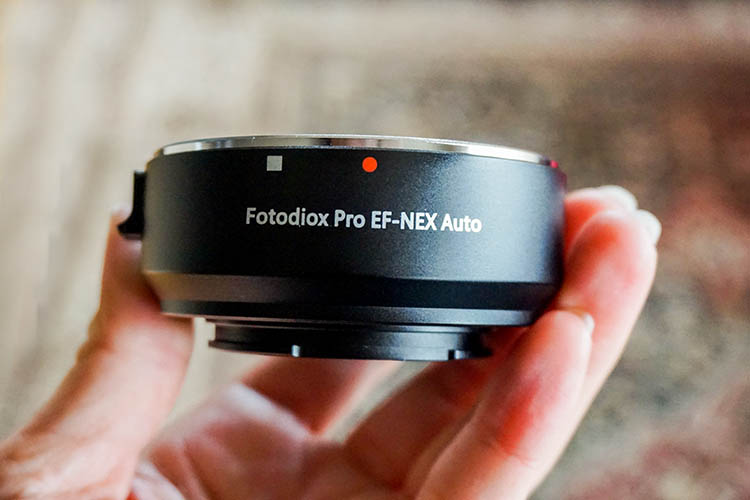
ony Canon Lens Converter

My Camera Background

As a corporate event and food photographer, the Canon 5D Mark III, plus an array of Canon zoom lenses and a handful of primes, are my go-to choices for professional photo work. However, the desire to carry a smaller camera while traveling casually, led to my recent purchase of a Sony a6300 camera, my first investment in a mirrorless system. While I did opt for a Sony 16-50mm kit lens and a 20mm f/2.8 prime lens, I wasn’t financially ready to invest in any more Sony brand lenses. Instead, research and recommendations from other fellow photographers led me to purchase a lens adapter, which promised the ability to use my existing Canon EF lenses with my new Sony E-Mount camera body.

If you’re in a similar position, where you’ve accumulated a collection of DSLR lenses and are considering adding the Sony a6300 to your kit, this article is for you!
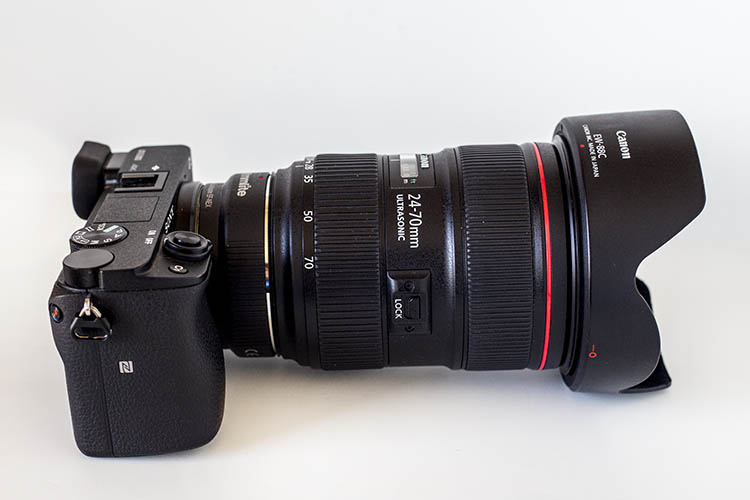
ony Canon Lens Converter

Sony a6300 body with a Canon 24-70mm f/2.8 lens, mounted using the Fotodiox adapter.

Lens Adapter Options

Third-party brands have already hopped on the lens adapter train, and there are quite a few options available, but two main ones that came up in research were the Metabones Smart Adapter IV and the FotodioX AF Adapter. At first glance, both options seemed comparable in their offerings:

  • Compact, lightweight, all-metal design.
  • Allows for automatic focus and aperture control from the Sony E-Mount camera body.
  • Infinity focus allowed if needed.
  • Removable tripod mount included to help distribute the weight.

The main difference between the two products came down to price: the Metabones version is priced at $ 385.99, while the FotodioX option is considerably cheaper at just $ 99.99. In the end, the price was the determining factor, and I went for the FotodioX lens adapter.
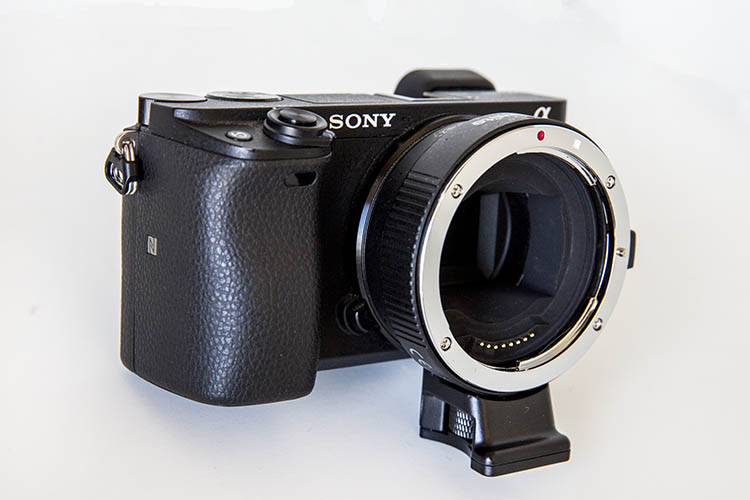
ony Canon Lens Converter

Sony a6300 with the FotodioX AF Adapter attached.

How did it perform?

The first thing to note about using an adapter is how it will impact the overall heaviness, bulk, and appearance of your system. The FotodioX adapter itself is truly compact, and isn’t much larger than the Sony a6300 kit lens. As a result, it looks like a natural complement to the a6300 when it’s connected. Adding on Canon EF lenses changes the look and feel of the a6300, depending of course, and which lenses are paired. Small, lightweight, prime lenses such as the Canon 50mm f/1.8 don’t add a lot of bulk to the camera, and also look like a natural fit.
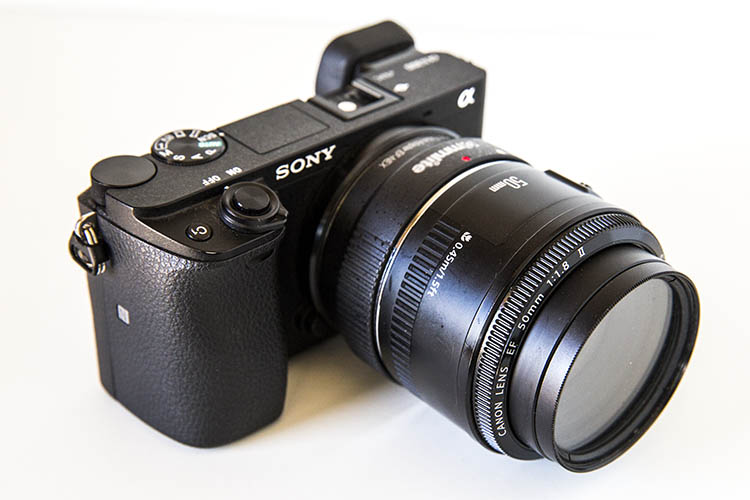
ony Canon Lens Converter

Sony a6300, FotodioX AF Adapter, and Canon 50mm f/1.8 lens.

However, adding larger zoom lenses such as the Canon 24-70mm f/2.8 definitely make the camera more front-heavy, to the point that it makes sense to grip the rig by the lens rather than the camera body. Still, the rig is considerably lighter than pairing the same Canon lenses with a DSLR such as the 5D Mark III.

ony Canon Lens Converter

Apart from aesthetics, the adapter actually performed surprisingly well! There are many reports of adapters causing autofocus to be either painfully slow, or lost altogether. While autofocus was not as snappy and accurate as it was using a Sony brand lens, the a6300 was still decently responsive, even with the FotodioX adapter and a Canon EF lens attached. If autofocus wasn’t working properly, which tended to happen for close-range shots, it was easy to switch the lens to manual focus and still capture a photo. Image quality was also tack-sharp, here are some image examples:


ony Canon Lens Converter

ony Canon Lens Converter

ony Canon Lens Converter

ony Canon Lens Converter

ony Canon Lens Converter

ony Canon Lens Converter

Overall thoughts

Using a lens adapter isn’t a perfect solution. The lagging autofocus was fine for casual use, but eventually became more noticeable and cumbersome when trying to shoot anything that moved. I’d hesitate to rely on an adapter when shooting something where quick autofocus mattered. It also felt like a pretty big tradeoff to not be able to take full advantage of what Sony purports to be the “world’s fastest autofocus” in the a6300. But other than that, the ability to use my existing DSLR lenses with a new camera body made by another manufacturer is a convenient luxury.

Have you tried a lens adapter before? What was your experience like?

googletag.cmd.push(function() {
tablet_slots.push( googletag.defineSlot( “/1005424/_dPSv4_tab-all-article-bottom_(300×250)”, [300, 250], “pb-ad-78623” ).addService( googletag.pubads() ) ); } );

googletag.cmd.push(function() {
mobile_slots.push( googletag.defineSlot( “/1005424/_dPSv4_mob-all-article-bottom_(300×250)”, [300, 250], “pb-ad-78158” ).addService( googletag.pubads() ) ); } );

The post FotodioX Lens Adapter – How to Put Your Canon EF Lens on Your Sony E-Mount Camera by Suzi Pratt appeared first on Digital Photography School.


Digital Photography School

 
Comments Off on FotodioX Lens Adapter – How to Put Your Canon EF Lens on Your Sony E-Mount Camera

Posted in Photography


Canon offers SD card-shaped Wi-Fi adapter, EOS 7D II bundle

26 Aug

Canon has introduced a Wi-Fi adapter shaped remarkably like an SD card, designed to bring wireless connectivity to dual card slot cameras like the EOS 7D II and 5DS/R. The W-E1 adapter will be sold bundled with the EOS 7D II as well as separately, and will work with previously purchased 7D II and 5DS/R models once a firmware updated is applied.

Though it looks like an SD card, the W-E1 doesn’t include any storage, so the camera’s available CF card slot will need to be used. When used with the EOS 7D II the card can transfer stills and MP4 video files; with the EOS 5DS/R only still images can be transferred. 

The W-E1 will be available in early September for $ 50. A new Canon EOS 7D II kit with the W-E1 and the EF-S 18-135mm F3.5-5.6 IS USM lens will go on sale in October for $ 2,449; a body-only kit with the adapter will cost $ 1,849. Firmware to enable use of the card with previously purchased 7D II units will be available in early September, followed by one for 5DS/R owners will in November.

Press release:

CANON ANNOUNCES NEW CANON EOS 7D MARK II KIT FEATURING NEW WI-FI® ADAPTER FOR THE EASY SHARING OF IMAGES AND VIDEOS

New Bundle Also Includes Canon EF-S 18-135mm f/3.5-5.6 IS USM Lens

MELVILLE, N.Y., August 25, 2016 – Canon U.S.A., Inc., a leader in digital imaging solutions, announced today the new Canon EOS 7D Mark II Kit, featuring the new SD card-sized Wi-Fi® Adapter W-E1. This new Wi-Fi adapter, when placed in the camera’s SD slot, provides the EOS 7D Mark II with Wi-Fi capabilitiesi like easy transferring of images and MP4 videos as well as use of the Canon Camera Connect App for remote capture of still images via a compatible smartphone or tablet.ii

The Wi-Fi Adapter W-E1 will be sold with the EOS 7D Mark II body as well as sold separately, and can also be used with the EOS 5DS and 5DS R as well as previously purchased EOS 7D Mark II camerasiii. When used with EOS 5DS and 5DS R cameras, the Wi-Fi Adapter W-E1 functionality is limited to the transfer of still images only. The W-E1 will support 802.11 b, g and n using the 2.4 GHz band.

Additionally, for the first time the EOS 7D Mark II camera will be conveniently bundled with the Canon EF-S 18-135mm f/3.5-5.6 IS USM lens. This lens has been optimized for high-speed autofocusing when shooting stills and quiet and smooth zoom when shooting video. This is the first Canon lens equipped with Nano USM technology providing high-speed autofocus for shooting stills and silent, smooth autofocus when shooting video. The Canon EF-S 18-135mm f/3.5-5.6 IS USM Lens also provides up to four stops of optical image stabilization.

The new Canon EOS 7D Mark II Lens Kit is currently scheduled to be available in October 2016 for an estimated retail price of $ 2,449.00*, with the body-only version also currently scheduled to be available in October 2016 for an estimated retail price of $ 1,849*. The Wi-Fi Adapter W-E1 is scheduled to be available in early September 2016 for an estimated retail price of $ 50.00*. A firmware update to enable compatibility with the W-E1 for previously purchased cameras is currently scheduled to be available in early September 2016 for the EOS 7D Mark II camera and November 2016 for the EOS 5DS and 5DS R cameras.

For more information: http://www.usa.canon.com/

i The Wi-Fi Adapter W-E1 must be inserted into the available SD card slot. The W-E1 does not have storage and is not designed to record images. To record and store images, a CompactFlash card must be used in the dedicated CF card slot.

ii Compatible with iOS® versions 8.0/8.1/8.2/8.3/8.4/9.0/9.1/9.2/9.3, Android™ smartphone and tablet versions 4.1/4.2/4.3/4.4/5.0/5.1/6.0. Data charges may apply with the download of the free Canon Camera Connect app. This app helps enable you to upload images to social media services. Please note that image files may contain personally identifiable information that may implicate privacy laws. Canon disclaims and has no responsibility for your use of such images. Canon does not obtain, collect or use such images or any information included in such images through this app.

iii EOS 7D Mark II, EOS 5DS and EOS 5DS R cameras that have already been purchased separately require a firmware update to utilize the Wi-Fi Adapter W-E1.

* Availability, prices and specifications are subject to change without notice. Actual prices are set by individual dealers and may vary.

Articles: Digital Photography Review (dpreview.com)

 
Comments Off on Canon offers SD card-shaped Wi-Fi adapter, EOS 7D II bundle

Posted in Uncategorized


Meike iPhone lens adapter case takes ring light and Sony QX1

18 Jun

$ (document).ready(function() { SampleGalleryV2({“containerId”:”embeddedSampleGallery_5756523953″,”galleryId”:”5756523953″,”isEmbeddedWidget”:true,”standalone”:false,”selectedImageIndex”:0,”startInCommentsView”:false,”isMobile”:false}) });

Hong Kong accessory manufacturer Meike has introduced a new case for the Apple iPhone 6/6s that accepts three accessory lenses and offers a mount for a ring light and Sony’s ILCE-QX1 E-mount ‘lens-style camera’. The MK-H6S PRO comes with a hand grip that has a Bluetooth-enabled shutter release button to deliver a more camera-like experience for mobile phone photographers.

The kit includes three lenses – a 0.65x wide-angle adapter, a 180° fisheye and a 2.5x macro lens – that screw into a mount over the device’s built-in camera. A larger mounting ring in the middle of the case accepts an optional ring light with built-in mirror for selfies. The same ring is also compatible with Sony’s 20MP APS-C QX1 adapter so users will be able to fit Sony E lenses to the device, preview the image on the phone’s screen and control capture via the grip’s shutter release.

The Meike MK-H6S PRO will cost £45/$ 65. For more information visit the Meike website.

Articles: Digital Photography Review (dpreview.com)

 
Comments Off on Meike iPhone lens adapter case takes ring light and Sony QX1

Posted in Uncategorized