RSS
 

Posts Tagged ‘35mm’

C.P. Goerz launches ‘always-in-focus’ Citograph 35mm lens on Kickstarter

07 Jul

German startup C.P. Goerz has launched its new ‘always-in-focus’ Citograph 35mm f/8 lens on the crowdfunding website Kickstarter. The Citograph is designed to shoot photos ‘instantly’ by removing the need to manually focus and adjust the lens, with C.P. Goerz claiming that its product ‘may very well revolutionize street photography.’

The lens features a disc aperture equal to f/8 alongside a 35mm focal length and super-compact design—the Citograph does not have any moving parts.

“The Citograph 35 was designed specifically for capturing those fleeting, decisive moments that are gone in the flash of an eye,” the company says, explaining that anything located at least 9ft / 2.8m from the camera ranging to infinity will be in focus. Despite its capabilities—or because of them—the lens is described as being among the thinnest in the world.

Here are a few sample images C.P. Goerz published on Kickstarter:

C.P. Goerz plans to offer the Citograph 35mm lens in Sony E, Fuji, Nikon, Canon, Pentax, MFT and Leica M mounts.

Those interested in acquiring this strange WYSIWYG lens can claim a unit by pledging at least $ 220 USD on the Kickstarter campaign (early bird offer). Shipping to backers is estimated to start in March of 2018, with the company planning to launch the product on the retail photography marketing in the Spring of 2018 at an expected retail price of $ 550 USD.

Technical specs per Kickstarter page:

  • Magnification ratio 1:8
  • Optical construction 4 elements in 3 groups
  • Field of view +/- 31°
  • Distortion ? 1% Light loss max. 27 %
  • Focussing 3m bis ?
  • Filter thread M 37 x 0,75
  • Dimensions Ø 58 mm x 23 mm
  • Weight ±. 120g

Articles: Digital Photography Review (dpreview.com)

 
Comments Off on C.P. Goerz launches ‘always-in-focus’ Citograph 35mm lens on Kickstarter

Posted in Uncategorized


Videre 35mm is a build-it-yourself cardboard pinhole camera

21 Jun

In an era where everyone has a camera in their pocket, incredibly, cardboard analog cameras are having a moment. It’s easy to see the charms of Videre 35mm, an adorable, assemble-it-yourself pinhole camera that’s seeking funding as part of Kickstarter’s Gold program right now.

It’s a re-tooled version of the medium-format Videre, which was fully funded on Kickstarter in 2013 by creator Kelly Angood. Her second project, a smaller version called Viddy which took 35mm and medium-format film, was successfully crowdfunded a year later.

$ (document).ready(function() { SampleGalleryV2({“containerId”:”embeddedSampleGallery_5146472518″,”galleryId”:”5146472518″,”isEmbeddedWidget”:true,”standalone”:false,”selectedImageIndex”:0,”startInCommentsView”:false,”isMobile”:false}) });

Videre 35mm is smaller and easier to assemble than its medium-format predecessor, offering a tripod mount, redesigned film mechanism and a sturdier shutter. Angood claims that the whole thing can be assembled in about an hour, and shipping is anticipated for December 2017 – provided its $ 10,000 funding goal is reached. With 40 days to go the project has reached close to $ 4,000.

Articles: Digital Photography Review (dpreview.com)

 
Comments Off on Videre 35mm is a build-it-yourself cardboard pinhole camera

Posted in Uncategorized


Samyang targets Sony E mount users with new 35mm F2.8 AF lens

05 Jun

Korean optical manufacturer Samyang has released details of its third AF lens – a full frame 35mm F2.8 lens designed for Sony E mount cameras. The company says the lens is tiny and lightweight to suit these smaller compact system cameras, and that these characteristics make it ideal for travel and street photography.

$ (document).ready(function() { SampleGalleryV2({“containerId”:”embeddedSampleGallery_1799764306″,”galleryId”:”1799764306″,”isEmbeddedWidget”:true,”standalone”:false,”selectedImageIndex”:0,”startInCommentsView”:false,”isMobile”:false}) });

The Samyang 35mm F2.8 FE weighs 85g/3oz, measures 33mm/1.3in in length and uses seven elements in six groups. It has a seven-bladed iris, a filter thread of 49mm and a closest focus distance of 0.35m/1.14ft. It will be available from July and will cost £279.99 (approx $ 350). For more information see the Samyang website.

Press release

Samyang Introduces third autofocus lens – AF 35mm F2.8 FE

June 5th, 2017, Seoul, Korea – Global optics brand Samyang Optics, is pleased to announce the release of Samyang’s third autofocus lens: the AF 35mm F2.8 FE. A tiny lens with a mighty performance, it is ideal for daily photography as well as travel photography. This new compact and lightweight lens, together with the existing AF 14mm F2.8 FE and AF 50mm F1.4 FE lenses, now expands Samyang’s autofocus lens line-up to three.

Tiny and Mighty
The AF 35mm F2.8 FE weighs just 85g and measures 3.3cm in length, without the hood and rear cap, it is roughly the equivalent in weight of a bar of soap and smaller than a name card in size. Thanks to Samyang’s exceptional optical technology, its compact size is packed with features for outstanding image quality. Featuring seven elements in six groups, two aspherical lenses and one high refractive lens plus Ultra Multi Coating to minimise aberration and unnecessary light dispersion, the lens delivers high resolution from the centre to the corners of the image.

Perfect Partner for Everyday Photographers
This new lens is specifically designed to work in harmony with full frame mirrorless cameras in Sony E mount. For full frame sensors, the focal length resembles the human eye the most. For APS-C types for Sony alpha 6000 and 5000 series users the lens is equivalent to approximately 52mm, which is also one of the most popular focal lengths among photographers.

Portability with mighty performance and a 35mm focal length makes this lens the best choice for daily photographers who want to capture every memory as a high quality image. The autofocus is fast and accurate and is ideal for the capture of outdoor events such as hiking, sports events and landscape photography. It also has a minimum focusing distance of 0.35m and is ideal for street, portrait and close focus photography.

Available from July 2017
This tiny and mighty Samyang 35mm F2.8 FE lens will be available from July, and will carry a suggested retail price of £279.99 inc VAT.

Articles: Digital Photography Review (dpreview.com)

 
Comments Off on Samyang targets Sony E mount users with new 35mm F2.8 AF lens

Posted in Uncategorized


Canon EF-S 35mm F2.8 IS STM Macro sample gallery

30 May

Canon’s new EF-M 35mm F2.8 IS STM Macro comes in at a reasonable $ 349 MSRP, and offers 1:1 magnification (very close to the front of the lens, admittedly), a claimed four stops of image stabilization and the stepper motor should work great for when you switch from stills to video. We’ve sampled it for both macro and general photography, as its 56mm equivalent focal length makes it a good option for Canon APS-C users who are looking for a modern ‘normal’ lens. Take a look at how it holds up in our sample gallery.

Canon EF-S 35mm F2.8 IS STM gallery

$ (document).ready(function() { SampleGalleryStripV2({“galleryId”:”6833345058″}) })

Sample photoSample photoSample photoSample photoSample photo

Articles: Digital Photography Review (dpreview.com)

 
Comments Off on Canon EF-S 35mm F2.8 IS STM Macro sample gallery

Posted in Uncategorized


Canon introduces EF-S 35mm F2.8 macro lens with built-in ring light

06 Apr

$ (document).ready(function() { SampleGalleryV2({“containerId”:”embeddedSampleGallery_8064378539″,”galleryId”:”8064378539″,”isEmbeddedWidget”:true,”standalone”:false,”selectedImageIndex”:0,”startInCommentsView”:false,”isMobile”:false}) });

Canon has introduced a compact 35mm F2.8 IS STM macro lens for crop-sensor DSLRs. Similar to the EF-M 28mm F3.5 Macro lens introduced a year ago, the 35mm F2.8 has a built-in LED ring light. 

The lens, which is equivalent to 56mm when mounted on crop body, has a minimum focus distance of just 3 cm (1.2 in.). It uses Canon’s ‘Hybrid’ IS system, with up to four stops of shake reduction. Canon says that the lead-screw-type STM motor allows for quiet AF operation, which is ideal for video capture. The lens has seven rounded aperture blades as well as a glass-molded aspherical element.

The EF-S 35mm F2.8 IS STM lens will ship this June with an MSRP of $ 349.

Press Release

UP CLOSE AND PERSONAL: CANON ANNOUNCES NEW EF-S 35MM F/2.8 MACRO IS STM LENS TO HELP EXPLORE THE BEAUTY OF MACRO PHOTOGRAPHY

New Compact and Lightweight EF-S Macro Lens Opens Up a World of Photographic Possibilities and Helps Capture Close Subjects with Incredible Detail

MELVILLE, N.Y., April 6, 2017 – Compact and lightweight, the new Canon EF-S 35mm f/2.8 Macro IS STM, announced today by Canon U.S.A., Inc., a leader in digital imaging solutions, is the widest-angle Macro offering in Canon’s popular EF-S lens series. The new lens is designed to help both entry-level and advanced amateur DSLR photographers discover the incredible possibilities of macro photography. Capable of capturing close-up subjects with incredible detail, Canon’s new EF-S macro lens is also the first in the series to feature built-in Macro Lites that allow users to control lighting with ease.

“Macro lenses are an amazing way to explore the worlds that exist all around us, and the new Canon EF-S 35mm f/2.8 Macro IS STM lens is the ideal starting point for amateur photographers eager to capture incredible, up-close details on the go,” said Yuichi Ishizuka, president and COO, Canon U.S.A., Inc. “Whether capturing a delectable dessert or the subtleties of a backyard flower, users will be challenged to find new colors and shapes that turn everyday moments into art.”

The new Canon EF-S 35mm f/2.8 Macro IS STM captures stunning images and is a terrific companion lens for entry-level users eager to expand beyond their existing Canon EOS DSLR kit lens. Capable of shooting as close as 30mm from the end of the lens to the subject, aspiring photographers can get up close to a fruit or flower for an entirely new perspective, while capturing high-quality images with beautiful background blur. Additional technologies built into the new Canon EF-S 35mm f/2.8 Macro IS STM lens include:

  • Popular 35mm focal length (56mm equivalent) and wide f/2.8 aperture
  • Hybrid IS system offers up to four stops* of shake correction
  • Smooth Movie Servo AF with Lead Screw-type STM ensures quiet AF operation
  • Full-time Manual Focus

In a first for the EF-S lens series, the new Canon EF-S 35mm lens sports built-in Macro Lites that allow photographers to carefully arrange macro lighting without using special equipment. With built-in LED lights on each side of the lens, users can create compelling shadows on either side of a subject or adjust intensity to give images a sense of dimension. Once the scene is set, the lens uses superb rendering performance to capture high contrast, sharp images.

While specialized for high magnification photography, the Canon EF-S 35mm f/2.8 Macro IS STM is still a versatile option for day-to-day use, easily capable of capturing portraits, landscapes or snapshots. As the latest addition to the lineup of EF-S lenses, Canon continues its commitment to providing a wide-range of affordable lens options for photographers of all levels.

The Canon EF-S 35mm f/2.8 Macro IS STM lens is scheduled to be available in June 2017 for an estimated retail price of $ 349.99.

Canon EF-S 35mm F2.8 Macro IS STM specifications

Principal specifications
Lens type Prime lens
Max Format size APS-C / DX
Focal length 35 mm
Image stabilization Yes (4 stops)
Lens mount Canon EF-S
Aperture
Maximum aperture F2.8
Aperture ring No
Number of diaphragm blades 7
Optics
Elements 10
Groups 6
Special elements / coatings Glass-molded aspheric element
Focus
Minimum focus 0.03 m (1.18)
Maximum magnification 1×
Autofocus Yes
Motor type Stepper motor
Full time manual Yes
Focus method Internal
Distance scale No
DoF scale No
Focus distance limiter No
Physical
Weight 190 g (0.42 lb)
Diameter 69 mm (2.72)
Length 56 mm (2.2)
Sealing No
Colour Black
Filter thread 49.0 mm
Hood supplied Yes
Tripod collar No

Articles: Digital Photography Review (dpreview.com)

 
Comments Off on Canon introduces EF-S 35mm F2.8 macro lens with built-in ring light

Posted in Uncategorized


Hawks Factory announces new 35mm F2 in M-mount

07 Jan

Japanese optical manufacturer Hawks Factory has released details of a new lens it has designed in homage to ‘old-style’ Leica M lenses. The Tsubasa Swallow 35mm F2 comes in a Leica M-mount and intends to produce images with a retro feel, according the company. It will display high resolution in the center of the frame and a soft blur at the edges when used wide open. Hawks Factory claims that the style of image the lens produces is something that ‘fascinates people all over the world’. 

The Tsubasa Swallow 35mm F2 is constructed using eight elements in six groups and features an iris created with 14 blades that closes to F16. The company says the glass and the polishing are Japanese, and that they designed their own helicoid for the focusing ring. The lens has an all-metal barrel that is said to be designed to withstand decades of use, but the company doesn’t specify whether the focusing mechanism is coupled to the camera’s rangefinder system or whether users will be expected to focus via Live View.

The lens is expected to be released for sale in February and, according to Leica Rumours, will be priced ¥198,000 (approx. $ 1800). For more information and some sample images see this translated version of the Hawks Factory website.

Articles: Digital Photography Review (dpreview.com)

 
Comments Off on Hawks Factory announces new 35mm F2 in M-mount

Posted in Uncategorized


The whole nine yards: Canon 35mm F1.4L II USM review

01 Dec

Canon is on a roll with its updated Mark II lenses and scoring bullseyes with pretty much every shot. New versions of key focal lengths are being rolled out across the range, with fully revised optics and mechanical construction. Most are class leading, often setting new standards in one area or another, and the Canon EF 35mm F1.4L USM MkII is no exception – it is sharp, very, very sharp!

The MkII model launched last year replaces the elderly MkI of 1998. That lens was originally designed for film SLRs, but it won many digital hearts, including some on the DPReview team and several articles have already been published, looking back at the old lens and forward to the MkII with sample galleries, user reports and comparisons.

One thing missing from those articles though, is the close scrutiny of DxO Mark’s lab tests, with full analysis of MTF (Modulation Transfer Function) sharpness performance, and other important aspects of image quality that can only be properly assessed under controlled conditions. So now we’re putting that right, and the resolution of this lens on a 51 megapixel Canon 5DS R is something to behold. The new Canon 35mm F1.4 MkII shares headline specifications with the MkI, and most key features are the same or similar. It’s all-change under the skin though, with more of everything in the quest for quality, including a significant increase in size, weight and cost.

Key specifications

  • New optical design with 14 elements in 11 groups (MkI version has 11 in 9)
  • One UD glass element added, and two aspherical surfaces (MkI has one aspherical)
  • New BR Optics layer reduces CA
  • Nine rounded aperture blades (MkI has eight)
  • Weight goes up 31% and length 23% (compared to MkI)
  • Military-grade weather resistant build (MkI is not weather resistant)
  • Manufacturer’s Suggested Retail Price $ 1799USD (MkI $ 1479)

Canon has paid close attention to the optical redesign and the mechanical construction, and both raise the bar. No stone has been left unturned, and just about the only thing that stays the same as the MkI is the 72mm filter size, and the minimum focusing distance is also very similar at 28cm (11in).

There is no image stabilization, with that option already very effectively covered by the Canon 35mm F2 IS USM. Purists will welcome the decision to concentrate on sheer optical quality, and it helps to keep complexity and the burgeoning weight in check.

Angle of view

35mm focal length delivers a 63° field of view on full frame cameras, measured conventionally across the diagonal, from corner to corner. Image corrected for lateral CA, distortion and vignetting in Lightroom, at default sharpening. Canon 5DS R (51mp), 1/2500 sec, F4, ISO 100, mirror lock-up.
On APS-C format, the 35mm focal length’s field of view is narrowed to 42° (56mm equivalent). This is a digital simulation, cropped 1.6x (20mp) from the full frame image above. Shire Hall, Cambridge, UK.

Articles: Digital Photography Review (dpreview.com)

 
Comments Off on The whole nine yards: Canon 35mm F1.4L II USM review

Posted in Uncategorized


dPS Writer’s Favorite Lens: Nikon 35mm f/1.8G

14 Sep

A few years ago Nikon started revamping their lens lineup to include faster focusing, better coatings on the glass elements, and for the first time, no manual control over the size of the aperture. This series of lenses was given the “G” moniker, and one of the earliest that went into production is still one of the best: the 35mm f/1.8G.

This inexpensive little workhorse is not only supremely versatile but performs well beyond its price range in almost any shooting situation. It was designed to work for crop-sensor cameras, which Nikon refers to as DX models, but in many circumstances, it works just fine on full-frame FX cameras as well. I enjoy shooting mostly portraits and nature photography and there’s hardly a situation in which this 35mm lens doesn’t give me good results. It’s by far my favorite lens, and I’d like to share a little bit more to let you know why.

favorite-lens-nikon-35mm-seattle-skyline

Seattle skyline, photographed with the 35mm f/1.8G DX on a Nikon D7100.

One of the best features of the 35mm 1.8G lens is something that could also be seen as a significant limitation: it does not zoom in and out. It’s a prime lens which means it has a fixed focal length. So if you are used to twisting your lens to get a close-up view of your subject, you will have to train your mind to think about things a bit differently when using this lens. Since it is permanently stuck at 35mm you have to use your feet and get creative when shooting pictures. But once you get past this limitation you will start to notice that it pales in comparison to one of its most important strengths: a super wide aperture.

Fixed focal length, amazing results

If you’re not entirely familiar with what the term aperture means, it’s basically the opening in your lens that lets light pass through. This is an f/1.8 lens which means it has a huge maximum aperture, or opening, compared to some other lenses, especially most zooms. This feature allows the lens to capture much more light so you rarely have to use the flash, and also helps you get the kind of smooth blurry backgrounds you see in professional-style portraits. The f/1.8 aperture is the one key factor that makes this lens so incredibly useful and versatile. Even though it lacks the ability to zoom in and out it’s a tradeoff well worth making, in my opinion.

I took this quick snapshot of my niece while she was playing with her cousins, but the wide f/1.8 aperture on the 35mm lens gave me a nice blurry background.

I took this quick snapshot of my niece while she was playing with her cousins. The wide f/1.8 aperture on the 35mm lens gave me a nice blurry background.

Avoid dreaded pop-up flash issues

Before I got into more advanced photography several years ago I owned a decent pocket camera. While it did take good pictures in broad daylight, any time the sun even started to get low on the horizon it would fire the flash and bathe everything in a weird artificial light. I noticed the same thing happening to my friends with DSLR cameras too, and couldn’t figure out why even the more expensive cameras were always turning on the pop-up flash when the lighting was dim.

If you have wondered about this yourself, the answer almost certainly relates to the aperture of your lens. Smaller apertures let in less light, which therefore require the use of an additional light source like a flash in order to take a picture. The 35mm f/1.8 lens almost never has that problem because it lets in so much light (when you shoot at f/1.8), which can seem like a miracle from heaven if you are tired of shooting so many of your photos with the flash turned on.

The lighting in this church was very poor, but thanks to the f/1.8 aperture I got several photos of this baby at his baptism without using the a flash.

The lighting in this church was very poor, but thanks to the wide f/1.8 aperture I got several photos of this baby at his baptism without using the flash.

Whether you are out taking photos of nature and wildlife, doing paid portrait sessions, or just snapping photos of your kids playing around the house, the f/1.8 aperture is going to give you outstanding results if you are used to a lens with a smaller aperture. I was blown away when I first started shooting with this and other prime lenses and began realizing that I could use the natural light all around me to get the photos I was really trying to shoot. That, instead of constantly relying on a tiny little pop-up flash.

No zoom, no problem

Many years ago when some of my photographer friends first recommended a prime lens to me I thought they were joking. Why on earth would anyone want a lens that doesn’t zoom in and out? The fixed focal length of a prime lens, I soon realized, forces you to be more creative and puts you in a different frame of mind than a zooming lens by making you work around a limitation. In the years since, as my collection of lenses has grown to include several prime lenses, I keep coming back to this specific 35mm f/1.8 lens as a workhorse not just for daily pictures of my family but for professional photo sessions too. 35mm is somewhere between a wide angle and telephoto lens, which makes it ideally suited for a variety of types of photography. It’s not too zoomed out and not too zoomed in, so it’s kind of like the Goldilocks of camera lenses. It’s just right.

In the years since, as my collection of lenses has grown to include several prime lenses, I keep coming back to this specific 35mm f/1.8 lens as a workhorse. It’s not just for daily pictures of my family but for professional photo sessions too. 35mm is somewhere between a wide angle and telephoto lens, which makes it ideally suited for a variety of genres of photography. It’s not too zoomed out and not too zoomed in, so it’s kind of like the Goldilocks of camera lenses. It’s just right.

favorite-lens-nikon-35mm-olympic-mountains

The Cascade Mountains: shot with the 35mm 1.8G DX on a Nikon D7100

Is like “normal”

On a crop-sensor camera like the Nikon D3300 or D7200 the focal length of this lens is multiplied 1.5x which puts it right about 50mm, or very close to what the human eye naturally perceives. This means that the image you see when you hold your camera up to compose a shot is very similar to that which you would see without any camera at all. There is very little distortion, and everything just tends to look…well…

There is very little distortion, and everything just tends to look…well…normal. I know some people are put off by this type of lens because it’s so pedestrian that it borders on boring, and because it does so many things well it also excels at nothing in particular. However I happen to like the 35mm focal length precisely because of the photos I can get with it, and also because it’s wide enough that I can take pictures at relatively slow shutter speeds like 1/45 second and not worry too much about motion blur.

favorite-lens-nikon-35mm-kansas

Hay bales in Kansas: shot with the 35mm 1.8G DX on a Nikon D7100

Works on full frame too

One bonus feature, of this lens in particular, is that, unlike some other lenses that are designed for crop-sensor cameras, this one performs quite well on full-frame models too. If I put it on my D750 I can get outstanding results provided I shoot around f/4. If I use an aperture much smaller than that, however, it starts to exhibit some pretty bad vignetting on the corners.

This makes the lens ideal for situations where you want to get a little closer to your subjects for pictures that are a little more personal and intimate, and also for landscapes where you want to take in a much broader view of the scene. All this for a lens that costs about $ 200 and you can hopefully see why it is, without question, my favorite lens.

favorite-lens-nikon-35mm-hairless-cat

Even though this lens is designed for crop-sensor cameras, it works fine on full-frame cameras like the D750 if you can put up with some vignetting around the corners. This allowed me to get right in the middle of the action while having a wide enough angle to get several people in the shot.

I recommend this lens often

I often have people ask me for recommendations when it comes to camera lenses, and if they are Nikon shooters my advice is always the same: The 35mm f/1.8G DX. I recently followed up with about a dozen friends and family members to see if my recommendation was to their liking after using the lens for several months. Every single one of them said that yes, the lens was great and did just what they were hoping it would do. Some said that it helped them explore new aspects of photography and while a few had since augmented their collection with zoom lenses or other primes, they all agreed that this particular lens worked like a charm.
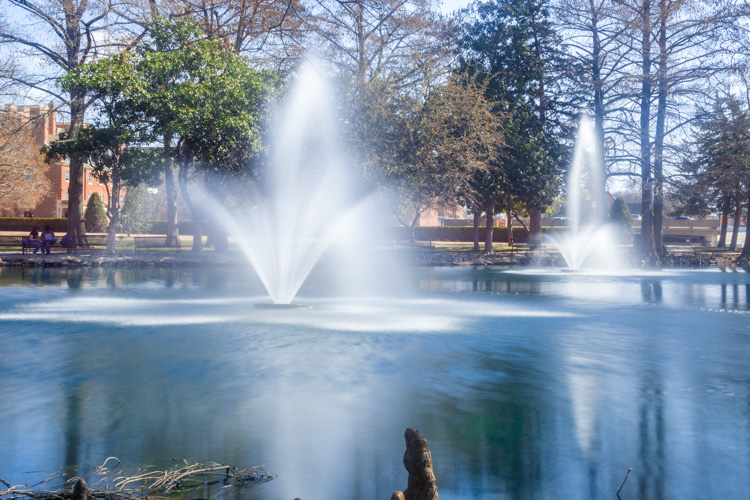
favorite-lens-nikon-35mm-fountains

Theta Pond: shot with the 35mm 1.8G DX lens on a Nikon D7100

At this point, it probably sounds like I’m some kind of paid shill for Nikon, but I promise you that is not the case. I buy all my gear the same as anyone else and have never gotten any lenses, cameras, or other gear from Nikon or any other company. I just like this lens so much, and I think you would too, that I can’t help but gush about how it’s by far the favorite one in my kit and the one that gets used more often than anything else. But what about you? Do you have this lens and if so, what do you think of it? What other lenses do you like that you wish other people would learn about? Leave your thoughts in the comments below!

But what about you? Do you have the Nikon 35mm f/1.8G lens? If so, what do you think of it? What other lenses do you like that you wish other people would learn about? Please leave your thoughts in the comments below!

googletag.cmd.push(function() {
tablet_slots.push( googletag.defineSlot( “/1005424/_dPSv4_tab-all-article-bottom_(300×250)”, [300, 250], “pb-ad-78623” ).addService( googletag.pubads() ) ); } );

googletag.cmd.push(function() {
mobile_slots.push( googletag.defineSlot( “/1005424/_dPSv4_mob-all-article-bottom_(300×250)”, [300, 250], “pb-ad-78158” ).addService( googletag.pubads() ) ); } );

The post dPS Writer’s Favorite Lens: Nikon 35mm f/1.8G by Simon Ringsmuth appeared first on Digital Photography School.


Digital Photography School

 
Comments Off on dPS Writer’s Favorite Lens: Nikon 35mm f/1.8G

Posted in Photography


Samyang continues summer announcements with 35mm F1.2 ED AS UMC CS for mirorrless

01 Aug

$ (document).ready(function() { SampleGalleryV2({“containerId”:”embeddedSampleGallery_2809181414″,”galleryId”:”2809181414″,”isEmbeddedWidget”:true,”standalone”:false,”selectedImageIndex”:0,”startInCommentsView”:false,”isMobile”:false}) });

Sticking with its plan to introduce a whole bunch of new lenses this summer, Samyang has announced the 35mm F1.2 ED AS UMC CS for APS-C and Micro Four Thirds mirrorless cameras. It will be produced for Sony E, Canon M, Fujifilm X and Micro Four Thirds mounts.

The 35mm will include nine elements in seven groups, using two aspherical elements and Samyang’s ‘Ultra Multi Coat’ technology. A cinema version of the lens has also been introduced: the 35mm T1.3 ED AS UMC CS, with gears for follow focus and a de-clicked aperture ring.

Samyang hasn’t provided pricing or availability.

Articles: Digital Photography Review (dpreview.com)

 
Comments Off on Samyang continues summer announcements with 35mm F1.2 ED AS UMC CS for mirorrless

Posted in Uncategorized


Sony 35mm FE lens firmware update improves manual focus reliability

15 Jul

Sony has issued firmware updates for its 35mm full-frame primes which claim to improve focus point reliability when using manual focus for long periods of time. The new firmware is offered for the FE 35mm F1.4 ZA and FE 35mm F2.8 ZA Zeiss-branded lenses.

Articles: Digital Photography Review (dpreview.com)

 
Comments Off on Sony 35mm FE lens firmware update improves manual focus reliability

Posted in Uncategorized