RSS
 

Archive for February, 2021

Frame Within a Frame Photography: A Guide

04 Feb

The post Frame Within a Frame Photography: A Guide appeared first on Digital Photography School. It was authored by Kevin Landwer-Johan.

frame within a frame photography

Frame within a frame photography is a creative technique that works in many genres of photography. But what is it, and how can you use it for amazing photos?

In this article, we’re going to take a look at this composition “rule” – which you can apply very obviously or even very subtly in your photographs.

So if you’re ready to create some unique images…

…then let’s get started!

woman framed by bus window
© Kevin Landwer-Johan

What is frame within a frame photography?

Frame within a frame photography is all about positioning your main subject so it’s framed by something else within the scene. 

You can use anything you like for this. For instance, you might use a full rectangular frame, like a door or a window. You could even use an actual picture frame.

But frame within a frame photography is not limited to structures that completely surround your subject. 

You can incorporate body parts and tree limbs as frames. Using rocks, plastic bags, or mannequins can be an effective way to add a frame within a frame. These things may occur naturally, or you can bring them in as props to include in your compositions.

Two mannequins and a girl for frame within a frame photography
© Kevin Landwer-Johan

Frames in front and behind

Typically, we think of a frame that surrounds a subject as being in front of it.

But it doesn’t need to be.

Because you can often effectively frame your subject with something that’s behind them.

Here are three examples to illustrate what I mean:

welder working in a round frame
© Kevin Landwer-Johan

In this first photo of the welder (above), I’ve used a hole cut in the steel to encircle the worker. There are also more holes in the panels behind him, though it’s the front hole that acts as the main frame.

Monks walking through a gate in Thailand
© Kevin Landwer-Johan

In this second shot, however, while the gate pillars do frame the young monks, the contrast of the shadow on the wall also helps to frame the main subject.

woman leaning on a window frame in a train for frame within a frame photography
© Kevin Landwer-Johan

Here’s a third example where I have used frames both in front of and behind my subject. By lining up the front and rear windows in the train carriage, I have managed to carefully frame the young woman.

Depth in frame within a frame photography

The woman on the train (above) is also an example of how using frames within a frame can help create an enhanced sense of depth in your compositions.

This becomes even more exaggerated when you use a shallow depth of field. Blurring the frame shows that the frame and the subject are at different distances from the camera (and it also helps draw the viewer’s eye to your subject!).

For instance, look at the photo below. The white pillars on either side of the dancer and the circular shape behind her head frame her well. And the shallow depth of field helps create actual depth in the image.

Thai dancer for frame within a frame photography
© Kevin Landwer-Johan

Note, however, that you can use frame within a frame photography in circumstances where you convey no sense of depth.

Sunset frames
© Kevin Landwer-Johan

Take a look at the photo above. Are the people walking in front of or behind the large palm trees? The trees create a nice frame, but because the key elements are silhouetted, there’s no visual information to reference depth.

Composing with existing and created frames

Some frames are more obvious than others. Unfortunately, more obvious frames tend to be a bit too common in photographic compositions – to the point that they become clichéd.

So instead of using obvious frames, access your imagination. Look for unusual elements you can incorporate into your compositions. These can sometimes create interesting frames around your subjects.

Frames don’t have to be physical; you can always use light and shadow as a frame. Look for areas of contrast that surround what you’re focusing on. Carefully position yourself and your subject to maximize the effect.

Out-of-focus elements can also be used to create frames. When you have an object in the foreground that doesn’t form a complete frame around your subject, simply choose a wide aperture setting and make sure the foreground object is close enough to your camera. You’ll get a rather abstract form that can frame the subject and help lead the viewer’s eye into your picture.

Take a look at the image below. Do you see how the blurred vegetation creates a frame around my subject?

Thai dancer framed
© Kevin Landwer-Johan

Making use of what’s around you to create a frame can be very effective. Here, I have used the model herself to make a frame within a frame:

woman making a frame with her fingers
© Kevin Landwer-Johan

Look for frames and you’ll find them

Practice looking for frames, and you’ll begin to see them everywhere. Study the work of other photographers and see how they work with frames. Do a quick image search online for examples, and you’ll soon see how imaginative some photographers are with frames!

Then go out with a camera. Like anything, the more you do frame within a frame photography, the easier it becomes. Set yourself the task of creating a frame within a frame every time you head out to shoot.

That way, you’ll begin to train yourself to see situations where you can incorporate this compositional technique into your work.

Frame within a frame photography: Final words

Frame within a frame compositions are a great way to focus the viewer’s eye on your subject – and a great way to add depth to your photos.

So make sure you get out and practice! As I explained, the more you practice, the sooner you’ll be creating stunning frame within a frame photos.

Now over to you:

Have you ever tried frame within a frame photography? Do you have any framing tips? What are your favorite frames? Share your thoughts in the comments below!

The post Frame Within a Frame Photography: A Guide appeared first on Digital Photography School. It was authored by Kevin Landwer-Johan.


Digital Photography School

 
Comments Off on Frame Within a Frame Photography: A Guide

Posted in Photography


Soft Proofing in Lightroom: The Essential Guide

03 Feb

The post Soft Proofing in Lightroom: The Essential Guide appeared first on Digital Photography School. It was authored by Charlie Moss.

soft proofing in Lightroom

If you’ve ever printed without first soft proofing in Lightroom, you might have been surprised to find that your print didn’t match the image that you saw on your screen. Your print may have included inaccurate colors or incorrect tones.

All because you didn’t soft proof!

But don’t worry. It’s not a complicated process to soft proof your photos.

And I guarantee:

If you start soft proofing images before printing them, you won’t end up with prints that turn out different from how you expect them to look.

So let’s discover all the key features of soft proofing, and how you can use it to get your prints looking beautiful.

What is soft proofing in Lightroom?

Soft proofing is the process of previewing an image prior to printing – in order to get a better idea of what that image might look like when actually printed. Soft proofing gives you the opportunity to make changes before sending along the digital file to be printed.

The result, after soft proofing in Lightroom, is that your print will match the image you created on your computer.

Taking this extra proofing step is the key to getting top-quality printed images.

Why is soft proofing important?

Without soft proofing, it’s almost impossible to tell what your printed photograph is going to look like.

Why?

Because every printer and printing surface will interact in a different way, meaning that your results will vary wildly from printer to printer and from printing medium to printing medium.

Now, if you consistently order from the same print lab or you have your own printer at home, you may learn to predict the adjustments you need to get your images looking right. But this will only come from experience with particular printer and printing surface combinations.

And as you can imagine, gaining this experience can be expensive, especially when you’re ordering premium prints and products!

Why you need a calibrated display

First things first:

Before you do any soft proofing at all, you need a calibrated display.

A calibrated display is essential if you want your prints to match the photographs you see on your computer monitor.

By calibrating your display, you ensure that the colors are accurate. Most monitors will not have perfect color reproduction out of the box (not even the expensive ones!). Monitors are often too blue or too magenta, too light or too dark.

Also, monitors don’t hold their color calibration for long periods of time – you need to keep calibrating them every three to four weeks.

What is a printer profile?

An ICC printer profile is a file that describes how a printing machine and paper will interact.

A printer has to convert your image file into instructions for how to put ink on the paper, and each printer will do this slightly differently.

Soft Proofing in Lightroom printer profiles

But ICC printer profiles give you a way to predict how the printer will turn your digital file into a physical print.

In fact, a good print lab will offer custom ICC printer profiles for you to download on your own computer. This lets you soft proof your digital photographs before sending them to be printed.

How to load printer profiles into Lightroom

Soft proofing begins with downloading printer profiles.

Once you have downloaded the necessary printer profiles from your favorite print lab’s website, you’ll need to add them to your computer so that software such as Adobe Lightroom and Photoshop can find them.

Fortunately, this is very simple. You just move the files to the correct operating system folder as follows:

  • Mac: Library/ColorSync/Profiles/
  • Windows: Windows\system32\spool\drivers\color

Now the different profiles will be ready for use when you start soft proofing in Lightroom.

How to soft proof in Lightroom

Once a file is ready for printing (i.e., you’ve edited it to your heart’s content), head over to the Lightroom Develop module.

There, in the bottom left-hand corner of the main window, you’ll find an option labeled Soft Proofing. Tick that box.

the Lightroom soft proofing process

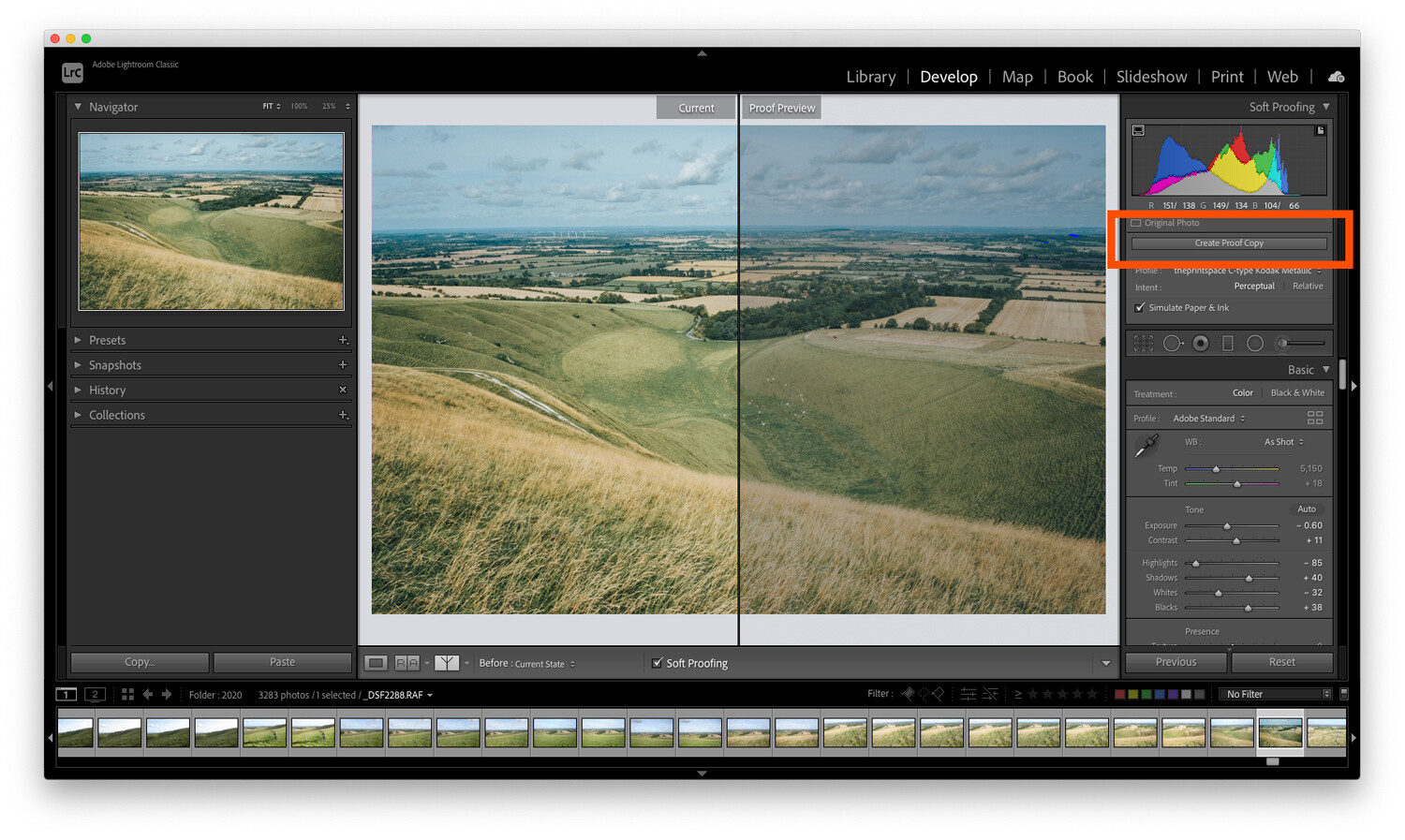
Once you’ve activated the soft proofing option, you’ll find that your photograph moves onto a white background and some new options appear in the top right-hand corner of the screen (as indicated above).

If you click the Profile option in the new Soft Proofing panel, you’ll find a list of profiles to choose from. If your new ICC printer profiles haven’t yet appeared on the list, then select Other at the bottom of the dropdown menu.

A window will pop up, and you can select from the different ICC print profiles that are installed on your computer. Each option you pick will appear in Adobe Lightroom for soft proofing.

choosing a profile when soft proofing

Once you’ve selected your profiles and closed the window, pick the profile you want to use and make sure the Simulate Paper & Ink box is checked.

Soft proofing challenges

The challenge with soft proofing is that, as you can see below, the image won’t look the same as the original file once you’ve applied the soft proofing ICC print profile.

In the example below, I’ve applied a profile for a metallic flex paper, and you can see that the image on the right is quite a bit darker than the original image. This means the print will likely be darker than we intended.

To fix this problem, hit the button labeled Create Proof Copy:

Soft Proofing in Lightroom proof preview

This will create a duplicate image with your print profile embedded so you can make adjustments for printing. By creating a proof copy first, Lightroom will leave your finished image unchanged – even as you make adjustments to your file for printing.

You see, on this new copy of the image, you can make adjustments while still in soft proofing mode. That way, you can ensure that what gets printed is exactly what you intended.

So simply make adjustments to the proof preview using the Lightroom sliders until you like the result!

Here’s one final technical check worth running:

The gamut warning feature.

In the left-hand corner of the histogram is a button that looks like a computer screen:

clipping check when soft proofing

If you toggle this setting on, your image may gain some striking blocks of color.

The colors are simply warning you which areas of the image will not reproduce properly when you go to print. To get the best quality print, you should do your best to reduce (and ideally remove) all of these problem areas.

To get rid of the warnings, try adjusting the saturation and exposure of your image.

Soft proofing in Lightroom: Conclusion

Many people see soft proofing for printing as unnecessary. They may get acceptable results already when printing, and they may have even learned to compensate while editing their photos to get the best prints.

However, if your prints don’t match the images you’re seeing on the screen, it’s because you haven’t done any soft proofing. With enough experience, you’ll learn the adjustments to make for perfect print results. But this is a process, one where you have to learn by making mistakes – so don’t be discouraged if things don’t work out the first time.

When you make your next print, give soft proofing in Lightroom a try. Calibrate your monitor, then soft proof your images with the correct ICC print profiles.

I guarantee it will improve the quality of your print!

Now over to you:

Have you ever tried soft proofing your prints? How did it go? Do you think you’ll start soft proofing before printing, now that you’ve read this article? Share your thoughts in the comments below!

The post Soft Proofing in Lightroom: The Essential Guide appeared first on Digital Photography School. It was authored by Charlie Moss.


Digital Photography School

 
Comments Off on Soft Proofing in Lightroom: The Essential Guide

Posted in Photography


8 Ideas for Awesome Abstract Photography

02 Feb

The post 8 Ideas for Awesome Abstract Photography appeared first on Digital Photography School. It was authored by Anthony Epes.

8 ideas for abstract photos

In this article, I plan to share some inspiring abstract photography ideas.

Now, I would never describe myself as an abstract photographer, yet I seem to have shot countless abstract photographs. In fact, I try not to assign myself to any genre. To me, that feels like the opposite of what photography should be – which is a place to have fun, to be curious, to explore, and most importantly, to give your imagination free rein.

I start the article like this because I want to encourage you not to be intimidated by this genre. Don’t worry about getting it right. Abstract photography should be a place of complete freedom. 

And this is why the most important quality for abstract photography is imagination

broken down wall

What is abstract photography?

For me, abstraction is about removing what’s in the world around us from its familiar context. It involves playing with elements and subjects, moving them away from their usual settings and placing them into new situations – so that they become something else entirely.

I find that doing abstract photography brings us into that childlike realm of imagination and makes us often think, “What is that?” Or, “That reminds me of…” Then our minds go off into dreamlike worlds.

smashed vegetable abstract photography ideas

“Abstraction demands more from me than realism. Instead of reproducing something outside of me, now I go inward and use everything I’ve learned thus far in my life.” – Susan Avishai

Therefore, I like to approach this genre as a way for us to have fun with our photos, the world around us, and ourselves. I’ll share eight abstract photo ideas that I hope ignite your imagination, and get you excited about exploring abstract photography!

Let’s get started.

abstract photography ideas balloon

1. Use your imagination as much as possible

abstract photography ideas

“Abstraction allows man to see with his mind what he cannot see physically with his eyes…Abstract art enables the artist to perceive beyond the tangible, to extract the infinite out of the finite. It is the emancipation of the mind. It is an exploration into unknown areas.” – Arshile Gorky

Doing abstract photography feels like I am trying to detach myself from reality and delve into a space where everything around me is a new sight, a new sensation, or a new experience.

I look around and see elements, colors, shapes, lines, textures – each is almost separate from the other. I am looking for things that are connected, but in a different way to how my mind usually puts things together.

Then it’s my imagination that kicks in and starts creating all kinds of ideas about what things look like. To me, the photo above looks like something coming from the cosmos, the beginnings of a new world.

(In reality, it’s some slime floating around in water, which I played with in Lightroom.)

So use your imagination constantly. When doing abstract photography, don’t let “conventional” thinking get in the way!

haunting idea for abstract photography

2. Search for textures

Textures are a fascinating subject to explore. When you focus on textures, you capture a tactile quality in your photos. You make people want to lean in and touch something.

And you often give very ordinary things – water, brick, wires, or stone – an inviting feeling.

Today, we are often so disconnected from the ordinary (i.e., what we perceive as the boring world around us). We are so often lost in thought that we’re only jolted out of it when we see spectacular things – like beautiful views, intense sunsets, etc.

But all around us are terribly ordinary subjects that can be so very intriguing, if only we viewed them with our sense of wonder! So instead of capturing a snapshot of an intense sunset, try looking more closely at some “boring” subjects to see what textures you can find!

abstract photography ideas

3. Shoot the ordinary

“The longer you look at an object, the more abstract it becomes, and, ironically, the more real.” – Lucian Freud

I love to shoot random, day-to-day subjects that I find all around me. I challenge myself to make these subjects seem interesting.

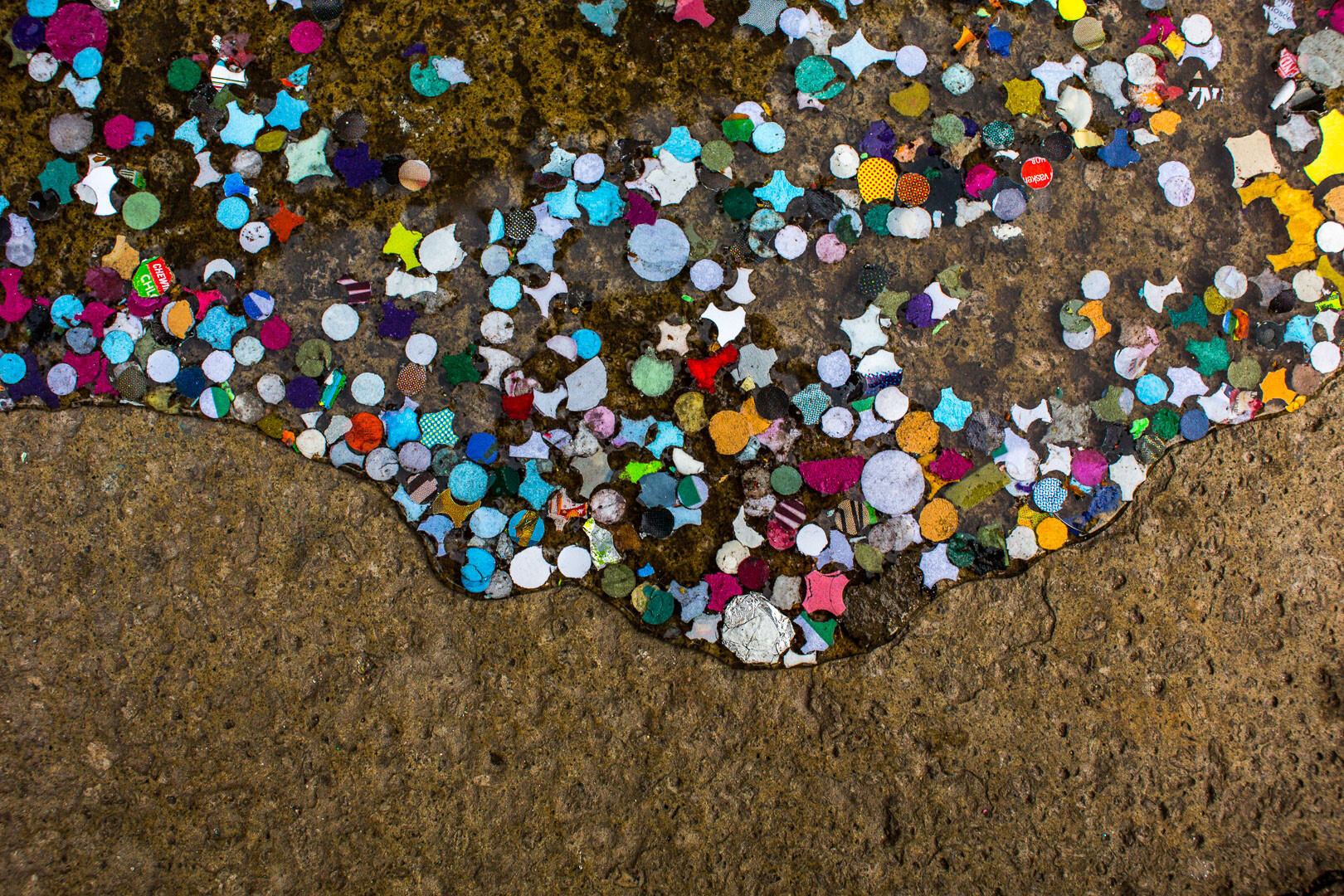
For instance, I am always on the lookout for torn posters on a wall – especially when they are bathed in beautiful light – as well as weird things I find on the street at my feet.

In fact, starting with what you find at your feet is a great way to do abstract photography! 

abstract photography ideas

Here’s why:

Everything, when you pay attention to it, can reveal different qualities than what we first notice. And our challenge as photographers- as artists, no less – is to find the most interesting way to shoot whatever catches our attention.

Maybe you need to take a different perspective – lying on the floor, getting up high, or changing angles. Or maybe, by using the quality of the light, you can turn the subject from ordinary to fascinating. 

yellow on blue shapes

Or perhaps you could even use color to give boring, unoriginal subjects interest and depth:

tangled wires against a wall

4. Include mystery in your abstract photos

“Abstraction generally involves implication, suggestion and mystery, rather than obvious description.” – Robert Genn

The appeal of abstract photos for me is very much about mystery. Creating something that doesn’t look as it should, displacing your subject, mixing up reflections, creating contrasts and jarring juxtapositions – it’s all a fun part of making the world less real and more mysterious. 

You can combine shapes together to create something that makes no real sense, but still sparks ideas and thoughts in the mind of the viewer. 

abstract photography ideas

In the photo below, I captured this reflection of a man on what I like to think is a moon landscape inhabited by interesting-looking creatures.

abstract photography ideas

At least, that’s what I see when I look at the photo. What do you see? It might be completely different!

5. Aim to capture the feeling of your subject 

“Of all the arts, abstract painting is the most difficult. It demands that you know how to draw well, that you have a heightened sensitivity for composition and for colors, and that you be a true poet. This last is essential.” – Wassily Kandinsky

In my photo teaching, I talk a lot about having a heightened awareness and sensitivity to the world.

Because if you want to find incredible photos wherever you go, you must have the ability to see more of what’s around you than you can when you are lost in your thoughts.

Now, with that heightened sensitivity comes increased feelings and impressions of what you see.

And thinking about the feeling you have when you look at your subject is so important. If you aren’t feeling anything, you won’t be able to communicate anything in your photos.

But if you do feel something when you look at your subject…

…you can channel it into the photo for a beautiful result! 

stones in water abstract

I like the sensations I get when I look at the texture photos above. It’s perhaps a sense of awe at the water and the beautiful colored stones. I can almost feel the water, and that feeling is translated through the photo. 

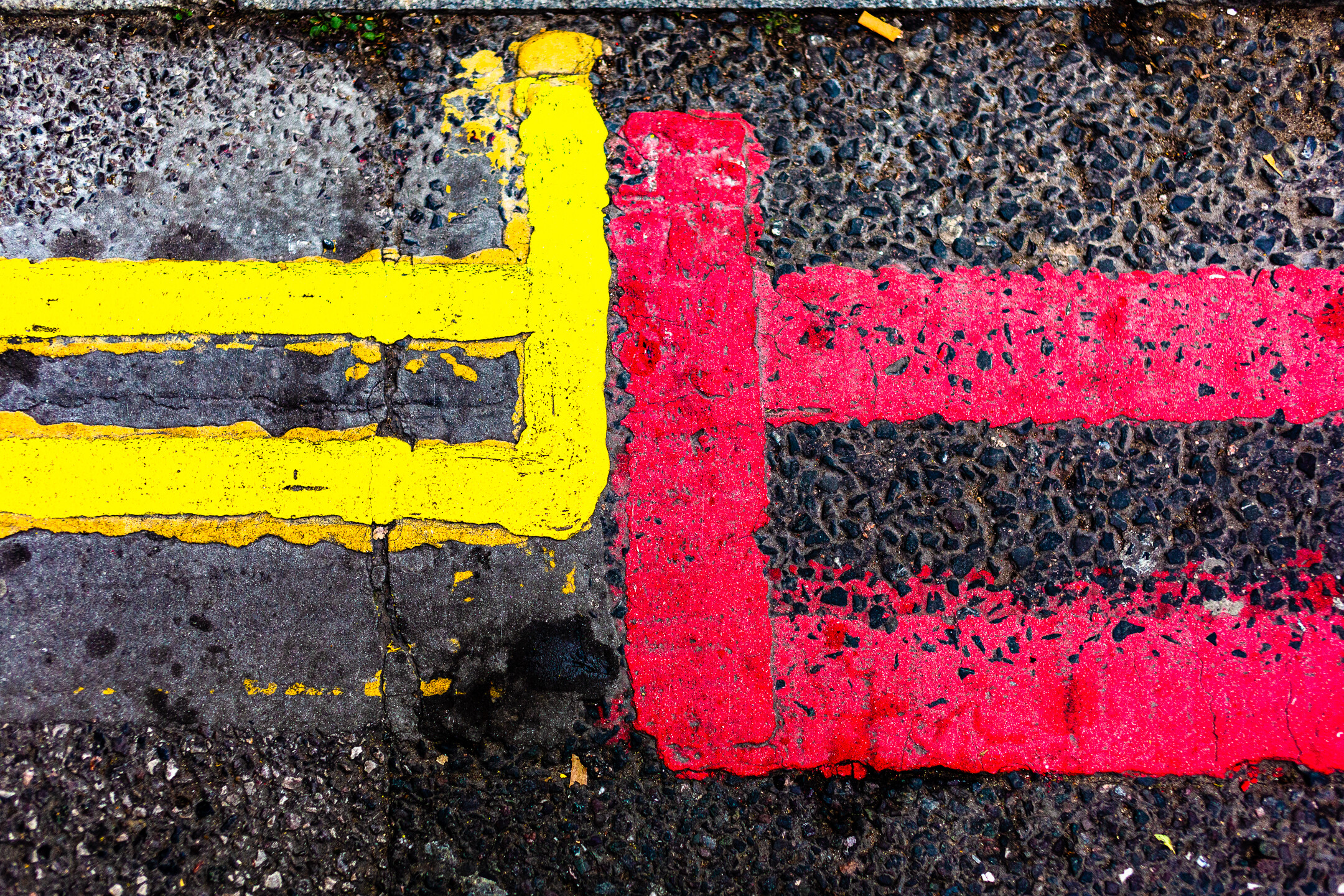
In the photo below, perhaps I get a feeling of fun, thanks to some bright colors on what I remember to be a dull London day:

red and yellow road labels

6. Find subjects that stop you in your tracks 

I strongly urge you to cultivate a sense of wonder.

Why?

I think we often get so jaded by the world around us – that is, we are so busy with our lives and worries and things to do – that we stop finding things awe-inspiring. It takes more and more to make us stop in our tracks and say “Wow!”

But we photographers have a gift:

We are visual people.

We just have to make sure we’re always refreshing our vision and our sense of wonder at the world around us.

And we must go seek subjects that makes us feel awe. 

rocks on water with reflection

I believe that we don’t always need new subjects and exotic locations. We can be impressed by things that are right on our doorstep. Therefore, going out with the intention of finding something that makes you go “Wow!” or “Cool” or “Interesting!” is a great thing to do.

Work on always trying refresh your eyes, so that you can be impressed by mundane subjects (this also refreshes the spirit!).

In the photo below, the faded street markings look like a sign in an unknown language. Maybe even a secret message.

abstract photography ideas

I find that the easiest way to refresh your eyes is to go out with the goal of having fun in your photography. Try to find something that makes you laugh. 

In this shot of gnarly wood below, I might have photographed a frog, or maybe an alien! 

tree trunk knots

That, for me, is the essence of abstract photography:

Creating a new world, a new vision, and a new experience from this very familiar (yet still awe-inspiring!) world around us. 

7. Use perspective for an unusual take on your subject

By changing perspective, you can create cool new images of otherwise dull subjects. 

building with sky reflection

By shooting upward and not focusing on the entire scene, I captured this image:

lights on the ceiling with surrounding windows

So make sure you don’t always shoot using the same boring, eye-level perspective.

Instead, mix things up a bit! Experiment with changing your vantage point or your angle.

Make sense?

8. Break down the world into elements 

In photography, you must learn how to see the world as a series of elements, and then learn to arrange these elements in pleasing and interesting ways.

Ultimately, you should be looking at the world as a series of elements, and not as a vast, interconnected whole. 

This is relevant to all genres of photography. Gaining a sense of control over the elements you place in your scene, what elements you use to support your subject, and what elements you remove from the composition is a great way to improve your abstract photos. 

abstract photography ideas

This idea of breaking the world down into elements is particularly useful when doing abstract shooting, because you are looking at the world afresh and trying to use your imagination to create something that is super interesting – and also super unique! 

Abstract photography ideas: Conclusion

Hopefully, you’ve found some exciting abstract photography ideas to try – and you’re ready to get out and start shooting!

So grab your camera and take some photos.

And make sure to have lots of fun while you’re at it!

Now over to you:

Have these abstract photography ideas helped you see what’s possible in your photography? Do you shoot abstracts, or will you now? Let me know in the comments below!

The post 8 Ideas for Awesome Abstract Photography appeared first on Digital Photography School. It was authored by Anthony Epes.


Digital Photography School

 
Comments Off on 8 Ideas for Awesome Abstract Photography

Posted in Photography


Canon unveils AI-powered automatic camera, the PowerShot PICK

01 Feb

Canon has launched a campaign on the Japanese crowdfunding site Makuake for an AI-powered camera, the PowerShot PICK. The campaign has proven to be highly successful, attracting nearly ¥100,000,000 in support. The goal was ¥1,000,000.

The experimental PowerShot PICK camera can analyze a scene, identify people, track their faces and then, using artificial intelligence, determine the ideal moment to capture a photo. In a rough translation, Canon refers to the PICK as an ‘automatic shooting camera.’ The PowerShot PICK combines Canon’s optical, video processing, and artificial intelligence technology.

In terms of design, the PowerShot PICK is a compact, modern-looking device. It has been designed to blend in, while Canon has also considered ways to give the PICK some character. You can also take the PICK with you when you leave the house, such as when going to a family gathering or an event. You can place the PICK on a tripod as well, and Canon is offering special Velbon tripods as part of the campaign.

The PowerShot PICK uses a 1/2.3-inch 12MP CMOS image sensor. The sensor is paired with a 19-57mm equivalent zoom lens with a maximum aperture of F2.8. The PICK includes built-in image stabilization. The PICK pans 170° in both directions and can tilt 110°. The PICK records to a microSD card and weighs a mere 170g. As you can see in the video above, the PICK is small, with a height of about 3.5″ (90mm) tall.

The Canon PowerShot PICK is a compact device. It has a 360° field of view and incorporates a 12MP image sensor. Image credit: Canon on Masuake

While the PICK is designed to take photos automatically in the background, which Canon believes will result in more authentic images and better mementos, the PowerShot PICK can also be manually controlled using keywords. A user says, ‘Hello PICK,’ followed by commands to take a photo, record video, change subjects and stop capturing.

The PICK will launch alongside a dedicated smartphone app, allowing you to view and share photos and videos captured by PICK. The app automatically recommends the best photos, although you can view all images.

The setup process promises to be easy. After pairing with your smartphone, which is required, you simply power on PICK and place it somewhere, depending on the situation. You could place it on a table at the center of a family meal, on a tripod near an event, on a bookshelf, etc. As mentioned, although PICK can operate automatically, it can be controlled using voice or by using the smartphone app.

The Canon PowerShot PICK is currently available only to backers on Makuake. The price for the PICK works out to just under $ 400. Given the campaign’s success, the only remaining units are for the PICK and charging cable. The tripod bundle has sold out. Canon intends to ship the PICK to backers this July. Canon hasn’t announced global or public release plans, so it’s unclear if the PowerShot PICK will be available outside of Japan. You can learn more about the PowerShot PICK by visiting Makuake.

Articles: Digital Photography Review (dpreview.com)

 
Comments Off on Canon unveils AI-powered automatic camera, the PowerShot PICK

Posted in Uncategorized


Beginner’s Guide to Light Painting

01 Feb

The post Beginner’s Guide to Light Painting appeared first on Digital Photography School. It was authored by Bruce Wunderlich.

a beginner's guide to light painting in photography

Do you want to use light painting for stunning results? Do you want to discover all the ins-and-outs of light painting so you can create otherworldly images at night?

You’ve come to the right place.

In this article, I’m going to share everything you need to know about light-painting techniques.

And by the time you’re done, you’ll be able to light-paint your images with ease!

Let’s dive right in.

light painting for beginners
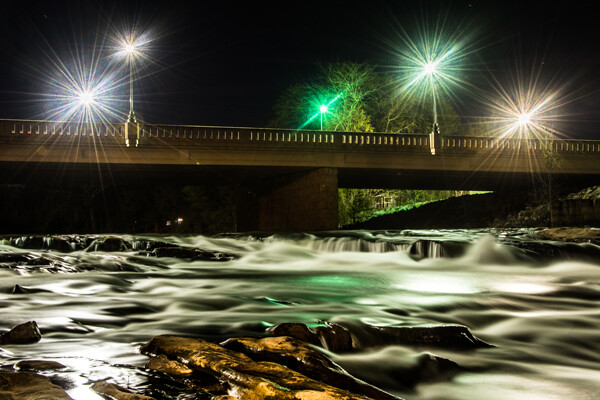
Mill Falls in Logan, Ohio. The main source of light for this scene was the street lights on the bridge over the river. The bridge was light-painted with a high-powered spotlight. I also added light to the rocks in the foreground. The exposure was 69 seconds, and I set the aperture to f/14 to maximize the starburst on the street lights. This image won me a Photographer’s Choice award in the 2014 Shoot the Hills photo contest.

What is light painting?

Light painting is a photography technique that uses a moving light source (e.g., a flashlight) to add light to a subject while taking a long-exposure photograph. A scene or object can be brought to life by painting with a beam of light.

When light painting, you, the photographer, become an entirely different kind of artist. Instead of just capturing an image as it’s presented, you create the image that the camera is capturing.

Now, light painting may take lots of patience and practice to perfect, but the results can be very rewarding.

And it’s important to recognize the simplicity of lighting painting – it’s a lot like any low-light photography, except you are putting an external light source in motion to enhance an image.

Let’s take a look at some of the basics for beautiful light painting photography.

school house in snow
Schoolhouse in the snow. This was a long, 170-second exposure, shot at f/8 (for depth of field) and ISO 100. Notice the light coming from inside the schoolhouse, added from the outside by shining a flashlight through windows at the back of the building.

Tools for light painting

Before you start doing light painting, you’ll need to make sure you have the proper tools:

  • Camera – Any digital camera capable of manual settings (including Bulb mode).
  • Tripod – One of the most important tools to produce light paintings. In most cases, your shutter is going to be open for several minutes, and it is very important that your camera does not move during the exposure.
  • Shutter release – Either use a cable release or a remote shutter release to begin your exposure. If you don’t have either of these, use your camera’s self-timer function to initiate the shot. It is very important that you never touch your camera or tripod during the exposure.
  • Stopwatch – A stopwatch or some other way of timing your exposures is helpful, since most light-painting exposures will use Bulb mode.
  • Light source – Many different types of lights can be used for light painting. These light sources are your “brushes” and may include flashlights, torch lights, lasers, glow sticks, flashes, cell phones, and even candles. Just about anything that can produce light can be used for light painting. Note that different light sources will produce different colors of light. For example, an LED light source will produce a cooler (blue) colored light, while a halogen source will produce a much warmer (orange) colored light.
  • Color gels – Color gels can be used to alter the tint of your light and add color to your painting.
light painting farmhouse
30 seconds | f/8

Camera settings

Now let’s take a look at the best camera settings for light painting:

  • Mode – Shoot in Manual mode, which allows you to set your shutter speed and aperture.
  • Image quality – Set your image quality to RAW, which allows you to capture as much information as possible. (This is not a necessity, but it is an important recommendation.)
  • White balance – If you want to balance out your artificial light source, choose either the Incandescent or Tungsten white balance setting. However, sometimes experimenting with other white balance settings can produce some interesting light effects. Daylight white balance is a good starting point if you want to maintain the original colors of your artificial light sources. Auto White Balance is not recommended.
  • ISO – Use a low ISO, such as 100.
  • F-stop or aperture – Stop down to f/8 or f/10, which allows you to get more depth of field and enables you to use a longer shutter speed.
  • Shutter speed – Set your shutter speed to Bulb mode (your final shutter speed will be determined by the amount of ambient light in the scene).
  • LCD brightness – Lower the brightness of your LCD preview, because the normal setting is too bright at night and will make your image look bright when it’s actually underexposed.
  • Histogram – Use your histogram to check your exposure. If the histogram skews heavily to the left, your image is going to be too dark.
  • Blinkies – Turn on your blinkies (a highlight warning) to help you determine if your highlights are exposed properly. It is perfectly acceptable for your brightest highlights to be slightly clipped if the rest of your image is properly exposed.
  • Image stabilization – Set this to Off. With your camera on a tripod, having image stabilization turned on can actually fool your camera or lens and cause blurring in your image.
  • Long exposure noise reduction – The recommended setting is Off. This can be set to On, but it will cause your exposure time to double (because the camera takes a second black exposure to help remove noise). If your camera is set to a reasonable ISO, the noise level will be low enough in most cases that in-camera noise reduction is unnecessary. Still, it is a good idea to check your noise levels in advance, and some older cameras may require this setting to be On to get acceptable noise levels.
still life flowers
This vase was backlit with a candle and I painted the flowers with a small penlight.
30 seconds | f/16 | ISO 100.

Begin with ambient light

The first step – before the actual light painting – is to determine the correct exposure for any ambient light in your scene.

Unfortunately, determining base exposures can be time-consuming when you’re experimenting with three- to four-minute shutter speeds.

Here’s a little trick that can help expedite this process:

  1. Set your ISO to six stops higher than the ISO you plan to ultimately use. For example, if you are planning to shoot at ISO 100, set your ISO to 6400.
  2. With your camera set to ISO 6400, experiment to find out how many seconds you will need for a nice exposure. Every second of exposure at ISO 6400 is equal to one minute at ISO 100.
  3. Once you’ve determined the proper shutter speed at ISO 6400, set your ISO back to 100 and prepare your exposure in minutes instead of seconds. (Many camera’s lowest ISO is 200, so 6 stops higher would be ISO 12800. And if your camera’s lowest ISO is 50, six stops higher would be ISO 3200.)
person with arms raised to the sky
A 30-second exposure at ISO 800. For this image, I increased the ISO to shorten the exposure to 30 seconds, because a longer exposure would cause a noticeable blur on the stars. Light painting was applied from the front of the subject, without letting the light shine directly back at the camera.

Focusing

Correctly focusing your camera is an important step – and in the dark, it can sometimes be difficult to pull off. The simplest way to get perfect focus is to shine a light source at a spot in your scene that you’ve determined must be in focus.

Then, using autofocus, focus on the light.

Finally, switch your lens from autofocus to manual focus (so that your focus point won’t change).

But remember:

If you move the camera, you must turn your autofocus back on and refocus. 

(Back button focusing is another great way to achieve focus when light painting.)

The exposure

At this point, you should have determined your exposure time, and your camera should be focused on your subject.

So now it’s time to begin your exposure and start painting! 

Most cameras allow you to set exposures of up to 30 seconds. For exposures over 30 seconds, set your shutter speed to Bulb. Use your cable release or remote to trigger your shutter button. Your shutter will remain open until you press the release again. Use your stopwatch, or the timer on your phone, to time the exposure length.

1971 VW bus light painting
This vintage 1971 bus was painted using one LED flashlight on the outside, with a second light inside to illuminate the bus interior.

Painting techniques

Light painting is subjective, so you’re free to approach it however you like.

But here is some advice for getting the most impressive results:

  • Paint from the sides – Don’t just stand behind your camera and wave the light across your image. Painting flat surfaces from the side will allow you to bring out textures.
  • Use lots of different angles – For instance, when painting the ground, hold the beam low and pan the light along the floor. This will keep the ground from appearing flat, and it’ll bring out all the details of the surface. Also, by adding light from many angles, the resulting image will have an interesting three-dimensional effect.
  • Don’t stand between the camera and your light source – If you do this, you will show up as a silhouetted ghost in the final photo!
  • Wear dark, non-reflective clothing and keep moving – Again, you do not want to appear as a ghost in your image!
  • Don’t shine the light source back at the camera – Otherwise, you’ll create a bright spot in the image.
  • Use a flashlight with a red filter when you check your camera to make adjustments. The red light will keep you from ruining your night vision.
  • Different surfaces are going to react to light differently – Wood surfaces may require more light than shiny surfaces such as metal or glass, because rougher surfaces absorb more light than smooth surfaces.
  • Keep your light moving – Move the beam in slow strokes to add lots of light and make faster strokes in areas where less light is needed.
  • Paint in up-and-down or side-to-side strokes, just like you’d work with real paint.
  • You probably won’t get the shot you want on the first try – It may take multiple attempts to get an image that you’re satisfied with. For this reason, try to keep track of how much light you add to each surface. Develop a plan so that you can make adjustments to each exposure until you get the image you’ve visualized.

A beginner’s guide to light painting: Conclusion

I’ve shared lots of tips and techniques to get you started with light painting, but there is so much more you can do with the medium! Be creative and fearless about trying new things.

Once you start to get the hang of light painting, there is no limit to the images you can create – all you need is a camera and a few creative light sources. 

Now over to you:

Which of these light painting tips is your favorite? Have you tried light painting before? Do you have any additional tips or tricks for great light painted photos? Share your thoughts in the comments below!

The post Beginner’s Guide to Light Painting appeared first on Digital Photography School. It was authored by Bruce Wunderlich.


Digital Photography School

 
Comments Off on Beginner’s Guide to Light Painting

Posted in Photography


Fujifilm Announces the X-E4, With 26 MP and 20 FPS (for Just $850)

01 Feb

The post Fujifilm Announces the X-E4, With 26 MP and 20 FPS (for Just $ 850) appeared first on Digital Photography School. It was authored by Jaymes Dempsey.

Fujifilm announces the X-E4

Earlier this week, Fujifilm announced a spate of new mirrorless gear, including the Fujifilm X-E4, a compact, rangefinder-style camera designed for enthusiasts, street photographers, and more.

The X-E4 offers no handgrip and none of the standard Canon/Nikon/Sony mode dials. Instead, you get a minimalist, flat profile (though you can buy an attachable handgrip), plus a shutter speed dial and an exposure compensation dial, reminiscent of the film days. This makes for a tactile photographic experience, as you rotate thick dials to change your camera settings – and you even have the option of purchasing Fujifilm lenses with aperture rings, if you’re hoping to take the “old days” experience a step further.

While the lack of a handgrip might annoy some photographers, it compresses and lightens an already-compact camera, making the X-E4 an excellent purchase for street photographers, travel photographers, and other walkaround shooters who don’t want the inconvenience of carrying a huge camera around their neck. 

On the back of the X-E4, you’ll find a decently-specced electronic viewfinder (it offers 2.36M-dot resolution, which is neither especially low nor especially high but should get the job done). If you’ve spent time working with a DSLR’s optical viewfinder or a mirrorless camera’s EVF, you’ll know how important a viewfinder is for any type of action or low-light shooting. There’s also a nice flip-up LCD, perfect for capturing shots at tough angles, and essential for vloggers needing to monitor themselves while filming. 

Then there’s the X-Trans sensor, which offers 26 MP of detail. Fujifilm APS-C images are consistently superb, and the X-E4 will doubtless continue the company’s dominance in this area; I could easily see the X-E4 creating top-notch files for street photography and portrait photography, as well as for more detail-demanding genres such as landscape photography.

Of course, no Fujifilm camera is complete without a handful of Film Simulation modes. Here, the X-E4 is outfitted to include film looks such as Velvia, and if you’re anything like me, you’ll have a blast switching through all the different simulations and watching as the EVF previews the world in vivid color, black and white, and even sepia.

As for action capabilities, the Fujifilm X-E4’s autofocus speed remains to be seen, but the press release claims “fast and accurate autofocus” that can nail subjects in “0.02 seconds.” You also get 8 frames per second when working with the mechanical shutter, and this leaps to 20 fps with the electronic shutter (higher still if you’re willing to accept a 1.25x crop!), which is more than enough for serious sports shooting.

So for photography enthusiasts looking for a compact camera packed full of high-end specifications and capable of pro-level image quality, I highly recommend checking out the X-E4. While the camera won’t ship until March, you can currently preorder an X-E4 for just $ 850 USD.

Now over to you:

What do you think of the Fujifilm X-E4? Is it a camera you’d be interested in buying? What would you use it for? Share your thoughts in the comments below!

The post Fujifilm Announces the X-E4, With 26 MP and 20 FPS (for Just $ 850) appeared first on Digital Photography School. It was authored by Jaymes Dempsey.


Digital Photography School

 
Comments Off on Fujifilm Announces the X-E4, With 26 MP and 20 FPS (for Just $850)

Posted in Photography