RSS
 

Archive for December, 2020

6 Tips for Capturing Dramatic Skies in your Landscape Photography

06 Dec

The post 6 Tips for Capturing Dramatic Skies in your Landscape Photography appeared first on Digital Photography School. It was authored by Hillary Grigonis.

Don’t let the “land” in landscape photography fool you; a great landscape photo relies just as much on the sky as the land. Boring gray skies make for boring landscape photos, after all!

That said, capturing a dramatic sky in-camera is trickier than it seems. When the sky is lighter than the land, your camera will typically overexpose it, turning a brilliant blue into a vague and unexciting gray or white.

But with a little fine-tuning, it is possible to capture a sky that is the cherry on top of a great scene! Here are six tips for capturing more dramatic skies in your landscape photography.

dramatic sky cityscape

1. Time it right

Landscape photography may not require the split-second timing that’s necessary for capturing a toddler’s smile or a wide receiver’s catch, but timing is still a big part of the picture. The sky that’s gray one day could be bright blue the next. So when planning out a landscape photo, consider how the timing will impact the sky.

Watch for weather patterns that add interest to a shot, like a storm brewing just above the horizon. Weather plays a big role in the overall mood of the image – so if you’re hoping to capture a dark and gloomy shot, head out when the sky is stormy.

On the other hand, if you’re hoping to capture a more relaxed or happy photo, look for blue skies dotted with clouds.

blue sky with fluffy clouds

The time of day matters, too. While the middle of the day will produce the most shadows on the land, it’s when the sky tends to be the clearest blue. And just after sunset and just before sunrise is often a good time to capture wispy clouds and a warmer tint of light.

Of course, sunrise and sunset is great for dramatic skies, as well.

2. Try the wrong white balance

Photography rules are sometimes meant to be broken, including rules about always using the correct white balance.

You see, the wrong white balance setting can create a more dramatic sky. This is especially true when shooting toward the beginning or end of the day – using a different white balance preset will adjust the color in the sky.

Auto, Cloudy, and Shade white balance presets will get you an orangish sunset with a light blue sky (with slight variations in warmth depending on the setting you choose). A florescent setting, on the other hand, will typically turn an orange sunset purple with a brilliant blue sky. Tungsten offers a similar effect, but with even deeper colors.

white balance examples

Using Kelvin temperatures to adjust your white balance results in even greater control over the colors in the sky. At around 5500K, you’ll usually capture a sunny sky with an accurate white balance – that is, where things that are white are still white in the picture, and where things that are gray are still gray in the picture.

A higher temperature – 6500K, for example – will give the land an orange glow but also enhance the colors in a sunset. A cooler temperature, on the other hand (e.g., 3000K), will play up the blues and purples. By using the Kelvin scale, you have more options for picking a white balance setting that best captures the colors in your photos.

Warm white balance for a warm sky
Here, the white balance was altered in post-processing to warm up the sky.

While it’s always best to get the shot right in-camera, shooting in RAW offers you even more flexibility when it comes to adjusting the colors in the sky (and the rest of the image, for that matter).

If you overdid things by making the shot too warm or too cool, you can easily adjust a RAW photo in post-processing, so that you use the color temperature that best fits the image. If you have a landscape photo that you already shot in RAW, open it and try different white balance presets, or the temperature slider, to see first-hand how shooting with a different white balance would have impacted the shot.

3. Compose for the sky

When the sky is more dramatic than the land, why not use that to determine your composition?

Pay attention to where you place the horizon when you are composing your shot. Use the rule of thirds to imagine the image is divided into threes, then place the horizon on one of those horizontal lines. If you are shooting a photo with an average-looking sky, try placing the horizon on the upper third of the image, so more of the land is included in the photo, like this:

horizon high up with a boring sky
As the sky here isn’t very dramatic, the higher placement of the horizon improves the composition.

But if the sky is really dramatic, take advantage of that and include more of it in the frame – by placing the horizon on the lower third:

horizon low in the frame with a dramatic sky
The sky here is dramatic, so the image was composed to show less ground and more sky.

4. Use a filter

There are two filters every landscape photographer should have in their camera bag in order to capture more dramatic skies.

The first is a graduated neutral density filter. Now, a regular neutral density filter is like putting sunglasses over your lens – it limits the light coming in for bright scenes or long exposures. But a graduated neutral density filter places that darkening effect only on a portion of the image. And by positioning the dark portion of the filter over a bright sky, you can properly expose the entire scene.

Without a graduated neutral density filter, the sky will often be overexposed and bland, or the land will be underexposed and dark. With the filter, you can achieve an exposure that works for both portions of the scene. The only downside is that graduated neutral density filters don’t work as well with an uneven horizon, like when shooting a cityscape. Graduated neutral density filters come in both circular and square formats, but the square is often preferred because you can place the horizon anywhere in the frame.

The second filter landscape photographers should use to capture more dramatic skies is a polarizing filter. Polarizing filters work by adjusting the reflected light coming through your camera lens. Since the sky is blue because of this reflected light, turning the front of the polarizing filter will adjust the intensity of the blues in the sky. Since polarizing filters only affect reflected light, they can still be used when mountains or buildings make the horizon uneven. Polarizing filters are also great for enhancing or removing reflections on water or other shiny surfaces.

polarizing filter example

5. Experiment with motion blur and long exposures

Long exposures aren’t just for photographing waterfalls. If you use a long enough shutter speed, the clouds will blur, too, creating a sky of wispy streaks and a slight feeling of motion.

To capture motion blur in the clouds, you’ll need to use a long shutter speed. The best settings will depend a bit on the weather and how much motion blur you’d like, but you can try starting with a two-minute exposure and adjust up or down from there.

motion in the sky

If you are shooting during the day, you may not be able to balance out a two-minute exposure with a narrow-enough aperture or a low-enough ISO; instead, you’ll end up with a photo that’s way too bright.

So how do photographers capture motion blur in the clouds when the photo obviously wasn’t taken at dusk or dawn?

They use a neutral density filter – which helps block out some of the light so that you can set a long exposure during the day.

(Note that a neutral density filter is the same thing as a graduated neutral density filter, but the entire filter is dark instead of just half of the filter).

motion in the water and sky due to a long exposure blur

6. Use the Adobe Camera RAW Graduated Filter tool

While it’s always best to get the shot right in-camera, there are a few editing tools that can improve the sky in your landscape photos. One of those tools is the Graduated Filter inside Adobe Camera RAW (this works the same in Photoshop and Lightroom).

With the Graduated Filter, you can drag an effect over the sky in your photo. Like an actual graduated filter, the effect will only cover the top portion of the image and gradually fade away, making it possible to create natural-looking edits.

The Graduated Filter tool can be used to adjust the exposure, creating an effect much like an actual graduated neutral density filter. But the tool can also adjust contrast, saturation, clarity, sharpness, and color. That opens up a lot of possibilities for applying edits just to the sky for more drama – creating effects that sometimes can’t be done in-camera.

rainbow in the sky
This is the original photo.
rainbow in the sky but with a Graduated Filter to enhance the drama
This is the same photo, but with a Graduated Filter used on the sky to increase the drama.

Capturing dramatic skies in your landscape photos: conclusion

The sky can make or break a landscape photo. From timing and composition to filters and post-processing, when you consider the sky as you shoot, you’ll end up with more dramatic, frame-worthy shots.

Do you have any other tips for creating dramatic skies in your landscape photography? Share them in the comments!

The post 6 Tips for Capturing Dramatic Skies in your Landscape Photography appeared first on Digital Photography School. It was authored by Hillary Grigonis.


Digital Photography School

 
Comments Off on 6 Tips for Capturing Dramatic Skies in your Landscape Photography

Posted in Photography


10 Ways to Take Stunning Portraits

05 Dec

The post 10 Ways to Take Stunning Portraits appeared first on Digital Photography School. It was authored by Darren Rowse.

How do you take portraits that have the wow factor?

Today, I want to talk about taking portraits that are a little out of the box. You see, it’s all well and good to have a portrait that follows all the rules – but it recently hit me that often the most striking portraits are those that break the rules.

stunning portrait

I want to look at some ways to break out of the mold and take striking portraits by breaking (or at least bending) the rules and by adding a little randomness to your portrait photography.

1. Alter your perspective

Most portraits are taken with the camera at (or around) the eye level of the subject. While this is good common sense, completely changing the angle that you shoot from can give your portraits a real wow factor.

stunning portrait high perspective

Get up high and shoot down on your subject, or get as close to the ground as you can and shoot up. Either way, you’ll be seeing your subject from an angle that is bound to create interest.

stunning portrait shooting from low down

2. Play with eye contact

It is amazing how much the direction of your subject’s eyes can impact an image. Most portraits have the subject looking down the lens – something that can create a real sense of connection between a subject and those viewing the image.

But there are a couple of other things to try:

A. Looking off-camera. Have your subject focus their attention on something outside the field of view of your camera. This can create a feeling of candidness and also create a little intrigue and interest as the viewer of the shot wonders what the subject is looking at. This intrigue is particularly strong when the subject is showing some kind of emotion (i.e., “What’s making them laugh?” or “What is making them look surprised?”). Just be aware that, when you have a subject looking out of the frame, you can also draw the eye of the viewer to the edge of the image, and this will take them away from the point of interest in your shot: the subject.

subject looking off-camera

B. Looking within the frame. Alternatively, you could have your subject looking at something (or someone) within the frame. A child looking at a ball, a woman looking at her new baby, or a man looking hungrily at a big plate of pasta – it can all work. You see, when you give your subject something to look at that is inside the frame, you create a second point of interest and a relationship between it and your primary subject. It also helps create a story within the image.

woman looking at child stunning portrait

3. Break the rules of composition

There are a lot of “rules” out there when it comes to composition, and I’ve always had a love-hate relationship with them. My theory is that, while composition rules are useful to know and employ, they are also useful to know so you can purposely break them – as this can lead to eye-catching results.

The rule of thirds is one rule that can be effective to break. You see, placing your subject dead-center can sometimes create a powerful image. And creative placement with your subject right on the edge of a shot can sometimes create interesting images.

stunning portrait centered

Another “rule” that we often talk about in portrait photography is to give your subject room to look into. This can work really well – but again, sometimes rules are made to be broken.

portrait with no room to look into

4. Experiment with lighting

Another element of randomness you can introduce in your portraits is the way you light them. There are almost unlimited possibilities when it comes to using light in portrait photography.

Sidelighting can create mood, while backlighting and silhouetting your subject to hide their features can be powerful.

sidelit portrait

Also, using techniques like slow sync flash (as well as long exposures combined with light painting) can create impressive images.

long exposure image with single flash

5. Move your subject out of their comfort zone

I was chatting with a photographer recently who told me about a corporate portrait shoot that he had done with a businessman at his home. They’d taken a lot of head and shoulder shots, shots at the desk, shots in front of framed degrees, and other “corporate” type images. The photos had all turned out fairly standard – but there was nothing that really stood out from the crowd.

The photographer and the subject agreed that there were plenty of usable shots, but they wanted to create something special and out-of-the-box. The photographer suggested they try some “jumping” shots. The subject was a little hesitant at first, but stepped out of his comfort zone – and then, dressed in his suit and tie, started jumping!

The shots were amazing, surprising, and quite funny. The shoot culminated with the subject jumping into his pool for one last image!

While this might all sound a little silly, the shots ended up being featured in a magazine spread about the subject. It was the series of out-of-the-box images that convinced the magazine the subject was someone they’d want to feature.

man jumping

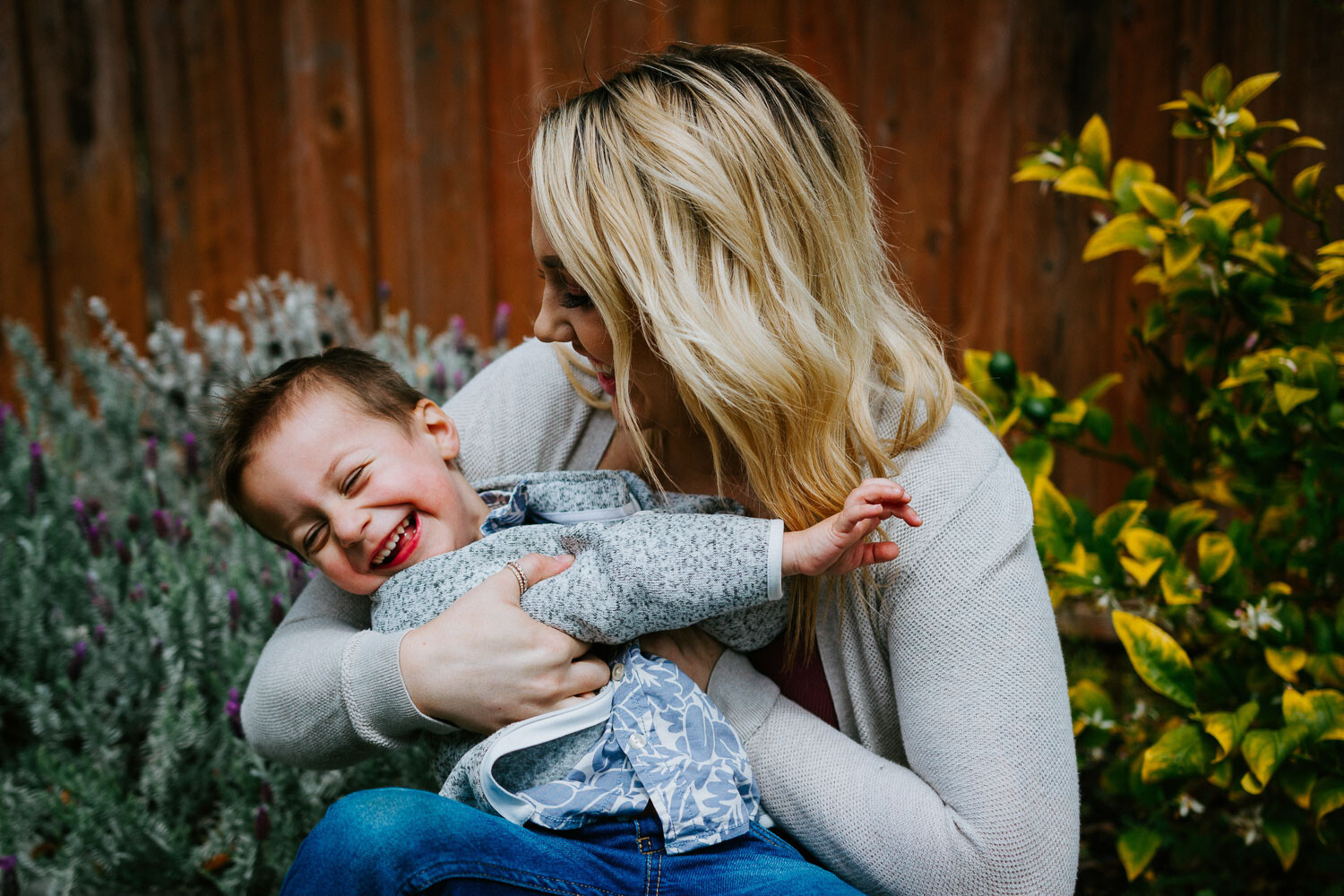
6. Shoot candidly

Sometimes, posed shots can look somewhat…posed. Some people don’t look good in a posed environment, and so switching to a candid-type approach can work well.

Photograph your subject at work, with family, or doing something that they love. This will put them more at ease, and you can end up getting some special shots with your subject reacting naturally to the situation they are in. You might even want to grab a longer zoom lens to give your subject space and get really “paparazzi” with them.

I find that this can work particularly well when photographing children.

candid child image

7. Introduce a prop

Add a prop of some kind, and you create another point of interest that can enhance your shot.

Yes, you might run the risk of taking too much focus away from your main subject. But you can also really add a sense of story and place to the image that takes it in a new direction, and gives the person you’re photographing an extra layer of depth that they wouldn’t have had without the prop.

portrait with gum and candy as a prop

8. Focus on one body part (and get close up!)

Use a lens with a long focal length, or get up close so that you can just photograph a part of your subject. Photographing a person’s hands, eyes, mouth, or even just their lower body can leave a lot to the imagination of the viewer.

Sometimes, it’s what is left out of an image that says more than what is included.

woman's arm in field

9. Obscure part of your subject

A variation on the idea of zooming in on one part of the body is to obscure parts of your portrait subject’s face or body. You can do this with clothing, objects, your subject’s hands, or just by framing part of them out of the image.

Doing this means that you leave a little to the imagination of the viewer. And you also focus the viewer’s attention on the parts of your subject that you want focused on.

eyes stunning portrait

10. Take a series of shots

Switch your camera into burst mode (also known as continuous shooting mode) and fire off several shots.

In doing this, you create a series of images that could be presented together, instead of just one static image.

This technique can work very well when you’re photographing children – or really when you’re photographing any active subject that is changing their position or pose in quick succession, like the runners below:

people running in a race

10 ways to take great portraits: conclusion

Capturing stunning portraits is easy – as long as you remember a few of these simple tips!

And if you’re interested in improving your portrait photography even further, make sure you’re subscribed to the Digital Photography School newsletter, where we share lots of photography tips and techniques every single week.

Also, make sure you check out the second half of this series here: 10 More Tips for Stunning Portrait Photography, as well as our Portraits: Making the Shot eBook!

And start taking some great portraits, today!

The post 10 Ways to Take Stunning Portraits appeared first on Digital Photography School. It was authored by Darren Rowse.


Digital Photography School

 
Comments Off on 10 Ways to Take Stunning Portraits

Posted in Photography


Video: How to safely make a 35mm daguerreotype at home

05 Dec

In the latest episode of ‘Darkroom Magic,’the George Eastman Museum’s historic photographic process specialist, Nick Brandreth, teaches viewers how to make a 35mm daguerreotype at home without the use of dangerous or expensive chemicals.

The daguerreotype gets its namesake from its creator, Louis Daguerre. The daguerreotype was introduced to the masses in 1839, becoming the first commercially viable photographic process. Although it fell out of favor about a decade later, the process has distinct characteristics that made it the process of choice for some specialists throughout the 20th century.

Nick Brandreth with some of his 35mm daguerreotypes

As Brandreth says, the at-home daguerreotype process is quite simple. In addition to a 35mm camera, you need a silver plate, or in his case, a piece of copper with silver plating. Orange or red glass is required in lieu of using mercury, which is part of the traditional daguerreotype process. You need iodine fuming materials and a glass vessel. Additionally, polishing materials are required to give your silver plate a mirror-like finish. The full ingredients are shown in the video below.

After you have gathered your materials, you must first buff and polish the silver plate. The first step requires a buff, olive oil, and rottenstone compound. This step removes any big scratches. Be sure to wash the plate with soap and water in between steps. The next stage is to polish the plate using lampblack, bringing the plate to a mirrored finish.

You’ll need a variety of materials to do this project, but they’re all safe, unlike the mercury used in the traditional daguerreotype process.

With the polished plate ready, the next stage is fuming. Combining silica gel beads and pure elemental iodine in a glass, you create a fuming material and place the polished plate above it, creating a photosensitive surface. The surface is sensitive to ultraviolet, violet and blue light, so you’ll want to expose it with natural light or a suitable artificial light source.

Orange or red glass is used to develop the plate. It takes between 30 and 45 minutes to fully develop the plate. It will then require fixing and a finishing stage.

The plate is now ready to be exposed. Place it inside your 35mm camera and the camera’s pressure plate should keep it stable. After exposure, it’s time for the ‘magic to happen,’ as Brandreth says. Place your exposed plate under a piece of red or orange glass and hit it with sunlight or a strong work light. You can watch the plate develop over the next 30 to 40 minutes. After this, give it a smooth, consistent fix and then wash the plate. To watch the finishing stage, be sure to watch the video above, as it requires a few steps.

If you’re interested in the science and art of photography, you can learn more about workshops at the George Eastman Museum’s website. Many more interesting videos can be viewed on its YouTube channel.

Articles: Digital Photography Review (dpreview.com)

 
Comments Off on Video: How to safely make a 35mm daguerreotype at home

Posted in Uncategorized


Under $10 Holiday Deals: Deal 1 from Photzy

05 Dec

The post Under $ 10 Holiday Deals: Deal 1 from Photzy appeared first on Digital Photography School. It was authored by Darren Rowse.

Instead of our usual 12 Days of Christmas promotion, we’ve considered the impact of the year to date and selected just 4 deals to promote (one per week) during December, all under USD$ 10. We hope you can find a little something to treat yourself or a loved one these holidays. We’ve negotiated some amazing deals for you with our trusted partners, who pay us a commission and have added some extra special bonuses for you.

Photzy Under$  10 Deal

Our first “Under $ 10 Holiday Deal” is from our trusted partner Photzy, and is a great alternative to their full set of Snap Cards . . .

Have you ever gone out to shoot, but forgotten a technique you recently learned?

We don’t all have a photographic memory, so having a compact reference guide at hand can help you recall what you learnt. 

That’s why the folks over at Photzy made these 20 printable Photography Training Cards called “Snap Cards”.

As part of our Under $ 10 Holiday Deals, they’re offering them to dPS readers for just $ 7USD. And they have already been flying off the shelves! It’s unbelievable how popular these cards are every time we mention them.

This is a gentle reminder – as a “dPS Under $ 10 Holiday Deal” you only pay $ 100 just $ 7 Today. And if you pick them up this week there are special bonuses available.

Normally $ 100, for the next 7 days you can get these reference cards for 93% off + a free limited daily bonus (more information on the page)

A few of the cards include:

  • Aperture Explained 
  • Shutter Speed Explained 
  • ISO Explained 
  • Shooting Modes Explained 
  • Auto Focus Modes Explained 
  • Taking Sharp Pictures
  • Exposure Compensation Explained 
  • Landscape Photography Checklist
  • Tips on Photographing Night Scenes  
  • Composition Tools 
  • Portrait Cropping
  • Working with Natural Light 
  • And So Much More!

There are 20 colour coded lessons in 8 main photography areas. Photzy offers a 100% money back guarantee, so there’s no risk in trying them out to see if they’re right for you.

Available with the current free bonus, if you pick them up this week, grab them here while you can.

People are loving these cards

“I was a little worried whether there’d be enough useful information on the cards…but I was pleasantly surprised. They are extremely useful. I’ve printed out different sets and they now live in my bag.” – Amy W.

“I found them to be a great point of reference which allowed me to be more creative with my photographs.”  – Kenny I.

There’s 20 cards in total, organized and color-coded into 8 key problem areas!

PLUS they’ve included two free video tutorials to show you how to print, and how best to use these cards…

If you’d enjoy having a quick, easy to read, (and understand), reference system that you can take with you “anywhere” when you’re out shooting pictures…

You owe it to yourself to Click Here

You can print out your Snapcards like this!

Print them out, pop them in your bag. They’ll be right there with you, exactly when you need them.

Print out your Snapcards and pop them in your camera bag

As always- your purchase is 100% Guaranteed by Photzy!

Time is running out on this special offer.

You need to check them out. This will be the most useful training tool you’ll pick up all year.

Don’t miss out. Check them out here.

Happy Holidays
Darren and the dPS Team

The post Under $ 10 Holiday Deals: Deal 1 from Photzy appeared first on Digital Photography School. It was authored by Darren Rowse.


Digital Photography School

 
Comments Off on Under $10 Holiday Deals: Deal 1 from Photzy

Posted in Photography


Weekly Photo Challenge – Light Painting

05 Dec

The post Weekly Photo Challenge – Light Painting appeared first on Digital Photography School. It was authored by Sime.

We had some great photos for last week’s ‘Wheels’ challenge, this week it’s a bit harder and maybe new for some, we’re going to try our hand at light painting!

Missed a challenge? Go back and do them all! Click Here

Weekly Photo Challenge - Light Painting

Not sure what light painting is, think it’ll be too hard? there’s a full blog post here that we’ve written to help – have a read and then come back and submit your photo!

SEE THE HOW-TO POST HERE

Make sure to include the tags #dPSLightPainting if you share your photo on Instagram or Facebook.

Weekly Photo Challenge - Light Painting

Great! Where do I upload my photos?

Simply upload your shot into the comments field (look for the little camera icon in the Disqus comments section) and they’ll get embedded for us all to see. Or, if you’d prefer, upload them to your favourite photo-sharing site and leave the link to them.

Weekly Photography Challenge – Looking Up

Share in the dPS Facebook Group

You can also share your images in the dPS Facebook group as the challenge is posted there each week as well.

If you tag your photos on FlickrInstagramTwitter or other sites – tag them as #DPSWheels to help others find them. Linking back to this page might also help others know what you’re doing so that they can share in the fun.

Follow us on Instagram?

The post Weekly Photo Challenge – Light Painting appeared first on Digital Photography School. It was authored by Sime.


Digital Photography School

 
Comments Off on Weekly Photo Challenge – Light Painting

Posted in Photography


Viltrox unveils 33mm F1.4, 56mm F1.4 APS-C prime AF lenses for Sony APS-C camera systems

04 Dec

Viltrox has announced the release of its new AF 33mm F1.4 and 56mm F1.4 APS-C prime lenses for Sony E-mount camera systems.

The new 33mm F1.4 (50mm full-frame equivalent) features an all-metal construction and is comprised of 10 elements in 9 groups, including one extra-low dispersion element and one high refractive index element. It features the option to manually or automatically control the aperture, a minimum focusing distance of 40cm (15.75″), offers a built-in micro USB port for updating the firmware and is compatible with Sony’s Eye AF technology thanks to its onboard stepping motor (STM) driving the autofocus.

The lens measures in at 72mm long, 65mm diameter and weighs 270g (9.5oz). Viltrox has a full list of compatible Sony cameras on the 33mm F1.4 product page, where you can also buy the lens today for $ 259.

Moving onto the 56mm F1.4 (85mm full-frame equivalent), it too features an all-metal construction and is comprised of 10 element in 9 groups, including an extra-low dispersion element and a high fraction index lens. Interestingly, unlike the 33mm F1.4 lens, the 56mm F1.4 lens appears to be identical in optical design and features to the 56mm F1.4 lens Viltrox released for Fujifilm X-mount systems back in September.

The 56mm F1.4 also supports Sony Eye AF technology, has a built-in micro USB port for updating the lens’ firmware and uses an STM motor for driving autofocus. The lens measures in at 72mm long, 65mm diameter and weighs 290g (10.2oz).

You can find a full compatibility list on Viltrox’s 56mm F1.4 product page, where you can also pre-order the lens for $ 299.

Articles: Digital Photography Review (dpreview.com)

 
Comments Off on Viltrox unveils 33mm F1.4, 56mm F1.4 APS-C prime AF lenses for Sony APS-C camera systems

Posted in Uncategorized


How to Use Photo Studio Ultimate 2021’s Color and Tone Wheels for Amazing Results

04 Dec

The post How to Use Photo Studio Ultimate 2021’s Color and Tone Wheels for Amazing Results appeared first on Digital Photography School. It was authored by Jaymes Dempsey.

ACDSee Photo Studio Ultimate Color and Tone Wheels

Color editing is an essential part of nearly every great photo.

Unfortunately, adjusting the colors in most post-processing programs is difficult – or downright impossible.

One impressive exception to this, however, is ACDSee Photo Studio Ultimate 2021, which offers two powerful tools for color editing:

  1. The Color Wheel
  2. The Tone Wheels
ACDSee Photo Studio Ultimate 2021 Tone Wheels

And that’s what this article is all about. I’m going to show you how to use the Color Wheel and Tone Wheels to apply gorgeous color adjustments to your photos. You’ll discover how the Wheels work, what they can do, and how to get a professional look in your own images.

Let’s dive right in.

The Color and Tone Wheels: overview

ACDSee Photo Studio Ultimate 2021

The Color and Tone Wheels come as part of Photo Studio Ultimate 2021, a recently updated, all-in-one photo editor that you can grab on ACDSee’s website for $ 8.90/month (you also have the option to purchase a lifetime license for $ 149.99).

ACDSee pricing

While Photo Studio Ultimate 2021 offers a lot of upgrades over its predecessor (including some major speed improvements that you’ll want to see for yourself), one of the biggest features for amateur and professional photographers is the set of color editing tools: the Color Wheel and the Tone Wheels.

Here’s a quick peek at the Color Wheel:

Color Wheel

And here is the Tone Wheels panel:

Tone Wheels

Together, these two tools can revolutionize your photo editing workflow.

And here’s why:

With the Color and Tone Wheels, you can make both broad and targeted adjustments to the colors in your images. You can shift, brighten, and saturate colors selectively, you can push colors into the shadows, highlights, and midtones separately, and so much more – all with a few easy-to-use wheels and sliders.

As someone who’s a bit color-obsessed, I’ve used quite a few color adjustment tools in many different post-processing programs. But I can honestly say that Photo Studio Ultimate’s version is one of the best implementations I’ve ever seen (if not the best). Yes, the wheels are amazingly powerful, and they should offer any amateur or professional all the color adjustment power they need. But they’re also just so fun and intuitive to work with, which is what’s really sold me on this program.

ACDSee Photo Studio Ultimate 2021 sample

Now let’s take a look at how you can actually use the Color and Tone Wheels for great results (and if you’re feeling intimidated, don’t be – I’ll give you simple, easy-to-follow instructions!).

How to use the Color Wheel to selectively adjust colors in your photos

You’ll find the Color Wheel in Photo Studio Ultimate 2021’s Develop mode, which you can select in the top-right corner of the screen:

the Develop mode in ACDSee Photo Studio Ultimate 2021

Then open the Color Wheel panel on the left-hand side, and you’ll see a color wheel with a series of sliders below it:

Color Wheel panel

Here’s what you need to know:

The color wheel itself lets you select the colors you’re targeting in the photo.

And the sliders below it allow you to adjust the targeted colors.

So once you have your Color Wheel panel open, here’s what I recommend you do:

Step 1: Select the colors you want to adjust

Selecting the colors you’d like to adjust pretty easy, and there are a couple of methods you can use.

First, you can simply hover your cursor over different parts of your photo, and watch as it turns into a dropper icon:

dropper tool

Then, by clicking once on the photo, you’ll select that color for adjustment.

So if you click on a pinkish-purple part of your photo, you’ll select all the pink-purple colors:

dropper example

And if you click on a yellow part of your photo, you’ll select all the yellow colors:

dropper example

Now, as soon as you click on a part of your photo, you’ll see the color wheel change. This is to show you the color range you’ve selected.

You can also use the display on the color wheel to either select colors (instead of the eyedropper), or to refine your color selection.

To select colors, just click on the relevant part of the wheel:

selecting a color on the color wheel

And to fine-tune the color selection, just narrow the range of colors on the color wheel – by dragging the edges of the selection inward or outward. That way, the adjustments you make via the sliders will affect a narrower or broader range of colors in your photo.

Here, I’ve narrowed the color selection:

narrow selection on the color wheel

And here I’ve broadened it:

broad selection on the color wheel

Also, if you want to get really picky with your selection, you can drag your color range upward from the center of the wheel:

selecting only saturated areas

And this will ensure you only select the more saturated colors.

You can also drag downward from the rim of the wheel to select only the less-saturated colors:

selecting only desaturated colors

By the way, if you want to see the areas you’ve selected displayed on your photo, just hit the Auto preview the selected range checkbox:

previewing the selection

Your selected colors will be highlighted on the image, while everything else will be grayed out:

previewing the selection

Cool, right?

Step 2: Adjust the colors using the sliders

Now comes the fun part:

Actually adjusting the colors.

While there are a number of sliders, I recommend you focus on three key options:

Hue.

Saturation.

And Brightness.

hue, saturation, and brightness sliders in ACDSee Photo Studio Ultimate 2021

These are the main adjustments you’ll want to make (I use them on almost every photo I edit).

By shifting the Hue slider, you shift the hue of your selected color range. So if I select the pink colors in this flower photo and want to make them more purple, I can just push the Hue slider to the left:

shifting the hue

I can also make them more red by pushing the Hue slider to the right:

shifting the hue

Speaking more generally, the Hue slider is useful for situations where you want to separate colors to create contrast, or where you want to make colors more similar to add harmony.

(How do you know what creates contrast and what creates harmony? Look at the color wheel! Colors that are opposite one another are contrasting/complementary colors, whereas colors next to one another are analogous colors.)

While color contrast will generally create a more powerful, in-your-face photo, analogous colors can result in a more peaceful final image.

Anyway, once you’ve adjusted the hue, I recommend turning to the Saturation slider. This works the way it sounds: It lets you selectively boost or reduce the saturation of your selected color range.

So by selecting the yellows in the image below, then adjusting the Saturation slider, you can boost the yellow intensity:

shifting the saturation

Or you can dial it back:

shifting the saturation

In general, boosting the saturation of your main colors looks pretty good, as long as you don’t overdo it. That way, a few colors in your photo will stand out and keep the viewer interested.

However, it can also be helpful to reduce the saturation of colors that distract from the main subject. So if your photo includes a red “Exit” sign in the background, you might reduce the saturation of those reds to keep the viewer focused on the foreground.

Finally, I recommend experimenting with the Brightness slider. This allows you to adjust the brightness of your selected color range. So you can brighten up your selection to make it pop:

shifting the brightness

Or you can darken the selection down to make it less impactful:

shifting the brightness

Step 3: Create additional color wheels for further adjustments

While one color adjustment may sometimes be enough, you also have the option to create more.

Simply click the Plus icon:

adding color wheels

Then follow the previous steps all over again!

Also, to toggle the effects of the color wheels on and off, you can just check and uncheck the box above each color wheel icon:

viewing the effects of color wheels

How to use the Tone Wheels to produce beautiful color grading

The Tone Wheels panel is located just below the Color Wheel panel in the Develop mode of Photo Studio Ultimate 2021:

using the tone wheels in ACDSee Photo Studio Ultimate 2021

Now, unlike the Color Wheel panel, you cannot select individual colors to adjust.

Instead, each of the three wheels corresponds to a different tonal range of your photo:

  • The top wheel corresponds to the highlights (the brightest tones)
  • The middle wheel corresponds to the midtones (the middle tones)
  • The bottom wheel corresponds to the shadows (the darkest tones)

And by adjusting the tone wheels, you change the color in the corresponding area of the image.

So by setting the Highlights wheel to yellow, your photo’s highlights will be tinted yellow:

adding yellow highlights

And by setting the Shadows wheel to green, your photo’s shadows will be tinted green:

adding green shadows

This is a fantastic way to add different looks to your images. For instance, you can create blue shadows and yellow highlights, which is a popular look on Instagram. Or you can make the highlights orange and the shadows teal, for a cinematic, movie-type result.

Now, the tone wheels themselves only allow you to select the hue and saturation of the color you’d like to add.

But by shifting the Brightness slider – found to the right of each wheel – you can also make the highlights, midtones, and shadows brighter or darker.

the brightness sliders

So how do you get great results using the Color Wheel panel? How should you approach this color adjustment tool?

Here’s what I recommend:

Step 1: Adjust the shadows

I like to start by adjusting the shadows in my images.

Now, you can choose your shadow color a few different ways:

One method is to select the Shadows eyedropper:

the shadows eyedropper

Then you can click on a part of your photo and the Shadows wheel will select its hue:

picking a shadow color

Alternatively, you can click around the wheel to select different colors:

clicking on the wheel

And you can further fine-tune the saturation with the left-hand slider:

using the saturation slider

Plus you can change the brightness of the shadows with the right-hand slider:

using the brightness slider

Personally, my favorite way to select colors is to use the wheel, but start by pushing the Saturation slider all the way up:

saturation pushed all the way to its maximum

That way, you can clearly see the effects of your color grade – and once you’ve chosen the right color, you can dial it back.

Also, while it’s always a good idea to experiment, the best shadow colors are generally cool – blues, greens, and purples.

I’d also recommend paying careful attention to the colors already present in your shadows – by matching the shadow color with already-existing colors, you can unify the darker parts of your photo and make it even stronger.

For this flower photo, I like blue-green shadows:

blue-green shadows example

Step 2: Adjust the highlights

Selecting a color for the Highlights wheel is just like selecting a color for the Shadows wheel.

You can use the eyedropper tool:

the highlights eyedropper

Or you can click on the wheel directly.

Of course, you can also fine-tune with the Saturation slider and the Brightness slider:

the brightness slider

Generally, you’ll want a warmer color for the highlights: an orange, yellow, or red.

It’s also a good idea to pay attention to your existing highlight colors. For instance, if your photo has a lot of warm sunlight, such as in the shot of the Black-eyed Susan flowers, you might want to accentuate the yellows with some nice golden highlights:

warmer highlights example

I’d also recommend looking at your shadow colors even when adjusting the Highlights wheel. For a nice result, you might choose a color that contrasts with the shadows to create a complementary color pair (as I discussed in the Color Wheel section, above).

Step 3: Adjust the midtones

Adjusting the midtones is a bit less common than adjusting the highlights and the shadows.

For one, if you adjust the midtones, your photo will often take on a more obvious tinted look, because we humans expect midtones to be more neutral compared to colder shadows and warmer highlights.

Plus, the midtones can correspond to skin tones, which you (generally) want to keep as natural as possible.

So I recommend you be careful when experimenting with the Midtones color wheel. If you do decide you want to make changes, I’d recommend keeping things closely aligned with the highlights, because too many colors in your scene will start to look messy.

Make sense?

As you’d expect, adjusting the midtones is just like adjusting the highlights and shadows. You have the Midtone color wheel that you can click on:

midtones color wheel

Plus your eyedropper:

midtones eyedropper

Which you can use to give your midtones a slight color grade!

ACDSee’s Color and Tone Wheels: the next steps

Now that you’ve finished this article, you know how to make pro-level color adjustments.

And with Photo Studio Ultimate 2021’s Color Wheel and Tone Wheels tools, you have everything you need to take your color editing to the next level.

So make sure you grab ACDSee Photo Studio Ultimate 2021. It’s currently available for just $ 8.90 per month, or you can get a lifetime license for $ 149.99. And if you’re just interested in trying out the software, you can get a free trial right here.

ACDSee is a paid partner of dPS.

The post How to Use Photo Studio Ultimate 2021’s Color and Tone Wheels for Amazing Results appeared first on Digital Photography School. It was authored by Jaymes Dempsey.


Digital Photography School

 
Comments Off on How to Use Photo Studio Ultimate 2021’s Color and Tone Wheels for Amazing Results

Posted in Photography


A Guide To The Limitations of Repairing Camera Lenses

04 Dec

There is one heart-stopping moment for every photographer. It happens when the prized possession that they spent hundreds or thousands of dollars to buy falls to the ground. If you’ve ever experienced it, you know the gut-wrenching agony and how the seconds feel like hours until you pick up your camera and begin to examine it. You know the cold Continue Reading

The post A Guide To The Limitations of Repairing Camera Lenses appeared first on Photodoto.


Photodoto

 
Comments Off on A Guide To The Limitations of Repairing Camera Lenses

Posted in Photography


Video: One man’s quest to watercool a Canon R5 into an 8K video powerhouse

04 Dec

This July, Canon released a media advisory clarifying the overheating concerns of early Canon EOS R5 and R6 users. After Lensrentals took apart the R5, we better understood the thermal constraints of the design. The camera is very tightly sealed, which is great when you want to keep water out, but not so great when you want heat to escape.

In its media release, Canon stated the approximate recording time for 8K 30p video with the R5 before the camera overheated is about 20 minutes. After letting the camera cool for 10 minutes, users can expect to record another 3 minutes of 8K footage before the camera overheats again. It’s a better, albeit similar, situation when recording 4K 60p and 4K 30p (8.2K oversampling) video. The feature set of the R5 and its performance is impressive, but in many settings, overheating is problematic.

Matt from the YouTube channel DIY Perks wanted to prevent his own Canon R5 from overheating, so he dismantled it and modified the camera’s internals. Should you feel inspired, it is worth pointing out the obvious. Dismantling your camera and modifying it will void your warranty and comes with significant risks. However, for the adventurous among you, you can see how Matt modified his camera in the video below.

Matt used some standard liquid cooling components you might find in a performance-oriented PC. He also installed thermal paste, which he believes is much better than the thermal pads that the R5 has between the main processors and a metal plate. To try to remove heat from the main processing area, he also installed copper, as it’s a good conductor of heat.

Matt used PC liquid cooling components to water cool his Canon R5. As you can see, it’s not a compact solution. However, it is remarkably effective, allowing for unlimited 8K recording times.

After making these mods, would the R5 record 8K video for longer than 20 minutes? No. Even though the camera was staying much cooler than it did before it was modified, it still shut down after 20 minutes of recording due to a timer-based heat management solution baked into the camera’s firmware.

Matt updated to a recent firmware version, which changes how the camera manages overheating, and tried the test again. This time, with firmware version 1.1.1 installed on the R5, the water-cooled R5 breezed past the 20 minute mark and Matt speculates that the camera should theoretically be able to record indefinitely. It’s worth noting that in certain situations, such as Matt’s testing area, the firmware update alone can increase 8K recording time limit. In this case, it added about six minutes of 8K recording time before overheating.

With custom-fabricated copper, the R5 becomes a much better high-end video camera.

Of course, the liquid cooling solution is not very practical or elegant. It requires tubing, a water reservoir, a pump, radiator and you must have the back of the R5 remain detached. Matt wanted to devise an improved heatsink solution and reassemble the camera completely.

Using copper, improved thermal paste, and thermal padding, he was able to get nearly 40 minutes of uninterrupted 8K recording, a significant improvement over the production camera. A five minute break allowed an additional half an hour of recording. This is a very impressive passive cooling solution and a big step up over an unmodified R5.

Combining modified internal components with copper heatsinks and an external heatsink results in unlimited recording time. It adds bulk to the camera, but the rear heatsink is removable, allowing the camera to retain its original form factor.

If you require even longer record times, coupling the passive cooling modification with a copper heatsink mounted to the back of the camera does the trick. While a heatsink adds bulk, it is also easily removed when not needed, quickly returning the camera to its original form factor. Matt also designed a 3D-printable base for the camera that includes room for a fan and batteries. The base works in tandem with the internal copper plate modification. The files for the base have not been uploaded yet, but the link will be added to the video’s description when available. To view more videos from DIY Perks, click here.

Articles: Digital Photography Review (dpreview.com)

 
Comments Off on Video: One man’s quest to watercool a Canon R5 into an 8K video powerhouse

Posted in Uncategorized


Tips For Achieving Blurry Backgrounds When You Don’t Have a Fast Lens

03 Dec

The post Tips For Achieving Blurry Backgrounds When You Don’t Have a Fast Lens appeared first on Digital Photography School. It was authored by John McIntire.

Using a shallow depth of field to get blurry backgrounds in your photos is a powerful and popular tool for photographers. Blurring your background in this way makes it easy to obscure details in your scene that don’t add anything to your photographs. This helps to ensure that the focus of your images is your subject, and only your subject.

Using fast lenses with maximum apertures such as f/1.8 or f/2.8 is the easiest way to achieve this blurry background effect.

Getting blurry backgrounds with a fast lens
Using a fast aperture (f/1.8 here) is a surefire way to ensure blurry backgrounds in your images, but what do you do if you don’t have access to a fast lens?
Canon 5D Mark III | Canon EF 85mm f/1.8 | 85mm | 1/1600s | f/1.8 | ISO 100

However, what do you do if you don’t have a fast lens? And what do you do in situations where you are unable to use your lens wide open?

Controlling aperture is only one way to alter the appearance of DOF when trying for blurry backgrounds.
Here, you can see the difference the aperture has on the background. On the left, the aperture is f/8, while on the right, it is f/1.8.

Fortunately, manipulating the aperture settings in-camera is only one way to control how depth of field appears in your images.

This article will show you two ways to help you achieve more background blur when you don’t have access to a fast lens and when you can’t shoot wide open.

1. Get closer to your subject

An easy way to obtain a shallower depth of field for blurry backgrounds is to simply get closer to your subject.

Achieve blurry backgrounds by getting closer to your subject.
Simply moving your position so that you are closer to the subject is a great way to manipulate depth of field. The closer you get, the shallower the depth of field gets.

Depth of field is determined by multiple factors. Aperture is one, but another important factor is how close the camera is to your subject. 

By moving your camera closer to your subject, you will increase the amount of background blur that appears behind your subject. 

(Conversely, if you want more depth of field in your image, move farther away from your subject.) 

Putting it into practice

With techniques like this, it can be a good idea to do a few exercises so you can see exactly what is going on.

To see this technique in action, find yourself a subject and position them in front of a background. Choose a background that’s a little bit busy (like foliage) so you can see the full effect. 

Getting blurry backgrounds without a fast lens
In the leftmost image, I was 12 feet away from the subject. You can see almost all of the details in the background. I slowly moved closer, 2 feet at a time; you should be able to see as the background gets blurrier. The last image was from 4 feet away. (Images are cropped for comparison.)

If you’ve chosen a portrait subject, start from between eight and ten feet away. If you’ve chosen something smaller, decrease that distance as much as you need to have a somewhat reasonable composition.

No matter what lens you have, you should be able to choose an aperture of f/5.6. Dial that in and adjust the other settings until you have a decent exposure. Take a shot. 

Step forward a foot and take another. Then move a foot closer again and take a third shot. Do this until you have reached your minimum focusing distance or you are too close to your subject to frame a photo. 

Then you can review the images in order. Watch for how the depth of field becomes shallower the closer you are to your subject. 

If you use multiple lenses, I encourage you to do this with all of them. 

The reverse

Of course, if what you want is more depth of field (i.e., less blurry backgrounds) in your frame, you can always move further away from your subject. 

In more depth

If you are technically minded and want to learn more about why and how this works, note that depth of field is governed by the inverse square law, just like many other aspects of photography. These other aspects include light intensity (which governs your exposure) and light fall-off (which governs the shape of the light). 

With an in-depth knowledge of the inverse square law and how it works, you would actually be able to calculate exactly where you need to be with a certain focal length and aperture to get an exact result. You will probably never find yourself in a situation where you would need to do this, but it is still possible! 

2. Bring your subject farther from the background

The other main way to achieve a shallower depth of field is to put more distance between your subject and the background.

Getting blurry backgrounds without a fast lens
Another easy way to manipulate depth of field for blurry backgrounds is to move your subject away from the background. Both images above were shot at f/8, but the lefthand image was taken 2 feet away from the background. The righthand image was taken 12 feet from the background.

This works the same way as the previous technique, but in this case, you will be moving your subject rather than the camera. If your subject is close to the background, more background detail will be present. To get more blur, simply move your subject forward. 

Practice

To see this concept in use, position your subject almost touching a background of your choice; this can be a studio background, some trees, or a wall. 

moving your subject away from the background is essential
To practice this, have your subject move away from the background in set increments. Make sure you move the same distance back, as well. Here (from top-left to bottom-right), the subject started 2 feet away from the background and ended 12 feet away from the background.

Start at an aperture of f/5.6 and get a decent exposure with your other settings. Take a shot. Now move your subject a foot away from the background. Note that it’s important that you move the same distance backward. If you don’t, then you will have two factors affecting the depth of field in the frame, and it will be impossible to accurately see what is blurring the background. 

Take another shot. Move yourself and your subject another foot back and shoot again. Repeat as many times as you want. In practice, how far away you move your subject is dependent on how much blur you want to achieve.

Do you want to retain some detail so that your viewers can recognize the background? Or would you rather obliterate any background details altogether, ensuring that your subject is the only thing for your viewers to focus on?

Real-world use

Now that you have put all of this into practice and you have your sequences of images, you should have a good idea of how the depth of field changes with your distance from the subject and the subject’s distance from the background. 

Getting blurry backgrounds is still possible at small apertures.
At the end of the day, you do not need a fast lens to achieve blurry backgrounds in your portraits. You are still able to achieve a shallow depth of field with smaller apertures.
Canon 5D Mark III | Canon EF 70-200mm f/4L | 1/200s | f/8 | ISO 800

Not only will you be able to use this knowledge to help you get a shallower depth of field when you can’t shoot wide open, but it will also help you design any desired photos long before you pick up the camera.

For example, you might want an image where your subject is in focus from front to back, but you want the background to be as obscured as possible. Having gone through these exercises, you should be able to approximate what aperture you need to use, how close to the subject you need to be, and how far away the background needs to be. And you should be able to do it in a fairly short amount of time, too!

Achieving blurry backgrounds: final words

Manipulating depth of field to get blurry backgrounds may be a basic technique, but understanding fundamentals like these helps give you a well-rounded set of camera skills that will serve you well in your photography. 

The post Tips For Achieving Blurry Backgrounds When You Don’t Have a Fast Lens appeared first on Digital Photography School. It was authored by John McIntire.


Digital Photography School

 
Comments Off on Tips For Achieving Blurry Backgrounds When You Don’t Have a Fast Lens

Posted in Photography