RSS
 

Archive for May, 2019

This wooden Leica is a covert music box with rotating ‘lens’

29 May

Unlike some of the camera replica projects that have surfaced over the years, this wooden Leica music box is available to purchase now. The music box, which is available from multiple sellers through online retailers Amazon and eBay, features a combination of wood components and wood burning to imitate the Leica M camera system.

$ (document).ready(function() { SampleGalleryV2({“containerId”:”embeddedSampleGallery_5276490978″,”galleryId”:”5276490978″,”isEmbeddedWidget”:true,”selectedImageIndex”:0,”isMobile”:false}) });

Different versions of the music box are available, including options that play Für Elise, The Blue Danube, and more modern tunes like the Harry Potter theme song. Users wind the music box by rotating the front lens, which then slowly unwinds as the music plays. Prices vary based on seller, but generally sit around $ 12.

Articles: Digital Photography Review (dpreview.com)

 
Comments Off on This wooden Leica is a covert music box with rotating ‘lens’

Posted in Uncategorized


K&F Concept TC2335 Carbon Fiber Tripod Review

29 May

The post K&F Concept TC2335 Carbon Fiber Tripod Review appeared first on Digital Photography School. It was authored by Adam Welch.

I’ve worked with a quite a few products from the folks over at K&F Concept in the last couple of years. Quality has ranged from great to average to the not so spectacular. When I was asked to have a look at their TC-2335 carbon fiber travel tripod, my expectations were at most cautiously optimistic. That being said, I’m happy to report that this little carbon fiber tripod from K&F Concept offers a lot in terms of performance. So, lets talk about K&F Concept TC-2335 carbon fiber tripod; what I liked, what I didn’t like and what you need to know if you happen to be in the market for a lightweight travel tripod.

First appearances

When the box first arrived my immediate reaction was “this is tiny…really tiny.” Not only that, but the entire package was alarmingly lightweight. After opening up the box I realized the logical reason for this: the TC-2335 is really tiny and incredibly lightweight. In fact, it is the most feather-like, compact tripod I have ever evaluated. The tripod itself is housed in its own padded carrying bag.

After removing the TC-2335 from its carrier, I was met with a surprisingly attractive carbon fiber tripod.

In terms of aesthetics, the TC-2335 proves to be one of the better-looking tripods I’ve entertained from K&F Concept. The carbon fiber is well done and is a default matte gray. This particular model comes with a matching orange color scheme, which looks great, But it is also available in an unlikely “thunder” version which features blue lighting graphics on the leg’s of the tripod…yes, really.

All leg locks are the twist type and are rubberized. I was honestly surprised with just how cleanly the leg locks are executed and would compare them to some higher-end tripod models I have handled.

Overall, the appearance of this tripod looks fantastic. But how would it perform in the field? Let’s find out.

In operation

Before we get rolling with how the TC-2335 performs, let’s have a look at a few specifications that you will want to know.

Practical technical specifications

  • Folded Height: 13.6 inches (34.54cm)
  • Maximum Height: 53.1 inches (134.9cm)
  • Minimum Height: 12.9 inches (32.8cm)
  • Weight: 1.85lbs (839g)
  • Maximum Weight Supported: 26.5lbs (12kg)

Stability

For such an admittedly small form factor, the TC-2335 is very stable. The terminating leg sections are quite small in diameter and this would lead one to assume that the legs are flimsy. But this is not the case. When locked down, this little tripod is reasonably stable even in high wind and awkward positions.

Speaking of the legs, I’ve mentioned already how impressed I was with the leg lock mechanisms, but there’s more. I was concerned, given the slender legs, that the overall stability would be compromised. However, the leg locks do an excellent job of arresting almost all leg movement.

The leg angle locks are something that I dislike about this tripod. They are not spring loaded; meaning that after you pull out on the locks, you must manually press them back into place to lock the legs. Again, I’m sure this is a weight saving measure, but the added convenience would have been worth the small amount of bulk, in my opinion.

The ball head

I used this tripod with three separate camera’s, ranging from lightweight crop-sensor mirrorless to full-frame DSLR. The ball head had no problems supporting the weight placed on it throughout my tests. K&F states that the tripod is capable of supporting virtually fourteen times its weight. While that may be extreme, I do not doubt that the ball head mechanism could support a camera system upwards of five to six pounds should the circumstances present themselves.

The ball head itself sports only a single adjustment knob which controls both panning and the ball head articulation. I’m sure this is a weight saving measure but can lead to complications when adjusting your camera at times. While panning is silky smooth, the ball head seems to be somewhat rough and quite audible when moved. A small amount of lubrication may help in this area. I feel I should also note that the ball head features not only a bubble level – which is quite useful – but also a magnetic compass.

Again, yes…really.

What’s great

In terms of packability, the TC-2335 from K&F Concept is superb. It’s extremely lightweight and doesn’t take up much room anywhere. It would be ideal for those who do a lot of flying or for anytime space comes at a premium. It looks great and is more than capable of supporting most camera systems that you’ll likely want to be carrying around. The twist locks on the legs also secure with extreme solidity. Overall, for a tripod of this size, the entire platform is oddly stable.

What’s not so great

I can’t get past the angle locks for the legs not being spring loaded, and this is the major gripe I have with this tripod. Granted, this is the first tripod I recall using which doesn’t have this feature. At the same time, I’m sure this would be something that could be a personal preference. Also, the quite serviceable ball head is not exactly smooth in operation, and I would have liked to have seen a secondary knob for panning.

Final verdict

For a tripod which is intended to be a travel companion for the highly mobile photographer, the K&F Concept TC-2335 is a wonderful low-cost option if you are in the market for a compact carbon fiber tripod. It’s good looks and solid stance will be completely adequate for most shooters who understand it’s uses and limitations.

Don’t look for a workhorse tripod here. Rather, I would suggest you view the TC-2335 as a wholly capable shooting platform that will come in handy when weight, size, and portability take precedence over the subtle functionalities found in larger, more dedicated camera support systems.


The post K&F Concept TC2335 Carbon Fiber Tripod Review appeared first on Digital Photography School. It was authored by Adam Welch.


Digital Photography School

 
Comments Off on K&F Concept TC2335 Carbon Fiber Tripod Review

Posted in Photography


Fujifilm teases new Instax camera with LCD screen ahead of June 12 launch event

29 May

Fujifilm has announced the upcoming launch of a new Instax camera model. Full details about the new instant camera won’t be released until June 12, but the company did tease one key feature in the below tweet on May 27: the inclusion of a small LCD. The new Instax model will be ‘perfect for the new age,’ Fujifilm’s tweet states.

The ‘new era’ of Instax cameras will include multiple ‘very special features,’ Fujifilm teased in its tweet, one of which is the LCD. The new model will include the same instant color printing capability found on other Instax models, but it’s unclear what new features Fujifilm plans to include.

The current Instax product line features more than a dozen models, including the relatively new Square SQ20 instant ‘hybrid’ digital camera, which features an LCD for previewing images before printing.

Articles: Digital Photography Review (dpreview.com)

 
Comments Off on Fujifilm teases new Instax camera with LCD screen ahead of June 12 launch event

Posted in Uncategorized


Image Resolution Explained – Seeing the Big Picture

28 May

The post Image Resolution Explained – Seeing the Big Picture appeared first on Digital Photography School. It was authored by Herb Paynter.

The very first thing you must understand about photography is that it is totally based on illusion; you choose to believe what you perceive. This concept didn’t originate with photography’s pixels and dots; it is the very basis for human sight. Your brain chooses to believe something to be true well beyond what your eyes can verify or recognize to be true. The very word “resolution” gives light to this concept. The resolving power of a lens is its ability to distinguish small elements of detail. This same issue is true concerning the human eye and its perception of images on a computer screen and the printed page. Each of these “interpretations” relies on a mechanism to carry out an illusion. The eye’s mechanism is rods and cones, cameras use photo receptors, computer screens use pixels, and printing machines use spots and halftone dots. The degree to which each device succeeds in their illusionary quest is dependent upon the resolution of the mechanism and the resolving power of the device.

Each system requires two elements – a transmitter and a receiver. Just as a magic trick requires both a salesman (the magician) and a customer (the viewer), each “visual” process requires a good presenter and a willing observer. The common phrases, “seeing is believing,” and “perception is reality,” pretty much define the benchmark of success. Now let’s get image resolution explained and show you where it’s is most effectively used.

Image resolution

There comes a finite distance when viewing any image where your eye can no longer distinguish individual colors. Beyond that point, your brain must sell the idea that detail indeed exists beyond that point of distinction. The detail you see when viewing an object at close range continues to be perceived long after that object is too far away to verify that detail. There are limitations to the normal resolving power of the human eye with “normal” defined as 20-20 vision.

In the image reproduction process, delivering an image with excess resolution becomes useless when the result of that extra resolution has no purpose. Thus, the gauge of all visual resolution must ultimately be framed by resolving capabilities of the human eye. Producing more image resolution than the eye can perceive doesn’t increase the detail or improve the definition, it just creates bigger files.

While you feel more confident when you pass massive amounts of pixels on to your printer, your printer doesn’t appreciate the excess. It throws all those extra pixels away. More ain’t better; it’s just more.

Dots, Pixels, Lines, and Spots

Beware of the numbers game that is played by manufacturers in the imaging industry. There is ample misinformation and misused terminology floating around that causes significant confusion about imaging resolution. Allow me to clarify some very foggy air beginning with terminology.

DPI (Dots per inch)

The term DPI is probably the most misconstrued acronym in the digital imaging world as it is loosely cast about in digital imaging and applied to just about every device. DPI, or dots per inch, is a reference to printing device’s resolution and describes the dots and spots that each technology uses in various combinations to simulate “tones.” Dots are neither pixels nor halftone dots. We’d all be a bit better off not using this term as it has little practical application.

PPI (pixels per inch)

The basic structure of every digital image is the pixel. Pixels are the square blocks of tones and colors that you see when images are enlarged on computer screens (see the Eye illustration below). The measure of those pixels (typically in a linear inch) determines an image’s resolution and should always be addressed as PPI, or pixels per inch. This setting is affected by the Image Size dialog box in editing software. The higher the number of pixels in an inch, the higher the image resolution. Scanners, digital cameras, and paint programs all use the PPI terminology.

Of all the resolution terms in the industry, this is one that deserves top billing. While the rest of the terms need to be recognized, rarely will they have to enter the conversation.

When viewed in imaging software, these squares are referred to as pixels and should be defined in values of pixels per inch (PPI). This particular dialog defines the size of the “Eye” picture in this article. Internet images are defined by pixel count and concern the linear measurement of horizontal pixels in the image.

LPI (lines per inch)

LPI refers to the halftone dot structure used by laser printers and the offset printing process to simulate the continuous tones of photographic images. LPI refers to the number of “lines” of halftone dots used by various printing processes. “Lines” is a throwback reference to the days when actual lines were etched in glass plates to interpret photographic tones in early printing processes.

This LPI number is specific to the printing industry. Lower numbers refer to larger, more visible halftone dots (newspapers) while higher numbers refer to much smaller and less visible dots (magazines and artwork). I’ll get into the numbers later.

Spots and SPI (spots per inch)

A spot is a rarely used term that refers to both inkjet and imagesetter processes. With inkjet, it is the measure of micro-droplets of ink sprayed during the inkjet printing process. SPI, or spots per inch is a User-Selectable issue concerning the resolution choices when using some inkjet printers. Higher SPI also affects the quality of the printing process by slowing the speed at which the paper is fed through the printer. The spot “marking” size of both plate and imagesetters determines the quality of the shape of halftone dots produced and only applies to high-end lithographers and service bureaus.

Device real-world requirements for optimal resolution

Now we’ll look at each device’s real-world requirements for optimal resolution. How much is too little and how much is too much? The answers require a bit of explanation because there are some variables involved in the projects and the printing devices. First I’ll clarify some misconceptions about digital camera files, then I’ll address three specific printing technologies and give you some concrete examples.

Digital Cameras

The most common reference to camera resolution relates to the camera’s image sensor. These sensors contain a grid of cells called photosites, each cell measuring the light value (in lumens) striking it during an exposure. The actual number of cells contained in an image sensor varies depending on the camera model. When the number of horizontal cells gets multiplied by the number of vertical cells on the sensor, the “size” of the sensor is defined. The Nikon D500 sensor measures 4,288 x 2,848, or 12,212,224 pixels, making it a 12.3 mega (million) pixel camera.

The individual cells in the image sensor are covered by either a red, green, or blue filter called a Bayer array. Each cell records the filtered light, converting the combined values into individual pixel colors.

These pixels can produce any number of different size pictures for various purposes. Each printing process requires a different number of pixels per inch (PPI) to deliver optimal quality prints at a given size. This is because the technology used for each type of printing is different. For example, high-quality inkjet printers spray liquid inks onto paper using very small nozzles (usually 1440 spots per inch).

Laser printers

Most laser printers are either 600 or 1200 dpi devices meaning that a solid line printed horizontally will be composed of either 600 or 1200 dots. Type is printed using all these dots while halftone images can be effectively reproduced from 220-300 pixel-per-inch (PPI) images.

Inside these laser printers is a raster image processor (RIP) that generates halftone dots from square pixels. The value of each image pixel gets transposed into a halftone cell. The formula for exchanging this grid of square pixels into a diagonal pattern of variable-size dots goes way beyond explanation in this article, but it’s kind of like magic.

Laser printers simulate gray tones using the halftoning process provided by the printer’s RIP.

Inkjet printers

Inkjet printers use totally different technology to translate color pixels into printed images. Tiny spray nozzles distribute ink to specific parts of the image to deliver their version of the imaging illusion. The resolution (PPI) required to deliver accurate inkjet images differs from laser printers. This is because they do not use the geometric mechanism of halftone cells but instead, spray microscopic amounts of each ink to precise locations as determined by the pixel values.

Inkjet printers require significantly fewer pixels per inch (PPI) than laser printers to carry the illusion. Typically 150-200 PPI is quite sufficient.

Lithographic printing

Offset printing includes newspapers, magazines, and brochures. Each requires a slightly different lines-per-inch (LPI) pattern of dots. Newspapers are typically 85 LPI, magazines are 150 LPI, and high-end brochures and other collateral material require up to 200 LPI resolution.

Each line screen value is produced by a different PPI formula. While all these types of printing can be produced from 300 PPI files, all that resolution is certainly not required and is technically overkill. Even those high-end brochures technically don’t require this much resolution, but the early-adopted myth of 2xLPI persists yet today. The actual requirement for all high-end printing is only 1.4xLPI. Any more resolution simply gets discarded by the platesetter’s RIP.

In this calculation, newspapers (85LPI) need only 120 PPI, magazines require only 212 PPI, and even the best quality print is ideally produced with just 283 PPI.

In case you’re thinking that this is splitting hairs and irrelevant, consider this… using the 1.4 rule totally meets the mathematical requirement and saves a whopping 50% of the file size in storage real estate and transfer time.

I fully expect to hear some pushback about these numbers, but science and math don’t lie. Phobias about resolution are long entrenched, respected, and expected. However, in the end, it really doesn’t matter that much.

No-nos

There are two unforgivable sins in preparing your images for proper resolution. Low-res and up-res.

Low-res

The biggest sin of all is sending files to the printer/publisher with too little resolution.

That is a certain formula for poor results and shows up in the form of soft detail and bitmapped edges caused by normal sharpening.

Every form of print technology requires a minimum of pixels to produce fully-detailed and sharp images. So do not shortchange your project in this respect.

Remember, size your images for the final appearance and assign the PPI at that final size. If you want to see an 8”x10” image appear in print, make sure you address the issue of PPI in the Image Size dialog and before you save the file.

Monitor the Image Size dialog carefully when you make changes. Resample an image while watching the Image Size figure at the top of the dialog. Try to never let it increase. You can get away with a small increase but do so only when necessary.

Up-res

Make it a rule never to increase your image size as it is a sure-fire recipe for disaster. You can’t create detail; you can only destroy it. Whatever size file (pixel count) you begin with is the largest pixel count you should print unless you’re okay with soft images.

Pixels are not rubber, and you cannot stretch them to a larger size without sacrificing the sharpness of the image. Your digital camera most likely provides you with ample original pixels to print most projects, try to stay within that original ratio.

You can increase the image size, but you can’t increase its detail. Every time you enlarge an image, you distort the pixels. So if you want to print sharp images, don’t enlarge them!

The major advantage to maintaining higher resolution files for an archive is that if an image ever needs to be cropped or enlarged, that extra resolution will undoubtedly come in handy.

It remains standard operating procedure in the printing industry to send all files to the printer with 300 PPI resolution. Cloud services, backup systems, and storage media sales folks certainly want you to continue the 300 PPI trend and rent more parking space on their sites.

Final thought

Make it your goal to make the best of this visual illusion called photography. Your camera, your computer, and your printer provide all the tools you need to perform your magic with great success. Enjoy.


The post Image Resolution Explained – Seeing the Big Picture appeared first on Digital Photography School. It was authored by Herb Paynter.


Digital Photography School

 
Comments Off on Image Resolution Explained – Seeing the Big Picture

Posted in Photography


Nvidia Studio will boost the performance of your creative apps

28 May

Nvidia has launched a new software and hardware initiative at the Computex Taipei trade show. Nvidia Studio is targeted at video editors, photographers and other content creators and consists of a collection of APIs, SDKs and drivers for Nvidia RTX GPUs that have all been designed to increase performance in use with creative software from providers like Adobe, Epic, Autodesk, Unity and Blackmagic Design.

App developers can make use of an AI-powered software that provides automation of some tasks, including image upscaling or video color matching.

Acer, Asus, Dell, Gigabyte, HP, MSI and Razer will all be announcing 17 RTX Studio-branded laptops between each other at the trade show this week. Graphics options in the new models include Nividia’s RTX 2080, 2070, and 2060 GPUs as well as the Quadro 5000, 4000, and 3000 workstation models.

Nvidia says that in testing with apps like Maya and RedCine-X Pro, an RTX Studio laptop with Intel Core i7 CPU and RTX 2080 Max-Q GPU was seven times faster than a top-end MacBook Pro with a Core i9 and AMD Radeon Pro Vega 20 GPU.

The first RTX Studio laptops will be available in June, with pricing starting at $ 1,599.

Articles: Digital Photography Review (dpreview.com)

 
Comments Off on Nvidia Studio will boost the performance of your creative apps

Posted in Uncategorized


SLC-1L-08: Senior Photo

28 May

This week, Ben, my youngest, graduates from high school. Which for any photographer dad also means senior photos. We obliged mom with a standard version, shot in the back yard with a soft box and underexposed foliage as a backdrop.

But we also wanted to do something a little cooler, of the real Ben: at his desk, late at night, appropriately doing some kind of science/engineering.

So this is what we came up with. Lit simply, the fill light was an on-camera flash. The key light was, well, a pencil.Read more »
Strobist

 
Comments Off on SLC-1L-08: Senior Photo

Posted in Photography


How to Mix Lifestyle and Posed Photography Styles to Add Variety

28 May

The post How to Mix Lifestyle and Posed Photography Styles to Add Variety appeared first on Digital Photography School. It was authored by Jackie Lamas.

As photographers, we take time to hone in our craft and practice many hours getting it right. When it comes to photographing people, there are two main approaches in directing clients to get the photos you want. I’ll explain the difference between both, and how to apply the two during the same session to get the most variety in the final gallery that your clients will absolutely love!

Mixing posed and lifestyle can add variety to your photos.

What is lifestyle photography?

Lifestyle photography is when you capture your clients a little more naturally than you would if you were posing them. It’s all about letting the session unfold naturally all while you photograph your couple, family, or individual being themselves.

Lifestyle can mean going for a walk through a botanical garden with your clients.

It’s also about showcasing the person in their daily life or routines too. For example, joining a family as they casually hang out at their home and bake together. Or joining a couple for coffee and a stroll through the park.

Going for coffee while you photograph your clients can also be considered lifestyle.

Lifestyle photography can be both natural or styled. Styled simply means curating the look so that even though the person is hanging out drinking coffee on their sofa, they are dressed and using items that make the photos have a cohesiveness.

Using a styled home can also offer a great location for lifestyle photos of a couple hanging out in the living room.

Much of what you see on Instagram can be considered lifestyle photography.

What is posed photography?

Posed photography is when you are directing your clients to sit, stand, and well, pose exactly how you would like them to. This gives you a more controlled and directive role in addition to being the photographer.

Directing people to pose a certain way is posed photography.

Posed photography can be really beautiful and usually lies in the editorial, fashion, or fine art styles of photography. However, posed photography can be used in every session where you want to control the final pose in your photo.

How to mix both styles to get variety

In a portrait session, it doesn’t matter if it’s family or just one person, mixing the two styles can really help add variety in the final images that you deliver to your client.

Mixing styles

When you’re starting the session, begin with posed photography because most clients are nervous at the beginning of a session. Getting them comfortable posing, and being more direct in how you want them to stand can help them to feel more comfortable in front of the camera.

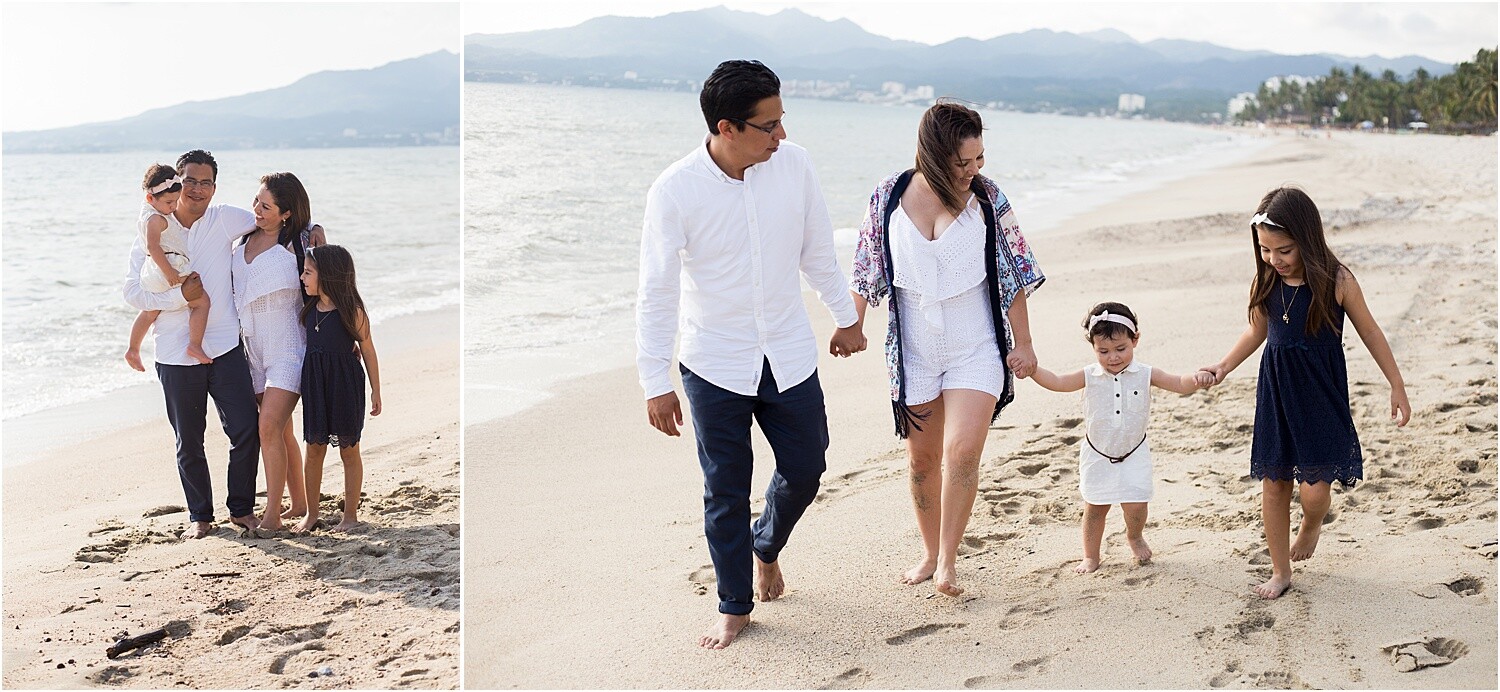
The photo on the left was lifestyle, and the right is posed. Same family, same session, two different styles that add variety to the final images.

While you’re posing, show your client exactly how you want them to pose rather than merely instructing, which can get confusing.

For example, instead of saying “put your left hand on your right elbow,” you would instead go over to where they are standing and show them how you want them to put the left hand on their right elbow.

This is a quicker way to help your client visually see what you want them to do.

After you’ve posed your client enough, and they seem a little more comfortable in front of the camera, go for the lifestyle approach.

Tell your client to relax and walk around the area. If it’s a family, for example, ask them to walk and talk to each other while telling a funny joke. Make sure to keep your camera at the ready during these times. That way you can achieve photojournalistic style photos that make lifestyle so meaningful.

With children, you can capture them playing with their toys and also get posed photos during the same session.

As you go through the session, keep alternating between posed and lifestyle. You can also pose your clients, a couple, for example, so that they’re facing each other, take a few photos and then ask the couple to say one nice thing about the other.

This is a great way to transition from posed to lifestyle. You will get authentic expressions from the couple because you are putting them in a particular pose then giving them something to do that will seem natural. It’s a perfect mix of the two styles at the same time.

If you’re more comfortable with lifestyle and candid photography styles, don’t be afraid to stop your clients in mid-walk, hug, or whatever they are doing naturally to hold the pose. This is a transition from lifestyle to posed.

Mixing the two styles offers your clients more variety as well as an overall great experience. They will feel more comfortable being in front of the camera because they were allowed to be themselves while you also stopped to make sure to get posed photos as well.

Using both styles will give the session a more fluid flow and also allows your clients to have a good time during the session. This is especially important when photographing children. Letting them play and have a good time while mixing in posed photos will give them a fun experience.

In conclusion

lifestyle-and-posed-photography

Mixing the two styles, lifestyle and posed photography, will add variety to your client’s photos and will also ensure that they have a great experience without feeling stiff or uncomfortable in front of the camera.


The post How to Mix Lifestyle and Posed Photography Styles to Add Variety appeared first on Digital Photography School. It was authored by Jackie Lamas.


Digital Photography School

 
Comments Off on How to Mix Lifestyle and Posed Photography Styles to Add Variety

Posted in Photography


The Asus Zenbook Pro Duo features a secondary 4K touch-display

28 May

With an Intel i9 processor, up to 32GB RAM and an Nvidia RTX2060 GPU the latest model the Zenbook Duo Pro’s spec sheet makes for some impressive reading. However, the device’s real highlight is the secondary 4K touch-display that sits above the keyboard.

The ScreenPad Plus as Asus calls it, measures 14″ and comes with a 32:9 aspect ratio and 3840×1100 resolution. Asus says the IPS display offers a 178-degree angle of view.

This is potentially a very useful feature for photographers, video editors and other content creators who can display the editing window on the main screen and use the secondary display for tool bars, time-lines, thumbnail previews and similar items. Image retouchers can display a zoomed-in section on the smaller display while showing the full image on the big screen.

The package also includes an Asus Pen as well as a palm rest. Next to the keyboard you find the trackpad that can be turned into a numeric pad.

The main 4K OLED display is also of the touch-variant, measures 15.4″ and is capable of displaying 100% DCI-P3 colour gamut.

Alternatively to the an 8-core 2.4Ghz 9th Gen Intel Core i9-9980HK processor you can choose a 6-core2.6Ghz Intel Core i7-9750H. RAM options range from 8 to 32GB. There’s also an Nvidia GeForce RTX2060 GPUwith 6GB of GDDR6 VRAM and up to 1TB of SSD storage.

Connectivity options include a full sized HDMI output for external displays, a Thunderbolt 3 Type-C USB socket and two USB 3.2 Gen 2 USB sockets as well as 3.5mm audio jack. At 2.5kg (5.51lbs) the Zenbook Pro Duo is not the lightest but the secondary screen should make more than up for the weight if you are image or video editing on the road.

No information on pricing or availability has been released yet but the ZenBook Pro Duo is expected to be released at some point during Q3 2019. More information is available on the Asus website.

Articles: Digital Photography Review (dpreview.com)

 
Comments Off on The Asus Zenbook Pro Duo features a secondary 4K touch-display

Posted in Uncategorized


How You Treat Your Subject in Photography Affects Your Photos

27 May

The post How You Treat Your Subject in Photography Affects Your Photos appeared first on Digital Photography School. It was authored by Kevin Landwer-Johan.

A great subject does not necessarily make a great photograph. The way you treat your subject will reflect in your photographs.

© Kevin Landwer-Johan

Don’t be a travel snapshooter. This is advice I frequently give people during our travel photography workshops in Chiang Mai, Thailand. There’s an abundance of interesting subject material here. As is often the case when you are outside your normal environment, it’s easy to think that grabbing a quick photo will suffice.

Returning home with thousands of impulse photos will be a disappointment. If you don’t pay attention to creating an interesting photograph, the results will be lacking. Temples, monks, tuk-tuks and the likes are all interesting but can make rather boring pictures if you don’t treat them well.

How to treat your subject well

I watched this video about renowned Magnum photographer Elliot Erwitt recently. About halfway through he makes an interesting statement saying, “It’s not the subject, it’s how you treat the subject.” Unfortunately, he does not go on to expand this thought, but he certainly provoked curiosity in me.

This idea is one I believe is very important to the development of your photography. The way you treat your subject influences the potential impact your photos will have.

© Kevin Landwer-Johan

Grabbing quick snapshots will typically produce lackluster results. Treating your subject with more attention and intent will compel you to make more interesting photographs.

“Treat” is an intriguing word. Particularly in the context, Erwitt uses it in the video. It can be taken to mean the way you chose to artistically represent your subject. It could also mean the manner with which you:

  • Communicate with them
  • Act or behave towards them
  • Consider or regard them
  • Or, if you give them gifts

Any of these will affect different responses from a living subject.

Artistic treatment in photography

Choices you make will influence the way your photos look and how your subject is represented.

Photographing a beach on a sunny day when it’s full of activity, will look significantly different than on a winter’s afternoon with an overcast sky. Your choice of when you take a photograph is part of how you treat your subject.

Timing when you photograph someone speaking can make them look attractive or not. Those open-mouthed, contorted faces we often see politicians with are used by news editors to portray them negatively. This treatment may seem unkind, but it is certainly intentional.

© Kevin Landwer-Johan

Lighting choice between soft or hard light alters the artistic treatment a subject is given. A wrinkled face will become more exaggerated using hard lighting at certain angles. The choice of a softer, more diffused light will be kinder to your subject.

Composition is without a doubt influential on the way viewers will understand the main subject of any photograph.

You can crop in tight, showing little or no context. This limits any relationship of your subject to its environment.

A looser crop, made with careful intention, can include or exclude elements. This will influence the look and feel of your photographs.

Contrast in color and tone within your photos helps a viewer determine the meaning of a photo. Pastels or soft tones provide a gentleness. High-contrast black and white or color combinations will induce a different look and feel.

Your awareness of these aspects of photography allows you to make intentional use of them.

© Kevin Landwer-Johan

Relational treatment of your subjects

This has more influence on subjects that can respond to you. The way you talk to a rock or flower will not have so much impact on the photos you make of it. Talking to your pet dog or goldfish will also elicit different responses.

Doggie treats given during pet photo sessions can provide huge assistance to a photographer. Offering more food to your goldfish will not likely arouse a more favorable response from it.

Speak politely to the person you want to photograph you’ll be more likely to receive a positive response. If you approach a stranger with uncertainty their response may not be so conducive to you getting a good portrait of them.

Treating someone with a smile and an air of respect will provide you a more positive opportunity. Most people will respond well. Projecting a positive attitude during a portrait session will enable you to make more attractive photos. Your subjects will be more relaxed and assured.

© Kevin Landwer-Johan

Even when you’re traveling and may not be able to verbally communicate, a smile often does the trick. Approach someone with an open, happy look on your face with your camera in hand. This usually communicates your intention clearly enough. Add in a few appropriate hand gestures and watch for the person’s response.

Take time to observe your subject

When you’re not sure how to treat your subject, step back and observe for a while if you can. Don’t rush to capture your photo.

Look at the environment and how your subject relates to it. Is it a prominent or a minor part of the location? Does it interact significantly with the surroundings? Can you find an angle that will suit the intention you have for your photo?

© Kevin Landwer-Johan

The more you understand about your subject, the better photos you will make of it. Understanding can affect the way you relate to any chosen subject.

If you see someone who is shy and reserved, treat them in a similar manner. They’re more likely to appreciate it than if you boldly get in their face with your camera.

A more extroverted person may require a different treatment. Be bolder. Be more effusive in your approach. Mirror back to them how you are experiencing them.

Take some time to research. Engaging in longer-term projects, or even before heading away on holiday to somewhere new. Find out as much as you can about what you want to photograph.

Do you want to photograph monks in Thailand? Is it okay to do so politely? Is this culturally fitting? Can you safely photograph beggars in San Francisco? Is street photography including people welcome in Paris? Knowing the answers to pertinent questions before you set out will enable you to treat your subject appropriately.

© Kevin Landwer-Johan

Conclusion

The right treatment of your subject will result in more compelling photographs.

Think about both aspects of treating your subjects. Considering the methods you use with your camera is one aspect. Communicating well with living subjects will influence the response you receive from them.

Take your time to practice. Apply yourself well. You will see an improvement in your photographs.


The post How You Treat Your Subject in Photography Affects Your Photos appeared first on Digital Photography School. It was authored by Kevin Landwer-Johan.


Digital Photography School
 
Comments Off on How You Treat Your Subject in Photography Affects Your Photos

Posted in Photography


Sample gallery update: Canon RF 35mm F1.8 IS Macro

27 May

$ (document).ready(function() { SampleGalleryV2({“containerId”:”embeddedSampleGallery_9958447403″,”galleryId”:”9958447403″,”isEmbeddedWidget”:true,”selectedImageIndex”:0,”isMobile”:false}) });

Canon’s RF 35mm F1.8 IS Macro is a compact, affordable prime lens for the new EOS R system. The only non – ‘L’ lens currently available for Canon’s mirrorless EOS R and RP, the 35mm F1.8 offers a versatile focal length for everyday shooting, optical stabilization and a useful semi-macro focus capability.

We’re working on a full review of the RF 35mm F1.8 right now, but in the meantime we just added several images to our previously-published sample gallery.

See our updated Canon RF 35mm F1.8 sample gallery

Articles: Digital Photography Review (dpreview.com)

 
Comments Off on Sample gallery update: Canon RF 35mm F1.8 IS Macro

Posted in Uncategorized