RSS
 

Archive for April, 2019

Skydio under fire for promoting illegal drone footage

08 Apr
Photo of Grand Prismatic Spring, in Yellowstone National Park, Wyoming, courtesy of Don Kawahigashi. Drone use is illegal in all national parks.

California-based drone manufacturer, Skydio, is under investigation after promoting its proprietary ‘true follow-me’ feature with footage of a rollerblader gliding along a West Thumb Geyser Basin boardwalk in Yellowstone National Park.

Operating a drone is illegal in all national parks. So is in-line skating on their respective boardwalks. Skydio’s social media manager geo-tagged Iceland as the location where the video was shot, not Wyoming. ‘Thermal tour a la rollerblade,’ read the caption in the post that was viewed over 10,000 times in one week. Users quickly caught on to the discrepancy in location and the video was removed from the company’s feed.

Some commenters were put off by the misuse of the location tag. ‘Super dishonest,’ Instagram user and avid drone photographer @justin_mcvideo posted. ‘I was following this account, but no more. Shame.’

Skydio R1 drone

Yellowstone National Park law enforcement rangers learned of the video’s existence and, according to park spokeswoman Morgan Warthin, have not made any determinations. ‘They are aware, and they will investigate it,’ Warthin said. ‘What’s important to recognize is that there are so many incidents of drone use that we deal with. Visitors using drones in Yellowstone is a problem.’

In 2018, alone, there were around 40 illegal drone flights that were brought to the attention of Yellowstone rangers. A significant portion resulted in citations, and some of those required a mandatory court appearance. Fines amounted to over $ 1,000 per offending pilot.

Skydio was founded in 2014 by three MIT graduates. The CEO and CTO were early engineers at Project Wing, Google’s drone delivery effort. Their flagship product, the R1 consumer drone, uses NVIDIA’s AI supercomputer and 13 onboard cameras to autonomously fly and avoid obstacles in every direction. According to Crunchbase, the company has raised $ 70 million in 4 rounds of funding as of February, 2018. Representatives for Skydio have not released an official statement regarding this investigation.

Articles: Digital Photography Review (dpreview.com)

 
Comments Off on Skydio under fire for promoting illegal drone footage

Posted in Uncategorized


Rode’s Wireless GO microphone system claims to be ‘the world’s smallest’

08 Apr

Rode has introduced the Wireless GO, a wireless microphone system that being deemed as ‘the world’s smallest, most versatile’ system of its kind.

Similar to its Wireless Filmmaking Kit, the Wireless GO is a kit that consists of a transmitter (TX) and receiver (RX). The difference is, the Wireless GO TX module works as a standalone microphone thanks to its internal omnidirectional condenser microphone and integrated clip or as a transmission unit for Rode’s lavalier microphone via the onboard 3.5mm TRS input.

The two modules measure in at approximately 44mm x 45mm x 18.5mm and weigh just 31g / 1oz. Wireless connectivity is powered by Rode’s new Series III Digital 2.4GHz transmission technology that’s rated for a maximum distance of 70m / 230ft in clear line-of-sight situations.

The modules include built-in Li-po batteries that are rated for seven hours of use and can be recharged via USB. Speaking of USB, the units can be updated with firmware using the same USB-C port that’s used to charge them.

The Wireless GO microphone kit comes with two fur windshields, one pouch, one USB-A to USB-C cable and one SC2 cable. B&H has the system available to pre-order for $ 199 with an estimated shipping date of April 17, 2019 at the time of posting this article.

Articles: Digital Photography Review (dpreview.com)

 
Comments Off on Rode’s Wireless GO microphone system claims to be ‘the world’s smallest’

Posted in Uncategorized


How to Turn Your Living Room into a Photo Studio

08 Apr

The post How to Turn Your Living Room into a Photo Studio appeared first on Digital Photography School. It was authored by Jackie Lamas.

Have you ever wished to have a studio space where you could bring clients in and photograph all types of portraits and ideas? You can! Your living room, or any room in your home for that matter, can be quickly converted so that you can photograph your studio ideas in your home!

Setting up backgrounds on a plain wall can help you take great portraits in your own living room.

Finding the right space

Your living room might be the room with the biggest space for you to get the best angles and set up your lights. As long as you have about 10 feet of blank wall space, you can use it for your at-home studio.

Choose a wall where you can mount backgrounds. Put up studio paper, or any background paper. Alternatively, use a painted wall for your photos. It doesn’t have to be anything special, and you could use the existing wall as the main background as well.

A bedroom with big windows can be used as a studio for portraits.

Why 10 feet? The wider your wall space, the more room you’ll have to the sides of your photos. This will enable you to photograph both horizontally and vertically. You will also have room for more than one person.

If you’re photographing headshots or only individuals, a smaller wall space would work. A wall with 5 feet would be sufficient enough for headshots and individuals.

Other spaces in your home that could work

The living room doesn’t have to be the only space that you can use. For example, if you don’t have studio lights, but want to create beautiful portraits with creative direction on backgrounds and don’t want to go on location, your home can still work!

You can photograph in a covered patio with lots of wall space, in your garage, in the bedroom, or on a balcony. All of these spaces work if you have the wall space to place your subject and space to photograph them from a distance.

This makes it much simpler to choose the right location for your at-home studio in the event that you don’t have studio lighting equipment or a special look to your photographs.

Creating the best set up for studio/flash  set up

You don’t necessarily need to use studio lights for your at-home studio, however, if that is what you’re going to use then let’s go through what you’ll need in the space for the best outcome.

Use flash bouncing off the ceiling to light portraits in your living room or in the space you want for your at home studio.

You’ll need to choose a wall space that is in a darker or not-so-brightly-lit room. You can also use shades or curtains to block out light so that your off-camera lighting can correctly light your scene.

Using a flash to light these portraits to simulate the sun. Plain wall background in the bedroom.

Living rooms offer the most space but make sure you can get it dark enough to set up the lights exactly where you want them.  You could also use external flashes to set up your at-home studio.

You can light portraits creatively when you have control of the space and lighting.

Have a lamp nearby so that you can use it as a modeling light. You can also use a light dimmer so that the light doesn’t affect the outcome or interfere with the white balance, exposure, or look and feel that you’re trying to achieve.

Best set up for natural light at-home studio

If your living room or any other room in your home has great natural light, you can definitely set up your studio there. The same tips apply as far as wall space so that you can pose your subject and have enough space in the frame in case cropping is necessary. It also gives you the option to photograph vertical or horizontal.

This was shot with all natural light using a silver reflector with a 3×3 grey background taped to the wall. Edited to bump up the contrast and desaturate the colors.

Choose a room that has great window light or light coming into the space. For example, a garage space with the garage door open is a good option. Another good option is a living room with big sliding doors where light floods the room. Make sure that the sunlight isn’t coming directly into the room or through the window where it casts weird shadows on your subject.

To diffuse the light, you can hang translucent curtains. This will help with harsh lighting, shadows, and the temperature of the room. Of course, you don’t necessarily need the window open unless it adds more light to your scene – if that is the look you’re going for.

If your home has textured walls, you can use them as backgrounds for the portraits as well!

Use a reflector and bounce cards to help bounce light in the direction you want. Black flags  (black boards that help darken the light) and are great for creating shadows and can help to give you more dramatic lighting.

Be aware of the floor

In your home, your floor is already installed and this can present a problem if you’re photographing full-length portraits. Take a look to see if the floor is what you’ll want for your photos. If it isn’t, you can use paper and place it from the wall all the way to the floor. This will create a seamless look to your photos like a real studio.

In the before photo, we covered the floor with a black sheet so we could photoshop the black background in and create a seamless look.

You can also get cheap wood floor-looking laminate flooring and create your portable floor. If the trim base to the floor isn’t distracting, you could even possibly photoshop that out to create a more seamless look with the wall and the floor.

Just be aware of your floor so you know what to do before you start photographing in your new home studio.

Backgrounds for in-home studios

There are a lot of great backgrounds that you can use for a home studio. Given that it’s completely your space and you can get really creative. The simplest one is the one you already have available! Use the existing wall color and texture to create interesting portraits.

You can use existing decor to create beautiful portraits or tape a paper background to the wall for a seamless background.

Other backgrounds you can use can be:

  • A sheet that covers the wall and onto the floor for a seamless fabric background.
  • Paper either rolled onto the floor for seamless or a piece of paper taped to the wall for up-close portraits
  • Any fabric or paper with a print on it
  • Different colored paper for headshots

Pretty much anything you can think of you can create as a background! You can get really creative with balloons, tissue paper, hanging strings, lights, paper flowers, artificial flowers, string or hanging garlands either made by you or already made newspaper or even plants.

The options and ideas are limitless and will give your photos a unique look no matter what your style is.

In conclusion

Your living room can be the perfect space for you to create beautiful studio work. You don’t need fancy equipment just nice wall space and the light you love to photograph with. Add in some music and you’ve got the perfect comfortable studio right in your home!

Do you have other suggestions to make a great living room studio? Share with us and our readers in the comments below.

The post How to Turn Your Living Room into a Photo Studio appeared first on Digital Photography School. It was authored by Jackie Lamas.


Digital Photography School

 
Comments Off on How to Turn Your Living Room into a Photo Studio

Posted in Photography


Sigma 70-200mm F2.8 DG OS HSM Sport Review

07 Apr

The post Sigma 70-200mm F2.8 DG OS HSM Sport Review appeared first on Digital Photography School. It was authored by Anabel DFlux.

Sigma has made a significant name for itself via its famous ART line of lenses. But did you know Sigma also has a Sport line? Lesser known than the ART lenses, the Sport lenses are the incredible workhorses of the photography world (and deserve recognition). The Sigma 70-200mm F2.8 DG OS HSM Sport (Canon and Nikon Mount) is the newest addition to the Sport line, featuring a loved focal length. A big contender in the telephoto field, this lens may just be the top dog you didn’t see coming.

This lens focal length is so splendid, that the Digital Photography School even has an article on why you need a 70-200mm lens!

Lens build

Weight

I have tried many different 70-200mm F/2.8 lenses in the past, and currently own the newest one from Canon’s L line. This version of a favorite millimeter stands out. Before we even get into the construction, I can tell you that this lens is not the heaviest by far as compared to other brands like Tamron, and Rokinon, and older versions of the Canon and Nikon. As someone who tends to shoot sporting events for a good 12 hours at a time, my back is bowing in thanks at the decreased weight. Weighing in at a teeny bit less than 4 pounds, this is by far a more useable weight. The lens size is customary for this focal range at 3.7 inches in diameter by 8.0 inches in length.

Construction

The body is constructed out of a clever mixture of a very durable form of plastic, metal, and a new compound known as TSC (short for Thermally Stable Composite). The lens feels durable, and I found it to be more shock resistant than many of my other lenses. The glass itself is a high-grade glass mixture – 24 Elements in 22 Groups. I like the tactile feel of the focus and zoom rings, and it is very comfortable to use.

Weather sealing

This lens is built to work, and as such, its weather sealing is incredible. I feel very confident taking this lens out for a spin in whatever situation I find myself in. With the recent rains and odd weather in Southern California, I was still able to take this lens out in ease at a local outdoor sporting event. The weather sealing is a testament to a highly effective dust and splash proof structure with special sealing at the mount connection, manual focus ring, zoom ring, and cover connection.

That said, do use your best judgment to determine whether the weather is good enough to go out and shoot or not… weather sealing is not equivalent to weatherproof! As for the glass, the forefront and rear lenses incorporate water and oil-repellent coating that allows water to be wiped away easily. It prevents oil and fat from sticking to the surface, even in challenging shooting conditions, making lens maintenance easy.

The only downside I find with the lens construction is that you cannot remove the customary tripod foot (that many 70-200mm lenses have). This lens is also still technically heavier than the latest Canon or Nikon versions, but I’d argue this is a fair trade for how shock resistant and durable it is.

Lens features

As is customary for the Sigma lenses, the Sigma 70-200mm F2.8 DG OS HSM Sport features a slew of unique and useful features. Before we even get into them, it is worth mentioning that at this time, this lens is available only in Sigma, Canon, and Nikon mount. Sigma does offer a mount conversion service in case you want your lens to fit onto a different camera brand.

Sigma has gone the extra step to make sure that the mechanics of their lenses work as well as Canon and Nikon native lenses. The Canon mount version is compatible with Canon’s internal chromatic aberration control, and the Nikon version works with Nikon’s electromagnetic diaphragm.

Focus range limiter switch

A nice added feature for any telephoto lens is the focus range limiter switch, which restricts the range of distance your lens can focus. I use this feature myself when I photograph dog agility shows to make sure that the lens doesn’t focus on any obstacles near me but remains locked on a running dog that is far away.

Hyper Sonic AF Motor (HSM)

As the name suggests, this lens uses HSM (Hyper Sonic AF Motor) for its focusing. HSM uses ultrasonic vibrations to drive the focusing group. This motor benefits an internal focusing system.

You can easily override the HSM for manual control via a finger switch on the lens. A feature that goes along with this aspect is the Manual Override (MO). With MO, a photographer can continue using autofocus as usual, before making any final manual adjustments using the focusing ring around the lens. The lens can focus as close as 1.2m away from the subject unless restricted by the focus limiter.

The lens comes with a locking lens hood, which is superb considering the number of times the hood on my other lenses go flying off because they get bumped! The lock is sturdy, but still very easy to use when you need to get the hood off in a flash.

Focus

With a sport and action lens like this one, strong autofocus is the key to success. I photograph a slew of canine athletes, and you’d be surprised how incredibly fast those small champion papillons are! Additionally, to ensure the dogs are not distracted by the sound of my camera or lens, quiet autofocus is pretty high up on my list of needs too.

Lucky for me – and anyone else interested in this telephoto model – the Sigma 70-200mm F2.8 checks all of these boxes. The HSM motor keeps the autofocus noise to a minimum or nonexistent, which allows me to get a wee bit closer to the dogs as they make their impressive jumps and leaps.

The autofocus is rather accurate – even on small moving subjects like an Italian greyhound dog, through to bigger canines such as the border collie. The lens allowed me to capture the agility competition with ease. The focus was very smooth too, with little focus hunting, even when the clouds took over and the location became quite dim. No manic focusing movements either, like I’ve experienced with Tamron’s equivalent of this lens last year at a tradeshow.

In comparison to my Canon 70-200mm F/2.8 L IS USM III lens, this one performed just as good, and I would certainly consider it as an additional.

Sharpness

Although zoom lenses may never be quite the same level of sharpness as fixed focal lengths, this one still performs brilliantly despite this fact. Sharpness and contrast are excellent, even when shooting wide-open, throughout the entire zoom range. Centre sharpness at 70mm is excellent and just fine at all other focal lengths. Corner sharpness is high at 70mm, but at 100mm and beyond, corner sharpness takes a significant downturn at larger apertures. If you want to get the entire frame sharp, you’ll probably have to switch over to F/11 or so. That said, this isn’t unusual for zoom lenses. The contrast it produces is also excellent.

Depth of field

The F/2.8 wide aperture gives a nice subject separation and bokeh (the out of focus areas in an image). The depth of field is creamy and smooth, and very pleasing to the eye. The 11 diaphragm blades help to keep bokeh looking natural.

There is some vignetting on the edges. Some people like this, others don’t. I enjoy the natural vignetting that is contrary to popular opinion, but for those that find it a nuisance, keep this in mind.

Image Stabilization

The image stabilization system in this particular 70-200mm is superb. This lens incorporates Intelligent OS, which is the latest algorithm to deliver image stabilization. The intelligent OS works horizontally, vertically, or diagonally – whatever direction your lens is being held or used. The mode can be adjusted by a switch on the side of the lens and has two modes from which to choose.

The optical stabilizer was effective up to four stops – fantastic for a telephoto lens. The panning stabilizer was equally impressive, allowing me to track my subjects with ease while handheld. I took this lens out for a swing at a local concert as well. The F/2.8 aperture paired with stabilization, allowed me to expose my shots quite well.

Flare resistance & chromatic aberration

The glass coating on this lens does a fine job decreasing flaring and ghosting – an annoying issue that plagues photographers when the light hits the lens at a bad angle. The chromatic aberration control is quite good as well, with the optical array comprising of 24 elements spread across 22 groups. This includes nine FLD pieces of glass and a single SLD lens, all of which are used to help control chromatic aberration.

The Canon mount versions of this lens also benefit from compatibility with a full set of in-camera corrections for lens aberrations (a big yippee for me as a Canon user).

Pros and Cons of the Sigma 70-200mm f/2.8 DG Sport

Pros:

  • Durable, comfortable, solid lens build.
  • Superb weather sealing, as well as dust and moisture resistance.
  • Water and oil repellent coating on the glass.
  • The Canon mount version is compatible with Canon’s internal chromatic aberration control and the Nikon version is able to work with Nikon’s electromagnetic diaphragm.
  • Various switches built into the lens for professional use such as the focus limiter, modes, and image stabilization.
  • On the topic of image stabilization, the IS is superb.
  • HSM for quite and reliable autofocus.
  • The addition of an Manual Override mode for focus.
  • Locking lens hood.
  • Good flare and ghosting resistance.
  • Excellent chromatic aberration control.
  • Good center sharpness.
  • Very nice, creamy, natural bokeh.

Cons:

  • Tripod foot cannot be removed.
  • Vignetting on the edges.
  • Sharpness suffers in the corners at 100mm and more.
  • Weight

Conclusion

At a price tag of US$ 1,500, while this may seem hefty to some, it’s actually much more affordable than equivalent lenses of this caliber. There is a lot of bang for your buck. Moreover, it’s a very worthwhile investment for those shooting outdoors or in questionable conditions, as this lens is built to be the perfect workhorse.

I genuinely loved this model. It was very easy to use for my athletic needs!

Have you used this lens? What are your thoughts? Please share in the comments below.

The post Sigma 70-200mm F2.8 DG OS HSM Sport Review appeared first on Digital Photography School. It was authored by Anabel DFlux.


Digital Photography School

 
Comments Off on Sigma 70-200mm F2.8 DG OS HSM Sport Review

Posted in Photography


CP+ 2019: Sigma interview – ‘Optical design is always a battle with the design constraints’

07 Apr
Sigma CEO Kazuto Yamaki, pictured at the CP+ show in Yokohama, Japan.

Last month at the CP+ show in Yokohama we spoke to executives from several major manufacturers, including Sigma. In our conversation with CEO Kazuto Yamaki we discussed his plans for future L-mount lenses (and cameras) and some of the challenges of supporting multiple mounts.


It’s been six months since the L-mount alliance was announced. How’s it going?

At CP+ our main theme is to show our commitment to the L-mount system. We didn’t bring [out] any totally, brand-new products at CP+ but we showed our commitment to L-mount system by showing our new mount adapter and prime lenses for the system.

The response is better than I thought, initially. Not only from retailers and distributors, but also users who have showed very strong interest in L-mount system. Potential customers are very positive, which is more than I expected: it’s a nice surprise.

You expected it to be harder to convince people?

Yes, because it’s a relatively new system. It’s not a brand-new system, because Leica already had their own system, but as an alliance, this is only the beginning. Panasonic just announced a few products, so compared to the existing systems, particularly compared to Sony system, it’s not [comprehensive]. I was pretty surprised customers showed interest in our system.

The Sigma 35mm F1.4 Art for L-mount is a new lens, but the optical design was laid down at the launch of the Global Vision lens series, in 2012.

Do you have plans to design native L-mount lenses?

We will probably release a few lenses this year, designed for the short flange-back distance.

What are the most important lenses the L system will need in order to be a success?

First of all we need to have more and more lenses. Variety is key. Regardless of whether it’s standard zoom lens, telephoto lens or primes, we need to have more lenses because professional photographers and enthusiasts want to try many lenses. [They don’t] have to be standard or unique, the first priority is to have more. That’s why we announced eleven lenses at CP+, all of which will be available this year.

It might also be a good idea to have unique lenses that only L-mount users can enjoy: we’ll need to think about this.

L-mount lenses from Panasonic and Leica are all fairly expensive, compared to typical Sigma pricing – should we expect your L-mount lenses to be more affordable?

We believe our mission is to provide high quality products with affordable prices. Although I have said we can’t be the cheapest product supplier, we do our best to provide the highest quality product with an affordable price.

Actually the production cost is very high but we minimize the organization, we maintain a very lean organization: we have very few employees in marketing, sales, administration or HR so we can provide products at an affordable price. Our goal isn’t to increase the price more than necessary.

DFD information part of the L-mount standard: will you be writing this information into your L-mount lenses?

I just can’t comment. It’s great technology but I’m not sure we can implement it in our camera because it requires a lot of processing power. We respect the technology but we cannot comment [on] whether we’ll implement in our cameras.

Ahead of the development of brand new lenses designed from the ground up for mirrorless, Sigma has created two MC-21 adapters to convert its Sigma SA and Canon EF lenses to the L-mount.

What about your lenses?

Yes, that’s why Panasonic, Sigma and Leica engineers [are working] together to enhance the L-mount system. We keep upgrading the L-mount system for much more communication between the lens and body to support technologies like DFD.

Sigma arguably started the trend of big, heavy, very sharp primes but now everybody is doing it. Can Sigma create a new segment?

I must admit our position in the industry: people [regard us as] a third-party or accessory provider. Many customers may wish to choose their original manufacturers’ lenses. So, as a lens manufacturer, differentiation is important for us. We always try to bring a unique lens that the body manufacturer doesn’t have.

A long time ago we produced similar lenses with much, much cheaper prices. But today we produce everything in Japan, including parts, so we can’t be the cheapest product supplier. The only way to survive in the industry is to produce unique products. I think big, heavy but super performance was one of the strategies to differentiate ourselves. But today many companies have similar products so perhaps we need to find another [strategy].

The Art series is our heart and we have many users all over the world, so we’ll maintain this lineup

Of course the Art series is our heart and we have many users all over the world, so we’ll maintain this lineup. In order to differentiate ourselves we’ll need to create new ideas for lenses and we’re currently working on it.

I can’t tell you [more] now. Maybe after several glasses of sake!

Is there room in the range for smaller, maybe F2 primes?

The advantage of mirrorless cameras is the small factor. I’m aware some users want very lightweight, small camera bodies and small lenses. They might want to use the big, heavy lenses for some occasions, but for casual shooting, like street photography, they might wish for smaller lenses. I can’t comment but maybe in the future we may be able to deliver such products.

With so many new camera systems on the market now, how do you prioritize which mounts you develop lenses for?

I have a great interest in the Canon R and Nikon Z systems because eventually they will have more and more customers. So we are now investigating these systems. But still it’s too early to make a statement about how we will respond.

Right now we see many new Canon R and Nikon Z users using mount adapters with their existing lenses. So we’re concentrating on optimizing the compatibility of our lenses with their mount adapters and cameras.

We’ve already made sure that our lenses work almost perfectly, without any problem, but we’re looking in detail: maybe there are some minor issues with this specific setting, or with that specific procedure, and so on, so you may still see some minor issues. Our software engineers are now de-bugging those kind of things. But, at the same time, we are looking into how to support the new systems.

Nikon’s wide, shallow mount provides some advantages for optical engineers, but according to Mr Yamaki it’s easier for a third-party manufacturer to design solutions for narrower standards first, and adapt them outwards.

How difficult is it to create one lens design which has to work for several different mirrorless mounts, with their different dimensions?

We have the same challenge in the case of DSLR. The Canon EF mount has larger diameter than Nikon F mount [for example]. We sometimes thought if we only made lenses for Canon EF mount it could be easier but we always overcame such challenges. So we have the experience.

Flange-back distance should not make much difference but [mount] diameter may make some difference. This is a challenge we need to overcome.

It’s true if you need to make a very fast, very high optical performance lens, the Nikon Z mount is very nice. Personally [I believe the short flange-back distance places the rear optical group] a bit too close to the sensor, I’m a bit concerned about reflection problems: it may create some strange ghosting. But its shorter flange-back and bigger diameter gives more options to an optical designer, in theory.

Are the mounts similar enough that you can use one optical design?

If we are to make lenses that are usable for all mounts, we’ll probably optimize to the longest mount. Such a lens could still be used for Nikon Z mount [which has the shortest flange-back distance]. If we optimize to the Nikon system, we can’t use that [lens design] on a [a mount with a longer flange-back].

There is some difference between the mounts but it doesn’t make a huge difference in designing the lens. Of course there are some challenges, maybe if we make exactly the same spec (same aperture and optical performance), a Nikon [Z mount lens] may be 2-3mm shorter but I don’t think it makes a huge difference.

Technically the larger mount diameter give more options to the optical designer

But the mount diameter does make some [amount] of difference when you’re designing. Optical design is always a battle with the design constraints: if the mount diameter is very wide, our optical engineers can use very big diameter lenses in the rear lens group, which makes the design easier. Technically the large diameter give more options to the optical designer but it doesn’t mean we can always design high optical performance lenses. That’s our technique: our technology tries to overcome such limits to provide the best performing lens.

Sigma has been making lenses for radically different mounts for decades, including some weird and wonderful products like this XQ 24mm F2.8 Filtermatic, with built-in filters for black and white film.

Via Wikimedia Commons, credit: Maksim Sidorov

Even in the film era, Sigma supported very different mounts – has anything really changed?

When designing a lens, we try to minimize aberrations, make [the lens] as sharp as possible and try to create nice bokeh in the background: such basics are the same. Mirrorless systems have pros and cons. The pros are that we can make wide-angle lenses much more easily than for DSLRs, just because of the short flange-back distance. But the challenge is the focusing system: if we need to support contrast detection AF or autofocus during movie capture [for example], it’s challenging.

It’s harder to support CDAF?

Yes, if we are to achieve the best optical quality. From an optical point of view it would be ideal to move the whole lens forwards or back to focus. When we had manual focus there were some designs where we moved the whole lenses to focus. But when we started building autofocus lenses we needed to make the focusing lens lighter and smaller so that the motor can support the focusing lens. But the basic physics is the same: the bigger and heavier the focusing lens, the easier it is to maintain optical performance in a shorter focusing distance.

We publish MTF charts but this is the performance at infinity. We optimize at infinity, but naturally the performance degrades at closer distances. If we use a smaller diameter, lighter focusing lens, it tends to degrade more at closer focus distances. That’s the challenge.

There is no ideal world for optical design

In order to support contrast AF we need to implement ‘wobbling’: we need to move the focusing lens back and forth to detect the subject. In order to do that, we need to make the focus lens very light and small and this tends to degrade the performance in the short focal distance.

That’s not always the case, though. Canon doesn’t use that system: they use dual pixel and it works like phase detection, but other manufacturers use pure contrast AF or hybrid AF so the lens has to support that kind of AF operation. Nikon is hybrid, Sony is hybrid. We will probably [implement a hybrid AF system too]. There is no ideal world for optical design, the engineer always has to fight against such limitations.

Does a lens design optimized for CDAF give better performance on cameras that use PDAF?

In terms of speed, yes. If we talk only in terms of focus performance and accuracy then yes, it’s better but the downside is optical performance, in theory. We have many other technologies to maintain optical performance and other companies try to solve the problem with such technologies but in theory it’s challenging.

Sigma’s 50mm f1.4 Art is not a new product, but its lovely rendering of out of focus areas and relative lack of longitudinal CA make it a beautiful lens for portraiture, even now.

When designing lenses, how do you balance things like sharpness with less quantifiable qualities like bokeh?

I think the [main goal] is to make the best possible optical performance for almost all lenses. So we like to minimize the aberrations, the coma, to provide the best quality from the center to edge.

You mention the ‘beauty’ of the image and that’s quite subjective, so it’s not easy to understand the real demand from users. But we [at Sigma] are also photographers, so we do understand these needs. So we may try such a target with some specific lens, so that we [can gauge] response from the customers.

We don’t have a specific plan, but we could have such a product in the future.

Today [our] design software can simulate bokeh: we always check whether the bokeh is ok or not, it’s very important. It’s a subjective matter but still we know what is good bokeh and bad bokeh so we always pay attention to that.

Is the existence of so many new lens mounts a challenge or an opportunity for Sigma?

It’s both. The more mounts, [the] more opportunity: the most active companies will survive in this very chaotic market. But we need to work very hard.

I personally regard this as an opportunity. If we stay only on the very conventional, old systems, we cannot stimulate the market. But on the other hand, this is a very, very big challenge for manufacturing, for our factory. Especially because we make everything ourselves, we make most of the parts and components. So if we make a much wider lineup, it [could] easily confuse our production system.

If we relied on many suppliers we could respond to demand by just changing the size of our order

If we relied on many, many suppliers we could respond to demand by just changing the size of our order, and buy from a different supplier: it’s easy to control. But we make everything by ourselves: we need to change a setting on the machine for each part, so every, let’s say, hour we change, it deteriorates our productivity and efficiency, and we very easily lose the profit margin from manufacturing. This is very challenging.

Will you need to change the way Sigma is organized?

Yes: I’ve been explaining this challenge to my staff for more than a year. The toughest time for [manufacturing] will come in maybe 2019, 2020, 2021 because we will maintain our current lineup for DSLR while also expanding to include more mirrorless [lenses]. So our product line will increase by 50%, maybe as much as twice. This will be very, very challenging for manufacturers like us.

Mr Yamaki, pictured here in Sigma’s factory in Aizu, Japan. Read more about the facility in our detailed tour, here [2015].

Will you need more factory space?

We do have plans to expand the factory. We will start construction of a new building in the same location for an assembly line to build the very modern, high performance lenses. We are putting more and more technology into the assembly line: checking performance and adjusting the lenses.

The assembly line is getting longer and longer so we need more space. We will start construction on two new buildings near the same location. But we’re doing this just to keep the pace with the modern technology, not to expand the production [volume].

Are you planning to create lenses for Fujifilm’s X-mount?

I have [had] many questions about it. I know that some [Fujifilm] customers are wishing for us to make lenses for them. It’s always a matter of priority. We know there are many good customers of the Fuji system and they’re perfectly matched with our ideal customer but [Fujifilm doesn’t] really disclose the protocol between the lens and camera, so we need to do the reverse engineering by ourselves.

It’s a really time-consuming process so we need to prioritize support for Sony E mount, our L-mount system, existing DSLR mounts and Micro Four Thirds.

So you’re balancing the cost of reverse engineering against the potential market size?

Yes, that’s true.

In other words, because you know that Nikon and Canon mounts will be popular, the cost of reverse-engineering can be justified?

Yes.

Sigma is working its next generation of cameras, which unlike the SD-series of old, will be built around the mirrorless L-mount and will feature full-frame Foveon sensors.

What is Sigma’s future as a camera manufacturer?

I have explained that our mission is to create unique lenses, a unique product for the customer and eventually I hope the customers have more choices. They can choose ordinary products from camera manufacturers and unique product from lens manufacturers [like us].

Our future camera business will be even more extreme: I’d like to deliver even more unique cameras that the big players may not deliver to market. We like to be a unique camera manufacturer in the future.

Unique in what way?

Right now I can’t say: you will see at some point in the future.

Are you hoping to make the type of camera that some people might want but that companies the size of Canon and Sony wouldn’t target?

When we launched the first DP it was the first compact camera to feature a large sensor. We [were consequently in] a very unique position but it’s not unique anymore, so we will pursue another solution to make us unique.

What potential benefits should a customer expect to see from a full-frame Foveon sensor?

The basic technology is the same, there is no complete silicon change. People can expect better image quality simply because of the sensor size: APS-C and Full Frame are quite different, so people can expect better performance.

I gave a presentation [to a Japanese audience at CP+] and we announced the basic spec of the [full-frame] sensor [currently being developed]. It’s 20 megapixels times three, so about 60MP. They’re not tiny pixels: they’re relatively big pixels so each pixel can capture enough light. And we’ve gone back to the original pixel structure: 1:1:1, so people can expect very nice, rich data from the sensor.

I hope they like it, but the Japanese audience [at the presentation] has a poker face: they don’t show their feelings on their faces, so I didn’t see a clear response, but I hope they’ll like it [laughs].

What improvements are you mainly targeting?

We tried to improve all aspects [readout speed, color separation, noise performance]. With this sensor we tried to improve the high ISO performance but color separation is the same: we maintained the same characteristics as before. It’s challenging: if we keep the same characteristics it’s challenging for the high ISO performance but it means we can reproduce better color gradation between blue, green and red.

Color specta derived from Raw images, with Foveon (top) showing much smoother red-to-green transitions and greater ability to capture violet tones that exist beyond the blue filter that the three Bayer cameras can capture.

This image [demonstrated by Mr Yamaki in the interview and reproduced above – the upper strip is from a Foveon sensor, the lower three are from three different Bayer-pattern sensors] is taken by a Foveon sensor. Foveon can capture greater graduation between each color. This is from a Raw file but if the Raw data has the correct response to each wavelength then we can render all these colors in processing.

One of the projects we have at the moment is to recreate this nice color graduation in the final image. You can’t create this graduation from nothing so while we retain the same color separation, we’re trying to improve the processing.

What’s the response been like to adding DNG capability?

When we announced DNG output, [our customers] were very excited but after they tried it they were a bit disappointed by the quality because the pre-processing was a little bit different. So most of the customers that I know prefer SPP, despite the [penalty in] processing speed.

Are you working on enhancing the DNG performance?

We’re always trying to improve the processing in the camera. Our Sigma Photo Pro software can do some pre-processing that DNG cannot, so we need to do that pre-processing in the camera and write it into the DNG file. The power of the in-camera processing is limited: when it comes to PCs, the processing power available is much [greater]. But we always try to improve the pre-processing in the camera.

What are the other products in the market you’ve been impressed by?

So far I like Canon, the 28-70mm F2 and the 50 mm F1.2. Their [RF] mount system is quite impressive.

But it’s noticeable that they both use slower, ring-type focus motors -presumably Canon has had to make that same image quality / speed decision…

This is the same challenge for all manufacturers.


Editor’s note: Barnaby Britton

The last time we spoke to Mr Yamaki was late 2018, at Photokina, where he had just announced the L-mount alliance with Panasonic and Leica. In the intervening six months it sounds like his team of engineers has been pretty busy developing a ‘unique’ Foveon-equipped full-frame L-mount camera, as well as ensuring a wide range of native L-mount lenses by the time it is launched (which we expect to happen later this year).

Of course the 11 L-mount lenses that Sigma has launched so far this year are only ‘new’ in the sense that they’re newly machined for L-mount: optically these are the same designs that we’ve seen before, going back to the launch of the Global Vision range in 2012. This fits with Mr Yamaki’s initial L-mount strategy of ‘more and more lenses’, with perhaps some unique optics coming a little later.

Reassuringly, despite the eye-watering cost of most L-mount lenses currently on the market from Panasonic and Leica, Mr Yamaki seems set on his long-standing strategy of quality at ‘an affordable price’. One of the ways of keeping prices down, of course, is to standardize optical designs across lenses made for different mounts. This is not a new challenge for Sigma – Canon EF and Nikon F mounts are radically different, for example, and the company has been offering versions of the same lenses for both, for more than 30 years.

When faced with the challenge of standardizing optical designs, it makes more sense to design for the most limiting mount first, and work outwards

In this interview Mr Yamaki confirmed a couple of things that we’ve long suspected: firstly that, in theory, systems with a wide mount and short flange-back give the optical designer more options, especially when it comes to creating certain kinds of lenses. And secondly, when faced with the challenge of standardizing optical designs for radically different lens-mounts, it makes more sense to design for the most limiting mount first, and work outwards from there. As Mr Yamaki says, ‘if we optimize to the Nikon system, we can’t use that [lens design] on a [a mount with a longer flange-back]’. But if he starts by looking at – say – creating a lens for Sony E-mount, adapting it to a wider mount should be relatively straightforward from an engineering perspective.

Of course, for that to happen, Sigma must first reverse-engineer the Z-mount. Nikon – like Canon, and Fujifilm – does not disclose details of its mount standard to third-parties. According to Mr Yamaki, the cost of the R&D required is easy to justify for major mounts, where sales are guaranteed. The flip-side, of course, is that for systems with a relatively small market share, and / or a large range of attractive native options already in existence – like Fujifilm X – it’s a trickier proposition.

Another complicating factor is the mixture of different autofocus technologies currently used by camera manufacturers. Some use pure contrast-detection, some on-sensor phase-detection, and some a combination of both. Mr Yamaki’s description of the optical and functional limitations imposed by the need for CDAF support is fascinating, and rather than unpack it again here, I refer you to his concise explanation, above.

Articles: Digital Photography Review (dpreview.com)

 
Comments Off on CP+ 2019: Sigma interview – ‘Optical design is always a battle with the design constraints’

Posted in Uncategorized


When Do You Need to Obtain a Model or Property Release?

07 Apr

The post When Do You Need to Obtain a Model or Property Release? appeared first on Digital Photography School. It was authored by Kevin Landwer-Johan.

Model and property releases are necessary when you want to use your photographs commercially. This also applies if you plan to upload your photos to a stock agency who will license them for commercial use. These rules apply only to photos that contain recognizable people or material which is copyrighted.

Market Scene When do you need to obtain a model or property release?

I have a model release for this photo so I can sell it commercially or on stock photography websites under a commercial license. © Kevin Landwer-Johan

If someone can recognize themselves in a photo, it needs a model release. Even if your photo of a person is a silhouette, it needs a model release for commercial use. Anything showing a company logo, branding, photograph or artwork needs to be accompanied by an appropriate property release if using it commercially.

Release requirements vary from country to country, even from state to state. You need to do due diligence to be sure. This article covers the broader issues of model and property releases and should not be considered in any way as legal advice.

What are model and property releases?

These documents are written, signed agreements between the photographer and the people or property in a photograph.

If you have a photograph of any group of recognizable people you want to upload to a stock photo website to sell commercially, every person in the photo must individually sign a model release.

When do you need to obtain a model or property release? Commuters

This photo could be used commercially without a license because no one in the photo is recognizable. © Kevin Landwer-Johan

Photographs of things like cars, storefronts, and even some buttons require the signature of the copyright owner or a property release to use them commercially. There are also many other situations where property releases are required.

France’s famous Eiffel Tower does not require a property release during the day. However, if you photograph this iconic landmark at night, a release to use it commercially is necessary. The lighting design that illuminates the tower at night is subject to copyright. Many other public structures are subject to copyright laws, as are any privately owned buildings. So do your homework before you embark on a commercial photography job.

When do you need to obtain a model or property release? Merlion Park, Singapore

A property release would be required to use this image commercially. ©Kevin Landwer-Johan

How can you know if you need a Property Release?

Research is easy these days. Jump online and do a quick, specific search and you will find your answer. It’s best to do this early on in your planning because if a release is required, this will have a significant impact.

Many times you will not be granted a property release. I can’t imagine any company would even pay attention to requests for general releases of their intellectual property.

In some situations, you’ll need permission even to photograph. When you are on public property, in most countries, there are no restrictions on what you can photograph. Restrictions only come into play if you want to publish your photos.

Photographing on private property, and in some public spaces such as museums and galleries, you need to seek consent.

Err on the side of caution. Commercial use of photos containing physical or intellectual property without an appropriate release can be very expensive if you get sued.

When do you need to obtain a model or property release? Jet Ski on the Beach

This photo can be sold commercially because there is no visible branding on the jet-ski. © Kevin Landwer-Johan

Is it difficult to obtain a Model Release?

Sometimes yes, sometimes no.

When photographing friends, family or hired models, it can be quite easy to get them to sign a model release. Careful communication is essential, and it pays to obtain model releases before you start photographing.

When do you need to obtain a model or property release? Song Khran Fun - Thai New year

I have model releases for the two recognizable people in this photo, so it can be sold commercially. © Kevin Landwer-Johan

Explain to the people you are going to photograph what you plan to do with the photos and ask if they have any objections. If not, have them sign a release form there and then.

Many people are happy to comply. You can offer them something in return for their services. Many times digital copies of their photos are sufficient. If I am working with models, I always require them to sign a model release prior to commencing the photography session.

Minors cannot sign a release form themselves. If you’re photographing anyone under the age of 18, you must have a parent or legal guardian sign the release for them.

When do you need to obtain a model or property release? Songkran Party in Chiang Mai

It would be impossible to use this photo commercially because there are so many people and so much company branding in it. © Kevin Landwer-Johan

At times when photographing groups of people, I have had one or two who do not wish to sign a release. This is problematic as it limits the whole photo session. I have ended up excluding these people from most of the photos because potential use of them is very limited.

If you frequently photograph the same models, it’s best practice to have them sign a new release form each time you work with them. Having a signed model release that’s months or even a few days old can cause problems. Most stock photo agencies require releases for photos made on different days.

A witness also needs to sign the model release at the time the person you are photographing adds their signature. Improperly filled out release forms will be rejected.

When do you need to obtain a model or property release? Attractive Young Photographer

© Kevin Landwer-Johan

Once I even had a model release rejected by a stock agency because the form was in the wrong language. I had photographed this young woman in Thailand and had her fill out my standard model release form. She is a French citizen living in France. Because the address she gave showed that she lives in Paris, the release form had to be in the French language. Thankfully I was able to email her a copy in French which she signed, had someone witness and sent it back.

Conclusion

Obtaining model and property releases may seem like a big hassle if you are not used to the process. It is a necessary part of being a professional photographer, or even a keen amateur who wants to license photos for commercial usage.

You must be well organized. You need to communicate clearly your intentions and that you require a model release before you begin photographing. Don’t be lax and wait until later – later may be too late.

Property releases are generally much more difficult to come by unless you own the property.

Be bold. If you don’t ask, you won’t get it. Be methodical. Build release acquisition into your workflow. Keep good records, even photograph the person holding their signed release form. Once you have gathered a few signed releases the whole process will seem less daunting.

The post When Do You Need to Obtain a Model or Property Release? appeared first on Digital Photography School. It was authored by Kevin Landwer-Johan.


Digital Photography School

 
Comments Off on When Do You Need to Obtain a Model or Property Release?

Posted in Photography


Venus Optics shares details of upcoming zoom and prime cine lenses

07 Apr

Venus Optics is showing prototypes of its new Laowa cinema lenses at the NAB show in Las Vegas, and has released more details of their specification, what we should expect and a better idea of when they will be shipping. The lenses were first shown at Photokina in September, but in the meantime the company has confirmed more information regarding both models which were at a very early stage on their last outing.

The Laowa OOOM 25mm-100mm T2.9, it says, was designed with the aim of suppressing focus breathing, as well as distortion, chromatic aberrations, focus shift across the zoom range and variations in exposure – hence the fixed T2.9 aperture. The company also says that the OOOM name stands for ‘Out Of Our Minds’ and reflects the engineers ideology when it comes to lens design – meaning I suppose that the plans for the concept were ambitious. The lens has a 32mm covering circle which Venus Optics says makes it suitable for all Super 35mm aspect ratios. Using 20 elements in 16 groups the lens will have a closest focus position of 12.7in/32mm.

Venus Optics says we should expect delivery late this year at a price ‘well below USD $ 10,000’ – and that it is working on two more lenses to join it. One will be a wide angle zoom, and the other a telephoto model.

The company’s 12mm T2.9 Zero-D cine lens is also making progress, with details pointing to another late 2019 shipping date. New information on the specification shows the full frame lens will have a covering circle of 46.5mm and a 110mm filter thread. A 114mm step-up ring will be included for filmmakers to fit a rod-supported matte box onto the lens.

For more information see the Venus Optics website.

Press Release:

Laowa OOOM 25-100 t/2.9 and 12mm t/2.9 Zero-D will make their North America debut in NAB Las Vegas (Booth# C11738)

Venus Optics, the camera lenses manufacturer who had previously launched a number of unique Laowa camera lenses, is proud to display the new prototypes of Laowa OOOM 25-100mm t/2.9 and 12mm t/2.9 Zero-D in NAB Las Vegas show (Booth#C11738) and its the first time in America.

Laowa OOOM 25-100 t/2.9 Cine

Laowa OOOM 25-100 t/2.9 Cine is a high quality cinematic zoom lenses dedicated for PL/EF cameras with Super35-sized sensors. The name “OOOM” stands for “Out Of Our Minds” which properly describes our ideology of designing lenses. Unlike some other cine zooms in the market, the OOOM 25-100mm was designed with a goal to suppress focus breathing to the minimal at the beginning. Featuring a 32mm image coverage, the new OOOM lens covers a relatively bigger image than other S35 zoom lenses and should be able to cover most of the aspect ratios of cameras with Super35 sensors. The lens can focus up to 12.7” (32cm) away from the front element, which is comparatively closer than other lenses in the market with similar zoom factor. The 20 elements in 16 groups optics design successfully suppress distortion and chromatic aberration to the minimal and deliver outstanding resolution across the frame.

The 4X zoom factor provides a great deal of flexibility to shoot in most scenarios. This lens also has a par-focal and fixed t/2.9 aperture design that both the focus point & brightness will stay unchanged throughout the whole zoom range. The focus, aperture and zoom ring feature a cine-style 0.8 Mod gear teeth for fitting with focus units or motors. An industry standard 114mm front diameter is equipped for filmmakers to fit with their own matte boxes. A focus mark calibration mechanism is incorporated for filmmakers to micro-adjustment in case of front/back focusing. A user-interchangeable PL/EF mounts are available.

Venus Optics are currently preparing a similar cinematic zoom lens with wider focal length and the other one with a more telephoto perspective. The specifications will be announced in due course.

The retail selling price of the Laowa OOOM 25-100mm t/2.9 lens is not fixed yet but it will be well below USD 10,000. It will be available to ship from late 2019.

The lens will make its US debut in the coming NAB show in Las Vegas between 6-11 Apr in Venus Optics Booth (C11738).

Laowa 12mm t/2.9 Zero-D Cine

Laowa 12mm t/2.9 Zero-D Cine is one of the widest and fastest available lens for shooting with large format sensors. It is designed with a 46.5mm image circle, successfully covers both full frame and Vista Vision-sized sensors. Despite the ultra-wide 122° field of view, the image is perfectly rectilinear and features a close-to-zero distortion rate. The focus flow is extended to 270° for cinematographers to also take advantage of the 0.6 feet (18cm) closest focusing distance. The lens is super lightweight (650g, 1.4lbs) and comes with a 100mm front diameter. A 114mm step up ring is included for filmmakers to fit rod supported matte box onto the lens. Both EF and PL mount will be available.

The retail pricing of the 12mm t/2.9 Zero-D Cine is not ready yet and it will be ready to ship in around late 2019.

Articles: Digital Photography Review (dpreview.com)

 
Comments Off on Venus Optics shares details of upcoming zoom and prime cine lenses

Posted in Uncategorized


Review: Photolemur 3 Photo Enhancer Software

06 Apr

The post Review: Photolemur 3 Photo Enhancer Software appeared first on Digital Photography School. It was authored by Sandra Roussy.

There are many options out there when it comes to photo editing apps and software. From the simple one-click filter apps for smartphones to the elaborate software programs like Photoshop and Lightroom.

Technology is making it easier to do photo editing quicker and expertly without learning the complete nuts and bolts of complex and expensive software. Depending on your particular needs, some software on the market today can do a very professional job in a few easy clicks.

Let’s take a look at one of these programs that have emerged on the market that boasts advanced technology using algorithms and artificial intelligence to enhance photos automatically and effortlessly.

Photolemur 3 Photo Enhancer

Photolemur is relatively new on the market and prides itself on being a completely automatic photo enhancer. It uses algorithms and artificial intelligence to analyze photos and applies corrections and enhancements as necessary. The software is only available for computer use at the moment and is Mac and PC compatible. You can purchase a single license for US$ 35.00 or a family licenses of up to five users for US$ 55.00.

How it works – instant and quick results

It really is as easy as they say! You drop your photos or import them into the app, and the software gets to work immediately. It analyzes skies, colors, exposure, and faces to enhance your images and fix any problems it encounters.

You can batch import and apply the editing to all your photos at once, or edit them one by one. The software supports a variety of file formats – even RAW files.

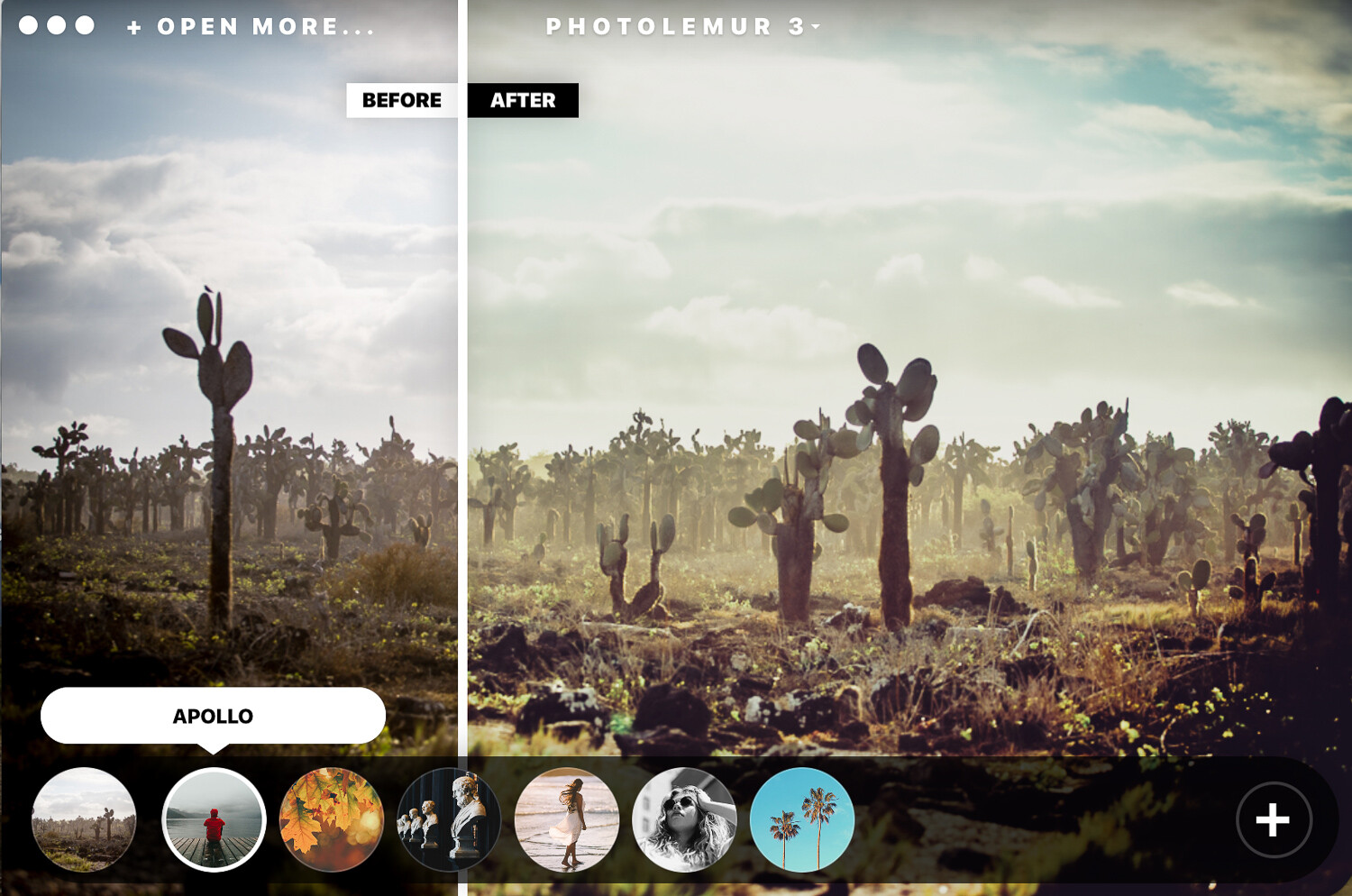
After Photlemur finishes analyzing your images, it gives you a before and after view with a fun slider. You can see and compare the enhancements applied to your photos.

At the bottom, you can click on the paintbrush and gain access to a slider that lets you adjust the amount of enhancement that you want to apply. The software won’t let you adjust the changes individually. For example, you can’t edit the exposure only. It does a pretty decent job at making the skies pop and fixing any exposure issues automatically.

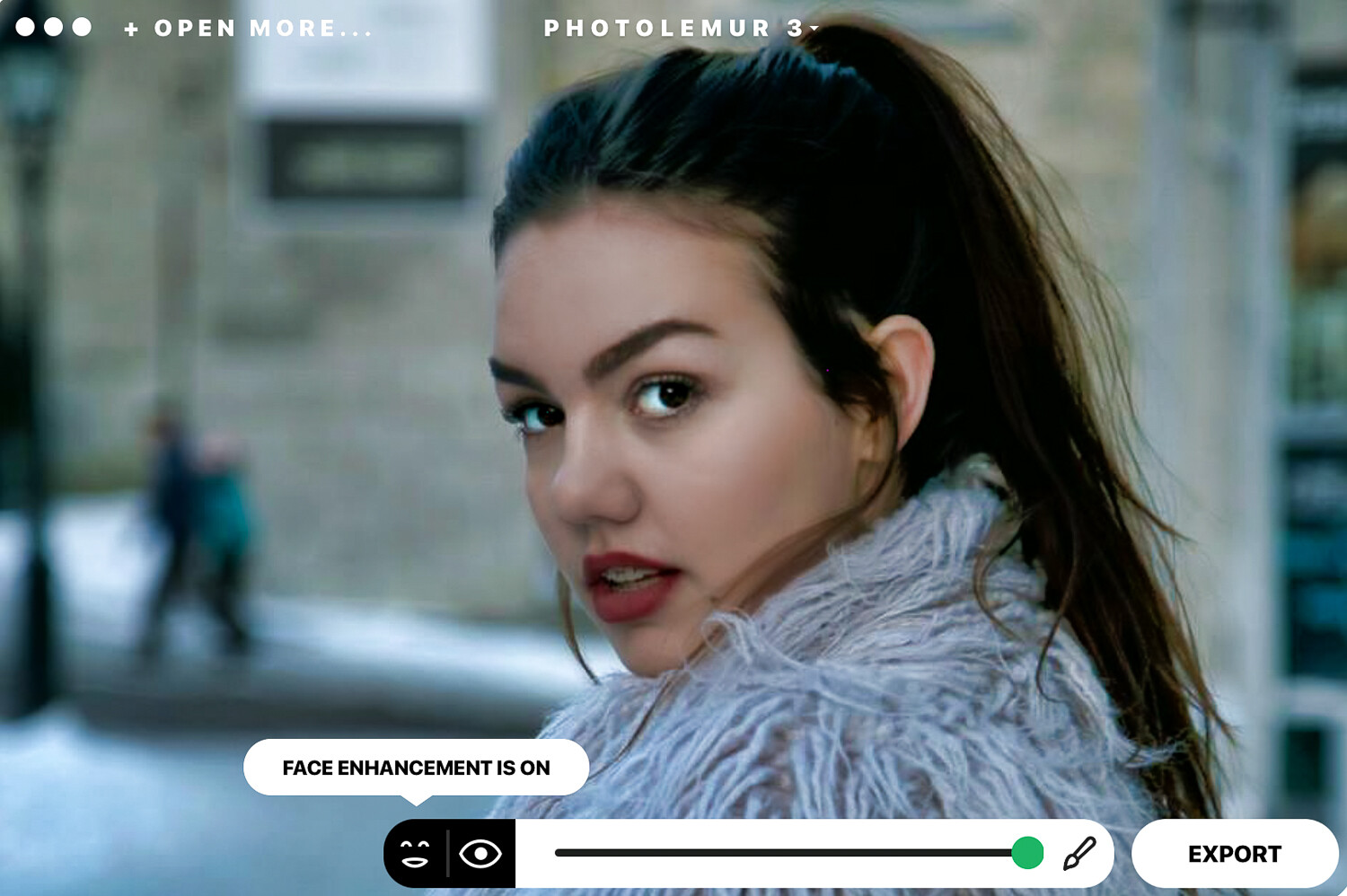
Photolemur 3 also features a face and skin enhancer that fix your portrait photos instantly by smoothing skin and imperfections, enhancing eyes, and whitening teeth.

On the left-hand side of the bottom slider, you will notice icons that let you turn on or off the “EYES ENLARGEMENT” and the “FACE ENHANCEMENT”.

I didn’t particularly like what happened to the hair of my model in this image. I would probably glide the slider a little to the left for portrait photos.

Applying filters

The software has integrated filters you can apply to your images. The filters are very similar to the ones you find on apps like Instagram. Click on the circle at the bottom and get access to all the filter options. If you’re a fan of filters, these do the trick pretty well. The mono filter transforms your photos to black and white with commendable results.

Exporting options

Once you’ve finished editing your photos, you can export them to your computer, upload them on various social media sites, or attach them directly to an email.

Standalone and Plug-in

You can use Photolemur 3 as a standalone app on your computer, and you can also add it as a plugin for Photoshop and Lightroom. Upon initial installation, you are prompted to add the plugin if you wish to do so.

Who it’s for

Photolemur 3 is a great tool for beginner or amateur photographers who want to easily and quickly enhance their photos. It does what it claims and has made photo enhancing stress-free. However, I don’t think that professional photographers will use this software on a regular basis because of its limitations.

It’s ideal for landscape photographers because of the sky enhancer and also for portrait photography. It’s super easy to set-up and get going. You can get your photos edited in a few minutes with a few simple clicks.

What it doesn’t do

If you have Photoshop or Lightroom knowledge and are accustomed to editing your photos manually, you will find Photolemur 3 restrictive. If you don’t like the way the software adjusted your exposure and colors, there is no way to go in deeper to adjust these results individually.

That said, it does a pretty good job automatically.

The program makes some sounds when it does certain actions that I’m not a fan of. Thankfully you can go to the settings drop-down menu and disable this feature.

Conclusion

I particularly like the way Photolemur 3 processes the skies to look better and how it corrects any exposure issues. However, I would go a little easy on the face enhancement features so that portraits don’t look over-edited.

You can give Photolemur 3 an unlimited free trial before you purchase it. Download the free limited version from their website and test it out for yourself. The free version adds a watermark and has other restrictions like no batch processing and limited export size.

This type of technology is the future of photo editing, and we will be seeing more algorithms and artificial intelligence applied to photography software and apps. I’m all for professional results done in a less time-consuming way. More time to have fun shooting!

Have you used Photolemur 3? What are your thoughts?

The post Review: Photolemur 3 Photo Enhancer Software appeared first on Digital Photography School. It was authored by Sandra Roussy.


Digital Photography School

 
Comments Off on Review: Photolemur 3 Photo Enhancer Software

Posted in Photography


Thinking about the Panasonic Lumix DC-G95 for video? Read this first

06 Apr
The G95 is being promoted as a video and stills camera, yet its video is more heavily cropped than the G85’s was.

Thanks to its groundbreaking GH series of cameras, Panasonic has developed a reputation for being one of the strongest brands for consumer video. But the release of the Lumix DC-G95 (known as the G90 outside North America) just draws attention to the fact that brand perception doesn’t necessarily convey those qualities across the lineup.

We’ve got used to Panasonic cameras delivering 4K capture from crops of their sensors but it’s beginning to look especially egregious on the G95 for a number of reasons. For a start, we know that Panasonic can do better: the G9 proves that the company is able to provide full-width video. Secondly, Panasonic is explicitly pitching this camera for video as well as stills (the addition of headphone socket and V-LogL speak just as loudly as the press release, in this respect).

But, most pressingly, the standard of the competition has risen: the Fujifilm X-T30 can shoot 4K/30p from a much larger sensor region with no crop (and none of the rolling shutter that holds back Sony’s offering in the class).

The challenges/balances of 4K video

This isn’t easy, of course. Every manufacturer faces a series of challenges (mainly in terms of processing power, battery consumption, heat generation and rolling shutter), and there are various solutions to this problem.

We’ve tried to summarize the trade-offs that each possible solution brings:

Detail level Noise performance Angle of view Processing demand
Full-width Oversampling High High Minimal crop Highest
Pixel Binning Moderate High Minimal crop Moderate
Line Skipping Low (risks moiré) Low Minimal crop Low
Cropped Oversampling High Moderate Some crop High
1:1 Capture Moderate Low Some crop Low

The G95 essentially takes the fifth option here: using a central chunk of its sensor to capture roughly the number of pixels required to produce its 3840 x 2160 video. This isn’t very demanding in terms of processing, so its rolling shutter performance is good and you’ll very rarely need to worry about overheating. But there are significant drawbacks, too.

The G95 / G90 already has a sensor that’s smaller than its APS-C peers, using less than half of it in 4K video mode (area indicated in blue) puts it at a further disadvantage.

The first is angle of view. The roughly 4100 x 2300 pixel region of its 20MP sensor that is used for 4K is pretty small: imposing a significant 1.25x crop. This means that the 12mm ‘wide’ end of the kit zoom ends up giving an angle of view closer to a 30mm lens on full frame, rather than the usefully wide 24mm equiv. it’ll give you in stills mode. That’s likely to be a major creative restriction.

Worse still is the effect on image quality and noise performance. Only using a crop of a sensor is, in essence, the same as using a smaller-sensored camera. The G95 uses a sensor region nearer that of a 1″-type sensor, which means you get noise performance comparable to a smaller (and probably cheaper) camera.

Reality ? reputation

Panasonic is far from alone in offering cameras with disappointing video, despite being well thought-of in this regard. Canon built a reputation for video with its EOS 5D II, but appears to have struggled to live up to it (in its consumer cameras at least). Even Sony, which was first to provide video features such as Log capture seems stuck with 8-bit capture at a time when other brands are providing 10-bit and is still introducing cameras with significant rolling shutter. And, though Fujifilm is beginning to build a reputation for great video, it’s still happy to promote some models as having ‘4K’ when they can only shoot a pitiful 15 frame per second.

Why is this suddenly a big deal?

There are still plenty of people who are adamant that they don’t want video, and perhaps there’s something inherently unfair about expecting every aspect of a new model to exceed the best performance we’ve seen in its class (rather than just showing strengths and weaknesses relative to each specific rival). But to our eyes, the increased crop of the G95’s video doesn’t fit with our expectations of a contemporary camera being pitched as a stills / video tool. Especially not compared to a camera it nominally sits above, and from a company that trades to a degree on its video expertise.

Articles: Digital Photography Review (dpreview.com)

 
Comments Off on Thinking about the Panasonic Lumix DC-G95 for video? Read this first

Posted in Uncategorized


CP+ 2019: Canon interview – ‘we want to capture as many customers as we can’

06 Apr
Left to right: Naoya Kaneda, Go Tokura, Yoshiyuki Mizoguchi and Manabu Kato

We were in Japan earlier this month for the annual CP+ show in Yokohama, where we sat down with senior executives from several camera and lens manufacturers, including Canon.

  • Go Tokura – Chief Executive, Image Communication Business Operations
  • Naoya Kaneda – Group Executive, Image Communication Business Operations [lenses]
  • Yoshiyuki Mizoguchi – Group Executive, Image Communication Business Operations [camera]
  • Manabu Kato– Deputy Senior General Manager, Utsunomiya Optical Products Plant

This interview was conducted with multiple people via an interpreter. As such, it has been edited for clarity and flow, and responses have been combined.


Looking at the EOS R system, can you explain why we’re seeing very high-end lenses but consumer-level camera bodies to start with?

With the EOS R system the target was all about taking the optical capabilities to the next level and achieving the highest image quality, so from that end we wanted to really optimize what the lenses can do: that’s why we’ve started with so many L-series lenses.

With the bodies, we were introducing a new system and expanding what we offer. We’re looking to capture as many customers as we can, that’s why we approached this segment of enthusiasts. And we wanted to make it affordable as well, because we wanted to capture as large an audience as possible.

And because you can adapt our EF lenses, the breadth of options is appropriate for that segment, too.

Should EOS RP customers expect more affordable lenses in future?

Yes, you can expect that.

How do you strike the balance between developing RF and EF in terms of resources?

Because this is a different system, you might expect us to have different teams working on the EF and RF lenses, but that’s not the case. We actually have the same optical engineers, the same mechanical/manufacturing engineers working on both EF and RF. In other words; everyone involved is a dedicated expert, skilled in terms of developing interchangeable lenses.

For the immediate future we will be focused on RF lens development

Because we’ve launched RF just recently and we believe there are a lot of gaps to fill in that system, for the immediate future we will be focused on RF lens development.

What’s the logic behind making a system that isn’t compatible with your existing EF-M mirrorless system?

When we started to design the RF lenses we didn’t want to compromise on what we can do. We wanted to develop RF to its full potential, so we wanted the latest specifications, state-of-the art technology and design. In the process of developing a no-compromise system, it became apparent that this wouldn’t be compatible with EF-M.

The cameras that use the EF-M lenses tend to be the smaller sizes which may be [oriented towards] a different customer, so we’re looking at what those customers want and we’ll develop according to that response.

You haven’t considered an APS-C RF camera, then?

I can’t tell you what the future plans are going to be, but it is the customer who directs us into our development, so if the customer requests that, it’s something we’ll try to respond to as best we can.

Is there a trade-off to be made between offering the best image quality and being able to offer fast, quiet focus, that you get from using Nano USM?

Nano USM is a technology we’ve very proud of having developed. The first time it was used, three or four years ago, was in an EF-S lens [the EF-S18-135mm f/3.5-5.6 IS USM] where it was all about raising the speed and also that it’s silent. That both catered to the needs of videography but also helped to raise the autofocus speed.

Canon doesn’t give many details about its Nano USM technology. It appears to be based on pulsing blue waves of some sort

To go with Nano USM you have to design with a lens with lightweight focus elements. It’s a new technology so we’re always looking for ways to adapt it to the different requirements of the cameras they’re used for. Because it can give silent, high speed AF we have a strain of development in place to expand the ways we can use Nano USM. So we’re looking into how we can adopt it in the different cameras that we have.

For each of the lenses that we develop, we always think about what we want to provide. With the large lenses you see in front of you [the 50mm F1.2 and 28-70mm F2] that was all about really achieving the optical quality performance, that’s why we decided not to use the Nano USM. But we did use Nano USM in the 24-105mm F4: that is for video and stills. We thought it would be more appealing and would help provide the features required for such a lens.

Almost all of the EOS R lenses announced so far are ‘L’ series. What does ‘L’ mean in 2019?

For a lens to be called ‘L series,’ it has to have the latest technology that Canon can offer. In other words, it’s about making sure the performance is the latest and best we can provide at that time. Because they’re designed for use by the professionals and enthusiasts, we want to provide them with a better choice of lens. So whenever we introduce an L series that’s what we mean: we want to offer a better lens for such a segment.

Canon has revealed plans for 15-35mm, 24-70mm and 70-200mm F2.8 L lenses for the RF mount

And, of course it also has to be dust-proof, etc: the durability aspect of it. That also has to be in place, given the situations these photographers will be using them in.

When you’re designing for mirrorless: what are main differences, compared with designing for DSLR?

It’s difficult question to answer simply. With the move to mirrorless the aim is to optimize the space where the mirror box used to be – that was what we were looking at. This allows us to make the lenses smaller and also to raise the optical quality.

What are you trying to achieve with the F2.8 trio?

We’re making sure that the new system and lenses are able to contribute value to the product the professionals produce: which in this case is their photography.

For them to be able to see that difference, to see the improvement is really what dictates how we design the lenses. It’s literally all about making sure we can offer that level of higher quality, higher value features for this professional segment.

We’re making sure the new system and lenses are able to contribute value to the product the professionals produce

The Nano USM question you had kind of relates to that. It’s all about making sure we have the better autofocus, the silent autofocus and also the 70-200mm to become smaller.

Other advances can be see in the wide zoom: it used to be that it started at 16mm, but now it allows for 15mm. And also with the image stabilization feature as well. All of these are about making sure we can actually provide the better value for these professional users: it’s about providing this new value.

With the three golden [lens] series that you’ve mentioned, the RF mount allows us to open up these possibilities for them.

In terms of making the new 70-200mm smaller, how difficult was it to decide to move to an extending zoom design?

We’ve not actually disclosed that it is going to extend or not, but we do have the extending mechanism in other lenses we make. So we do have the experience and know-how in-house: we have the capability to introduce such a feature in a new lens.

Canon won’t confirm its RF 70-200mm F2.8L IS (left) is an extending design. But it is.

To be clear, though: I have not said that it’s going to be an extending design. [Laughs]

And the advantage of fast and silent AF: is that primarily for video shooting?

With the silence of autofocus, yes we’re looking at the video. But we’re also working to improve the smoothness of the focus. All of this is in response to what people are looking for in terms of videography.

The current RF cameras offer 4K but with compromises. How do you see video features evolving in RF lineup?

We believe mirrorless cameras can be good for video shooting for the high end. They do their job well both for videography and still photography. Having said that, we always know there is a need for improvement in terms of specifications and the potential that we can provide for video photography.

We are working … so we can provide for better videography

For the EOS R and RP models, we’re aware of some of the dissatisfaction people have commented about our video features, and we are working to respond to this so we can provide for better videography, both in terms of the lens and the camera.

What are priorities for sensor development? Speed, pixel count, dynamic range, video?

Looking at our entire product lineup, yes, all of the points you mention are priorities for us. We need to evolve in all aspects of those things and that has to do with how we can upgrade our sensors.

The sensors used in the EOS R and RP don’t offer the best dynamic range in their respective classes, and both offer cropped video with significant rolling shutter.

In other words, we will be developing sensors so that we can maximize the potential that they can provide. But we always need to look at the camera it’s going into: to make sure that that sensor provides the best features or value characteristics that each camera’s concept requires.

It might be speed that’s important in one camera, as opposed to pixel count in another. So the camera dictates what sort of sensor we develop. But we are developing sensors to cater and optimize for each of their features and performances.

Are you ready for the Olympics in Tokyo next year?

Our plans are on track.

We have not disclosed any specification or details about the Olympic year model. But we’re making sure that by [the time of the Olympics] we are able to provide a product with the feature that’s most important, which is reliability of the camera. This is for professionals, for professional use as a tool. We need to provide a reliable camera, so that’s what we’re aiming for.

Do you think we’ll see more mirrorless than DSLR at the Olympics?

Even now I think a lot of competitors are all looking to design high-end mirrorless, so we will probably see more of this coming in.

Having said that, I’m not so much interested in the distinctions between mirrorless and DSLR. At the end of the day for the professionals are looking for the ultimate result that they can get from their professional tools. They’re looking for the reliability once again, and also the operability, the usability, ease-of-use: these are very important for these professionals. In other words, it’s these factors that are most important, not whether it’s a DSLR or mirrorless camera. It’s not so much about saying it’s a contest between mirrorless or DSLR.

In the long-term can you see Mirrorless replacing the DSLR?

There is a trend towards mirrorless. They’re the cameras being developed and produced, so there might come a time where that might happen. And Canon is making sure we’re not behind with that trend.

Canon has been working on a variety of novel camera concepts, four of which were on show at CP+.

Last year you showed us some compact camera concepts, more evolved version of which are now on the show floor. How is the development going?

I guess you’ve seen the four models. What we’re doing now is getting the customers response or the user response to see what sort of thing we can improve on. So we’re actually in that brushing-up stage, if you will. We would definitely want to get these cameras on the market soon, if we can.

In the light of the changes in the market, what does Canon have to offer mainstream/casual users?

Like the prototypes that you see, it has to work with smartphone as well. We believe there is something that can be done to co-exist with the smartphone.

we believe there’s a new… casual capturing market

So, in addition to the ILC and the compact camera market, we believe there’s a new genre of capturing: a new casual capturing market if I may say. I think there is potential for new developments to be had in that spectrum.


Editor’s note: Richard Butler

Perhaps the thing that surprised me most was Canon’s openness in this interview. Historically very few companies have been willing to even imply that their sensors or their video performance might need to improve, so the teams’ responses came as a refreshing surprise.

Similarly, it was interesting to hear Canon’s executives make clear that they’re currently focused on RF lenses. It’s an understandable course of action, given the company’s need to make the system look comprehensive and appealing as quickly as possible, but it’s still striking to hear such complete focus stated on-the-record. The implication, of course is that EF lens introduction will slow down for a while.

I didn’t think we’d ever hear Canon execs entertain the idea that sensor performance might need to improve.

As you might expect, Canon was very keen to talk about how seriously it takes its pro-level offerings, even to the point of almost confirming that there’ll be an ‘Olympic Year’ pro camera in 2020. While we tend to focus on technological improvements, Canon is stressing the importance of reliability (something that we can’t really capture in reviews, since it can only really be confirmed with hindsight).

I personally didn’t think we’d ever hear Canon executives even entertain the idea that mirrorless might one day replace DSLRs in the market (we’re so used to hearing ‘there’s a place for both’), nor allow even the slightest implication that the company’s sensor performance might need to improve.

There was an acknowledgement potential trade-offs between image quality and optimal autofocus performance

The intention of making a pro model isn’t much of a surprise, given the company’s focus on high-end, ‘L’ series RF lenses (eight of the ten lenses promised so far will wear the ‘L’ designation). But again, in amongst talk of ‘the latest technology’ and ‘the highest quality’ there was an acknowledgement potential trade-offs between image quality and optimal autofocus performance. If anything that just leaves us all the more keen to find out how the forthcoming Nano USM-powered F2.8 ‘L’ trinity will perform.

At the other end of the market, Canon was the only company we spoke to at CP+ that publicly confirmed that it’s searching for a market beyond enthusiasts and professionals (the audiences at which most recent announcements have been aimed). Promises of trying to “capture as large an audience as possible” with the EOS RP aren’t fully backed-up by the RF lenses announced so far, but the continued development of the compact prototypes suggest we should take Canon at its word when it says it believes “a new casual capturing market” could yet exist, if they can create the right product.

Articles: Digital Photography Review (dpreview.com)

 
Comments Off on CP+ 2019: Canon interview – ‘we want to capture as many customers as we can’

Posted in Uncategorized