RSS
 

Archive for November, 2018

DJI releases nine new accessories for Ronin-S handheld stabilizer

22 Nov

DJI has released a total of nine new accessories for its Ronin-S handheld camera stabilizer, expanding the system and making it more attractive to ambitious video shooters and film makers. Below is a quick run-down of each of the new accessories.

The new Focus Motor enables motorized focusing of lenses and offers lens control with an accuracy of .02 degrees. The Command Unit attaches to the side of the stabilizer and lets users to modify settings such as motor parameters, remote control and operation modes without the need to connect a mobile device.

The Ronin-S BG37 Grip offers an extra 12 hours of operating time via a 2400mAh built-in battery and the Top Hotshoe Bracket mounts to the camera hot shoe and the Ronin for extra security during fast-paced shooting, for example when the stabilizer is mounted to a moving vehicle. The grip comes with a cold-shoe, so you can still attach accessories with the adequate connector.

$ (document).ready(function() { SampleGalleryV2({“containerId”:”embeddedSampleGallery_0548625051″,”galleryId”:”0548625051″,”isEmbeddedWidget”:true,”selectedImageIndex”:0,”isMobile”:false}) });

The Extended Lens Support helps secure the camera and larger lens on then Ronin-S and can be used when the standard support is not long enough. With the Ronin-S Universal Mount the stabilizer can be mounted to a car, jib, cable cam system and more.

Finally, the External GPS Module offers improved stabilization performance during fast accelerations or decelerations and better reaction to sudden camera movements. All new accessories are available now, pricing is as follows:

  • Focus Motor: $ 169 USD
  • Focus Motor Rod Mount: $ 20 USD
  • Focus Gear Strip: USD $ 20 USD
  • Command Unit: $ 129 USD
  • BG37 Battery Grip: $ 99 USD
  • Top Hotshoe Bracket: $ 49 USD
  • Extended Lens Support: $ 20 USD
  • External GPS Module: $ 69 USD
  • Universal Mount: $ 179 USD

More information can be found on the DJI website.

Articles: Digital Photography Review (dpreview.com)

 
Comments Off on DJI releases nine new accessories for Ronin-S handheld stabilizer

Posted in Uncategorized


Photography gifts for every budget: 2018 edition

22 Nov

With so many accessories, bags, lenses and so on to choose from, shopping for a photographer can be daunting. But we’re here to help: From stocking stuffers to, well, entire cameras, we’ve got you covered – at every budget.

2018 Holiday Gift Guide: Under $ 50

2018 Holiday Gift Guide: $ 50-250

2018 Holiday Gift Guide: Over $ 250

Articles: Digital Photography Review (dpreview.com)

 
Comments Off on Photography gifts for every budget: 2018 edition

Posted in Uncategorized


Advantages DSLRs Have Over Smartphones, and Why They’ll Always Have Them

22 Nov

I love watching the annual press events of Apple, Google, Samsung and others where they show off their latest high-tech gadgets, including mobile phones. With each new iPhone, Pixel, and Galaxy they seem to repeat a common refrain: “And the camera is the best one ever in a smartphone”.

Are DSLRs fading away with modern advances in smartphone camera technology? Or are they primed and ready for an entirely new life?

Mobile phone cameras are mind-blowing marvels of modern technology. With some of the tech showcased in the recent Pixel 3 announcement, you might be wondering if traditional DSLRs and mirrorless cameras are even relevant anymore.

The answer is more complicated than you might think.

Before you get too deep into this post, I want to make one thing abundantly clear. No-one can tell you which camera is best for you. If you have a 3-megapixel point-and-shoot that does what you want, then, by all means, keep using it and don’t let anyone stop you. Also, if your smartphone takes selfies and Instagram-worthy photos of your morning coffee, then keep snapping away.

In this article, I’ll be looking at some advantages traditional cameras have over smartphones. However, I won’t be telling you which one to buy, and I certainly won’t be telling you to stop using the camera you already have. Too often, the point is missed entirely when people get caught up in silly arguments on internet forums and message boards about whether such-and-such camera is better.

It’s important to know the advantages and disadvantages of different cameras, so you have enough information to choose one that best suits you and your needs. However, please don’t think I’m trying to tell you what you should or shouldn’t buy.

In almost every way I can think of, modern smartphones can take incredible images compared to those from just a few years ago. These days they have real-time HDR, depth mapping, background separation, multiple lenses, machine learning, portrait mode, selective bokeh adjustment, and even computer-assisted sub-pixel digital zooming. It’s enough to make even the most staunch DSLR owner feel a tad envious.

Still, don’t toss out your Canon or Pentax just yet. DSLRs and other traditional cameras have a treasure trove of advantages no current smartphone can match, and some features they may never be able to achieve.

Lens Selection

What’s the essential advantage of DSLRs over smartphones? I couldn’t tell you, but lens selection would undoubtedly be near the top of the list. Despite all the advances in smartphone photography in recent years, some laws of physics and photons are only overcome when switching lenses like a traditional camera. Most mobile phones have lenses roughly equivalent to a 28mm lens on a full-frame DSLR, although some dual-camera models roughly mimic a 50mm field of view to try and recreate professional-style portraits. Even though you can get adapters (such as the Olloclip) that let you do some creative experimentation, they rarely hold up to dedicated lenses mounted on interchangeable-lens cameras.

By comparison, DLSRs can use hundreds of different lenses, each designed for specific photography needs and situations. No matter what you need from a DSLR, there’s a lens that does it – from wide-angle primes and telephoto zooms to basic kit lenses, tilt-shift, and specialized macro lenses.

A photo like this, which requires a telephoto lens with a wide aperture, isn’t currently possible on any smartphone (and may never be).

The AI-powered tricks and computational somersaults modern cell phones are capable of can work wonders for different photographic situations. But when it comes to choosing the perfect lens for the job, smartphones simply can’t compete. If you want to shoot close-up images, far-away wildlife, fast-moving sports or pleasing group portraits, your mobile phone will probably come up short. Sure, you can’t install apps on most DSLRs. But you can change out lenses which, when it comes to photography, is infinitely more useful.

The portrait mode on mobile phones is amazing. But it doesn’t come close to what you can achieve with a portrait lens on a DSLR or mirrorless camera.

Customizable Settings

While phones can produce amazing photographs in lots of different conditions, you’re fairly limited in terms of settings. You usually can’t change the aperture or focal length (and no, digital cropping is not the same as changing focal lengths). All you can really control are the ISO and shutter speed, and the native camera apps rarely even let you do that much.

When you press the button to take a picture on your phone, you’re letting the computer do most of the thinking it terms of white balance, shutter speed, ISO, and even which part of the image should be properly exposed.

One of the biggest selling points of DSLRs and other dedicated cameras is that (while they have auto modes that do much of the heavy lifting) they have manual modes that let you choose everything – aperture, shutter speed, ISO, and even the focal length if you’re using a zoom lens. Admittedly, not everyone wants that much control, and you can choose to shoot in auto or semi-auto if you want. But having such fine-grain control is a huge advantage over smartphones.

I could choose a slow shutter speed to get this shot on my Fuji X100F, whereas most mobile phones would have used a much faster shutter speed resulting in a vastly different image.

Smartphones and the software that powers them are so advanced and sophisticated that people are perfectly happy letting them make the decisions and do most of the heavy lifting. But if you want more control you won’t get it on a mobile phone. Even the dedicated camera apps run up against physical limitations such as focal lengths that can’t be changed.

There are times when the photo you want to take isn’t the photo your camera wants to take. In those situations, a dedicated camera will let you change aperture, shutter speed, and ISO to get the exact photo you want.

I shot this image at 200mm, f/2.8, ISO 100, and 1/4000 second, which is impossible for any mobile phone.

Low-Light Shooting

DSLRs will always have the advantage over mobile phones in low light due to the way camera sensors collect light. Larger sensors mean larger photosensitive sites, which means they can capture more information about incoming light when there isn’t a lot of it.

At Google’s recent Pixel 3 announcement they demonstrated a feature that vastly improves its low-light shooting. But it only works with still subjects. It also runs into the same limitations all mobile phones have such as fixed focal length and limited options for changing settings.

I took this deep under the earth in Mammoth Cave National Park, 23mm, f/2.0, 1/20 second, ISO 6400. While some phones could have taken a shot similar to this they would have needed much longer shutter speeds, which would make the people a blurry mess.

Try it for yourself to see what I mean. Even with the best night-mode options on the newest mobile phone, you’ll still struggle to get clear shots of moving subjects. It’s great if you only require pictures of static compositions such as buildings or parked cars. But if you want to capture shots of kids, animals or anything that moves around, your mobile phone will probably leave you wanting more.

As the technology advances, low-light photography on mobile phones will improve. But there will always be physical limitations inherent in the platform that DSLRs and mirrorless cameras simply don’t have to deal with. Much of it stems from their larger image sensors, which collect much more light data per pixel. But the fact cameras let you specify the ISO value you need to get the image you want is also a big advantage.

Model train in a dim basement, shot at 50mm, f/2.8, 1/60 second, ISO 3200.

Not Quite There… Yet

I’m a big believer in the promise of computational photography in mobile phones. If the best camera is the one you have with you, then for hundreds of millions of people around the world their mobile phone is the ideal choice. But even with all the rapid advances in technology, there are still plenty of reasons to own a traditional camera.

If you have one that’s been relegated to a dark closet or dusty shelf and replaced by a high-tech mobile phone, get it out and see what it can do. The results may surprise you and have you wanting to use it more and explore the possibilities it offers.

What about you? What are the advantages of using traditional cameras that keep you coming back to them time after time? I’d also like to hear your thoughts about mobile phones and the technology they offer photographers.

One thing is clear. No matter where you stand on this issue, we certainly live in exciting times for photography.

The post Advantages DSLRs Have Over Smartphones, and Why They’ll Always Have Them appeared first on Digital Photography School.


Digital Photography School

 
Comments Off on Advantages DSLRs Have Over Smartphones, and Why They’ll Always Have Them

Posted in Photography


Center Field – 9 Acceptable Ways For Breaking Rule of Thirds in Photography

22 Nov

When starting, most photographers tend to shoot all subjects center-frame. As they learn more about photography and composition, they learn that centering a subject is not appealing and that they must follow the ‘Rule of Thirds’ to have a good composition. What if I suggest breaking Rule of Thirds?

The Rule of Thirds

The Rule of Thirds is taking a frame and dividing it into three equal sections both horizontally and vertically, creating a rectangular ‘tic-tac-toe’ box. Framing a subject so that it falls on one of the four intersecting points of that box can sometimes make an image more appealing to a viewer engaging with it.

2 - Breaking Rule of Thirds in Photography

Implementing the Rule of Thirds.

While you may not perfectly frame your subject to fall within one of those four points, if your subject falls on one of the four internal lines within the box, in most cases, it still gives a better appeal than a centered image.

When It’s a Good Idea to Center Your Subject

1. Centering as a Compositional Tool

Placing your subject dead-center can work to your benefit if the subject still tends to comply with the Rule of Thirds guideline. Such as, when more than one point of focus falls on more than one line within that ‘Rule of Thirds’ box as shown in the image below.

The sets of pillars fall on one of the two vertical lines in the frame according to the Rule of Thirds even though the entire image is centered.

2. Place Focus on Your Main Subject

Sometimes when there is a busy foreground or background, placing your subject dead-center helps to draw the viewer’s attention to it. While the image below shows much texture, centering the stool brings focus to it.

4- Breaking Rule of Thirds in Photography

Bring better focus to a subject by centering.

3. Emphasize Symmetry

You may sometimes run into a subject that has a symmetrical value to it. The item could include columns at a building’s entrance, a person’s face or something with repetitional characteristics. Centering the subject, in this case, allows the viewer to relax because the order in the image makes sense.

5- Breaking Rule of Thirds in Photography

This nonsymmetrical image is not as appealing as the image below.

In the next image, there is a sense of order due to the equal number of pillars to the right and left of the fountain, producing symmetry.

6 - Breaking Rule of Thirds in Photography

This image represents symmetry.

4. Draw the Viewer’s Eye Inward

One of the most common goals for a photographer is to draw a viewer’s attention into the image instead of out of it. Straight roadways, paths, or sidewalks are great examples that keep your viewer’s attention within the frame – by drawing the eye inward.

The hall and chandeliers are centered taking the eye inward into the photo.

5. Create a Sense of Size and Space

Centering a subject can often showcase its size, especially when surrounded by people, buildings or other objects that serve as a comparison. Such as in the image below.

8 - Breaking Rule of Thirds in Photography

Centering a subject can sometimes emphasize the size of a subject.

Centering a subject can also give a sense of space. A good example is when there is water or cityscape in the foreground of an image and a clear sky in an upper part of the image. See an example below.

9 - Breaking Rule of Thirds in Photography

Centering the Eiffel Tower in this image works to show a sense of space.

6. Square Image Format

A great way to justify centering an image is when you use the square image format. A square has all equal sides in length, so placing a subject dead-center works well. I also like it because, in most cases, it’s an equal distance from the subject to all edges of the sides.

Centering the Eiffel Tower in this image works to show a sense of space.

7. Shooting With Shallow Depth of Field

When you open up your aperture and shoot with shallow depth of field around your subject, it creates a more three-dimensional feel, adding depth to your image. In this case, centering your subject works because it washes out distraction around your subject, as in the image below.

11 - Breaking Rule of Thirds in Photography

Shooting with a shallow depth of field.

8. Overcoming Location Difficulties

Sometimes the location of a fixed subject makes it difficult to capture a stunning shot. During these times try to get creative, as I did in the image of the clock at Grand Central Terminal in New York City below. I could’ve taken that shot from any number of directions or angles. However, for a better shot, I centered it at an angle that included the American flag in the background.

12 - Breaking Rule of Thirds in Photography

Center a subject to overcome location difficulties.

9. Simplicity

You know the saying, ‘less is more?’ While placing a subject off-center adds tension to an image, placing a subject dead center can give a calm and orderly feeling. In addition, placing your subject in a central position is like opening a book to its story. You are making it the most important element in the image. A natural environment, a natural face – it’s an open book. What is your subject’s story that you are introducing to your viewers?

13 - Breaking Rule of Thirds in Photography

Simplicity

Tying It Altogether…

Some ‘rules’ are meant to be broken. The Rule of Thirds is not the only way to guarantee a good composition. As long as you understand why you’re breaking the rules and foregoing guidelines with a specific intention, your images can be as compelling subject-centered as with your subject off-center.

The post Center Field – 9 Acceptable Ways For Breaking Rule of Thirds in Photography appeared first on Digital Photography School.


Digital Photography School

 
Comments Off on Center Field – 9 Acceptable Ways For Breaking Rule of Thirds in Photography

Posted in Photography


1959 Canon 45-200mm F2.8 (C35) ‘rarest’ prototype lens appears in eBay auction

22 Nov

An eBay listing is offering what the seller calls the ‘rarest prototype lens on Earth,’ a Canon 45-200mm F2.8 (C35) prototype lens. According to the listing, the lens was produced in Japan in 1959 and only “four or five” units were given to professionals for testing. Canon ultimately decided not to launch the lens commercially, possibly due to its heavy weight (approx. 3kg / 6.6lbs) and expensive price.

The seller goes on to claim that there are only two or ‘maybe three’ people in possession of these lenses globally. This particular unit, which is offered via auction with a starting price of $ 29,999 USD, is described as being in ‘Excellent+++’ condition for its age.

‘The lens was recently serviced, optics are cleaned,’ the campaign reads, ‘and [the] rear optic has minor sign on the coating in the corner, as it was properly cleaned from fungus and is missing [a] little coating.’ The product is said to be mechanically ‘perfect.’

The campaign references a 1959 Canon press release for the lens, but doesn’t provide a copy of it. Canon’s Lens Museum website doesn’t include any listing for this prototype, leaving only the seller’s claims. The seller has a 100% rating on more than 380 sales, but that doesn’t necessarily mean this listing is accurate.

The seller told DPReview the lens was acquired from ‘a very old studio’ that was torn down and sold off ‘a lot of stuff in auction.’ According to the seller, ‘some old movies were shot with the lens.’ DPReview is waiting to hear back with confirmation of what movies they were.

The auction includes the original metal lens storage box, front cap, filter, hood, focus knob and lens sliding attachment.

Articles: Digital Photography Review (dpreview.com)

 
Comments Off on 1959 Canon 45-200mm F2.8 (C35) ‘rarest’ prototype lens appears in eBay auction

Posted in Uncategorized


Fujifilm XF 8-16mm F2.8 R LM WR sample gallery

22 Nov

$ (document).ready(function() { SampleGalleryV2({“containerId”:”embeddedSampleGallery_0216755794″,”galleryId”:”0216755794″,”isEmbeddedWidget”:true,”selectedImageIndex”:0,”isMobile”:false}) });

The Fujifilm XF 8-16mm F2.8 R LM WR promises to appeal to everyone from landscape to architectural photographers. It has 11 points of weather sealing, fast and quiet autofocus, and a field curvature correction element that adjusts according to focal length to reduce the curvature that often occurs in wide angle lenses. Does it live up to expectations? We’ve been shooting everywhere from the city streets to the Canadian Rockies to test it out.

Articles: Digital Photography Review (dpreview.com)

 
Comments Off on Fujifilm XF 8-16mm F2.8 R LM WR sample gallery

Posted in Uncategorized


‘Everybody Street’ documentary free streaming options arrive on YouTube, Prime Video

21 Nov

Cheryl Dunn’s 2013 street photography documentary Everybody Street is now available to stream on YouTube and on Amazon Prime Video. The YouTube stream is ad-supported and the Prime Video option requires an Amazon Prime subscription. Alternatively, viewers can purchase the documentary on DVD. Everybody Street was previously only available on-demand through Vimeo.

The documentary, which enjoys a healthy 7.7-star rating on IMDb, focuses on New York street photographers Bruce Davidson, Ricky Powell, Mary Ellen Mark, Elliott Erwitt, and others, covering their life and work in the city.

IMDb explains:

Shot by renowned photographer Cheryl Dunn on both black and white 16mm film and color HD, the documentary pays tribute to the spirit of street photography through a cinematic exploration of New York City, and captures the visceral rush, singular perseverance and at times immediate danger customary to these artists.

Articles: Digital Photography Review (dpreview.com)

 
Comments Off on ‘Everybody Street’ documentary free streaming options arrive on YouTube, Prime Video

Posted in Uncategorized


How to Apply Compositional Theory to Still Life Photography

21 Nov

The so-called ‘rules of composition’ aren’t so much rules as guiding principles.

Rules of Composition for Still Life Photography-Darina Kopcok-DPS

Why? Because not every compositional tool works for every image. Art is subjective, and what works well for one image may not work so well for another.

That being said, good photography involves not only technical skill but also choosing the right composition.

It’s especially true in still life photography, where composition can really make or break an image. So here are some tips on how you can apply these compositional ‘rules’ to your still life photography.

Rules of Composition for Still Life Photography-Darina Kopcok-Dps

The Golden Ratio

If you’re new to photography, you may have not heard of the ‘Golden Ratio’ (also known as the ‘Divine Proportion,’ the ‘Golden Mean,’ and the ‘Greek Letter ?’).

Don’t worry if you haven’t heard of them. While artists and architects have been using this principle for hundreds (if not thousands) of years, I was well into my stint at photography school before I’d even heard about it.

It’s a mathematical expression that can describe a wide variety of phenomena found in nature. But when it’s used in art, the results are harmonious and aesthetically pleasant compositions.

You can find the Golden Ratio everywhere – from the works of Michelangelo to the great Egyptian pyramids to a nautilus shell. It’s also found in the human face and body, and even in our DNA.

Rule of Thirds Grid

Most photographers are familiar with the ‘Rule of Thirds.’ This compositional guideline divides an image into nine equal sections using two horizontal and two vertical lines, just like a tic-tac-toe board. The important elements in the scene should fall along these lines or at the points where they intersect.

Rule of Thirds

The rule of thirds works well for images such as landscapes but can be limiting for still life photography. The resulting images often feel awkward or unbalanced.

The Phi Grid

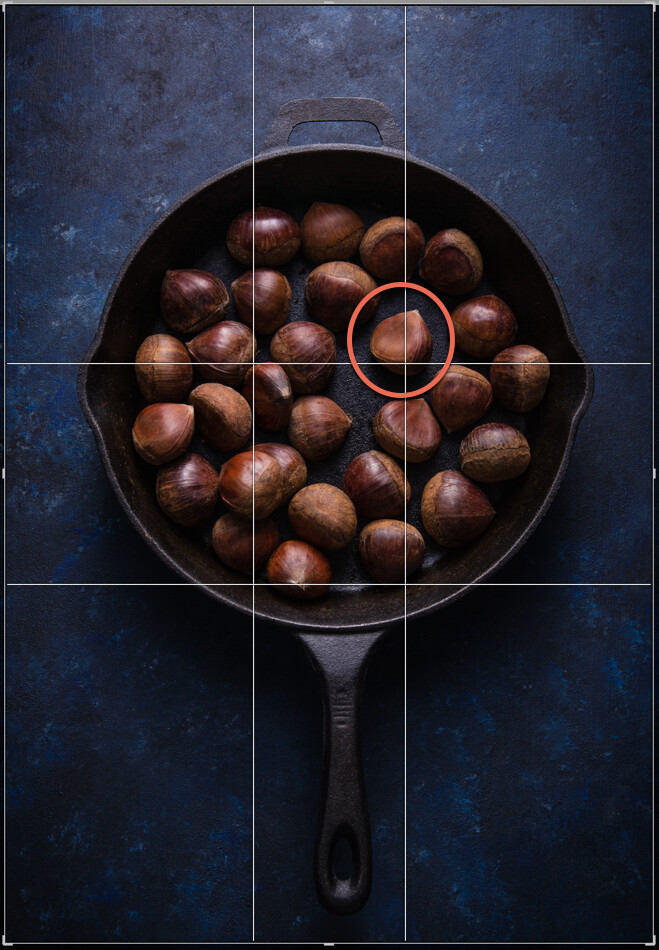
The ‘Phi Grid’ uses a similar concept but is much more powerful than the Rule of Thirds. Its center lines are closer together and express the Golden Ratio of 1:1:618.

Phi Grid

The Phi Grid is one expression of the Golden Ratio.

Rules of Composition for Still Life Photography-Darina Kopcok-DPS

This image uses the Phi Grid. Notice how the chestnut in the focal point is placed differently to the others, drawing the eye.

Fibonacci Spiral

Another expression of the Golden Ratio is the Fibonacci Spiral, which exhibits the same numerical pattern that makes up the Golden Ratio.

You can use this numerical pattern to draw a series of squares. If you draw an arc from one corner to the opposite corner in each square starting from the smallest square, you’ll end up with the Fibonacci Spiral.

This is a guiding principle you can use in your still life photography. By setting your subjects along a curve rather than a straight line you create flow and movement, and help guide the viewer’s eye through the image. It works particularly well in overhead shots that have several elements in the frame.

You can flip or turn the spiral so long as your focal point falls in the smallest part of the spiral. Other important elements should be placed along the curve.

Fibonnaci Spiral

Golden Triangle

Using triangles is a powerful way to create tension in a still life image, and retain the attention of the eye within the frame.

Here’s an image that expresses this principle.

Rules of Composition for Still Life Photography-Darina Kopcok-DPS

Notice the diagonal line going from one corner to the opposite, and the lines meeting that diagonal from the other corners? Where the lines meet are your points of interest, which you should use to place your focal point and divide your frame.

While horizontal and vertical lines suggest stability, triangles add a sense of flow and movement.

You can compose your image to imply triangles, rather than being strict about composing them exactly this way.

Other Helpful Principles

Rule of Odds

In still life photography, having an odd number of elements in a frame is more visually interesting than having an even number of elements.

Odd numbers create harmony, balance and a resting point for the eyes, whereas even numbers compete with each other and can divide our attention.

Aim to have three or five elements in your image. You can have more, but the mind has trouble registering higher numbers meaning your photograph will not have the same effect. If you do have more, put them into groups of odd numbers wherever possible.

Rules of Composition for Still Life Photography-Darina Kopcok-DPS

Odd numbers create tension

Negative Space

Positive space is the area your subjects take up.

Negative space is the empty area where the eye can rest.

Negative space can provide the feeling of movement, and emphasize your subject. Without any space for the eye to rest, a picture can feel chaotic or claustrophobic.

You see negatives space a lot in magazines or product packaging, where it’s used for text placement.

Rules of Composition for Still Life Photography-Darina Kopcok-DPS

Color

You may not think of color as a compositional tool. But it’s actually a very important one. It evokes emotion and creates the mood of the photograph.

Cool and dark colors such as navy blue and black recede, while light and warm colors such as yellow bring objects forward.

Color combinations can be monochromatic, or any of those found on the color wheel.

One of the most powerful combinations is complementary colors (i.e. colors that are directly opposite each other on the color wheel). Blue and yellow is one such combination, which you see a lot in food photography.

Take into account the color of the background or surface you’re shooting on. Colors that are too bright can detract from your subject. Make sure your background matches the mood you’re trying to create and works harmoniously with your chosen elements.

Rules of Composition for Still Life Photography-Darina Kopcok-DPS

Complementary colors make your images pop

In Conclusion

It can take years for a photographer to learn to shoot intuitively using compositional principles. Visualizing your focal point on a Phi Grid is one thing, but visualizing the Fibonacci Spiral while you’re shooting may be more difficult.

Thankfully, with still life photography, you can tether your camera to your computer or use its Live View function to estimate where your subject and focal point should fall.

Editing software such as Lightroom and Photoshop can help you place the various elements in your frame with overlays of compositional guides. You can shoot wider than you need for the final result and crop in post-processing.

The more you implement these compositional guidelines and work with them in post the more you’ll internalize them, which can only improve your still life photography.

The post How to Apply Compositional Theory to Still Life Photography appeared first on Digital Photography School.


Digital Photography School

 
Comments Off on How to Apply Compositional Theory to Still Life Photography

Posted in Photography


Vantage Robotics Snap drone receives receive FAA-certification for flights over crowds of people

21 Nov

Normally, the Federal Aviation Administration (FAA) prohibits flying drones commercially over people in the United States. However, Vantage Robotics’ compact 4K-capable camera quadcopter Snap is now the first drone to receive FAA-certification for flights over crowds of people for both emergency and non-emergency purposes.

The Part 107.39 waiver granted to Rutherford County, Tennesee is a first for a county government in the United States. This is due to the drone’s comprehensive set of safety features, including protected rotors and a lightweight design that lets the drone break into several smaller and less dangerous pieces in the event of a crash.

Brian Robertson, Chief Information Officer for Rutherford, says in the press release:

‘Demands of today’s local governments mean we must function in as many scenarios as possible. The ability to safely and appropriately maneuver our aerial assets over and near event personnel or participants gives our program several new possibilities. Whether for routine coverage of numerous events such as Main Street’s Jazz Fest in May, Uncle Dave Macon Days in July, or during incidents such as the November 6 tornado, the ability to capture the gravity or details of these events from the unique perspective is a major addition to this public service.’

This is a small step towards more drones flying overhead at large events and in crowded areas. More information is available on the Vantage Robotics blog.

Articles: Digital Photography Review (dpreview.com)

 
Comments Off on Vantage Robotics Snap drone receives receive FAA-certification for flights over crowds of people

Posted in Uncategorized


DPReview Buying Guide: Best DSLRs

21 Nov

Last updated: November 20, 2018

It’s not easy to answer the question ‘what’s the best DSLR’ because the question often means ‘what’s the best DSLR for me?’ And the correct answer to that question will depend on your budget and what you want to use the camera for.

It’s also complicated by the fact that, while DSLRs are renowned for their flexibility and image quality, there are now a series of cameras that offer similar (and potentially greater) capabilities that are also worth considering.

So, while this roundup will focus on DSLRs (cameras with a mirror that redirects the image from the lens through into an optical viewfinder), we’ll also recommend some mirrorless cameras that may be a better fit for you. These also have interchangeable lenses and comparable image quality but tend to be a bit smaller and are often better adapted to shooting video.

This guide breaks down your options roughly by price and focuses on all-round capability. For more precise recommendations, tailored to the photography you want to do, we’d recommend looking at our buying guides based around specific types of photography.

Jump to:

  • Best DSLR around $ 600
  • Best DSLR around $ 1000
  • Best DSLR around $ 1500
  • Best DSLR over $ 2000

Best DSLR around $ 600: Canon EOS Rebel SL2
($ 650 with 18-55mm lens)

The EOS Rebel SL2 (EOS 200D) features a 24 Megapixel sensor, fast Dual Pixel autofocus when using live view or taking video, a fully articulating touchscreen LCD and a ‘Feature Assistant’ that makes adjust complex settings easy. It can capture 1080p video and has built-in Wi-Fi and Bluetooth for easily sharing photos.

Read review | Check prices | More info

Mirrorless alternative:

Olympus E-M10 Mark III
$ 599 with 14-42mm lens

The E-M10 III has a retro-styled body and its electronic viewfinder is larger than the optical viewfinder on the SL2. It has a smaller, lower resolution sensor compared to the SL2 and a tilting (rather than fully articulating) touchscreen display, and it includes 4K video capture.

Read review | Check prices | More info


Best DSLR around $ 1000: Canon EOS 77D
($ 949 with 18-55mm lens)

The EOS 77D is two notches above the SL2 in Canon’s lineup, offering more controls, a faster processor and a sturdier body. It too has a fully articulating touchscreen though, oddly, its optical viewfinder is smaller than what’s on the SL2. Video can be captured at 1080p and connectivity features include Wi-Fi and Bluetooth.

Read review | Check prices | More info

Mirrorless alternative:

Fujifilm X-T20
$ 999 with premium 18-55mm lens

The X-T20 has a classic design and produces great-looking photos. It offers Film Simulation modes to bring out your creative side and also has a tilting touchscreen display, 4K video capture and Wi-Fi.

Read review | Check prices | More info


Best DSLR around $ 1500: Nikon D7500
($ 1450 with 18-140mm lens)

The Nikon D7500 inherits some features from the more expensive D500, including its 20 Megapixel sensor, improved metering system, tilting touchscreen LCD, weather-sealing and 4K video capture. While the live view experience isn’t nearly as robust as on Canon models, the D7500 is a clear winner when shooting through the viewfinder.

Read review | Check prices | More info

Mirrorless alternatives:

Sony a6300
$ 1299 with 18-135mm lens

The a6300 is a comparatively inexpensive alternative, and has a top-notch 24MP sensor, gorgeous 4K video, excellent AF and fast burst shooting. It’s also pretty compact, though its user experience isn’t for everyone.

Fujifilm X-T3
$ 1899 with premium 18-55mm lens

The X-T3 excels at both still photography and video. Photos look great and video features (including 4K/60p) and quality are top-notch. The weather-sealed body has an ultra-high-res viewfinder along with a clever 3-axis tilting LCD.

Read review | Check prices | More info Read review | Check prices | More info

Best DSLR over $ 2000: Nikon D850
($ 3300 body only)

The D850 is a high-end DSLR that sits just below the flagship D5 in Nikon’s lineup. It has a 46 Megapixel full-frame CMOS sensor, top-of-the-line autofocus system, a huge optical viewfinder, a tilting touchscreen LCD and dual memory card slots. Image quality is as good as you’ll find and the D850’s 4K video isn’t bad, though controls are a bit limited. As you’d expect the D850 is built like a tank and weather-sealed. Its large battery can take thousands of photos on a single charge.

Read review | Check prices | Read more

Mirrorless alternatives:

Sony a7 III
($ 2000 body only)

The a7 III is a heck of a camera for the price. It has built-in image stabilization along with an excellent 24MP full-frame sensor, stellar autofocus system, great 4K video quality and battery life that’s well above average.

Sony a7R III
($ 3200 body only)

The a7R III has a superb 42MP full-frame sensor plus in-body IS, excellent 4K video quality, dual card slots and above average battery life. It’s autofocus system isn’t as robust as the D850’s but it’s still solid in most situations.

Read review | Check prices | More info Read review | Check prices | More info

Articles: Digital Photography Review (dpreview.com)

 
Comments Off on DPReview Buying Guide: Best DSLRs

Posted in Uncategorized