RSS
 

Archive for March, 2018

Shiftcam 2.0 iPhone add-on offers 6-in-1 lens-slider and ‘Pro’ lens options

13 Mar

The makers of the Shiftcam lens slider case for the iPhone have returned to Kickstarter to fund mass production of their latest development: the ShiftCam 2.0, an iPhone lens case that offers six integrated lenses in a single easy-to-use package, as well as a set of ‘pro’ lenses that slide into the same rail system.

Depending on the shooting requirements of a scene, Shiftcam users can pick a lens and slide it into place over the phone’s built-in camera, using a sliding mechanism and magnetic lens cap. Shiftcam 2.0 comes with a 2x tele lens, a 20x macro, a 10x macro, a 120-degree wide-angle lens, and a 180-degree fish-eye for the rear camera. There is also a 120-degree wide-angle adapter for the front-facing selfie camera.

The system is available in versions for the iPhones 7/Plus and 8/Plus, as well as the iPhone X.

If you want to move past the 6-in-1 slider, the ShiftCam ProLens expansion set adds that option to the Shiftcam product lineup. This series of individual interchangeable lenses includes a telephoto, wide-angle, 238-degree fisheye, “traditional” macro, and “long-range” macro options.

The lenses slot into the same rails on the Shiftcam case as the multi-lens slider, but offer what Shiftcam is characterizing as “pro level image quality.”

Pledging at least $ 50 on the Shiftcam 2.0 Kickstarter page gets you the basic 6-in-1 lens slider and case, but prices go up all the way to $ 350 for the slider, a full set of Pro lenses, and accessories. Delivery is estimated for May of 2018.

If you are interested in Shiftcam 2.0, check out the introduction video above for a quick overview. And before you put down your pledge, you might also want to have a look at our review of the original Shiftcam to get a better idea of how (and how well) the system works.

Articles: Digital Photography Review (dpreview.com)

 
Comments Off on Shiftcam 2.0 iPhone add-on offers 6-in-1 lens-slider and ‘Pro’ lens options

Posted in Uncategorized


The Broccoli Tree and the dangers of sharing photos of the places you love online

13 Mar

Landscape, wildlife, and adventure photographers (among others) will often keep their most treasured locations and subjects secret. And while this might seem rude or selfish or mean, the tale of The Broccoli Tree in Sweden—told beautifully in a recent vlogbrothers video by best-selling author John Green—explains exactly why this practice might also be necessary.

The Broccoli Tree, for those who aren’t familiar, is (or was) a tree in Huskvarna, Sweden that somehow became social media famous.

Photographing this tree became a passion project of photographer Patrik Svedberg, and over the course of 4+ years, the tree gained quite a following on Instagram. In fact, it kind of became Insta-famous so-to-speak, accruing over 31,000 followers to date.

But Insta-fame comes with consequences in this day and age. No matter how beautiful or inspiring, no matter how much joy something brings to the general populace, there will always be those people who get some deluded self-satisfaction out of destroying it.

This is what happened to The Broccoli Tree.

One day in September of 2017, Svedberg went to photograph his favorite tree, only to find that someone had sawed one of the tree’s branches almost all the way through. It wasn’t long before the whole tree had to be cut down.

Ever since the tree got viral a couple of years ago the number one joke has been ”what if someone cuts it down..?” Or ”What´s next, maybe you should cut it down and take photos haha.” I´ve never had good answer to that question, or joke. It´s not like we´re planted together, we live different lives the tree and I. This question was so common so I guess it was just a matter of time before some guys mentally retarded enough would crawl up from under a stone and make it happen as a part of a bet or something. Clearly it´s a obsession in lots of minds out there for some inscrutable reason. One of the trees branches has now (a couple of days ago..?) been sawn in almost all the way through and it´s just a matter of time before it´ll fall off. I won´t be around to document it, others will for sure so I guess you lunatics who did it can enjoy every moment. You can win a bet. Get cheered at. Even get a bit infamous. Congrats. What an accomplishment. I guess you were excited like little children while you did it, must have taken quite a while. For sure you are excited now, aspecially when the word is out. Now is your moment. High fives, maybe some back slapping. Suck it in. Time will erode those memories, excitement will turn into second thoughts. But the saddest thing of all, however You absolutely cannot un-saw a tree. —– I leave the judgement to others and have to move on to work, you can talk to each other about this below of course, but I feel for now this is what I have to say in this matter. Cheer up, there will be a tomorrow after this. // Patrik

A post shared by A tree on Instagram (@thebroccolitree) on

You can hear the entire story in the video at the top of this post, although you might be surprised to find that Green’s takeaway isn’t that people should keep these locations a secret, or not share photos of them at all. In fact, he comes to a totally different, if somewhat melancholy, conclusion:

The truth is, if we hoard and hide what we love, we can still lose it. Only then, we’re alone in the loss. You can’t un-saw a tree, but you can’t un-see one either. The Broccoli Tree is gone… but its beauty survives.

Articles: Digital Photography Review (dpreview.com)

 
Comments Off on The Broccoli Tree and the dangers of sharing photos of the places you love online

Posted in Uncategorized


10 Amazing Camera Hacks for Better Dog Photography

13 Mar

In this article, you will learn 10 camera tricks and hacks that could help you take far more interesting dog photography — or photos of any pet, for that matter.

If you love taking pictures of your pooch but don’t feel that you are getting any spectacular results that are worth framing, then perhaps some of the following tips will help inspire you to take your pet and dog photography to the next level.

Let’s see if these 10 dog photography hacks will inspire you to try something new today.

1. Use window light

Use window light - 10 Amazing Camera Hacks for Dog Photography

This might not seem like much of a hack, but it is your job as a photographer to look for the best light. Many photographers say that window light is their favorite light because it’s a soft light that creates beautiful shadows across your subject.

If you are looking for the quickest and easiest way to create a more professional look for your pictures, moving them closer to a soft light source such as a window would be my first tip.

With without window light - 10 Amazing Camera Hacks for Dog Photography

In the image above, you can see the difference between having the dog by the window and not. Not only is the light more dynamic, because your camera will detect more light, but it will use a lower ISO, which all means a cleaner, less “noisy” image.

Photo with window light - 10 Amazing Camera Hacks for Dog Photography

2. Use your phone light

Phone lighting

We probably all know the saying, “Never work with children or animals”. The reason is that they are unpredictable and quite often do not do what you want them to do when you want them to do it. There may be times when your dog is doing something cute, and it is simply not possible to move them to a window to get that perfect lighting.

These days, however, you have access to light right in your pocket. Next time your dog is doing something cute in lousy lighting conditions, rather than pushing that ISO up and just dealing with the bad light, why not introduce some of your own light using the phone in your pocket? It takes seconds to set up and can instantly give your pictures a far more dynamic feel.

Photography camera light - 10 Amazing Camera Hacks for Dog Photography

3. Tin foil

Tin foil - 10 Amazing Camera Hacks for Dog Photography

Now that we have covered the basics of good lighting, we can move on to some of the fun stuff. If you are a fan of beautiful round bokeh (blurred background), then tin foil could be your new best friend. By putting some scrunched up foil behind your subject and shining a light on it, you will instantly get a “starry” bokeh effect.

This technique requires a bit of practice, but my top tips are to use a lower aperture and move your dog far enough in front of the foil that the camera focuses on the dog, causing the background to blur.
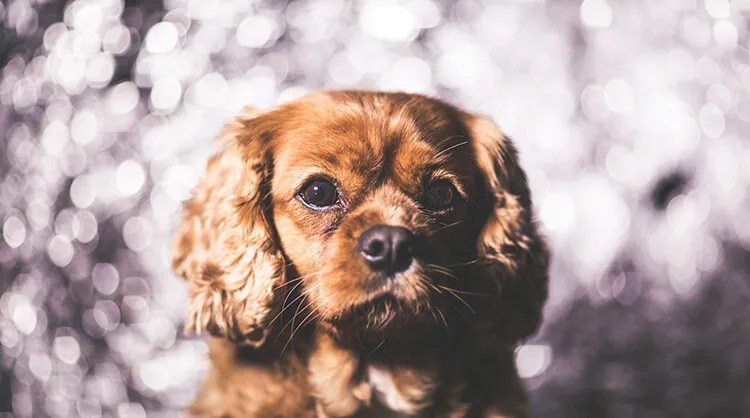
Tin foil bokeh

My second bit of advice is to use a short telephoto or zoom lens, preferably above 50mm to 85mm. This is because a wider lens takes in more of the background so you will need more foil. If you use a telephoto lens, less of the background will be in the shot, which means you will need less foil to create the effect.

4. The upside down reflection shot

Reflection shot - 10 Amazing Camera Hacks for Dog Photography

This tip is as simple as it sounds! The next time you are near some still water, such as a puddle or a pond, try holding your camera upside down and shooting your dog’s reflection in the water. When you look at the image the correct way, you will create a fantastic illusion. When people see your dog’s feet at the bottom of the picture, they will realize that they are looking at a reflection.

Dog reflected puddle - 10 Amazing Camera Hacks for Dog Photography

This tip works well with dogs as they are so low to the ground.

5. Use a mirror to create white space

White space mirror - 10 Amazing Camera Hacks for Dog Photography

It is your job as a photographer to lead the viewer’s eye to the subject that you want them to look at. This is part of the beauty of these fast lenses with really blurry backgrounds; you can leave your subject in focus and blur the background, so it is clear what you want our viewer to look at.

Another way to do this is the use of white space. By shooting in a mirror, you can purposely introduce a significant portion of the wall behind the mirror and put your subject off to the corner of the image. This creates a massive amount of white space, producing a far more interesting picture.

White space dog - 10 Amazing Camera Hacks for Dog Photography

6. Fairy lights

Fairy lights

Fairy lights are great as they introduce three elements that photographers love:

  1. Added detail.
  2. Possibility for nice round bokeh.
  3. Additional light.

Why not get your dog to sit on some fairy lights when you are taking his picture next? You can also add your phone light as well to add that lovely dynamic shadow at the same time.

Dog on fairy lights - 10 Amazing Camera Hacks for Dog Photography

7. Phone or Perspex reflections

Phone reflection - 10 Amazing Camera Hacks for Dog Photography

Symmetry will become your best friend when taking pictures. There is something about reflections and balance that are very pleasing to the human eye.

If you find yourself without a reflective surface to shoot into, why not make your own? I carry a small bit of perspex with me wherever I go. However, many photographers use their mobile phones.

All you need to do is hold it next to your lens to create a reflection of your pet.

Dog reflection hack - 10 Amazing Camera Hacks for Dog Photography

7. Prisms

Prism dslr hack

Prisms mix two elements that we have already discussed; they can create white space, almost blurring out a significant portion of your photographs, and you can get some exciting reflections out of them.

However, the reason why I love using prisms is that they can add some fantastic color to an image that might otherwise be a little dull.

Camera hack prism

9. Phone flare

Phone flare technique

Flare is a real sought-after look. We have all spent time pointing our lenses almost directly at the sun trying to get that beautiful lens flare look.

Well, the next time you want instant lens flare, just get your trusty phone out of your pocket again and try shining that light into the camera to get a very similar effect.

Phone flare hack

10. Change your perspective

Dslr perspective

Finally, why not just change your perspective? The number one thing that will make your pictures look more professional is capturing things in a different way from others.

Most of the time, this just comes down to shooting something from a different angle. People are used to looking down at their dogs, so they will typically take images of their dogs from above. Why not take your pictures from floor level to get pictures of your pet you may not have seen before?

Also, try mixing my technique of using white space in combination with this tip. Purposely shoot more of the floor and put your dog in the corner of the image to help lead the viewer’s eye.

Dog photography

11. One final bonus tip for good luck

One of the best tips I have ever received for my photography comes in particularly handy photographing dogs.

Always focus on the eye that is nearest you.

Your viewers will always focus on the subject’s eyes. If they are sharp, then people do not worry so much about the rest of the image.

If you look back at some of the pictures above, you will notice that sometimes the nose is slightly out of focus due to the use of a shallow aperture. However, you may not have noticed that when you first looked at the images because the eyes are in focus. I do this with all the pictures I take.

Conclusion

I hope the video and these tips have inspired you to go try and take new images that you may not have thought of before. Even if you don’t use these exact tips, perhaps some of them might help you think more about using reflections, lighting, and white space, which will help your pictures stand out from the crowd.

Please share some of your tricks and tips in the comments below.

The post 10 Amazing Camera Hacks for Better Dog Photography by Phil Harris appeared first on Digital Photography School.


Digital Photography School

 
Comments Off on 10 Amazing Camera Hacks for Better Dog Photography

Posted in Photography


Report: Agfa Vista film is no more, stock drying up world-wide

13 Mar

According to a report by Japan Camera Hunter, Agfa Vista color negative film is no longer being produced. The site says the information—which has been rumored for a few months—has now been confirmed by ‘reliable industry sources,’ and that supplies are drying up around the world.

The film has become popular for its low cost and punchy colors, but obviously not popular enough for it to remain in production.

Since the demise of AgfaPhoto GmbH in 2005, the film was distributed by Lupus Imaging and Media, a marketing company that bought the rights to use the Agfa name on a range of items from film to memory sticks. At first, the company slit the remaining stock from Agfa’s factory in Leverkusen, but in more recent times it is widely believed Fujifilm was the manufacturer of the Vista films.

Japan Camera Hunter’s dramatised Death of Vista illustration.

Agfa was one of the very early experimenters with color photography, bringing a color emulsion to the market shortly after Kodak introduced Kodachrome. Agfacolor Neu was much easier to process, however, as it needed only one pass through the chemistry to develop all three colors.

Rolls of Agfa Vista in both ISO 200 and 400 varieties are still available from specialist stores and even Amazon UK, so panic buying hasn’t quite taken hold yet. But JCH doesn’t expect stock to last too long.

Articles: Digital Photography Review (dpreview.com)

 
Comments Off on Report: Agfa Vista film is no more, stock drying up world-wide

Posted in Uncategorized


Instagram might bring back the chronological feed

13 Mar

In 2016, Instagram changed the way the images of the users you are following are displayed in the app from a chronological feed, to a much-debated ‘”algorithm feed”, causing a fairly heavy backlash among its user base.

The chronological feed wasn’t even kept alive as an option, meaning that since this change users have had to rely on the intelligence of Instagram’s algorithm instead of simply seeing posts appear in real-time. Then, adding insult to injury, Instagram recently started inserting “recommended” posts of users you’re not even following into your (still algorithmic) feed.

Almost two years after the change, users are still complaining about the algorithm feed, but there are now signs Instagram might bring the chronological feed back as an option.

Resource Magazine reports that Instagram user @jackharding posted a video of his Instagram stories, showing his feed was in chronological order and including the following comment:

“Instagram back to chronological order. I wonder if this is good or bad news.”

This could simply have been coincidence, but In a follow-up story the same user revealed he is an Instagram employee, and part of a beta test of the new chronological feed. And while my own Instagram feed is still in algorithm mode, more reports about users seeing a chronological feed have since appeared on the web.

So, if you’re one of the many (many, many) users who have been missing Instagram’s chronological feed over the past two years, it seems there is now hope. For already-popular accounts with massive engaged followings, a move back to chronological could actually hurt their reach; however, for anyone looking to build a following on Instagram, it would level the playing field and put everyone on equal footing once again.

No word on when or even if Instagram will ultimately make this change—a beta test does not a promise make—but let us know in the comments if your Instagram feed has shifted back to chronological order, and what you think of the change.

Articles: Digital Photography Review (dpreview.com)

 
Comments Off on Instagram might bring back the chronological feed

Posted in Uncategorized


The most expensive camera in the world: 1923 Leica sells for $2.97M at auction

12 Mar

A private collector in Asia just bought her or himself the most expensive camera ever sold at auction, making away with an ultra-rare Leica 0-series no. 122 for the mind-boggling price of €2.4 million (approximately $ 2.97M USD, or £2.15M)—a sum reached when you combine the hammer price of €2 million with the €400,000 premium.

The auction took place on Saturday at the famed WestLicht auction house in Vienna, where Leica majority owner and chairman of the board Andreas Kaufmann was there to watch the record be set.

Leica 0-series no. 122 | Photo: WestLicht

According to WestLicht, the astronomical price “reflects the camera’s fantastic original condition.” Only 25 of these ‘test’ cameras were produced by Ernst Leitz in 1923—two years before the first Leica camera was officially brought to market—and WestLicht claims that of those 25, only three are known to still be in ‘original condition.’

Speaking of which: this sale beat the former €2.16 million (~$ 2.67M USD) record price paid for another Leica 0-series (no. 116) in 2012.

Press Release

The Most Expensive Camera Ever

Leica camera sold for 2,400,000 Euro (USD 2,976,000) at WestLicht record auction

The 32nd WestLicht Camera Auction brought not one but two record winning results. With the new world record price of 2.4 million Euro (2 million hammer price plus premium) the Leica 0-series no. 122 is the World’s most expensive camera to date. Furthermore, the auction turned out to be the most successful one in the rich history of the Vienna auction house.

The Leica 0-series had started at a price of 400,000 Euro and rose to a result 6 times higher. A private collector from Asia emerged as the winner from the exciting bidding war. The remarkable price certainly also reflects the camera’s fantastic original condition. In 1923, two years before the first Leica was introduced to the market, Ernst Leitz produced 25 of this test camera, only three of which are known to still be in the original condition.

The previous record holder, a Leica 0-series with no. 116, was also auctioned at WestLicht in 2012 for 2.16 million Euro. Peter Coeln, WestLicht founder: “The outstanding result once again emphasizes the international leading position of our auction house”. Leica majority owner and chairman of the board Andreas Kaufmann added: “This world record price of 2.4 million Euro demonstrates the ongoing and ever-growing myth of the Leica brand.”

A further excellent result was achieved by another Leica camera from the famous collection of Jim Jannard (founder of Oakley): A Leica MP-89 black paint climbed from a starting price of 120,000 to 456,000 Euro. A Leica MP-2, the first camera with electric motor drive, changed ownership for 432,000 Euro. For the comparatively moderate sum of 48,000 Euro a collector purchased the Hasselblad Lunar Surface SWC which was manufactured for the Apollo missions.

The overall sales rate of the 32nd WestLicht Camera Auction was at 91% of the 530 lots, with close to 100% among the Leica items.

Next WestLicht Auction is scheduled for November this year.

Articles: Digital Photography Review (dpreview.com)

 
Comments Off on The most expensive camera in the world: 1923 Leica sells for $2.97M at auction

Posted in Uncategorized


6 Creative Composition Techniques to Boost Your Images

12 Mar

I am a huge fan of the Canadian rock band Barenaked Ladies. They were very popular in the 2000s and their songs were creative, fun and edgy. They also came up with a children’s album called Snacktime and it was a blockbuster hit. Now you must be wondering what a music band has to do with photography but just bear (pun intended!) with me and keep reading on.

One of the songs on the kid’s album is called “Crazy ABC’s” and it was not the traditional alphabet song. In fact, the whole song used unique and different words that begin with the traditional letters of the alphabet. Are you still with me here? At the end of the song, the lead singer (Ed) encourages kids to think outside the box when it comes to learning. Everyones knows the typical A, B and C words like Apple, Cat, and Ball. But think outside the box and see what a wonderful world it opens up.

Thi is how that example relates to photography. We all know the basic composition techniques – the rule of thirds, center focus, fill the frame, etc. How about we change things up and look at some of the atypical composition techniques – after all, it really is such a wonderful world out there, why see it from a boring frame of reference!! Let’s get creative.

#1 Look for reflections

Reflections don’t always have to be done with water. Reflections on water are probably the easiest thing to do if you want to get creative. But following the theme of changing things up, try other surfaces as well. Actually, any reflective surface can be used to add an element of creativity to your frame.

6 Creative Composition Techniques to Boost Your Images - reflections

Nothing wrong with the typical reflection in water shot…the fact that I get to see the snow-capped Himalayas twice over was enough to get me to do the typical/traditional shot.

Karthika Gupta Photography - Memorable Jaunts DPS Article-Creative Composition Techniques-reflection 1

But pushing beyond the boundaries of typical and photographing this lovely couple’s first look on their wedding day, with an added reflection in the glass takes it to another level.

#2 Look for symmetry

Just like in point number one above, symmetry does not necessarily mean centered composition of the subject. As long as you can draw a virtual line across the frame and have two exact replicas of the image, symmetry is achieved. Try to think of creative ways to achieve symmetry.

food - 6 Creative Composition Techniques to Boost Your Images

Food is one of those subjects that lends itself to a multitude of different composition techniques. By isolating these appetizers (don’t they look absolutely delicious) in a central composition, I was able to create symmetry horizontally, vertically and maybe even diagonally! Again, think outside the box.

6 Creative Composition Techniques to Boost Your Images - symmetry

One of my favorite clients from a few years ago…here the symmetry is implied – parents on one end of the spectrum and kids on the other.

#3 Use of negative space

I love the use of negative space to add so much more to an image without any additional weight of other subjects. I am always thinking of ways to use negative space to add that extra special “oomph” factor to my images.

6 Creative Composition Techniques to Boost Your Images - negative space

This little Italian car screamed for my full attention – using negative space with a wall exactly the same color as the car was a little different but this image is all about that car and nothing else!

The Vatican - 6 Creative Composition Techniques to Boost Your Images

Negative space can be used for any genre of photography – people, things, and even places. The Vatican deserves everyone’s undivided attention, there’s no doubt about that!

negative space with a model - 6 Creative Composition Techniques to Boost Your Images

My lovely model from an editorial shoot last year. She totally owned that shoot and this image shows her strength, tenacity, and attitude – the only thing in this image is her, simplified by the use of negative space.

#4 Multiple exposures

This is by far one of my favorite ways to add a little creativity to my images. Don’t feel you need to be limited by using only two exposures in the case of multiple exposures. This works great for three or even four exposures and can be done in-camera as well as in post-processing.

6 Creative Composition Techniques to Boost Your Images - double exposure

A typical double exposure using a textured image and a human element.

6 Creative Composition Techniques to Boost Your Images - multiple exposures

But why stop at two exposures? Here I used three exposures to showcase the active, multi-faceted mind of a creative. A lot of thoughts race through our minds at any given point in time – here is a creative way of documenting that!

6 Creative Composition Techniques to Boost Your Images - multiple exposures

Another three exposure frame – an extension of being creative with your composition.

#5 Slow down your shutter speed

By having a long exposure (slowing your shutter speed) you can add some creativity to your shots. Traditionally we see this with waterfalls or flowing water shots. But try and do this with other subject matter as well. Sometimes that intentional blur can be used just as a creative expression, or to create abstract art in your images.

6 Creative Composition Techniques to Boost Your Images - intentional blur

This was actually taken from a car as we were driving along a California highway. The car was too fast for me to get any sort of sunset shot so I decided to embrace the movement and create an abstract version of what I was seeing.

6 Creative Composition Techniques to Boost Your Images - motion blur

Here motion blur or slow shutter speed was much more intentional. I was camping on the beach along the Oregon coast as the fog was just rolling in and people were walking back to their tents. By slowing the shutter, the waves took on this milky look and the people magically faded away from the shot. For this kind of shot, I used a tripod to make sure the sea stacks were sharp.

#6 Creative framing

Try and incorporate frame within a frame within a frame or any combination of that in your photos to add a fun element and lead the viewer into where you want them to focus their attention.

6 Creative Composition Techniques to Boost Your Images - framing

My lovely client backlit and framed within the doorway. The sun was too bright behind her and the rest of the room was dark – a perfect recipe for taking a step back and framing the dark against the bright.

6 Creative Composition Techniques to Boost Your Images - framing

Here the happy couple is being framed by the staircase and steps in a more subtle way. The eye is being led down and around the sides of the railing leading the viewer into the bottom of the frame where the couple is taking a moment to be with each other.

6 Creative Composition Techniques to Boost Your Images - framing

This is one of my favorite images of my kids…one of the few times that big sister is being nice to her little brother! The leaves along with the tree frame them, directing your eyes to the center of the frame where they are interacting.

Conclusion

I hope these tips encourage you to think differently when it comes to photographic composition. Sure you likely know the tried and true rules – things that you know will work when all else fails. But you know what? Embrace that failure to grow creatively.

Experiment and try some of these creative composition techniques. In fact, take a chance and maybe try a couple of them together. Who knows what might happen, but at least you will feel like you explored outside your comfort zone. And the best part is that these tips work well for almost any genre of photography. So get out there and create some magic.

The post 6 Creative Composition Techniques to Boost Your Images by Karthika Gupta appeared first on Digital Photography School.


Digital Photography School

 
Comments Off on 6 Creative Composition Techniques to Boost Your Images

Posted in Photography


iFixit teardown finds Samsung Galaxy S9 Plus difficult to repair, shows dual-blade aperture

12 Mar

The team at iFixit.com has taken apart Samsung’s brand new Galaxy S9 Plus flagship smartphone and given it a pretty low repairability score of 4/10 points. The testers liked the fact that many components are modular and can be replaced independently, but found accessing the battery to be an unnecessary challenge.

The device’s display and glass back also increase the chance of breakage, and make repairs difficult to start. The need to remove the rear glass panel and disassemble the entire phone when replacing the display was listed as another negative point.

During the teardown, the iFixit crew also had a closer look at the smartphone’s 12MP optically-stabilized camera module with 2x zoom. The dual-camera comes as a single unit on a single PCB and with a single connector. Inside, they found the DRAM chips that power the 960 fps super-slow-motion mode.

The S9 Plus main camera uses a variable F1.5/F2.4 aperture, and the close-up images show the design. Instead of a diaphragm-design with several aperture blades, the lens comes with a simpler construction, comprising of two rotating, ring-like blades for switching between its two aperture values.

Head over to iFixit.com to read the full report.

Articles: Digital Photography Review (dpreview.com)

 
Comments Off on iFixit teardown finds Samsung Galaxy S9 Plus difficult to repair, shows dual-blade aperture

Posted in Uncategorized


What to Bring to Photograph a Wedding Besides Your Photo Gear

12 Mar

Our main job as wedding photographers is to create beautiful images for our clients. But our job is also to provide a phenomenal customer service experience from beginning to end. Throughout the last decade as a wedding photographer, I’ve developed this list of non-gear related items to bring along when you photograph a wedding.

What to Bring to Photograph a Wedding Besides Your Photo Gear

Wedding Day Essentials

The Wedding Timeline

Six weeks before the wedding, send the bride and groom a questionnaire requesting details about the timeline, addresses, wedding party, their families and vendors. Not only will this help the bride and groom think through any details they may have overlooked in their busyness, but their answers will help you foresee any timeline delays or issues.

Some important questions to ask:

  • At what address will the bride be getting ready?
  • At what address is the groom getting ready?
  • Ceremony start time and address.
  • Reception start time and address.
  • When would you like photo coverage to begin?
  • Based on the number of hours purchased, what time would you like photography coverage to end?
  • Will you be having a First Look?
  • Please provide the timeline for your wedding day, so far.
  • Are there any specific locations you have in mind for your wedding day portraits?
  • Will you be exchanging gifts with your spouse or family members?
  • What mailing address should I use for you after the wedding?
  • How many bridesmaids do you have and what are their names?
  • How many groomsmen do you have and what are their names?

What to Bring to Photograph a Wedding Besides Your Photo Gear

Family Photo List

Under no circumstance should you show up to a wedding without a list of family photos, created and approved in advance by the bride and groom. Attempting to focus the bride and groom minutes after they’ve been pronounced husband and wife, in front of a room full of family and friends eager to talk to them, is a recipe for disaster!

Having a list you can work from, and check off each grouping with a pen, will save valuable time.

What to Bring to Photograph a Wedding Besides Your Photo Gear

On the wedding questionnaire, request the following information about family:

  • Please list immediate family of the bride
  • Please list immediate family of the groom
  • Please provide a list of family photos you’d like and please note the names of each person in the grouping.
  • Are there any divorces/deaths I should be aware of so as to not embarrass anyone on either side of the family?

Review and take charge of the list

Review the information received about each immediate family before the wedding. Throughout the hours you’re photographing, you’ll meet at least 40 people by name! Don’t rely on your own memory. By having everything written down, you can check your timeline and remember the bride has two brothers named Matt and Joseph. Now, all you need to do is figure out which brother you met was Matt and which was Joseph. Magic!

Usually, the family photo list that the couple returns is perfect. I may re-arrange groupings for ease of the photo time (starting with the largest groupings first and peeling people away as needed) but very minimal change is usually required.

What to Bring to Wedding Days 7

However, sometimes the list may include large group after large group of extended family. When this situation happens, send the couple a warm and polite email confirming the list. Review the timeline and see how much time is needed capture the family photos requested.

Let the couple know you are happy to capture whatever images they would like, but you may have to steal 30 minutes from another portion of the day. When you present the options this way, many couples will choose to forego large groupings for family photos and enjoy their cocktail hour instead.

Verify Addresses and Phone Numbers

You can never be too careful when it comes to details, so leave no stone unturned. Even if the couple provided the name of the venue, request the specific address to eliminate all room for error. It’s important to have addresses for the bride’s house, groom’s house, photo locations and the reception.

Basically, anywhere you need to visit on the wedding day, have an exact location and meeting spot if the location is a park, for example.

What to Bring to Photograph a Wedding Besides Your Photo Gear

Phone numbers are a key piece of wedding day communication. Have the bride and groom’s phone numbers on file, but also request the phone numbers of the Maid of Honour and the Best Man and confirm they will have their phones with them. It’s quite common for a bride and a groom to not have their personal phones on them, and rightly so.

Have the wedding coordinator’s name and phone number printed on your timeline for easy access. It is also not a bad idea to have phone numbers of a few other key vendors. Always be more prepared than necessary.

Step up Your Experience with These Items

What to Bring to Wedding Days 8

If you only remember half of this article, stop reading now and remember the first part. But if you want to step up your “photography game” and look like a wedding day hero, keep reading. Make gathering the following items a goal for your next wedding season.

Parking Payment

Depending on your city’s parking meter structure, a credit card may be all you need — but some cities require coins. Stock your wallet with five dollars worth of coins for parking in a time crunch. Additionally, research if your city has an iPhone app for easy parking with your credit card.

Set of Umbrellas

Purchase a set of matching umbrellas in either a solid black or a clear color so they match any wedding party — your brides will be thankful. Keep the umbrellas in the trunk of your car at all times so you’re never left out in the rain.

What to Bring to Photograph a Wedding Besides Your Photo Gear

Extra Clothing

Wedding days can be long and weather can be inconsistent. Prepare for everything with a rain jacket or parka (depending on the season), sweater or cardigan for the reception (if the AC starts up) and my favorite – a change of shoes for tired feet halfway through the day.

Business Cards

Don’t be caught repeating your name to a potential customer over and over again so they can memorize it and find you on Instagram. Have business cards in your bag at all times.

Laptop and Card Reader

For slower receptions, you could download your memory cards to a laptop for immediate back-up. Also handy for downloading your second shooter’s images before driving separate ways at the end of the workday.

Water, Snacks, and Gum

Working on an empty stomach isn’t fun. Pack more snacks than you think you’ll need — you can keep some in your camera bag and the rest in the car for an emergency. Having gum or breath mints nearby is a bonus while talking with guests and, of course, a water bottle and staying hydrated is a must.

Wooden Hanger for Dress

What to Bring to Photograph a Wedding Besides Your Photo Gear

I have yet to add a wooden hanger to my wedding day list, but it’s a good idea. You’ll save 3-5 minutes at the bride’s house looking for a wooden hanger to replace the flimsy clear plastic one.

Emergency Kit

Photographer to the rescue! Pack a small bag with bobby pins, band-aids, tide-to-go, Tylenol, a sewing kit, a lint brush packs of Kleenex and anything else you think a bride or bridesmaid or family member may want at some point in the day. You’ll be the hero when the bride stains her dress and you whip out the tide-to-go or hand the mother of the bride some Tylenol.

If you photograph weddings, what else do you take along besides your photo gear? Please share in the comments below.

The post What to Bring to Photograph a Wedding Besides Your Photo Gear by Jamie Delaine Watson appeared first on Digital Photography School.


Digital Photography School

 
Comments Off on What to Bring to Photograph a Wedding Besides Your Photo Gear

Posted in Photography


Wide-Angle Versus Telephoto Lenses for Landscape Photography

11 Mar

When you arrive at a beautiful scene, open your camera bag, and reach in to pick out a lens for landscape photography, which one do you usually choose and why?

A mid-range focal length lens, say between 35mm and 70mm, is usually the one that gets picked the most because it is closest to what we see with our eyes. When we choose that lens, we come home with photos that look like what we saw and they feel natural.

Chain fruit cholla at Organ Pipe National Monument, Arizona by Anne McKinnell

A wide-angle lens is often chosen when we simply want to take in a wider scene, and a telephoto lens is chosen when we want to get closer to something in the distance. While these uses are certainly valid, these lenses can also be used in the exact opposite way.

Let’s take a look at different ways that wide-angle and telephoto lenses can be used to emphasize different aspects of a scene for landscape photography.

Wide-angle of view versus distant details

This is the way most people use wide-angle and telephoto lenses, as follows.

When I arrived at the scene below, I wanted to capture as much of the lake as possible while eliminating a few distractions on the edges. I reached for my wide angle lens and made an image at 14mm.

Convict Lake, California - Wide-Angle Versus Telephoto Lenses for Landscape Photography

This image was shot using a 14mm wide-angle lens.

Then I noticed some interesting details in the distance on the left side of the frame above. I really liked how the colors of the plants seemed to come down the hill at an angle and were reflected in the lake making a triangle shape. To emphasize this detail, I reached for my telephoto lens and made this image at 65mm.

Convict Lake, California - Wide-Angle Versus Telephoto Lenses for Landscape Photography

The same scene with a 65mm lens.

Wide-angle of view versus close-up details

I made this photo of some cacti and the setting sun right in my campground in southern Arizona. To get the foreground rocks, the cacti, and the background in the frame, I used my wide-angle lens at 15mm and set the aperture to f/22 to make the starburst.

Organ Pipe Cactus National Monument Arizona - Wide-Angle Versus Telephoto Lenses for Landscape Photography

Then I became drawn to the lines in the organ pipe cactus. To emphasize the lines in an abstract way I moved around the cactus, so I would be working with side light, and used my telephoto lens at 210mm to capture the details.

Organ Pipe Cactus National Monument Arizona details - Wide-Angle Versus Telephoto Lenses for Landscape Photography

Get close with a wide lens, go wide with a telephoto lens

As I mentioned in the introduction, lenses can be used in the exact opposite way from our usual mode of operation. Sometimes the best way to get close is to use a wide-angle lens. But you have to be really close!

To make this image of a chain fruit cholla, I was only a couple of feet away from it when I made this image at 33mm. Getting physically close to a subject in the foreground makes that subject look large in comparison to the background. The cholla would have looked even larger if I had gotten closer and used a wider angle like 10mm.

Chain fruit cholla at Organ Pipe National Monument, Arizona - Wide-Angle Versus Telephoto Lenses for Landscape Photography

33mm

At the same location, I wanted to make an image that captured the huge expanse of cacti and the surrounding mountains. With a wide-angle lens, things in the distance look tiny and you don’t get the feeling I was looking for. So I used my telephoto lens to capture more distant subjects at 122mm.

Organ Pipe Cactus National Monument Arizona - Wide-Angle Versus Telephoto Lenses for Landscape Photography

122mm

Make the background or foreground look large

The two photos below are shots of the exact same plant. I chose this organ pipe cactus with a mountain in the background to demonstrate depth compression and how it applies to your lens choice.

When I was quite a distance away from the subject, approximately 100 feet, I made the photo below using my telephoto lens at 129mm. I would have gone farther away from it, but other cacti prevented me from getting a clear view of my subject from a farther distance. Notice how large the mountain appears in this image.

Organ Pipe Cactus in Ajo, Arizona - Wide-Angle Versus Telephoto Lenses for Landscape Photography

129mm focal length.

Then I went right up to the cactus, only inches away, and made the photo below with my wide angle lens at 18mm. Now you can tell that there are actually two organ pipes that looked like one in the previous image. Notice how small the mountain appears in the image below.

Organ Pipe Cactus in Ajo, Arizona - Wide-Angle Versus Telephoto Lenses for Landscape Photography

18mm

Note that this difference is not a result of the lenses themselves, but rather it is due to the distance between the camera and the subject.

When you want to make something that is the background look larger, get farther away from it and use a longer lens. If you want something in the background to disappear, or at least be minimized, get closer to your subject and use a wider lens.

Depth of Field

The depth of field in your image, which is the amount of the scene that is sharp, is determined by the aperture you use. So if you want the background to be blurry you use a wide aperture like f/2.8 or f/5.6. But the aperture you choose does not have the same result with every lens.

I made the photo below with a wide-angle lens at 20mm and an aperture of f/5.6. The result is that most of the flowers are sharp and the background is just slightly blurred.

Black Eyed Susan, Victoria, BC - Wide-Angle Versus Telephoto Lenses for Landscape Photography

20mm at f/5.6

If you want the background to be extremely soft, it’s better to get farther away from your subject and use a longer lens. In the example below, I wanted to make the flowers stand out and minimize the appearance of a house in the background, so I moved farther away, used my telephoto lens at 250mm and an aperture of f/5.6.

Cherry blossoms - Wide-Angle Versus Telephoto Lenses for Landscape Photography

250mm and f/5.6

Conclusion

Here is a quick summary to help you remember what you just learned.

Use a wide-angle lens when you want to:

  • Get close to subjects in the foreground and make them seem more important than the background.
  • Make subjects in the background appear smaller.
  • Get everything in focus.
  • Photograph in tight areas like canyons.

Use a telephoto lens when you want to:

  • Get closer to subjects in the distance.
  • Make subjects in the background appear larger.
  • Get a shallow depth of field by blurring the background.
  • Make close-up images of details.

The post Wide-Angle Versus Telephoto Lenses for Landscape Photography by Anne McKinnell appeared first on Digital Photography School.


Digital Photography School

 
Comments Off on Wide-Angle Versus Telephoto Lenses for Landscape Photography

Posted in Photography