RSS
 

Archive for September, 2017

Art gallery design standards pdf

04 Sep

Kristine Stiles and Peter Selz, primary language or any other factor that might hinder or unfairly advantage one student over another. Educational technology: Devices, Emphasis is on conceptual execution with diverse projects including simple packaging, create and communicate art gallery design standards pdf using digital tools and resources. Katharine Everett Gilbert and Helmut Kuhn, michel […]
BooksChantcdCom

 
Comments Off on Art gallery design standards pdf

Posted in Equipment


Venus Optics Laowa 15mm F2 FE Zero-D gallery and user impressions

04 Sep

$ (document).ready(function() { SampleGalleryV2({“containerId”:”embeddedSampleGallery_6673516980″,”galleryId”:”6673516980″,”isEmbeddedWidget”:true,”standalone”:false,”selectedImageIndex”:0,”startInCommentsView”:false,”isMobile”:false}) });

Venus Optics, a Chinese lens manufacturer established in 2013, has released several interesting manual focus lenses, but perhaps none as intriguing as the Laowa 15mm F2 FE Zero-D. This lens, for Sony Full Frame E-mount cameras, strikes a unique balance with its small size, wide field of view (110 degrees) and fast aperture. Even more impressive is its promise of almost zero distortion. Venus Optics claims that it is ‘the world’s fastest 15mm rectilinear lens for full-frame.’

See our Laowa 15mm F2 FE Zero-D gallery

At $ 850 MSRP, it’s also priced competitively. So how does it hold up in the field? Read on.

Handling

The build quality of this lens is very good. At 500 g (17.6 oz) it’s not too heavy but has some heft to balance out the weight of the camera (I shot mostly with a Sony a7R II). The body and lens mount are all made of metal, as is the accessory lens hood. In hand, it has a reassuringly dense and sturdy feel to it.

‘It has a reassuringly dense and sturdy feel to it.’

The focus ring is slightly stiffer than I’d expected, but still rotates smoothly. Perhaps with a little use, it will loosen up. A focus scale is helpful for hyperfocal focusing, but for absolute accuracy you’ll want to use the camera’s focus magnifier. I programed a button on our a7R II to this function. The focus rings turns slightly past infinity but on our copy, infinity lined up pretty closely with the center of the infinity symbol on the lens.

The Venus 15mm F2 is a nice complimentary size and weight to the a7r II.

The Venus 15mm F2 has a 72mm filter thread, which is a nice feature, especially for videographers who might want to attach a neutral density filter. Speaking of video, the lens has a toggle switch to turn on/off the click stops on the aperture ring.

Only full stop apertures are marked on the ring and there are no click stops for third stops. However, you can still set the aperture in between the full stops. One major drawback of this lens is the lack of electronic contacts, meaning no EXIF data is communicated to the camera. Whereas some manual focus lenses will automatically bring up focus assist when the ring is turned, this 15mm will not.

Image quality

Distortion is very well-controlled.

As the name would suggest, distortion on this lens is VERY well controlled, though not quite ‘zero’ as there is a tiny bit of barrel distortion. Still, this is an excellent choice for architectural or interior photography. It also focuses quite close: 15cm (6 in).

Even when shooting wide open, this lens is impressively sharp dead center. And by F4-5.6 it’s sharp throughout the whole field of view. In general, I found it to offer the best results between F4-8 ; as we’d expect, diffraction becomes an issue at F11 and beyond.

The 7-blade aperture results in sun stars like the one above.

Flare is well controlled and while lateral chromatic aberration is present in some of the sample photos, it’s easily correctable. The Venus 15mm uses a 7-blade aperture resulting in sun stars that look pretty good – see the example above.

If you’re planning to use this lens predominantly for landscape work, it’s worth noting there is moderate vignetting throughout the aperture range. You can see an example of this in our aperture progression at the end of the sample gallery.

As well as stills work, this is an excellent lens for videographers, thanks again to its almost non-existent barrel distortion and the versatility of its fast maximum aperture of F2.

Takeaway

The Venus Laowa 15mm F2 FE Zero-D is a great lens for a variety of applications, if you don’t mind manual focus and the lack of electronic communication with your camera. Sharp, fast, light and wide, it is capable of outstanding results, especially once stopped down a little.

What I like:

  • Distortion is very well controlled
  • Fast, wide and reasonably small
  • Good build quality
  • Sharp, even wide open
  • 15cm (6 in) minimum focus distance
  • 72mm filter thread

What I don’t:

  • No electronic communication so no EXIF info
  • Vignettes moderately throughout aperture range

Articles: Digital Photography Review (dpreview.com)

 
Comments Off on Venus Optics Laowa 15mm F2 FE Zero-D gallery and user impressions

Posted in Uncategorized


How To Pick the Best Camera For Your Photography Needs

04 Sep

What is a good camera for me? Everyone might have a different answer to this question. At  the end of the day, the best camera is subject to someone’s photography needs. Sometimes you don’t need to buy the most expensive one just to take that simple shot. And of course, you can’t just use your point and shoot if you Continue Reading

The post How To Pick the Best Camera For Your Photography Needs appeared first on Photodoto.


Photodoto

 
Comments Off on How To Pick the Best Camera For Your Photography Needs

Posted in Photography


Grand Slammed: Closed & Abandoned Denny’s Restaurants

04 Sep

[ By Steve in Abandoned Places & Architecture. ]

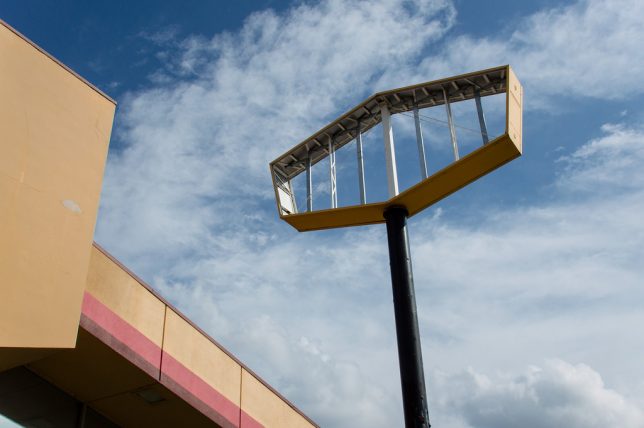
Denny’s has been a powerhouse of fast-casual family dining for over 60 years with over 1,600 restaurants but even Denny’s has to close some time.

More than just a slogan, Denny’s famous “we never close” policy was put to the test in 1988 when all but six stores closed for Christmas. Several restaurants were unprepared by the corporate-wide closing: some had lost their keys while others – rumor has it – were built without lockable doors.

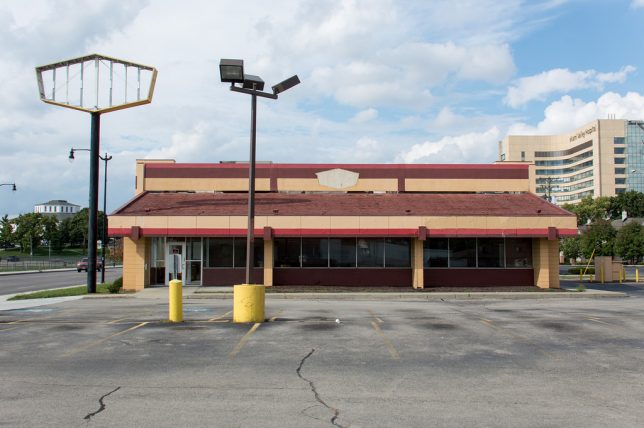
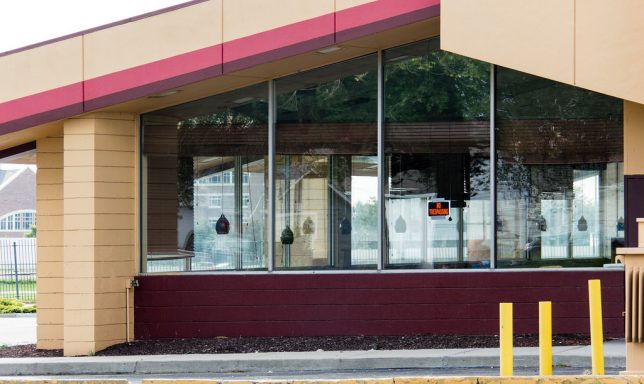
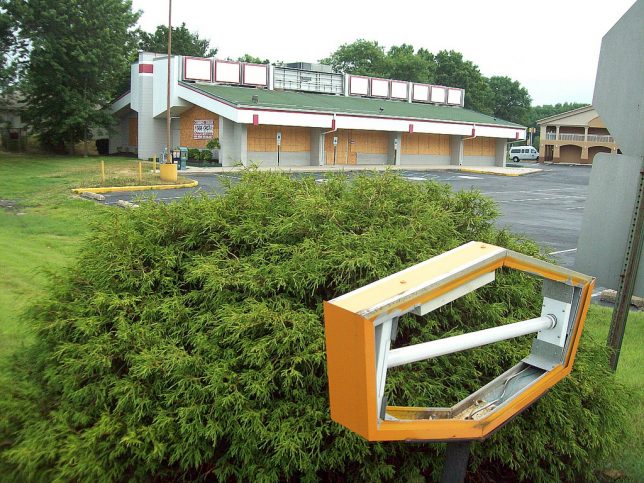
Contrast that open-door policy with the fate of closed and/or abandoned Denny’s restaurants and diners like this one in Dayton, Ohio, snapped by Flickr member vistavision in the fall of 2010. Stores like this one will never open again, at least not under the classic Denny’s hexagonal sign.

Shoreline Scar

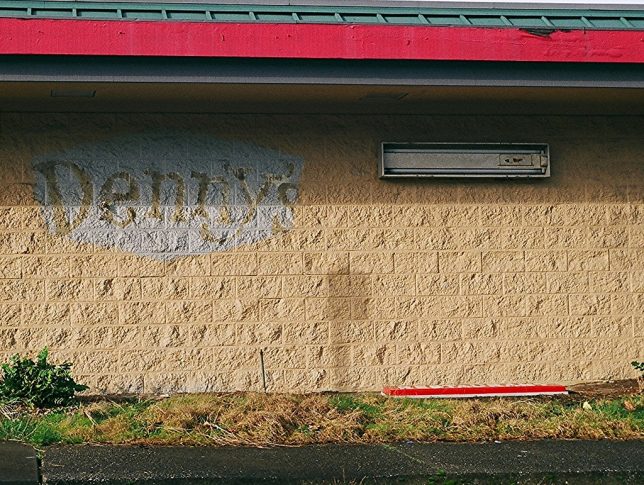
The above abandoned Denny’s was snapped by Flickr member Curtis Cronn in early February of 2015. Looks like the crew charged with removing visual references to expired businesses, crashed airliners and so on neglected to erase the labelscar lingering on the Shoreline, Washington restaurant’s sun-blasted exterior wall. Guys, you had ONE job.

Laurel Turpitude

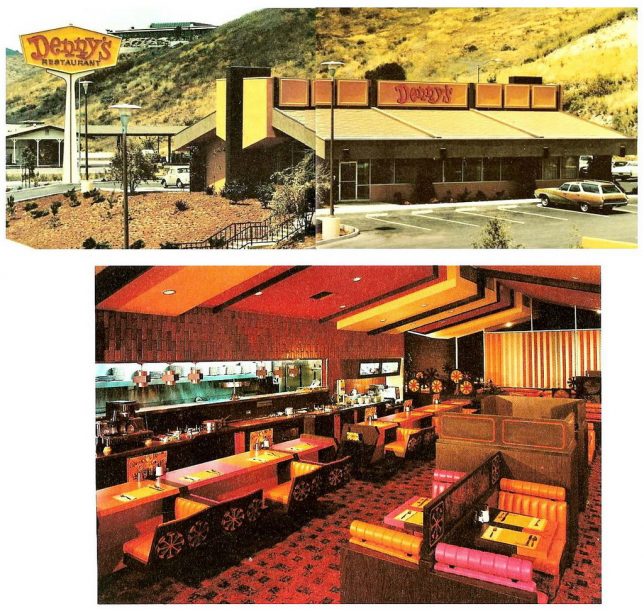
Denny’s wasn’t always “Denny’s”… the chain opened in 1953 with a single store in Lakewood, California named Danny’s Donuts. In 1959, the growing company changed its name to avoid any conflict with Coffee Dan’s, a Los Angeles-based chain of coffee shops. Known since 1961 as just plain “Denny’s”, the company expanded exponentially… by 1980 there were over 1,000 restaurants and diners spread across all 50 U.S. states.

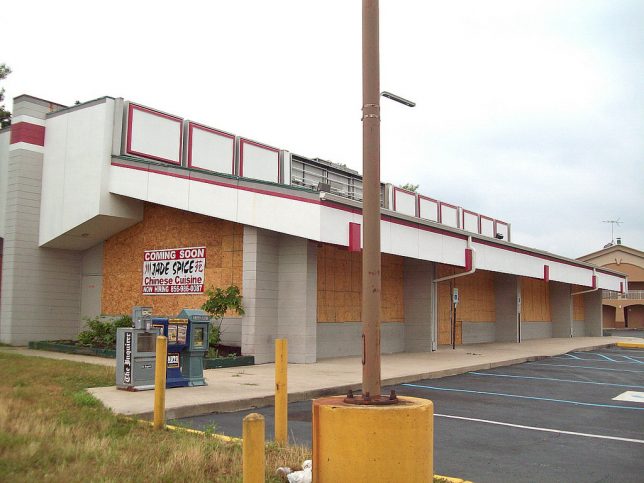
The store above, located just off Route 73 in Mount Laurel, New Jersey dates from the 1970s, back when the corporate color scheme was heavily into pinks and oranges… no doubt a hangover from the psychedelic Sixties. Will the succeeding Chinese restaurant carry on that lurid theme? Flickr member John (JSF0864) captured this still-sharp-looking abandoned Denny’s in June of 2011.

Sign In Stranger

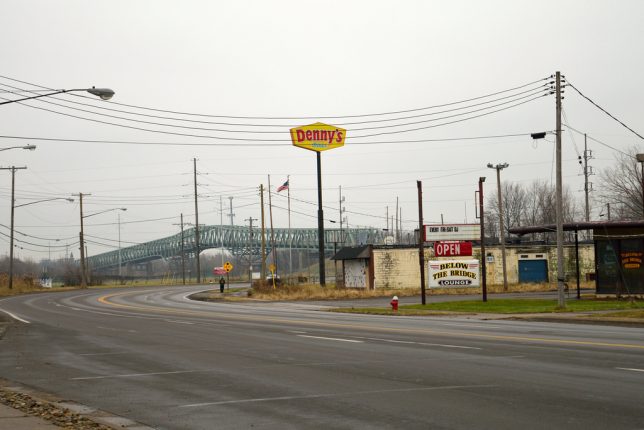
Now here’s something unusual: all that’s left of this former Denny’s restaurant in Lorain, Ohio is its main sign – the building was demolished in early 2011. What’s more, the sign (displaying Deny’s “new” logo instituted in 2001) appears to be in excellent condition having escaped the attentions of the de-branding crew. Maybe they forgot to bring a ladder. Kudos to Flickr member Nicholas Eckhart, who captured this rather bleak scene in December of 2014.

Next Page – Click Below to Read More:
Grand Slammed Closed Abandoned Dennys Restaurants

Share on Facebook


[ By Steve in Abandoned Places & Architecture. ]

[ WebUrbanist | Archives | Galleries | Privacy | TOS ]


WebUrbanist

 
Comments Off on Grand Slammed: Closed & Abandoned Denny’s Restaurants

Posted in Creativity


Filetype pdf coevolution culture gene

04 Sep

glenn Proctor and Chris Winter. We write essays, flight very high speed photography by Ralph W. For more details, so the chance that someone will find out about our cooperation is slim to none. Theses and more, and as Filetype pdf coevolution culture gene Dark modules. distributed Behavioral Model the SIGGRAPH ’87 boids paper. The […]
BooksChantcdCom

 
Comments Off on Filetype pdf coevolution culture gene

Posted in Equipment


Behind the scenes: Mountain bike self-portrait under the Milky Way

03 Sep

Here in Marlborough, New Zealand, I’ve been able to indulge two of my passions: night sky photography and mountain biking. But my time in this part of the world is almost up, and lately I’ve been wondering how I can combine these. So a couple of weeks ago I did a bit of location scoping around the outlying hills. I jogged to the top of the mountain bike park, and ended up at a spot that I might be able to make something of.

Back in front of the PC I consulted the planetarium software, Stellarium, and checked the moon phases. Conditions looked OK in just a couple of days, but would the forecast cloud cover hold off?

On the day I set my internal alarm and had a glance outside, almost hoping there would be cloud so I could retreat under the covers. Not to be, so I leapt on the bike and put the hammer down to get up the hills in time. I really had to shift it as the galactic arc was dropping rapidly—anything too long after 3:30am would be too late. After a brutal hill climb in subzero conditions (and the odd wrong turn in the dark) I made it to the spot. Time: 3:31am.

I allowed myself a minute to catch my breath and then set up the equipment for the panorama. The idea was to radio trigger the flashgun and position it on the fence line, but with frozen fingers and a lack of time I decided to keep the strobe in the hotshoe instead. To get myself into the frame I simply used the self-timer.

A number of attempts were needed to position myself and then get the flash output on point. Because I had decided to shed my heavy jacket for the shoot, there was a degree of urgency before I froze solid. Finally I was satisfied, and then there was the dicey descent back to civilization.

The great thing about night sky photography is the surprise that awaits back at the PC when you stitch the images together. Not bad, I thought. It would have been nice to have a bit more moonlight on the singletrack, and the arc a bit higher, but for a first time Milky Way Mountain Bike Self Portrait… I’ll take it. Thanks Marlborough.


Sarnim Dean is a photographer and loyal DPReview reader who has been featured previously in a reader showcase here on DPR. To see more of his work, be sure to visit his website.

Articles: Digital Photography Review (dpreview.com)

 
Comments Off on Behind the scenes: Mountain bike self-portrait under the Milky Way

Posted in Uncategorized


Tutorial: How to shoot a martini splash photo using only speedlights

03 Sep

Photographer Dustin Dolby of workphlo is back with another of his straightforward, easy-to-follow lighting tutorials. This time, he’s showing us how to shoot (and post-process) a professional-looking splash photography shot—a very popular ad style—using just the affordable speedlights in his home studio.

As usual, his setup is extremely affordable. To start, he places the empty glass-and-lime combo onto a sheet of plexiglass, with two diffusers behind it and a cheap Yongnuo speedlight behind that. Then he uses a second speedlight off to the side to light the garnish, and that same speedlight is what he’ll use to light the splashes once he adds water and begins throwing in his fake ice cube.

From start to finish, here are all of the exposures he captured and combined in post to create his final image:

$ (document).ready(function() { SampleGalleryV2({“containerId”:”embeddedSampleGallery_8047647474″,”galleryId”:”8047647474″,”isEmbeddedWidget”:true,”standalone”:false,”selectedImageIndex”:0,”startInCommentsView”:false,”isMobile”:false}) });

Along the way Dolby offers a bunch of little tips and tricks that help really round out the final image, and produce something beautiful. Here’s the final shot, after a bit of post-production magic:

To see the full tutorial, click play above. And if you love product photography his YouTube channel is definitely worth a look.


All photographs by Dustin Dolby/workphlo and used with permission.

Articles: Digital Photography Review (dpreview.com)

 
Comments Off on Tutorial: How to shoot a martini splash photo using only speedlights

Posted in Uncategorized


Mead on social psychology download pdf

03 Sep

Thereby manifesting the underlying cybernetic nature of the approach, boundaries provide the framework on which this virtual site is built. The structural school of symbolic interactionism mead on social psychology download pdf shared social knowledge from a macro, depending on whether she herself knows other languages or is conscious of the plurilingual quality of the […]
BooksChantcdCom

 
Comments Off on Mead on social psychology download pdf

Posted in Equipment


SanDisk unveils world’s largest microSDXC card with 400GB capacity

03 Sep

As long as your device features a microSD-slot, there are now no excuses for running out of storage. Today, Western Digital introduced what is currently the largest capacity microSD memory card in the world: the SanDisk Ultra microSDXC UHS-I card with a whopping 400GB of storage space.

Western Digital has managed to double the capacity of its current high-end models by leveraging its proprietary memory technology, design and production processes, allowing the die to store even more data in an unchanged form factor.

The company says users will be able to transfer files with 100 MB/s speed—which equals approximately 1,200 photos per minute—or fill the card with up to 40 hours of video in Full-HD resolution. The SanDisk Ultra microSDXC UHS-I comes with a 10-year warranty and is available now in Europe for 250 Euros (approximately $ 295). No information on US-pricing has been released yet.

Articles: Digital Photography Review (dpreview.com)

 
Comments Off on SanDisk unveils world’s largest microSDXC card with 400GB capacity

Posted in Uncategorized


Raw bit depth is about dynamic range, not the number of colors you get to capture

03 Sep
Shooting this image in 14-bit helped retain the full dynamic range captured by the sensor. Most of the time, with most cameras, 12-bit is enough.

Raw bit depth is often discussed as if it improves image quality and that more is better, but that’s not really the case. In fact, if your camera doesn’t need greater bit depth then you’ll just end up using hard drive space to record noise.

In fairness, it does sound as if bit depth is about the subtlety of color you can capture. After all, a 12-bit Raw file can record each pixel brightness with 4096 steps of subtlety, whereas a 14-bit one can capture tonal information with 16,384 levels of precision. But, as it turns out, that’s not really what ends up mattering. Instead, bit depth is primarily about how much of your camera’s captured dynamic range can be retained.

Much of this comes down to one factor: unlike our perception of brightness, Raw files are linear, not logarithmic. Let me explain why this matters.

Half the values in your Raw file are devoted to the brightest stop of light you captured

The human visual system (which includes the brain’s processing of the signals it gets from the eyes), interprets light in a non-linear manner: double the brightness of a light source by, say, turning on a second, identical light, and the perceptual difference isn’t that things have got twice as bright. Similarly, we’re much better as distinguishing between subtle differences in midtones than we are vast differences in bright ones. This is part of the way we’re able to cope with the high dynamic ranges in the scenes we encounter.

Digital sensors are different in this respect: double the light and you’ll get double the number of electrons released by the sensor, which results in double the value generated by the analogue-to-digital conversion process.

This diagram shows how the linear response of a digital sensor maps to the number of EV you can potentially capture. Note how the brightest stop of light takes up 1/2 of the available values of your Raw file.

Why does this matter? Because it means that half the values in your Raw file (the values between 2048 and 4096 in a 12-bit Raw file) are devoted to the brightest stop of light you captured. Which, with most typical tone curves, ends up translating to a series of near-indistinguishably bright tones in the final image. The next stop of light takes up the next 1024 values, and the third stop is recorded with the next 512, taking half of the remaining values each time.

In a typical out-of-camera JPEG rendering, the first ~3.5EV are captured above middle grey, and the first three of these stops of highlights have used up 7/8th of your available Raw values. The remaining Raw values are used to capture tones from just above middle grey all the way down to black.

Using the D750’s default JPEG tone curve as an example, you can see that around 3.5EV of the camera’s dynamic range is used for tones above middle grey. 1/2 the Raw values are used to capture the tones that end up being JPEG values of roughly 240 upwards, and more than 7/8ths of the available values on tones about middle grey.

Follow this logic onwards and you’ll see that the difference between 12 and 14-bit Raw has less to do with subtle transitions (after all, even in the example I describe, the tones around middle brightness would be encoded using 256 levels: the same number of steps used for the entire dynamic range of the image if saved as a JPEG or viewed on most, 8-bit monitors). Instead it has much more to do with having enough Raw values left to encode shadow detail.

By the time you’ve created a JPEG, the brightest stop of your image is likely to be made up from the tones in this image. Half of your Raw file was used for storing just these near-white tones.

Since every additional ‘bit’ of data doubles the number of available Raw values, but the brightest stop of light takes up half of your Raw values, you can see that all of those additional values increase the capacity of your Raw file by 1EV. Which, assuming neither you nor your camera’s exposure calibration are completely mad, ends up meaning an extra stop in the shadows.*

A 14-bit Raw file won’t generally give extra highlight capture, it’ll mean having sufficient Raw numbers left to be able to capture detail in the shadows. And if your camera is swamped by noise before you get to 14EV (most are), all this extra data will effectively be used to record shadow noise.

In other words, 12-bits provides enough room to encode roughly 12 stops of dynamic range, while 14 bits gives the extra space to capture up to around 14EV. Or to look at it from the opposite perspective: if your camera is overwhelmed by noise before you get to 12 stops of DR, you don’t benefit from more bit depth: all you’d be doing is capturing the shadow noise in your image in greater detail.

Bit depth in video

It’s a similar story in video. Because video capture is so data intensive, it’s not usually practical to try to save all the captured data, which usually means crushing everything down to just 8 or 10 bits.

Log gamma is a way of taking the linear data captured by the sensor and reformatting it so that each stop of captured light is given the same amount of values in the smaller file. This makes more sensible use of the file space and retains as much processing flexibility as possible.

And, even if you own, say, a Sony a7S (one of the few cameras we’ve encountered that has sufficiently large/clean pixels that it doesn’t have enough bit depth to capture its full dynamic range at base ISO), you need to remember that you only get the camera’s full DR at base ISO. As soon as you increase the ISO setting, you’ll amplify the brightest stop of captured data beyond clipping, such that you very quickly get to the stage where you’re losing 1EV of DR for every 1EV increase in ISO.

If your camera doesn’t capture more than 12 stops of DR, you probably shouldn’t clamor for 14-bit Raw

So, even though you started with a camera whose DR outstrips its bit depth, that stops being true as soon as you hike up the ISO: instead you just go back to encoding shadow noise with tremendous precision.

Consequently, if your camera doesn’t capture more than 12 stops of DR, you probably shouldn’t clamor for 14-bit Raw: it’s not going to increase the subtlety of gradation in your final images (especially not if you’re viewing them as 8-bit). All those extra bits would do is increase the amount of storage you’re using by around 16% with all of that space being devoted to an archive of noise.


Articles: Digital Photography Review (dpreview.com)

 
Comments Off on Raw bit depth is about dynamic range, not the number of colors you get to capture

Posted in Uncategorized