RSS
 

Archive for August, 2017

California City: The Half-Built Desert Metropolis of the Golden State

01 Aug

[ By WebUrbanist in Abandoned Places & Architecture. ]

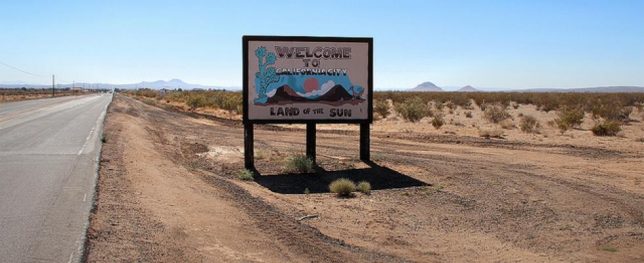
It’s the third-largest city in California by land area but most people (including many in CA) have never even heard of this mostly-empty desert oasis, home to around 15,000 people. It’s not quite a city, but not quite a ghost town either.

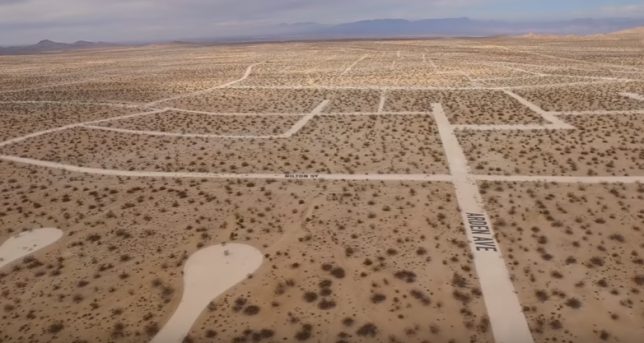
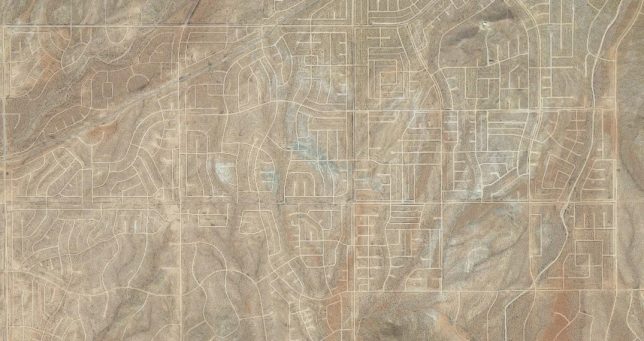
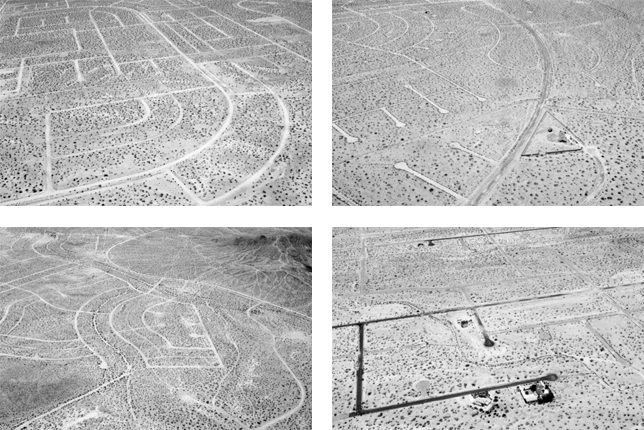
Visiting the area is a bit surreal – roads running through its 200 square miles connect nothing to nothing in the hot Mojave, in some cases following straight lines and in others wrapping to form cul-de-sacs.

Some roads are paved, but most aren’t. In places, nature has started to reclaim the dirty gravel strips with hearty desert plants growing right up through streets.

Photographer Noritaka Minami recently took a trip in a helicopter to photograph the strange sprawling semi-ghost town, which are on display at On Freedom, an exhibition at Aperture for another month.

The place was a mid-century vision of a real estate developer named Nathan Mendelshon who purchased over 80,000 acres, imagining California City as a fresh metropolis for a growing state.

Some parcels were resold but never developed — others were bought and remain in use, mainly for people working at a nearby military base or prison.

The few houses that do exist seem almost stranger than the framework of roads around them, neatly fenced in a neighborhood of empty plots.

More from Minami: “This project focuses on California City, a master planned community in the Mojave Desert conceived by sociologist turned real estate developer Nathan K. Mendelsohn in 1958. California City was envisioned as the next major metropolis in California in response to the population and economic growths after World War II. This development was based on the belief that even in a harsh desert landscape, mankind had the freedom and power to produce a built environment that provided all of the essential needs for a prosperous modern life.”

In his series of black-and-white images, “aerial photography is used to document the scale of the vision Mendelsohn proposed in the desert and question whether this ‘wonderland’ could have even been sustainable in this environment. Despite having the foundation for a city in place, there are no indications that this city will ever be realized in the future.” In the end, half-built may be an overstatement — in reality, the place is more like a skeletal outline of a city, punctuated (like a normal rural landscape) by pockets of development and clusters of community.

Share on Facebook


[ By WebUrbanist in Abandoned Places & Architecture. ]

[ WebUrbanist | Archives | Galleries | Privacy | TOS ]


WebUrbanist

 
Comments Off on California City: The Half-Built Desert Metropolis of the Golden State

Posted in Creativity


Nikon 1 mirrorless system discontinued

01 Aug

You would have to be quite the optimist to have expected new models in Nikon’s 1 series of 1″ sensor mirrorless system cameras being launched any time soon. Despite camera manufacturers hardly ever announcing a product line’s end-of-life the 1-series phase-out is now pretty much official.

German camera website Digitalkamera.de produces buying guides in e-book format and the production process for those guides includes research into what models are still available to order by retailers and what is being discontinued. While updating their guide for mirrorless system cameras the guys at Digitalkamera.de found that the Nikon 1 AW and 1 V3 are both not available any more. The Nikon 1 J5 is still available but only while supplies last.

So, what has been obvious for quite some time is now confirmed: the Nikon 1 system has reached its end. The question is what’s next for Nikon in terms of mirrorless cameras? Thanks to an official Nikon statement we know that the company is working on a new mirrorless system. We’d expect the new cameras to come with a larger sensor than the Nikon 1 models but at this point Nikon has not made information on specifications or features available.

Articles: Digital Photography Review (dpreview.com)

 
Comments Off on Nikon 1 mirrorless system discontinued

Posted in Uncategorized


DPReview on TWiT: How to take macro photographs

01 Aug

DPReview has partnered with the TWiT Network (named after its flagship show, This Week in Tech) to produce a regular segment for The New Screen Savers, a popular weekend show hosted by technology guru Leo Laporte.

On this week’s episode of The New Screen Savers, the hosts discussed emojis, action cameras and Macro photography. DPReview editor Barney Britton spoke to Leo Laporte and Jason Snell about how to get great closeup pictures, without breaking the bank. We’d recommend watching the whole episode, but if you’re especially interested in macro photography tips (or if you’re Barney’s mum) jump to 43:00 for the beginning of our segment.

You can watch The New Screen Savers live every Saturday at 3pm Pacific Time (23:00 UTC), on demand through our articles, the TWiT website, or YouTube, as well as through most podcasting apps.

Articles: Digital Photography Review (dpreview.com)

 
Comments Off on DPReview on TWiT: How to take macro photographs

Posted in Uncategorized


Leica releases TL2 firmware update, fixes critical Visoflex bug

01 Aug

Last week, Leica confirmed that the newly-released Leica TL2 had a serious issue: when used with the company’s Visoflex electronic viewfinder, the camera could simply stop working… permanently. Fortunately, the company has come up with (and rigorously tested) a firmware update that will fix the issue.

The new firmware, version 1.1, is available to download from Leica’s website now, and it fixes the ‘defect’ the company described in its original notice to customers. If you own a TL2 and Visoflex viewfinder, consider this update mandatory, not optional.

Here is the official statement from Leica:

Important Information for Leica TL2

The fault when using the Leica TL2 together with the external electronic viewfinder (Visoflex) has been identified.

In order to rectify this defect, an updated Firmware can now be downloaded now from the Leica Corporate Website and at your local authorized Leica Dealer. With the new Firmware 1.1 the Leica TL2 is fully functional; camera and viewfinder can be used without any restrictions.

We thank you for your continued trust.

Articles: Digital Photography Review (dpreview.com)

 
Comments Off on Leica releases TL2 firmware update, fixes critical Visoflex bug

Posted in Uncategorized


How I Evaluate Crowdfunding Projects: Kickstarter, Indiegogo & Beyond

01 Aug
How I Evaluate Crowdfunding Projects

How I Evaluate Crowdfunding Projects

13 Questions You Should Ask
Before Backing A Crowdfunding Project
on Kickstarter, Indiegogo and Beyond

Crowdfunding projects via sites like Kickstarter and Indiegogo have been increasing in popularity and some would say hit the mainstream. No disrespect to my wife, but she’s not an early adopter and it wasn’t until recently a mini ice machine showed up at our door that I realized she knew and took part in Kickstarter. By contrast, I’ve been using Kickstarter since it launched 2009/2010 and Indiegogo since 2014. In that time, for all the bad press these sites sometimes get, I’ve had a really good rate of return on my pledges. Roughly 85% of the projects I’ve backed have been delivered to my door and as it turns out my rate of return monetarily has been 83 cents on the dollar (ie for every $ 1 spent I’ve lost $ 0.17).  It would seem I’ve backed enough crowdfunded projects that I’d be considered a “super backer”, so I thought I’d share my evaluation process with you to increase the odds you back successful projects.

Do I Need This? / Suspension of Disbelief
The first thing you’re likely to see when visiting a project on Kickstarter or Indiegogo is the video pitch. Invariably the product discussed will be the best thing since sliced bread, but before you impulsively back the project ask yourself:

1. Is this a product I really need and/or will I use more than X times to recoup my cost? 

I can’t say I absorbed a lot in my college economics course, but I never forgot the discussion about the difference between wanting and needing a product. Be honest with yourself about whether you’re getting something that will be of use to you or if your money will be better spent on essential goods and services.

2. Is the product too good to be true? Or are the project organizers over ambitions?

One of the most entertaining aspects of evaluating crowd funded projects is to determine if they’re even possible. Does the product defy physics? (Ex. laser face razor)  Figuring out if you’re being sold snake oil is an important part of evaluating a pitch. When in doubt, watch the pitch video a few days later so as to not get swept up by hype and allow yourself time to research the technology/concept behind the product.

Product or Platform Dependencies

3. Is the product dependent on other products to be compatible?

If so will this product be obsolete by the time the product ships? (ex. iPhone cases being released after the next generation phone is released, GoPro accessories, etc.)  The biggest downside to accessory projects is that the product they’re an accessory for can change faster than the project can execute. Cell phone cases, cell phone lens add-ons and action cameras are all prone to this. For this reason, I rarely back these types of projects.

Is This Product Filling A Hole In The Marketplace?

4. Is there already something out there that is equivalent, proven and at a price point I should get instead?

If you like gadgets it’s pretty easy to lose sight of the larger marketplace as a whole when browsing crowdfunding sights. When you browse Kickstarter or Indiegogo your frame of reference will be all the projects on that site.  One project may seem better in relation to another and when you find one that strikes a nerve your reference point will be set against other sub par projects. Ultimately the “good” project catching your eye may be solved by an equivalent product elsewhere… like Amazon, so do your homework. This is especially true for batteries, chargers and similar accessories.

5. Are there or have there been other crowdsourced projects that are similar and how did they fare?

Odds are the products you’ll find on crowdfunding sites will not be one-of-a-kind. Research to see if an equivalent project is on going and/or more likely to be delivered? If you find a similar product that was crowd funded see if it was successful, well reviewed, and/or delivered on time. If a similar project failed in the past investigate why and see if the project you’re considering is repeating the same mistakes.

6. Will this product obsolete itself or be obsoleted by a dependent technology?

Sometimes our immediate desires cloud our vision of the future. Some products and technologies cycle faster than upstart companies (ex. operating systems). If you’re backing software (app or desktop program) is it likely to be compatible in 6 to 18 months? Will the company/product you’re backing be faced with an incompatibility and have to pivot resulting in costly delays?

Likelihood of Delivery

7. When is delivery targeted and what roadblocks are likely to impede that goal?

Most projects are required to list “Risks and Challenges”. Don’t gloss over this section and weigh it heavily in your evaluation whether to back the project. Are all the risks and challenges being accounted for? Are some risks being taken too lightly? If these risks don’t match up to the proposed delivery date reconsider backing the project or communicate your concerns to the project team.

8. Will this project bust because of expensive materials or labor costs?

Some projects face an uphill battle simply because the project organizers lack an understanding of the cost of materials and labor or have initial quotes unexpectedly changed by vendors mid-project increasing overall costs. Of the many projects I’ve backed, this is one of the most common reasons a project fails.

9. Is there a prototype in existence and has it been reviewed by others?

Crowdsourced projects are essentially pre-order campaigns and most crowdsourcing sites require a prototype to be in place before taking pledges. If this is not the case for the project that has caught your eye it’s time to take a harder look and/or reconsider backing it.

Leadership & Experience of Project Organizers

10. Is it a known company or are the project organizers well known?

Is the company or project organizers known? Sometimes established companies use crowd funding sites as a preorder mechanism. Odds are if they already produce and deliver products you’re going to get what is promised to you. If it’s a lesser known company or team look into the credentials of those running the project you’re interested in. It should not be good enough that a social media or celebrity talking head is the face of the company. In the worst case scenario see if the people behind the project have a bad reputation.

11. Do the project organizers have experience in the area of their project (software, engineering, manufacturing, etc.)

Ideally, the person or team assembled for the project that has caught your eye has the appropriate background, skill(s) and network to complete the job. A good idea alone won’t get the job done.

12. Have they successfully completed a Kickstarter or Indiegogo project?

Has the company or team behind the project successfully completed other crowd funded projects? Is the project being run by a company that is already established? If the answer to either of these questions is yes, your odds of seeing the promised product go up exponentially. On the flipside, Google the team or team members to see if they’ve tried before and failed under a different company name. Was it delivered on time? If not how late was it?

13. Do they communicate effectively and frequently?

Never underestimate the power of good communication. It is important to make sure that backer concerns and expectations are addressed quickly. If project comments are addressed slowly or incompletely that is a big red flag. Also important is the ability of project organizers to address hard questions constructively as it may be telling how they’ll communicate when the project hits some rough patches.

Committing to the Project
If everything looks good to these questions, I strive to back projects at a pledge level that is the best value (ex. early bird pricing or multiple unit orders). Then I swing back in a few days to reevaluate the project. At that point, I either back out or mentally validate I’m making a wise purchase. Note: If you get cold feet about a project you can undo your pledge, without penalty, if the fundraising window is still open.

Risk
With all this in mind I usually only commit a monetary pledge I’m willing to lose, assuming the project is never executed and delivered. There is never a guarantee a project will be completed and most crowd funding sites insulate themselves legally from liability if a project is a bust. My track record to date is pretty good with 85% of my backed projects being delivered. Again only pledge or spend an amount that you’re willing to lose. In an ideal world, the organizers will have a great deal of experience with engineering and manufacturing, delivering quite quickly after their campaign ends. For those that are trying their hand for the first time, you’re betting they can navigate the process before their funds evaporate. It doesn’t always work out, but when it does it can be a lot of fun.
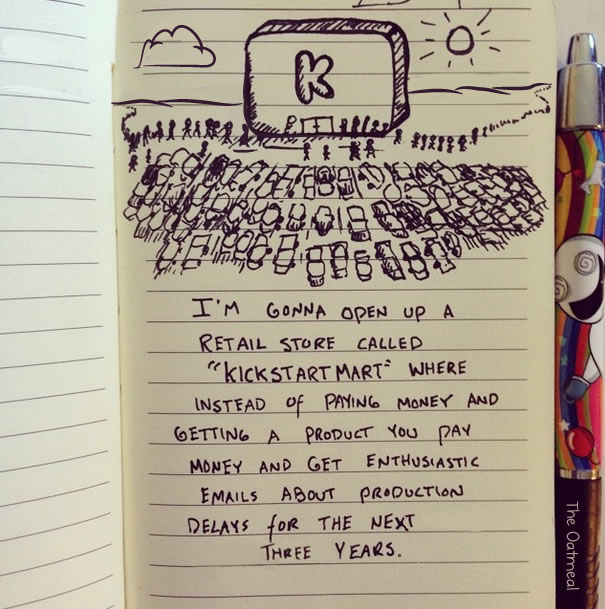
kickstartmartvia The Oatmeal

Addressing The Skeptics
Given my earlier reported rate of return, it could be interpreted that every successful project I’ve backed really cost me 17% more. If I’ve lost 17 cents overall for every dollar spent that could be equated to a 17% premium paid for my successful campaigns. In the macro sense, you could look at it this way but consider my reported numbers cover a span of 7+ years. From year to year the amount I lost, per dollar spent, fluctuates depending on how bold/expensive my pledges were. As it turns out my overall average pledge in this time frame was $ 132.77. I’d like to think that most of this “premium” is recouped by grabbing the greatest discounted offers with early project pledges (aka early bird pledges).  On the other side of the coin, one can make the argument that you’re backing projects for more altruistic purposes to help upstarts get started rather than opportunistically satisfying your consumer urges. In my case, I have backed several projects to help other photographers (photo books, conservation campaigns, etc.) so I’m not backing crowd funded projects just for material goods alone.

No matter how you slice it you’re going to have varying degrees of success, but hopefully, my process of evaluating projects helps you avoid scams and/or get the most out of your investment.

Related Reading
The 5 Biggest Crowdfunding Failures Of All Time (2017)
The Ugly Afterlife Of Crowdfunding Projects That Never Ship And Never End (2014)

The post How I Evaluate Crowdfunding Projects: Kickstarter, Indiegogo & Beyond appeared first on JMG-Galleries – Landscape, Nature & Travel Photography.
JMG-Galleries – Landscape, Nature & Travel Photography

 
Comments Off on How I Evaluate Crowdfunding Projects: Kickstarter, Indiegogo & Beyond

Posted in Equipment


Former Google SVP prefers iPhone over Android for mobile photography

01 Aug

Vic Gundotra was an SVP of engineering at Google for almost eight years before leaving the company in 2014, and heavily involved in running Google’s mobile initiatives. However, despite being one of the main drivers behind Android from 2007 to 2010, Gundotra appears to prefer Apple’s iPhones over Android devices, at least for photography.

In a Facebook post, Gundotra called the results of the background-blurring iPhone 7 Plus portrait mode “stunning” and “the end of the DSLR for most people”. When replying to comments on the post he went on the say that, in terms of imaging, Android phones were years behind the iPhone:

Here is the problem: It’s Android. Android is an open source (mostly) operating system that has to be neutral to all parties. This sounds good until you get into the details. Ever wonder why a Samsung phone has a confused and bewildering array of photo options? Should I use the Samsung Camera? Or the Android Camera? Samsung gallery or Google Photos?

It’s because when Samsung innovates with the underlying hardware (like a better camera) they have to convince Google to allow that innovation to be surfaced to other applications via the appropriate API. That can take YEARS.

Also the greatest innovation isn’t even happening at the hardware level – it’s happening at the computational photography level. (Google was crushing this 5 years ago – they had had “auto awesome” that used AI techniques to automatically remove wrinkles, whiten teeth, add vignetting, etc… but recently Google has fallen back).

Apple doesn’t have all these constraints. They innovate in the underlying hardware, and just simply update the software with their latest innovations (like portrait mode) and ship it.

Bottom line: If you truly care about great photography, you own an iPhone. If you don’t mind being a few years behind, buy an Android.

Apple’s portrait mode doesn’t come without its limitations, but it’s probably fair to say among all the various incarnations of depth or bokeh effects we have seen so far it is the best performing. On the other hand some Android smartphones, such as the Google Pixel or HTC U11, offer an advantage over the latest iPhone models in terms of detail resolution and textures.

So, like with so many things, the smartphone camera that is best for you depends a lot on your personal requirements. Vic Gundotra definitely seems to have made his mind up, though. In another post he says he “would NEVER buy an Android phone again if I cared about photography.” Do you agree? Let us know in the comments.

Articles: Digital Photography Review (dpreview.com)

 
Comments Off on Former Google SVP prefers iPhone over Android for mobile photography

Posted in Uncategorized


Rethinking the Refugee Camp: 8 Architectural Proposals for Asylum Seekers

01 Aug

[ By SA Rogers in Architecture & Cities & Urbanism. ]

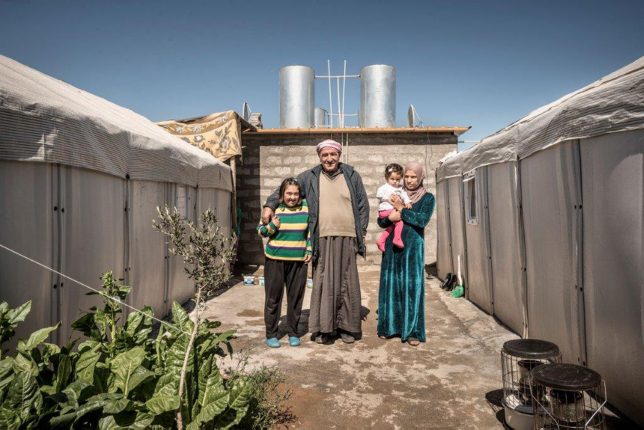
Refugees fleeing the worst humanitarian crises of our time don’t just need tents – they need safe and stable long-term housing, a sense of community, access to transitional resources and plans for permanent integration into existing cities. Smart and sensitive design solutions may play just one small role in addressing the crisis, but they can help provide the architecture and infrastructure needed to start a new life.

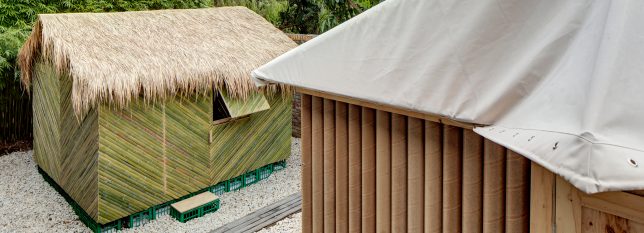
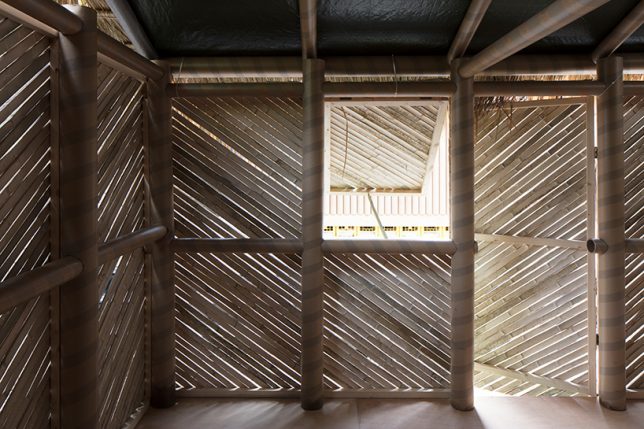
Mannheim Refugee Pavilion, Germany

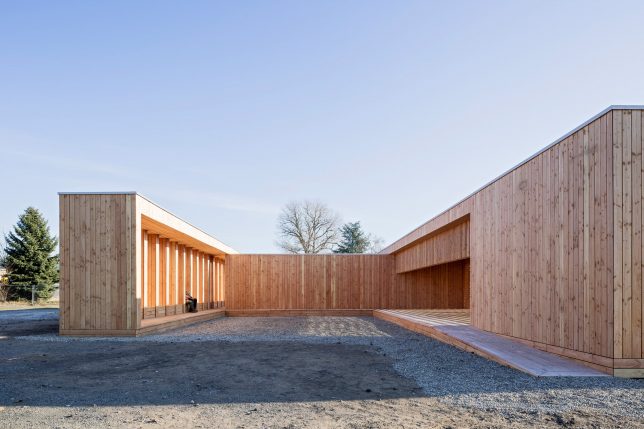
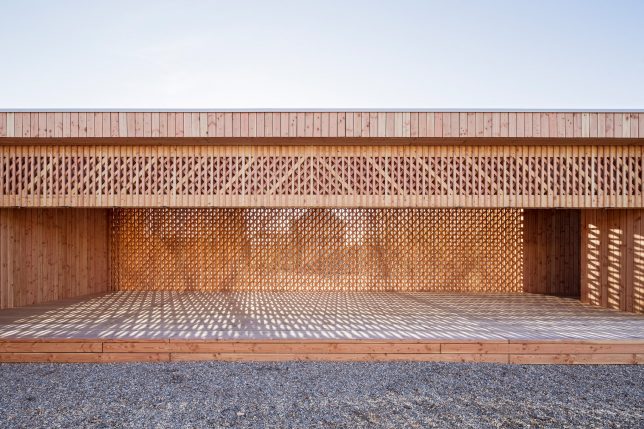
Architecture students at the University of Kaiserslautern in Mannheim created an airy community center made of latticed wood to offer a sheltered communal area for refugees arriving to an adjacent camp. The team worked with 25 refugees and building companies to create the shelter. “Due to bureaucratic procedures, refugees arriving in Germany are condemned to sustain a long period of passiveness. They are well provided with the bare essentials but the immediate area is quite desolate and lacking of quality common spaces. The residents at the preliminary reception center has the opportunity to actively shape their environment and create a quality place for common or individual use.”

20,000 New Homes for Refugees in Kenya by Shigeru Ban

Japanese architect Shigeru Ban will design 20,000 new homes for refugees at the Kalobeyei refugee settlement in Kenya based on discusses he held with refugees in the area. “The key thing will be to construct shelter where no or little technical supervision is required, and use materials that are locally available and eco-friendly,” he says. “It’s important that the houses can be easily maintained by inhabitants.”

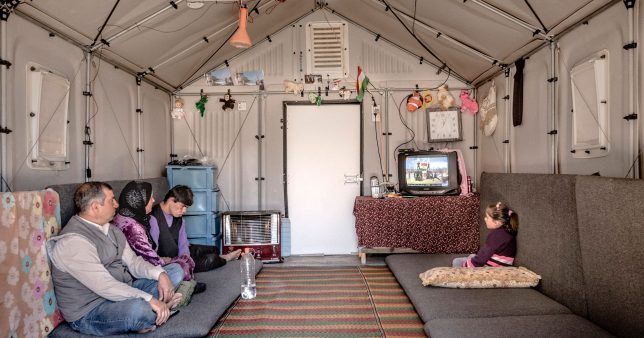
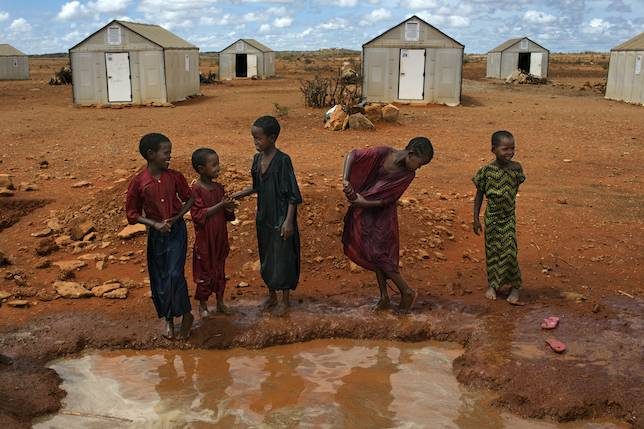
Ikea’s Flat-Pack Refugee Shelter Named 2016 Design of the Year

The ‘Better Shelter’ by Ikea is a flat-pack structure large enough to house a family of five that can be assembled in just a few hours. Made from recyclable plastic, it consists of just 68 components and includes a solar panel to power lights and charge smartphones and other devices. It went into production in 2015, and since then, tens of thousands of units have been delivered to countries all over the world. Though it’s more practical than glamorous, the Better Shelter won the Beazley Design of the Year Award presented by the Design Museum in London in 2016.

‘Weaving a Home’ by Abeer Seikaly

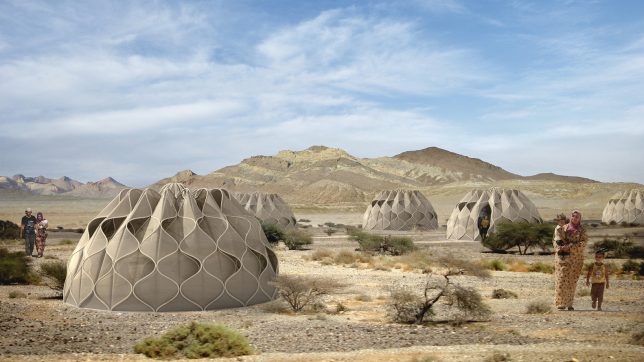
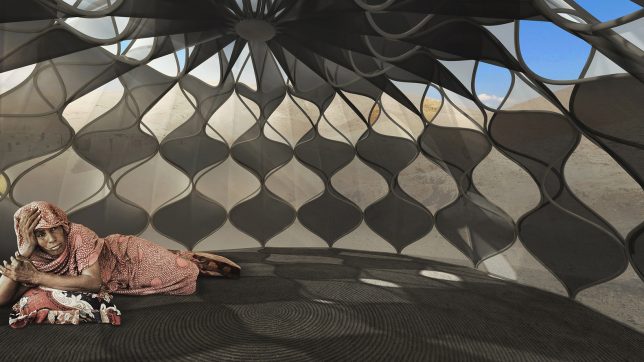
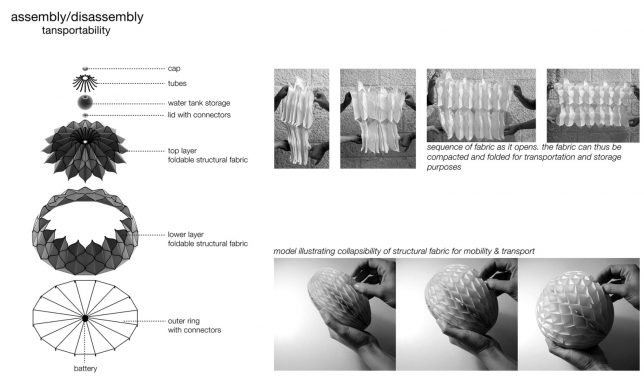
Winner of a Lexus Design Award in 2013, ‘Weaving a Home’ by Abeer Seikaly is a collapsible structural fabric shelter capable of adapting to various climates. The design is cellular, made of high-strength plastic tubing woven into a fabric membrane, and segments can be left open to create doorways or windows or closed to retain heat. At the top of the unit is a water storage tank supplied by rainwater or an onsite source to provides running water inside. “Refugees carry from their homes what they can and resettle in unknown lands, often starting with nothing but a tent to call home…” says Seikaly. “In this space, the refugees find a place to pause from their turbulent worlds, a place to weave the tapestry of their new lives.”

Next Page – Click Below to Read More:
Rethinking The Refugee Camp 8 Architectural Proposals For Asylum Seekers

Share on Facebook


[ By SA Rogers in Architecture & Cities & Urbanism. ]

[ WebUrbanist | Archives | Galleries | Privacy | TOS ]


WebUrbanist

 
Comments Off on Rethinking the Refugee Camp: 8 Architectural Proposals for Asylum Seekers

Posted in Creativity


This is the first photo of a total solar eclipse ever taken, shot in 1851

01 Aug
The first successfully captured photograph of a total solar eclipse, this daguerreotype was shot on July 28, 1851, by Prussian photographer Johann Julius Friedrich Berkowski.

Here’s a little history lesson to help you pass the time between now and the next total solar eclipse on August 21st. The photograph above, a daguerreotype captured almost exactly 166 years ago, is the first successfully-captured photograph of a total solar eclipse.

The photo was captured by master daguerreotypist Johann Julius Friedrich Berkowski, a Prussian photographer who was commissioned by the Royal Prussian Observatory at Königsberg to do what nobody else had managed up until that point: capture an appropriately-exposed photograph of a total solar eclipse.

Up until that point, every photograph taken had been over or under-exposed, and/or didn’t capture sufficient contrast between the bright corona and the obscuring disk of the moon.

According to a paper in the journal Acta Historica Astronomiae, the photograph was captured using a small refracting telescope attached to the hour drive of the 15.8-cm Fraunhofer heliometer. Berkowski began exposing the image shortly after totality, and the final daguerreotype took 84-seconds to capture.

To learn more about this photograph, click here. And if you want to learn how to capture the August 21st eclipse for yourself (and why you should maybe put the camera down for this one…) check out our own eclipse how-to.

How to photograph the August eclipse, and why you probably shouldn’t try.

Articles: Digital Photography Review (dpreview.com)

 
Comments Off on This is the first photo of a total solar eclipse ever taken, shot in 1851

Posted in Uncategorized


Sample gallery: Tamron 10-24mm F3.5-4.5 Di II VC HLD

01 Aug

The Tamron 10-24mm F3.5-4.5 Di II VC HLD is an ultra wide angle lens for crop sensor DSLRs. It offers a 15-36mm equivalent field of view on Nikon DX and a 16-38.4mm equivalent field of view on Canon’s APS-C format DSLRs.

We’ve been out and about with the 10-24mm recently in and around Seattle, shooting on the Canon EOS 80D.

$ (document).ready(function() { SampleGalleryStripV2({“galleryId”:”8541266682″}) })

Sample photoSample photoSample photoSample photoSample photo

Articles: Digital Photography Review (dpreview.com)

 
Comments Off on Sample gallery: Tamron 10-24mm F3.5-4.5 Di II VC HLD

Posted in Uncategorized


Nikon and Canon both announce delays for upcoming DSLRs

01 Aug

Both Nikon and Canon have warned users that forthcoming DSLRs will be hit by delays: The 100th anniversary edition of the Nikon D5 and the Canon 6D Mark II kit with the EF 24-70mm F4L lens are both going to arrive at your door later than expected.

According to a statement on Nikon’s website, the 100th anniversary edition of Nikon’s D5 has been put back by a couple of weeks from July 28th to ‘early August’ while final adjustments are made. The company promises to inform users of the new release date once it is determined.

More seriously perhaps, Canon has issued a statement letting hopeful shoppers know that demand for the EOS 6D Mark ll kit with the Canon EF 24-70mm F4L IS USM lens has exceeded expectations, and that orders will take some time to fulfill. The kits were supposed to ship on August 4th, but Canon has not revealed when it will be able to satisfy the initial demand.

The EOS 6D ll is also offered body only and as a kit with the 24-105mm F3.5-5.6 IS STM lens, so those desperate to buy the camera do have other options.

Articles: Digital Photography Review (dpreview.com)

 
Comments Off on Nikon and Canon both announce delays for upcoming DSLRs

Posted in Uncategorized