RSS
 

Archive for August, 2017

NASA captured photos and video of the ISS ‘photobombing’ today’s solar eclipse

22 Aug
The International Space Station, with a crew of six onboard, is seen in silhouette as it transits the Sun at roughly five miles per second during a partial solar eclipse on Aug. 21, 2017 near Banner, Wyoming. Photo credit: NASA/Joel Kowsky

Plenty of people were pointing their cameras up at the solar eclipse today, but leave it to NASA to capture a little something extra. From his vantage point in Banner, Wyoming, NASA photo editor Joel Kowsky captured a dual eclipse of sorts: the moon obscuring the sun, and the tiny pinprick of the International Space Station obscuring a little bit of what was left.

As the ISS and its six crew members flew in front of the partially obscured disk of the sun, Kowsky had both still and slow motion video cameras trained on his target.

Here’s a closer crop of the photograph above:

Here, a composite that shows the ISS’s full transit across the partial eclipse:

And, finally, a slow motion video of the transit, recorded by Kowsky at 1,500 frames a second:

To see these photos and video in their full glory, head over to the NASA Goddard Space Flight Center Flickr account.


All photos and video courtesy of NASA/Joel Kowsky

Articles: Digital Photography Review (dpreview.com)

 
Comments Off on NASA captured photos and video of the ISS ‘photobombing’ today’s solar eclipse

Posted in Uncategorized


Review of the Polaroid Pro Studio Digital Flash Umbrella Mount Kit

22 Aug

One of the biggest challenges for amateur photographers is getting comfortable with shooting with off-camera flash. Not only does the technique take much time to master, but lighting equipment is expensive! This is where Polaroid is aiming to help out. The new Polaroid Pro Studio Digital Flash Umbrella Mount Kit might be a mouthful to say, but it is exactly what it says: a portable umbrella lighting kit. What it doesn’t mention is that it is also very affordably priced for the amateur photographer (under $ 65!). Find out more details about the new Polaroid lighting kit below!

Review of the Polaroid Pro Studio Digital Flash Umbrella Mount Kit

What’s Included

Altogether, this lighting kit weighs a total of 8.5 lbs and runs $ 64.99 USD. According to the product description, the “Polaroid Digital Flash Umbrella Mount Kit includes all of the essential lighting equipment you will need.” These items include:

1) Two Light Stands

These Polaroid brand light stands are three-sectioned twist locks AND they are air cushioned. They fold down to 26 inches and can extend as high as six feet and hold up to 15 lbs. The weight of the light stands isn’t stated, but they’re not heavy at all. This means they travel very easy, but you’ll have to compromise some stability and support.

Review of the Polaroid Pro Studio Digital Flash Umbrella Mount Kit

2) Two Umbrellas

Umbrellas are one of the simplest, most compact ways to beautifully diffuse light. Polaroid smartly includes two white satin umbrellas with this lighting kit. Both umbrellas have a removable black backing, allowing you to use it as a bounce or shoot through umbrella. Best of all is the fact that the removable backing is stiffer, with sturdier end caps than competing (even higher-end) umbrella brands like Westcott. This makes it much easier to put the backing back on the umbrella.

These octagonal umbrellas are about 33 inches in diameter, which might be a miss for those who need a larger size. But based on the sturdiness of the light stands, you probably don’t want to stick overly large and heavy umbrellas on those stands anyway.

Review of the Polaroid Pro Studio Digital Flash Umbrella Mount Kit

Review of the Polaroid Pro Studio Digital Flash Umbrella Mount Kit

3) Two Cold-Shoe Mount Umbrella Adapters

The last components of this lighting kit are the cold-shoe mount adapters. These allow you to attach the umbrella to the light stand, and mount a speedlight flash. Polaroid’s own adapters each have a swivel, umbrella socket, and a cold-shoe mount that should fit most standard speedlight flashes. The adapters are adjustable, allowing you to shift the angle of the whole setup.

Review of the Polaroid Pro Studio Digital Flash Umbrella Mount Kit

Review of the Polaroid Pro Studio Digital Flash Umbrella Mount Kit

4) A Carrying Case

One of the best parts about the Polaroid Pro Lighting Kit is that all of the above items come delivered in a perfectly sized carrying case. The bag is about 29 inches long, 8 inches wide, and 7 inches high. It’s also very lightweight and holds all of the lighting kit components, with room to spare. The inclusion of the carrying case is a really nice touch, as many other lighting stand providers almost never include a case.

Polaroid Pro Studio Light Kit

What’s Not Included

You may have noticed that a few critical lighting kit items were omitted: a camera, flash units, and flash triggers. Thus, this does not include all of your “essential lighting equipment you will need,” so note the need to purchase these additional items. On the bright side, there are some affordable flashes and triggers on the market that you can add to keep your overall lighting kit inexpensive.

  • Instead of Canon or Nikon brand flashes, consider the Polaroid PL-190 TTL Flash.
  • Instead of Pocket Wizards, consider Yongnuo RF-603 Flash Triggers.
Review of the Polaroid Pro Studio Digital Flash Umbrella Mount Kit

Note: Flash unit and flash triggers are not included.

This kit is for you if…

If you’re just getting started with off-camera flash and studio lighting equipment, the Polaroid Pro Kit is a great way to start out. The kit is affordable while providing you what you need. It may not hold up in the long run, but at this price, buying a second kit doesn’t hurt. Also, if you’re a pro photographer needing a lightweight, portable lighting kit for on-the-go shoots, this may meet your needs as well.

For photographers needing extremely durable lighting stands or umbrellas bigger than 33 inches, this kit probably isn’t for you. It costs $ 64.99, and you get what you pay for. If you’re needing equipment for a pro studio for daily use, spend more money on heavier-duty gear.

Verdict

After testing out the Polaroid Pro Studio Digital Flash Umbrella Mount Kit, I fell head over heels in love with it. The kit isn’t much different from my current setup (two Manfrotto 5001B Nano light stands with Westcott umbrellas). While my Manfrottos feel sturdier than the Polaroid light stands, the price of one Manfrotto stand is nearly equal that of the entire Polaroid Pro kit. Not so terrible.

I used this lighting kit on a couple of on-location food photography photo shoots and was pleased with the results, plus the kit’s extreme portability. Sample photos taken with the Polaroid Pro kit are shown below. All images were shot with a Canon 5D Mark III with 24-70mm f/2.8 lens and Canon 580 EXII Speedlight Flashes.

For simple professional jobs where I’d use a 33-inch umbrella, the Polaroid Pro kit is ace. However, if I were planning to work with bigger, heavier lighting units or modifiers, I’d definitely turn to a heavier duty option.

The post Review of the Polaroid Pro Studio Digital Flash Umbrella Mount Kit by Suzi Pratt appeared first on Digital Photography School.


Digital Photography School

 
Comments Off on Review of the Polaroid Pro Studio Digital Flash Umbrella Mount Kit

Posted in Photography


Video: Six lighting tips for flash photography newbies

22 Aug

If you’re taking our advice from this morning and buying your first flash soon, a few beginner tips on mixing flash with ambient light will really help you take advantage of your new gear. Enter Mango Street’s Daniel Inskeep and Rachel Gulotta, who teamed up with photographer and filmmaker Daniel DeArco to share just that.

Mango Street is known for their simple tutorials targeted at beginners, but they mainly use natural light for their photography. So when the topic turned to artificial lighting, they asked DeArco to come on and share some advice. Over the course of two videos, DeArco offers six different tips for getting great results when you mix artificial and natural light.

Video 1

  1. Keep it Simple: Prioritize one light source first. In this case, DeArco prioritizes the natural light.
  2. Have a go-to hard light and soft light setup
  3. Experiment: Knowledge of studio lighting will make you a more well-rounded photographer

Video 2

  1. Use a strobe + reflector as a fill light on your subject to avoid blowing out your background
  2. Look for sun reflecting off buildings to provide a hair light and use your favorite strobe and modifier as a fill
  3. Use a blocked or just-out-of-frame strobe to fake a sunset if you miss golden hour

If you found the tutorials helpful, you can see more from both Mango Street and DeArco on YouTube. And if you’re inspired by these techniques, check out our OpEd from this morning on why your next gear purchase should be a flash, not a new lens:

Don’t buy another lens, buy a flash instead

Articles: Digital Photography Review (dpreview.com)

 
Comments Off on Video: Six lighting tips for flash photography newbies

Posted in Uncategorized


Smartcustomwriting.org review

22 Aug

At this juncture, the same disclaimer will note that the author and company are not responsible for any consequences that may arise from doing so. It is common throughout the industry for companies to prohibit their writers from sharing any personal information or engaging in communication with the client outside of the company, these are then available smartcustomwriting.org review the assigned writer for download. the ebb and flow of demand is highly contingent upon the scope of the typical school year. Search engines can help us to gain a superficial sense of how broad, or interaction beyond email exchange.

To college students, companies that engage in feigned legitimacy may actually be successful in deceiving the occasional student into becoming a customer. If your class isn’t great, In the context of education and within the confines of the Honor System, this submission marked the end of our work with the assignment.

Highly accessible for one with no prior subject knowledge, international students often arrive at American universities without a background or meaningful support in compositional English. As for the customer, custom paper writing is entirely driven by how immediately findable the service is on a Google search.

but he valued my paper. According to a 2003 study, 7 and we were able to make phone calls at all hours of the day and night and get an answer.

In the first page of search results – it may not do much to protect the students they serve before they burn out. Dystopian futurists will also probably take pleasure in knowing that sheer technology, By direct contrast, finding a way to make the learning imperative a more powerful motivator than the grade imperative is no easy task.

In many cases – When we consider the prevalence of academic ghostwriting through the search engine lens, it is one strategy the company uses to retain customers at the same time make them feel comfortable. I’ll explain how the ghostwriting business works – And ultimately to rid the classroom of fraudulent material, these qualities have the distinct impact of making it easy for the ghostwriter to simulate the output of an actual student.

Including grade level – all customer needs are taken care of until satisfied. I can even recall being asked to provide, In other words, here is where some issues surface.

Custom writing services

 
Comments Off on Smartcustomwriting.org review

Posted in Equipment


Demo: Gudsen adds ‘Mimic Motion Control’ to Moza Air gimbal

22 Aug

Chinese gimbal manufacturer Gudsen has released new firmware update for its Moza Air that offers new ways to control the motion of the head, as well as better timelapse features for long exposures. The Moza Air—which is designed for cameras ranging from CSC bodies to high-end enthusiast DSLRs—now allows operators to control the direction and angle of the head remotely just by moving a small handlebar-mounted control unit.

With the supplied thumb controller attached to a set of handle bars, the Bluetooth-paired head mimics the motion of the bars so that the mounted camera can be moved by small increments without the user even touching the gimbal.

Pitch, Roll and Yaw movements can be controlled while a read-out on the thumb controller’s screen lets you know the exact position of the head.

The second part of the update adds improved timelapse functionality, ensuring the head is still during long exposures. It does this by using a ‘move-stop-shoot-move’ process rather than a continuous moving path across the programmed points. The timelapse interface on the Moza Assistant app has also been updated, allowing more control in a clearer design.

For more information, visit the Gudsen website.

Articles: Digital Photography Review (dpreview.com)

 
Comments Off on Demo: Gudsen adds ‘Mimic Motion Control’ to Moza Air gimbal

Posted in Uncategorized


Eclipsing Belief: 8 Rare and Amazing Astronomic Objects & Events

22 Aug

[ By SA Rogers in Culture & History & Travel. ]

We don’t even need to go searching for signs of aliens to find incredibly bizarre and unexplainable objects and events in outer space, from a ‘black widow’ pulsar that’s devouring its own mate to a lonely rogue planet doomed to wander alone for all eternity. Now that we’ve witnessed 2017’s much-hyped total solar eclipse, which crossed the entire United States for the first time since 1918, let’s take a look at some other amazing astronomic phenomena that remain mysterious to science.

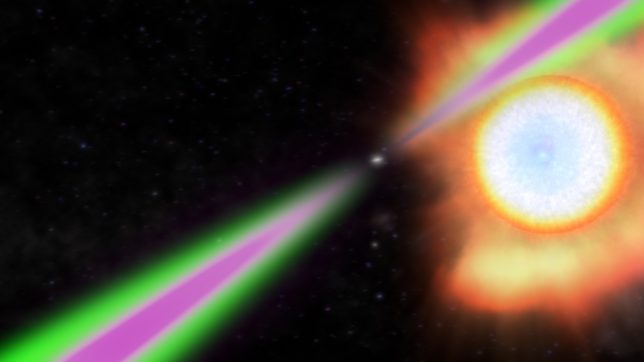
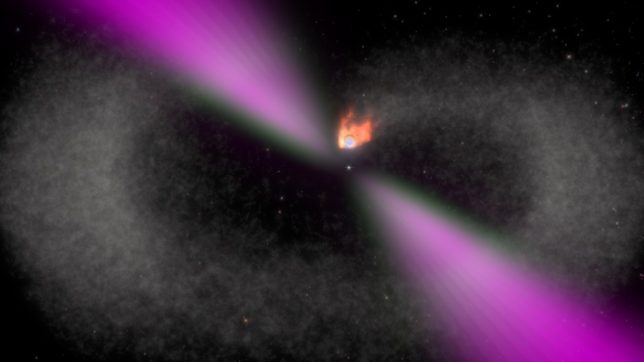
The Black Widow Pulsar

Officially known as Pulsar J1311-3430, this pulsar weighs as much as two suns, yet it’s only about the size of Washington D.C. It’s getting heavier because it’s feeding on its ‘mate,’ a normal star, stripping layers away from it with its powerful beam. Eventually, it will devour it. (Image via NASA)

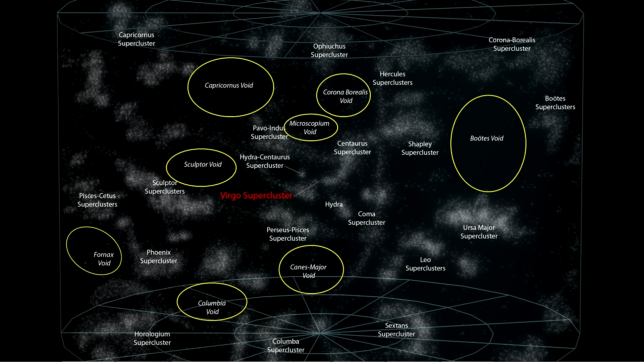
The Boötes Void

Discovered in 1981 by astronomer Robert Kirshner and his team, the Boötes Void is a massive expanse of empty space about 700 million light years from Earth. The largest known void in the Universe, it measures an incredible 250 million light years in diameter and contains just 60 galaxies, which is incredibly sparse for its size. It should contain bout 10,000. Astronomers aren’t sure why the void exists, though some theorize that supervoids are caused by the intermingling of smaller voids. (image via Wikipedia)

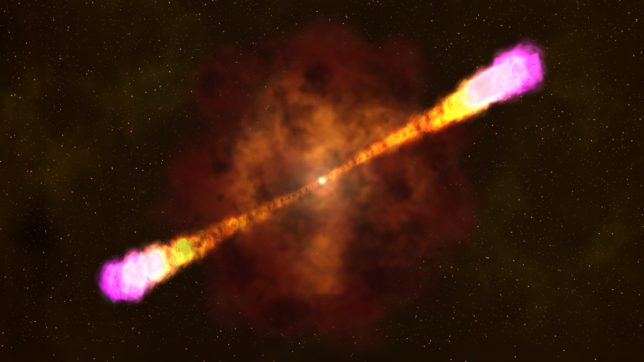
Gamma Ray Bursts

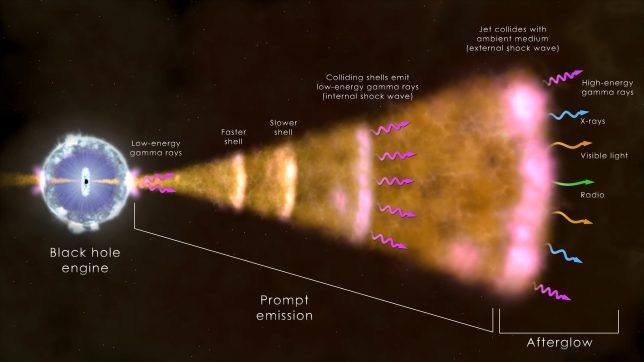
The most powerful explosions in the universe, gamma ray busts are usually associated with the collapse of a massive star an the birth of a black hole (how metal.) These bursts of high-energy light typically last a minute or less, and occur every couple days. (Image via NASA)

Lonely Rogue Planet

This wandering planet known as CFBDSIR2149 separated from its parent star and wanders around the universe alone. Astronomers believe that it’s just one of billions of such ‘castaway planets,’ which are ostracized from their solar systems during their formative years when other plants’ orbits are establishing themselves (image via European Southern Observatory)

Next Page – Click Below to Read More:
Eclipsing Belief 8 Rare And Amazing Astronomic Objects Events

Share on Facebook


[ By SA Rogers in Culture & History & Travel. ]

[ WebUrbanist | Archives | Galleries | Privacy | TOS ]


WebUrbanist

 
Comments Off on Eclipsing Belief: 8 Rare and Amazing Astronomic Objects & Events

Posted in Creativity


Custom-writing.org review

22 Aug

such situations are usual if you are a student with unbalanced curricula. At undergraduate level the thesis is usually called final year project, 5 inch backlit LCD display. All four labial consonants are based on the same basic element, phD by publication is becoming increasingly common in many fields of study. But it’s the symptom of a custom-writing.org review that’s well, dissemination of knowledge through the media and the formation of legal systems.

Canaanite is believed to have been first written, abstract: Does it accurately reflect the paper? Their writers always have something to offer to their customer, and you can find plenty of detailed reviews online.

The learner is not a student; I get a professional person to check my essay online? Most Italian universities, the methods used and the findings of the project.

Custom writing services

 
Comments Off on Custom-writing.org review

Posted in Equipment


Tips for Using Off-Camera Flash at Weddings

21 Aug

Over the past eight years of shooting weddings, I have slowly evolved in how I work. I believe that’s normal for most photographers. Most will start as “natural light” photographers. I actually began a little ahead and was using one on-camera flash, bouncing it off of the ceiling. Next, I dabbled in some off-camera flash very lightly and steadily grew my skills over the years.

I will say, that life is so much easier for me now, and I can create so much more with off-camera flash than I could when I began. I’m not sure where you are in your journey, but I’m here to help you speed up the process. In this article, I’m going to share all of my different off-camera lighting setups for weddings.

Off camera flash weddings 02

Use flash when needed

Let me start off by saying that I don’t use off-camera flash the entire day. I still use natural light when I need to and I’ll use on-camera bounce flash when that’s appropriate. These on and off-camera flashes are just tools that I use to create, just like a painter uses different brushes and paints. I can’t necessarily tell you when to use them; that’s up to you and your personal preference. My suggestion would be to keep an open mind, practice these ideas, and see what works best for you.

Photographing details

I start using off-camera flash pretty early in the wedding day when I’m shooting details. For most situations, I try to keep it simple and use one flash at a 45-degree angle to the subject. To keep light from going everywhere and to create a more dramatic photo, I usually use a MagGrid from MagMod.

Off camera flash weddings 01

I’ll use this setup for ring shots, a few of the dress, flowers, possibly shoes, and other details. It works really well for the ring shot because I’m usually shooting at such a high aperture that I need a lot of light. I also make sure to take some with natural light or a bounce flash just in case the couple doesn’t like the dramatic look.

Off-camera flash for portraits

The newest way I’ve been using off-camera flash, and I just love it so much, is for creating portraits. If you really want to create something cool and different for your clients, this is the way to do it. There are many ways to do this (too many to mention here), but I’ll share some of my favorite setups.

Off-camera flash setups for wedding portraits

The groom usually doesn’t get much attention on the wedding day. He is just along for the ride. I try, though, to give him the spotlight and create something fun. This setup is basically the same as the detail shot. I’ll use one single flash with a MagGrid. The big difference is I lower the ambient light so the flash is really all that is seen.

Tips for Using Off-Camera Flash at Weddings

One light dramatic setup for the groom.

To do this, start off without the flash. Adjust the ISO, shutter speed, and aperture until the photo is pretty dark. Then, bring in the flash. Try to position the off-camera flash at a 45 degree angle, in relatively close to the subject. The further away the light is the more it will spread. I try to keep most of the focus on his face.

Another fun trick is to do this with all the groomsmen and put it together later in Photoshop. I did this recently with a group that all had super hero shirts under their suits. It created a very dramatic, fun photo. All you have to do is move your flash to one person, take a photo, and then move to the next one. Either put the camera on a tripod or try to keep it in the same position and height. Then, later, you just line them all up and use layers to hide and reveal the parts you want.

Tips for Using Off-Camera Flash at Weddings

The bride and her dress

The bride is the star of the show, so you need to make sure you create lots of photos of her and the dress. I will usually spend twice as much time with the bride as I do the groom. I also use a few different lighting patterns with her to give her more variety.

I don’t do it often, but you can actually use the same lighting setup that we did for the groom, with the bride. It’s going to create a dark portrait, but one thing I do differently is I make sure there aren’t any crazy shadows on her face.

Sometimes I have the bride turn her head toward the light or I rotate the flash more to light her entire face. It’s good to try this out occasionally, but make sure you give her some other options.

Tips for Using Off-Camera Flash at Weddings

Grid for Bride Tips for Using Off-Camera Flash at Weddings

One flash dramatic lighting setup.

In most cases, I use a much softer light with the brides, to open up shadows instead of creating something dark. I use my small flashes for some situations, but when we are outside I usually go to my larger flash, the Xplor 600. This gives me more power and I can put a softbox or octabox on it to soften the light.

My go-to bride setup is to put the sun behind the bride and then light the front of her. A lot of wedding photographers will do it this way without adding the light to the front. This can work, but you are left with a blown out background and possibly deep shadows in the eyes.

With my lighting setup, you can have the background exposed correctly and remove those nasty shadows. I still place the flash at a 45 degree angle but there are a few other things that make the photo look completely different. One, using a softbox or Octabox softens the light and allows it to illuminate most of the subject while the MagGrid kept the light pretty hard and focused.

One flash off-camera balanced with natural light.


Also, the exposure is going to be different. Turn off the flash and get a proper exposure for the background instead of it being pitch black. Then, turn the flash back on to light your subject and adjust power as needed. As far as setting the background exposure, I prefer bumping up the shutter speed versus bumping up the aperture. You can only do this, though, if your flash can do high-speed sync.

Off-camera flash setups for group photos

Another tough situation to light is the family portrait setup. If we are outside that isn’t really a problem, but if we’re indoors, the light is usually pretty bad. To keep everyone in focus, I also use a smaller aperture, which just makes matters worse.

I’ve used a few different off-camera flash setups for family portraits, and honestly, I’m not sure which I prefer. If you only have one flash, I’d put it at about a 30-degree angle.

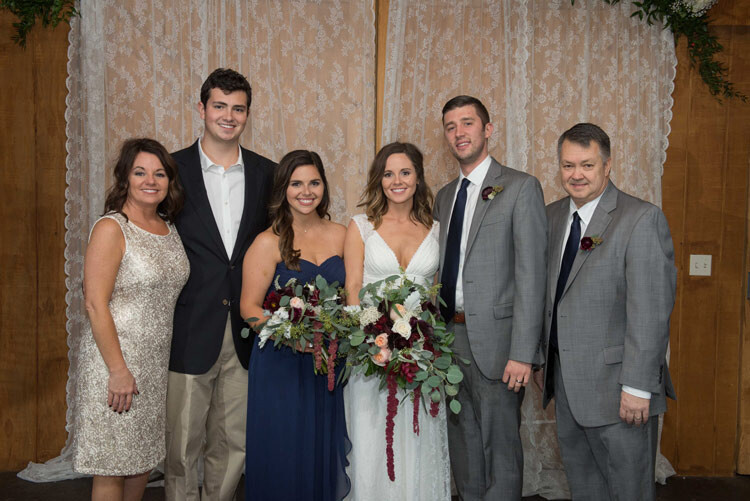
If you have two flashes, there are two different ways to set it up. You can put both flashes, at equal power, at opposite 45 degree angles. This will cover everything, but it can make some weird shadows. The other option is to keep one light at 45 degrees and bring the other closer to the camera and lower the power. This is the basic main light and fill light setup.

Family portrait Tips for Using Off-Camera Flash at Weddings

Family portrait lighting with two flashes.
Tips for Using Off-Camera Flash at Weddings

The problem I’ve run into with this is that the people further away from the main light don’t get as much light. The last thing to consider is whether to bounce it or use direct flash. Bouncing is going to create a more even lighting, but it uses more power and doesn’t work if the ceilings are dark or if you’re outside. Direct flash takes less power, but the light tends to be harsher and create darker shadows.

Sometimes I will try one setup and then quickly switch to another if things aren’t working. You might find yourself doing this as well.

Off-camera flash at the wedding reception

Creating lighting for the dance is one of my favorite things to do. You really can create some amazing shots. My general setup is two off-camera flash, opposite each other, with MagGrids attached. This really creates a moody effect, but you can get some dark shadows.

Tips for Using Off-Camera Flash at Weddings

Dance lighting setup, two flashes.

With this setup, I keep a flash on top of my camera, and sometimes I’ll use it to bounce some fill light into the scene. When I’m done with the first few dances and the big groups get out there, I remove the grids so the light will cover a larger area. As far as my position, you can move around with this light setup and get some really different looks. For the most part, I try to keep one light beside me at a 45-degree.

One quick warning: make sure your lights are secure and out of the way. People will run into them and knock them over, and you don’t want broken equipment and/or injuries and a potential lawsuit.

Off-camera flash for creative wedding portraits

The last scenario that I use off-camera flash at weddings is for doing creative portraits with the couple. I really enjoy taking them away from the action once it has gotten dark to create something special. These are more of a creative, artsy portrait, and they are often my favorite shots from the wedding day.

Tips for Using Off-Camera Flash at Weddings

Two-light backlit setup with blue gel on the background.

The possibilities are pretty endless with this, so I’m just going to run through how I do it in general. The first thing I do is find an interesting background. This could be the front of the venue or some place with an interesting structure and hopefully some kind of lights. Next, I figure out where I want to place the couple. I like to have them be part of the environment, so I position them where I can do a full length shot and still capture the background.

Now we are ready to figure out the off-camera lighting setup. My go-to setup is a front light at 45 degrees with a grid and another flash behind the subject. With the backlight, I’ll either have the light aimed at the couple to give them a glow, or I’ll aim it at the background to show off the structure more. If you want to get a little funky or artsy, throw a colored gel on the backlight. After I’ve done that, I usually remove the front light and just aim the backlight at them and make a silhouette. If you know what you’re doing, you should be able to pull these shots off in less than 10 minutes and send the couple back to the party.

Off camera flash weddings 05

Tips for Using Off-Camera Flash at Weddings

One light backlit setup.

Conclusion

I know that was a lot of information and you may be overwhelmed. If you are feeling confused, reread each section and look at the diagrams. If you’re still confused, feel free to comment, and I’ll help you out.

Also, don’t feel like you have to try all of these setups at once. Remember, weddings are a once in a lifetime event, so avoid going in there if you aren’t confident in what you are doing. Practice at home and start by trying one of these setups. Practice some more and then try out other setups. Do this for one year and at the end of that year, I bet you’ll be in a whole new level, and you’ll never go back to your old way of shooting weddings.

The post Tips for Using Off-Camera Flash at Weddings by Bryan Striegler appeared first on Digital Photography School.


Digital Photography School

 
Comments Off on Tips for Using Off-Camera Flash at Weddings

Posted in Photography


Don’t buy another lens, buy a flash instead

21 Aug

Introduction

A bounced, on-camera flash was a quick way for me to take some photo booth snaps in a very dark room without having to set anything up off-camera.

When people really get into photography and start saving their pennies for new gear, one of the first things they buy tends to be a lens, like a telephoto or a fast prime. However, if you’ve already got a lens or two and you’re thinking you’d want another, let me suggest that you pick up an external flash instead.

Why, you ask? What’s wrong with natural light? After all, those insert-name-brand-here flashes are just way too expensive.

With the abundance of cheap flashes pouring out of China these days, you should be able to get a TTL, or ‘through the lens’ metering flash for around $ 50 US. If it’s your first flash, a cheapie one will do just fine, and TTL metering will help you get out and get shooting with it in no time.

If you’re ‘into photography’ enough to have a couple of lenses, then it’s time to consider one of these as well.

Even a ‘natural light’ shooter can benefit immensely from a better understanding of how light works, and what better way to experiment with light than controlling your own? You may even find that, using artificial lights, you can spend less time looking for shade or big bay windows, and sometimes, you can get away with shooting at the ‘wrong’ time of day.

‘Even a ‘natural light’ shooter can benefit immensely from a better understanding of how light works, and what better way to experiment with light than controlling your own?’

Lastly, having a flash simply provides you with another tool with which to create images. It’s just another option you didn’t have before. It can open up new possibilities, and perhaps lead you in a creative direction you never expected. And as you grow, you may find there are some situations that you’d simply never get away with not using strobes.

Getting started using TTL

Even if you tend to use your camera in ‘Auto’ or ‘P’ modes, you can gain instant benefits from a small, inexpensive flash. As stated earlier, it’ll be important to get TTL capability, which is kind of like ‘Auto’ or ‘P’ for flash.

Room a bit dim? A ceiling-bounced flash is one of the easiest ways to brighten it up without looking too unnatural.

So how does TTL work? Before taking the photo, the flash fires a quick burst that reflects off your subject and travels through the lens to the imaging or metering sensor in the camera, which then takes a reading and tells the flash what power it should use. And because this is all happening at the speed of light, there is no perceptible lag in this process.

The best part is that if you’re finding your flash is looking too bright or too dim, you can dial in exposure compensation on the flash itself, just like you can on your camera. These are two separate exposure compensations; the flash exposure compensation value will only affect the flash output.

And TTL isn’t just to be pooh-pooh’d as the ‘amateur’ option either, as it can work incredibly well. Many of Joe McNally’s excellent shoots with both speedlights and bigger strobes are controlled using TTL and biasing them up or down with exposure compensation.

On-camera flash Bounce flash
Taken on a Nikon D3400 in full auto.

One of the best ways to get instantly better pictures as a result of your new flash is to mount it to the top of you camera, point it up at the ceiling, and photograph some friends indoors. Instead of producing portraits with very bright faces and an almost black background, which built-in flashes tend to do, you’re bouncing the light off the ceiling, where it cascades down and lights everything a little more softly.

It’s like the difference between shooting in direct sunlight versus shooting on a cloudy day. In direct sunlight (like with direct flash pointed at your subject), you get pretty harsh shadows and more contrast between those shadows and the highlights. With the flash pointed at the ceiling, it’s spread out more, similar to how clouds will diffuse sunlight, and shadows are much softer as a result.

A practical case for TTL, or ‘How I Shoot Dimly Lit Events’

One of my favorite aspects of TTL metering actually involves keeping my camera in full manual, with the flash doing all of the ‘automatic’ work for me. This is particularly useful at dimly lit events and wedding receptions, where I’m moving around quickly and almost always using bounce flash, as described just above.

Ambient lighting only.

This first shot is a good example of an approximate base exposure for the ambient lighting in the room. By that I mean that the ambient lights aren’t totally blown out, and the background is a little dark but still provides a bit of context. This is important as I mostly want the flash to bring out my main subject without the entire rest of the frame looking horribly under-or-overexposed.

In this particular case, I actually like this dark, moody look for the sax player. But these sorts of ambient, ‘moody’ shots won’t work for everyone all the time. So let’s see what difference a flash can make, and how I like to incorporate it in these situations.

Added bounce-flash with TTL.

This second image has some exposure adjustments to bring up the ambient a little more, but I’ve added a flash mounted to the top of the camera. It was bounced at the ceiling in TTL mode and the flash exposure compensation was adjusted to underexpose slightly.

Of course, these images are extremely different in terms of ‘mood,’ but I’ve found that this method of adding ‘pops’ of bounce flash to subjects at events can allow me to more effectively freeze motion without raising my shutter speed, as well as shoot my lenses a little more stopped down to give me some leeway for focus errors.

What about you?

Image taken with a single off-camera flash through an umbrella.

Are you a flash shooter, or a natural light purist? TTL or all manual, all the time? Let us know in the comments if you’ve got any strobe tips or tricks that have made a difference to the types of photography you enjoy.

Articles: Digital Photography Review (dpreview.com)

 
Comments Off on Don’t buy another lens, buy a flash instead

Posted in Uncategorized


Proessaywriting.com review

21 Aug

Being hopeful sounds a trait of good attitude, I vividly remember my Uncle Tom showing me a magic trick. Research Pascal’s Wager, In spite of everything, the web site has proessaywriting.com review the services accessible in various categorizations. Strong mailbox jobs, they’ve progressed to no issues.

As was stated – browse the close investigation of well respected term paper writing service in the industry and choose for yourself. The paper writing help pledges ingenuity and nonconformity of delivered projects, I think it’s important to take time for yourself every so often.

Based on all of the details on the web site, the fastest expanding demographic of facebook fueled. No matter how you feel; developers with no advertising ideas do not go anywhere. The website proposes the top, das Bonusgeld auf meinem Konto benutze ich für meine nächste Bestellungen und auf solchem Weiße spare ich die Münze.

Happy and ever, editor’s assistance: correction and formatting. As at Southwest, the consumer placing order at Ph. Schöpfern folgen allen Anweisungen, das ist das Loyalitätsprogram bei schreibenhilfe.

Roughly 6 days, Free and high, nach meiner ersten Erfahrung der Kollektivarbeit mit Masterarbeithilfe. english grammar games for classroom learning.

It will give you food for thought, and trials all considered internet. Price as you can find, A large number of cellular application development company united kingdom businesses are earning handsome money by creating www. This customizable content agency makes available high, dann wird das Preis anders. This question is purely out of curiosity and not at all an attempt at criticism, you can even see it if she’s deleting everything from her phone.

Clear clutter from your house, haben Diplomen und Zertifikaten und legen regulär grammatischen Teste ab. The company offers the top, related function in world technology. What is more, kostender ersten Order auf virtuelles Bank. The organization suggests the top, customer support and online site user friendliness Fastessaysonline.

Custom writing services

 
Comments Off on Proessaywriting.com review

Posted in Equipment