RSS
 

Archive for July, 2017

Now with More Minimalism: Brandless Brand Trademarks Bland White Boxes

28 Jul

[ By WebUrbanist in Design & Products & Packaging. ]

Viral Silicon Valley controversies like those revolving around Juicero (a device that squeezed out juice) and Lyft (which seems to be reinventing the bus) are often held us as examples of how innovators are out of touch, which leads us to Brandless, a brand that is apparently reinventing minimalist packaging — the kind of thing that companies like Target have been doing for ages.

To be fair, the Brandless boxes don’t look all that bad, and color-coding products make some sense. Plus, the idea of making everything the same price (three dollars) is fascinating if a bit difficult to scale. They are trying to take things a step further, too, by putting more information on the box (including the Brandless name) and less on the product, which could in theory be a nice way to visually declutter one’s home.

But of course, reality and regulations don’t always play nice with packaging design — for starters, the smooth look is interrupted by a black-printed net weight stamp toward the bottom and other essential labels of that sort. And, really strangely, a white trademark stands out from the colored portion of the product. Naturally, if one wants to order the flat-priced products, a shipping charge also interrupts the otherwise consistent pricing scheme.

None of this is meant to knock the conceptual underpinnings or commercial viability too much — entrepreneurs Tina Sharkey and Ido Leffler are clearly tapping into the West Coast demographic that has money and craves simplicity. But their claim to be making something “completely fresh and new” is a bit much — grocery and convenience store chains have been selling products in simplified and distinctive brand-free packages for a long time, with the same mission in mind (to reduce the “brand tax” people pay to get a name-branded version of something).

For now, the company is rolling out around 200 initial products. And, at least for the time being, they are all at the same price point. But one has to wonder: does that flat rate idea really make sense for a growing consumer brand? Surely some things are best bought in bulk to save money, or simply too expensive to sell for a few dollars. And consumers who want one-stop shopping may find their offerings a bit thin. In the struggle for minimalist simplicity, Brandless just may be making things harder on themselves than they have to.

Share on Facebook


[ By WebUrbanist in Design & Products & Packaging. ]

[ WebUrbanist | Archives | Galleries | Privacy | TOS ]


WebUrbanist

 
Comments Off on Now with More Minimalism: Brandless Brand Trademarks Bland White Boxes

Posted in Creativity


Richard Prince must face lawsuit over image theft, judge rules

28 Jul

Controversial artist Richard Prince must face a lawsuit over his unauthorized use of photographer Donald Graham’s photo ‘Rastafarian Smoking a Joint,’ a federal judge has ruled. The ruling concerns a 2015 lawsuit Graham filed against Prince after he failed to heed a cease and desist order. Prince and Larry Gagosian, owner of the Gagosian Gallery where the pilfered image and others were displayed, had claimed the work is ‘transformative’ in an effort to have the case dismissed.

Real Bongo Nyah man a real Congo Nyah ? repost @indigoochild

A post shared by Jay Kirton Kwame Ka Asante (@rastajay92) on

Though Prince has managed to escape past lawsuits unscathed, this latest one may prove different. Talking about the ‘transformative’ claims, U.S. District Judge Sidney H Stein stated, “The primary image in both works is the photograph itself. Prince has not materially altered the composition, presentation, scale, color palette and media originally used by Graham.”

Graham’s version of the image was acquired from another Instagram account where it was featured; he had it enlarged and printed with his own Instagram-style comment beneath the original user’s caption. The exhibit at Gagosian contained a total of 38 of these ‘borrowed’ images, including the Rastafarian photo cited in the lawsuit. The court’s ultimate ruling on the lawsuit could set a major precedent for fair use as it relates to Instagram images.

Via: New York Times

Articles: Digital Photography Review (dpreview.com)

 
Comments Off on Richard Prince must face lawsuit over image theft, judge rules

Posted in Uncategorized


Three Good Reasons To Learn More About Photography

28 Jul

Photography has become so popular, mainly because of the inclusion of cameras on mobile phones, so it’s more difficult for your photos to be noticed. But, if you learn a little more about photography your photos will be more likely to stand out from the crowd.

Your life is full of gadgets and equipment that can be challenging to learn to use really well. Learning to use your camera will make your photography so much more enjoyable. Photography is therapy. Picking up your camera, making time to take photos, can be a wonderful break from the busy pace of your daily life.

Three Good Reasons To Learn More About Photography - Thai ladies

Committing even a small amount of time regularly to learn more about photography will help you enjoy the creative process of image making. It will help overcome frustrations you may have because you don’t understand your camera well enough. As you study you will find that your creative ideas and expression will come more naturally. And, as you know and understand more and begin to relax when you have your camera in your hands, you will find a personal groove and means of expression that will be unique to you.

So here are three really good reasons for you to learn more about photography.

#1. Create outstanding photos

Most of us love to share our photos and see the response or family and friends have to them. Even more exciting is when strangers begin to show appreciation for our photographs. The desire to have your photos seen and enjoyed by others can be a real motivation for you to enjoy photography. But getting your photographs noticed is not so easy.

Three Good Reasons To Learn More About Photography - girl with elephant

This has become more of a challenge in recent years because pretty much everybody has a some form of a camera these days. Social media has made it extremely easy to share photos and have them seen by a potentially global audience. But how do you get your photos noticed when everyone else is sharing their photos in the same way?

Take some time to learn more. Learning about light, exposure, color, tone, composition and timing will help you produce more creative, more interesting, more noticeable photographs. And, if you think about it, you probably something about these things already, because you see them all the time, but are not necessarily thinking about them.

You can’t see anything if there’s no light. Light is the essence of photography. With no light, you can have no photo. Learning to appreciate different types of light and when some light is better for making photos than others, will help you create more outstanding photographs. You see light all the time and if you can begin to understand it and appreciate how to expose your photographs well, you will create more compelling images. Knowing something of the limitations of your camera and how it captures tone and color will also help greatly in the creative process.

Three Good Reasons To Learn More About Photography - flower

Compose and time your photos better

Learning composition rules and developing a real feel for them will also help your photographs be more impactful. Like with any creative expression, learning the rules will allow you to eventually implement them without really thinking about them. This is when I believe you will become most creative.

Certainly timing your photographs well takes research and practice. Learning to anticipate action and choose precisely the best time to make a photograph, the decisive moment, is a skill that will certainly enhance your photography and make it stand out.

2. Become intimate with your equipment

Learning how to use your camera well and becoming confident will result in a more enjoyable and more creative photography experience. I have met (and taught) many people who own very nice cameras but are not confident in using them. If you don’t have a good understanding of your camera you will most likely become somewhat frustrated when you pick it up to use it, or later when you are looking at disappointing photos.

Three Good Reasons To Learn More About Photography

Becoming familiar with your camera and how to use it well takes time and commitment to study. Because each camera model is different, with the controls in different places, it means you need to do some research and hands on practice to know how to use your cameras with confidence.

Essentially all cameras are the same. They function the same way, with light hitting the sensor (or film) to create photographs. Whether you use a camera in any of the automatic modes, or prefer to use it in Manual Mode, the process of creating photos is the same, but the amount of creative control differs greatly.

Setting your exposure manually gives you far more control over the end result. Learning to do this takes a bit more dedication but will ultimately result in you making more unique, creative photographs. If your camera is always set to one of the automatic modes then the camera is making some (or all) of the most creative choices. Cameras are smart, but they are not creative – you are.

Three Good Reasons To Learn More About Photography

Learning to take control of the camera will help you enjoy the creative process of photography far more than if you have to stop and think about the basics of what to do each time you pick up your camera.

3. Photography can be therapeutic

Having creative drive, wanting to make good photos and have others enjoy them, will hopefully lead you to want to learn more about using your camera well. Doing that will free you up to enjoy your whole photography experience and you can then experience photography as a therapy.

Three Good Reasons To Learn More About Photography

Expressing your creativity with a camera you understand and love is very therapeutic. Taking time out from your busy day, even just for 10 or 15 minutes, to take a few photographs can be enjoyable and relaxing. Indulging in longer photography sessions on weekends or during vacations can be terrifically therapeutic.

I find when I pick my camera up to shoot for pleasure, (it’s different shooting for work if I have a client to please,) I can easily become absorbed only in making photographs, and nothing else matters! Being able to really zone in on what I am doing helps me forget all the worries and stresses I may be experiencing in life and just enjoy the process of being creative.

Narrowing the attention of your thoughts to the creative processes of photography, meditating on photography, brings a whole other dimension to the experience. Being aware of and intentionally seeking opportunities where you can use your camera creatively can help you relax differently than other activities you may enjoy. Watching the news on TV, checking social media, or going to a movie are all things that add a change of pace to your daily life. But a lot of what you do to relax does not involve being creative. Being creative with your camera adds a whole new dimension to life and can be most therapeutic.

Three Good Reasons To Learn More About Photography

Conclusion

Having the desire and drive to want your photos to be noticed when you share them is a good reason to learn more about photography. Overcoming the frustration you may feel because you haven’t taken the time to learn how to use your camera is another good solid reason to invest some time, and maybe even some money, in learning how your camera functions and how you can control it better (preferably in manual mode.)

Once you are on the path to learn more about your camera and about photography, knowing that it can be wonderfully therapeutic, should be most encouraging for you to follow some course of study to make the most of your camera – even your phone camera! Here’s a video for you to watch more on this topic as well.

What other good reasons do you have for learning more about photography? Please share in the comments below.

The post Three Good Reasons To Learn More About Photography by Kevin Landwer-Johan appeared first on Digital Photography School.


Digital Photography School

 
Comments Off on Three Good Reasons To Learn More About Photography

Posted in Photography


Capitol Hill photographers asked to delete protest images, claim journalists

27 Jul
Photo by Phil Roeder, licensed under Creative Commons

Journalists photographing a protest in the US Capitol building report that they were told by Capitol Police to delete photos and videos of arrests. The events unfolded yesterday in the third floor Senate wing of the building as demonstrators protested the vote that would begin an effort to repeal the Affordable Care Act.

As police handcuffed and removed protestors from the hallway outside of the Senate chambers, journalists were reportedly told by police to stop taking photos, and were instructed to delete photos and videos they had captured.

Official policy for press in the Senate Gallery states that photography is indeed prohibited in that area. However, the ACLU spoke up to remind press that police may not force anyone to delete a photo or video without a warrant, no matter the circumstances.

Articles: Digital Photography Review (dpreview.com)

 
Comments Off on Capitol Hill photographers asked to delete protest images, claim journalists

Posted in Uncategorized


How to do More Creative Wildlife Photography by using Rim Lighting

27 Jul

Wildlife photography is one of the fastest growing hobbies today. With DSLR and lenses getting cheaper by the minute, it is only bound to grow faster. With more and more people taking to wildlife photography as a means to connect with nature and share its beauties, it’s become imperative that you start pushing the bar of your photography ever higher. One of the best and easiest ways to do that is to try out rim lighting shots. If you do not know what that means, you are on the right page – keep reading.

How to do More Creative Wildlife Photography by using Rim Lighting

There are many ways to get creative with your wildlife photography, but in this article I will teach you one of the most impactful. Let’s start with getting to know rim lighting a little better.

What is rim lighting?

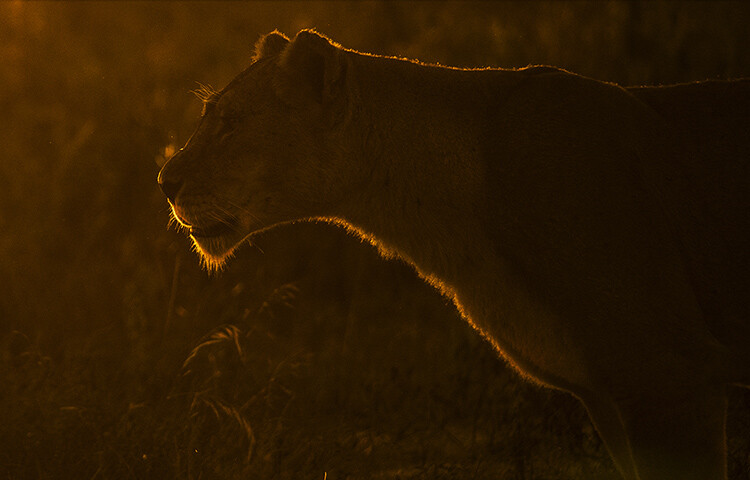
By definition, rim lighting in photography means any image where the light at the edges of the subject seems more intense than the other areas. For example, take a look at the image below.

How to do More Creative Wildlife Photography by using Rim Lighting

Notice how the outline of the giraffes stands out? The rim of the subject looks well-lit. Quite simply, that’s what rim lighting is about.

How do you achieve rim lighting?

First and foremost, you need to position yourself such that the subject stands between your camera and the light source (more often than not, that will be the sun in nature photography). Rim lighting will happen in the natural world only if you can see the rim, lit up with your eyes. Some of the easiest subjects for this are animals that have a lot of fur and are not too smooth coated, for example, bears, giraffes, lions, or deer with antlers.

Take a look at the visual below for a quick understanding on positioning yourself.

750

Guidelines

There are a few guidelines that you need to adhere to while trying to obtain a rim-lit image:

  • Rim lighting happens best when the sun is low in the sky, so try to look for a subject around that time.
  • A dark background is necessary (check all the images in this article) so make sure that you try this in an area where your background is conducive to good results.

Speaking about the camera now, composition aside, rim-lit photography can be done using one of two approaches.

Approach #1 – Exposure Compensation

Using exposure compensation is the easiest way to execute rim-lit shots. Once you have ensured that you are able to see a rim-lit subject just go ahead and try a test shot with a little underexposure. Take a look at the sequence of images below.

How to do More Creative Wildlife Photography by using Rim Lighting

Make note, by default when using the built-in metering system in your camera, more often than not the image in such scenarios (a lot of black and little bit of white) will turn out to be a bit washed out. It is just that the camera does not know what is the most important part of the image and makes an error in judgement (it tries to average the exposure).

Knowing where to stop with regards to exposure compensation is a subjective call. You could be happy with the second or the third image above. Just know that the more you underexpose the darker the surroundings will get.

This is a perfectly valid way of getting a rim-lit shot, but I generally recommend the second approach. The simple reason being that exposure compensation doesn’t reset itself. If you forget your camera is set at an EV of -2, it would mean disaster for the next few shots where you may not be trying to create a rim lighting shot.

How to do More Creative Wildlife Photography by using Rim Lighting

Approach #2 – Exposure Lock (AE-L)

This approach is slightly more advanced in terms of understanding. Imagine yourself standing in front of a monkey with the sun setting behind him and the immediate background being dark trees. Now, do the following:

  • Point your camera toward the sky. Half press your shutter-release button to activate metering.
  • Next, press the Exposure Lock Button (AE-L or * button) which often resides right where your right-hand thumb would rest.
  • Now, recompose your image with the subject as needed and click.

What happens is that when you point your camera towards the sky and ask it to meter from there, it takes a light reading from the bright sky and sets up a shutter/aperture combination accordingly. Let’s assume for a minute that the value came out to be 1/2000th at f/4.

Now, if you press the Exposure Lock button, the camera will lock on to these readings and will not change them for your next set of clicks. So when you recompose and photograph the monkey, the camera uses the locked in settings thus rendering only the areas in the frame that are as bright as the sky correctly. In this recomposed image, the only area that is as bright as the sky is the outline of the monkey, giving you a nice, well exposed rim-lit image.

How to do More Creative Wildlife Photography by using Rim Lighting

Practice around home first

Go ahead, practice the AE-L at home and then get out there and try a couple of rim-lit shots. Here is what you can do at home, before heading out to the wild.

Catch hold of a friend or family member and make them stand in front of a car at night. They should be covering the headlight of the car completely. If you stand at the other end with your friend in between yourself and the light source, you should be able to see his entire body with rim lighting.

Now that you know how to get a subject, go out there with your camera and start trying the exposure compensation trick to get some fabulous rim-lit images. Please share your rim-lit wildlife images below as well as any questions you may have about this technique.

How to do More Creative Wildlife Photography by using Rim Lighting

The post How to do More Creative Wildlife Photography by using Rim Lighting by Rahul Sachdev appeared first on Digital Photography School.


Digital Photography School

 
Comments Off on How to do More Creative Wildlife Photography by using Rim Lighting

Posted in Photography


GoPro launches QuikStories feature for automated story-telling

27 Jul

GoPro’s Quik app for making short and shareable videos from your GoPro footage has been available for a while. Now the new QuikStories feature is taking things one step further by generating clips automatically and making them as easy as possible to share on social media and get them off your GoPro’s memory card.

QuickStories is integrated into the latest version of the GoPro app. After a day of shooting video with your GoPro the app will search your camera for new clips and automatically create a shareable version, complete with edits and music. It’ll also picks brief elements from longer clips and you can still interfere manually though and change the order of clips or the music. You can also add other media from your phone into the mix if you want to.

As you would expect, QuikStories integrates with most social networks you already have on your phone but you can also export the finalized video to use it in any way you want. The video below gives you a pretty good idea of how the feature works.

Articles: Digital Photography Review (dpreview.com)

 
Comments Off on GoPro launches QuikStories feature for automated story-telling

Posted in Uncategorized


How to Make Funky Colorful Images of Ordinary Plastic Objects Using a Polarizing Filter

27 Jul

A cornerstone in modern manufacturing, plastic is an amazing thing. Look around and you’ll see an abundance of plastic materials used in an endless variety of products. From pens to planes – yep, even modern commercial aircraft are cutting down on weight by introducing plastic composite components – plastic has revolutionized the way we live. And while much of the plastic we encounter is discarded after the first use – this photography tutorial will give you a good reason to hang onto those plastic knives and forks. By using a polarizing filter, some plastic materials and a computer screen, we can reveal a surprisingly beautiful side to the internal stresses of hard plastic material.

How to Make Creative Colorful Images of Plastic Objects Using a Polarizing Filter

Supplies you will need:

  • Polarizing filter or polarized sunglasses
  • Computer screen
  • Camera
  • Clear sticky tape
  • Sheet of glass
  • Tripod (optional)
  • Transparent plastic objects

Setting up

In basic terms, what we’ll be doing is sandwiching a plastic object between a polarized light source and an on-camera polarizing filter. Polarizing filters that screw into the front of a camera are used by photographers to add contrast and reduce glare.

How to Make Funky Colorful Images of Ordinary Plastic Objects Using a Polarizing Filter

Don’t have a polarizing filter? Use your polarized sunglasses in a pinch.

If you don’t have a polarizing filter, a pair of polarized sunglasses will do the trick. Simply position the sunglasses so that one eye sits over the front of the camera lens like a filter. Keep in mind that the shape of the eyepiece will probably prevent complete coverage of the front lens element. If this is the case, some cropping may be required in Photoshop later. You may also need to do some sticky-taping to ensure the glasses sit correctly.

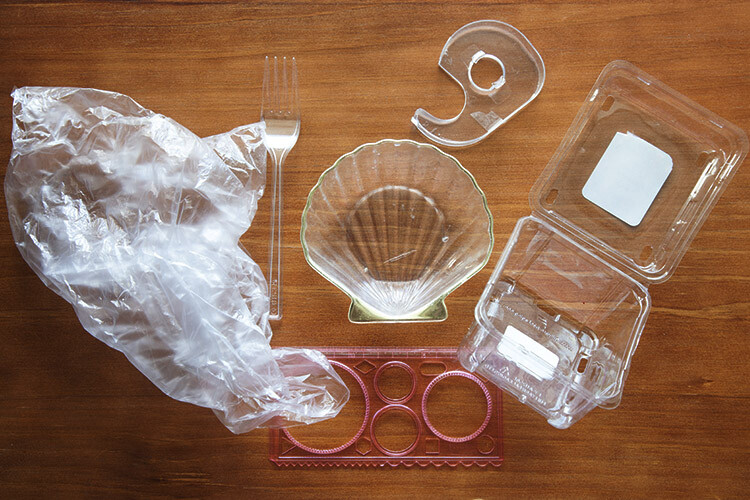
Now gather some clear plastic materials to photograph. Objects like plastic bags, sticky tape dispensers, plastic food containers, clear plastic cutlery and packaging all turn out well. Basically, any cheap, transparent plastic will work to some degree, so have a good scavenge around!

How to Make Creative Colorful Images of Plastic Objects Using a Polarizing Filter

Finding good backlighting

Next, you’ll need a polarized light source to shine through the transparent plastic material. Conveniently, modern desktop and laptop computer screens emit linearly polarized light. First, you need to maximize the white light emitting from our computer screen. To do this, download a plain white background from Google Images. Once downloaded, open the file in a default image viewer and set the image to Full-Screen Mode. This will spread the white backdrop over the entirety of the functional computer screen, providing the backdrop for our polarized objects.

Once downloaded, open the file in a default image viewer and set the image to full-screen mode. This will spread the white backdrop over the entirety of the functional computer screen, providing the backdrop for your polarized objects.

How to Make Creative Colorful Images of Plastic Objects Using a Polarizing Filter

Set the viewing mode of a clean white image to full-screen so that it completely covers the screen.

Arrange the subjects

Once the white background is set, you can start arranging your plastic items on the computer screen. If you have a choice between using a desktop or laptop computer, I recommend going with the laptop. Unlike a desktop computer, you can turn an open laptop upside down, so the screen lays flat on a surface. This turns your laptop into a home-made light box of sorts, perfect for sitting your plastic objects on.

Keep in mind however that laptops with touchscreen capabilities may not work as effectively. From my own experience, these laptop screens deliver far less pronounced results. Note: A large tablet or iPad may work as well.

How to Make Creative Colorful Images of Plastic Objects Using a Polarizing Filter

Viewed through a polarizing filter, this transparent stencil is placed on the top of a touchscreen laptop. While the polarizing effect can still be seen, the finished image falls flat.

Workaround for desktop screens

Because the screen is upright, using a desktop computer for this project can seem a little trickier. Rather than tipping a full sized computer screen on it’s back, I’ve been fixing my plastic materials to a sheet of glass with tiny pieces of clear sticky tape. Easily recovered from old photo frames, the glass sheet means you can avoid sticking tape directly to your computer screen, without blocking out any light. For best coverage, a larger sheet of glass is preferable, just make sure that it’s dust free. Once you are finished taking your photographs, you can remove any evidence of the sticky tape with the “Clone Stamp” in Photoshop.

For best coverage, a larger sheet of glass is preferable, just make sure that it’s dust free. Once you are finished taking your photographs, you can remove any evidence of the sticky tape with the “Clone Stamp” in Photoshop.

How to Make Creative Colorful Images of Plastic Objects Using a Polarizing Filter

I’ve affixed this transparent stencil to a pane of glass to keep it upright against the computer screen. The small amount of tape can be removed easily in Photoshop later.

How to Make Creative Colorful Images of Plastic Objects Using a Polarizing Filter

In this image, a small piece of the clear sticky tape can be seen.

How to Make Creative Colorful Images of Plastic Objects Using a Polarizing Filter

Taking advantage of the solid black background, any trace of the sticky tape can be removed by using the paintbrush tool with a black swatch selected

Getting the shot

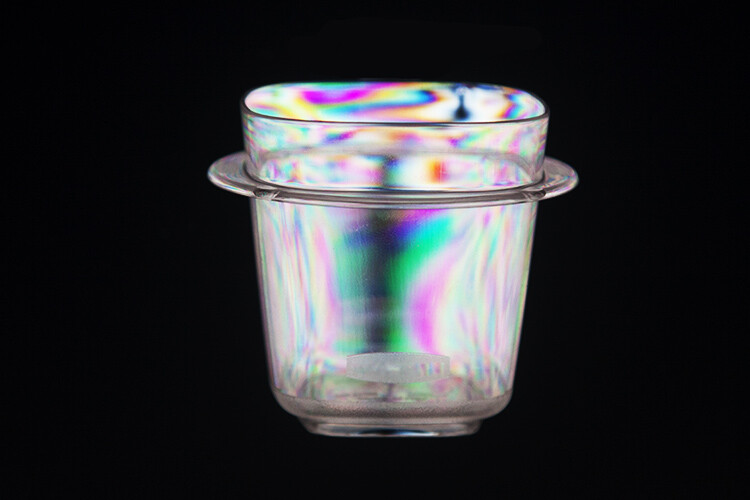
Once you have assembled your objects against the computer screen, it’s time to see some results!  Grab the camera you outfitted earlier with either the polarizing filter or the polarized sunglasses. While looking through the viewfinder (or LiveView Mode) point the camera at your plastic assemblage. Like magic, the boring clear plastic materials are filled with a beautiful array of colors.

Change the angle – change the background

Depending on the angle of the polarizing filter, you’ll notice that the backdrop of your image ranges from the white computer screen to jet black. The degree of polarization you see through the lens is dictated by the angle of the filter in relation to the wavelengths emitted by the computer screen. This means that by changing the angle of the polarizing medium, you can adjust the brightness of the computer screen without impacting the color of the plastic objects.

Simply hold the camera in one hand (or use a tripod) and use the other to slowly rotate the filter around. The same effect can be achieved by manually tilting the polarized sunglasses from side-to-side.

How to Make Creative Colorful Images of Plastic Objects Using a Polarizing Filter

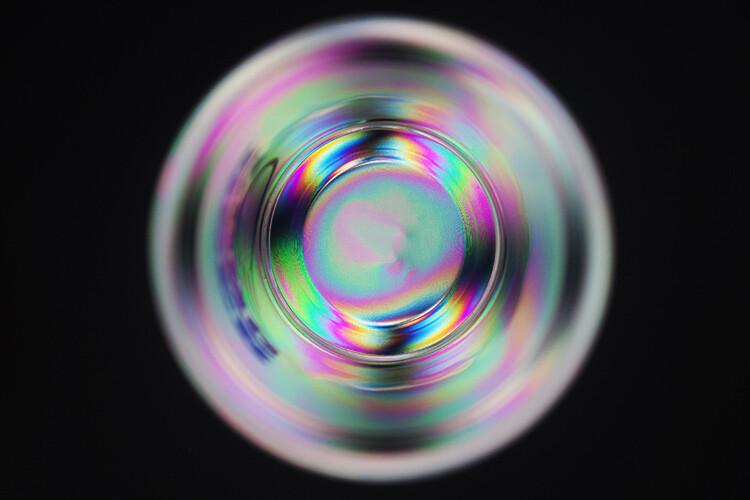
An image of a pretty shell shaped container I had on my dresser. The polarization effect highlights the stresses in a plastic material, rendering them as beautiful arrays of color.

The same shell container, this time with the filter angled so that the white light passes through to the camera sensor, rendering a white background

Your turn!

Now that you’ve got the basics, it’s time to raid the recycling bin! Post your results below and have fun.

How to Make Creative Colorful Images of Plastic Objects Using a Polarizing Filter

How to Make Creative Colorful Images of Plastic Objects Using a Polarizing Filter

How to Make Creative Colorful Images of Plastic Objects Using a Polarizing Filter

The polarizing effect caused this plastic bag to take on a rugged, mountainous appearance.

How to Make Creative Colorful Images of Plastic Objects Using a Polarizing Filter

How to Make Creative Colorful Images of Plastic Objects Using a Polarizing Filter

How to Make Creative Colorful Images of Plastic Objects Using a Polarizing Filter

The post How to Make Funky Colorful Images of Ordinary Plastic Objects Using a Polarizing Filter by Megan Kennedy appeared first on Digital Photography School.


Digital Photography School

 
Comments Off on How to Make Funky Colorful Images of Ordinary Plastic Objects Using a Polarizing Filter

Posted in Photography


Nikon marks 100th anniversary with new scholarship program

27 Jul

Nikon is marking its 100th anniversary in many ways, including the creation of a new scholarship program for ‘future visual creators’ in the USA and Canada.

The scholarship will consist of two programs: ‘The Nikon Storytellers Scholarship’ will award ten college students with academic scholarships of $ 10,000. In addition, Nikon will identify rising stars on digital platforms and recognize them as a part of a curated ‘Nikon100 List.’

Criteria for consideration will be announced later this year, and submissions will be reviewed, selected and awarded prior to the 2018-2019 school year.

Press Release:

NIKON INC. CELEBRATES 100TH ANNIVERSARY WITH SCHOLARSHIP PROGRAM FOR FUTURE VISUAL CREATORS AND PLANS TO RECOGNIZE UP-AND-COMING PHOTOGRAPHERS TO NEW #NIKON100 LIST

Imaging Leader Allocates $ 100,000 in Scholarship Funds to invest in Next Generation of Students Pursuing Photography, Film, Journalism, Visual and Fine Arts Degrees

NEW YORK, NY (July 27, 2017 at 10:00 a.m. EDT) – Today, Nikon Inc. announced two new programs to recognize and support the next generation of visual creators. “The Nikon Storytellers Scholarship” will award ten college students with academic scholarships of $ 10,000. Additionally, Nikon Inc. will identify rising stars on digital platforms and recognize them as a part of the curated “Nikon100 List.”

“For the past 100 years, Nikon has been at the forefront of optical innovation and exploration,” said Kosuke Kawaura, Director; Marketing, Communications & Planning, Nikon Inc. “We have never been more excited about the future of imaging and are committed to supporting the next generation of photographers and creators that are eager to capture and share their world.”

This fall, Nikon will announce the criteria for students throughout the United States and Canada to be considered for the scholarship program. Submissions will be reviewed, selected and awarded prior to the 2018-2019 school year. Recognizing the value of education and creative collaboration, Nikon is using their 100th Anniversary milestone to celebrate current and future creators.

“Nikon understands the dedication it takes to pursue and become successful in creative fields, and we are honored to play a role in supporting students’ achievement in academic excellence,” added Kawaura.

In addition to the scholarship, Nikon will identify and curate a list of rising stars in photography. The “#Nikon100 List” will identify photographers on Instagram that are creating inspiring work and telling amazing stories. Throughout the 100-day campaign, Nikon will highlight one new photographer to follow each day and will share that individuals’ photos on the Nikon Instagram channel with hashtag #Nikon100.

These new programs build upon the deep commitment Nikon has made to supporting imaging talent. Nikon is the founding sponsor of the Eddie Adams Workshop, an intense four-day gathering of top photography professionals and 100 carefully selected, gifted students. Nikon also has a robust product loan program for students to learn the art of photography at 33 colleges and universities throughout the country. For some students, this is their only opportunity to access photography gear to learn and share their creative point of view. Nikon has also been teaching photographers of all levels for over 30 years through their Nikon School program which offers online and offline courses.

Students interested in the Nikon Storytellers Scholarship and those looking to learn more about the “#Nikon100 List” can follow Nikon on Instagram , Facebook, Twitter or Snapchat (@NikonUSASnap) or visit http://www.nikonusa.com this fall for more details.

Articles: Digital Photography Review (dpreview.com)

 
Comments Off on Nikon marks 100th anniversary with new scholarship program

Posted in Uncategorized


Pursuit: A spectacular storm-chasing time-lapse made from 90,000 photos

27 Jul

Storm chaser and award-winning photographer Mike Oblinski has done it again: he’s created a time-lapse that will blow you away. Captured over the course of three months, across 10 states, and involving 28,000 miles of driving and over 90,000 time-lapse frames, Pursuit is the result of utter determination.

Oblinski tells the story behind this time-lapse in the video’s description, explaining how this season of storm chasing nearly broke him.

After 12 straight days on the road and away from his family, he left once again, just 24 hours after getting home, to chase another storm on June 12th. But doubt got the better of him, and he found himself 80 miles away from the spot he needed to get to.

“I got back in the car and as I drove, the pain got the better of me and the tears came,” he writes. “It may not be easy to understand why, but when you work as hard as I did this spring, a moment like that can break you. I felt like I let my wife down. But mostly I let myself down. I forgot who I was and that’s not me. Or it shouldn’t have been me. I failed myself. And it seemed like the easy choice to just give up and head for home.”

But he didn’t head for home, he decided to keep going, got out ahead of the storm, and captured one of the best structures he’d seen all spring.

The result of that decision not to give up, to keep on going even when it seemed like he had utterly failed, is one of Oblinski’s best time-lapse films yet… and that’s saying something if you know his previous work.

To see more from Oblinski’s portfolio, head over to his website or give him a follow on Facebook and Instagram.

Articles: Digital Photography Review (dpreview.com)

 
Comments Off on Pursuit: A spectacular storm-chasing time-lapse made from 90,000 photos

Posted in Uncategorized


5 Questions to Ask Yourself to Help Improve Your People Photography

27 Jul

They say the lines on a person’s face can tell a thousand stories. Getting the photo that tells those many stories is the holy grail of photography. So what can you do to create standout people photography, especially if you don’t already know the person?

The approach that every people photographer takes is different, but below are five questions that all most will have asked themselves. Each photographer may answer the questions differently and yet still produce amazing results, as photography styles are all different, of course. To improve your people photography, take the time to look at these questions, and ask how they apply to you.

5 Questions to Ask Yourself to Help Improve Your People Photography

This is a photo of a Shaman from Malaysian Borneo. A connection had already been formed with this man after my friend told him I’d photographed for National Geographic. So we were able to use off-camera flash as he posed for us.

1 – Long lens or short lens?

The chances are when you start photographing people you’ll use a longer focal length. This can be true of people who you know, it’s especially true of people you don’t know. Photographers who enjoy street photography will tell you that using a 50mm lens is best. But the truth is that it really depends on the situation.

The long lens

This really means any lens over 85mm on a full frame camera. The nice thing about these lenses is that you can photograph from a distance that’s non-invasive. This is great because you don’t need to interact with the person you’re photographing, and this is terrible because you don’t need to interact with the person you’re photographing.

There are good reasons for and against direct interaction with your subject, something we’ll come to later. The reason you may come to use a long lens is that it compresses the scene, and allows you to focus in on the person, without outside distracting elements.

5 Questions to Ask Yourself to Help Improve Your People Photography

A longer lens was used in this photo, resulting in a simpler photo.

The short lens

This means lenses 50mm or below, with the 50mm lens being the street photographers go-to lens. Using a lens like this will force you to interact with the person you’re photographing on some level. It’s far better to build a rapport with the person than going with hit and run. Besides the advantages you will gain from building rapport, wider lenses also allow more context to be seen in the frame.

5 Questions to Ask Yourself to Help Improve Your People Photography

Using a wider lens can improve your portraits. This was photographed at 50mm, and more of the story behind the scene can be seen.

Now, of course, you can get prime or zoom lenses that are both long or short in focal length. When it comes to people photography, the larger aperture that prime lenses offer is a great advantage. Photographing people with prime lenses is, therefore, best and will to improve your portraits.

2 – What technique works best?

There are many different approaches to people photography to improve your portraits. As discussed above, choosing your lens will help. Applying techniques like bokeh can also get you better results. A few ideas that might help you are described here.

Shoot from the hip photography

This means leaving your camera at your hip and photographing without lifting your camera to your eye. How can this be good photography you may ask? Those experienced at this technique know how to use their camera, and can pre-visualise the result without needing to confirm it with their eyes.

  1. To take photos like this focus the lens to a set distance in front of you.
  2. Use an aperture of f/11 or smaller to have more depth of field.
  3. Choose an ISO that allows for a fast enough shutter speed to avoid motion blur.
  4. Make sure your camera isn’t too crooked, although some angles can work for this style of photography.
  5. Walk past the location you wish to photograph, and hit the shutter as you’re walking or with a brief pause.
5 Questions to Ask Yourself to Help Improve Your People Photography

This scene from the New York subway was photographed from the hip.

Use the light

The correct use of light will always improve your people photography. There are occasions when natural or artificial light can drastically improve your photo. At night you will need to look for a strong artificial light that people can stand near, during the day a shard of sunlight through a gap in the roof could also be used.

Here are some tips for using light to your advantage:

  1. Take up position away from the light source. You will want people walking towards you and into the lit up area.
  2. Wait until the magic moment comes, and the person’s face is well lit by the source of light.
  3. Have your camera focused on the area where the person will become lit up, and switch the camera to manual focus.
  4. Expose for the person’s face. This will mean the background appears very dark, or even black. The background may be at a -2 or -3 exposure value.
  5. Wait for people to walk into the lit up area, and then photograph them. You will need to wait patiently for people to walk by, into the correct area.
5 Questions to Ask Yourself to Help Improve Your People Photography

This man was lit up by artificial light, giving the photo a low-key, high-contrast look. Learning how to use light will improve your people photos.

Patience

Waiting for people to walk into the light isn’t the only time patience will be needed. You might have a natural frame like a doorway, so you will need to wait for someone to walk through it. This approach is not unlike fishing, and the time spent waiting for the right moment can be calming. The most important thing is to make sure your composition and camera settings are already set. Now it’s just a waiting game for somebody to walk past. Alternatively, you could speed things up by asking a friend to walk into the frame.

Forming relationships

5 Questions to Ask Yourself to Help Improve Your People Photography

The value of building relationships in photography is important, it will improve your portraits. This was the first time I saw the monk, Cheongsan. I didn’t interact with him at all, and this is the result.

The very best way to take photos of people, time permitting, is to form a bond with them. Taking the time to interact, and find out about the person you want to photograph will almost always give you a much better photo. The chances of them giving you permission to photograph will be much higher, and you can control the scene more.

Once you have permission you then have the choice between a staged or candid photo, since you can ask the person to ignore you when you are shooting. The chance to get a great photo that you can share with them can form a lasting connection with you as a photographer. The level of interaction also depends on time, whether it’s 30 minutes or several hours. The types of photos you may get if you’re able to revisit the person on several occasions will also improve dramatically.

5 Questions to Ask Yourself to Help Improve Your People Photography

The next time I saw Cheongsan, I made the effort to approach him. As a result, he let me take this photo and gave me a business card.

3 – Do you ask for permission?

When the person you’re photographing is your friend or a model, then in most cases asking permission would not be needed, and indeed might be strange to ask. Photographing a stranger is a different proposition though, so to ask or not to ask, that is the question.

There is no one correct answer to this conundrum, but certain situations may dictate your actions. If you want a truly natural moment, with no hint of a staged photos then you’ll want to try and avoid asking permission. The caveat to that statement is that if you have time to build a friendship with those people you wish to photograph in a natural way this is also possible, after getting permission to take the photograph.

5 Questions to Ask Yourself to Help Improve Your People Photography

The next time I visited Cheongsan, I had contacted him ahead of time and asked if I could take some photos of him. You will improve your people photography even more by setting up a shoot with someone.

Asking permission is the polite thing to do, and will often improve your photos. You need to have thick skin when asking people though, as asking on the spot will lead to many rejections. You need to ask yourself how you can form a relationship with someone even quickly to smooth this process, so you’re more likely to have the person say yes. Is the person you want to photograph a vendor, for instance. Perhaps you need to show some goodwill and buy one of the things they’re selling. If you’re in a country where English is not spoken asking permission may involve the use of body language. So perhaps learning a few polite words like please and thank you for going along with those non-verbal cues would be prudent.

The general rule on whether you should ask permission is up to you. When the photo you’re taking is in that person’s personal space, it’s much better to ask permission.

5 Questions to Ask Yourself to Help Improve Your People Photography

I loved this man’s glasses and general style, so I asked if I could take his picture. I got a posed photo, but loved the way he posed.

4 – Candid versus staged?

This is related to the question above, but you can get candid photos even after asking permission. If the quest here is for authenticity, can you capture a great moment with your camera that’s natural? This is the aim of many photographers. However, if your aim is to tell a story through a series of photos you should really try and get a mixture of both. On an individual basis, let’s weigh up both the pros and cons of candid and staged photos.

Candid captures

This requires a keen eye, sharp reflexes, but also absolute patience. When walking around taking photos you have to be hyper aware of your surroundings in order to get photographic moments that last the blink of an eye. Photographing split second moments means you need to be utterly absorbed in your surroundings, you need to become the surroundings.

You almost have to achieve an internal meditative state. Staying on the move means you are going to the moment of capture. This means you need to be very quick to catch it. Alternatively, you can find a location, compose your photo, and then wait for the right moment to come to you. This approach can take hours, so you will need a lot of patience!

5 Questions to Ask Yourself to Help Improve Your People Photography

This photo taken was taken in the harbor in Yangon. There is nothing staged about it, I just had to wait for the right moment.

Staged shots

Once the photo is going to be staged, you have a lot of control over how the photo is taken. At this stage the person you’re photographing has consented and will be actively involved in how the photo is produced. When done well, this often leads to a more striking photo than one produced candidly, you are in the realms of a visual storyteller.

The photograph could be a simple head shot, or a more complex photo when your model interacts with their surroundings. As the photo is staged, you can ask your model to stand in the best position for available light, and the background. Your model should be well lit, with the eyes illuminated by the light in the frame. If you have off-camera flash with you, you might even consider using this to really improve your portraits.

5 Questions to Ask Yourself to Help Improve Your People Photography

In this photo, I asked the lady if she would pose for me. After getting permission, I was able to set up the photo and use off-camera flash to light her face.

5 – Where should you take people photos?

The answer to that is anywhere there are people, which is more or less everywhere. You can also choose a location to visit such as a market. Below are a few ideas you can try, though you may have some better ideas specific to where you live.

  • The market – This is the stock location for many people wanting to take people photos. There will always be people at the market. You can take photos of the vendors, customers, or the vendors and customers interacting. The downside is the people working in the market may not like yet another photographer take photos of them. This is where building relationships with the people in the market can help.
  • Public transport – A great reason to avoid the taxi, and leave your car at home. Getting on public transport is a great way to explore a location, and the people there. Be aware that in some locations you will need to get permission from the transport operator, as well as the people you are photographing.
  • A harbor – Anywhere there is a river will likely have a harbor. The life of people working in these places can produce great photographs. You will need to be prepared to wake up early in the morning to see the fishermen at work. This is another great example of how building relationships help, you might be invited onto one of their boats if you get to know a fisherman.
  • Festivals – This could mean a cultural festival such as Chinese new year, or a rock concert. Festivals will have people dressed in attention grabbing clothes that look great when photographed. You may find people more open to having their photo taken at an event as well, because they’re having a good time, and are often dressed well.
5 Questions to Ask Yourself to Help Improve Your People Photography

Visiting places people work can be good locales for people photography. A sulfur mine is an extreme example, however, going to extremes will improve your photos though.

Getting model releases, and paying your model

Whether or not to pay for a photo is another question many people ask about. It is up to you to judge each situation for yourself. Photos being taken for a specifical commercial usage are the types of images where you should pay the model a percentage of your fee. When the photos you are taking are for personal use, paying the model is at your discretion. Chances are you will find someone who will let you take their photo for free, so it’s a nice gesture to send them an image once you have processed them.

Once you decide to pay the person to take their photo, it’s unprofessional not to get a model release. If the person you’re paying won’t sign a model release then don’t pay them, and move onto somebody else. The reason you are paying for a photo is you intend to use it for promoting your work, or for direct commercial usage. This means you need to get a model release, and there are apps available for smartphones that make this very easy.

5 Questions to Ask Yourself to Help Improve Your People Photography

This is one of the miners at Kawah Ijen in Indonesia. He signed a model release and was paid for this photo.

It takes practice to improve your people photography

Now it’s your turn. It’s time to go out and practice your people photography in your local area. Are there any ways that you like to take portraits that are different from this article? I’d love to hear your ideas as well, so please share them in the comments below.

What’s your favorite people photo you’ve taken? Again share your great photo with us, and describe how you went about taking it. Finally, get out there and get some new people photos. Hopefully, some of the ideas in this article will help improve your images.

The post 5 Questions to Ask Yourself to Help Improve Your People Photography by Simon Bond appeared first on Digital Photography School.


Digital Photography School

 
Comments Off on 5 Questions to Ask Yourself to Help Improve Your People Photography

Posted in Photography