RSS
 

Archive for June, 2017

Flash review: the Godox Ving V860 II is a great-value wireless solution

19 Jun
  • Godox Ving V860 ll flash – $ 199/£161
  • Godox Ving V860 ll flash kit with X1 transmitter – $ 245/£199
  • X1 transmitter – $ 40/£37
  • www.godox.com

I’ve been a big fan of independent flash brands since I was a teenager. Marquee brands’ hotshoe units were always disproportionately expensive, and for a young photographer on a stacking-shelves budget the appeal of cheaper and more powerful models from secondary manufacturers was obvious.

In those days of course flash unit controls were much less complicated, but working with flash was generally much harder than it is today – all we expected back then was a cable socket and a manually variable burst of illumination.

The Godox V860 ll is a very well made flash unit that comes equipped with an AF assist light on the front, a sync socket for cabled triggering and a USB port for firmware updates.

The head offers full tilt and swivel movements, manual and automatic zoom, a diffuser and a white card reflector for catchlights

Flash changed with the advent of aperture priority options, the coming of full TTL metering, optical off-camera communications and then, eventually, radio controls. While in the distant past the independent flash brands were very much following in the footsteps of the big names, now we often see the resourcefulness of some companies putting the sluggish progress of the main brands to shame.

While Nikon and Canon have held on to their intermittently effective optical flash control systems for far too long, innovative brands such as Godox, Phottix and others have been making real progress in the field of 2.4GHz radio controls. The big names have been catching up of course, but for those looking for something that doesn’t come with a significant premium for having radio wireless TTL control these companies offer an interesting set of alternatives.

Specification

Godox V860 ll
Compatible Canon, Nikon, Sony
Guide No 60m/190ft @ ISO 100
Flash coverage 20-200mm (14mm with diffuse)
Zoom control Auto and manual
Tilt/Swivel -7-90 degrees/180 degrees both L and R
Flash duration 1/300-1/20000sec
Exposure TTL and manual

Flash exp comp

+/- 3 stops
Sync mode

High speed (up to 1/8000sec)
First curtain and second curtain

Strobe-flash Up to 90 bursts at 100Hz
Wireless functions Master, Slave, Off
Slave groups

3 (A, B, C)

Transmission range

Optical indoors: 39-49ft
Optical outdoors: 26-33ft
2.4G Radio: 100m/328ft

Channels

Optical: 4
Radio: 32

Modelling flash Yes, via camera’s depth of field button
AF assist beam Yes. Range – Centre: 33ft, Edge: 16ft
Power 11.1V/2000mAh Li-ion polymer battery
Recycle time <1.5 seconds
Battery life Approx 650 full power flashes
Sync triggering Hotshoe, 2.5mm port, wireless
Color Temperature 5600 +/-200k
W x H x D 64x76x190mm/2.5x3x7.5in
Weight without battery 430g/15.2oz
Weight with battery 540g/19oz

In case you aren’t aware, the attraction of radio over optical controls in flash-to-flash communications is that the signal is more reliable outside on a sunny day and it can pass through walls and other physical barriers. Units don’t have to be the same room or very close together, and we don’t have problems of modifiers covering sensors if the flash unit needs to sit inside a softbox or similar. And that is what makes me excited about using these Godox Ving V860 ll units.

Features

The V860 II is the latest Godox offering for Canon, Nikon and Sony users, and it provides TTL metering and off-camera control via a wireless 2.4GHz radio system, as well as the usual optical control system. The unit can operate on the camera’s hotshoe as a commander unit for both other Godox flashguns and the marque brand’s own radio units, or it can join a network controlled by an ‘official’ flash unit – or indeed by a radio transmitter plugged into the camera.

The output is healthy enough, with an official guide number of 60m/190ft @ ISO 100 at 200mm, and we are offered full manual control from full to 1/128th power in 1/3rd EV increments. Flash duration figures range from 1/300sec at the more powerful settings to 1/20,000sec for the lighter bursts.

High speed sync allowed me to shoot with shutter speeds well above the standard sync speeds of the Nikon D810. The shot on the left was taken at 1/640sec and that on the right at 1/1000sec. Despite the short shutter speed and the reduced opportunity for the flash to get its illumination out, the V860 ll was easily able to compete with the bright sunlight – even when hindered by a mini softbox

The flash provides rear curtain sync even if your camera doesn’t, and high speed sync allows the flash units to be used on or off-camera at shutter speeds of up to 1/8000sec. The head has zoom positions to cover the angle of view of lenses from 20mm to 200mm, while a wide angle diffuser provides for focal lengths as short as 14mm. Comprehensive swivel and tilt positions help us direct that coverage in practically every direction except directly downwards.

Strobing can be arranged at a range of frequencies, intensities and over fixed periods, though the over-heating protection asks that we limit ourselves to 10 sequences before resting. To give you an idea of what the unit is capable of at ¼ power it is possible to choose options between 1 flash per second for 7 seconds and 2 flashes at a rate of 100 flashes per second. At minimum power that changes to 90 bursts at 1 per second, and 40 bursts at 100 per second. In normal shooting though Godox says 30 full power or 100 ¼ power flashes can be fired in quick succession before the over-heating protection kicks in and demands a 10 minute break.

One of the interesting elements of the flashgun is its power source. The V860 II is powered by the sort of rechargeable lithium ion block battery we might expect to see in a large camera. With a 2000mAh capacity the battery is claimed to be good for 650 full-power bursts and can be recharged in about two and a half hours. I’m not sure this constitutes a revolution, but it feels like one and is a good deal more convenient and civilized than carrying and burning endless AA cells.

What can be controlled wirelessly?

The V860 II is very flexible. It’s happy to to be used to command a group of connected flash units or to be controlled by another. As a commander it can fire to influence the exposure itself or be used as a pure trigger, with no flash output. Godox offers a separate commander/receiver called the X1 that makes a more cost-effective hotshoe commander when no light is required from the camera position.

The system allows three groups of flashes to be controlled at the same time, and users can pick between 32 channels to steer clear of other radio systems in the vicinity. The V860 II can still be controlled optically across four channels, but when in radio mode it has a range of 100m and works outside even in bright light, as well as when positioned in a different room with a wall between the flash and the controller.

This scene was lit with a pair of V860 ll units – one inside and one outside the house. The main flash unit was fitted into a Godox S-Type Speedlite Bracket with a SFUV softbox, and was positioned in the garden to fire through the window on the left of the frame. A second V860 ll was placed camera-right, to light the back of the subject’s head through a Rogue snoot. The camera’s metering was set to matrix, while both heads were set to +1EV via the X1 transmitter on the camera.

I found the flash’s color consistent, well balanced and in no need of correction. The cool-day/warm-day effects here were created in post-production.

Wireless control extends to manual and TTL control, as well as high speed working and strobotic operation, and a modelling burst is still possible with a press of the camera’s depth-of-field preview button.

Handling

The V860 II has a clear enough screen and lays out its wares in a pretty logical way. Once we are familiar with the mostly standard type icons it is easy to see what settings are prevailing at any one time. Changing the settings though is less straightforward so a good and thorough read of the instruction manual is recommended. The controls are really not intuitive enough that they can be used with a hazy memory or no previous experience.

With familiarity we can take advantage of a good range of control in the master and slave units. Exposure compensation runs only to +/-3EV for in-unit controls and for slaves across the three channels, which some may consider a little short for complex set-ups. On a similar note it isn’t possible to control the zoom position on slave units from the master control panel. To be fair this is not a standard feature on this sort of flash unit, but it would be useful.

A nice touch – when in commander mode the rear screen of the V860 ll turns green and when being used as a slave it turns orange. The button arrangement is simple enough – at least once you’re used to it and know what the icons mean.

Buttons and dials on the rear of the flash are nicely designed and make operation deliberate once you’ve worked out what each one does, but the controls on the X1 transceiver are a little more fiddly than they need to be and require quite small fingers. The display screen is adequate but a bit small, and on every occasion I used the rear wheel I turned it the wrong way.

The controls on the X1 are small and quite fiddly. They are fine in a relaxed studio environment, but less easy to operate on the go or with gloves on

Changing batteries in mid-shoot is fantastically easy and can be achieved in much less than a quarter of the time it takes to change four AA cells – which makes for much more relaxing weddings. And when fumbled these batteries don’t clatter and roll all the way down the church either. I am rather taken with this idea and wonder why we haven’t been using lithium blocks in our flash units for years. I’m told it makes export more difficult, but I’m not sure how much I believe that’s the whole reason.

Cheap flashguns are all very well but we need something well made and built to last, and these Godox units seem to satisfy both requirements. They feel nice to use and have a reassuring solidity about them without being too weighty. They are actually really well made and I can personally vouch for the fact that they can withstand being dropped from about waist height on to pretty hard ground.

Performance

I used a pair of these V860 ll units with the X1 transceiver on a Nikon D810, and across a couple of weddings and a few portrait shoots they did very well indeed. Nikon I suppose must be given credit for the accuracy of the metering, but the Godox units worked with the camera seamlessly.

Godox’s operating range claims seem well-founded and the radio communication does in fact work well through walls and around corners, though in a couple of instances at very close range I managed to find a blind spot when using the X1 hotshoe transmitter. I was quite surprised to encounter this on a number of occasions when holding the gun in my hand while shooting, and also while the gun was mounted on a bracket next to the camera. The blind spot seems to be at 45 degrees forward of the transmitter when the flash is placed directly alongside.

At greater distances, more normal perhaps for off-camera work, the system performed really very well, but the short range reliability became a bit of an issue for me until I got used to it – I often hold a unit in one hand and the camera in the other when working on my own at events.

Here is an overhead view of the set-up, with flash A in the softbox and flash B bouncing into the reflector. The Godox bag is being used to create a shadow around the base of the bowl. I used an X-Rite Color Checker Passport to white balance the rear flash, and found the shift in color from the camera’s flash white balance setting was hardly noticeable .
For this shot I used a single flash (A) in a softbox, set to 0EV compensation, positioned behind the subject. Here the only light is coming from flash B, positioned forward to the side and bouncing into a gold reflector.
This shot shows the effect of both flashes lighting the scene, with both set to 0EV compensation To create a little more of a three-dimensional feel I increased the power of flash A in the rear to +2EV, and reduced flash B at the front to -1.3EV

At one stage I found the X1 wouldn’t trigger the guns at all, and no matter what I tried I couldn’t make it work. This was extremely frustrating for a long time. I solved the issue by accident when I triggered one V860 ll from the other and then found that suddenly the X1 wanted to work again. I’m not entirely sure what the problem was, but suspect some sort of communication issue that was somehow unblocked when the second flash unit kicked in.

The limitations of the over-heating system will prohibit a few users from being able to make use of these units, but for the vast majority of photographers requiring more than 30 full blast bursts in quick succession is something of a rarity. I certainly can’t complain about recycle times as even at full power the lithium ion battery feeds the flash quickly enough that we can expect a burst every second.

With one flash in another room off the corridor and aimed towards the groom, and another in my hand positioned to bounce from the ceiling, I was able to create some nice lighting effects quickly with this system. The bounced flash was set to -1.3EV so it would just fill the shadows.
The robust metal threads on the supplied feet make the V860 ll units easy to mount on tripods or lighting stands. I used a pair of softboxes to light this shot, one either side of the couple. The small size of the softboxes and the flash heads contributes to the cut-out feeling and illustrates a limitation of hotshoe flashes.

I found the coverage to be even enough at most focal length settings and the output of manual burst to be consistent from shot to shot. The color shifts somewhat between the brightest and the weakest bursts, but not so much that it will be an issue for most non-technical applications.

The flash duration quoted by Godox seems to be the total flash duration rather than the effective duration (the time the maximum intensity drops by half) . Using a Sekonic L-858D meter I measured the total duration at full power to be approx. 1/450sec, and the effective duration to be more like 1/1600sec. The difference will probably not be noticed by most.

Shot in bright sunshine at f/5.6 and 1/400sec at ISO 100, and the zoom in the 70mm position. The flash was in the hotshoe and was more than powerful enough to reach the subjects in an effective way. I was glad of the long-lasting lithium ion batteries on such a day of full power bursts. The main light here is daylight from a window to camera-right. The walls behind the bride though were rather too dull and shaded, so I placed a single V860 ll behind her to light them up a bit. I left it at 0EV and it did the job nicely.

Translating the guide number into real world situations, I found that full power gave me a meter reading of f/8@ISO 100 with the flash 10 feet away and the zoom head set to 50mm. Changing the zoom position to 200mm increased the reading to f/11 ½ in the same situation.

Add-ons and accessories

Included in the two-flash kit I received were feet/stands with a brass tripod thread in the base, a pair of strap-on diffusers, a set of colored gels and a pouch for each flash.

Like many other flash brands, Godox offers a range of accessories that help to modify the light from their units. My favorite accessory though is the S-mount adapter that allows the flash to be clamped within an adapter ring for S-Mount (Bowens) accessories. I tried the V860 ll flashes with big and small softboxes and dishes, as well as the good-sized pop-up softbox that comes with the adapter. As you will know, some speedlight accessories are too big, floppy and cumbersome to use easily, but with its own clamp the S-adapter is excellent and the softbox genuinely useful.

The company also sells an external battery pack for these flash units. The ProPac Lithium Power Pack PB960 can deliver 1800 full power bursts after a three-hour charge, and can accommodate two flash units at the same time. Via adapter cables it can run Godox, Canon, Nikon and/or Sony guns.

It is worth noting too that the radio system of the V860 ll flash units is the same as that which controls some of the company’s studio flash heads, so you can use a mixture of speedlite and studio style sources together.

Conclusion

I have been really very impressed with this system. Firstly because these V860 II units make excellent hotshoe flashguns on their own, and secondly as they provide a comprehensive amount of control and a mostly-reliable wireless radio connection. They perform well when paired with other Godox flashes and are equally well behaved within a group of Nikon radio units, as well as within a collection of optically controlled flashguns.

I really appreciate the reliability and range of radio controlled flash units, not just in these flashes, and that they can be used in a much wider set of circumstances. I got thoroughly sick of trying to use optical systems outside some years ago, and was frustrated at the chances I was missing out on.

The light in this room was nice and even, but being able to balance a flash unit on a basin in the adjoining bathroom allowed me to quickly add an extra dimension to the bride’s face and body with a bit of a broad keyline. Knocking 0.7EV off the brightness of a single V860 ll placed wide camera-left was enough to get the balance right for this early evening shot. The flexibility of the system allowed me to work quickly to get a nice result without having to dash to the flash unit to change the power

I really enjoyed having a block battery and not carrying and disposing of AA cells – it just makes life that much more relaxing and enjoyable. And with the 650-burst capacity it makes me wonder why other brands don’t adopt the same idea.

The most surprising thing about these flashguns though is their price, and that when they turn up they don’t feel like or perform like low cost alternatives. They make an astonishingly good purchase, and I highly recommend them.

Pros

  • Good wireless connection at normal distances
  • Very well made
  • Great block battery with good life
  • Plenty of control on and off the camera
  • Powerful enough for most users
  • Really good price

Cons

  • X1 transceiver could be easier to use
  • Radio signal not so reliable when the flash is close to the X1
  • Needs more than +/-3EV range of compensation

Articles: Digital Photography Review (dpreview.com)
 
Comments Off on Flash review: the Godox Ving V860 II is a great-value wireless solution

Posted in Uncategorized


BAM! BIFF! POW! Street Art Showcases Adam West’s Batman

19 Jun

[ By Steve in Art & Street Art & Graffiti. ]

The late Adam West’s role as TV’s campy yet cool Batman garnered him a permanent place in pop culture – just ask these 12 graffiti artists.

Caped crimefighters don’t come any campier than Adam West’s iconic TV Batman, and the late actor’s take on Gotham City’s kitschy caped crusader still stands cowled head and bat-suit bedecked shoulders above a host of latter day Dark Knights. Seriously, would anyone spying a streetside stencil of bat-garbed George Clooney, Michael Keaton or (gasp!) Ben Affleck be moved emotionally? It is to laugh.

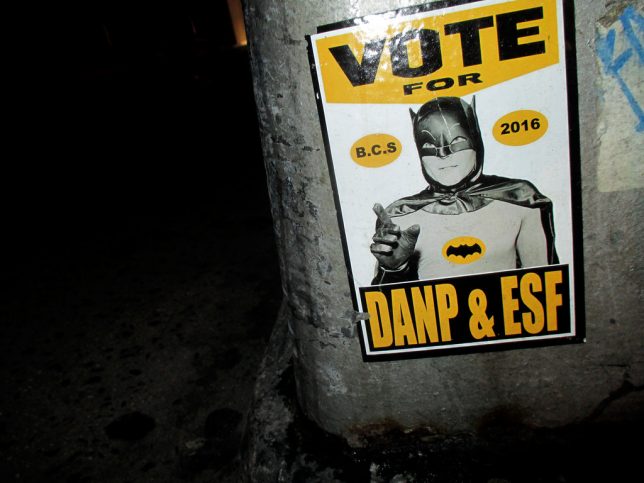
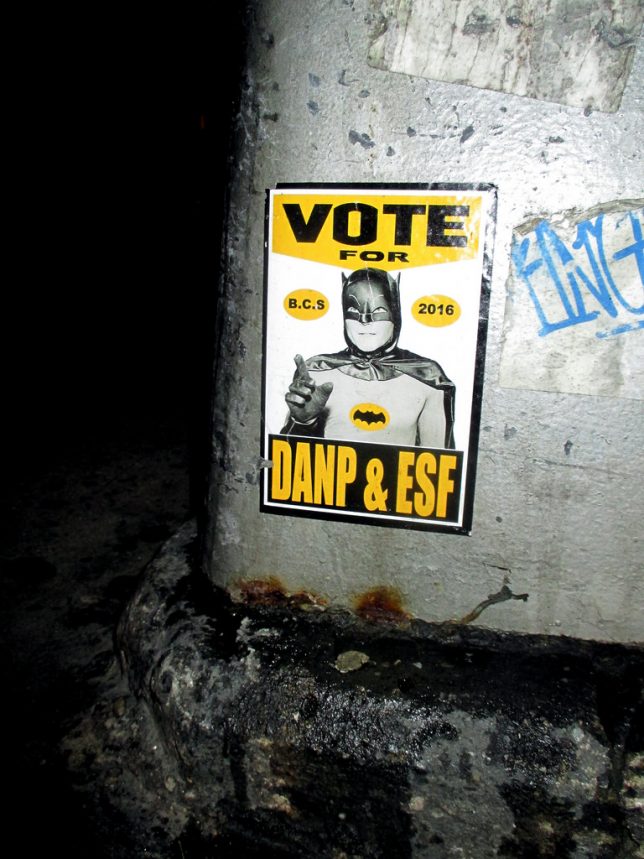
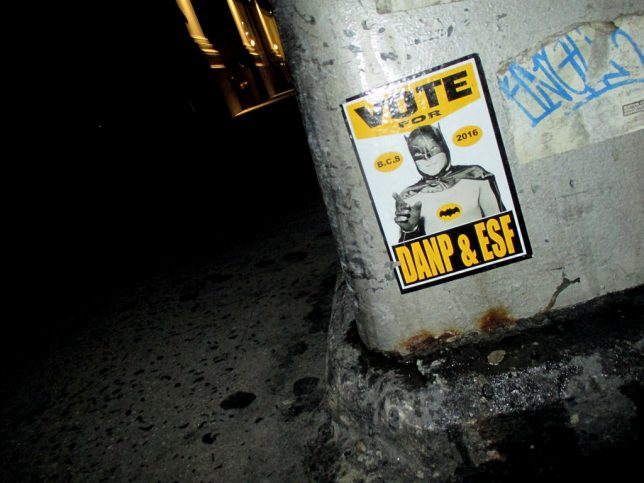
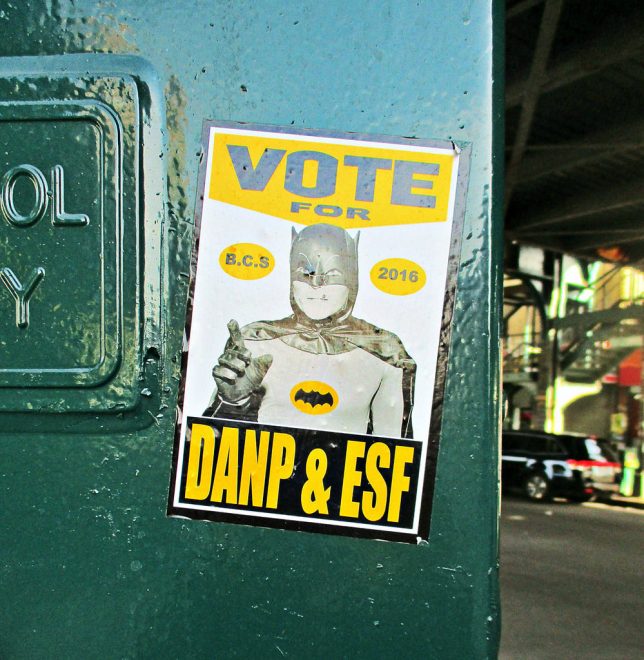
Comedic pretensions aside, Adam West never played the Batman for laughs. Instead, his signature deadpan delivery – coming from a guy wearing tights and accompanied by a similarly spandex-clad “Boy Wonder” – allowed kids to take the superhero at his words while letting adults appreciate the subtle humor in between the lines. Indeed, West’s Batman would have made a great politician, amiright? Check out Flickr user Brecht Bug‘s snaps of a sticker slapped on some subterranean NYC concrete in late 2015, while Robert S was moved to photograph a similar sticker elsewhere in Brooklyn in January of 2016.

Walla Walla Wall Walker

West, born in 1928 as William West Anderson, hails from Walla Walla, Washington… which has absolutely no relation to the creative modding of the Wet Floor sign above. Kudos to Flickr user timfootman for posting the image above in August of 2011; the photographer isn’t saying whether they’re also the artist but double-kudos if do. By the way, did you know those classic scenes of Batman and Robin effortlessly scaling building walls were actually filmed flat and tilted 90 degrees? Of course you did – and we’re still not invoking any Walla Walla connection.

Gouda Grief

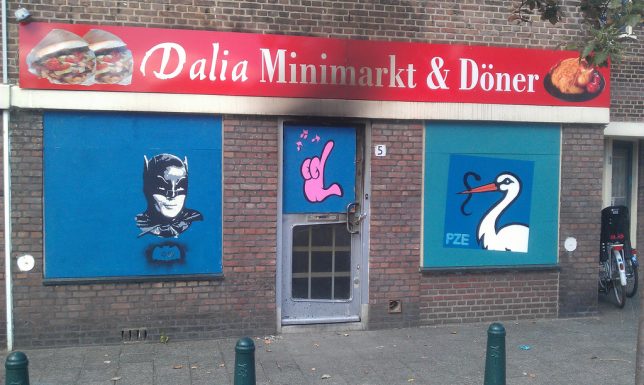
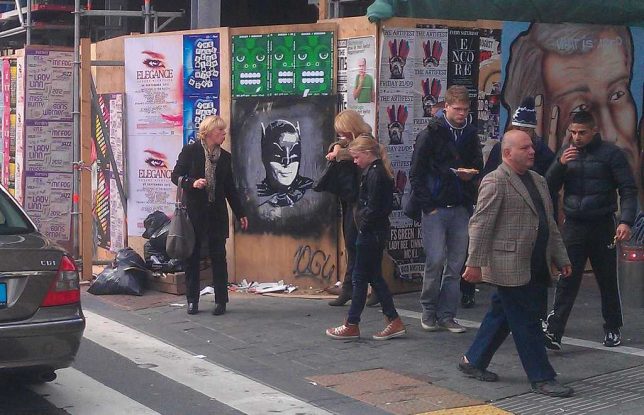
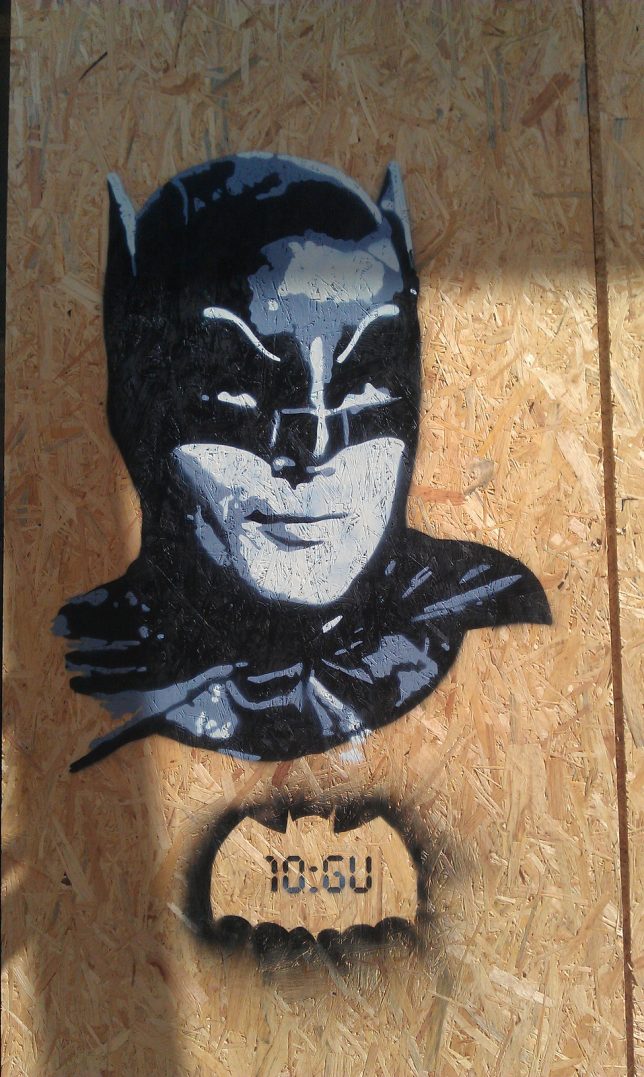
It’s not often a graffiti artist is also a Flickr member but here we are – with Gu (10:Gu [VDS]). The artist is apparently based in Amsterdam, the Netherlands, as that’s where most if not all of his superb Batman stencil graffiti works can be found.

West’s confident, restrained grin so perfectly captured by the artist is almost Mona Lisa-esque, adding to the character’s mystique and illustrating why West’s portrayal of Batman continues to earn respect as time goes by.

Streetcorner Chalkin’

“Saw this little Adam West tribute on my jog last night,” states Imgur member Seoulfoundation of the above street art tableau. The apparently anonymous road work was posted to Imgur on June 12th of 2017, just three days after West passed away at the age of 88.

Next Page – Click Below to Read More:
Bam Biff Pow Street Art Showcases Adam Wests Batman

Share on Facebook


[ By Steve in Art & Street Art & Graffiti. ]

[ WebUrbanist | Archives | Galleries | Privacy | TOS ]


WebUrbanist

 
Comments Off on BAM! BIFF! POW! Street Art Showcases Adam West’s Batman

Posted in Creativity


Olympus TG-5 gallery updated

18 Jun

Now that summer adventure season is getting underway, we’ve had more time with Olympus’ rugged TG-5 compact in just the conditions it was built to withstand. Bring your SPF 50 and head to our updated gallery for more samples – just bear in mind we don’t yet have Raw support.

See our updated Olympus Tough TG-5 sample gallery

Articles: Digital Photography Review (dpreview.com)
 
Comments Off on Olympus TG-5 gallery updated

Posted in Uncategorized


Photos from the edge of the earth: World Photography Organization interviews Kiliii Yuyan

18 Jun
An Iñupiaq whaling crew cleans the hide of a polar bear that attacked their camp the previous day. Many Iñupiaq believe that declining sea ice has lead to these animals starving.
Photo by Kiliii Yüyan

Seattle-based photographer and traditional kayak-maker Kiliii Yüyan has spent years documenting the lives of people who live at the edges of the world. We’ve had the pleasure of working alongside him in Seattle and Alaska, but his work has also taken him as far as central Australia and Scandinavia.

In an interview with the World Photography Organization, Kiliii goes into detail about his current project, featuring the Iñupiaq whaling community of Utqiagviq (formerly known as Barrow, AK) and explains what motivates him as a photographer.

A humpback whale and calf feed on anchovies in the waters of Monterey Bay.
Photo by Kiliii Yüyan
California Condors feed on a stillborn calf. Photo by Kiliii Yüyan

Read the full article at worldphoto.org

Watch Kiliii’s talk at PIX 2015

Articles: Digital Photography Review (dpreview.com)
 
Comments Off on Photos from the edge of the earth: World Photography Organization interviews Kiliii Yuyan

Posted in Uncategorized


30 Years of Graffiti: Peeled Dutch Wall Sample Reveals Colorful Art History

18 Jun

[ By WebUrbanist in Art & Street Art & Graffiti. ]

The sides of the structure are painted from ground to roof, but peeling back layers of artwork reveals just how far back the building’s vibrant history goes.

“This is Doornroosje, the location where I took the piece from, “explains Paul De Graff. “It’s a Graffiti Hall of Fame in the city of Nijmegen, the Netherlands. What started as a 70’s Hippie cult place, became a center of music and art in the early 80’s.”

It was apparently “one of the first places where it was legal to smoke cannabis” and “the building is surrounded by walls that are all spray painted from top to bottom.”

And over its many years and various uses, the building has gathered coats of paint, which De Graff has deconstructed like a geological core sample (or piece of Fordite).

Like a good urban scientist (or someone trying to sell proof with a section of the Berlin Wall on the streets of Germany), he also shows people exactly where it came from, then includes a banana for scale.

Share on Facebook


[ By WebUrbanist in Art & Street Art & Graffiti. ]

[ WebUrbanist | Archives | Galleries | Privacy | TOS ]


WebUrbanist

 
Comments Off on 30 Years of Graffiti: Peeled Dutch Wall Sample Reveals Colorful Art History

Posted in Creativity


Video tutorial: how to make a double exposure in Photoshop

17 Jun

Youtube user Eye Stocker makes a lot of useful Photoshop tutorials and we found this one in particular to be valuable. Even if you are not well-versed in the program, this double exposure tutorial is easy enough for anyone to follow along. And for those already comfortable with PS, it’s still full of useful tips and advice.

After all, one of the beautiful things about this Adobe staple is there are a near infinite number of ways too accomplish a task. And it’s always nice to watch someone else achieve an outcome in a completely different way than you might.

To get started, all you will need to make a cool double exposure is two images that pair well, a copy of Photoshop and a desire to learn. There’s also written steps, which some might find easier to follow.

Articles: Digital Photography Review (dpreview.com)

 
Comments Off on Video tutorial: how to make a double exposure in Photoshop

Posted in Uncategorized


Benjamin Button captures *and edits* your family video footage

17 Jun

As a parent, I take a lot of photos and videos of my children and the things we do together as a family. I edit most of the photos but barely any of the videos, because who has time for that? Even when I manage to set aside some time to go through them, I get sucked into a rabbit hole of watching old videos of my son laughing for the first time or my daughter running around the house with a waste can on her head. Those videos are adorable, seriously.

That’s why the announcement of a Kickstarter for a new HD video camera that captures, culls and edits (!!) video for you has caught my eye. Benjamin Button is a hands-free and kid-friendly “button” that clips to your child’s (or your) clothing and records up to 3 hours of video. When you plug it in to recharge, it automatically processes the video and uses a combination of face detection, sound recognition, and human activity to analyze the footage and edit it into a movie for your enjoyment. You can also use a mobile app to manually select footage that you want to be included, so you get some control over the results.

We haven’t had a chance to try it out yet, but I sure am curious. Will this be the gadget that gives me family videos more recent than 2010? Or that gets me into a video or two, rather than just my disembodied voice saying, ‘No, come back here’? Do you think I can clip it onto one of my children’s jackets without them noticing so that I can find out who really started the argument? Or will this go the way of the pet’s view cameras that were so popular a few years ago? (Turns out my dogs don’t do anything very interesting when I’m not there.)

Press Release

Benjamin Button – The World’s First Smart Wearable Camcorder for Kids

It’s never been easier to capture and store childhood memories.

CHICAGO, June 12, 2017 – Many parents have long struggled to balance the chaos of life with kids and recording all of the precious moments that happen along the way. Especially those that children will most likely not remember, but play a significant role in forming their lives and personalities (from 0 to 4 years old, children have a very limited memory). Thanks to the team at Benjamin Button, now there’s an easy solution. They’ve just launched the first smart wearable camera in the shape of a button created for kids and parents alike.

Parents simply clip Benjamin Button to their child’s clothing and they will get authentic, natural, and loveable full HD content from their child’s perspective with up to three hours of recording time. Based on sound recognition, face recognition and action recognition parents will automatically be given only the best parts of the day that have been captured with Benjamin. There’s the option to hand choose the best moments after they have happened, too. The button is large enough to eliminate any risk of choking, has advanced encryption privacy security, no WiFi or Bluetooth radiation, and is made of safe BPA-free plastic.

“We wanted to create a product that made it possible for parents to be free to focus on enjoying time together with their child, rather than operating a camera. That’s exactly what Benjamin Button does! Our long term goal is to create an ecosystem around family memories and create a revolution in parenting by allowing parents and their kids to spend time together and capture and keep memories for future generations to enjoy. Through the memories of the youngest family members we are creating a world where we are bringing families together in this fast and demanding era,” said Dominik Orfanus, CEO of Benjamin Button.

Benjamin Button’s Specifications

  • 140 degree diagonal FOV aspherical lens
  • 1080/25 fps full HD recording (video), time-lapse mode, advanced video enhancement features
  • 16 GB storage
  • Custom made Li-pol battery
  • Automatic turn on and turn off system
  • 3hrs of video recording
  • Water, dust and kids-proof (IP 66/67)
  • USB type C connector
  • 264 video encoding
  • 2 inch (53 mm) in diameter and 0.79 (20 mm) inch in thickness
  • Weight of 65 g (2.3 Oz) = 4 packs of chewing gum
  • No active WiFi or Bluetooth

About the Benjamin Button Team

The Benjamin Button team is led by serial entrepreneur and former journalist, Dominik Orfanus. Together with Andrej Spanik (CTO), co-founder of the tech company and serial entrepreneur too, they are now focused on bringing the final hardware prototype to life. The girl power behind Benjamin Button: Michala Lipkova is in charge of UX and product design, together with Boris Salapa, the Head of Marketing and Ivan Za?ko, the crowdfunding manager, they have launched a Kickstarter crowdfunding campaign.

The company is taking pre-orders for Benjamin Button exclusively through Kickstarter until July 3, 2017. The campaign, where early adopters can still take advantage of the special Kickstarter only discounted prices, was funded in under four hours.

Kickstarter page: http://kck.st/2rajbZB

For additional information about Benjamin Button please visit our website, follow us on Facebook, Twitter, Instagram, and YouTube.

Articles: Digital Photography Review (dpreview.com)
 
Comments Off on Benjamin Button captures *and edits* your family video footage

Posted in Uncategorized


The good, the bad and the ugly of aerial photography part 5: examples and comparison

17 Jun
The Holuhraun eruption in Iceland, taken from a helicopter. This remains one of my most rewarding photographic experiences.

So far in this series I have talked about the advantages of aerial photography and about shooting from a helicopter as opposed to shooting from a light plane. I have also talked about the right equipment for this kind of shoot, and about technique and parameter selection. In this final article in the series I want to discuss my experiences from 4 aerial photography sessions, compare them and analyze what I learned from them.

I won’t be presenting any new info, but I think it’s important to do a comparison since I learned a lot from these short sessions, and if you can learn from my experience and mainly from my mistakes, I will have done what I set out to do with this series of articles.

My first ‘serious’ photography flight was in Namibia, in March of 2014. I flew over Sossusvlei to capture the dunes of the Namib Desert in morning light. It was in a Robinson R44, mentioned earlier as a great helicopter for photography flights, and both doors were taken off. I flew around for 1:15 hours and the hourly rate was about $ 850, which is quite good. I took one Canon EOS 5D Mark III with a Tamron 24-70mm F2.8 stabilized lens on it, plus a 70-300mm which I never actually used. This was the flight on which I understood the need for 2 bodies, but I really did fine with the 24-70mm as most of the beauty was in the larger-scaled structures, mainly the shapes of the dunes.

About half an hour into the flight the pilot noticed mist between the dunes ahead, and it was an easy decision to carry on flying and shoot the dunes shrouded in mist. Overall the flight was a huge success, and it triggered my love for aerial photography. I highly recommend flying in Sossusvlei. The fact that the pilot was flexible and had enough insight to suggest flying further above the dunes made a huge difference. Where possible, you should always opt for a pilot with experience of photographers, and make sure you listen to their suggestions.

The second flight was during a very special event: the Holuhraun volcanic eruption in Iceland. I had come back to the hostel after shooting the eruption from the land three days before the flight, and I encountered several days of harsh winds and sand storms. Then finally the weather improved and I secured my spot on a sunset flight. We had an unbelievable flight over the volcano with a pink sunset in the background, and even today, that flight ranks among my favorite photography experiences

I took two bodies, a Canon EOS 5D Mark II and a 5D Mark III, with 24-70mm and 70-300mm zoom lenses. I used the telephoto lens quite a bit to shoot the details of the eruption, and in this case it was a good decision to opt for a telephoto instead of an ultra wide.

The flight was very costly. For 1:45 hours I paid 2600 Euros, at a rate of almost 1500 Euros an hour. Ouch. Helicopter flights in Iceland are more expensive than in other countries, so make sure it’s really worth it if you intend to fly there. These are some of my favorite shots from this flight. You can decide for yourself if it was worth it or not, but note that unique images such as these are the key to getting noticed: thanks to this shoot alone, I sealed an ongoing postcard deal in Iceland (which alone paid back for the trip), an interview with Iceland’s largest news website, several new private clients and a share by National Geographic on Facebook, hitting over 124,000 likes.

My third photography flight was in Disko Bay, Greenland. Unfortunately, this was also my most disappointing experience. I flew in a small airplane with a tiny hatch to shoot from, which both made it very hard to achieve a decent composition, and caused the lens to vibrate violently, rendering many of my shots blurry.

On top of that, communication with the pilot wasn’t good enough, and he didn’t understand that I needed more room on my right to shoot from. I paid way too much, over a thousand Euros for a flight I could have definitely done without. It was a bad experience, but at least I learned a great deal about what not to do.

My fourth and most recent photography flight was above the Lofoten Islands in Arctic Norway. It was an amazing flight, and it reinforced my belief in light planes. The pilot was highly experienced and understood exactly what I needed, even without words. It comes to show how important a good pilot who understand photography actually is. The flight was affordable at about $ 300 per hour, and the conditions were excellent.

Due to their relatively small size, the Lofoten Islands are a perfect place for photography flights. You can get from place to place very quickly, and the mountainous landscape is incredible from above. The famous shooting spots are easily recognizable, too, which is a wonderful bonus.

Aerial photography is amazing. I doubt that anyone who tries it will not like it, but it comes at a cost. I hope this series has helped you understand the benefits of shooting from the air, the different options and the importance of being prepared. Enjoy your flight!


Erez Marom is a professional nature photographer, photography guide and traveler based in Israel. You can follow Erez’s work on Instagram, Facebook and 500px, and subscribe to his mailing list for updates.

If you’d like to experience and shoot some of the most fascinating landscapes on earth with Erez as your guide, you’re welcome to take a look at his unique photography workshops around the world:

Land of Ice – Southern Iceland
Winter Paradise – Northern Iceland
Northern Spirits – The Lofoten Islands
Giants of the Andes and Fitz Roy Hiking Annex – Patagonia
Tales of Arctic Nights – Greenland
Saga of the Seas and The Far Reaches Annex – The Faroe Islands
Desert Storm – Namibia

More in This Series:

  • The good, the bad and the ugly of aerial photography – Part 1: Why shoot aerials?
  • The good, the bad and the ugly of aerial photography – Part 2: Aircraft
  • The good, the bad and the ugly of aerial photography – Part 3: Equipment
  • The good, the bad and the ugly of aerial photography – Part 4: Technique

Selected Articles by Erez Marom:

  • Parallelism in Landscape Photography
  • Behind the Shot: Dark Matter
  • Mountain Magic: Shooting in the Lofoten Islands
  • Behind the Shot: Nautilus
  • Behind the Shot: Lost in Space
  • Behind the Shot: Spot the Shark
  • Quick Look: The Art of the Unforeground
  • Whatever it Doesn’t Take
  • Winds of Change: Shooting changing landscapes
  • On the Importance of Naming Images
  • On Causality in Landscape Photography

Articles: Digital Photography Review (dpreview.com)
 
Comments Off on The good, the bad and the ugly of aerial photography part 5: examples and comparison

Posted in Uncategorized


Through the lens of black women photographers

17 Jun

Photography is storytelling, and the photographer’s perspective can be an important part of the story. The exclusion of diverse perspectives deprives us of valuable insight. In an attempt to address this exclusion and the associated under-representation of black women photographers, Laylah Amatullah Barrayn and her colleagues have self-published “Mfon: Women Photographers of the African Diaspora”.

Read about the first issue of their planned series publication at the New York Times LENS blog or watch their video above to learn more.

Articles: Digital Photography Review (dpreview.com)
 
Comments Off on Through the lens of black women photographers

Posted in Uncategorized


ICYMI you can print your own lens hoods for free

17 Jun

If you’re looking for a cheap, DIY alternative to shelling out cash for a replacement lens hood, look no further than lenshoods.co.uk. They offer free PDFs with rounded and petal lens hood designs for plenty of lenses from Canon, Nikon, Olympus, Pentax, Sigma, Tamron and Tokina. Of course, they recommend printing on a darker, more rigid material than plain white paper if you can. But if you’ve already got a printer and the paper, you certainly don’t have much to lose giving it a shot.

Articles: Digital Photography Review (dpreview.com)

 
Comments Off on ICYMI you can print your own lens hoods for free

Posted in Uncategorized
