Ein Beitrag von: Foufinha

kwerfeldein – Fotografie Magazin
Using off-camera flash is one of the most requested articles we get here at dPS. I found this short but informative video on YouTube on using off-camera flash. My thought after watching it was “oh that poor girl” at it was clearly shot in some rather nasty weather.
check it out here:
For more articles on off-camera flash see:
The post Quick Off-Camera Flash Tutorial by Darlene Hildebrandt appeared first on Digital Photography School.
[ By Steve in Abandoned Places & Architecture. ]

Won’t somebody please care for the children? Sorry, Helen Lovejoys of the world, these 10 eerie abandoned daycare centers just don’t care any more.
 (images via: Boston.com, WXXI and Boing Boing, Miles O’Brien)
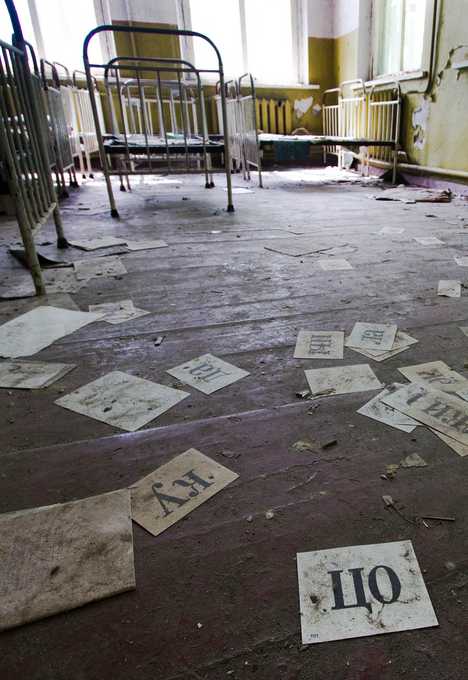
Let’s get this one out of the way post-haste: an abandoned daycare center in the nuclear ghost town of Pripyat, Ukraine. Like every other public and private facility in the former Soviet atomic boomtown (no pun intended), Pripyat’s daycare center was abandoned suddenly in 1986 when the nearby Chernobyl reactor exploded and governmental authorities couldn’t hide, er, became aware of the scope of the subsequent disaster.
 (image via: Inmobiliaria Lares)
Before the catastrophe, Pripyat’s schools and childcare centers – this one appears to be a combination of both – must have been pleasant places suffused with bright primary colors, echoing to the joyful voices of cheerful children and dedicated caregivers. That’s hard to imagine now. Kudos to Flickr user Inmobiliaria Lares for the still life (heavy on the still; light on life) photograph above.
 (images via: Toadhaven Homeschool)
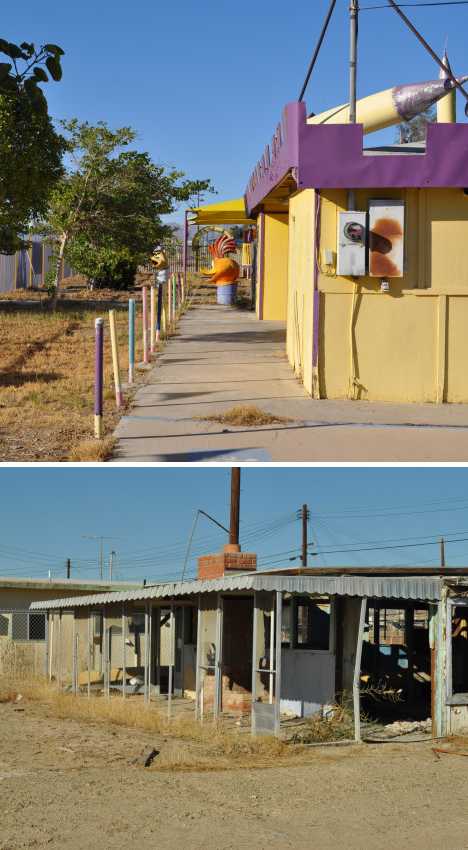
Niland, located in California’s far southeastern Imperial County just south of the Salton Sea, is home to about a thousand hardy souls and, presumably, their equally hardy children. With the population shrinking by about 20 percent in the past decade and the region’s relentless drought showing few signs of abating, borderline communities like Niland are having an especially tough time surviving. One of the town’s daycare centers, investigated by visitors from the Toad Haven Homeschool, has already bitten the dust.
 (image via: Trashsociety)
How does one make Double Rainbow Guy doubly tearful? Show him this intense late-2010 scene from an abandoned daycare center in Waco, Texas! Full credit to Trashsociety for the cropped image above, which succinctly captures the former facility in all its dayglo post-apocalyptic glory.
 (images via: West Seattle Herald)
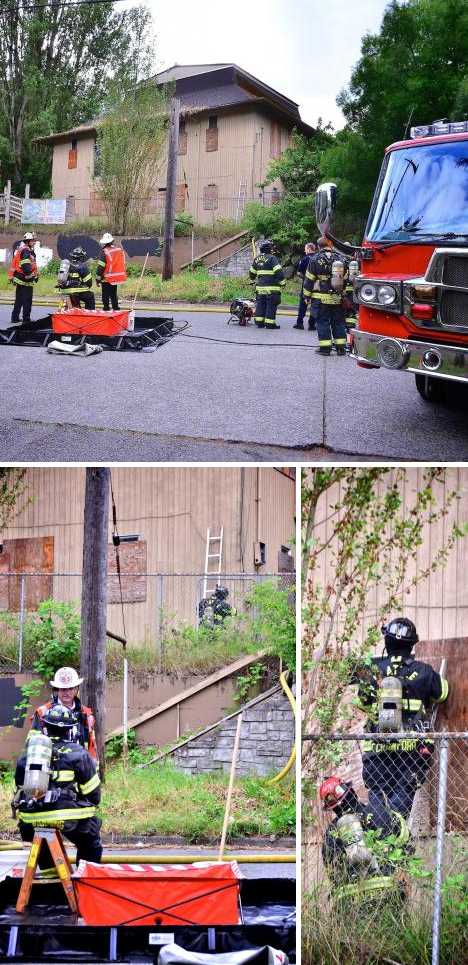
HazMat and daycare: two words that never should appear in the same sentence but did, in the June 24th, 2013 online issue of the West Seattle Herald. Reporter Patrick Robinson recounts that after receiving a 9-1-1 call, a HazMat team from the Seattle Fire Department raced to the five-years-abandoned Avalon Daycare Center and began prying boards off the former church’s windows. “It was the smell of chemicals or gas but we put up air monitoring and nothing’s coming out,” according to SFD Spokesperson Kyle Moore. We’re not sure if Moore’s referring to fumes or occupants but either way that’s a good thing.

These 10 eerie abandoned orphanages were once repositories for unwanted, illegitimate and unsupportable children from a fast-fading, socially unenlightened age.
Click Here to Read More »»

In some cases disaster strikes. In others, changing technologies render old designs obsolete, leaving majestic airplanes and giant steamers to rust and gather …
Click Here to Read More »»
Alley oops! From lustrous lanes of leisure to the gutters of despair, these 10 eerie abandoned bowling alleys have all gone so quiet you can hear a pin drop.
Click Here to Read More »»


[ By Steve in Abandoned Places & Architecture. ]
[ WebUrbanist | Archives | Galleries | Privacy | TOS ]

The new Panasonic GM1 is a tour-de-force of miniaturization. It takes most of the capabilities of the GX7 and squeezes them into a body smaller than just about any interchangeable lens camera ever made. But, is this a "good thing"? Find out in Michael’s hands-on report from Antarctica and Chile.
FIND OUT MORE
…
The Luminous Landscape – What’s New
Recently I was introduced to a free open source RAW file editor called Darktable. I know most everyone loves free stuff and quality RAW file editors are not easy to come by with a price tag of $ 0.00, so I thought it would be worth taking a quick look at Darktable vs Lightroom here on DPS.
I’d like to preface this article with a simple disclaimer…
I’ve only spent a handful of hours with Darktable and therefore by no means have I mastered the workflow and features packed into it. My intention here is to introduce it to you and share with you some of my experiences within the first few hours of opening it up. Is it for you? I can’t say that for sure, but if you’re like me, and you’re saying – “Did he just say free?” – than why not head on over to Darktable’s website and get your own copy today.
Darktable is no slouch when it comes to RAW file processing. In fact, it is probably one of the better free options that I’ve come across in my travels. If there is one flaw with the software I’d have to say that it boils down to its learning curve. It simply has A LOT of tools, and as a result the interface ends up feeling a bit cluttered and confusing to a first time user.

Overall the basic processing will feel very similar to Lightroom. The tools are broken into different groups, you still move sliders around to manipulate the photograph, and you have various ways of doing the same action. It feels very much like it was inspired by Lightroom and while there are some similarities, it is also very different in what it can, and can’t do.
I’m not going to go through everything in this article, but rather, just show you a couple of generic examples that I ran through both Darktable and Lightroom 5.
In this first example I’ve spent a bit of time processing a very simple photograph of a flower. I thought this would be a nice simple start to get my feet wet with the program.
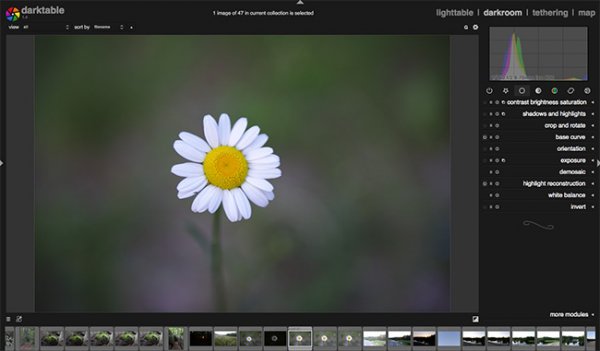
Darktable Screenshot – Before
Notice how Darktable’s imported image appears slightly underexposed compared to that of Lightroom. While this isn’t a big deal, it is interesting that the same RAW file displays differently by default within the two programs.
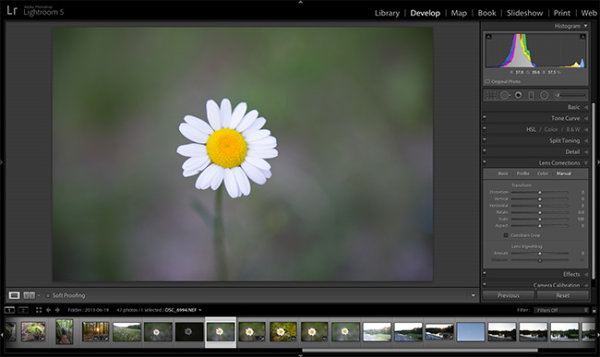
Lightroom Screenshot – Before
Overall the workflow for processing images is much simplier and more streamlined in Lightroom, but both pieces of software do perform quality edits on the flower. While I did try my best to get the two edits to come out to be the same, they did end up a bit different. This isn’t necessarily a flaw of Darktable, just that its layout of sliders, nomenclature, and the way the algorithms and coding behind the scenes work to process your edits are different.

Darktable final edit

Lightroom final edit
Another example, which I thought might be more difficult for Darktable to handle, was a photograph taken just after sunset. It was part of a bracketed set of images and was slightly underexposed. My goal here was to see how Darktable performed at recovering shadows from underexposed areas while retaining the highlight details in the sky and reflections.
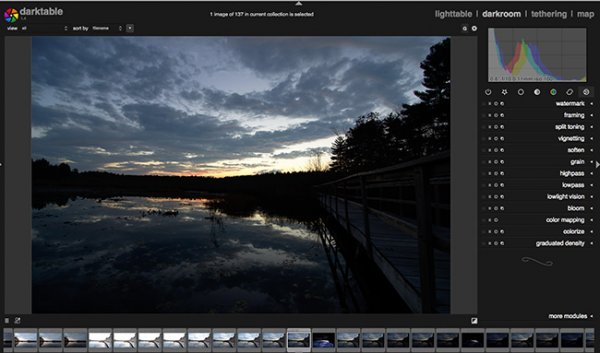
Darktable Screen Shot – Before
You can see here, once again, the original RAW file imported into Dartable is slightly darker compared to that of Lightroom. Potentially this is something that could be fixed within the settings of the program, but either way, it is a consistent trend in my experience.
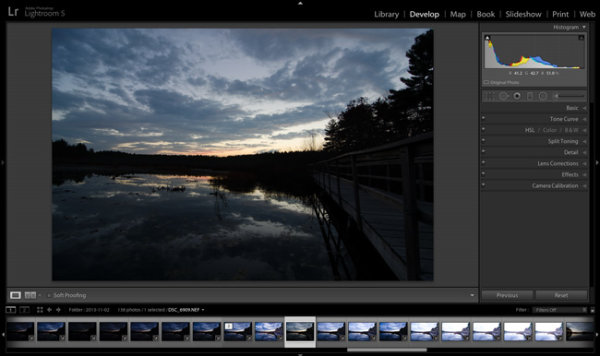
Lightroom Screenshot – Before
As I mentioned, the goal for this edit was to recover the foreground shadows along the tree line and retain the highlight detail just above the horizon and within the reflections.
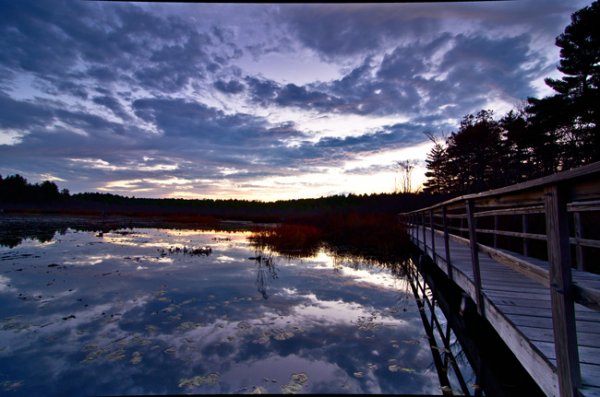
Darktable Final Edit
You’ll notice that while Darktable was able to dramatically improve the photograph, Lightroom was able to retain more detail in the brightest and darkest regions of the original photo. This wasn’t surprising to me as Lightroom has only recently had this much control over these areas of the photograph and I can only imagine how much math goes into creating the code behind the operations that we perform with a simple move of a slider.

Lightroom Final Edit
Darktable is a powerful RAW image processor – there’s no question about that – and for the price of $ 0.00 it is an attractive alternative to Lightroom. It’s not going to replace Lightroom for me and probably won’t for anyone who currently uses Lightroom, but if you’re absolutely set on paying nothing for a RAW file processor, Darktable might be the perfect choice for you.
Over to you – have you used Darktable? What are your own experiences with it? Do you have any tips to share with those who are trying it for the first time?
The post Darktable vs Lightroom – Does it measure up? by John Davenport appeared first on Digital Photography School.

We’re at the CP+ show in Japan this week and one of the busiest stands belongs to Sigma. Best known for manufacturing lenses, Sigma is showing off its latest camera, the dp2 Quattro. Editor Barnaby Britton sat down with Kazuto Yamaki, CEO of Sigma, for a chat about the Quattro, as well as the challenges of the modern photography industry and what it’s like being the head of a family business.
News: Digital Photography Review (dpreview.com)
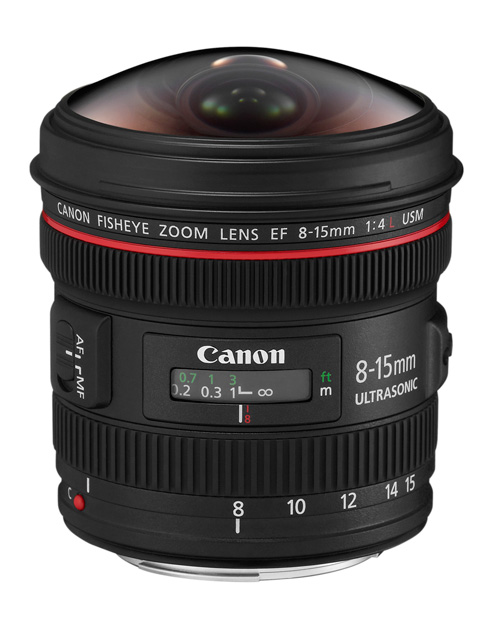
Canon’s 8-15mm f4L fisheye is an unusual lens, the only fisheye zoom that I know of. Most fisheye lenses are primes.
Following on from my article A Concise Guide to Choosing a New Lens I thought it would be interesting to go a little deeper into the question of whether to buy a prime lens or a zoom.
First, the definitions:
Prime lenses have a fixed focal length. There is no zoom ring and no way to magnify the subject other than moving closer. There are two settings to adjust: aperture (often handled by the camera) and focusing distance.
Zoom lenses have a variable focal length. There are three settings to adjust: aperture, focusing distance and focal length.
Both primes and zooms have benefits. I’m not going to try and persuade you one way or the other. Rather, the goal is to explore the benefits of both to help you decide which is the best for you.
Generally speaking, prime lenses have better image quality. It is easier to make a lens with good optical performance at a single focal length than it is to make one that performs well through the entire range of a zoom lens. This is especially true with wide-angle lenses where zooms tend to suffer from barrel distortion at the shortest focal lengths. With longer focal lengths (ie. 50mm plus), there is less difference in the performance between zooms and primes.

This photo shows the barrel distortion of an 18-135mm zoom lens set to 18mm. The curved lines in the frame should be straight.
Prime lenses tend to be smaller and lighter than zooms covering the same focal length range. This isn’t true all the time, high end primes are bigger because they have wider maximum apertures, which need larger lens elements to let the light in. Anyone who has used Canon’s 85mm f/1.2L prime lens knows what I mean – it’s a monster.
Don’t forget that the size and weight advantage is quickly lost if you end up buying two or more primes to cover the same focal range as a zoom. But if your aim is to use your camera with a single, lightweight lens then primes are the way to go.
An advantage of smaller lenses is that they are less obtrusive for portrait and street photography. It’s interesting how lens size affects the dynamics of a portrait shoot. In my experience models, even experienced ones, are much more relaxed in front of the camera when I use a smaller lens.
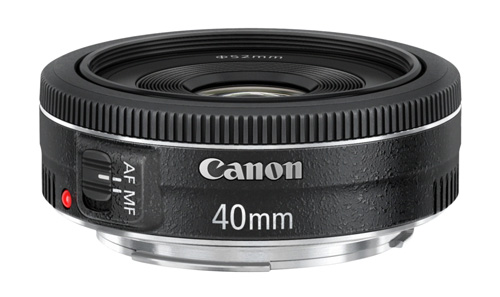
The Canon 40mm f/2.8 pancake lens is about as small and light as you can get. Pancake lenses are the ultimate in unobtrusive lenses.
The wider maximum apertures of prime lenses are useful for taking photos in low light or for creating beautiful bokeh. They also let more light into the lens, giving you a brighter image on cameras with optical viewfinders. However, if you have a camera with good high ISO performance you may not be so bothered about the advantages of using primes in low light.

You can only take portraits like this one that have very little depth of field with prime lenses. Shot at f/1.8 with an 85mm lens.
Prime lenses often give really good value for money, especially at the lower end of the price range. Most manufacturers have inexpensive prime lenses in their range that give superb image quality, much better than you would get from a zoom lens costing the same.
There was a time when the quality of zoom lenses was so poor that most photographers didn’t use them. Thankfully, things have changed and they have become more popular as the quality has improved. These are the main benefits of zoom lenses:
The main benefit of zooms is the convenience arising from covering a range of focal lengths in one lens. This can save you time (swapping lenses) and money (being cheaper to buy one zoom than two or more primes). Zooms are useful as walkabout lenses, or if you are working in dusty or damp conditions where you don’t really want to take the lens off the camera.
With so many benefits, are there any disadvantages? Unfortunately the answer is yes. Here are some things to bear in mind:
The trade-offs for convenience are image quality and size. Zooms tend to be bigger than primes, and if you want one that has good image quality throughout the entire focal length range then you will need to spend some money. One tip is to go for lenses that cover a shorter focal length range, such as a 24-70mm rather than 18-200mm.
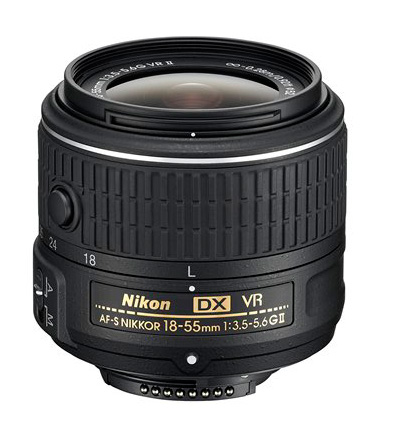
A kit lens with variable maximum aperture. Avoid these types of zooms if you can.
Another thing to watch out for on cheaper zoom lenses is variable aperture. An example: an 18-55mm f/3.5-5.6 kit lens has a maximum aperture of f/3.5 at the 18mm end but only f/5.6 at 55mm. This makes it harder to work in manual mode (what if you have the aperture set to f/4 at 18mm and then zoom in to 55mm?) and is a general hassle all-round. Pay a bit more and get a fixed aperture zoom.
While some people will tell you that a benefit of prime lenses is that they make you zoom with your feet (ie. move closer to or further from the subject to change the composition) there are times when this isn’t possible. You may be at a sporting event, and unable to get any closer to the athletes involved. Or you may be standing near the edge of a cliff taking a landscape photo, unable to move further forward because you would fall off. Zoom lenses are invaluable in situations such as these.
I took this photo standing near the edge of a cliff. I couldn’t move any further forwards, but was able to frame the image precisely using a 17-40mm zoom lens.
Now it’s your turn. What lenses do you prefer to use – zooms or primes? Have you bought any lenses recently and why did you decide to buy them? I’m looking forward to reading what you have to say.

My ebooks Understanding Lenses Part I and Understanding Lenses Part II will help Canon EOS owners decide what lenses to buy for their cameras. They are both filled with lots of tips to getting the most out of your Canon lenses. Click the links to learn more.
The post Buyers Guide – Prime Lenses vs Zoom Lenses by Andrew S. Gibson appeared first on Digital Photography School.
Plant Ihr schon Euren diesjährigen Urlaub? Unsere Artikelserie „Fotogenes Deutschland“ zeigt schöne Orte aus ganz Deutschland, die nicht nur fotografisch interessant sind, sondern oft auch zum Wandern und Entdecken einladen. Es fehlt in unserer Serie noch ein ganz besonderer Ort? Dann zeigt Ihn uns, macht tolle Fotos und schreibt darüber.
Fotospecial: Wintersport
Flickr


500px


Deutschsprachig
• Wie findet man schöne Locations in der nächsten Umgebung? Foufinha kennt ein paar Tricks.
• Eine kleine Bildserie über unsere Einstellung zu Nahrungsmitteln und der Frage, was gut, schön, neu, und frisch ist.
• Der 18-Jährige Hobbyfotograf Philip Paulus sah in einem Musikvideo von Rihanna eine Szene, die fast eins zu eins eines seiner Bilder nachstellte. Vor dem Landgericht Stuttgart reicht er momentan Klage ein.
International
• Rachel Baransi fotografiert Fremde in Amsterdam.
• Der Blogger VSE OK zeigt Miniatur-Superhelden in absurden und lustigen Situationen.
• Sofie Knijff hat Kinder aus ländlichen Gebieten in Südafrika, Indien, Mali, Brasilien, Island und Grönland fotografiert, verkleidet als das, was sie später einmal werden möchten.
• 30 sehr aussagestarke Bilder, die viel über Menschlichkeit und Unmenschlichkeit erzählen. Überlegt, ob Ihr sie wirklich sehen wollt, es sind auch Tote zu sehen.
• Steve McCurry fotografierte auf seinen Reisen auch immer wieder Menschen beim Lesen. Eine Sammlung dieser Bilder haben wir hier gefunden.
• Auf Kickstarter wird für die Entwicklung einer speziellen Tastatur für Photoshop und andere Grafik- und Video-Software-Editionen für PC und Mac gesammelt.
• Der Erste Weltkrieg in Farbe: Fotos der deutschen Front des Fotografen Hans Hildenbrand.
• „In My Bag“ ist dazu da, dass Fotografen den Inhalt ihrer Fototaschen präsentieren. Zu entscheiden, ob das nun wirklich interessant ist, überlassen wir mal lieber Euch.
• Der Franzose Ludovic Florent fotografiert Akt auf äußerst hohem Niveau, wie eines seiner Projekte mit dem Namen „poussière d’étoiles“ zeigt.
• „Die Zwei“ ist ein Fotoprojekt mit dem Ziel, die hektische Welt zum Stillstand zu bringen und romantische Ideale in die Welt zu bringen. Schöne Fotos gibt’s auf jeden Fall.
Neuerscheinungen und Tipps vom Foto-Büchermarkt

• „Hinter den Bergen“ von Lois Hechenblaikner* zeigt, auf welch dramatische Art und Weise sich die Alpen in den letzten zwei Generationen verändert haben. Seine Farbfotografien stellt er den 60 Jahre alten Bildern von Armin Kniley gegenüber und konfrontiert den Betrachter so mit zwei gegensätzlichen Szenarien. Einen Einblick ins Buch bekommt man auch auf der Homepage des Fotografen. Das Buch wird für 28 € erhältlich sein.
• „Topos: Fotografien 1991-2011“ von Tobias Madörin* zeigt großformatige Farbfotografien aus Barcelona, São Paulo, Grindelwald, Uganda, Japan und Indonesien. Der Schwerpunkt liegt dabei auf urbanen Sammlungspunkten. Der große Bildband ist 256 Seiten dick und kostet 80 €.
Zitat der Woche
Es gibt nur eine Regel in der Fotografie: Entwickle niemals einen Film in Hühnchensuppe.
Freeman Patterson –
Mehr Zitate
Videos
Brandon Stanton fotografiert Menschen in New York und seine herzliche, sympatische Art hilft ihm dabei, schnell das Eis zu brechen.
Der Fotograf Robert Nickelsberg spricht über seine Arbeit in Afghanistan seit 1988.
* Das ist ein Affiliate-Link zu Amazon. Wenn Ihr darüber etwas bestellt, erhalten wir eine kleine Provision, Ihr bezahlt aber keinen Cent mehr.
kwerfeldein – Fotografie Magazin

Building modern digital cameras and lenses is an exacting business. Each product is made up of sometimes hundreds of tiny components, assembled to meticulously narrow tolerances and if one piece is out of alignment, the whole is compromised. But you want to see what stuff looks like when it’s been cut in half? Yes. You do, you know you do. It’s OK, we won’t tell anyone. Click through for a look at things that we found at CP+ that have been cut in half.
News: Digital Photography Review (dpreview.com)

We’re at the CP+ show in Yokohama Japan where Fujifilm is showing off its latest camera, the weathersealed X-T1. Yesterday the show was cancelled due to heavy snow and today the line of people waiting to get in is formidable. Editor Barnaby Britton finagled an exhibitor’s pass to get in early and beat the crowds. Click through to read our report from the Fujifilm stand.
News: Digital Photography Review (dpreview.com)
You must be logged in to post a comment.