RSS
 

Archive for January, 2014

Bike Tire Tent: Compact Travel Shelter Wraps Inside Wheels

29 Jan

[ By WebUrbanist in Technology & Vehicles & Mods. ]

tire bike travel tent

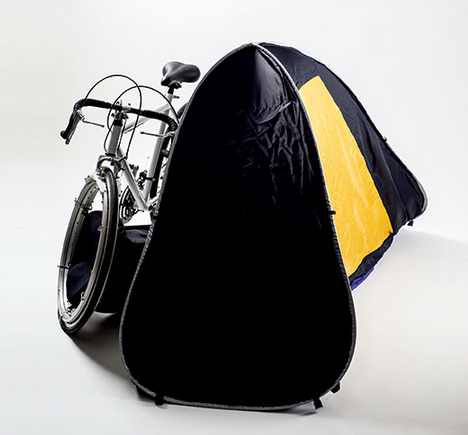
For the cycling nomad, this design uses space you never knew you had, and helps free up room in front-of-handlebar baskets or on above-back-tire racks for other uses in the process.

tire deployed camping closeup

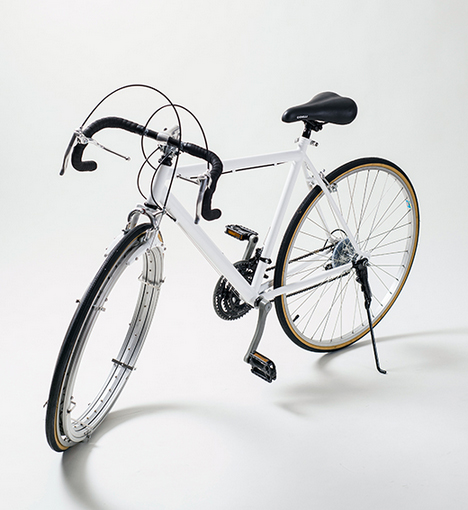
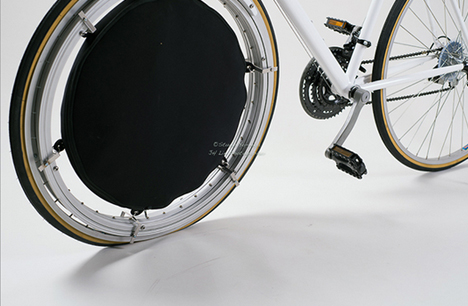
Designed by Chung-Jung Wu, Pei-Chun Chen & Li-Fu Chen, a specially-reinforced tire creates a void into which a biker can clip their travel tent for extended rides.

tire shelter wheel design

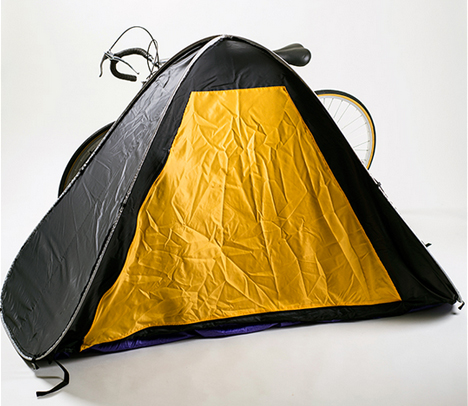
The easy-to-access clasps make it simpler and speedier to deploy the tent when you reach your temporary destination, rather than unwrapping it from a pack or unstrapping it from a fender platform.

tire tent fully open

Of even greater value to long-distance travelers: precious cargo space on your back and elsewhere on your bicycle is freed up for clothes and other essential gear.

Share on Facebook


[ By WebUrbanist in Technology & Vehicles & Mods. ]

[ WebUrbanist | Archives | Galleries | Privacy | TOS ]


WebUrbanist

 
Comments Off on Bike Tire Tent: Compact Travel Shelter Wraps Inside Wheels

Posted in Creativity


Apple’s magnetic solution for expanding capabilities of iPhone camera

29 Jan

Screen_Shot_2014-01-28_at_6.28.19_PM.png

Two patents, discovered by AppleInsider, show how Apple might allow users to expand the photographic capabilities of their iPhones. One describes a removable ‘back panel’ which contains different camera options, and another (slightly more plausible in the near-term) details how users might be able to attach ‘modules’ to their phones’ camera lenses to provide different lens options. Click through to learn more at Connect.

News: Digital Photography Review (dpreview.com)

 
Comments Off on Apple’s magnetic solution for expanding capabilities of iPhone camera

Posted in Uncategorized


5 Things to Consider Before Starting Your Photography Business

29 Jan

Starting a photography business is extremely easy with the accessibility and affordability of digital cameras and processing programs. Often the lure of entrepreneurship, with these low barriers to entry, leads to many photography business owners of all business experiences. Experience levels range from lack of business competence, to the need for growth in photography skills to a mixture of skills with varying weaknesses and strengths. Before entering into business it is important to evaluate whether you are technically proficient, ready to deal with business legalities, have a good grasp of business operating costs, engaging in market research and client management.

Photography business 05

#1 – Are you technically proficient?

The first step is to determine if technical proficiency is at a level to provide a quality, consistent product to each client that comes through the door. The importance of delivering consistently rests in word of mouth marketing and preventing disappointment when a client’s expectations are not met.

Photography business 04

#2 – Are you ready to deal with business legalities?

After technical proficiency comes the battle of business legalities including (but certainly not limited to: business formation, filing appropriate tax documents, acquiring required permits and licenses and using quality contractual documents. These legalities can be acquired through outsourcing to lawyers and certified public accountants, but a good, knowledgeable grasp of business legalities and the requirements placed on business owners is paramount to the success of your business.

Photography business 03

#3 – Do you know your business operating costs?

Following the previous two business necessities comes the costs of running the business. Having arms around the operating costs will assist you in setting appropriate pricing, and in making future investment decisions. Business operating costs are expenses that are directly related to the operation of the photography business. This is calculated by ascertaining costs of resources used to maintain the existence of the business. Operating costs include: rent, utilities, licenses, fees, insurance, maintenance of equipment, office supplies, income taxes, and wages.

Note: It is a good idea to also include a “rainy day savings” into the operating costs for you to have to fall-back on in times of need.

Photography business 02

#4 – Have you done your research?

An ever-required and demanding aspect of business is the initial and constant research on market influences, demands and overall factors that impact how the business will be maintained and marketed. Engaging in research is an organized effort to obtain information about the local market and potential clients. In order to effectively create and implement a successful business strategy, research must be done. Research should include identifying marketing information, trends, and the SWOT (SWOT = Strength, Weakness, Opportunity and Threats to the business) analysis of competitors. The strategies decided upon from out of this research are a key factor to maintaining a competitive edge over competitors and a higher probability for engaging clients.

Photography business 07

#5 – Do you know how to manage clients?

Juggling all of the previous “business things” can get even more complicated when adding on managing of clients. Having a solid business workflow filled with automation, organization and constant revision is necessity to keep the business moving forward when it becomes easy to be distracted with client management and production of the products and services.

Photography business 06

Having the right answers to these considerations does not guarantee a successful business but will increase probability for success, higher level of client satisfaction and less frustration along the way.

The post 5 Things to Consider Before Starting Your Photography Business by Rachel Brenke appeared first on Digital Photography School.


Digital Photography School

 
Comments Off on 5 Things to Consider Before Starting Your Photography Business

Posted in Photography


28. Januar 2014

29 Jan

Ein Beitrag von: .vermilion

Schneeflocke, Makro, Nahaufnahme,


kwerfeldein – Fotografie Magazin

 
Comments Off on 28. Januar 2014

Posted in Equipment


Swim the Thames: Pair of Pools for London’s Polluted River

28 Jan

[ By WebUrbanist in Architecture & Public & Institutional. ]

london urban swimming design

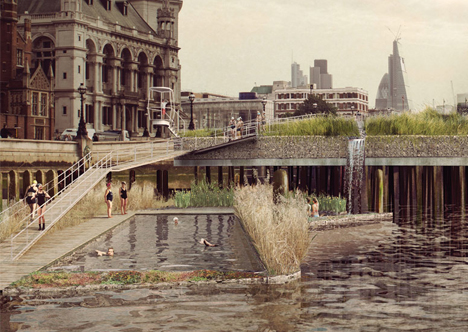
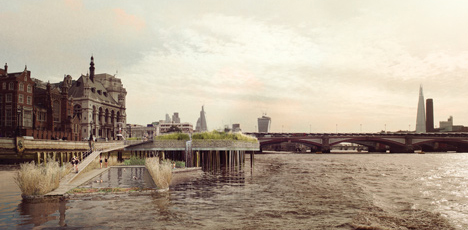
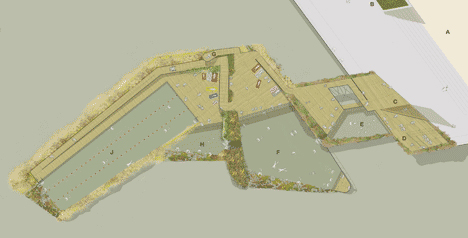
Inspired by planned Super Sewer that will reduce pollution in London’s central waterway by 96%, this audacious design aims to take advantage of a future in which it is finally safe again to swim in the River Thames. Unlike a similar proposal for New York City’s Hudson River (more on that below), this bold plan proposes to use unfiltered river water to fill its swimming holes.

london swimming overview image

london pool site plan

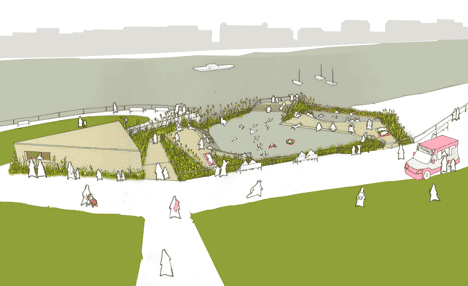
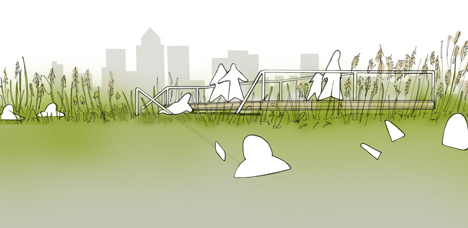
Studio Octopi and their partners at Civic Engineers and Jonathan Cook Landscape Architects ask doubters to imagine the experience of clean swimming right in the heart of the city, with incredible urban views framed by rich regional plant life.

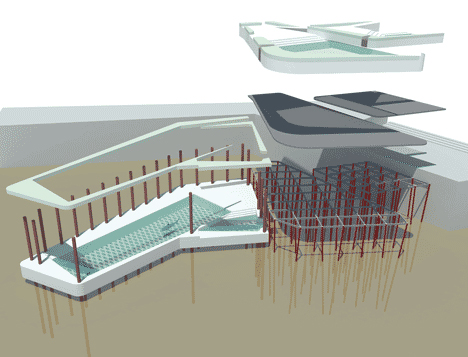
london pool structural diagram

One fixed-in-place pool would be replenished each time the surrounding tides rise over its high water mark (like coastal rock pools). The other would itself lift and lower, floating up and down with the river’s natural highs and lows, thus providing swimmers with a sense of the currents but within a protected space.

london thames in context

london pool landscape watercolor

More on the project’s context: “In 1865, Sir Joseph Bazalgette’s London sewage system was opened. 150 years later the sewers are at the limits of their capacity. In 2012, 57 combined sewer overflows discharged 39 million tonnes of sewage into the River Thames. Thames Water is planning the Thames Tideway Tunnel, or ‘Super Sewer’, for completion in 2023.”

new york pool rendering

new york urban swimming

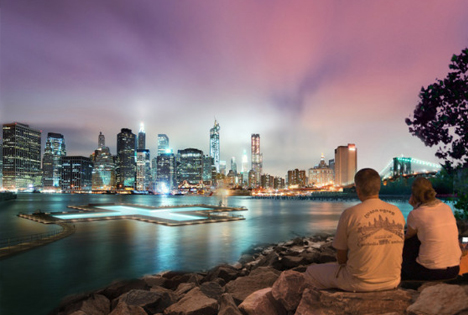
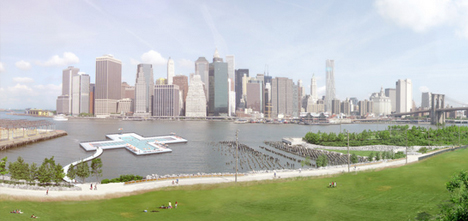
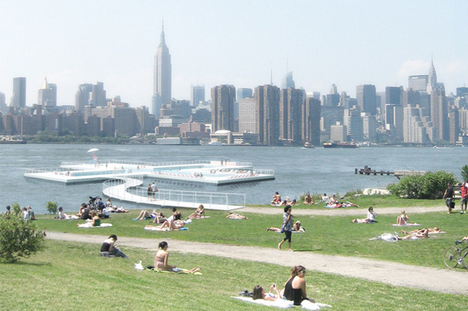
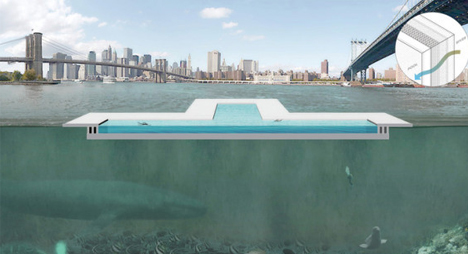
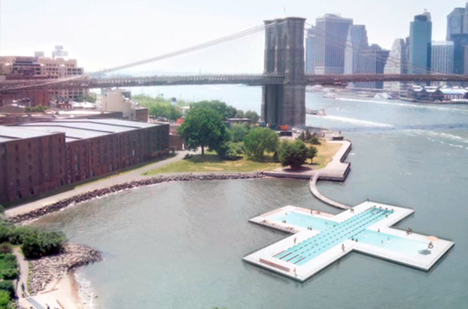
Meanwhile, across the pond in New York, the Plus Pool reached its crowdfunding goal some time ago but is a long way from completion. Though both propose to use water from the rivers they are set in, this one, unlike its British brethren, assumes filters will be essential.

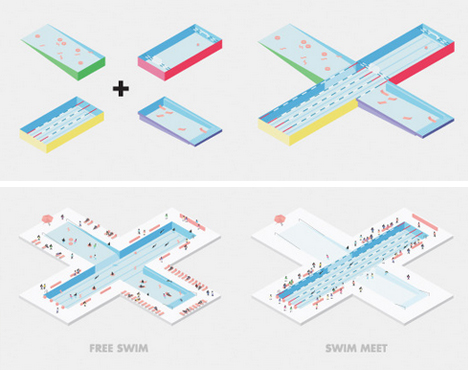
new york pool diagram

new york plus pool

The design is also somewhat more contemporary – the plus shape is clean, modern and separates the pool into four primary zones for different use cases.

new york pool section

new york hudson pool

Whether either proposal will be realized remains to be seen, but one thing they may have in common: selling the public has already proven easier than pushing their respective cities into accepting the plans and taking action on them.

Share on Facebook


[ By WebUrbanist in Architecture & Public & Institutional. ]

[ WebUrbanist | Archives | Galleries | Privacy | TOS ]


WebUrbanist

 
Comments Off on Swim the Thames: Pair of Pools for London’s Polluted River

Posted in Creativity


How to Create Portraits With Depth

28 Jan

Ben Evans - Street Photography, Barcelona

Would you like to make portraits that show more about the person’s character than what they look like? In this article, you’ll learn some new ways to look at your subjects so you can better understand them; and therefore create portraits with depth and more interest.

A portrait is a picture of a person. So, what separates the pictures we make from those made by a photo-booth?

Leaving discussions about mind-body duality aside, it’s safe to say that we’re all flesh and blood. Our photographs, therefore, are of surface appearances. But beauty is more than skin deep.

What we call character, or soul, or ‘I’ is the driving force that makes, shapes, and motivates our bodies; and our inner thoughts and emotions are often written on our faces.

This is my personal approach to portraiture and particularly portrait photography, gleaned from countless hours of reading, and a degree in Literature, Philosophy and Psychology. It’s compressed a lot here, but should be useful if you explore each area independently.

Reading your subject’s character

Portrait photography aims to capture and communicate some aspect of a person’s character. I think this shows itself in a few ways

prince-charles-english-photographer

What are their habits?

What we do often changes us; makes us. Whether it’s Aristotle talking about excellence as a habit, or Warren Buffett urging graduates to develop the habits of success, habits are an important part of who you are. If you exercise regularly, you get fit. If you eat well, you’ll be healthy. Habits are hard to fake, because they have to be consistent in order to have much effect. Look at your subject; how have habits transformed them?

Ben Evans Barcelona Documentary photography

What decisions have they made?

Satre said that making no choice is still a choice. If I let my beard grow, it can either be a decision to do so, or an unconscious decision not to shave; so decisions can be active or passive. Do they have an afro, or dreadlocks? Both take commitment to grow and maintain so why did they bother? Ask them about the choices that they’ve made with their bodies; it says a lot about their character.

A tattoo is a good example of a decision to pay attention to when making a portrait. It might indicate teenage rebellion, artistic expression or even affiliation with the Japanese underworld. It’s a choice to permanently mark the body; so it’s likely that some thought has gone into it. Likewise with piercings. Is it a yearning to be different? Or to be the same?

This is also a space to think about what they spend most of their time doing; and that’s generally going to be their career. Are they following their passion, living their dream? Or are they worn down in a job they’d rather forget? Both tell stories. Uniforms may be one indicator; but it’s not too difficult to tell a rock star apart from a senior diplomat.

ben-evans-english-photographer-guardsman

How does the subject present themselves?

How are the subjects presenting themselves to the world? This can be intentional, like putting on a smart suit with finely polished shoes, or passive, when they are wearing clothes that were chosen ages ago. Chances are that they spent quite a bit of time choosing what they are wearing; at the shop, and on the day. Steve Jobs had his iconic turtleneck sweaters with jeans, and Doctor Who has his bow ties. Which identity have they bought (and bought into)?

Somebody might think of themselves as belonging to a certain nationality, a subgroup or clan; but photographs are silent, and you’ll want to look at the outward expressions of this in order to communicate this message. People often have ‘props’ that can say a lot about them. It might be an expensive watch; a necklace; a well-designed house; or if they’re young, a light sabre or cuddly rabbit. Assuming your subject isn’t naked, what have they brought with them? Ask them about what they’re wearing; you’ll likely be surprised by the answers you get.

portrait-photographer-barcelona-art

Facial expressions and body language

Make them laugh! I met the chap who photographed the Beatles back in the 60s and he talked about making people say ‘cheese’. I always thought this was just a quirky thing to say to break the tension, but the idea is that the mouth forms a smile when you say the word ‘cheese’. This works better than telling someone to smile; but not by much. Mainly because expression isn’t just in the mouth; it’s a product of a whole range of muscles in the face. Ask the robot designers in Japan who are trying to replicate human emotions on an android’s face!

So the best way is to actually elicit emotions to create the gestures that you’d like to photograph. There are lots of ways to achieve this, but most need to be taught in person. It is worth noting that people are never just the face they show you; there’s a whole host of different identities that make up their sense of who they are. It’s a matter of bringing them to the fore.

Body language is also an incredibly revealing aspect of non-verbal communication. Every portrait photographer should have an awareness of different postures, and how they can help in reading a person. And of course, it’s possible to pose a subject too. One part of Holistic Photography (which is the philosophy that photography needs both craft/technique and art/vision) is a study of micro-expressions and how to see, and photograph them. Our faces will register emotions before we have time to control them. So you can photograph someone’s ‘real character’ by eliciting these micro-expressions, and then capturing them in the photograph.

portrait-photography-YN560iii-flash

Physical attributes – what can you focus on?

One thing I didn’t mention, partly because it’s hard to avoid doing, is the ‘flesh and blood’. Some people just have fascinating faces, topographically. It might be that their eyes are bright green. This is a rare and beautiful eye colour, so chances are other’s reactions to it will have influenced their sense of self – rather like Kafka explores in The Metamorphosis. Likewise, my ginger cousins have developed an identity around their red hair. People, unconsciously or otherwise, live up to these imposed identities. I’m 6’2″. It’s a number; my height. But does it mean more than that? What about a ‘Perfect 10′? It’s just an arbitrary measurement; but numbers are intrinsically linked to our self-worth in our consumerist society. Look for physical features that stand out, that are striking. How is your subject restricted by their physical identity? How are they empowered by it?

Summary

Hopefully this gives you some different things to think about when you’re photographing people and want to make portraits with a bit of depth. Holistic Photography goes a lot deeper within each category but my writing isn’t good enough yet to properly communicate what’s pretty simple to demonstrate and explain in person. Therefore, have a look at portraits you admire, both photographic and painted, and look at each of the different categories to see what fits.

Then practice really going beyond the person-as-object photography by finding out more about your subject. Think like Sherlock Holmes. Push like Platon. Light like George Hurrell. And feel like Edith Piaf. Portraiture is like a game of chess; ‘you must think first, before you move’!

The post How to Create Portraits With Depth by Ben Evans appeared first on Digital Photography School.


Digital Photography School
 
Comments Off on How to Create Portraits With Depth

Posted in Photography


Fujifilm X-T1 offers weather-resistant body and improved EVF

28 Jan

1.png

Following its first appearance in a teaser ad last week (and a comprehensive leak), the Fujifilm X-T1 makes its official debut. It’s a weather-resistant, SLR-styled mirrorless camera bearing a 16MP X-Trans CMOS II sensor, a chip it borrows from its X-E2 sibling. What really separates it from the X-E2 is the X-T1’s giant electronic viewfinder and triple control dials on its top plate. The X-T1 also has Wi-Fi built-in, and supports remote control from a smartphone.
News: Digital Photography Review (dpreview.com)

 
Comments Off on Fujifilm X-T1 offers weather-resistant body and improved EVF

Posted in Uncategorized


Fujifilm X-T1 First Impressions Review

28 Jan

decrapped.jpeg

The Fujifilm X-T1 has a lot in common with its X-series siblings – bearing an important distinction: it’s weatherproof. It does in fact offer many of the same inner workings as the X-E2, including its 16MP X-Trans CMOS II sensor with on-chip phase detection. On top of that it adds a revamped EVF, an OLED panel boasting a claimed lag time of 0.005 seconds. Consider also that it shoots 8 fps with subject tracking and it all adds up to a very well specified package. Read our first impressions review

News: Digital Photography Review (dpreview.com)

 
Comments Off on Fujifilm X-T1 First Impressions Review

Posted in Uncategorized


Pencil vs. Camera: Illusion Drawings Pop Off the Page

28 Jan

[ By Steph in Art & Drawing & Digital. ]

Pencil vs Camera Optical Illusion Drawings 1

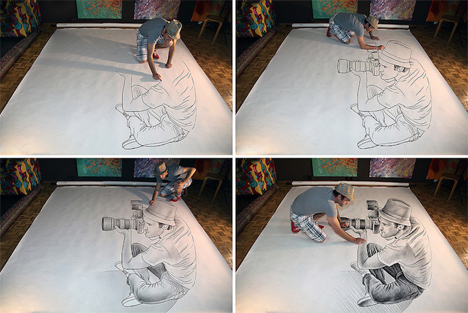
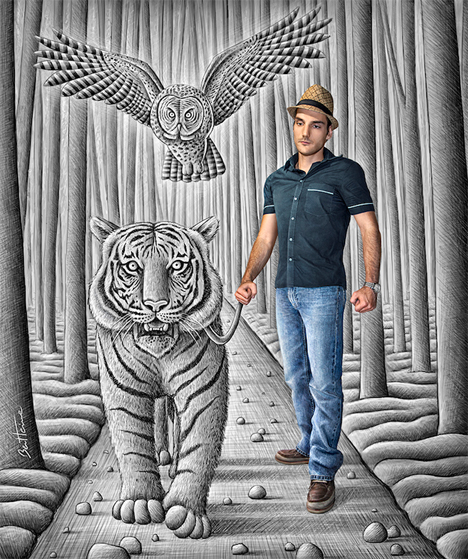
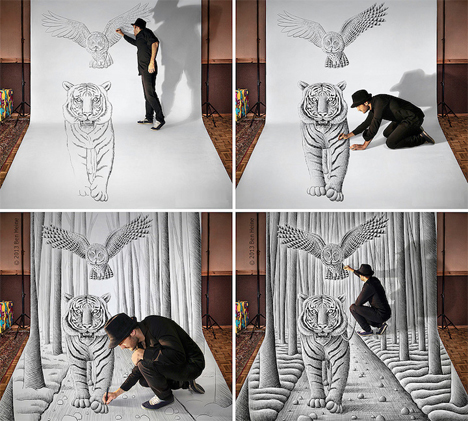
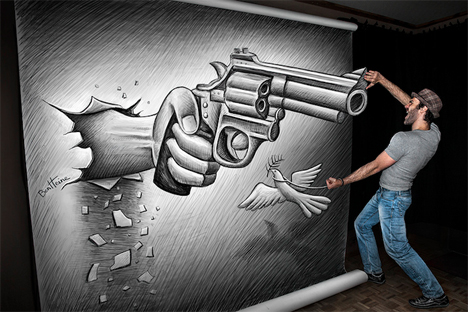
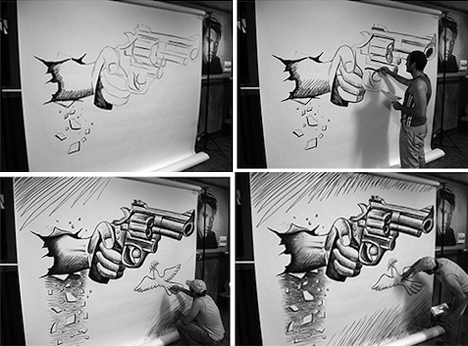
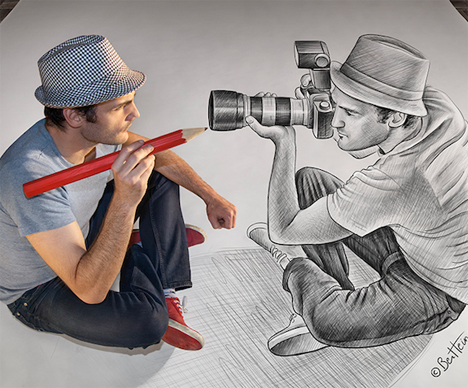
You might think artist Ben Heine has Photoshopped himself into his own pencil drawings, but he’s actually standing on top of them. Much like the mind-bending optical illusions produced in chalk by sidewalk artists, these are flat drawings that just seem like they’re three-dimensional.

Pencil vs Camera Optical Illusion Drawings 2

Pencil vs Camera Optical Illusion Drawings 3

Pencil vs Camera Optical Illusion Drawings 4

The Belgium-based multidisciplinary artist mixes photography and drawings for the series ‘Pencil vs. Camera,’ one of his best-known projects. The drawings seem to pop out from the page when viewed from a certain perspective, making it look like the artist is interacting with his own creations.

Pencil vs Camera Optical Illusion Drawings 5

Pencil vs Camera Optical Illusion Drawings 6

“I just make art for people,” says Heine. “I want them to dream and forget their daily troubles. I used to write poems many years ago, I want to convey a poetic and philosophical meaning into my pictures, each new creation should tell a story and generate an intense emotion, like a poem, like a melody.”

Ben Heine Scenery Drawings

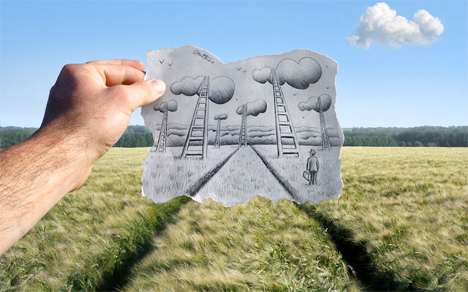
Another part of the series blends Heine’s drawings with landscape photos so they match up. The artist selects a location, draws a fanciful illustration, and then takes a photo of the combined results.

Share on Facebook


[ By Steph in Art & Drawing & Digital. ]

[ WebUrbanist | Archives | Galleries | Privacy | TOS ]


WebUrbanist

 
Comments Off on Pencil vs. Camera: Illusion Drawings Pop Off the Page

Posted in Creativity


Warning: “Strobist” Flashes

28 Jan

There is a disreputable company out of the UK and Australia persistently referring to their flashes as “Strobist Flashes.” Over my protest, they are deliberately implying an association with this site where none exists.

I have zero connection with either these people or their gear. Had they asked for any kind of endorsement, five minutes worth of research would have warned me off any association with them.

Of course, they did not ask. They merely appropriate the name and hope enough people are stupid enough not to know the difference. As such, they are merely using my company’s name and brand to try to get into your pants. Which should tell you all you need to know about the company’s ethics.

The flashes themselves are (surprise) rebranded Chinese mystery meat flashes. For the record, there are no genuine “Strobist” branded flashes. Even the LumoPro LP180, while highly recommended, is not a Strobst-branded flash. For many conflict of interest reasons, I do not sell gear.

I have asked them to stop, to no response. Clearly, they don’t give a whit about IP. Although they do of course claim copyright over the content of their site, natch. Intellectual property is important—when it suits them.

Please do not infer any type of endorsement of these (at best) bozos. I obviously do not trust them as far as I can throw them.


Strobist

 
Comments Off on Warning: “Strobist” Flashes

Posted in Photography