Month: December 2013

  • Enter the 2014 World Press Photo contest

    NAS1-AL_copy.png

    One of the premier photojournalism competitions, the 2014 World Press Photo contest, is now open for entries to professional photographers. The deadline for submissions is January 15, 2014 and the winners will be announced on February 14, 2014. The top award, the World Press Photo of the Year, carries a cash prize of €10,000 (~$ 13,764). Learn more

    News: Digital Photography Review (dpreview.com)

  • DPReview Gear of the Year Part 5: Canon Rebel SL1/100D

    goty-SL1-50mm.jpg

    A lot of equipment passes through our Seattle and London offices, everything from high-end cameras to inexpensive accessories. A lot of it gets reviewed, but we can’t cover everything. In this series of short articles, DPReview staff will be highlighting their personal standout products of the year. In part 5, Shawn Barnett talks about his personal favorite – the Canon Rebel SL1/100D.

    News: Digital Photography Review (dpreview.com)

  • Tips for Landscape Photography in Exotic Places

    The Exotic Landscape

    Landscape photography is difficult. If you live in a location that lacks spectacular landscapes, or you just fancy going somewhere new, travelling to a new location – especially a beautiful one – may seem like the solution. A few days ,or a week, in a national park or other beautiful spot with your tripod and camera sounds like a great way to create some wonderful new images. What could go wrong?

    Actually, plenty. The weather (and consequently the light) might not do what you want. If you are shooting by the sea, the timing of the tides may not be conducive to taking great photos. You may not have time to find the best places to take photos, and be able to get on location when the light is at its best.

    I wrote more about that, and the advantages that concentrating on your local landscapes here, in my article The Intimate Landscape – 5 Tips for Better Landscape Photography.

    Does that mean you should give up the idea of travel altogether? Of course not. Travel broadens the mind and provides fantastic new photo opportunities. It’s also a lot of fun. But because time is tight when you are travelling, you need to plan well to make the most of the opportunities that come your way. I’m going to show you how in this article.

    Do your research before you leave

    Research is very important. If your visit is brief, you’re going to be under time pressure. The more preparation you do, the better prepared you will be.

    1. Use Flickr and 500px

    The Exotic Landscape

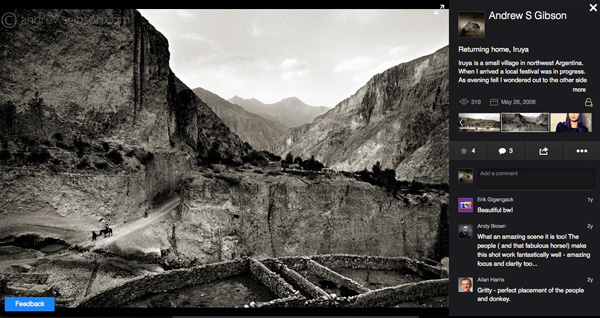
    Get on both of these websites (Flickr and 500px are both free to join) and search for photos taken in the place that you are going. The results will give you a great idea of the potential of that location. You might also find some new spots, away from the ones that everybody else seems to photograph.

    If you are going to a coastal location, try and figure out how the changing tides affect the composition of the images you see. Some places are at their best at high tide, and others are at low tide. If this is the case, do an online search for tide tables. If the best photo opportunities are at low tide, for example, then the ideal time to travel there is when low tide coincides with sunset or sunrise, so you can take advantage of the golden hour and twilight.

    Got a question about an image? Why not send the photographer a message and ask for their advice? Not everybody will reply, but you may receive invaluable advice from those that do.

    2. The Photographer’s Ephemeris

    The Exotic Landscape

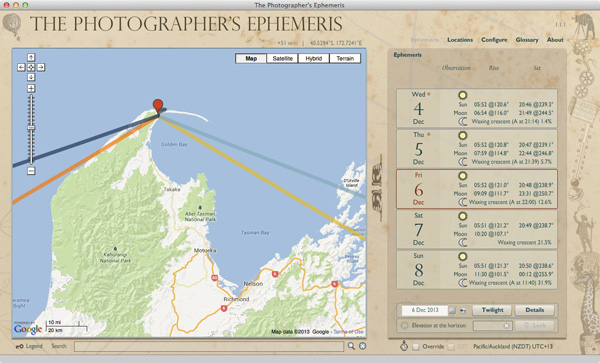
    When you are looking at other people’s photos, bear in mind that the light, and the direction it comes from as the sun rises and sets, changes during the year. There’s an easy way to calculate where the sun will rise and set in any given location, at any time of the year. Simply download The Photographer’s Ephemeris – this application will do the calculations for you. It’s free for Windows and Mac OS X; ideal for research before you go, and you can buy apps for smart phones and tablets; useful if you may need to use it while out in the field.

    3. Check the weather forecast

    The Exotic Landscape

    It sounds almost too obvious to mention here, but it’s important to check the weather forecast before you go. Most trips are booked ahead of time, but long range forecasts are only accurate a few days in advance. Checking the forecast helps you prepare.

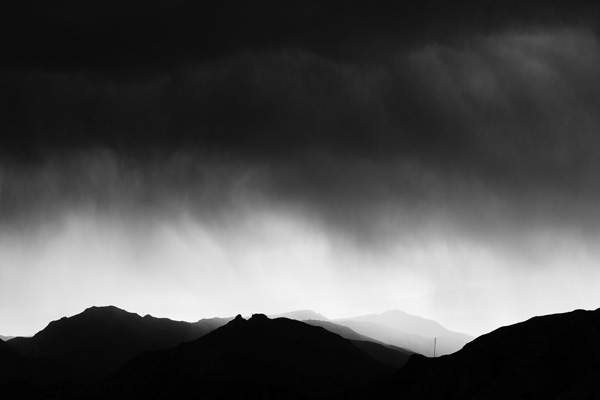
    What if the forecast is for rain and cloudy skies? Then you need to work out how you are going to cope with that (for example, you could work in black and white, or concentrate on creating evocative images showing the background blurred out by the rain). If rain is forecast, make sure you have a waterproof camera bag to protect your gear and lens cleaning tissues or cloths to clean water off your front lens element. A cover to protect the camera is also a good idea (you can buy them from Amazon or BH Photo & Video).

    4. Take minimal gear

    Think about the gear you need to take. It’s a personal choice, but the trick is to find the balance between taking enough lenses and accessories to create great images, but not carry so much that you are so worn out when you arrive at your destination that you are too tired to take photos. For example, on a recent trip I took my 17-40mm wide-angle zoom and an 85mm prime lens (plus cable releases, filters etc). That’s it – because of my preparation I knew that I wouldn’t need anything else.

    Tripods are tricky. You need to compromise between weight and stability, not always easy. If you need to buy one, this article (How to Buy a Tripod) covers the factors you should consider.

    Don’t forget personal items, such as protective clothing, rain coats, food, wather etc. They all add weight to your load.

    5. Be flexible

    Good planning gives you a great head start, but don’t be afraid to change plans when you’re on location if you learn something new. Use local knowledge to your advantage. Why not ask the person you deal with in your accommodation, the best places to take photos? You might see postcards, or a local photo book in a shop, that show you new places to take photos. The weather may do something unexpected. Don’t get so locked into your plans that you are unable to see fresh opportunities.

    Above all – have fun. Enjoy yourself and create some beautiful images.

    Mastering Photography

    Mastering Photography

    My ebook Mastering Photography: A Beginner’s Guide to Using Digital Cameras introduces you to photography and helps you make the most out of your digital cameras. It covers concepts such as lighting and composition as well as the camera settings you need to take landscape photos like the ones in this article.

    Post originally from: Digital Photography Tips.

    Check out our more Photography Tips at Photography Tips for Beginners, Portrait Photography Tips and Wedding Photography Tips.

    Tips for Landscape Photography in Exotic Places

    The post Tips for Landscape Photography in Exotic Places by Andrew Gibson appeared first on Digital Photography School.


    Digital Photography School

  • 10. Türchen: Photodil

    10. Türchen

    Manchmal sitzt man ewig vor einem Bild und weiß einfach nicht, wie man es bearbeiten soll. Es reichen oft ganz kleine Ideen, die dem Bild dann das gewisse Etwas geben. Unsere Redakteurin Laura Zalenga ist eine Meisterin der Bildbearbeitung und kennt die kleinen, aber auch die ganz großen Tricks.

    Zusammen mit zwei Freunden betreibt sie die Seite Photodil, auf der sie online Bildbearbeitung anbietet. Schickt man ihr ein Foto, bekommt man es bearbeitet zurück. Natürlich kann man auch noch auswählen, was gemacht werden soll. Und wenn man das nicht genau weiß, dann klickt man einfach auf „Schön machen“ und lässt sich überraschen.

    Photodil

    Der Clou dabei ist, dass man nur bezahlt, wenn man wirklich zufrieden mit dem Ergebnis ist. Aber wir sind sicher, wenn Euch die Vorher-Nachher-Bilder auf Photodil gefallen, werdet Ihr mit der Bearbeitung glücklich sein.

    Das Angebot reicht von einfacher Farbkorrektur und Nachschärfen über Hautretusche und Vintagestil bis hin zum Freistellen von Objekten. Im Vorhinein könnt Ihr auch noch festlegen, ob die Bearbeitung natürlich leicht oder perfektionistisch künstlerisch werden soll. Nach nur ein bis zwei Tagen erhaltet Ihr dann eine E-Mail mit dem Vorschaubild.

    © Laura Zalenga

    © Laura Zalenga

    In diesem Kalendertürchen liegen ganze fünf Gutscheine für je eine Bildbearbeitung Eurer Wahl!

    Um einen der fünf Gutscheine zu gewinnen, schreibe einen Kommentar unter bürgerlichem Namen und gültiger E-Mail-Adresse bis heute um 24 Uhr. Danach verlosen wir sie per Zufallsgenerator unter allen Kommentatoren. Die genauen Gewinnspielregeln findest Du hier. Viel Glück!


    kwerfeldein – Fotografie Magazin

  • How to Capture the Essence of a Place – Travel Photography Tips

    How to Capture the Essence of a Place
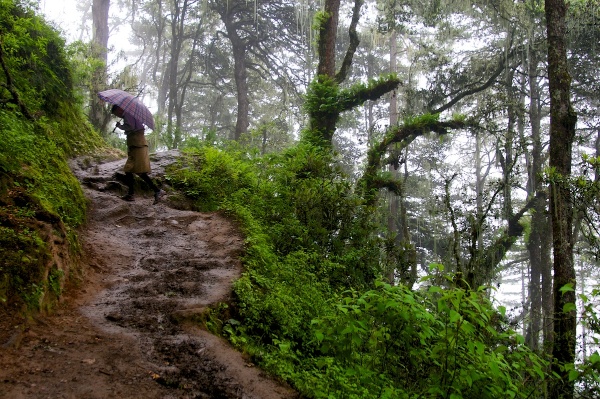
    Storytelling  Sangay Walking Up Trail to Tiger s Nest Monastery  Paro Bhutan  Copyright 2013 Ralph Velasco

    Travel Photography Tips

    If you’re a traveler and you enjoy bringing back photos of the places you’ve visited – let’s face it, who doesn’t – then it’s extremely important to capture a set of images that more completely tells the story of the place. To me, the best way to ensure this in my own work is to work from a well thought out and organized shot list. Then I don’t have to worry about trying to remember the categories of images I have yet to photograph, as I have a check list at the ready all the time and I can easily track my progress.

    Creating a shot list

    The idea of creating a shot list is nothing new. It’s a concept that’s been around since the dawn of photography, and it’s so easy to incorporate into your photography workflow. I research what’s unique about the place so that I know what to be on the lookout for and then I make a list of all the categories of images I’d like to capture before I even set foot in a location. I find the more I know what I’m looking for, the more likely I am to find it. It really is as simple as that.

    Scouting a location

    Recently I had the opportunity to spend 10 days scouting in the reclusive Kingdom of Bhutan. It is one of the few countries in the world that require you to work with a local guide to drive and show you around the country at all times, that is unless you’re from a small number of surrounding countries, like India, whose citizens can come and go as they please.

    Scouting trips are essential to laying the groundwork for the future photo tours I lead to any country, but even more so to this landlocked nation, about the size of Switzerland, but with only about 700,000 inhabitants. During a scouting trip I have a chance to meet, assess and bond with the local guide(s); visit the sites our group will visit; have the experiences they’ll be having; figure out the best times of days to be in certain locations and from where to shoot; and even test out the hotels, modes of transportation, restaurants and other services we’ll be using. But of course I’m also out to capture the quality images necessary to help market the trip to potential clients and to add these to my ever-growing portfolio from around the world. Additionally, although I’m often shooting right alongside my groups, having been to the location allows me to more fully concentrate on helping each participant to bring back the best possible images from their trip.

    Dream location – Bhutan

    Bhutan is a photographer’s dream, and there seems to be a photo opportunity around every corner from most of the categories on my shot list. But instead of shooting randomly, I try to use my list to track and organize the images I’m after. Maintaining your own shot list is as easy as using a piece of pen and paper, creating a spreadsheet, or simply using a free Notes app on your smart phone. Although, I did find the use of a shot list so important that I actually created an app for iPhone, iPad and iPod touch® called My Shot Lists for Travel to aid me in doing this, and it’s always in my pocket.

    Below is a set of images I culled from the many thousands I made during that initial scouting trip, as well as several from the photo tour itself. This select group of images is meant to give viewers a high level sense of what the country of Bhutan is about, and what one might expect on a visit there. I could, of course, add dozens of other images from additional categories (food, interiors, sacred sites, details, etc.) to help create a complete cultural portrait of Bhutan, and when I put together my slideshow presentations I certainly have the chance to do that, but unfortunately space doesn’t allow here. Perhaps in a follow up article I’ll continue this theme.

    The following categories are presented in alphabetical order:

    ARCHITECTURE
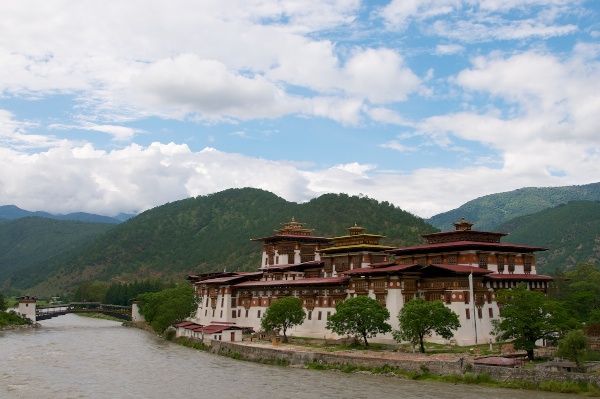
    Travel Photography Tips Architecture  Punakha Dzong  Punakha Bhutan  Copyright 2013 Ralph Velasco

    The architecture in Bhutan is extremely unique and it’s rare to find a single building that doesn’t adhere to this strict building convention. The “dzongs,” or fortresses (Punakha Dzong is pictured here), that dot the country are icons, and as such they’re an essential part of the visual story I want to tell.

    EVERYDAY LIFE
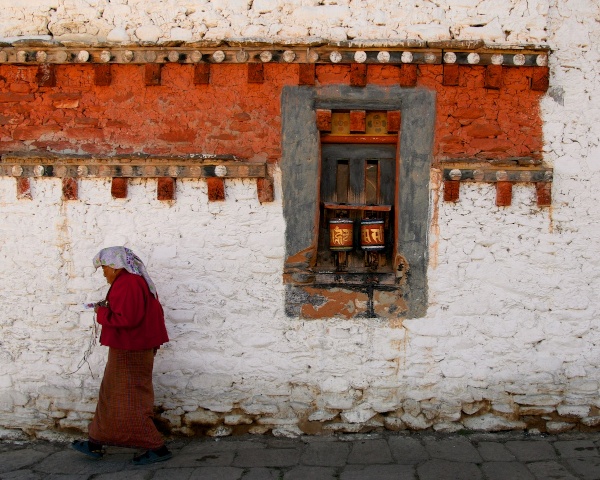
    Travel Photography Tips - Everyday Life  Woman Spinning Prayer Wheels at 7th Century Monastery  Bumthang Bhutan  Copyright 2013 Ralph Velasco

    It’s extremely important to show the local people just doing what they do. It might be standing in doorways, sweeping the local monastery courtyard, or filling butter lamps. As is the custom in Bhutan, many people, from young to old, are found at the local monasteries spinning everything from very large prayer wheels (with the right hand only and in a clockwise direction) to personal ones as they walk, again clockwise, around the building.

    LANDSCAPES
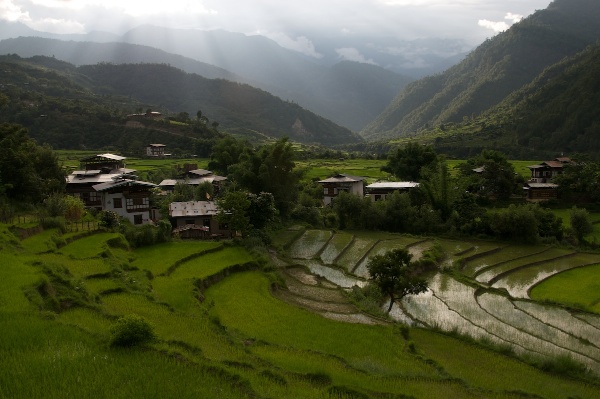
    Travel Photography Tips Landscapes Sunset Over Rice Paddies  Punakha Bhutan  Copyright 2013 Ralph Velasco

    Capturing the landscapes in Bhutan is a must. Here, venturing just outside the town of Punakha, on a fairly rough dirt road, we came upon yet another series of rice terraces spilling down the hillside. At this time of year (image above), during the summer monsoon season, the fields are an almost neon green, and just as the sun was falling behind the nearby mountains, considered foothills to the mighty Himalaya nearby, we pulled off the side of the road and I was able to make a few images before the good light was gone. Summertime is a great season to highlight the very green rice fields and other local vegetation. Come fall and winter, however, this area is completely dry and brown and a different photo opportunity presents itself (below).
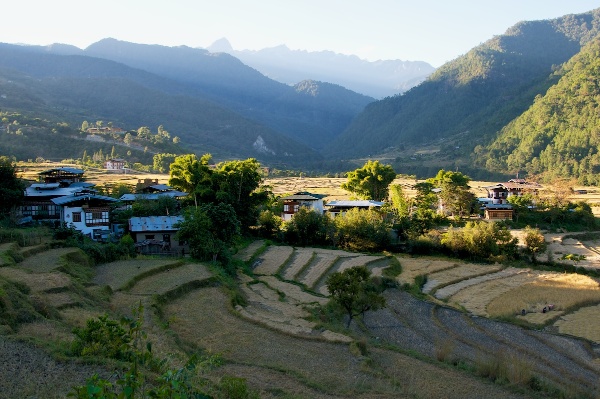
    Travel Photography Tips Landscapes Dried Up Rice Paddy Landscape in November  Punakha Bhutan  Copyright 2013 Ralph Velasco

    MAN-MADE WONDERS

    Travel Photography Tips - Man Made Wonders - Tigers Nest Monastery in Complete Fog  Paro Bhutan  Copyright 2013 Ralph Velasco

    Travel Photography Tips - Man Made Wonders - Tiger s Nest Monastery in the Mist  Paro Bhutan  Copyright 2013 Ralph Velasco

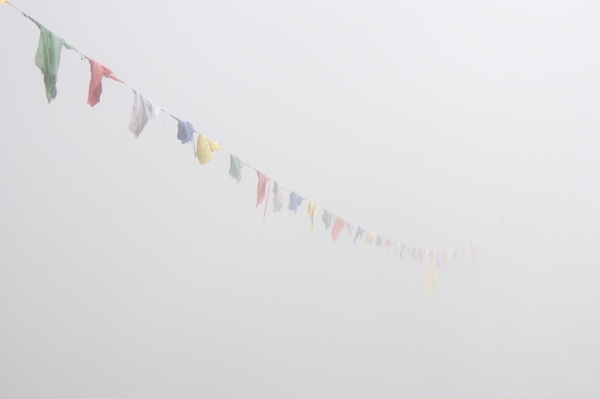
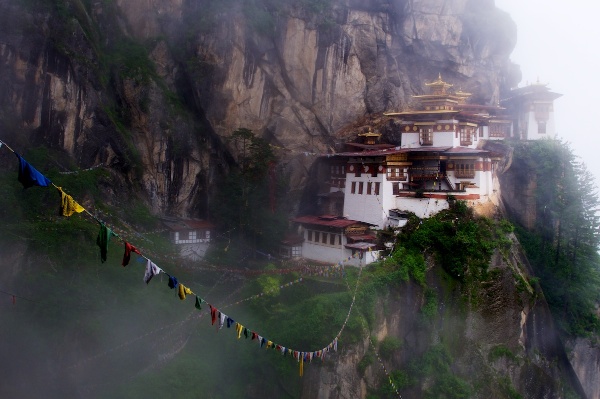
    The Tiger’s Nest monastery is a classic example of a man-made wonder. First constructed in the late 1600s (it’s since burned down and been rebuilt several times) at almost 3,000 feet above the valley floor on a sheer cliff face, this architectural wonder is a great way of demonstrating man’s ingenuity and building skills. These images were made from the local viewpoint, just across a gaping chasm with a 1,000-foot drop. In the summer, weather is a bit unpredictable, but that can make for some great photo opportunities. I’d prefer to shoot on the fringes of inclement weather any day, as opposed to a plain blue sky, it just makes for much more interesting images. In the first image above I wanted to show what the scene looked like upon arrival, the prayer flags disappearing into the fog. But a bit of patience, one of the photographer’s best qualities (along with curiosity), paid off as the low lying clouds came and went, eventually revealing the Tiger’s Nest in an otherworldly haze, adding to its mystery.

    NATIVE CLOTHING
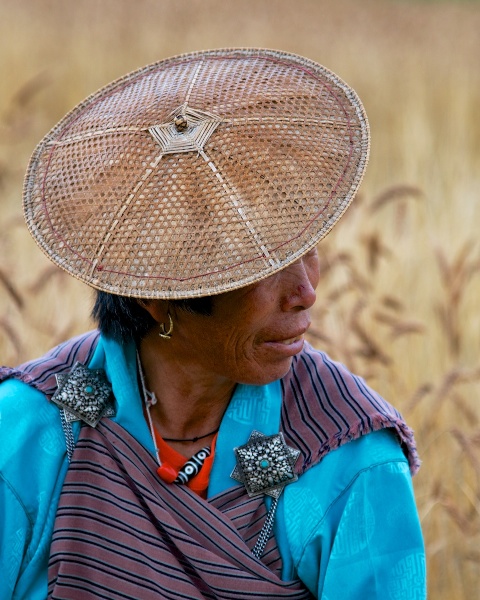
    Travel Photography Tips - Native Clothing - Woman in Kira in Wheat Field  P  Bumthang Valley Bhutan  Copyright 2013 Ralph Velasco

    The people of Bhutan wear very distinctive clothing. The women wear what’s known as a “kira,” often accented by two broaches, as in the first image above. Some of these broaches are antiques and have been handed down to each successive generation and can be worth thousands of dollars. Again, something very distinctive to this place. I encountered this particular woman as she was picking wheat in a field in the Bumthang Valley. Asking my guide/driver to pull over to the side of the road, I climbed over several fences and negotiated some muddy trails to get closer, but I like to think the result was worth the effort. She’s also wearing a traditional bamboo hat often seen in this part of the country, and I certainly want to highlight that.
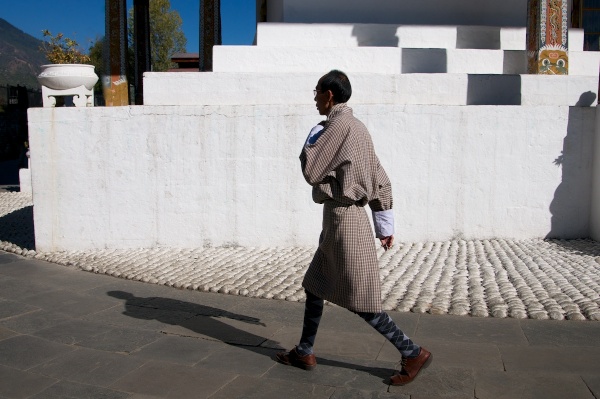
    Travel Photography Tips- Native Clothing - Man in a Gho with Shadow  Thimpu Bhutan  Copyright 2013 Ralph Velasco

    Men, on the other hand, wear what’s called a “gho.” This single piece of cloth, expertly wrapped around the man’s body and accented by the often white, rolled up sleeves, is seen everywhere in Bhutan, from the young school boys to the older men spinning their prayer wheels. The addition of a simple shawl is required to be draped over the man’s shoulder and around his waist as he enters the very sacred dzongs where it’s of the utmost importance to show respect for country and king. Our guide, Sangay, said that it’s law that during working hours a man must wear a gho. One of my tour participants asked him what the penalty is if a man is caught not wearing a gho, and Sangay said, “There is no penalty, it just doesn’t happen.”

    PEOPLE
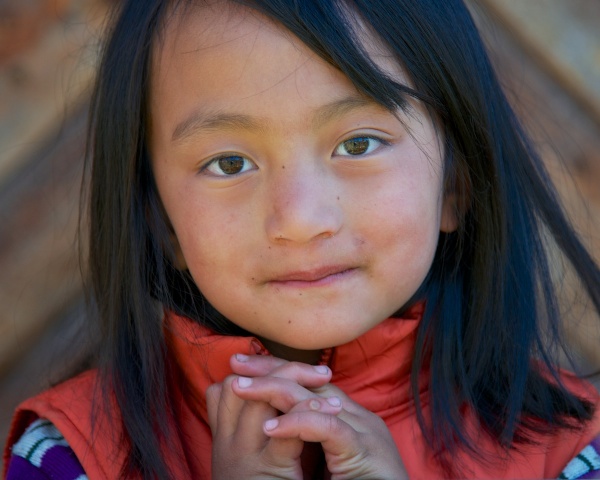
    Travel Photography Tips - People - Little Girl with Hands Folded at Pepper House  Bumthang Valley Bhutan  Copyright 2013 Ralph Velasco

    Travel Photography Tips - People -  Time in a Face  Thimpu Bhutan  Copyright 2013 Ralph Velasco

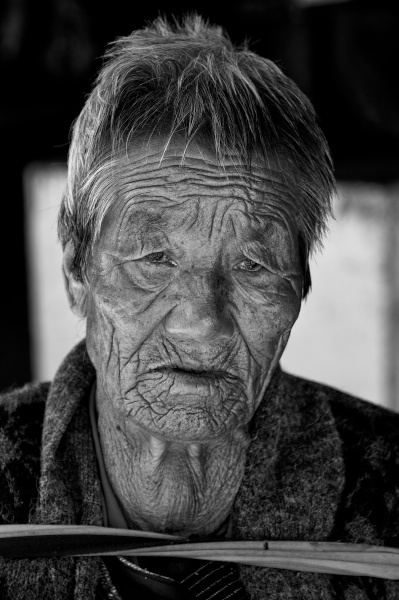
    As in any country, a people are their culture, and undoubtedly Bhutan is no exception. The people photo opportunities are virtually endless in this nation where everyone seems to be outside most of the time (the interiors of the houses can be very dark and smoky from the wood burning stoves and lack of quality electricity). Although I do make an effort to get inside of people’s homes to experience this essential part of a place, as well. Getting out early in Bhutan will often be rewarded, allowing you to capture the children on their way to school, and the adults on their way to work, all generations dressed in their traditional ghos and kiras.

    STORYTELLING
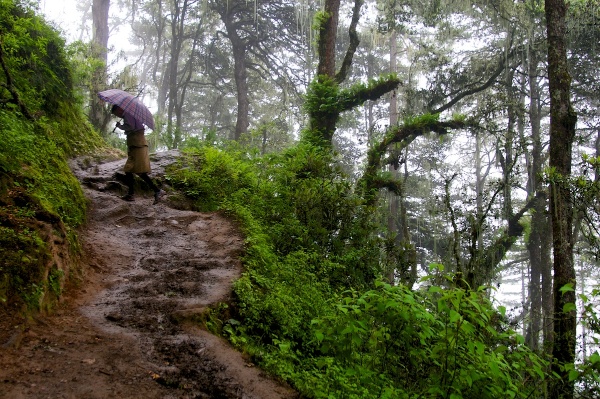
    Travel Photography Tips - Storytelling  Sangay Walking Up Trail to Tiger s Nest Monastery  Paro Bhutan  Copyright 2013 Ralph Velasco

    Although it’s a good aspiration, not every image has to be worthy of a magazine cover. Sometimes it’s important just to make an image so that you can convey the story behind it. In this shot I simply wanted to show the condition of the trail we took to get up to the viewpoint overlooking the infamous Tiger’s Nest Monastery near Paro, Bhutan. It’s not going to win any awards, but I think it conveys this idea, which was my intention.

    Final words of advice

    So my recommendation is to work from your physical shot list, not try to commit it to memory or shoot whatever presents itself at the time. The more prepared you are for the photo opportunities you seek, the more you’ll find them, I can almost guarantee it. Have a goal of five solid images in each category before you tick it off your list, as this will provide you with options when it comes to putting together that book, website or slideshow presentation later.

    Finally, know that any single image may represent two, three or even five or more categories, so there can be some crossover.

    Post originally from: Digital Photography Tips.

    Check out our more Photography Tips at Photography Tips for Beginners, Portrait Photography Tips and Wedding Photography Tips.

    How to Capture the Essence of a Place – Travel Photography Tips

    The post How to Capture the Essence of a Place – Travel Photography Tips by Ralph Velasco appeared first on Digital Photography School.


    Digital Photography School

  • Parasite Tent Pods: Vertical Urban Wall Homes for Homeless

    [ By Delana in Architecture & Cities & Urbanism. ]

    parasitic homeless tent community

    In cities around the world, people are feeling the effects of a weak global economy and homeless populations continue to rise. Taking shelter in cardboard boxes or in isolated tents can be dangerous – not only due to inclement weather, but also for the fear of robbery or violence.

    hanging tents for homeless population

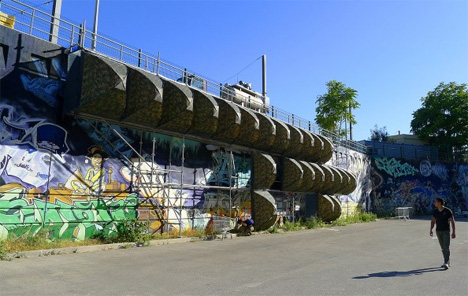
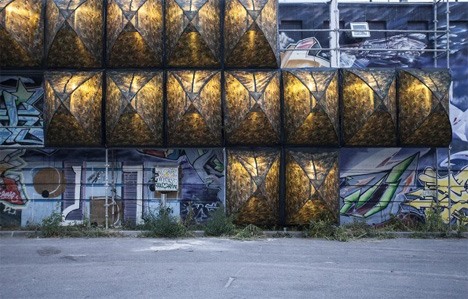
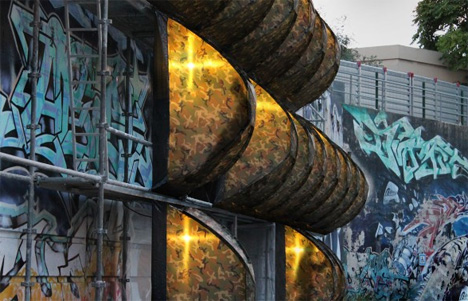
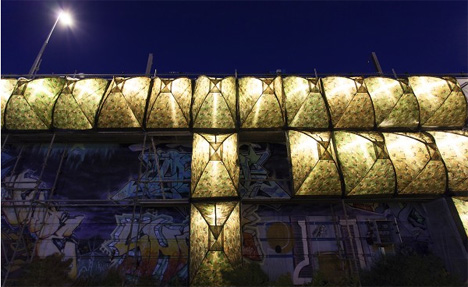
    The A-Kamp47 project from Malka Architecture gives the homeless a safe place to sleep. Using a blank vertical expanse of wall, they installed 23 small tent pods. The pods are “parasitic” structures, meaning that they rely on another structure to provide them a place to sit.

    suspended camp for homeless people

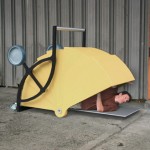
    Each tent provides a private space for the city’s homeless. The grouping of tents embodies the old adage “safety in numbers.” Residents can enter their tents via the scaffolding between the wall and the tend pods.

    a-kamp 47 homeless tent colony

    The project is not without controversy; the wall used by the architects exists in a grey area between private and public space. They hope, however, that their efforts will lead to increased awareness of the homeless problem and encourage people to get involved in the cause.

    Share on Facebook


    [ By Delana in Architecture & Cities & Urbanism. ]

    [ WebUrbanist | Archives | Galleries | Privacy | TOS ]


    WebUrbanist

  • Make your own Google Street View virtual tours

    google.png

    Google is reaching out to photographers to help capture and record the planet’s most hard-to-reach places using Android’s Photo Sphere feature. A new tool lets users upload and connect their 360-degree photo spheres to create virtual tours that can be shared in Google’s Street View. Learn more on connect.dpreview.com.

    News: Digital Photography Review (dpreview.com)

  • Cinematic Structures: Illustrating Famous Film Architecture

    [ By WebUrbanist in Art & Drawing & Digital. ]

    classic poster set

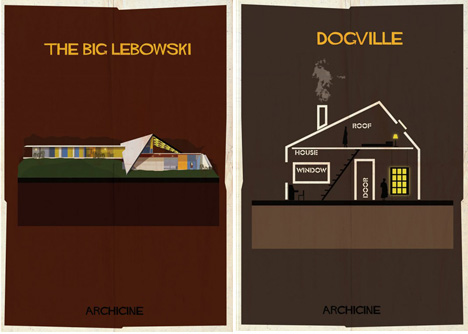
    Some cinematic experiences are defined by their built environments, be it the minimalist architectural plan outlines of Dogville or the lavish Mid-Century Modern estate from the Big Lebowski.

    classic the fountainhead home

    classic vintage poster remake

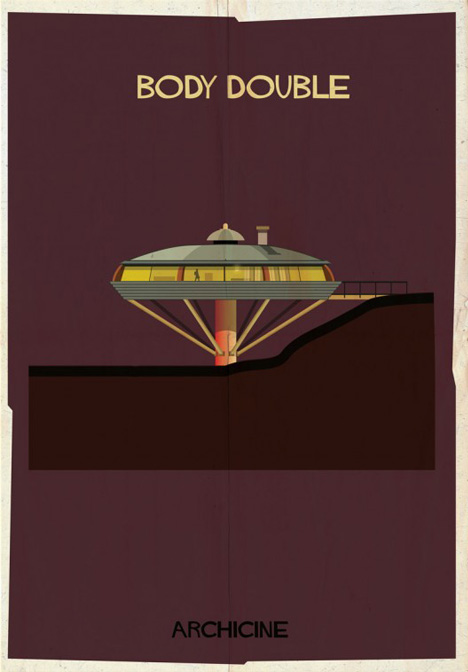
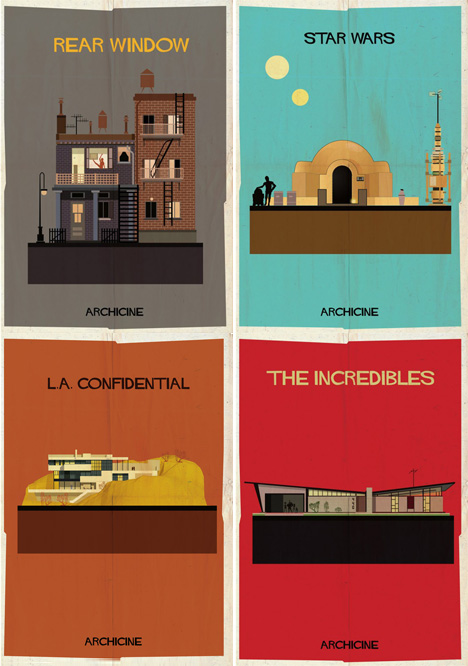
    Illustrator Federico Babina has taken iconic structures from major motion pictures and rendered them in a way that both shows off the unique character of these charismatic buildings and ties them together aesthetically.

    classic the party rendering

    classic movie poster designs

    This set of poster-worthy ARCHICINE prints features classics like Rear Window and Star Wars as well as contemporary sets including L.A. Confidential and The Incredibles.

    Next Page – Click Below to Read More:
    Cinematic Structures Illustrating Famous Film Architecture

    Share on Facebook


    [ By WebUrbanist in Art & Drawing & Digital. ]

    [ WebUrbanist | Archives | Galleries | Privacy | TOS ]


    WebUrbanist

  • Shooting in The Dark by Dominique Shaw

    My brother Liam and I have been shooting weddings without flash for over eight years. The flash equipment is safely in the car boot just in case of an absolute emergency but for the last four years we haven’t had the need to bring out the flash gun at all! We like to let the […]
    dslrBlog