RSS
 

Archive for October, 2013

Sigma announces pricing and availability of 24-105 F4 lens

25 Oct

635_24-105mm.png

Buried among all of the cameras announced last week was a new 24-105 F4 DG OS HSM lens from Sigma. The company has announced pricing and availability for this full-frame ‘Art lens’, which will be available for Canon, Nikon, Sigma, and Sony mounts (in that order). You’ll be able to pick one up for yourself starting next month at a retail price of $ 899.

News: Digital Photography Review (dpreview.com)

 
Comments Off on Sigma announces pricing and availability of 24-105 F4 lens

Posted in Uncategorized


Real Street Photographer Documents Virtual Life in GTA V

25 Oct

[ By WebUrbanist in Gaming & Computing & Technology. ]

gta v street photos

Advanced artificial characters and enhanced in-game graphics have increasingly made in-game worlds look and feel like real-life places. It was only a matter of time before photographers hit the digital pavement to shoot the resulting scenes, equipped with an in-game camera no less.

grand theft street art

Fernando Pereira Gomes has shifted from the actual streets of New York to the simulated ones inside the San Andreas of Grand Theft Auto V. People and buildings come alive with lighting, reflections, details and detritus, all captured in his photo series Street Photography V.

gta v lonely walker

“Being a big fan of GTA, I went to the midnight launch and played the night away,” Gomes explains.  “As I played, I noticed that the characters had cameras on their phones… With this new tool, and the huge world of Los Santos, I started experimenting with the camera and the digital streets.” His resulting (and ongoing) series captures everything from passed-out drunks and hungover street walkers to ambling pedestrians and everyday business people heading to and from work.

grand theft auto street

“What I found was remarkable. The game is so realistic that it felt like being in the streets outside, running around for shots, anticipating passersby’s movements and reactions. In a way, it was also incredibly frightening that these algorithms could look so real, or is it that we ourselves are becoming ever more algorithmic?”

gta v character art

As with many forms of art, there are limitations one can see as restrictive or liberating, like the inability to tilt the camera significantly up or down. Also as in real life, there are many shots of opportunity that only come once – you have to look around, see what is happening, snap an image and hope for the best.

Share on Facebook


[ By WebUrbanist in Gaming & Computing & Technology. ]

[ WebUrbanist | Archives | Galleries | Privacy | TOS ]


WebUrbanist

 
Comments Off on Real Street Photographer Documents Virtual Life in GTA V

Posted in Creativity


Newborn Photography Black and White Conversion in Lightroom

25 Oct

Introduction

The Following is an excerpt from the SLR Lounge Lightroom Preset System v5 and accompanying workshop.  The Lightroom Preset System is designed to take you from Ordinary to Extraordinary photos in just a few seconds and clicks. In this tutorial we’re going to be creating a nice soft black and white portrait for a newborn baby captured from the Newborn Photography Workshop where we teach photographers how to take beautiful newborn with any camera using simply natural window light and a reflector.

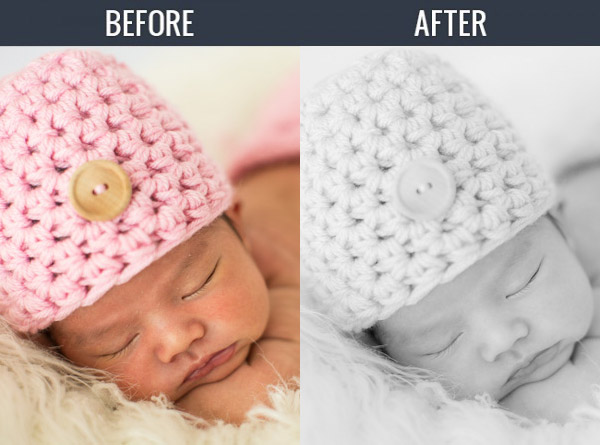
The complete written tutorial is below, and you can also watched the video tutorial at the end of this article. Here’s a sneak peak at what our image will look like before and after our edit.

newbeforeafter


Black and White Conversion for Newborns

The first thing we did to this image was adjust our Color Tempurature to taste, and in this case we used the Eye Dropper Tool (W) taking a reading from the fur that the newborn is sleeping on.

After our Color Temperature adjustment we used our “01-10 Base – Soft: 12b Super Soft – B&W” preset to edit our photo. This preset does all of our work for us and after this preset is applied our photo edit is pretty much finished. So let’s go over exactly what this preset did.

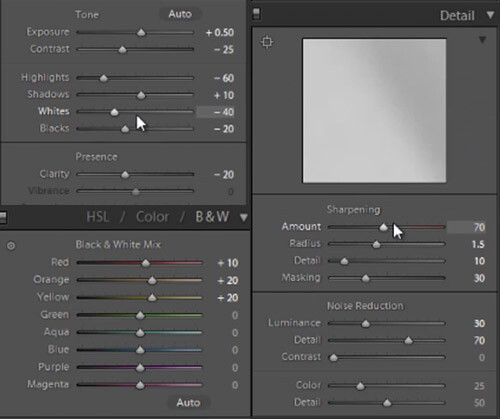
First, the Highlights and Whites have been taken down to -60 and -40. This is to smooth out highlights by bringing them closer to the mid-tones and shadows. This adjustment has the effect of softening highlights over skin tones giving us much more evenly lit skin.

Next, Clarity is being dropped to -20 in order to reduce mid-tone contrast. The reduction of mid-tone contrast again helps us achieve a softer and more flattering look. However, I would caution not to take the Clarity slider down too far as it can create an overly-soft looking image completely lacking in contrast and mid-tone detail.

In this black and white conversion the Reds, Oranges, and Yellows in the HSL are being raised, which again is primarily for skin tones. This brightens up the skin tones, further enhancing the soft flattering look.

We have our standard amount of Sharpening for portraits applied to this image which you can see below.

Also worth noting, the preset we selected dialed in a Noise Reduction Luminance setting of +30. Noise reduction was added to the preset in order to quickly reduce a little bit of the pore detail in the skin giving it a slightly smoother overall look. At an amount of +30, we will see a nice smoothing effect over skin, while retaining the majority of our fine detail in the hair, eyes and so forth.

Below is a snapshot of all of our final settings to achieve this look.

developsettings

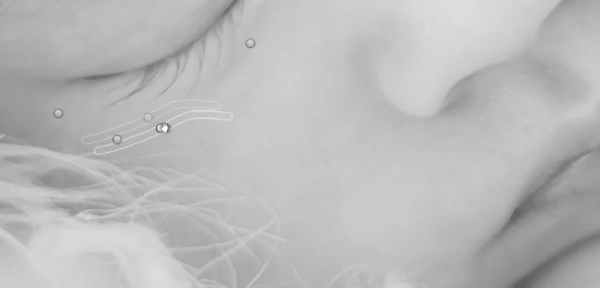
To clean up the skin a little we can use the Lightroom 5 Spot Removal Tool to remove some of the more obvious bits of dry skin and hair. Adobe has modified the Spot Removal Tool in Lightroom 5 to operate more like a brush making the tool much more powerful than in previous editions of Lightroom.

Just remember to keep your Spot Removal Tool size small and just large enough for the area you are working so that it doesn’t look unnatural.

Screen-Shot-2013-07-30-at-9.59.27-PM-650x313

Black and White Conversion for Newborns

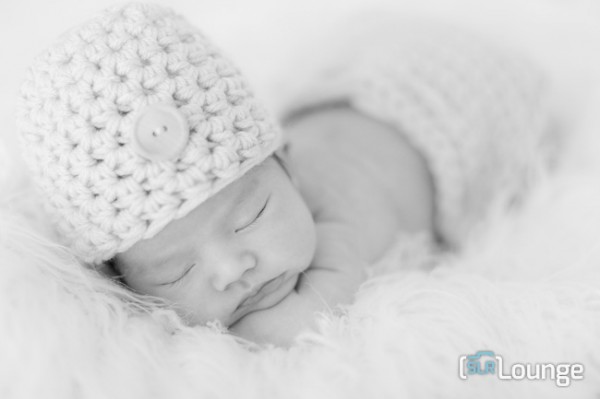
Here’s  a look at the final before and after of our newborn black and white portrait.

Before

lightroom-5-tutorial-soft-black-and-white-newborn-0001

After

lightroom-5-tutorial-soft-black-and-white-newborn-0002

Watch the Video Tutorial

If you would like to see exactly how all of the settings and adjustments were applied, please watch the video below from the SLR Lounge YouTube Channel.

Conclusion and Learn More

We hope you all enjoyed this tutorial. If you are interested in learning more or purchasing the SLR Lounge Lightroom Preset System v5 or the newly released Lightroom Workshop Collection v5, please click any of the links in this article. If you are interested in Newborn Photography Workshop please also check out our Newborn Workshop Collection and Lightroom Presets now available via digital download.

Post originally from: Digital Photography Tips.

Check out our more Photography Tips at Photography Tips for Beginners, Portrait Photography Tips and Wedding Photography Tips.

Newborn Photography Black and White Conversion in Lightroom

The post Newborn Photography Black and White Conversion in Lightroom by Post Production Pye appeared first on Digital Photography School.


Digital Photography School

 
Comments Off on Newborn Photography Black and White Conversion in Lightroom

Posted in Photography


PPE 2013: Hands-on with Fujifilm’s newest cameras

25 Oct

fujifilm_xq1front.jpg

We’re at the Photo Plus Expo in New York, and one of the busiest stands belongs to Fujifilm, which is showing off its new XQ1 and X-E2 cameras, as well as this year’s other key products, the X20 and X100S. We’re running around the show having meetings and trying out all of the latest gear, and we made sure to stop by and say hi to Fujifilm. Click through for a quick hands-on look at the latest products.

News: Digital Photography Review (dpreview.com)

 
Comments Off on PPE 2013: Hands-on with Fujifilm’s newest cameras

Posted in Uncategorized


Dubble app uses crowdsourcing to create double exposures

25 Oct

dubble.png

Dubble, a new community-based photography app takes the concept of double exposures — either a trick or a mistake in which photographers expose a roll of film twice, thereby layering two images in a single frame — and applies it to your smartphone, with a crowdsourcing twist. We take a closer look at Dubble on connect.dpreview.com.

News: Digital Photography Review (dpreview.com)

 
Comments Off on Dubble app uses crowdsourcing to create double exposures

Posted in Uncategorized


99% Invisible: 7 Episodes of the Best Radio Show on Design

24 Oct

[ By WebUrbanist in Architecture & Cities & Urbanism. ]

roman mars 99 invisible

There is no witty wordplay nor shocking truth in our title today, but that is quite by design – we simply did not want risk underselling Roman Mars, the maker of a radio show that covers architecture, design and cities at a level more than sufficiently clever to speak for itself. Below, we will share with you a hand-selected set of some of the most fascinating episodes 99% Invisible has aired to date. If you like what you hear, be sure to support the program on Kickstarter.

roman mars radio show

Roman Mars, host of 99% Invisible and Progam Director of Public Radio Remix from PRX, crafts artful stories that reveal hidden realities in the built environments around us and celebrate secret histories of seemingly ordinary spaces. Roman has 450,000 listeners on SoundCloud and has won praise from the likes of This American Life and RadioLab – two programs that this author has regularly compared to 99% Invisible (“It’s like RadioLab for design geeks”).

suburban cul de sac

Today, from the lawless metropolis of Kowloon Walled City to the tame suburbs of the American cul-de-sac and beyond, we invite you to explore a series of compelling stories from this stellar radio show, with more links and information at the end of this article.

 Kowloon Walled City – Den of Iniquity [Episode 66]

Kowloon Walled City, covered previously on WebUrbanist, was a lawless metropolis – a strange no-mans-land between (then) British Hong Kong and mainland China. “By its peak in the 1990s, the 6.5 acre Kowloon Walled City was home to at least 33,000 people (with estimates of up to 50,000). That’s a population density of at least 3.2 million per square mile. For New York City to get that dense, every man, woman, and child living in Texas would have to move to Manhattan.” Even with pictures, it is almost impossible to visualize – but listen to the above tale and it starts to come alive the same way a fictional city rises from the pages of a book.

Cul-De-Sac – Symbol of Suburbia [Episode 29]

The cul-de-sac once represented the American Dream, but has in the minds of many turned from a utopian ideal to a dystopian symbol of dead-end suburban life.  “When people critique cul-de-sacs, a lot of the time, they’re actually critiquing the suburbs more generally. The cul-de-sac has become sort of like the mascot of the suburbs– like if suburbia had a flag, it would have a picture of a cul-de-sac on it. Cul-de-sacs by definition aren’t well connected to other streets and they are far away town centers. For little kids, cul-de-sacs can be great, but they do have some real, quantifiable design flaws.” In the episode above, Roman and a guest explore the back and forth, exploring the evolution and alternating emphasis on urbanization and suburbanization, and changes in regulation that first allowed and are are now destroying these strange street layouts.

In and Out of LOVE – Skating in the Park [Episode 71]

Skateboarding enjoys a dubious reputation in most cities – some places are set aside for skateboarders in some cases, but many of the best impromptu skate parks (at least: from the perspective of skaters) are those that are forbidden. “Though its official name is JFK Plaza, the open space near Philadelphia’s City Hall is more commonly known as LOVE Park. With its sleek granite benches, geometric raised planter beds, and long expanses of pavement, its success as a pedestrian plaza is debatable. But it turned out to be perfect for skateboarding. As skateboarding culture grew in the 1990s, LOVE Park became a Mecca of the skating world–even though skateboarding was officially banned there.” Even if you hate having a skateboarder whip by you on the sidewalk, you may find yourself softening to their perspective as you listen to this episode.

Next Page:
99 Invisible 7 Episodes Of The Best Radio Show On Design

Share on Facebook


[ By WebUrbanist in Architecture & Cities & Urbanism. ]

[ WebUrbanist | Archives | Galleries | Privacy | TOS ]


WebUrbanist

 
Comments Off on 99% Invisible: 7 Episodes of the Best Radio Show on Design

Posted in Creativity


PPE 2013: Hands-on with new Manfrotto 190 tripods

24 Oct

manfrotto_port.jpg

We’re at the Photo Plus Expo in New York, and this morning we got an opportunity to look at Manfrotto’s new 190-series tripods. The 190 series has been among Manfrotto’s most popular products for a long time, and the recently-announced updates take up less space when folded, and add some interesting and well thought-out improvements to the design. Click through for a quick hands-on at the new Manfrotto 190-series. 

News: Digital Photography Review (dpreview.com)

 
Comments Off on PPE 2013: Hands-on with new Manfrotto 190 tripods

Posted in Uncategorized


Anticipating Great Images

24 Oct

A contribution by Dan Bailey – author of the eBook Zen Photographer (currently 13% off at SnapnDeals here).

What if you could predict the future? Wouldn’t that make you a much better photographer?

Think about it: Photography is largely about capturing the moment. Not just any moment, though. We’re talking that singular instant when light, expression, movement and environment all converge in one significant fraction of a second. That’s when the dirt’s flying, the action’s peaking and that ray of golden sunlight is turning your subject into a hero. If you knew exactly when that moment of truth was going to happen, you’d be a true camera master.

S308665

Of course, most of us don’t have psychic abilities, but we do possess a minor form of clairvoyance that allows us to see into the future. It’s called anticipation.

In photography, looking into the future involves imagining with high probability how the scene will play out in a time that’s later than “right now.” It’s seeing a convergence of light, moment and subject in your mind that might happen, and then working backwards to make it happen.

Most great images some form of of anticipation, whether it’s noticing how the light will hit your subject in a few minutes, paying attention to how your subject and background will look when lined up as a two-dimensional image, or recognizing when and where the height of action of expression might occur.

AK BIK DNL 00340

You may not be able to predict exactly how the future will play out, but by gauging the scene and all of the elements in your immediate surroundings, you can get a pretty good idea of what’s likely to happen, and in the world of image making, that’s as good as gold.

Once you have that information, you can then put yourself in the optimum location, direct your subjects as needed, and set your gear accordingly in order to nail the shot that you now have in your mind. This is active image making, and it’s almost always more effective than trying to grab a shot that’s already started to unfold.

Let’s say you’re shooting a trail runner. With one eye, you watch the runner follow a certain path through the landscape. With the other, you’re, you’re looking for something that might make for a compelling background, all the while, checking the position of the sun.

TRN AK 2372

When you see a potential convergence, you move to the ideal vantage point that will let you capture the scene in the most powerful way, figure out the technical details, such as lens choice, exposure mode, EV compensation, and then wait for the right moment. When the runner reaches the right spot, you press the shutter and nail the shot.

You didn’t just stand there and snap away, hoping for something good, though. That would be passive. You got the shot because you used your imagination and anticipated a potentially great image before it actually came together. You took an active part in the image making process. You looked. You imagined. You reacted, and maybe even sprinted with your backpack full of camera gear over rough terrain so that you could get to the right vantage point. Active image making.

I call this thinking and acting geometrically, and it’s a process that’s hard wired into our brains. We use these skills whenever we get behind the wheel of a car, or when navigating a stressful situation. In traffic, they keep you alive. In photography, they keep you tuned into all the elements of your scene.

So the next time you’re out shooting, look into the future. Imagine a great image, anticipate how your scene might play out, and then work geometrically and bring the shot to life.

For more creative insight like this, be sure and check out my brand new ebook, ZEN PHOTOGRAPHER: Turning Your Passion into Focus (13% off for the next few days at SnapnDeals).

Dan Bailey is a full time professional outdoor, adventure and travel photographer based in Alaska. When he’s not off exploring in the mountains, writing about photography, or flying his little yellow bush plane, he can sometimes be found lurking in the forums right here at DPS. Check out his blog and find him on Facebook and Google+.

Post originally from: Digital Photography Tips.

Check out our more Photography Tips at Photography Tips for Beginners, Portrait Photography Tips and Wedding Photography Tips.

Anticipating Great Images

The post Anticipating Great Images by Guest Contributor appeared first on Digital Photography School.


Digital Photography School

 
Comments Off on Anticipating Great Images

Posted in Photography


Leica unveils D-Lux 6 Silver Edition

24 Oct

dl6silver2.png

Just in time for the holiday season, Leica has announced a ‘Silver Edition’ of its D-Lux 6 premium compact camera, with a high-gloss black body and silver lens barrel. The camera also gets a new accessory: the Leica Soft Pouch in lambskin nappa leather, which the company says features a ‘fascinating wrap-around design’. The camera is otherwise the same as the standard D-Lux 6 (and by extension, very similar to the Panasonic Lumix DMC-LX7). 

News: Digital Photography Review (dpreview.com)

 
Comments Off on Leica unveils D-Lux 6 Silver Edition

Posted in Uncategorized


24. Oktober 2013

24 Oct

Ein Beitrag von: Christian Greller

Nebel © Christian Greller


kwerfeldein – Fotografie Magazin

 
Comments Off on 24. Oktober 2013

Posted in Equipment