RSS
 

Archive for September, 2013

Verloren gegangen

28 Sep

„Wir können keinen Eintrag finden.“

Mein Mund ist trocken und die Worte, die vorher noch so schön zurecht gelegt waren, nett gefaltet wie Gästehandtücher für den Besuch, bleiben einfach irgendwo in mir drin hängen.

„Das kann nicht sein!“, erwidere ich stoisch. Auf weiteres Drängen gibt er mir die Nummer eines anderen Labors. Aber auch dort die gleiche Antwort. Ich lege den Hörer beiseite, schüttle den Kopf. Hatte ich es mir vielleicht nur eingebildet, gab es diese beiden Filme überhaupt?

Aber natürlich, es gab sie. Ich hatte die Zettel in der Hand, die Nummern, die ich nun schon auswendig konnte. Kundennummer, Autragsnummer, ja, genau, hinten eine 5. Aber da war nichts. Kein Computer hatte es erfasst, kein Mensch hatte diese Ziffern in irgendein Formular eingetragen. Sie blieben unauffindbar.

Ich schüttelte wieder und wieder den Kopf. Die Erinnerungen rauschten an mir vorbei. Ich sehe die Frau vor mir, das schöne glatte Haar, ihre Haut, die Bewegungen. Ich sehe die Farben, blassgrün die Kissen, das Licht zartes Nachmittagslicht. Langzeitbelichtungen auf dem einen und ihr Körper detailliert aufgezeichnet auf dem anderen Film.

Ich erinnere mich an das Lächeln, an das Zurechtlegen der Haarsträhne, an meine Frage, ob das in Ordnung ist, wenn ich das mache, aus Angst Grenzen zu überschreiten, wo vielleicht nicht einmal eine ist.

Die Aufzeichnung eines Tages, eines Gesprächs. Flackern in den Augen, Runzeln der Stirn, Nicken. Leise gesprochene Worte, Erkenntnisse, während draußen die Amseln auf der Mauer sitzen und hereinschauen.

Ich wähle noch einmal die Nummer des Labors, frage noch einmal nach. Dieses Mal mit mehr Nachdruck. Ich ließ mich nicht abwimmeln wie bem ersten Mal und dann sagt er es endlich: Sie hätten gerade Probleme mit der Software, es könnte sein, dass er erfasst ist, aber nicht angezeigt wird. Allerdings hätten sie auch gerade Probleme mit der Annahme analogen Materials. Ich solle noch eine Woche warten und dann einen Antrag stellen, die Filme zu suchen.

„Aha“, sage ich und ein zerknirschtes Danke hinterher. Ich lege auf.

~

Die Filme sind noch immer nicht aufgetaucht. Jeden Tag gebe ich die Ziffern in die Suchmaske des Labors ein, jedes Mal flammt kurz Hoffnung auf.

Was ich daraus lerne, willst Du wissen? Mir ein besseres Labor suchen natürlich. Man bringt seine Kinder ja auch nicht irgendwo hin, nur weil es da billiger ist. „Selbst Schuld!“, raunt das schlechte Gewissen. Oft genug ist es ja gut gegangen bei diesem Großlabor.

„Masse statt Klasse, aber schön günstig, wo doch die Fime schon soviel kosten“, versuche ich kleinlaut dem schlechten Gewissen etwas entgegen zu setzen. Und außerdem kann ich Farbdiafilme einfach nicht selbst entwickeln, verdammt. Oder doch?

Das Gefühl ist jedenfalls elendig. Zwei verloren gegangen Filme.


kwerfeldein – Fotografie Magazin

 
Comments Off on Verloren gegangen

Posted in Equipment


What The Duck #1436

28 Sep

wtdlogo_big.jpg

We’ve been fans of Aaron Johnson’s comic strip ‘What the Duck’ for years. ‘WTD’ is one of the best satirical comic strips in the world, and it’s published here every week, as well as being included in our weekly newsletter. Barbed, topical and always amusing, we hope you enjoy WTD as much as we do. 

News: Digital Photography Review (dpreview.com)

 
Comments Off on What The Duck #1436

Posted in Uncategorized


Miniature wide angle lens under development at UCSD

28 Sep

UCSD.jpg

Researchers at UCSD’s Jacobs School of Engineering are working on a miniature wide angle lens, taking advantage of the benefits of spherical lenses. At just a tenth of the size of a traditional wide angle lens, a spherical lens can create wide angle images without chromatic aberration or loss of resolution at corners. The challenge is capturing the lens’ spherical projection on a flat sensor. The team have overcome this by using optical fibers fused to the rear of the lens to relay light to electronic sensors. Click through to read more about the this unique concept.

News: Digital Photography Review (dpreview.com)

 
Comments Off on Miniature wide angle lens under development at UCSD

Posted in Uncategorized


Backlight: Weekly Photography Challenge

28 Sep

The Stories

This week we explored the technique of back lighting subjects in a blog post so thought it might make a good challenge topic.

Paris Saint Germain

Backlighting is something that can add impact to many types of photography – portraits, landscapes, wildlife etc and it can be done with both natural and artificial light – so you should have lots of scope to take some great shots this week.

There's a light that never goes out

Once you’ve taken your ‘Back Lighting’ shots, upload your best ones to your favourite photo sharing site either share a link to them even better – embed them in the comments using the our comments tool to do so.

devendra banhart:dragonflies

If you tag your photos on Flickr, Instagram, Twitter or other sites with Tagging tag them as #DPSBACKLIGHT to help others find them. Linking back to this page might also help others know what you’re doing so that they can share in the fun.

Also – don’t forget to check out some of the great shots posted in last weeks In Motion challenge – there were some great shots submitted.

Post originally from: Digital Photography Tips.

Check out our more Photography Tips at Photography Tips for Beginners, Portrait Photography Tips and Wedding Photography Tips.

Backlight: Weekly Photography Challenge


Digital Photography School

 
Comments Off on Backlight: Weekly Photography Challenge

Posted in Photography


Latest and greatest smartphones battle it out in mobile photo comparison

28 Sep

shootout.jpg

Thinking of upgrading to the latest smartphone, and want to see which takes the best photos? We pit four top photocentric mobile devices in an imaging showdown to test three new smartphones — the Sony Xperia Z1, Nokia Lumia 1020 and LG G2 — and Samsung’s Galaxy S4 Zoom in real world shooting scenarios. See how they fared in our tests on connect.dpreview.com.

News: Digital Photography Review (dpreview.com)

 
Comments Off on Latest and greatest smartphones battle it out in mobile photo comparison

Posted in Uncategorized


Painting with Light in the Landscape

27 Sep

Painting with light

Most of the articles I’ve written about light so far have explored the use of natural light. Painting with light in the landscape takes that idea further by mixing artificial light, provided by the photographer, with the ambient light to create surreal and dramatic images.

Painting with light is an effective technique because it works with two ideas that, when combined, become very powerful:

  • Painting with light usually takes place at dusk. The main reason for this is entirely practical. You use either a torch or a portable flash to paint with light, and they are not bright enough to use during the day. The light is very beautiful during twilight, so this turns out to be a benefit.
  • Painting with light uses two colours that work very well together – orange and blue. Now, you may use coloured gels to paint with other colours, but these should still be colours like red, green and yellow that contrast nicely with the natural blue colour of the light you get at twilight.

The tools

Let’s take a look at the tools you can use to paint with light. First is my favourite, a hand-held rechargeable lantern that I bought from a local hardware store (just like this one). It’s powerful – the light has a strength of one million candlepower (you can buy models with two or five million candlepower). It wasn’t expensive, and also comes in useful to keep around the house or in the car. It has a tungsten bulb.

Using the lantern is easy. First, you need a spectacular landscape.

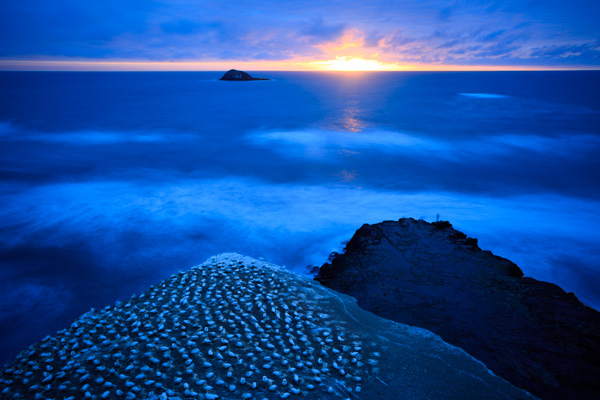
For example, these cliffs at Muriwai, a beach near Auckland in New Zealand, are a dramatic scene:
Painting with light

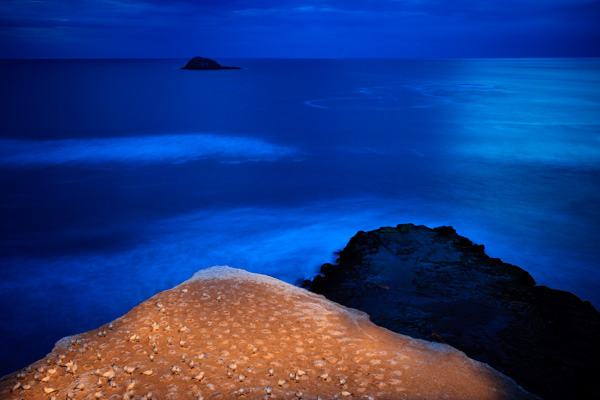
I was curious to see what happened if I used the lantern to paint the cliffs with light. I returned another evening to try it, here’s the result:
Painting with light

The technique itself is quite simple. Turn the lantern on, point it at the scene you want to paint, then gently move the lantern so the light from its beam covers the surface of the subject. You do this while the camera’s shutter is open.

You’ll need a shutter speed that gives you enough time to paint the subject, so you’re looking at at least ten seconds. Thirty seconds is easier (hence the need for low light). Don’t use neutral density filters to obtain these shutter speeds, as they also block the light from the lantern. You need to wait until the ambient light is low enough to obtain these shutter speeds through a combination of low ISO and small aperture (such as f11 and f16, but preferably not f22 as diffusion will soften the image).

The crucial aspect is timing. Try it too early, when the light is bright, and the light from the torch won’t be strong enough to overpower the daylight. Leave it too late and it will be too dark. The sky will be black, and you won’t have any background detail.

What you’re looking for is the sweet spot between these two extremes. When the light is low enough to give you a shutter speed of around 30 seconds, and the light from the torch balances with the ambient light, and it is still light enough to get good background detail.

The best way of finding the sweet spot is to test it out. Put your camera on a tripod, decide how you will compose the image and then wait for the light to fade. Take a test shot when the light is low enough for a shutter speed of ten seconds or so. Then look at the result on your camera’s screen.

Does the ambient light overpower the light from the torch? Then you need to wait until it gets darker. Did you cover the subject evenly with the torch light? This may take several attempts to get right. Hopefully, the moment that you figure out how to paint the subject with light will coincide with the moment the ambient light and torch light balance each other perfectly.

When you find the sweet spot, keep going until the ambient light fades away. You can decide which image you prefer when you view the results on the computer.

Painting with light

This is a photo taken earlier. You can see that it’s too early to work yet – the light from the lantern is overpowered by the ambient light. It also needs more work to get the coverage right.

Using portable flash

Another way to paint with light is to use portable flash. Using a lantern is simple, and a good way to get started. But if you’d like to take up the challenge, portable flash gives you some interesting options. Here’s why:

  • You can use portable flash to fire multiple bursts of light at the subject, building up the exposure over time.
  • You can use coloured gels to give light of different colours.
  • You can shoot at night, rather than at dusk, using portable flash to fire multiple bursts of light, building up an exposure over time. You can use multiple flashes, or the same flash with different coloured gels, to do so. There are lots of good examples here at Troy Paiva’s Lost America website.

The essence of the technique is again simple. Switch your flash unit to manual, and use the highest powered setting (1:1). Work out your composition in advance, preferably while there is still enough light to see. Wait until the light gets low, then start using your flash to illuminate the subject.

If you are going to be in the frame yourself, make sure you are wearing black clothes. Don’t stand still – keep moving so that you don’t register in the frame. Keep your body between the flash unit and the camera so that the light from the flash head itself doesn’t appear in the frame, just the light that illuminates the subject. Keep checking the camera’s LCD screen to see how the images are coming out, and adjust your technique accordingly.

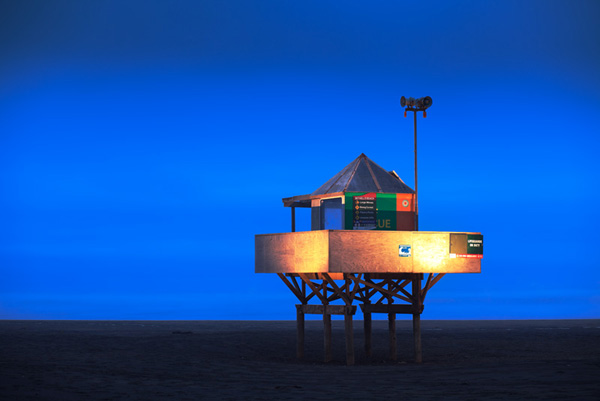
Here’s a photo I created using a portable flash unit fitted with an orange gel (CTO – Colour Temperature Orange) to imitate the look of a tungsten bulb.
Painting with light

Mastering Photography

Painting with light

My ebook Mastering Photography: A Beginner’s Guide to Using Digital Cameras introduces you to digital photography and helps you make the most out of your digital cameras. It covers concepts such as lighting and composition as well as the camera settings you need to master to take photos like the ones in this article.

Post originally from: Digital Photography Tips.

Check out our more Photography Tips at Photography Tips for Beginners, Portrait Photography Tips and Wedding Photography Tips.

Painting with Light in the Landscape


Digital Photography School

 
Comments Off on Painting with Light in the Landscape

Posted in Photography


Secret Operation: Flightless Aircraft is a Research Station

27 Sep

[ By Steph in Art & Sculpture & Craft. ]

Secret Operation Aircraft Research Base 1

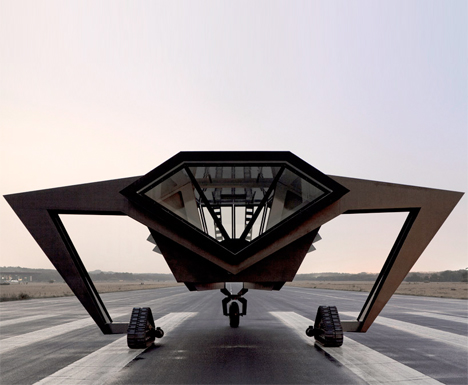
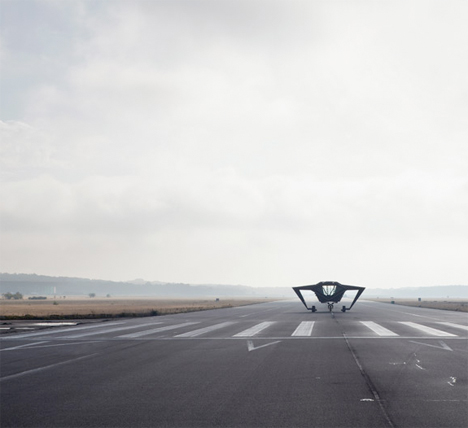
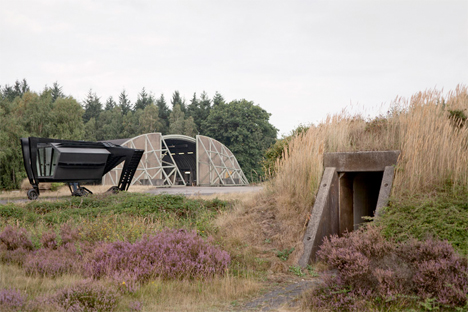
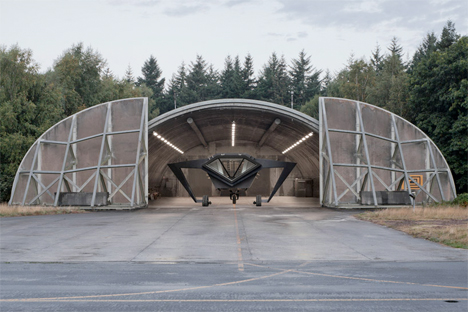
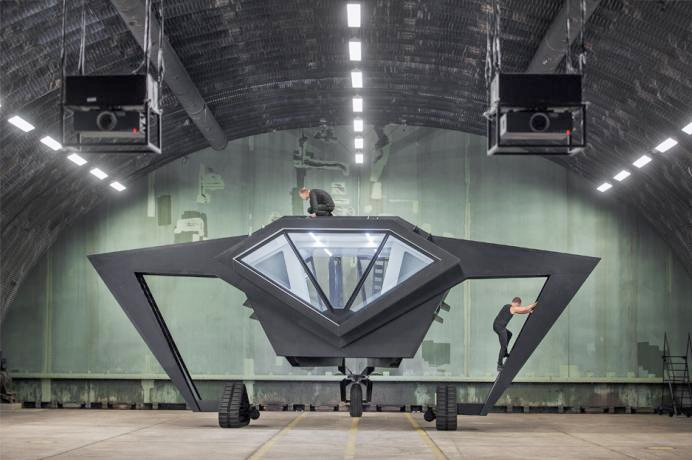
Anyone peering into a disused F15 hangar at the Cold War-era Soesterberg airbase in The Netherlands might have spotted this bizarre black structure and imagined that it was some kind of secret, high-tech aircraft project. They would have been half correct. The angular behemoth, with its wing-like appendages, is an imposing sight upon the airstrip as it rolls slowly out of Shelter 610.

Secret Operation Aircraft Research Base 2

Secret Operation Aircraft Research Base 5

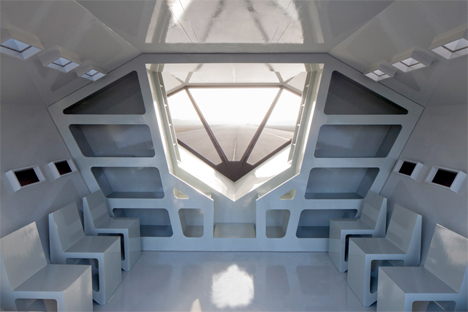
But look a little closer. It’s crawling so excruciatingly slowly for a reason. It’s not an aircraft at all – it’s moving on military treads. Secret Operation 610 is both a sculpture and a functional research station for aerospace engineering students at Technical University Delft who are developing ‘no noise, no carbon, just fly’ technologies .

Secret Operation Aircraft Research Base 3

Secret Operation Aircraft Research Base 4

Created by Rietveld Landscape, Secret Operation 610 deliberately mimics the look of science fiction aircraft. The point, essentially, is for it to look a bit scary. “The object revives the mysterious atmosphere of the Cold War and its accompanying terrifying weaponry,” say the designers.

Secret Operation Aircraft Research Base 6

The old runway serves as an ideal test site for state of the art aviation experiments, so this mobile research shelter enables students to become immersed in the atmosphere of the airbase as it rolls around. “The unconventional combination of nature and Cold War history offers an exciting environment for the development of knowledge about nature, technology and aviation.”

Share on Facebook


[ By Steph in Art & Sculpture & Craft. ]

[ WebUrbanist | Archives | Galleries | Privacy | TOS ]


WebUrbanist

 
Comments Off on Secret Operation: Flightless Aircraft is a Research Station

Posted in Creativity


27. September 2013

27 Sep

Ein Beitrag von: Felix Pacholleck

Felix Pacholleck


kwerfeldein – Fotografie Magazin

 
Comments Off on 27. September 2013

Posted in Equipment


Augenschmaus: Schokoladen-Tarte mit Brezeln

27 Sep

Ein Beitrag von: Nadine Burck

Erdnussbutter, Karamell, Frischkäse, Schokolade und Salzbrezeln – als locker-leicht kann man diese Tarte wohl kaum bezeichnen, aber sie ist einfach unfassbar lecker. Wer sich vor der Kombination von süß und salzig scheut, sollte sich einfach mal trauen und eine Salzbrezel ins Nutellaglas tauchen. Lecker! Genau wie diese Tarte.

Portionen: für eine 29 x 20 cm große Tarteform (am besten mit Hebeboden)
Zeit: ca. 45 Minuten + 4 Stunden Kühlzeit

Zutaten

350 g dunkle Lieblingslingsschokolade
60 g + ca. 28 kleine Salzbrezeln
125 g ungezuckerte Cornflakes
3 Blatt weiße Gelatine
200 g Doppelrahmfrischkäse
80 g Zucker
3 EL Karamellcreme
150 g Erdnussbutter
200 g Schlagsahne

© Nadine Burck

Zubereitung

Den Boden der Tarteform mit Wasser befeuchten und mit Frischhaltefolie auslegen. Die Hälfte der Schokolade (175 g) in Stücke brechen und über dem heißen Wasserbad schmelzen. 60 g Salzbrezeln und die Cornflakes im Mixer zerbröseln und mit der flüssigen Schokolade mischen. In der Form zu einem Boden andrücken – den Rand nicht vergessen! – und dann eine Stunde kalt stellen.

Zehn Minuten vor Ende der Stunde die Sahne steif schlagen und die Gelatine in kaltem Wasser einweichen. Den Frischkäse, den Zucker, die Karamellcreme und die Erdnussbutter mit dem Handrührgerät glatt rühren. Die Gelatine (wie einen Lappen) auswringen, bei schwacher Hitze in einem Topf auflösen und dann mit einem Esslöffel der Erdnussbutter-Creme verrühren. Die Gelatinemischung in die übrige Creme rühren und zum Schluss die Sahne unterheben.

Den Schokoboden nun von der Folie befreien und auf eine Tortenplatte oder einen Kuchenteller setzen. Ich hab die Frischhaltefolie einfach rundherum abgeschnitten und den Boden vorsichtig zurück in die Form gelegt. Jetzt die Creme darauf verteilen und die Tarte wieder für zwei Stunden kühl stellen.

Für die Glasur die restliche Schokolade hacken und wieder über dem heißen Wasserbad schmelzen, vorsichtig auf der Erdnusscreme verteilen und evtl. mit einer Gabel ein paar Wirbel herstellen, um kleine Unregelmäßigkeiten wie gewollt aussehen zu lassen. Die 28 Salzbrezeln regelmäßig darauf verteilen und noch mal mindestens eine Stunde kalt stellen. Die Tarte sollte ungefähr eine halbe Stunde vor dem Servieren aus dem Kühlschrank genommen werden.

© Nadine Burck

Fotorezept

Die Fotos habe ich mit der Canon 450D und dem 50mm f/1.8 fotografiert (Einstellung f/1.8 und 1/640 s). Als Untergrund habe ich eine alte, etwas verwitterte und daher rustikal anmutende Holzkiste benutzt und als Hintergrund ein einfaches, weißes Brett. Die Fotos sind bei Tageslicht direkt unter dem Dachflächenfenster aufgenommen worden – als Reflektor diente eine Styroporplatte.

~

Du hast auch ein leckeres Rezept und die passenden Food-Fotos dazu, die einem das Wasser im Munde zusammenlaufen lassen? Dann werde einfach selbst Teil von „Augenschmaus“!


kwerfeldein – Fotografie Magazin

 
Comments Off on Augenschmaus: Schokoladen-Tarte mit Brezeln

Posted in Equipment


Get Started with the Beautiful World of Film Photography in 7 Easy Steps

27 Sep

Ahh, film photography.  The cool kid on the block.  The “old” thing that’s suddenly the “new” thing.  In recent years, it’s been popular opinion that it was an identifying trademark of hipsters, and only then for an artistic flair that digital photography has failed to capture for them.  The reason Instagram has been such an enormous success recently is our Continue Reading

The post Get Started with the Beautiful World of Film Photography in 7 Easy Steps appeared first on Photodoto.


Photodoto

 
Comments Off on Get Started with the Beautiful World of Film Photography in 7 Easy Steps

Posted in Photography