We’ve been fans of Aaron Johnson’s comic strip ‘What the Duck’ for years. ‘WTD’ is one of the best satirical comic strips in the world, and it’s published here every week, as well as being included in our weekly newsletter. Barbed, topical and always amusing, we hope you enjoy WTD as much as we do. Click through for this week’s strip.
We’ve been fans of Aaron Johnson’s comic strip ‘What the Duck’ for years. ‘WTD’ is one of the best satirical comic strips in the world, and it’s published here every week, as well as being included in our weekly newsletter. Barbed, topical and always amusing, we hope you enjoy WTD as much as we do. Click through for this week’s strip.
We have just announced a 20% discount for the combined purchase of our Lightroom 4, 4x and 5 Training Videos.
These three tutorial videos are the most comprehensive way to learn Lightroom, and cover virtually every aspect of the program, both basic features as well as the more advanced and latest additions.
The Luminous Landscape has just announced two spectacular new
Antarctic Photographic Expeditions for January and February 2015
Find Out More Now These Expeditions Will Sell Out Quickly. They Always Do.
We’ve just posted our review of the Panasonic Lumix DMX-TS5/FT5. In the latest of our series of reviews of this year’s crop of waterproof tough compacts we’ve put the TS5 through our usual studio and real-world tests to get a feel for how well it performs. On paper, the 16MP TS5 is one of the best specified cameras of its type, offering built-in GPS, Wi-Fi and NFC (near field communication) inside a tough body and Leica-branded lens. Does it live up to expectations? Read our review to find out.
“Well that’s weird,” you thought. “My Instagram photos are moving.”
What you thought might be the coolest side effect of downing too much coffee turned out to be Instagram’s latest major app update — Instagram video!
Just when you were totally kicking butt on Vine, Instagram video showed up with its 15 filters, extra long video length and the fact that you get to share your videos with all your friends on Instagram.
Now is the time to put your cinematographic moves into high gear, which is why we’re here to bestow on you, dear readers, a heap of Instagram video pro-tips.
Learn how to edit your shots, get better sound, and make your friends say “ooooh” at the creative ways you’ll be playing with video, all in the confines of 15 seconds.
Now you can sip your coffee with ease ’cause all you need is a tap to focus.
Photojojo’s Guide to Instagram Video
p.s. We’re hiring for an amazing opening at Photojojo. We’re looking to re-invent what/how/where we publish online, and we’re seeking one amazing somebody to lead the charge. Learn more and apply for our Editorial & Community Lead.
p.p.s. Tell friends!
Basics You Need to Know
What is it? It’s the Instagram you know and love, only now you can shoot and share videos, too. Videos show up in your stream the same as photos, and they load as you go. You can shoot videos that are three seconds minimum, 15 seconds max, and the format is square.
How is this different from Vine? Four main things make Instagram video stand apart. 1) Filters, 15 to be exact. 2) The ability to go back and delete or add scenes after you’ve shot some of your video. 3) Longer videos. Vine caps videos at six seconds. 4) No looping.
Featured in video: The Macro Lens Band.
How do you shoot a video? Tap the camera button to go into photo shooting mode. You’ll see an icon of a video camera on the bottom right. Tap it, and you’re now in video shooting mode. To shoot video, hold the big video button down. For as long as you’re holding it, it’ll shoot video! This means you can shoot one long stream or shoot a series of clips to make a mini movie.
Can you upload old videos? No, actually! We kinda like it that way, though. That way, you know everyone’s videos were shot right at that moment, and it also gives you a fun challenge.
What’s this thumbnail business? When you go to upload, you’ll see the option to pick a thumbnail. This is the image that will show up on your stream. Take time to pick the best frame! This’ll make it more likely that your followers will take out the time to watch it.
What’s that camera icon with parentheses around it? That’s the shake reduction icon, and you’ll only see it if you’re using an iPhone 4S or 5. After you’ve shot some video and hit next, it pops up. Watch your video with it on and off (just tap it to turn it on and off). You’ll notice if the video is shaky, it’ll lessen it.
Pro-Tips to Make Your Vids Stand Out
Edit as you go.
One of the coolest things that sets Instagram video apart from Vine is that you can view your video (with filters on it even!) and then go back and delete or add shots. See the video to the right for how to delete a shot from your video.
The stage to do this is before you’ve uploaded the video and when you’re ready to add filters. To delete a shot, go back to video shooting mode, tap the “x” button on the bottom left. It’ll highlight the last shot in red. Tap the button again to confirm that you want to delete that shot. Now you can keep adding new shots or leave it as is!
PSA: Stabilization crops your video.
Here’s something to keep in mind. That neato stabilization feature we talked about above crops your video frame. That means your video will look a little zoomed in. View it with stabilization and without (by tapping the stabilization icon) and decide if you want to go with it or not.
Adjust exposure as you shoot.
To adjust how light or dark your video is, tap around your screen when you’re in shooting mode. You’ll notice if you tap a dark spot, the entire image will brighten, and if you tap a light spot, the entire image will get darker. Since exposure and focus go hand-in-hand, this also means the spot you’re tapping will be the part of your video that’s in focus.
Lighting = Better vids.
When you don’t have enough light, you’ll notice your video will end up looking pret-ty grainy. The more well-lit your video is, the sharper, more contrasty and vibrant it’ll look! (You want that.) To get more light, simply go near a window, use something to bounce light like a wall or a reflector, or nab yourself an external light made for phones (like the Pocket Spotlight or Kick seen in the vid on the right).
Prevent those weird video pulsations.
When playing back one of your videos, you’ll notice sometimes it’ll pulsate seemingly out of nowhere. Totally odd. But it’s not that odd when you think about it. Your camera’s focus and exposure are trying to keep up with the changes happening in your frame.
Maybe something super close suddenly shows up in the video or something super bright pops up. Your camera might take a second to adjust and thus pulsates. It can also be caused by your phone shaking. To prevent it, keep your phone steady with a hand-held stabilizer or a tripod. (Check out the stabilizer in the vid below.)
Think about sound.
If you’re talking over your video, one way to get better sound is to use your headphones since it has a built-in mic. Smart, eh? If you don’t want any sound at all, turn off anything in the background, close windows, or tell the people near you to stay quiet for the next 15 seconds (pretty plz!). You can even leave a note in your caption simply instructing to listen with or without sound.
Upload a video later in time.
You can’t technically upload an old video, but you can shoot a video and keep it on Instagram to upload at a later time. Do this by –
1) Shooting the video.
2) Turning on Airplane Mode in your phone’s settings.
3) Going back into Instagram and trying to upload the video. Since you’re not connected to the internet, your upload will fail. It’ll stay in your Instagram stream as a failed upload with a button next to it to retry the upload.
4) Upload it anytime after that by tapping the retry button. Keep in mind, the video might disappear if you turn off your phone or “x” the app.
Save your videos to your phone.
Your video will save to your phone every time you upload one to your stream. To make sure your phone does this, go into your Instagram settings and turn the “Save Original Photos” to “On.”
Pause and play.
Say you’re in the middle of watching a super enthralling Instagram video, but you have to step away for a second. You can pause the video by tapping it. You can also replay a video by tapping it after it’s ended, so that adorb-as-heck vid of your baby niece can last 45 seconds instead of just 15!
Embed your videos into a website.
Just a couple days ago, Instagram introduced embedding, which lets you put an Instagram video into a webpage. Go to your Instagram page on the web, which would be “instagram.com/[your screenname here]“. Click on the video you want to embed, then click on the arrow icon to the right of it. The embed code will pop up, and you just copy and paste it into your blog or Tumblr post. NEAT!
Creative Ways to Play with IG Video
Get cool FX with phone lenses.
So you know how you can switch out lenses on your DSLR to get different effects? You can do the same on your phone with phone lenses.
A macro lens will give you a crazy super close-up view of whatever you point it at to get all the tiny detail you wouldn’t normally be able to see. A fisheye lens gives you that 180-degree view that you’ve seen in some of your favorite skate or music videos. A telephoto lens will give you a zoomed in view! We used these three phone lenses in the video to the right!
Tell a story by making transitions.
What’s rad with Instagram video is that you can get pretty savvy about editing together various scenes. You can make your video less choppy and weave a story by creating visual transitions. One way is to cover the lens, so that all you see is black. When you take the cover away, the image will slowly come into view (try it!). Another way to transition is to blur the scene with something like plastic or a glass bottle. Or pan from one end of the room to the next, where your main subject is. Get creative!
Take your video places!
Like *amazing* places. You can shoot underwater or in the snow with waterproof cases or strap your phone to your bike with a bike phone mount. (BTW! The underwater vid to the right was shot with this waterproof case.)
Use a hashtag to link a series of videos.
Let’s say you get really serious about your movie-making and want to tell a longer story with your videos. Or maybe you came up with a sweet theme that you want to keep shooting around. You can link your series of videos together by coming up with a unique hashtag. That way your friends can follow along with your mini series!
Make a stop-motion.
Stop-motions might seem like a really challenging project to take on, but you can totally do it! You just need a tripod or a place to keep your phone still, a few props, and a good idea. Here’s how to shoot a stop-motion: shoot a second of video, move your prop, then shoot another second of video, and so on, until you have a few seconds of movement. That’s it!
Get crazy smooth panning. (Like in the movies!)
Remember how the cameras dramatically panned across Gatsby’s estate? You can get dramatic panning fx, too! Maybe not at a Gatsby scale, but a slow smooth pan across a scene can make for some rad shots that look right out of a movie. We used a camera table dolly for our pan in the vid to the right!
Make a moving photo.
If you’ve ever seen cinemagraphs, you’ll know what we mean by moving photos. The idea behind a moving photo is to pick a scene that is has only one or two moving parts in it. When you shoot your video, you won’t move the frame. The frame stays the same, while a small part of the image moves.The Instagram blog also had an official moving photo hashtag for a weekend — check out some rad vids.
Related posts:
Re-Animation: Turn Found Photos into Mesmerizing Videos Did you know you can make an animated video without…
FlipClips — Print Your Short Videos into Magical Flipbooks If you bought your digital camera in the past few…
The Ultimate Guide to Vine: Pro-Tips, Awesome Ideas, and Who to Follow! It’s easy to forget about the video function built into…
Having lit a full-sun outdoor group shot with a Fuji X100s and a couple speedlights, I had been itching to see what a couple Einstein e640 monoblocs would do.
Way too much, as it turns out. The leaf shutter of the X100s and the insane t.1 times of the Einsteins are a match made in heaven. We had to dial them waaay down for this shot of a local food truck scooter operator…
Samsung’s successor to the popular Galaxy S3 has a lot to live up to, especially given the S3’s impressive performance as a camera. We’ve put Samsung’s latest flagship smartphone, the Galaxy S4, through our rigorous imaging tests to see if it meets the high expectations set for the new model. Read our full camera review now on connect.dpreview.com.
On a recent outing to Yankee Stadium, the only lens I had on my 5D Mark III was the Canon 8-15mm fisheye zoom. I love a fisheye for a situation like this- great foreground, great sky, and an obvious subject. Most fans go to the game hoping to zoom in on their favorite player. Knowing I would never be close enough, I went the other direction and wanted to get everything.
I used to think I’d never want to shoot with a fisheye lens. My objections were the same as most others who’ve ever shot with one: “All the shots end up looking the same,” or “there’s too much distortion.” Then I actually got to use one. And my first results were much as I expected- too much distortion, and a lot of shots that all looked the same. But the more I started working with it, the more I fell in love with using the fisheye. It’s a lot more versatile than I gave it credit for.
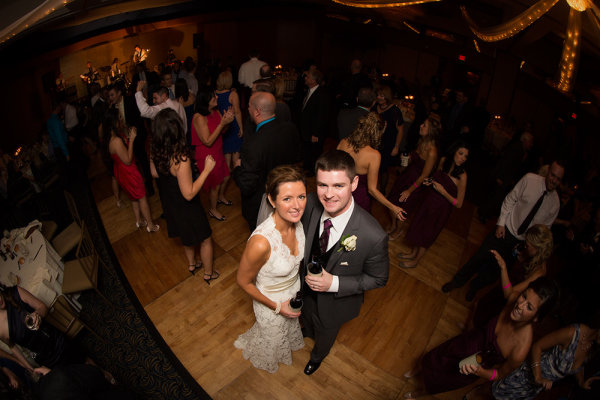
A fisheye lens has become a staple in my bag for shooting weddings. I’ve found it useful in the church for taking an overall scene, as well as on the dance floor for shots like this, of the bride and groom surrounded by their guests. Simply pop the flash at the same time and put them in the spotlight.
St. Patrick’s Cathedral in New York City is a prime place to shoot with a fisheye. It can get crowded, and the shooting area can be tight. In addition, the architecture is incredible, so emphasizing those lines with the extreme wide angel makes a lot of sense. EOS 60D with EF 8-15mm Fisheye zoom.
I’ve found fisheye lenses to be useful in many situations. The secret to using a fisheye is to know it’s limitations, as well as it’s strengths, which is true for all lenses. You can use them for portraits, but you need to be aware of subject placement in the frame, as well as how close you plan to get. The closer you get, the more caricature like the image will be. Stand back a bit, and don’t put your subject too close to the edge, and you can use the surroundings to put your subjects as the main focus. Add a pop of the flash with the head zoomed slightly, and it will create a spotlit effect. I’ve found a fisheye is a great way to get a group shot without simply lining the subjects up.
Another great use for fisheyes- a fairly obvious one- is tight spaces. You don’t always have room to step back, and you might want to include most of the scene in front of you in one shot. In many cases, that’s not possible without a fisheye. You need to be prepared to deal with the inherent distortion, but that can be used creatively to really draw the viewers eye. Use the lines of the image, try an extreme point of view by getting the camera higher or lower.
Fisheyes are great for landscapes as well. They emphasize the foreground and make it possible to include both foreground and sky. Distortion is less of an issue here, unless the horizon is prominent. In that case, it’s essential to either embrace the distortion, or be sure to place the horizon in the center to minimize the distortion. If the horizon can be obscured, this point becomes moot. I love to use fisheyes as the “anti-macro”. I get close up to a flower, or even underneath them, placing them prominently in the frame.
Finally, architecture is an excellent use for a fisheye lens. While it’s traditionally not used for architecture due to the distortion, the way a fisheye can emphasize the lines of a beautifully designed building opens it up to a variety of uses, especially interiors of large cavernous buildings like cathedrals and churches, or sports arenas.
I’m still finding new ways to use my fisheye lens. What are yours?
By getting close to this daisy, it is easily emphasized in the foreground, while the other daisies just behind it get pushed back. EOS 5D Mark III with EF 8-15mm Fisheye Zoom
Fisheyes are great for portraits of kids. The extreme wide angle emphasizes the expressions and movements, creating a cartoon-like effect. EOS 5D Mark III with EF 8-15mm Fisheye zoom.
Post originally from: Digital Photography Tips.
Check out our more Photography Tips at Photography Tips for Beginners, Portrait Photography Tips and Wedding Photography Tips.
If you think humans in creative professions aren’t in danger of someday being replaced by robots, which ostensibly don’t possess the ability to produce real art, you’re going to want to watch this video. A robot called e-David watches itself paint and constantly adjusts its style and technique, planning each stroke in succession to create works of art that feel much more alive than you might expect.
The team behind the e-David project equipped a standard robot with all the necessary means for painting, including five different brushes, a range of 24 colors, and a camera so it can watch itself independently while painting.
The robot takes a picture of what it’s going to copy, and then processes it through its software to determine where to add dark or light tones to reproduce the original. It can even decide to switch brushes or clean them.
The paintings created by the robot aren’t determined by a human programmer; they’re really and truly the creation of the robot itself. It even signs them. Of course, robots can’t express emotion – yet – so they’re still pretty far from being able to capture the spirit of human-created art. But give them a few decades.
Our friends and collaborators over at DxOMark have been investigating Samsung’s NX system, and have recently published reviews of the NX210 and NX300 cameras, alongside an article covering how the company’s lenses measure up in comparison to those from the Sony NEX system. Other reviews on the site this week include lens tests on Nikon super-telephoto primes, an assessment of the Sony RX100 II’s new back-illuminated CMOS sensor, and the first installment of a multi-part article looking into which lenses score best on the Canon EOS 6D. Click through for the links.