RSS
 

Archive for January, 2013

How to exchange the display for Canon IXUS 90

14 Jan

Unser Ebayshop stores.ebay.de Unser Onlineshop www.chip-tip.de We are digital cameras and Camcorder- spare-parts wholesalers. We offer Displays, CCDs, objective and housing for all digital cameras ,for example Canon, Casio, Sony, Nikon, Samsung, Lumix, Kodak, Ricoh and Fujifilm! We are your partners when it comes to convenience and professional repairs to our fototechnischen workshops. We repair for you, so cheaply and quickly all devices, 250 digital camera models of 11 producers. Our Service has to repair all Canon, Nikon, Casio, Kodak, Fuji, Samsung, Pentax,Oplympus, Panasonic and Sony models and similar specialized devices. If you do need, please contact us without hesitation! Tel 0049 40 73442383 0049 40 73442383 Fax: 0049 40 73442382 Unsere Adresse: Chip-Tip Handel & Consulting GmbH Nordkanalstr.58 20097 Hamburg
Video Rating: 4 / 5


How to Get Your Lightroom Catalogue Perfectly Organized

14 Jan

Did you know that ‘getting organized’ is one of the top ten New Year’s resolutions? It’s true! So let’s roll up our sleeves and get to tidying up your lightroom editing process. Lightroom, after all, is an archive of your work, a database of your creative content. Having a streamlined system will allow you to minimize your editing and post-processing Continue Reading

The post How to Get Your Lightroom Catalogue Perfectly Organized appeared first on Photodoto.


Photodoto

 
Comments Off on How to Get Your Lightroom Catalogue Perfectly Organized

Posted in Photography


Selling Your Images As Art: 5 Tips To Getting Started

14 Jan

As photographers, the highest compliment we can be paid is to have someone pay us for our vision and creativity.  For some, this means becoming wedding or portrait photographers, getting paid per event or session.  But what about those of us who enjoy shooting landscapes, or wildlife? Subjects that aren’t often paid for in advance? Aspiring photographers are often told they should try selling their work, but are unsure where to start. It’s relatively easy to set up a website, but getting potential customers there can be difficult.  So how do you get your work seen? What are the options?  Here are five tips to getting started.

1. Establish an Online Presence

This allows you to get customers when you aren’t otherwise selling your work.  The secret here is to go with a web presence that will allow you to be found when others don’t even know they are looking for you.  I use FineArtAmerica.com to host my website.  The beauty here is that all of my work gets entered into their database. I keyword my images, so they appear in pertinent searches by people who’ve come to the site looking for art to purchase. Visitors who know of me can use my own URL, but my guess is that few, if any of my sales actually have come from people visiting my personal URL.  There are other websites out there- Zazzle.com and RedBubble.comare two others. 

I will admit I know very little about how they operate, so do some research before you commit to any of these websites.  One of the beautiful things about the online presence is that it can work with the other outlets I mention below.  It will allow you offer other sizes and products, such as canvas prints, that you may not keep in stock at an art show or be displaying in a gallery. It allows someone who saw you at a show, but wasn’t prepared to purchase, place that order a day, a week, or a month later.  With any of these sites, depending on how quick you are to upload your work, you can be selling within hours.
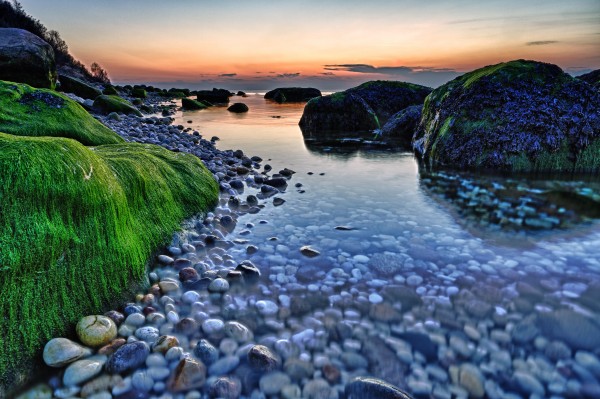
Horton Point Sunset

This image of a local point of interest on Long Island, NY would do well in a local restaurant, cafe, or art show but would probably not garner interest in a more national setting.

2. Look Locally

There are opportunities to sell your work everywhere.  That coffee shop on the corner. That new restaurant down the block.  Many local banks will occasionally show local artists’ work.  The local library will as well.  Prepare a portfolio and ask who to speak with at the establishment. 

Be prepared to have your images printed, matted, and framed.  Work with the establishment to set up guidelines, commissions, and payment for the images.  The best images for this kind of use are images of local landmarks that compliment the restaurant, or images that work well with the restaurant or establishment’s theme.

3. Besides local restaurants and cafes, local art galleries and framing shops are also a good bet

Contact the gallery owners for their guidelines and ask how they like to review new submissions. I’ve found they all seem to work a little differently. Some galleries will charge a membership fee, or a rental fee for space. Most will have specific requirements for digital files, and commission structure will vary- the usual range is from 40%-60%

4. Local art and Craft Shows

These can be tricky, because you never know what kinds of buyers will show up.  It’s best to avoid shows that may be more crafty than artsy, but you’ll have to evaluate each show on it’s own merits. These are a good way to get your feet wet, as they tend to have low entry fees and less stringent requirements, but at the same time, you don’t get the kind of buyer who is necessary looking for fine art and is willing to pay top dollar for it.

Local shows, like local eateries, tend to look for more local art.  My first show I showed up with lots of images from around the country in my travels.  The stuff that got the most interest was all stuff local to where I lived. You’ll want to have a variety of sizes, with most images matted and a few framed images.  While the larger images look great, it’s generally the smaller sizes that will sell better.

5. A-list Art Fairs are the “Big Time”

I have not ventured into this arena yet but have researched it thoroughly.  Sunshine Artist Magazine(subscription required) is pretty much the definitive resource for these larger art fairs. Each fair is different, with artists required to apply and be accepted into the show.  Application fees can be in the hundreds of dollars and apply to your booth fee if accepted. The applications are generally accepted months in advance, so planning is required.

There are requirements for your booth layout as well.  Nothing about these shows is just thrown together at the last minute.  It is virtually a full time job to do such fairs, so be prepared for a commitment.  It is an expensive proposition as well.  You must have a stockpile of prints, framed and unframed, as well as a way to display them.  Several artists I know well have spent well over $ 1000 just on displays. That said, they can be lucrative as there are many who do make a good portion of their income doing such shows.
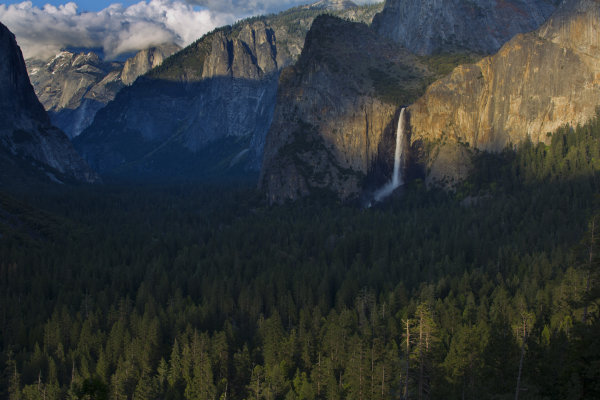
An image of a national park or other nationally known landmark will have broader appeal.

As I mentioned, it’s incredibly gratifying when someone is so taken with your work that they actually pay for it.  There are various outlets for you to get started in selling your work. All it takes is some commitment, and some time to get started.  Remember, ultimately,

Post originally from: Digital Photography Tips.

Check out our more Photography Tips at Photography Tips for Beginners, Portrait Photography Tips and Wedding Photography Tips.

Selling Your Images As Art: 5 Tips To Getting Started


Digital Photography School

 
Comments Off on Selling Your Images As Art: 5 Tips To Getting Started

Posted in Photography


14 January, 2013 – Architecture of a New Landscape

14 Jan

Many observers (myself included) see the mainstream of photography as somewhat constipated, endlessly self-referential, and boringly repetitious.

Today, one of our finest contemporary photographers, Eric Meola, looks at the use of colour in photography and explores The Architecture of a New Landscape.


 "Every time I go back to a module I had already seen, I learn additional things.  I have never seen tutorials that have the excellent mix of what the features are, 
how to use them, enough of the under-the-hood information 
and concepts so that I can utilize the features creatively and efficiently, 
and just enough humor to keep the motivation level high.  Wow!"


The Luminous Landscape – What’s New

 
Comments Off on 14 January, 2013 – Architecture of a New Landscape

Posted in News


Episode 142 – 22-07-2003

14 Jan

A devastated Simran tells her father that she lost for the first time in her life. Saurabh comforts her. She promises him that she will not cry anymore. Anandi suggests to her father that he visit his grandchild. Rashmi tells Simran that she ll talk to Abhimanyu once and see if there sa solution. Abhimanyu s father visits Simran but Saurabh speaks rudely to him and asks him to go away.
Video Rating: 0 / 5

No copyright infringement intended. For entertainment purposes only. An Imaginary Portrait of Diane Arbus (also known simply as Fur) is a 2006 film starring Nicole Kidman as iconic American photographer Diane Arbus, who was known for her strange, disturbing images.


RuneScape BOSS Monsters Solo Version 2 (Part 2)

14 Jan

Music: — Fairy Tail – Salamander Fairy Tail – Hyoujin Mau [Dance of Ice Blade] Fairy Tail – Natsu’s Theme Fairy Tail – Erza’s Theme (Original upload date: May 17, 2010) This is Part 2 of my High-Level Boss Monsters Solo series featuring RS2 combat system before EoC, featuring the following bosses: Phoenix, Wild Jade Vine, Bork, Skeletal Horror, Giant Mole, Kree’arra, Commander Zilyana, General Graardor and K’ril Tsutsaroth Like mentioned in Part 1, this video was made in 2010 and did not include the following updates: Damage Soaking Damage Splat Calculation Ancient Prison in God Wars Dungeon Nex armour The reappealing of the Unbalanced Trade Removal Capes of Distinction Polypore staff Left-clicking Attack boss feature New Combat Sound Effects Commander Zilyana’s redesign K’ril Tsutsaroth’s redesign Items/Abilities related to the Loyalty Programme Several Armour revisions Evolution of Combat RuneScape is a trademark to Jagex Ltd. I do not own any of the contents used for this video, but used for the sole purpose of entertainment without profit. All music used in this video is copyrighted to the respective owners.
Video Rating: 4 / 5


Retouch images faster with new Content-Aware Patch

14 Jan

Bringing imaging magic to Adobe® Photoshop® CS6 software, the acclaimed Content-Aware family of tools lets you retouch or recompose images with astonishing ease, control, and speed. One of the newest of these intelligent editing tools, Content-Aware Patch, was just introduced in Photoshop CS6.

What is Content-Aware Patch?

Content-Aware Patch is designed for times when you want to remove unwanted content from a photo and then replace it with a precise and seamless patch. The tool automatically creates the patch for you, but only after you’ve shown it exactly which area of your image you’d like it to sample from.

And it uses Content-Aware technology to blend the patch into the surrounding area.

Patching challenges

The Content-Aware Fill option introduced in Photoshop CS5 is a great choice when you want to remove unwanted content from an image. Once you’ve deleted your selected content, it can analyze the surrounding pixels and then fill the space with content that matches those pixels. In some cases, though, Content-Aware Fill doesn’t return the desired results. For example, it can fill the space with poorly matched content if the area surrounding the deleted content lacks consistency or a discernible pattern.
How does Content-Aware Patch solve the problem?

Content-Aware Patch gives you superior results by letting you determine the area it will sample from to create your patch. For example, if you want to remove an object from a tight row of similar objects, you can tell Content-Aware Patch to sample from a nearby background area to create a precise and natural-looking patch.

Retouch with greater precision

Content-Aware Patch gives you a fast and easy way to perfect your images. Simply delete the content you don’t want, direct the tool to the patch material you think will work best, and then watch as it uses Content-Aware technology to magically create a stunning result.

Any suggestions, ideas? Feel free to comment on this article!

Back to Top

BlogPhoto

 
Comments Off on Retouch images faster with new Content-Aware Patch

Posted in Equipment


Meet The Photographers Who Write For Digital Photography School ~ Pye Jirsa

14 Jan

You’ve been reading their articles for months or years, have you ever wondered “Who are the photographers who write for DPS”? We thought it would be a good time to introduce them to you through a series of interviews. No worries, Darren will get his turn too.

Today meet Pye Jirsa from Orange County, California.

1. How long have you been shooting?

I feel like I wasn’t serious about photography until around mid 2008. Before that, it was just dinking around on a point and shoot, which really doesn’t count in my book. We can all say “I have been shooting all my life” but in reality, I wasn’t serious about learning until I decided I wanted to do it professionally in early 2008.

2. Do you have a full time job or are you a full time photographer?

I am a full time photographer, it is my job. I am one of the owners of Lin and Jirsa Photography out of Orange County, California.

3. If you had to limit yourself to one genre of photography, what would it be and why?

Wedding photography. I know it probably isn’t what most photographers “aspire” to, but personally I love it. I have tried virtually every type of photography, from landscapes, to runway, editorial, fashion, band, headshots, product, etc. I find that I get bored very quickly with these other types of shoots. It lacks the variety that my ADD personality needs, haha! Weddings have always kept me interested and on my toes because within a single day, I get to wear many “photographic hats” if you will. I get to shoot product shots in the details, portraits, candids, landscapes, editorials with the bridal party, and so forth. I am writing this the day after my last wedding for 2012. It was an extremely technical wedding. Over the course of the day, we counted 19 different lighting setups were used! It’s that variety that keeps me always interested. But, I think best of all, weddings are very uplifting. Being able to document people on such a happy and joyous occasion is something that makes me happy in-turn. After a wedding, I am sort-of on an emotional high which I have never gotten from shooting products, fashion, headshots or any other type of photography.

4. When did you start writing for dPS and why?

I think my first article went onto DPS a year or two ago. When we first got into the industry, we had wonderful mentors. They inspired me to want to teach as well, which is why we created SLR Lounge and is why I enjoy writing for other great sites as well, such as DPS.

5. What do you shoot with and what’s your favorite lens?

I shoot with a lot of cameras/lenses. If you were to ask what my all-out favorite camera is at the moment, I would say a Nikon D800. But, out of habit, I am usually shooting on my canon 5D Mark 3. I typically only use my D800 for my personal editorial/landscape work because I find the 5D Mark 3 fits better in our production workflow. My go-to lenses for my 5D Mark 3 are my 50mm 1.2 and my 70-200 F2.8 Mark II. I probably shoot 80-90 percent of my images on those two lenses.

6. What would be your number one tip to any new photographer?

Try out everything before deciding. From types of photography to styles of lighting. Don’t just settle on something because it is “comfortable” or familiar to you. Always push yourself to try new things and develop your own style/look over time, rather than attempting to define it right when you jump in. The biggest mistake I see new photographers making is in trying to define what type of photographer they are, or even what type of lighting they specialize in before having tried anything else. It places an immediate limitation on their technical growth and their development of a unique style.

7. What’s your next big project?

We completed our Lightroom 4 Workshop Collection mid-way through 2012, and we are just finishing up our 3 Part HDR Photography Workshop on DVD which should be out before the end of the 2012. To be honest, I am not sure what project I want to move on to next. There are so many subjects I enjoy and would like to teach, at the moment, I am just enjoying this short break with family before we decide and kick into the next project in 2013.

8. Where can people go to find out more about you and your work?

Our educational tutorials and products can be seen and purchased from slrlounge.com. We also have a YouTube channel at youtube.com/slrlounge where we post free tutorials and behind the scenes videos on our photography and style. Our studio’s work under Lin and Jirsa Photography can be seen on our website and blog at linandjirsa.com.

Post originally from: Digital Photography Tips.

Check out our more Photography Tips at Photography Tips for Beginners, Portrait Photography Tips and Wedding Photography Tips.

Meet The Photographers Who Write For Digital Photography School ~ Pye Jirsa


Digital Photography School

 
Comments Off on Meet The Photographers Who Write For Digital Photography School ~ Pye Jirsa

Posted in Photography


Nikon 18-55mm Review

14 Jan

Review of Nikon’s Nikkor 18-55mm midrange kit lens. The full review can be found here: raspix.com
Video Rating: 2 / 5


Crossed Up: 9 Twisted Swastika-Shaped Buildings

13 Jan

[ By Steve in Architecture & Public & Institutional. ]

swastika-shaped buildings
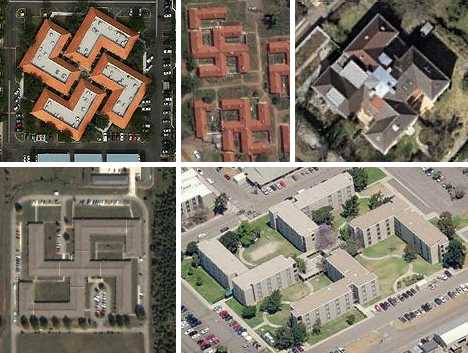
Swastikas are ancient symbols of positivity tarnished by a negative recent past, which explains why modern architects have generally avoided employing the hooked cross design in their blueprints. With that said, a little digging turns up more than a few swastika-shaped buildings – some where one might expect to find them, others most definitely not.

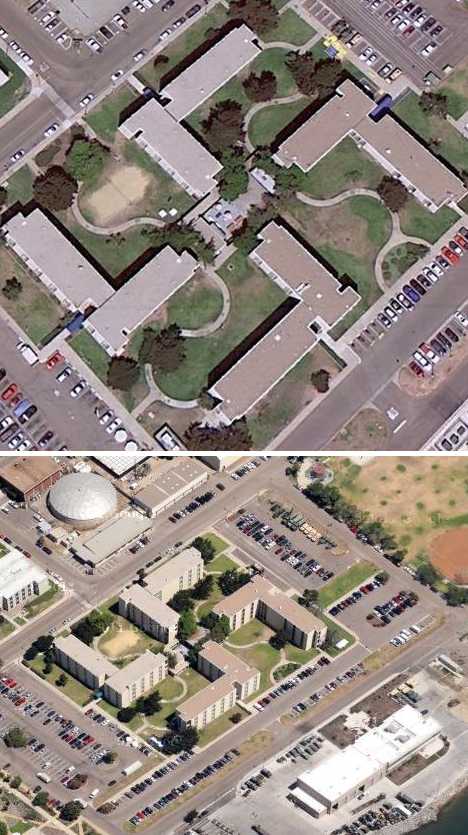
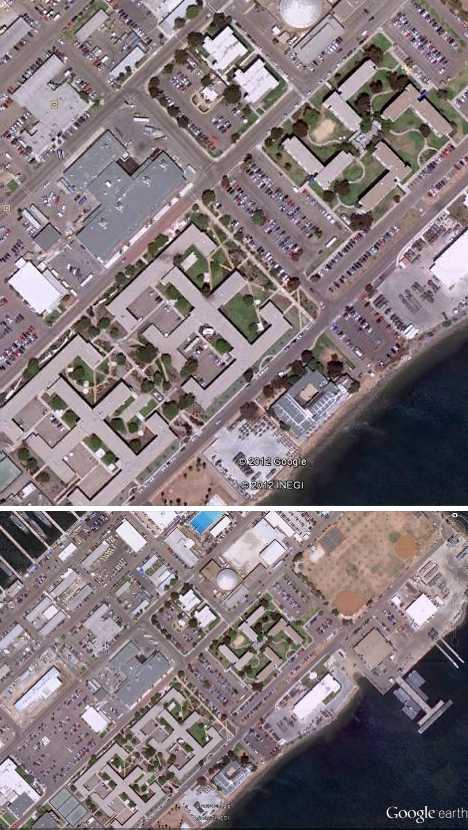
Barracks at Naval Air Station North Island, Coronado CA

swastika-shaped building coronado Nay(images via: Si1very and Google Sightseeing)

The United States Navy’s Naval Air Station North Island in Coronado, California was established in 1917 and during the Second World War it was the main naval base supporting the war effort in the Pacific. Post-war construction at the base salutes the American armed force’s victories with streets named “Tulagi” and “Guadalcanal” to name just a couple. Though nobody’s admitting it, commemorative construction may have moved beyond roadways and into the base’s buildings.

swastika-shaped building Coronado Navy(images via: San Diego City Beat, IsraelMilitary.net and The Power Hour)

The buildings in question are a six-building complex currently occupied (according to a USN Public Affairs Officer) by the U.S. Navy’s Amphibious Construction Battalion 1 (the Seabees). Originally designed by John Mock of Hendrick & Mock Architects in the late 1960′s, the Navy’s original specs called for “a boiler plant and a recreation room; and a single ‘L’-shaped 3-story barracks.” The plan was then amended to have the dormitory building “be repeated three times and placed at 90-degree angles to the central buildings.” It was only after ground was broken on the project that the Navy realized what shape the complex would display when seen by the air but as very few people overflew Naval Air Station North Island in the early 1970s, figured it wasn’t a big deal.

swastika-shaped building coronado(images via: About Facts)

Which it wasn’t, for decades, until the Internet and Google Earth allowed anyone and everyone to enjoy birds-eye views of anywhere and everywhere… and some folks did NOT enjoy what they viewed at the Navy’s Coronado barracks. The cost of adding additional landscaping and associated construction to camouflage the barracks’ shape has been pegged at $ 600,000 though a, er, final solution to the matter has yet to be implemented. Curiously, a pair of buildings just beside the barracks appear to be modeled after World War II-era bombers flying directly at the “swastika” (the other side of which sits an empty baseball field) though neither the Navy nor the architects will confirm this.

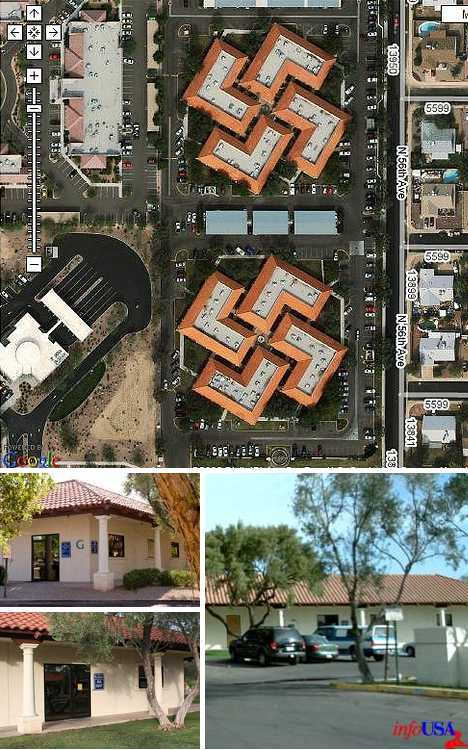
Glendale AZ Medical Buildings

swastika buildings Glendale medical(images via: Cloverangel7, Thunderbird Internal Medicine and City-Data)

Located just north of Thunderbird Hospital on W Thunderbird Rd west of 56th Ave. in Glendale, Arizona you’ll find the Thunderbird Internal Medicine building and its doppelganger to the south, the Oakeson Physical Therapy building. Known together as “The Fountains”, the buildings house a number of small to mid-sized doctor’s offices, labs and diagnostic facilities. The low-lying, nested cluster of buildings feature coppery-red terracotta tiled roofs and exhibit a blueprint more like a child’s pinwheel than a classic swastika. The coordinates of the buildings on Google Earth are 33.36.48.96 N by 112.10.43.02 W.

swastika buildings Phoenix(image via: Phora)

Curiously, another group of 4 buildings (probably by the same architect) is situated relatively nearby at 33.28.50.87 N by 111.56.45.60 W. The two buildings at either end of the row display a full swastika/pinwheel plan while the inner pair display 3/4 crosses only. What’s up with metro Phoenix and swastika-shaped buildings? Like many such designs, structuring these buildings in a swirled cross design optimizes the exterior wall area to allow for a maximum number of outward-facing windows. While visually pleasing for those working there, the plan also eases the need for air conditioning, an important factor when planning architecture in the desert southwest.

Kenyatta National Hospital

swastika buildings Nairobi Kenya(images via: TechMtaa and YouTube)

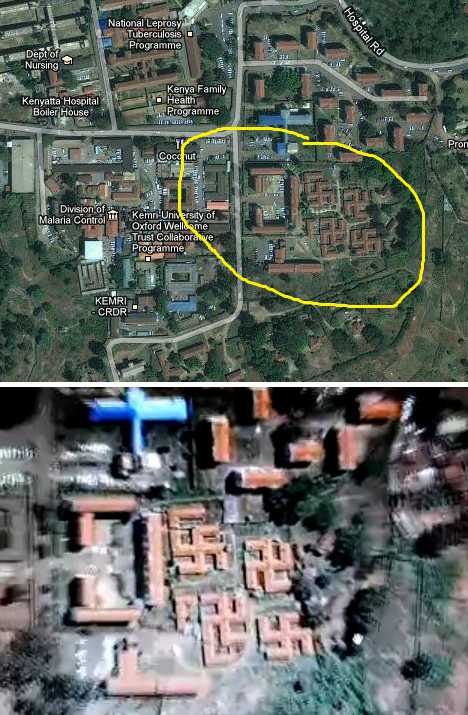
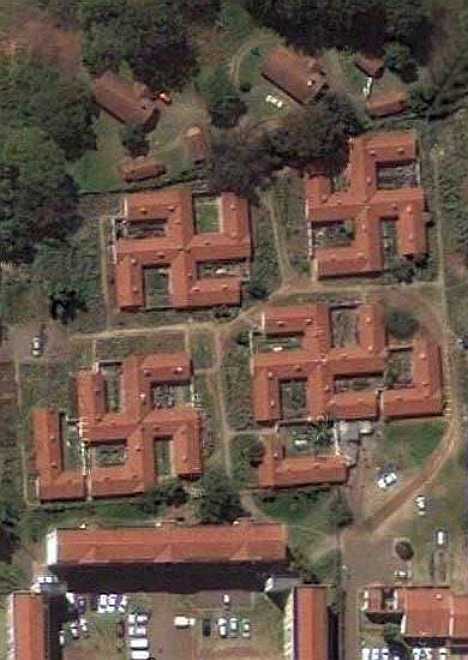
Located on the grounds of Kenyatta National Hospital in Nairobi, Kenya, is an “estate” of four low buildings that from the air display swastika floorplans. Two of the buildings are oriented in the traditional counterclockwise direction as employed for several thousand years by cultures as disparate as India’s ancient Sanskrit-speaking Indus Valley Civilization and the Native American tribes of the American desert southwest.

swastika buildings Nairobi Kenya(image via: Kikulacho)

Another two buildings on the hospital grounds are laid out in the clockwise (right-facing) direction similar to the swastika design adopted by Germany’s Nazi Party in 1920. As far as the Kenya buildings are concerned, it’s estimated they house nurses who work at the Kenyatta National Hospital and/or its associated buildings such as the Kemri University of Oxford Wellcome Trust Collaborative Programme offices just across the street.

Next Page:
Crossed Up 9 Twisted Swastika Shaped Buildings

Share on Facebook


[ By Steve in Architecture & Public & Institutional. ]

[ WebUrbanist | Archives | Galleries | Privacy | TOS ]


WebUrbanist

 
Comments Off on Crossed Up: 9 Twisted Swastika-Shaped Buildings

Posted in Creativity