Photographer Alex Bitar heaps praise on Canon’s 100mm macro lens. Visit Alex online at www.alexbitar.com (c) 2012 Green Hill Camera http Produced by Kozak Films www.kozakfilms.com
Video Rating: 4 / 5
Photographer Alex Bitar heaps praise on Canon’s 100mm macro lens. Visit Alex online at www.alexbitar.com (c) 2012 Green Hill Camera http Produced by Kozak Films www.kozakfilms.com
Video Rating: 4 / 5
Some cool visual art images:
Flower : EVOLUTION : See : FEEL : Beyond : OBVIOUS! Enjoy : the TEXTURE : the lines! 🙂

Image by || UggBoy?UggGirl || PHOTO || WORLD || TRAVEL ||
Abstract art
Abstract art uses a visual language of form, color and line to create a composition which may exist with a degree of independence from visual references in the world. Western art had been, from the Renaissance up to the middle of the 19th century, underpinned by the logic of perspective and an attempt to reproduce an illusion of visible reality. The arts of cultures other than the European had become accessible and showed alternative ways of describing visual experience to the artist. By the end of the 19th century many artists felt a need to create a new kind of art which would encompass the fundamental changes taking place in technology, science and philosophy. The sources from which individual artists drew their theoretical arguments were diverse, and reflected the social and intellectual preoccupations in all areas of Western culture at that time.
Abstract art, nonfigurative art, nonobjective art, and nonrepresentational art are loosely related terms. They are similar, although perhaps not of identical meaning.
Abstraction indicates a departure from reality in depiction of imagery in art. This departure from accurate representation can be only slight, or it can be partial, or it can be complete. Abstraction exists along a continuum. Even art that aims for verisimilitude of the highest degree can be said to be abstract, at least theoretically, since perfect representation is likely to be exceedingly elusive. Artwork which takes liberties, altering for instance color and form in ways that are conspicuous, can be said to be partially abstract. Total abstraction bears no trace of any reference to anything recognizable. In geometric abstraction, for instance, one is unlikely to find references to naturalistic entities. Figurative art and total abstraction are almost mutually exclusive. But figurative and representational (or realistic) art often contains partial abstraction.
Both Geometric abstraction and Lyrical Abstraction are often totally abstract. Among the very numerous art movements that embody partial abstraction would be for instance fauvism in which color is conspicuously and deliberately altered vis-a-vis reality, and cubism, which blatantly alters the forms of the real life entities depicted.
EXPLORE MORE AND SOAR:
WIKIPEDIA = ABSTRACT = TO THE WORLD
Thoughts about abstract…….forms…….
As you see, I do not treat the creation of fiction, that to say the invention and development of fantasies, as a form of abstract thought. I dont wish to deny the uses of the intellect, but sometimes one has the intuition that the intellect by itself will lead one nowhere.
—J. M. Coetzee
Some more……..
Delight at having understood a very abstract and obscure system leads most people to believe in the truth of what it demonstrates.
—Georg C. Lichtenberg
Please MORE EXPLORE……..
Evil is the product of the ability of humans to make abstract that which is concrete.
—Jean-Paul Sartre
Flower : EVOLUTION : See : FEEL : Beyond : OBVIOUS! Enjoy : the TEXTURE : the lines! 🙂

Image by || UggBoy?UggGirl || PHOTO || WORLD || TRAVEL ||
Abstract art
Abstract art uses a visual language of form, color and line to create a composition which may exist with a degree of independence from visual references in the world. Western art had been, from the Renaissance up to the middle of the 19th century, underpinned by the logic of perspective and an attempt to reproduce an illusion of visible reality. The arts of cultures other than the European had become accessible and showed alternative ways of describing visual experience to the artist. By the end of the 19th century many artists felt a need to create a new kind of art which would encompass the fundamental changes taking place in technology, science and philosophy. The sources from which individual artists drew their theoretical arguments were diverse, and reflected the social and intellectual preoccupations in all areas of Western culture at that time.
Abstract art, nonfigurative art, nonobjective art, and nonrepresentational art are loosely related terms. They are similar, although perhaps not of identical meaning.
Abstraction indicates a departure from reality in depiction of imagery in art. This departure from accurate representation can be only slight, or it can be partial, or it can be complete. Abstraction exists along a continuum. Even art that aims for verisimilitude of the highest degree can be said to be abstract, at least theoretically, since perfect representation is likely to be exceedingly elusive. Artwork which takes liberties, altering for instance color and form in ways that are conspicuous, can be said to be partially abstract. Total abstraction bears no trace of any reference to anything recognizable. In geometric abstraction, for instance, one is unlikely to find references to naturalistic entities. Figurative art and total abstraction are almost mutually exclusive. But figurative and representational (or realistic) art often contains partial abstraction.
Both Geometric abstraction and Lyrical Abstraction are often totally abstract. Among the very numerous art movements that embody partial abstraction would be for instance fauvism in which color is conspicuously and deliberately altered vis-a-vis reality, and cubism, which blatantly alters the forms of the real life entities depicted.
EXPLORE MORE AND SOAR:
WIKIPEDIA = ABSTRACT = TO THE WORLD
Thoughts about abstract…….forms…….
As you see, I do not treat the creation of fiction, that to say the invention and development of fantasies, as a form of abstract thought. I dont wish to deny the uses of the intellect, but sometimes one has the intuition that the intellect by itself will lead one nowhere.
—J. M. Coetzee
Some more……..
Delight at having understood a very abstract and obscure system leads most people to believe in the truth of what it demonstrates.
—Georg C. Lichtenberg
Please MORE EXPLORE……..
Evil is the product of the ability of humans to make abstract that which is concrete.
—Jean-Paul Sartre

Giottos has announced a range of tripods that use a unique ‘Y’-shaped centre column profile to offer a more compact folded package. The ‘Silk Road YTL series’ replaces the existing MTL range in its entirety, and according to Giottos offers a 30% space saving without any sacifice in stability or weight capacity. The range includes 12 models offering 3- or 4-section legs, conventional 2-way or tilting centre columns, and weight capacities from 5 to 10 kg. They’ll be on sale from mid-January, with at prices starting from £100 for aluminium, or £220 for carbon fibre models.
News: Digital Photography Review (dpreview.com)
For my last detailing boot camp class I brought in a 2008 Cadillac CTS with the original factory black basecoat/clearcoat finish to let my students learn how to use the Meguiar’s DA Microfiber Correction System. This car was trashed as every panel was completely filled with swirls and scratches. I gave about a 20 minute introduction, demonstration and explanation on how the system works and how to use it and then I turned the class loose to see what they could do. Many of the people that buffed on this car had never used any type of machine to polish paint before attending my class. I think the video plus the before and after pictures speak for themselves. To see ALL the before and after pictures PLUS, * How to wetsand by hand and machine * How to use a Flex 3401 on a 1940 Ford Coupe Hotrod * How to use a rotary buffer with Meguiar’s M105 on a 1966 Corvette Copy and paste the below into Google, Pictures & Comments from September 2012 Detailing Boot Camp -Mike Phillips
Video Rating: 4 / 5
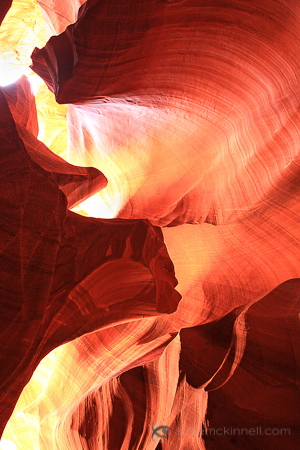
Backlight is when the sun is directly in front of you lighting the back of your subject.
Shooting a backlit scene is more difficult technically but that is no reason to shy away from what can become a dynamic and energizing image.
One of the strengths of backlight is that it emphasizes shape so you will want to find subjects with strong shapes.
In this image of Antelope Canyon in Arizona, it would be hard to distinguish the shape of this part of the canyon wall had the sun not been high in the sky.
Because it was mid-day, the light went straight down the slot canyon lighting up the canyon walls. I was at the bottom of the canyon shooting straight up, so my subject was backlit.
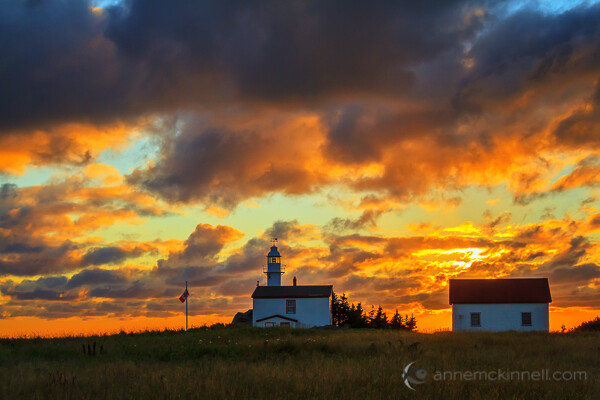
I always think of this image as the shot I almost didn't make. It was an after thought. My intention was to get down to the beach for a seascape and I was disappointed that I couldn't find a way down. As I went back to the parking lot feeling defeated I looked back and thought "I just have to capture that sky regardless of how boring those buildings are." When I looked at the photo on my computer afterwards I learned my lesson that an image only needs one really exciting element. I was able to bring quite a bit of detail out of the shadows in post-processing.

Backlight creates the rim light you often see in portraits but this effect works on wildlife too.
In this image of an egret the majority of the light was coming from behind the bird, causing the feathers around the edge of the bird to glow, but there was still enough ambient light to capture detail in the front.
When there is not enough ambient light to capture the details in the foreground you can use fill flash or a reflector.
The part that can be technically more challenging when it comes to backlit scenes is getting the proper exposure. If you have your camera set to evaluative metering it will take into account the entire scene and try to determine the best exposure. This works great when you have a fairly evenly lit scene, but when you have a scene with high contrast it doesn’t work as well. Your camera can’t meter for both the bright areas and the dark areas at the same time.
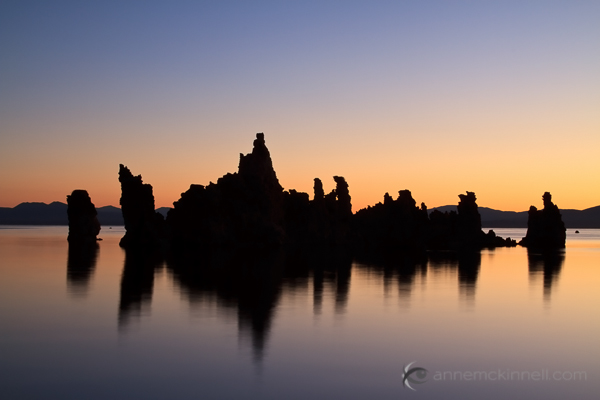
The solution is to switch to a different metering mode, such as spot metering, so you can tell your camera which part of the frame is important to you. You can choose to meter on the darker area to maintain detail in the shadows and let the highlights go completely white as I did in the photo of Antelope Canyon above. Or you can meter on the bright part of the scene and let the shadows go completely dark to create a silhouette.
One of my favourite techniques is to create a starburst effect in a silhouette image when the sun is still above the horizon. To do this, position yourself so that the sun is partially hidden behind an object and use a small aperture, like f/22.
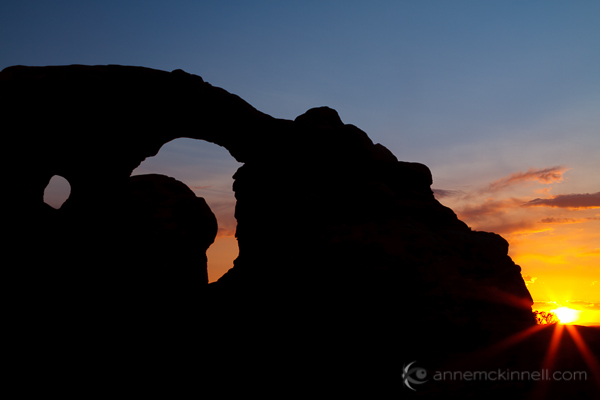
When the sun is in your frame it’s a good idea to use your live view on your LCD monitor to protect your eyes rather than looking through the viewfinder, especially if you are using a telephoto lens.
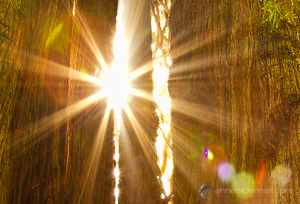
Be sure to watch for lens flare when you are shooting directly into the sun. Lens flare is when the light hits your lens directly and reflects inside the lens causing bright streaks or polygonal shaped bright spots with rainbow colours to appear. This is not necessarily a bad thing but if you don’t like it you will need to shade your lens with a lens hood or your hand. Shading your lens is not usually possible when the sun is in your frame but you can reduce the lens flare by positioning yourself so the sun is partially behind an object.
Once you master the art of setting the exposure for a backlit scene you will open the door to new possibilities by looking into the light.
Post originally from: Digital Photography Tips.
Check out our more Photography Tips at Photography Tips for Beginners, Portrait Photography Tips and Wedding Photography Tips.
Using Backlight in Nature Photography
Though it’s been out for quite a while, many photographers are still making the transition to Photoshop CS6.
Last fall Alain Briot write a piece titled Alain’s Favourite CS6 Features. Things were a bit hectic for me at the time, and I neglected to publish it then. Sorry Alain. Here it is now though.

…
The Luminous Landscape – What’s New
Slide show of some of my photographs set to the Atmosphere song “Always Coming Back Home to You” It’s dedicated to my home state of Minnesota, where I have lived my whole life, and hope to continue that for the rest of my life. *Edit- I realized there is one duplicate picture, I’m not to bothered by it, but I did notice it.
Video Rating: 5 / 5
Unser Ebayshop stores.ebay.de Unser Onlineshop www.chip-tip.de We are digital cameras and Camcorder- spare-parts wholesalers. We offer Displays, CCDs, objective and housing for all digital cameras ,for example Canon, Casio, Sony, Nikon, Samsung, Lumix, Kodak, Ricoh and Fujifilm! We are your partners when it comes to convenience and professional repairs to our fototechnischen workshops. We repair for you, so cheaply and quickly all devices, 250 digital camera models of 11 producers. Our Service has to repair all Canon, Nikon, Casio, Kodak, Fuji, Samsung, Pentax,Oplympus, Panasonic and Sony models and similar specialized devices. If you do need, please contact us without hesitation! Tel 0049 40 73442383 0049 40 73442383 Fax: 0049 40 73442382 Unsere Adresse: Chip-Tip Handel & Consulting GmbH Nordkanalstr.58 20097 Hamburg
Ein Beitrag von: Dennis Skley
Meine letzten Experimente, die Filmentwicklung mit Urin sowie die Fixierung mit Salz, waren nun schon eine ganze Weile her und in mir loderte ein Feuer. Ich wollte – nein, ich musste – mal wieder etwas Neues wagen!
Nur was?
Ein „neuer Entwickler“ sollte es werden, doch leider kenne ich mich mit dem chemischen Kram kaum aus. Vitamin C beschleunigt die Entwicklung, also muss Säure eine wichtige Rolle spielen. Sowohl Kaffee als auch Wein oder Urin beinhalten Säure, die Theorie kann also nicht ganz falsch sein.
Ist in Bier Säure drin? Ich suchte schnell im Internet und fand heraus, dass Bier einen ähnlichen pH-Wert wie Wein hat – und mit Wein funktioniert es ja auch.
Ich startete eine weitere Suche mit „Film Bier entwickeln“, doch hier wurde ich nicht fündig. Na gut, dachte ich mir, versuchst Du es halt selbst, im schlimmsten Fall geht halt ein Film drauf.
In meiner Mittagspause fing ich an, den Film – einen Agfa APX 100 – zu belichten. Die Pause war wie immer zu kurz, also mussten die restlichen Bilder auf dem Heimweg gemacht werden. ISO 100, Dunkelheit und kein Stativ dabei. Tolle Voraussetzungen – aber der Film wurde voll.

Bier hatte ich keines zu Hause, also musste der Spätkauf aufgesucht werden. Der Spätkaufverkäufer begrüßte mich mit einem Lächeln, nach über zehn Jahren kennt man sich halt. Er staunte nicht schlecht, als ich zum Kühlschrank ging und mir eine Flasche Pilsator heraus nahm, das billigste Bier vor Ort.
„Das ist nicht für mich, ich will damit einen Film entwickeln“, raunte ich ihm zu. Ich rechnete mit einem erstaunten Blick und/oder einer Nachfrage. „Das macht 70 Cent, Dennis, ich wünsche Dir viel Spaß.“ Er lachte.
Manchmal frage ich mich, was dieser Mann schon alles erlebt haben muss…
Zu Hause angekommen ging es dann los, der Hexenkessel wurde rausgeholt, um den Entwickler anzurühren.

Mein Rezept:
Mit einem Milchaufschäumer verrührte ich das Ganze. So wollte ich gleichzeitig auch die Kohlensäure loswerden. Ich ließ das Gebräu noch etwa eine halbe Stunde in der Küche stehen, danach hatte es eine Temperatur von 20°C. Perfekt!

In der Zwischenzeit hatte ich den Film bereits in die Entwicklerdose gespult, wo er auf sein Besäufnis wartete. Es ging los und er „Entwickler“ kam in die Dose. Für den ersten Versuch setzte ich eine Zeit von 30 Minuten an. Ein guter Grundwert für „alternative“ Entwickler. Dazu alle 30 Sekunden die vertraute Schwenkbewegung.
Nach diesen 30 Minuten entleerte ich dann die Dose. Das Bier hatte sich von uringelb zu giftgrün verfärbt. Mhhhh, lecker! Es folgte das übliche Prozedere: Zwischenwässern, Fixieren, Wässern, Anti-Statik-Bad. Der Film war fertig, nun kam der Moment der Wahrheit, ich öffnete die Dose und…
TATSACHE! Schöne, kräftige Negative, die sogar für Kontaktabzüge geeignet wären. Fantastisch!
500 Jahre Reinheitsgebot … und ich entwickle einen Film damit. Prost!

Es ist wirklich erstaunlich, mit was für Mitteln man so tolle Ergebnisse erreichen kann. Gern würde ich auch eine chemische Erklärung dafür haben. Langt eventuell auch Wasser mit genügend Vitamin C? Oh, das muss getestet werden, demnächst vielleicht mehr dazu!
Die Bilder des Films kann man in meinem Flickr-Album finden.
kwerfeldein – Fotografie Magazin

Thanks Eric for the Topic! www.youtube.com www.youtube.com ———————————————————- All my Channels youtube.com youtube.com youtube.com youtube.com Blogtv www.blogtv.com Add me on Skype! Domingo0022 Follow me on Twitter twitter.com twitter.com Like me on Facebook www.facebook.com www.facebook.com Visit my Shirt Shops www.cafepress.ca www.districtlines.com All music and graphics used Royalty free and licensed under Creative Commons “Attribution 3.0” creativecommons.org “Copyright Disclaimer Under Section 107 of the Copyright Act 1976, allowance is made for “fair use” for purposes such as criticism, comment, news reporting, teaching, scholarship, and research. Fair use is a use permitted by copyright statute that might otherwise be infringing. Non-profit, educational or personal use tips the balance in favor of fair use.” ——————————————————————–
Video Rating: 4 / 5

You must be logged in to post a comment.