RSS
 

Archive for February, 2012

Nickelback – Photograph

06 Feb

© 2007 WMG Photograph Buy it on iTunes: bit.ly

During his month long artist in residency at the Ace Hotel in NYC, photographer Chase Jarvis explores and celebrates the art of the snapshot and invites the world to further pursue their own creative endeavors.
Video Rating: 4 / 5


Kenko-Tokina exhibits mockup of image-stabilised 70-200mm F4 at CP+

06 Feb

tokina70-200_4.png

Kenko-Tokina will exhibit a mockup of a 70-200mm F4 telephoto zoom that features both a ring-type ultrasonic autofocus motor and optical image stabilization at the CP+ trade show in Japan. The AT-X Pro SD 70-200 F4 (IF) FX will be the company’s first stabilized lens, and will likely be especially interesting to Nikon SLR users who currently have no option that’s directly comparable to Canon’s popular and highly-regarded 70-200mm F4 designs. Further details are limited, but the lens appears to feature both internal zoom and focus mechanisms, and has a usefully-close minimum focus distance of 1m. (via Megapixel.il)

News: Digital Photography Review (dpreview.com)

 
Comments Off on Kenko-Tokina exhibits mockup of image-stabilised 70-200mm F4 at CP+

Posted in Uncategorized


10 Minute Double Suction Cup Camera Mount for a Kayak Deck

06 Feb

I discussed applications of suction cups from Sticky Pod in numerous posts in this blog – mounting different cameras or GPS units on a kayak deck. A single suction cup works usually pretty good for small waterproof cameras like GoPro Hero or Pentax Optio. However, things are getting a little bit awkward if your kayak has a steep deck with a ridge in the middle. It is the case of JKK Supernova kayak where it is not so easy to level and center a camera on a front deck. I also wanted to set up the camera a little bit above the deck.

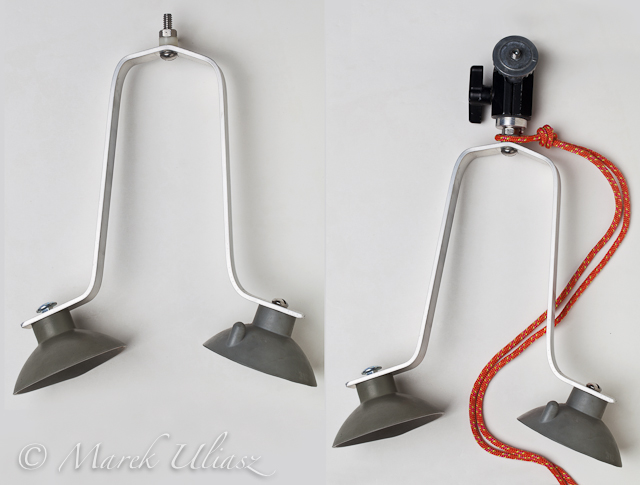
The problem was solved with the two suction cup mount. I used the following basic ingredients:
– two suction cups (you can order then directly from Sticky Pod or from Amazon.com, for about $ 3 each)
– aluminum flat bar (1/8″ thick, 1″ wide) from your local hard store, the length depends on your design
– three 3/8″ bolts, two 3/4″ long and one 1/2″ (or you may need some spacers) and one nut
– a piece of some cord for a tether
It took me about 10 minutes to cut the aluminum bar, drill 3 holes, smooth sharp edges and bend it to a shape.

sticky-pad-mount-2x

I added a small knuckle (ball head) to my mount. It provides easy way to control the camera position and is really useful for Pentax Optio or a similar camera. I needed a tripod mount adapter for the GoPro Hero. The knuckle is really not necessary in this case since a hinge allows for up and down camera adjustment, but it is still helpful. The picture shows the knuckle from Sticky Pod. I am also using a smaller and cheaper one made by Giotto.

sticky-pad-mount-2x
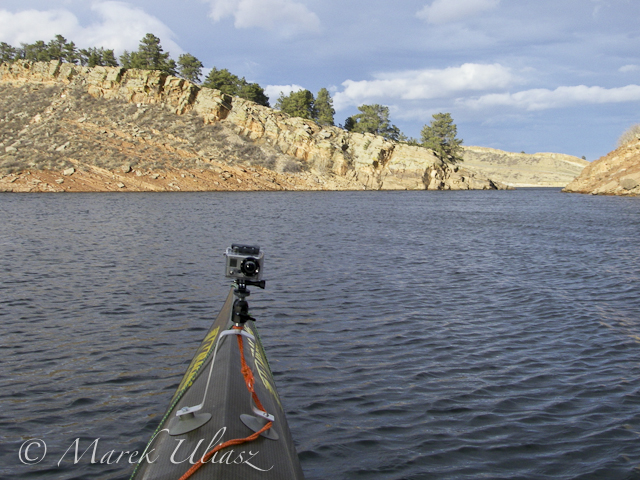
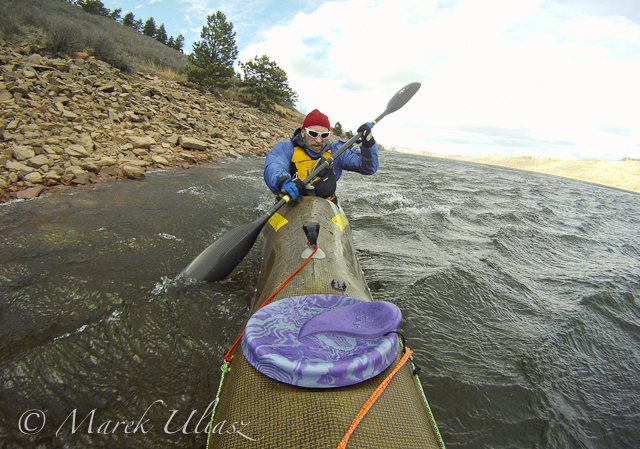
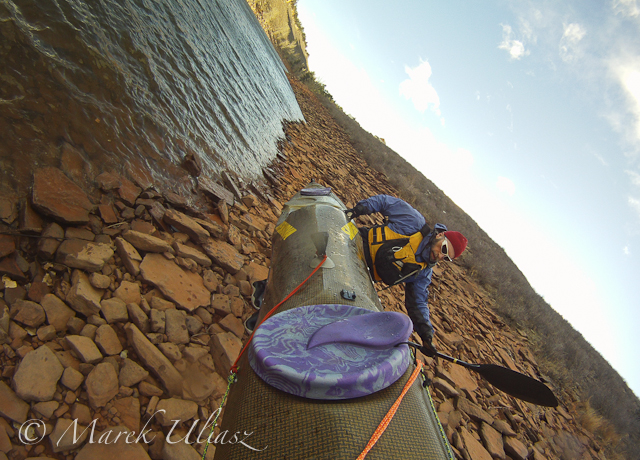
Here is the GoPro Hero camera mounted on the front deck of JKK Supernova kayak (shot from a cockpit with Pentax Optio W30) and some pictures from a January paddling on the Horsetooth Reservoir. The mount worked fine in very windy conditions. The camera mounted about 12″ above the deck is less likely to be hit by water splashes from my paddle.

DCIM100GOPRO
DCIM100GOPRO

During another paddling workout on the Horsetooth I set up the GoPro Hero a little closer to the cockpit, see picture examples here and here.


ch_client = “mmuliasz”;
ch_type = “mpu”;
ch_width = 550;
ch_height = 120;
ch_color_title = “3c78a7”;
ch_color_site_link = “3c78a7″;
ch_non_contextual = 4;
ch_vertical =”premium”;
ch_sid = “Chitika Premium”;
var ch_queries = new Array( );
var ch_selected=Math.floor((Math.random()*ch_queries.length));
if ( ch_selected < ch_queries.length ) { ch_query = ch_queries[ch_selected]; }

Related posts:
A Bird’s-Eye View of Kayaking with GoPro Hero Camera
Kayak Video Camera Mast – Sticky Pod Combined with Monopod
Paddling with Canon PowerShot G11 Camera on a Monopod Mast
A New Shooting Angle – Camera Video Mast on Thunderbolt Kayak
Sticky Pod Review – A Suction Cup Camera Mount for Kayak Photography
South Platte River with GoPro Hero HD Camera and Thunderbolt Kayak
A Simple Suction Cup Mount for Garmin Forerunner 305 GPS


paddling with a camera

 
Comments Off on 10 Minute Double Suction Cup Camera Mount for a Kayak Deck

Posted in Uncategorized


HDR used properly is appropriate for photojournalism, says Unified Color’s Omvik

06 Feb

WP.jpg

Are High Dynamic Range photos appropriate for illustrating news? That’s the debate that’s been started by the Washington Post’s use of an HDR image on its front page in January. Sean Elliot, president of the National Press Photographers Association came down firmly against it, saying, ‘HDR is not appropriate for documentary photojournalism.’ John Omvik, Marketing VP with HDR software maker Unified Color understandably disagrees. He’s written us a response arguing that what we see is closer to HDR than, say, a mono photo shot with Tri-X film.

News: Digital Photography Review (dpreview.com)

 
Comments Off on HDR used properly is appropriate for photojournalism, says Unified Color’s Omvik

Posted in Uncategorized


Total Training for Photoshop CS5 Essentials – Chapter 1: Lesson 2. Color

06 Feb

Description: Mastery of Adobe Photoshop CS5 requires a solid foundation in the fundamental tools and techniques used by the pros to create eye-popping effects, achieve stunning visuals. Total Training for Adobe Photoshop CS5 Extended: Essentials is intended for the beginner to intermediate user as a guide through comprehensive tutorials on color correction, layout techniques, special effects and image touch up. This series will give you the confidence and know-how to achieve fantastic results using Photoshop CS5 new interface and enhanced tools. The updates to Photoshop CS5 include the Adjustments and Masks panel, the 3D commands, annotations and an improved interface. In addition you will learn non-destructive color effects and color correction, how to set file format and image compression for use on the web and how to create and apply special effects. By the time youve finished watching Total Training for Adobe Photoshop CS5 Extended: Essentials, you will be proficient will the skills required for managing and manipulating images in Photoshop. You will know all about photo retouching, color correction and how to use the Quick Mask mode, work with selections, resize images and many more valuable and time saving techniques to use when working with Photoshop CS5. Five New Features covered in this title: 1. The Refine Radius Tool 2. Content-aware healing and fills 3. The Mixer Brush 4. Live Workspace updates 5. Mini Bridge

This video shows a quick use of Content Aware Scaling and shows the application and effects of a few Actions from Mama’s Lollipop Bundle which has caricature, art, and retouching Actions. To see more go to www.photoshopmama.net
Video Rating: 4 / 5


Yoga For Kids – Yoga Helps To Focus

06 Feb

Watch Learn To Maintain Mind Balance With Yoga – Kids Learning Videos. The tree pose helps one to maintain balance and make the appropriate choices in life. To watch more entertaining educating videos on animation stories nursery rhymes learning series school poems SUBSCRIBE NOW at www.youtube.com To watch more kids animation videos in high quality log onto www.youtube.com

Teach your child the importance of work with this educational Video. To watch more entertaining and educating videos on animation stories nursery rhymes learning series and school poems. SUBSCRIBE NOW at www.youtube.com To watch moreKids animation videos in high quality log onto www.youtube.com
Video Rating: 0 / 5

 
Comments Off on Yoga For Kids – Yoga Helps To Focus

Posted in Animation Videos


Killzone 3 – PS3 – E3 2010 gameplay footage official video game preview trailer HD

06 Feb

The Helghast are back on the PlayStation 3 – and they’re bigger and fiercer than you’ve ever seen them! The story for Killzone 3 begins where Killzone 2 left off, with Visari, the vicious Helghast dictator, lying dead at the feet of Special Forces soldiers Sev and Rico. The battle may have been won but the war is far from over. With levels 10 times bigger than in Killzone 2, this is Helghan like you’ve never seen it before. From jetpack troopers to enemies wielding portable weapons of mass destruction, your enemies will be tougher, scarier and equipped with a host of new toys in their quest for destruction. Killzone 3 will be fully playable in high definition Stereoscopic 3D, immersing you more deeply into the ferocious world and putting you at the heart of the action. www.killzone.com Please don’t forget to SUBSCRIBE to www.youtube.com – Rapid firing the latest game news, trailers, screens and art that true players don’t wanna miss out on.

LG Thrill Unboxing: Affordable 3D Superphone For more tech reviews and news, check us out at: www.technobuffalo.com Follow Us on Twitter www.twitter.com Like Us on Facebook: www.facebook.com Check Us Out on Google + bit.ly The LG Thrill 4G got official with AT&T yesterday for the surprisingly low price of , and while we may not be totally sold on the concept of 3D on phones yet, that is a heck of a deal for a phone with these sorts of specs. AT&T got us one today for some unboxing goodness. Will this phone live up to what we are hoping for? A 4.3-inch screen is a monster, so how will it feel in your hand or your pocket? How does the 3D feel? All of these questions and more are answered in the video above. If you need a reminder of the specs: LG Thrill 4G Tech Specs 4.3-inch TFT screen (480 x 800) Android 2.2 Froyo Dual core, Texas Instruments OMAP4, 1000 MHz 512 MB RAM 8GB of space microSD, microSDHC up to 32GB 5 Megapixel rear camera with 1080p video and 3D VGA front-facing camera 802.11 b/g/n Wi-Fi microUSB 2.0 3.5mm headphone jack A-GPS Accelerometer, Compass, Gyroscope FM Radio 1500 mAh battery Are you interested in the LG Thrill 4G?
Video Rating: 4 / 5


NAMELESS – Making of Photo shoot / New EP

05 Feb

Soundtrack : NAMELESS – Hero From the new album – Coming soon www.nameless.fr http Directed by Rayan Younès Photographed by Ana Lorenzana & Benoît Frenette Fashion design : Sabra Lahrache Art Direction : Clémentine Berry & Thomas Weil Shot with Nikon D90 – Nikkor 30mm 1.8

This is my second video offering carry options for a heavy pro DSLR camera and pro glass. The camera is a D700 and the glass is the Nikkor 24-70 f2.8 and the new 70-200 VRII. I also sometimes carry my 70-210 f4 lens when lighting is not a problem. I show a NewsWear.com gear vest and the SpiderHolster.com carry option.


Nikon refreshes Coolpix S series with 16MP CMOS and CCD cameras

01 Feb

nikon_cps6300.png

Nikon has refreshed its line of S series style compact cameras, which ranges from $ 140 6x zoom models through to bells-and-whistles-including 18x compact superzoom. The range is topped by the S9300 which offers that 18x, 25mm-450mm equiv. stabilized lens, 16MP back-lit CMOS sensor, 1080p30 with stereo sound recording and built-in GPS. The S6300 is a slim, 10x 25-250mm equiv camera built around the same sensor. The S4300 and S3300 are more modest, CCD-based affairs with 6x, 26-156mm equivalent zooms.

News: Digital Photography Review (dpreview.com)

 
Comments Off on Nikon refreshes Coolpix S series with 16MP CMOS and CCD cameras

Posted in Uncategorized


How To Shoot 360 Degree Panoramas While On The Road – With Audrey Scott And Daniel Noll Of Uncornered Market

01 Feb

It’s worth your while to click on the image above to be taken to the full sized 360 view of the Shah-é-Chéragh Mosque taken by Audrey Scott and Daniel Noll of Uncornered Market.com. As DPS evolves, we’ll be adding in the ability to see these immersion style Shockwave files on the blog, but for now, take a look at this example before diving into this post.

Daniel And Audrey have been creating these wonderful images for years. I’ve been a bit addicted to the far-flung locations they show and the amount of detail they can pack into a full spherical image (which looks fabulous in full screen mode). I recently contacted them to find out how they capture their images as I wanted to present my panoramas (not full 360) in the same manner. This post will explore how they capture what they do and will point you to some resources you can use to do the same.

In an upcoming post, I will dive a bit deeper into a slightly different style I currently use to create similar images.  But for now, on to the Q & A!

NOTE: I suggest subscribing to their blog as they post one of these images from around the world every week. Plus they have other great photography and travel stories on their site I think you will enjoy.

1 ) Starting with the photo shoot, list for us the equipment you use to capture your scenes.

Photo Shoot:

  • Camera body (e.g., Nikon D300)
  • Circular fisheye lens (e.g., Sigma 8mm f/3.5 EX DG Circular Fisheye Lens)
  • Monopod Velbon RUP-43 (optional, we carry one)
  • Panoramic tripod head (optional, we do not carry one)

 Post-processing:

  • Your favorite photo editing software (e.g., Photoshop)
  • Spherical panorama stitching software (e.g., Autopano Giga)
  • Spherical panorama tour software (e.g., Panotour Pro)

2 ) You’ve captured hundreds of 360 panorama images while traveling almost full time. Can we get some technique tips that will help those learning the technique shorten their learning curve, please?

For the purposes of this Q&A, we’ll assume you are shooting with an 8mm circular fisheye lens.

 The shots: You will shoot in RAW format at least five images in portrait orientation – four images each at 90-degree angles to one another (think around a single axis), then a fifth shot overhead to be sure you’ve captured the entire sky or ceiling. If you are not shooting with a lens at least as wide as 8mm, you may need to take more images to be sure you’ve covered everything from a 360-degree perspective.

We take virtually all our panoramic photos without a monopod, tripod heads or other aids. After you’ve taken enough photos, you get a feel for properly aligning with the ground and horizon. An alignment trick: tie a string around a coin (or heavy item) and hang this from your lens so that you can be sure you are shooting at the same angle around the axis.

Exposure and focus: To ensure a consistent exposure, be sure you are in fully manual mode. As a general rule (there are exceptions), you’ll want to expose for the sky. Also make certain your lens is set to infinity focus. (There are exceptions to the infinity rule if the bulk of your subject and surroundings are close up, say inside a bus for example.)

 Subject area: Having some people or objects in the foreground can be useful to provide action or perspective. Because you are working with an 8mm lens, objects in the distance (e.g., mountain ranges) will appear especially far away, so they may not be as engaging in a spherical panorama as they might appear to the naked eye.

 3 ) After you have the images, run us through your workflow (on a high level as this isn’t a complete tutorial).

The workflow consists of two parts: 1) image stitching, and 2) creating the 360-degree tour.

 The stitch:

  • Be sure that software settings are properly set at spherical panorama.
  • Drop the five RAW images from the scene into a stitching software program in order to detect the control point (overlaps) between images.
  • Examine the draft stitch. Adjust variables such as roll, pitch and yaw in order to correct for distortion and camera body angle.
  • Render the stitched photos into a panorama. The output will be a flat .jpg file.
  • Post-process the resulting .jpg file in your favorite photo editing software to tune exposure, contrast, saturation, etc.
  • Use pixel clone/stamp to fill in the black/empty area at the bottom of the image.

Creating the tour:

  • Take the post-processed flat panorama .jpg and drop the file into a 360-degree panorama “tour” software. We use Panotour Pro to create the flash-based tours you see on our website.
  • Set your preferences, including logo/watermarks and button/user interface options (e.g., full screen) you’d like available on your tour.
  • Render the flash tour. The resulting output will be a .swf file that you can upload to your website or blog’s media manager. More information on this Panotour wiki on how to format. WordPress users can also use PanoPress.

4 ) Which step is the hardest to master in this entire sequence?

Equally, subject selection and the actual shooting process. Not only are you concentrating to ensure that the photographs are properly exposed and aligned, but you must pay attention to people/cars/animals/etc. coming in and out of view. These can be wonderful in terms of showing action, but if they move too quickly, they may create “ghosts” (where heads, feet or body segments are missing) in the resulting stitched image.

5 ) Have you found any resources particularly useful while learning to create these shots?

We first became involved in 360-degree panoramas thanks to 360cities.net. The site has a tutorial for people getting started in panoramic photography, it offers inspiration in its collections, and it features the ability to host and serve panoramas.

6) What particular challenges have you had to face while creating these images while still on the road?

We have one camera body to shoot photos for panoramic photography (with our 8mm Sigma lens) and two-dimensional photos. Often, we’ll be in the midst of a scene that is wonderful for both types of shots, but we have to make a quick decision to shoot one over the other if the scene is quickly evolving. Many of our best panoramas have also been shot in less-than-ideal physical conditions including dust, snow, heat, moisture, so we have to continually mind the camera sensor as we swap out lenses.

7 ) Including shooting and editing time, how long would you say it takes you to produce one solid 360?

If all goes perfectly, the process can take as little as 20 minutes: 5 minutes for the shoot, 10 minutes for rendering/photo editing, and 5 minutes to create & test the stitched 360-degree panorama and .swf file tour.

8 ) For beginners who love to travel, which three areas of the world would you suggest as havens for producing 360 panoramas?

1) India – so much color, activity, wonderful markets and temples. Good for interiors and exteriors.

2) Andean South America – surreal landscapes (e.g., Salar de Uyuni salt flats in Bolivia), mountains, active indigenous markets

3) Middle East and Central Asia – for Islamic art interiors, bustling spice markets.

4 Favorite panoramas:

a) Disco Ball Mosque, Iran (awesome interior)

b) Petra By Night, Jordan (night, possibly our most popular panorama)

c) Udaipur Market (market action)

d) Crossing Thorong La Pass, Annapurna Circuit, Nepal (landscape)

Bonus Panorama in time for Valentine’s Day: Petronas Towers Fun (panoramic trickery)

Bio:

Daniel Noll and Audrey Scott are the husband-and-wife storytelling and photography team behind the around-the-world travel blog, Uncornered Market. More than five years and 70 countries later, they are still exploring the world, still taking panoramic photos…and still married. You can follow along with their adventures via Twitter, Facebook, Google + and by subscribing to their blog.

Post originally from: Digital Photography Tips.

Check out our more Photography Tips at Photography Tips for Beginners, Portrait Photography Tips and Wedding Photography Tips.

How To Shoot 360 Degree Panoramas While On The Road – With Audrey Scott And Daniel Noll Of Uncornered Market


Digital Photography School

 
Comments Off on How To Shoot 360 Degree Panoramas While On The Road – With Audrey Scott And Daniel Noll Of Uncornered Market

Posted in Uncategorized