Category: Uncategorized

  • DSLR 101 – ISO

    Time for lesson number two in our DSLR 101 series! Our topic today? You may have heard of it, it’s a little thing called ISO.

    What?
    ISO is traditionally a measure of film speed; basically how sensitive a roll of film is to light. Obviously if you’re using a DSLR you’re not using film but your camera still has ISO settings. Instead of film it’s a reference to how sensitive the camera’s image sensor is to light. ISO settings can vary greatly but most cameras have at least 100, 200, 400, 800, and 1600. The lower the number the less sensitive the sensor is to light.

    Why?
    Although lower ISOs are usually desirable (leave your camera on Auto settings and it’ll choose 100 or 200 most of the time) to give you clear, sharp photos there are times when a higher ISO can be useful.

    Choosing a higher ISO allows you to use a higher shutter speed or smaller aperture. This is especially useful for shooting in low light, particularly shooting action in low light (for example indoor sports events or concerts). It also comes in handy in places like museums and art galleries where use of flash and/or tripods may be prohibited, or in any low light situation when you don’t have a tripod available!

    Higher ISOs cause a grainy effect, which, while we often want the clearest photos possible, can sometimes be desirable to create a certain look in an image.

    How?
    You can choose your ISO setting in the menu of most DSLRs, check your manual if you can’t find the ISO option in yours.

    Extra tip
    Try taking the same shot at several different ISO settings so you can get a feel for what each different setting produces.


    Photodoto

  • the evolution of a photographer

    Found over at RobertBenson.com.  absolutely hilarious, and very true… hits close to home actually!

    Tweet This Post Stumble This Post


    ed | zawadzki

  • Paddling with Canon PowerShot G11 Camera on a Monopod Mast

    camera-mast-G11-1

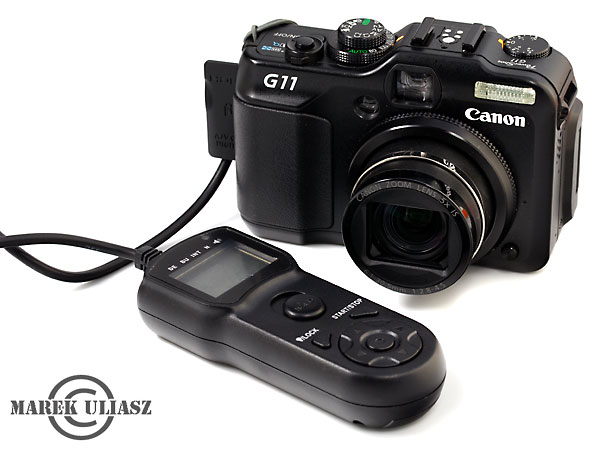
    I recently bought Satechi TR-C Timer Remote Control for my Canon PowerShot G11 camera. It can be programmed as an intervalometer, so I can use G11 as my Pentax Optio W series cameras. Well, almost. G11 is not waterproof.

    The Satechi Timer Remote Control is a pretty big device as seen on the picture above, but it works as advertised. The only inconvenience is that it has no memory, so after each turning off/on it needs to programmed again.

    camera-mast-G11-2 camera-mast-G11-3

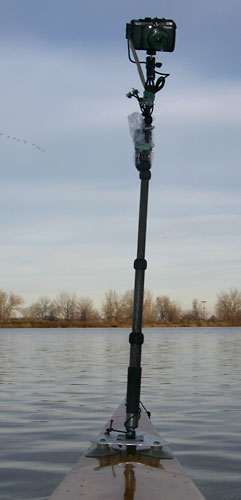
    I set up the Canon G11 on my camera mast – a reversed photographic monopod on the top of a suction camera mounts (my sticky pod). Its design remain the same as described in a last year post (Kayak Video Camera Mast). However, I added a small ball head which gives me more flexibility in controlling the camera.

    camera-mast-G11-4

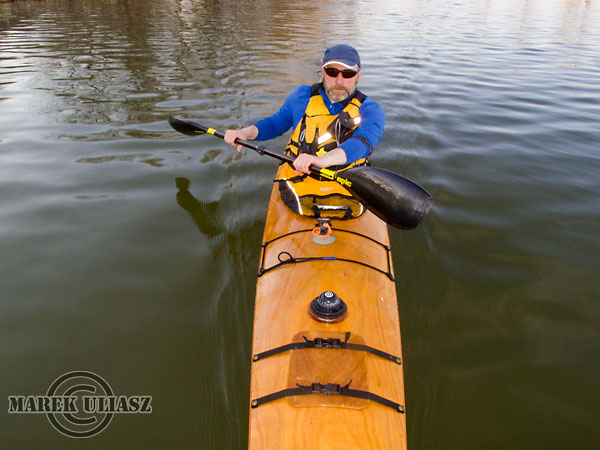
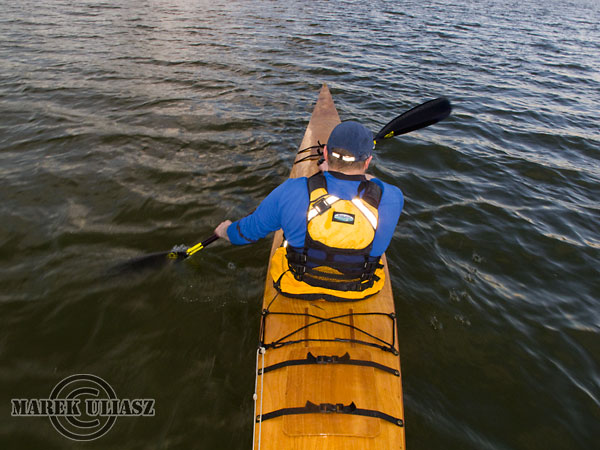
    I took the entire setup and CLC Patuxent kayak (much more stable than my racing Thunderbolt) for a test paddle. A swinging LCD screen of Canon G11 which can be set up at any angle appeared to be very useful since my monopod extends really high up to 50″. With Pentax Optio I was forced to shoot blind at higher camera positions.

    The camera together with the intervalometer worked pretty well. I enjoyed a shooting angle and perspective I could achieve with the mast. Unfortunately, the light was not so great at that day, so I used camera flash. Of course, it revealed every piece of reflective tape on my life jacket, spray skirt and a cup.

    camera-mast-G11-5

    This is not a solution for a rough water. My waterproof Pentax Optio W30 remains on duty.


    Related posts:
    Kayak Video Camera Mast – Sticky Pod Combined with Monopod
    A New Shooting Angle - Camera Video Mast on Thunderbolt Kayak
    How to Make a Simple Camera Mount for a Kayak Deck - Video Mast
    Sticky Pod Review - A Suction Cup Camera Mount for Kayak Photography
    How to Mount a Camera on a Kayak Deck with Suction Cups from Sticky Pod
    Canon PowerShot G11 First Paddling Pictures
    Canon PowerShot G10 with Waterproof Case for Paddling?


    paddling with a camera

  • Wyoming Introduces Fee for Paddling and Boating

    It looks like I need to update my post Cost of Paddling – Access to Local, County, State and Federal Waters. Wyoming Game and Fish Department requires now Aquatic Invasive Species decal:

    Based on direction from the Wyoming legislature, the Wyoming Game and Fish Commission has implemented emergency regulations to address the aquatic invasive species threat. Under this regulation, all watercraft using Wyoming waters are required to display an Aquatic Invasive Species decal. Costs for the decal under the emergency regulations are for motorized watercraft registered in Wyoming, for motorized watercraft registered in other states, for non-motorized watercraft owned by Wyoming residents and for non-motorized watercraft owned by non-residents. Inflatables 10 feet or less in length are exempt. Decals go on sale on the WGFD website April 15 and at license agents May 17.


    north-platte-052807-6a
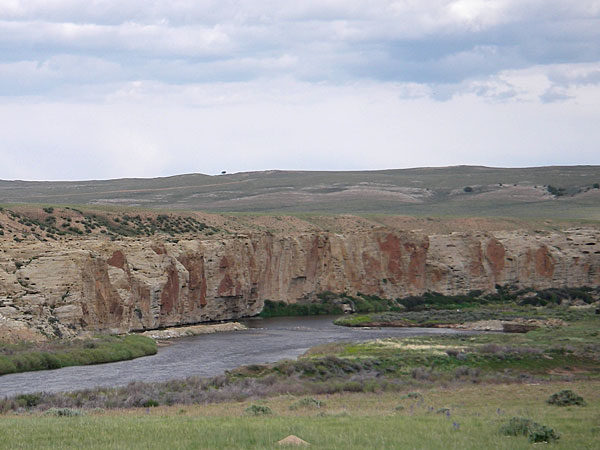
    North Platte River at Eagle Nest below Saratoga, Wyoming

    I paddle in Wyoming only a few times per year, mostly, on the North Platte River. If I need to pay for that sticker I will probably visit Wyoming more often to justify this extra cost. And, there are plenty of paddling opportunities there.

    Related posts and resources:
    Zebra and Quagga Mussel Distribution in U.S. Lakes
    Paddle and Portage: The Floater's Guide to Wyoming Rivers
    Paddling Yellowstone and Grand Teton National Parks
    Bennett Peak to Pick Bridge on the North Platte River, Wyoming - my last year paddling in Wyoming with more links related to the North Platte River


    paddling with a camera

  • Best of ’09

    As the year closes, it’s fun to go through the library and pick out my personal faves from the year… In no particular order, my favorite shots from ’09.  Not necessarily my best or most commercially successful, just the ones that tickled my own fancy:

    bestof09-001
    bestof09-002
    bestof09-003
    bestof09-004
    bestof09-005
    bestof09-006
    bestof09-007
    bestof09-008
    bestof09-009
    bestof09-010
    bestof09-011
    bestof09-012
    bestof09-013
    bestof09-014
    bestof09-015
    bestof09-016
    bestof09-017
    bestof09-019
    bestof09-020
    bestof09-021
    bestof09-022
    bestof09-023
    bestof09-024
    bestof09-025
    bestof09-026

    Tweet This Post Stumble This Post


    ed | zawadzki

  • San Francisco and Sonoma

    This year for the birthday, did a fantastic 2 week trip to San Francisco and Sonoma.  Lots of touristy stuff, lots of wine drinking, and lots of photos… Cameras were the GF1 and a Holga – this was my my first “real” outing with the GF1 and it absolutely lived up to my expectations.  Was able to carry the body with kit lens and 20/1.7 in the corner of my daybag with room for the rest of my assorted junk.  Never missed carrying the big SLR one bit!

    SFtrip-001
    SFtrip-002
    SFtrip-003
    SFtrip-004
    SFtrip-005
    SFtrip-006
    SFtrip-007
    SFtrip-008
    SFtrip-009
    SFtrip-010
    SFtrip-011
    SFtrip-012
    SFtrip-013
    SFtrip-014
    SFtrip-015
    SFtrip-016
    SFtrip-017
    SFtrip-018
    SFtrip-019
    SFtrip-020
    SFtrip-021
    SFtrip-022
    SFtrip-023
    SFtrip-024
    SFtrip-025
    SFtrip-026
    SFtrip-027
    SFtrip-028
    SFtrip-029
    SFtrip-030
    SFtrip-031
    SFtrip-032
    SFtrip-033
    SFtrip-034
    SFtrip-035
    SFtrip-036

    Tweet This Post Stumble This Post


    ed | zawadzki

  • It’s the Lighting, Stupid.

    Lee and Patrick over at Fstoppers have put together a video that pretty much proves that good lighting can squeeze great results out of the most mediocre of cameras.

    Their sensor of choice for the proof of concept? An iPhone 3gs.

    Yep.
    __________

    (Lots more lighting BTS stuff over at Fstoppers.com)

    -30-


    Strobist

  • Syncing Your Flash: The Recommended List

    Today, I’m going just a little bit out on a limb, making the first-ever detailed recommendations from this site. And we’ll be jumping right into the deep end, into the crowded and somewhat murky waters of remote syncing devices.

    Recommendations for three budgets — and why — after the jump.
    __________

    Guidelines

    First, this stuff is not carved in stone. It is one person’s opinion, based largely on personal experience. Think of it as if we were sitting at a bar, you were about to buy some remotes and you asked me for some friendly advice.

    And since you asked me, you would of course be buying the beer. Because as long as I am imagining scenarios, I may as well imagine a free drink out of it. Or two.

    Second (and much like the nice, foreign beer I would be enjoying) you don’t ride first class on a third class budget. That said, all of these recommended sync methods get triple aces in one key area — and that is sync reliability.

    That’s kind of a no-brainer for a desirable quality in a remote, and suffice to say that not all remotes are reliable. That is a deal breaker for just about any photographer — or should be, at least.

    The second quality is longevity. Which is to say that the remote system you buy this year should be expandable next year, and hopefully for several years after that. Additionally, there are other issues (sync speed, battery availability, etc.) But reliability and longevity are the biggies.

    High End

    For those of you looking to build a long-term system with an unmatched reliability record (and who are willing to reach deep into your pockets to do so) the following should come as no surprise. I recommend the PocketWizard Plus II Transceiver.
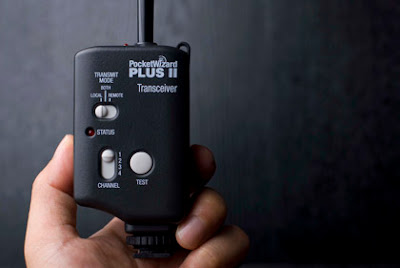
    (Pocket Wizard Photo by Krazewerks)

    Why? Several reasons.

    I have used them (and their predecessors) for the majority of my professional life. And I have counted on them day in and day out, for thousands upon thousands of off-camera flash exposures.

    And as for range, suffice to say that they give me all of the range I need. And I tend to push the envelope even on PW’s occasionally.
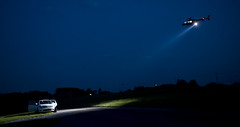
    Case in point, this air-to-ground shoot of a police helicopter at night. You can see more on that in a two-part, On Assignment post starting here. And it is a great example of what a PW can do when the boundaries are pushed.

    PocketWizard or no, you gotta remember that radio is not perfect. Which is to say that there will be environments in which, for some reason, a given wireless remote will not work. The folks who are really serious about lighting sports arenas, for example, will usually opt for hard-corded sync options when possible just for this reason.

    But I will say that I have rarely met the environment that will best a PocketWizard. If one won’t fire, it generally comes down to a bad battery or a bad cord between the PW receiver and the flash. And I have very occasionally had issues when they were being used illegally in other countries with different RF spectrum allocations in, um, atypical environments.

    But, back to the batteries, they run on AA’s.

    Dear God, why can’t all remotes run on AA’s? I always have spare AA’s in my bag, and you could probably get AA’s on the moon if you ran low. Sadly, that is not the case with many remotes. And it is yet another reason why I love my PWs.

    So, why PW+ II’s and not the new Flex/Mini platform? Coupla reasons, for now.

    One, I am not a TTL guy. So I do not need most of the extra features. Two, the Flex/Mini platform is only out for one camera brand. But that is changing pretty soon. (They are pretty complex, and it’s basically like a run-thru of the Star Trek episode “Spock’s Brain” to integrate a Flex/Mini into a camera brand.

    That said, I am a beta tester of the upcoming Nikon model and I am very excited. In the end, I will probably get one or two.

    That is as compared to my 12 copies of various standard PW’s. (I have +’s, +II’s, standards, etc.)

    With a Flex unit (runs on AA’s, so Flex will get my nod over the Mini) on camera, I can get the most important upgrade — a higher full-sync speed. And it will transmit that capability to all of my older PW’s being used as receivers, thus making every single flash I have nearly twice as powerful. Relatively speaking, at least.

    But, that’s down the road. Short version: When it absolutely, positively has to be there overnight: Fedex.

    When it absolutely has to sync: PocketWizard. And the PW+ II’s are the gold standard.

    Midrange

    This is where it gets a little complex, because there are variables that will determine what may be a better choice for you. Plus, by talking you through those variables, I could probably stretch this into another beer.

    In my experience (and that of friends) I would not hesitate to recommend any of the following, midrange remotes: RadioPopper JrX, Paul Buff CyberSyncs or Elinchrom Skyports.

    For those of you using Einsteins, for instance, PCB’s CyberSyncs offer significant advantages — the receivers even drop right into sockets in the top of the Einsteins. A specialized transmitter allows you pretty much full remote access to the flash’s controls. Ditto with the Skyports and many Elinchrom lights — including the punch-above-their-weight Ranger Quadras.
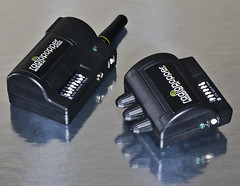
    For generic, manual shooters either one will work well. But you may well also consider the RadioPopper JrX’s. Since you are on a budget if you have read this far, I would suggest you skip the studio version and go straight for the bare-bones JrX. It’s a great, albeit imperfect, little system.

    So what’s the difference between the PW’s and the midrange stuff? Coupla things.

    First, the range will not quite be the same. And while you may never need to sync something 1500′ away and/or way up in the air, that extra range equals extra robustness at lesser distances.

    Other little quirks, too. Just niggling stuff, really. But worth considering, as it may guide you to different models in this range.

    First, batteries. CyberSyncs take AA’s on the receivers, but button cells on the transmitters. Skyports take button cells, too.

    RP JrX’s take CR123a batts — more capacity than a button cell, but hard to find in a pinch. If you go JrX, then I strongly suggest going with rechargeable NiMH CR123s. You can read more here, and my rechargeables have performed flawlessly.

    Other stuff: Design, oddly enough. The Skyports have a swivel antenna that is small enough to scare me a little. (Purely psychological, maybe, as I have not heard reports of them breaking off.)

    And the CyberSyncs have raised buttons (including the on/off switch, on older models) that you need to mod to keep from being pushed accidentally in your bag. You also have to mod them if you want a lanyard. Else your sync cord becomes your lanyard (not good.)

    But What About the Brand X Units?

    I hear you already: What about Phottix / Yong Nuo / Gadget Infinity / eBay / etc. remotes?

    To be sure, there are some very good remotes being made by the above companies — at some very good prices, too.

    Just a couple of years ago, the so-called “eBay remotes” were somewhat of a joke. A “newb tax,” as it were, to be paid by the light of wallet. You buy them, they kinda work, you stay into it, you move up to a better remote within a few months. So you buy twice.

    Not any more. The various oriental manufacturers are coming on strong. None are perfect, but many are very good — and very cheap. But among their flaws is a deal breaker for me at this point, and the reason I would not recommend them to most people.

    All of the remotes recommend above have either a demonstrated or presumed commitment to backwards compatibility. Which is to say that next year’s remotes will work with last year’s remotes. One of the problems with the constant improvements of the various oriental brands is that they have also been (for the most part) jerking us around with model-year-to-model-year incompatibility.

    By comparison, I have 15-year old PWs in my bag that I can trigger with my beta Flex units. Even the RP’s JrX system was designed to be compatible with their previous, higher-end system. That is, I think, because they are photographers themselves and know how important the continuity thing is. Choosing remotes that will let you painlessly expand your bag in a few years is essentially making a bet on your future commitment.

    I expect that the Chinese/etc. remote manufacturers will get this soon enough. And when they do, I will be happy to recommend them providing they have good performance. And to any manufacturer reading this, if you are dedicated to backwards compatibility you should proclaim it on your product page and give yourself an advantage over your competitors.

    Bargain Basement

    Hello, poor-but-honest starving artists who have read this far. So, you may be long on talent and sincerity, but are presently short on cash. What, for you?

    I do not recommend a remote at all. I recommend going hard core, or, rather hard cord.
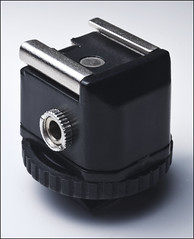
    Specifically, get on the 1/8″ sync bus with a set of Universal Translators (only one if you are using, say, an LP160, or AlienBees, for example, as they already rock the 1/8″ jack.

    So, if you spend less than a sawbuck and get your camera onto the 1/8″ standard with a Universal Translator, you do some pretty cool things for yourself. First, you are kinda making a down payment on future remotes, which also work on the 1/8″ jack system. In fact, all of the ones I recommend above do just that. That is to say, you are standardizing on a cheap sync cord right from the get-go.

    Second, you are into a system that is for the most part rock-solid. RF interference? No prob. Batteries? Don’t need ’em.

    Only issues are with range (limited to your sync cord length) and multi flash (I recommend flashes with built-in slaves.) You cord one flash, slave the others, and you are set. You can also move to a remote relatively painlessly later, starting with just two units. Slave your other flashes until you wallet recovers and then grab some more receivers.

    And the cord itself? That’s the beauty of the 1/8″ system.

    It gets you out of the grips of the PC Cord Mafia and into the promised land of nearly free, 1/8″ sync cords. Seriously, 25-foot sync cord for .94, anyone?

    You want backups, and reliability? Get five at a time at that price. (Cheaper, actually, if you get 5.) But still, create a little strain relief by rubber banding your sync cords to the light stand to keep them from jiggling and they will last far longer.

    And you will always have a backup in the future when your fancy remotes crap out on you because you are shooting too close to Area 51 or something.

    But that non-syncing PW may not be your biggest problem problem at that point. I’d concentrate more on the very serious gentlemen in the rapidly approaching green jeep with the .50-cal machine gun mounted up top.
    __________

    Dang, that was a pretty long post for a Thursday. (I like to coast into the weekend with a short post and a single malt…)

    And as I said, this is my opinion alone — worth what it cost ya. And naturally I got everything wrong, as I am sure many of you are about to tell me in the comments.

    But that’s okay. And did I mention earlier that I had switched to single malts? Nothing too pricey — let’s call it a 12-year old Jura. (I was educated this spring in Edinburgh.)

    But they have been going on your tab for the last 15 minutes.


    Strobist

  • Thank You Post

    Every once in a while, it’s nice to say thanks to those who’ve supported or helped you in some way. In that spirit, I’d like to say thanks to the following folks. First, to a couple of fellow photographers:

    John Mitchell, who provides great tailored photo workshops in Australia.

    Gregg Lowrimore, who does some great landscape and wildlife work in Colorado.

    And to some businesses that support photographers and have supported DSLRBlog or Photocrati in various ways:

    FrameFit.com, which has over 32 years of experience carrying picture frames, plexiglass, mat & foamboards, plus many other picture framing items.

    Delmiaco Design Studio, which provides photoshop templates & digital backdrops that are professional, customizable, press ready.

    Photogenic, one of America’s leading professional photographic lighting companies since 1904, specializing in electronic flash systems for professional and amateur image makers.

    Photodex ProShow, software for making breathtaking photo & video slideshows for both DVD and web.

    Profiles by Rick, whose custom ICC profiles provide a great, low-cost solution for photographers who want accurate color from their printers.

    i2K Quickage Panorama Software for creating great panoramas, even with no tripod, on both Mac and Windows systems.

    Diversified Lab – Pro Photo Lab, which has served professional photographers since 1977 with online proofs, printing, photofinishing, albums and more.

    Denevi Digital Imaging Service, which provides High quality professional scanning and DVD transfer services, including Blu-ray for great prices.

    DSLRBLOG – Photography Business Blog

  • Beers With: Edward Hopper

    It’s been a while since we got a chance to chat with any dead artists, and Edward Hopper was actually in the news this month.

    So I caught up with him last week at (appropriately) a bar in Fell’s Point in Baltimore to chat about the use of light in his most famous work.
    __________

    Strobist: First of all, Mr. Hopper, I’ll confess to being a big fan. You have long been an influence on my lighting. And also for a lot of other photographers, from the look of things.

    Hopper: Don’t mention it. Really. Influence is one thing, but some of the “homages” are another thing altogether. And please, call me Edward.

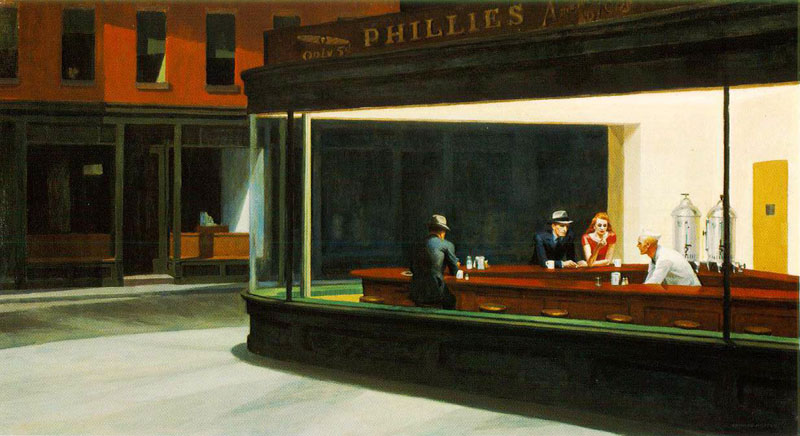
    Strobist: Thanks. I don’t want to waste any time before getting to the painting you are most associated with: “Nighthawks” (1942). It has become a cultural touchstone.

    Hopper: Well, that’s one way of putting it…


    [Ed. Note: Click on the pic to open it bigger in a different window for reference.]

    Strobist: So, here’s the picture. And I think it is damn-near perfect, if you don’t mind my saying. Was that available light?

    Hopper: Oh, no — it was lit.

    Strobist: So … it was also staged?

    Hopper: Yep. The redhead is from Model Mayhem. 0 (and a CD) for three hours.

    Strobist: And the guys?

    Hopper: Locals. They cost me a coupla beers. We did it after hours. We paid the barkeep a C-note to stay late and pose, too. Pretty bootstrapped, really. Fortunately, we did it before that stupid 0 NYC shooting permit crap. Ridiculous.

    Strobist: Indeed. So it is lit, then. Mind if I give it a go?

    Hopper: Be my guest.

    Strobist: Okay, so everyone has front light, and that can only be coming from one place. Direct light up in the ceiling?

    Hopper: Close. It’s actually a tight bounce. Direct might have looked better, but it would have been hard to hide the bare reflection in the coffee machines. With a near-surface bounce, we mostly tone down the reflection in the top dome. I actually considered pulling one of the coffee machines and using that window divider to hide the light’s reflection on the other machine.

    Strobist: Ah, and that would have given you an easy way to use a bare light.

    Hopper: Yep, but what all-nite joint wouldn’t have caf and decaf?

    Strobist: Exactly. Thus the bounce?

    Hopper: Yep. And that was the only interior light we used. It was an Elinchrom Ranger Quadra, by the way. It kicks out 400 watt-seconds, but was small enough to gaffer-tape the whole damn thing to the ceiling fixture. With a Skyport remote, we could control the power remotely, too. But we ended up running full power. The bounce ate up a lot of light.

    Strobist: So, you say that’s the only interior light. Were there more?

    Hopper: Yes, there is one more strobe — another Ranger Quadra.

    Strobist: Where is it?

    Hopper: You tell me.

    Strobist: Well, shadows on the right side of the far window point to the light, so I know it is somewhere around that corner.

    Hopper: Keep going…

    Strobist: Any Photoshop tricks?

    Hopper: Nope.

    Strobist: Then it has to be behind the back right wall, on a very high stand … and a boom?

    Hopper: Yep, thus the tiny little Quadra. Head just weighs a few ounces. You can stick it way out there. Stand goes up behind the back right wall, boom comes out to the left, light is hanging out over the street and hidden by the wall over the window. That give me a hair light on Red, and separation on the guy sitting next to her.

    Strobist: Is that important?

    Hopper: Oh, yeah. Look at the other guy. See how he gets lost against the background on his camera left side?

    Strobist: Yep.

    Hopper: No separation light on him. That kinda makes him secondary to the couple as a subject. That back light is catching the barkeep’s face a little, too. But we gobo’d it to keep it from hitting the area across the street directly behind the bar patrons. We left that nice and dark.

    Strobist: Sweet. And everything else is ambient?

    Hopper: Yeah, about 3-4 stops down. We dragged the shutter for eight seconds — always bring a good tripod when lighting at night. Had the interior lights off in the bar, so no ghosting issues if they sat still. Ambient-wise, the bar is actually darker than the street outside. But the strobes reverse that.

    Strobist: So, do you just wing this kind of stuff, or do you comp it out?

    Hopper: Oh, no. I plan everything. Even did a run-thru a few nights before.

    Strobist: Really? So you just lay it out on a cocktail napkin, McNally style?

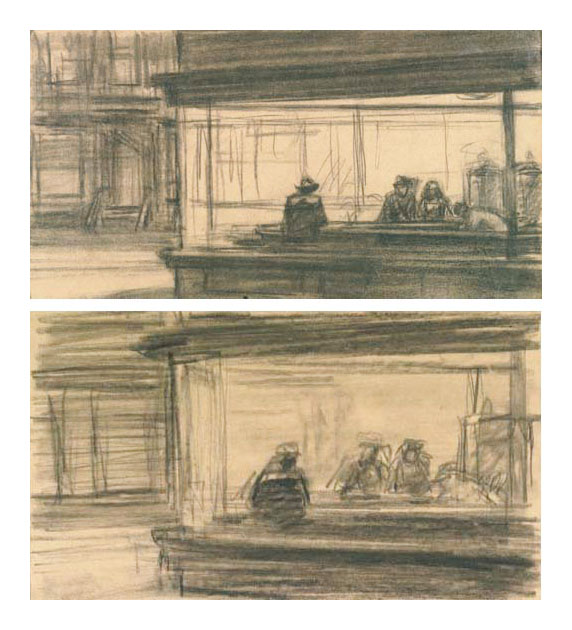
    Hopper: Used to, not any more. Now we do nice charcoals, on acid-free paper.

    Strobist: Wait, what?

    Hopper: Let me explain. Case in point — see this?


    Strobist: Yeah. Nice, I guess.

    Hopper: I guess? That baby went for 2,000 at Christie’s.

    Strobist: The rough draft? Are you kidding?

    Hopper: No kidding.

    Strobist: Wow. I use my iPhone to make lighting diagrams.

    Hopper: Aren’t you cool.

    Strobist: Apparently, not. Let’s get back to the idea of the homage.

    Hopper: You mean, ripoff?


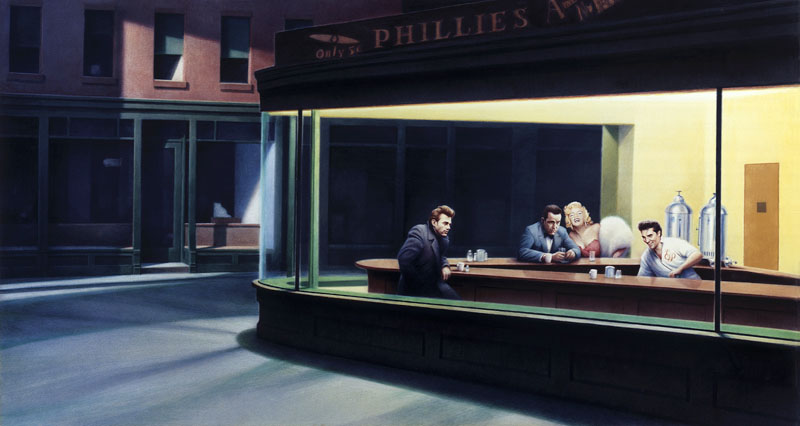
    Strobist: Whatever. So, here is “Boulevard of Broken Dreams II,” (1984) by Gottfried Helnwein. Kinda cool, really — James Dean, Humphrey Bogart, Marilyn Monroe, Elvis. It’s cool because they all died before their time, and here they are in a bar together at night.

    Hopper: Oh c’mon. It’s a watercolor on cardboard, for pete’s sake.

    Strobist: Yeah, but…

    Hopper: Really? You like it? REALLY?

    Strobist: I have another small confession — for the longest while, I thought the Broken Dreams painting was the original one.

    Hopper: Are you friggin’ kidding me? Look. I really gotta go, okay?

    Strobist: But…

    Hopper: Bye.

    Strobist: Well, in that case…

    __________

    Abruptly ended fictional interview aside, this painting was in the news this month. After much painstaking research, it was determined that the bar in Nighthawks — real tho Hopper made it — probably never actually existed.

    You can read more about that, starting here.

    And if you enjoy beers with dead guys, you can read our earlier conversations with Rembrandt and Vermeer.


    Strobist