Category: Uncategorized
-
How to Become a Top Wedding Photographer
In the process of launching Best of Wedding Photography, we’ve had the chance to review thousands of the best wedding photographers in the world. I’ve personally looked at over 3000 wedding photography websites in the last three months, and as part of our invitation process (in the middle of that now), I’ve had the chance to trade emails with over 300 of the very best in the world.
It’s been an educational experience, and it’s given me a great feel for the landscape of the wedding photography industry. One of the most insightful aspects of this is seeing what kind of things separate the best from the rest.
The best wedding photographers are those who produce awesome, modern, artistic imagery. They combine great composition and lighting with incredible post processing to produce breath-taking imagery. But more than that, they are the ones who build distinctive, bold brands for their work that separate them from the rest. They participate in groups like the WPJA, ISPWP, Modern Photographers, Photographik, and now Best of Wedding Photography, and they use their participation in those groups to enhance their credibility and reputations among brides and prospective clients. They position themselves at the top of the market, shooting premium and destination weddings. These people shoot 30-200 weddings per year, at prices averaging between ,000-,000 per year. If you multiply those numbers out, you’ll see that they really add up. For many of these photographers, it’s not uncommon to shoot destination weddings in Europe or the Caribbean for ,000 or more. Many of these photographers share their knowledge, and add a lot to their bottom lines, by launching their own workshop series in which they’ll teach everything they know to you and a dozen others over a weekend for 0.
These are the people who don’t just scrape by as photographers, they thrive and prosper.
So how do you get there?
I’m not primarily a wedding photographer. My background is in photojournalism in Asia, and now I spend most of my time bringing photographers together for big projects like Photocrati or Best of Wedding Photography. But I have a good business mind, and exposure to the greats in wedding photography has given me a sense for exactly the steps I WOULD take if I wanted to join these photographers at the pinnacle of the industry.
I don’t plan to go that route, but rather than let the knowledge go to waste, I thought I’d go ahead and share my thoughts with any of you who think you’d like to try it. So here are the steps. I honestly believe that someone who did these with focused energy could establish themselves at among top in the field within about 2 years. The key point here is that you need to know what they know and do what they do. That means that you will need to invest in training, resources, branding and advertising. Many would-be photographers balk at such investments, but keep in mind that this is business, not a hobby. Every business requires investment – nothing ventured, nothing gained.
1. Achieve technical mastery by learning from the masters and using Photoshop Actions
You can’t thrive and prosper in this field unless you master the ability to produce consistently outstanding imagery. That appears to be a daunting challenge in part because most people learn slowly through trial and error or through reading books. You can dramatically accelerate your learning curve by finding people who produce the kind of outstanding imagery you want to produce, and taking a small, intensive workshops with them to see, first hand, how they do what they do. You model them, get feedback, and quickly and dramatically improve. Right now, if I were going to invest in one workshop, I’d do it with David Beckstead.
One important note here is that there are two distinctive steps in producing great imagery – the actual shooting, in which your ability to read light and compose are the critical talents, and post processing, in which your expertise with Lightroom and Photoshop is critical. In fact, my recent experience leads me to believe that the quality of post processing is now as important or possibly more important than your shooting skills. The top photographers are masters of post-processing. The fastest way to start post-processing like them it to buy a set of Photoshop actions, perhaps like those from KJImages. I would absolutely find a photographer who’s actions you like, buy them, and start using them. To be honest, I can’t think of a single step that would more immediately and dramatically improve the imagery of most wedding photographers.
2. Build your wedding photography portfolio with free shoots and model shoots
If you are an established photographer with a large body of work, but with imagery that doesn’t compare with the top people, I’d invest a few weeks re-processing my images from the last few years with new photoshop actions, and create a new portfolio of exquisite imagery that way. I’d strip everything off of my site that didn’t have the cool, fresh, modern style that premium brides are looking for. You need to be brutally honest with yourself. I’ve seen a lot photographers with 20 years of experience and good client and referral bases, but they are still shooting and post processing with a style circa 10 years ago, or even circa the 1980s. The top photographers produce bold, modern, and artistic imagery. That’s the kind of work that brides at the top of the market are looking for. Look at their sites, and compare what they’re producing with what you’re producing.
If you are newer and just starting out, you need to get shooting. I would begin offering free portrait and engagement shoots to build up my portfolio. That’s a great way to build up not just your portfolio but your client list. Free engagement shoots are particularly valuable for newbies. The benefits: you get the experience of working with clients; you get the images for your portfolio; if you do a great job on engagements shoots, they’ll likely use you for their wedding; and you’ll get word of mouth referrals.
You’ll also need to build your portfolio of wedding images. One great way to do this is to hire models with wedding garb. This can be expensive, but it allows you to tightly control your shooting situations and work with people who know how to make your photos look great. A lot of top photographers use model shoots to produce some of their more exquisite and distinctive imagery. If I were you, I would also offer my camera for free as a second shooter to an established photographers, on the understanding that you get to keep a selection of the images to display on your own portfolio.
3. Get an awesome website with a great, sidebar-less WordPress BLOG
If you don’t have one already, get a professional caliber website. For your portfolio site, get a slick, flash-based site. I know, I know, many people (including myself) talk down about flash because of it’s SEO disadvantages. But flash sites display with a quality and pizazz that is just not achievable any other way. To get around the SEO disadvantages, you need to set up a blog on a separate domain. In fact, many people are using ONLY blogs, and skipping the flash portfolio. If you are shooting enough to keep your blog regularly updated, I think that’s a reasonable approach. But regardless, you must have a blog, and it must be a great looking blog. I would opt for a WordPress based blog WITHOUT a sidebar. Photocrati is about to release some great themes of that kind. The other great place to look, albeit rather expensive, is prophotoblogs.com.
4. Invest in a great logo and bold, distinctive brand
Great branding is second only to great imagery in distinguishing the great photographers. What is great branding? When people come to your site, what they see should be unusual, distinctive, bold, fun. Your site and style should stick in their minds. Achieving this effect is a combination of the name you choose for your business, the logo you have to represent you, the colors of your site, and the kind and quality of your imagery. For me, a great example of branding is Our Labor of Love photography. They have a great, unusual name, and that combined with the logo and distinctive image on their home page makes me remember them (and brides will remember them too).
Part of your brand is also market positioning. The best photographers in the world position themselves at the top of the market. They’re looking for brides who are willing to pay -10,000 for truly outstanding imagery. That’s where you need to move as quickly as possible, rather than competing with the masses for 00-00 weddings. To justify the higher prices, you need to be able to produce outstanding imagery, which is why the training above is so important.
5. Master SEO
Any business today must master SEO – this is not distinctive to photographers. If you can get on the front page of Google for a specific set of keywords, and you have a decent site, you WILL get a endless stream of leads. If this is the only thing you did to promote yourself, you could still be highly successful in terms of bringing in a lot of wedding photography business. There’s a lot that goes into producing great SEO results. Sometime soon, we’re going to start offering SEO training and services for photographers through Photocrati. We’ve developed a great strategy there, and although Photocrati is just 9 months old, we now get 80,000 visitors per month, about half of which are from Google. Since we’re not offering those services yet, let me give you two other tips to get started.
First, while you want to do basic SEO steps for your flash portfolio site, you want to focus most of your SEO efforts on your blog. For many reasons, blogs do better.
Second, when you do SEO, you need to orient your efforts around specific keywords. In your case, the selection of those keywords is easy. You want to show up for “[location] wedding photographer” where location is nearest large metropolitan city or town. If you are near Denver, you want to show up on page one for Denver Wedding Photographer searches. That will be more valuable to you than, say, Denver Wedding Photography. You need to make sure that those keywords are prominent in your site title (ie, “Denver Wedding Photographer – John Smith”) would be a good title. And make sure those keywords appear throughout your site. Use those terms in the titles of your blog posts.
Third, you need to start getting links back to your site. Submit your site to relevant, quality directories (either photography-related directories, or the big, important ones like the Yahoo! directory or Dmoz). Every time you do a shoot, post photos from it on your blog and let your clients know. They’ll link back to you, and those will boost your rankings. Comment on other blogs and link back to your own site that way. Produce great content on your blog that other people consider worth linking to. One idea is ask some great photographer if you can interview them for your blog, then post the interview. Mostly likely that person or others will link to the interview. Finally, you sometimes just need to go out and ask for links. Email website owners, comment on why like their sites, and politely but unabashedly ask if they’d be willing to link back to you. Uncomfortable, yes, but also critical.
There are a lot of other link building strategies, but that should at least get you started. The other big thing I might suggest is taking a workshop such as one with Lawrence at ToFurious here or one with us at Photocrati when we get it our services launched.
6. Advertise via Google Adwords and Strive for High Conversion Rates
In addition to your SEO efforts, or until they kick in, you should also plan on investing a substantial amount of money in Google Adwords advertising. If you cannot appear in the organic search results for “[your location] wedding photographer” then you need to appear in the paid search results for those terms. If brides go to Google and search for those keywords, they are looking for someone to shoot their wedding. They are ready to buy, and that’s precisely the time you want to be in front of them. Once you dominate search results, or once you’ve built a powerful client base with a lot of referrals, you can drop this advertising. But for now, you need to think of this as a necessary business expense to build your client base and brand awareness.
Paid search can be expensive. You may layout as much as 00 per month to be in the top 1-5 keywords throughout the month. But keep in mind that if you charge 00 for wedding, you only need to get one wedding every two months to break even on your advertising.
Conversion Rates. One important side note to this is that if you are going to do Google Adwords, you need to take every possible step to increase your CONVERSION RATE. If 200 people click on your paid search result during the course of a month, and each click costs you , then you’ve spent 0 on advertising. Conversion rates online tend to vary between .5% and 6% depending on the quality of your site, your marketing message, the quality of your imagery, and lots of other things. A conversion rate of .5% mean you’ll get 1 job from those 200 clicks. A conversion rate of 2% means you’ll get 4 jobs. If those are weddings with an average price of 00, then 1 job = 00 and 4 jobs = 00. That means that a very small improvement in your conversion rate (1.5%) produces 00 in additional revenue. That’s why conversion rates are so important.
How do you increase your conversion rate? That’s a science unto itself, and I could write a small book on it. But for now some things to keep in mind are: only display your best imagery; make it very, very easy and tempting for people to contact you; use various methods to enhance your credibility (membership in wedding photography groups, awards, etc); if you are just starting out, give people a risk free way to try you out, such as free engagement sessions. You need to spend time and energy on a free engagement session, but if you do a great job, the wedding will be yours.
7. Join Every Wedding Photography Group You Can
This get’s to the last point above about enhancing your credibility. Brides are more likely to see you as established and successful if you are a member of the WPJA, or the ISPWP, or Modern Photographers, or some other group. Of course, to get into these groups, you need to meet various standards, and that’s why their valuable. Some are more prestigious than others, such as the Grace Ormonde Platinum List. We’re trying to create the most prestigious of all with Best of Wedding Photography, but that’s invitation only and you can’t get an invitation until you’ve already established yourself at the top.
Once you are a member of these groups, display their badges prominently on your site.
Many of these groups run competitions on a quarterly basis. If you are a member, enter the contests. Winning third place in a quarterly WPJA competition allows you to write “International Award Winning Wedding Photojournalist” on your website, and that will increase your conversion rate (see above). The more such awards you have, the more credibility you will have, and the more likely brides on your website will call you up and try you out. Of course, to win these awards, you need to produce great imagery and that, again is why you need to invest in the technical training above. It’s the starting point for everything else.
8. Build Relationships with other Wedding Vendors
So far, I’ve focused on online mechanisms for building your client base. But another important mechanism is meeting, networking, and building relationships with great wedding vendors in your area. You are looking for wedding planners, cake makers, florist shops, wedding and reception venues, and other providers of wedding-related services. When you find ones you like, go meet them and introduce yourself. Stay in touch. Add them as preferred vendors on your own website – that is, you direct brides on your site to those vendors. You send them business referrals. And if you do good work, and you build good relationships, they will list you likewise on their websites and materials and send business to you. Getting plugged into that kind of wedding vendor network can transform your business, so it’s worth the time and energy you need to put into building the relationships.
A great way to build these relationships, as well as get more clients directly, is to attend bridals shows. If you have not done so, find the big ones in your area and do what’s necessary to sign up and attend.
9. Build Relationships with Other Great Wedding Photographers
There’s an old saying that you become like the people you spend the most time with. Ideally, you want to spend more time training with, corresponding with, and meeting with top photographers. Call up the best photographers in your area and ask if they’d be willing to spend 30 minutes sometime in the next month sharing their wisdom in exchange for lunch. Take workshops with the best photographers. Find the best photographers in places like Digital Wedding Forum, and interact with them via the forums. Consider asking top photographers if you can interview them for your blog – start an interview series. There are a lot of ways to break the ice and begin interacting with top photographers. The more you do, the more their knowledge and strategies will rub off on you.
10. The Transition: Moving Toward the Pinnacle of the Market + Destination Weddings
As you build a larger client base, a better portfolio with great imagery, and a better reputation with stronger branding, you need to keep focusing your efforts on moving toward the top of the market. Raise your prices, be more selective, radiate excellence from your site and blog. You would much rather shoot 20 wedding per year at 00 each than 40 weddings per year at 00. Same income with fewer clients and less work.
One step that distinguishes the best photographers is also a move toward destination weddings. Most top photographers shoot A LOT of wedding that are not in their own geographic locations. They travel around their countries or to increasingly exotic destinations to shoot weddings. You should make this a focus. Why? There are several reasons. First, destination weddings pay more. When people are willing to fly you to New York or Mexico for a wedding, that means they really want you. Destination weddings often pay-10,000 or more. Second, destination weddings add an elite flavor to your branding. If you can say you regularly shoot destination weddings in this or that exotic location, it enhances your credibility and attractive even to brides who want a local wedding. Third and finally, destination weddings often produce spectacular wedding imagery. The images from a beach wedding in the Caribbean make a GREAT addition to your portfolio.
–
Ultimately, you want your branding, website, blog, imagery, and relationships to look like those that distinguish the top wedding photographers. Study the greats, emulate them, train with them to accelerate the learning curve dramatically. If you walk, talk, shoot, process, and look like a top wedding photographer, eventually you will BE a top wedding photographer. The big thing to recognize is that looking and acting like the top photographers is NOT as difficult as it might look. If you have good photographic talent and a decent business mind, you have the basic resources you need. After that, it’s just a question of learning what they know, emulating them as much as possible, and spending time with them. Once you’ve emulated them successfully and mastered what they know, you can start innovating and pushing yourself in directions even they have not gone.
UPDATE: You can also get started by checking out the work of some of the masters in the field. Here’s a selection from Best of Wedding Photography from around the world:
INTERNATIONAL WEDDING PHOTOGRAPHERS
Italy Wedding Photographers
Mexico Wedding Photographers
United Kingdom Wedding Photographers
France Wedding Photographers
Toronto Wedding Photographers
Vancouver Wedding Photographers
Spain Wedding Photographers
Tuscany Wedding Photographers
London Wedding Photographers
Switzerland Wedding Photographers
Riviera Maya Wedding Photographers
Bahamas Wedding Photographers
Greece Wedding PhotographersUS-BASED WEDDING PHOTOGRAPHERS
Los Angeles Wedding Photographers
New York City Wedding Photographers
Hawaii Wedding Photographers
San Francisco Wedding Photographers
Boston Wedding Photographers
Miami Wedding Photographers
Seattle Wedding Photographers
Atlanta Wedding Photographers
Napa Valley Wedding Photographers
Orange County Wedding Photographers
Denver Wedding Photographers
Charleston Wedding Photographers
Minneapolis Wedding Photographers
San Diego Wedding Photographers
Chicago Wedding Photographers
Kansas City Wedding Photographers
Portland Wedding Photographers
Philadelphia Wedding Photographers
Washington DC Wedding Photographers
Phoenix Wedding Photographers
Houston Wedding Photographers
Virginia Wedding Photographers -
Slave Q&A: Your Questions from Last Week
 After the two posts on slaves last week, there were lots of tips being shared in the comments — and some good questions, too.
Answers to the latter, after the jump.
__________?Diego? (and several others) asked:
David, I’ve had some problems in the past with pre-flashes fooling the optical slaves causing the flashes to fire before exposure. Have you experienced any of that?
Yep, sure have. Especially when using my Canon G11 to sync with slaved SB-800’s. The trick is to use the triggering flash in manual mode to eliminate the pre-flashes that are setting off your slaved flash too early. And if you do not want the triggering flash to contribute to the photo, turn it down as much as possible and/or block the light in a way that will allow your other flash to see it — but not the area inside your frame.
?Scott? asked:
I bought two high-end Wein optical slaves (the ones with the integrated hot shoe) two years ago and now they do not work. I suspect user error, but I am not sure what it is I am doing wrong. Could the level of the batteries in the flash affect the trip point of the slave? Does the optical device age and sensitivity drop over time?
Scott, I have never heard of that kind of aging, and at two years I would not expect it. And I am almost positive the batts in the flash would not affect the slave. I would contact Wein about your slaves. They have a very good reputation for quality gear, and I would bet they will run down and/or fix the problem for you.
Moishe at Midwest Photo noted and asked (echoing the woes of many Canon users):
Finding a slave that is compatible with YOUR flash can be very very tricky. This is one of those areas where you will be very well served to search the discussion groups on Flickr to find actual user experiences. You can NOT rely on compatibility published by the various slave manufacturers / distributors.??
I am yet to find an optical slave that works reliably with Canon flashes. I’ve tried Fotodiox, several styles of Wein, Dot-line, Nisha and a couple others I can’t think of right now.
Some of those work some of the time. Some work with some flashes but not with another identical model. If anyone has any recommendations on slaves that work with modern Canon flashes, please email me. Would love to carry them in our store!
??Suggestions? Email him at moishe at mpex dot com.
?Charles Verghese? asked:
I wonder if these optical slaves can be DIY’ed into functioning as a Lightning trigger? Without thinking it out through, I am of the opinion that it could be soldered onto a camera trigger cable. Reason I am asking is because I am trying to avoid having to pay the big bucks for a traditional lightning trigger.
Well, Charles, there is good news and bad news.
First, the bad news: I have never been able to get a slave to remote trigger a camera, and I have tried several models. I am not absolutely sure, but I think that the devices that will remote fire a camera both use relays and complete the circuit for longer than a slave does. Whatever it is, it does not work.
The good news, from someone who has shot a lot of lightning: You do not need a lightning trigger. First, lightning exists for longer than you think. Use a tripod and a cable release and you can do pretty well if you are fast on the draw when you see the lightning. Better yet: Use long exposures and cast a bigger net (time-wise) for catching the strikes.
You can also keep the shutter open (as long as your camera stays below the noise/time threshold) and block ambient with a black card held in front of the lens. That’s very quick to move when lighting strikes, and you won’t jar the camera, either.
E?do? asked:
Is it ok to use PW in master flash & trigger the slave using the master? Are we going to have synch issues?
Edo, that depends on your flash and, more likely, your camera. The good news is that slaves add almost zero latency to the process. They are very fast circuits. That said, I have run into problems specifically with Canon 5D’s and slaved flashes. The problem is that as slow as the 5D sync already is, they cut it awfully close on the second curtain. I am convinced that many 5Ds (Mk 1 and II) cannot reliably get a full, off-camera sync until you open them up to 160th.
?Outofnapkins? asked:
I have run across the “standard” H-prong connector on the Wein slaves before, back in my old medium format film days. I had inherited a sync cord for it but didn’t know what it went to until today.
For the life of me, I can’t figure out when you could use one of those today without that dang cord. Would you mind including a section on the various slave connectors?
Actually, many big flashes used to use the HH sync cord plug. Even my old Vivitar 283’s had aftermarket “Holly Flash Foot 1” metal feet that converted them to household sync. It is a cheap and rock-solid method, but pretty over-engineered.
There are way too many connectors to go down the road of listing them all, and to very little benefit. My suggestion is to get on the 1/8″ (3.5mm) Sync Jack Bus. It’s air conditioned, with comfy seats, wi-fi and a big screen TV. You’ll love it.
?Laird? asked:
I love the convenience of Wein Peanuts, being small and plugging right into Vivitars, but have a unusual problem. I use PW to trigger a SB800, and slave other flashes off that. Sometimes, the Vivitar slave doesn’t sync at 1/250 and I have to drop down to 1/160 or slower. Other times they’re fine.
I use Nikon D300 in manual (not TTL) and no rear-curtain sync. Seems to be unique to Peanuts, as I’ve not had this happen with “off brand” slaves that slide on the hot shoe. Any ideas?
Wow. I dunno. For one thing I would suggest PW’ing the Vivitar and slaving the SB-800 via its excellent, built-in slave. That will get you two reliable lights firing at full sync, at least.
?Ad? offers the following tip:
When shooting with optical slaves or CLS in cavernous environments which are tricky to get the slaves to fire (gymnasiums, theatre) I aim the flash forward on the light standard and place an umbrella behind it to act as a surface to bounce the PW’ed flash master off. The umbrella is not used to soften the light, its simply used to catch and reflect back the master onto the slaved light.
Yep. Looks like the parabolic antenna on the Death Star and works great. You can also use sheets of paper or aluminum foil to do the same thing in a pinch.
?Catherine? asked:
I recently bought a Canon 580 EX II and have learned from the comments in this thread that it doesn’t have a built in slave. I’d intended to get the Canon 430 EX II in future to use as a second flash, and some Pocket Wizards Plus IIs to trigger them.??If I attach one PW+2 to my hotshoe, and the other to either of the Canon flashes, does this mean that I’d need another PW to attach to the other flash, because the two flashes can’t ‘talk’ to each other?
Catherine, in theory you should be able to slave the 430 (using a slave with hot shoe adapter cord) but as you may have read above some Canon flashes can be really picky with slaves. I would call Midwest and/or Flash Zebra for help with that.
On a broader note I would say that as a Nikon shooter, I have frequently been jealous of many of the Canon digital bodies over the years. That jealousy has never extended to the Canon flashes, for a variety of reasons. Several people have asked for specific advice about the Canon eTTL system, and how to set up master and “slave” flashes with that optically based system.
Alas, I am so in-the-dark on Canon’s light-based off-camera light system that I would be doing a disservice if I tried to explain it. There is a new book by photographer N.K. Guy, entitled “Mastering Canon Flash Photography,” which is a sort-of lighting compendium told from the Canon flash perspective that may be of more specific help to you.
It is not a purely Canon book, but rather as small-flash lighting book with a strong Canon orientation. If you are in the dark on your system’s capabilities, it may be of help to you.
-
Sony A850 Review
I’ve been very busy on Photocrati over the last few months, which largely explains my infrequent posts here on good old DSLRBlog. Just seven months old, Photocrati is now doing about 150,000 page views per month, which is great to see.
I just wanted to let readers here know that Peter Burian (co-author of the National Geographic Photography Field Guide and author of many of the Magic Lantern DSLR guides) has just published a review of the Sony A850. That’s one newsworthy camera. It’s the most affordable full-frame digital SLR on the marketing now, yet offers the highest available resolution on the market at 24.6 megapixels. Compare that to the D3X, which offers the same resolution but costs about 00 more.
In any case, Peter’s review is one of the first full field test of the A850 out there. There are a few others, and you can see some at TestFreak’s Sony A850 page. It’s clear that Sony has made some dramatic advancements in it’s offerings for digital SLR enthusiasts over the last year or two. It makes me wonder if and when it would ever be possible for manufacturers like Sony, Olympus, or Pentax to challenge the behemoths, Nikon and Canon, in the digital SLR market.
-
On Assignment: Betty Allison
 See that black blob?
 It’s not a mistake. It’s the first frame of any consequence on a quick biz portrait of Betty Allison, the woman who runs our local wholesale food market. Her job is to make sure the fresh food supply runs smoothly for the state of Maryland and surrounding areas. And we have to shoot a quick portrait of her for a local business paper.
So, c’mon — hurry up. We only have a few minutes to get the light worked out before we shoot her between appointments…
__________Okay, the black(-ish) blob is there for a reason. That is a knocked-down, ambient-only exposure. What I am looking for is an exposure that is dark, but not excessively so.
Reason is, I will be adding lights to this in just a minute. And since I am using speedlights I also want to be conscious of not cranking down my exposure excessively. That would mean I would have to ask for more power from the strobes to compensate.
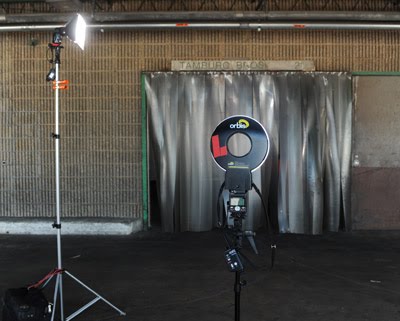
Okay, that was easy enough. Those refrigerated room barriers are translucent. So all I have to do is to stick a speedlight behind them to get a cool background. Should be a piece of cake. Be right back with a test shot.
 Eww.
Eww. That kinda sucks. Apparently, the doors are more transparent than diffused. The bare strobe is too… point-sourcy.
No prob — I’ll add a shoot-thru umbrella to make the light source bigger and that should do it. It’ll cost me a little power, but no worries — I am only at 1/8 now.
 Crap.
Crap. Close, but no cigar. I need the light source to be bigger yet.
The problem is the umbrella is the biggest light modifier in my bag. I was not expecting to use a big light source, and now I need one.
Alright, let’s kill the umbrella altogether and turn the flash around. We’ll use the whole fricken’ wall as the light source.
That oughtta do it.
 Better.
 And the lines in the door flaps hide the flash, too. I’d rather be lucky than good, any day. But still, needs more cowbell.
I could vary the exposure a bit, walk the aperture up and down to see how it looks. But no, the exposure looks fine. That’s not it.
Hmm… cold…
I know:
 A 1/2 CTB gel on the flash cools it down a little.
This will give me some nice color separation from Betty, and it connotes the cool temperature. Full CTB woulda been a little too much.
Plus, that wall and the gel combined to force me to pump the speedlight up to 1/2 power. Remember, it has to go thru the gel, bounce off the wall and go thru the door flaps.
All of that costs light. And 1/2 power is my effective upper limit when shooting people. I’m not so big on a 4-second recycle. Much rather cut that in half.
 Here it is without the doors. That whole wall is my light source. Little hot in the center, but that will probably work for me as a framing device.
Okay, let’s set up the front lights.
I already have my working aperture and shutter speed, so I’ll have to adjust the power on the key and fill lights to match. (Oh, and subtract a couple stops for the fill…)
Since we started out on the threshold of ambient black, we can bring up the ambient very easily at any point by opening the shutter speed. Or we can make it a flash-only exposure by leaving the shutter alone.
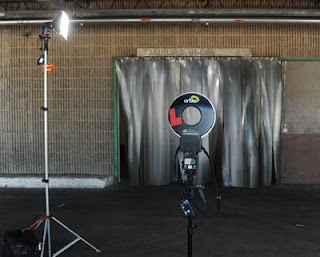 Here are the front lights — including some ambient dialed in so you can see them better. We’ll add the blue background light back in a minute.
We’re using a fairly harsh key to give her some pop in the cheekbones, and some nice on-axis fill to tame the harsh shadows. The key (a Lumiquest SB-III) is feathered up and away from her to let the light fall off nicely. Add a 1/4 CTO to the key to give her a little color, and you’re golden. Or she is, anyway.
She will hide the fill light’s reflection in the doors. The key light is small, and that reflection looks fine. Okay, good to go. Bring her in.
Hmm… need something to do with her hands to keep her from looking stiff. Most people are not used to being photographed this way, and it is harder than it looks.
Does she have a Blackberry? Of course she does. That’ll give her something to be doing, and a natural look for her hands.
A couple minutes later:
 All set, and good to go.
 Only took a couple of mins for her, and she is off to her next appointment a little bit early. It’s a bread-and-butter biz portrait, done just about as quickly as if we’d used natural light — only it has a lot more pop.
Okay, let’s tear this down, throw the gear into the car and get some breakfast — it’s your turn to buy.
-
the solution to the elinchrom quadra umbrella mount
When I was looking at reviews of the Elinchrom Ranger Quadra, one of the most common complaints people seemed to have was the fact that they couldn’t mount standard umbrellas on it (Elinchrom uses a 7mm umbrella shaft, while most others in the US use an 8mm shaft).
Now this seemed kind of silly to me – first off, the Quadra head is extremely small and lightweight – hanging anything larger than a *tiny* umbrella off it just seems like a recipe for disaster. Secondly I thought to myself “I mount umbrellas on speedlights all the time and they have no umbrella holder whatsoever – why is the quadra any different?” The solution:
The plain ol’ vanilla Umbrella Swivel. Beloved of “Strobists” everywhere, it provides a secure slot/mount for the umbrella, placing the weight & torque on itself rather than the strobe head. Screw in a post on top, plop the Quadra head on that and good to go. You can even still use the angle of the quadra head itself to hit the sweet spot of the umbrella.

Personally this is just fine for me. works great for my umbrellas, Apollo softboxes and Softliters…but let’s say you need the light more “on axis” with the umbrella shaft (maybe to fit the hole in one of the new PLM diffusion screens for instance…) I found the easiest thing is to simply take a second swivel, and use it to “hang” the head off the umbrella shaft itself. The head is light enough that it doesn’t put undue strain on the shaft (or the swivel).

Kinda kludgy but it works. Personally I don’t bother – mounting it on the swivel itself is quick, easy and gets the job done with hardware that I’m already carrying anyway for my speedlights.
So there you have it: Mounting umbrellas on the Quadra made easy!

Tweet This Post Stumble This Post
-
New Writers and Digital SLR Camera Reviews on Photocrati
Dear readers, sorry for the temporary absence. It’s been over ten days since the last post. I’ve been busy working on my other site, Photocrati. If you haven’t been there yet, check it out: Photocrati Photography Blog and Digital SLR Camera Reviews. We’ve recently added a gear review section and brought on Peter Burian (co-author of the National Geographic Photography Field Guide and author of numerous Magic Lantern guides to digital SLRs) as a reviewer. We’re also about to add Jack Neubart, author of the Photographer’s Exposure Handbook and at least three other books on photographic lighting, as a reviewer. They join a team of 7 other pro photographers working in diverse fields. We’ve added a Twitter account – you can follow us at www.twitter.com/photocrati – which something I’ll be doing soon on DSLR Blog as well. And we’ll be launching a forum and major photo contest sometime in the next two months.
Anyways, now that the flurry of changes is done on Photocrati, I can get back to sharing some business tips here. Up shortly: a review of Printroom.com online storefronts.
Thanks for the patience, Erick
-
Do you need a portfolio?
Short answer: Yes, but not in the way you think.
For most photographers, the word “portfolio” evokes images of a physical “portfolio” of images, often in a big black portfolio case, that represents who you are as a photographer. There are still a few situations when such classic portfolios are relevant—for example, if you are applying for a prestigious art gallery, going to visit a high-dollar commercial photography client, or meeting in person with prospective wedding clients.
But for most photographers most of the time, the traditional “portfolio” has always been of limited value. That’s not to say most photographers don’t use portfolios. Indeed, every time a photographer sends a submission to a magazine, stock agency, or other prospective buyer—whether slides, prints, or an email with digital images—that photographer is sending a portfolio. In this case, each portfolio is different, depending on the client.
Today, however, the portfolio concept is taking on yet another connotation. In the digital era, your website is your portfolio.
A website is like a conventional portfolio in that it showcases your best work and presents an overall impression of your style and identity. Yet a website is also much more powerful. It offers an enormous range of creative design possibilities. And it is capable of reaching hundreds or thousands of people with relatively little extra work on your part. It’s also the first impression that most prospective buyers will have of your work.
Even the conventional situations above—art galleries, high-end commercial assignments, and weddings—most clients will see your website before they see anything else. Many stock agencies and buyers will now simply ask for a link to your website instead of asking for a submission of photos.
So in the digital era, the question “do you need a portfolio” is synonymous with the question “do you need a website.” And the answer is yes, absolutely. And you need to give your website — it style, the images it includes, the aura it projects — the same attention you might have given to preparing a portfolio in a bygone era. It’s the most critical step you can take to start selling photos and getting clients.