Category: Uncategorized

  • Hermann Rorschach, White Courtesy Phone Please.

    We get lot of smoke photography in the Strobist Flickr Group, but this is the first time one has come close to getting bounced for not being family-friendly.

    On second thought, I don’t see anything unusual about it at all.

    (Nope, nothing.)

    Click the pic to get to the Flickr page, where Strobist reader Shafik Saba includes a brief run-thru on how he shot this purely random smoke photo.

    -30-


    Strobist

  • Canon T1i Review

    Hey folks, just a quick note. Jack Neubart has just published his new, user-friendly Canon T1i Review on Photocrati. Here’s a bit of what he has to say:

    Small and compact, a good choice-if you don’t mind some compromises.

    I’m not really sure that Canon knows exactly what to do with this camera. It seems simple enough, judging by weight and size, but is otherwise a complex tool with lots of oomph built in. If you’re looking to move up to a digital SLR without making a heavy investment or simply want an inexpensive and lightweight DSLR that you can tool around with on your next vacation, the Rebel T1i would be a good choice.

    However, don’t buy this camera if you expect to use it extensively to shoot video-HD or otherwise, as you may be disappointed. Buy it as a still digital, and use the video capture as an adjunct feature to capture special moments when a camcorder isn’t handy….”

    DSLRBLOG – Photography Business Blog

  • new gear – elinchrom ranger quadra

    DSC_2676

    Just got the 2 head kit, looks like a great piece of gear.  Full review forthcoming as soon as I get a couple of shoots down with it.  Initial impressions are *wow*  It puts out an amazing amount of *quality* light for such a tiny package.

    Tweet This Post Stumble This Post


    ed | zawadzki

  • Shooting in the Snow

    For years now, I’ve had this concept of a shoot at night, under the streetlamps with snow coming down… dramatic light and environment… the whole nine yards

    Unfortunately I live in Philly, and the only “snow” we get here is usually slush, rain, and more slush…

    Course this week was different… practically couldn’t have asked for better conditions.   It was coming down pretty hard, and I think I put the weather sealing on my gear to the test (watching piles of snow accumulate on your lights is a little disconcerting…)  By the time we finished my camera bag on the ground was merely a small white lump.  Luckily no gear casualties though, and some great shots came out…

    snowshoot (1 of 7) snowshoot (2 of 7) snowshoot (3 of 7) snowshoot (4 of 7) snowshoot (5 of 7) snowshoot (6 of 7) snowshoot (7 of 7)

    Tweet This Post Stumble This Post


    ed | zawadzki

  • Negotiating for photographers

    One of the issues that always comes up for emerging photographers is dealing with contracts and negotiation.  Let’s face it – most of us are more “artist” than “businessman”.  we just want to make pictures and leave the legalese to someone else. 

    Of course the reality is that to be a successful *artist* you must be a successful *businessman* as well. 

    Go to any photography forum on the web and you will invariably find questions such as “how do I make a contract/terms for such and such a job?” or “the client sent me this crazy contract to sign, what do I do?”

    In this piece, Bill Cramer of Wonderful Machine, Inc shows an actual contract negotiation he had with an editorial client, including exchanges, contracts and revisions.   This is a fantastic read for any photographer and a perfect example of how to do it right.  In particular, notice how he responds to the disagreement in contract terms – guiding the exchange to a mutually satisfactory agreement, rather than stonewalling and confronting. 

    This is great stuff folks!

    http://www.wonderfulmachine.com/wmideabox/pricing_and_negotiating_01.html

    Tweet This Post Stumble This Post


    ed | zawadzki

  • Understanding and Using Optical Slaves, Pt. 1

    First off, this is a long-overdue post. It arguably could have been in Lighting 101. But this week (four-plus years later) we’ll be looking at choosing and using optical slaves.

    In this post, how to figure out which kind is right for you.
    __________

    Only Two Things Matter

    Slaves are not particularly complicated. They see a light pulse, and then they complete a circuit — hopefully firing your second flash in the process.

    There are only two variables that should concern you — connectivity and sensitivity. (Okay, price, maybe. But as you’ll see later, it is better to wait a little bit and buy a little further up the scale if you possibly can.)

    Connectivity

    How sensitive a slave is doesn’t mean squat if it will not connect to your flash. Typical connectors are HH (meaning US-style household plug), 1/4″ plug, 1/8″ (3.5mm) plug, PC plug and specialized connectors such as the weird Vivitar thingie.

    There are hot-shoe based slaves, too, but you will always pay a premium for them. Which is why the very first rule of slaves is to:

    ALWAYS TRY TO CHOOSE FLASHES WITH BUILT-IN SLAVES.

    Sorry for the all caps, but I do not even consider a flash unless it has a built-in slave. But if your flash hasn’t got one, you’ll have to choose a slave that will connect to it. And God help you if you have a series of flashes with different connectors. With decent slaves starting at north of , you can see how the necessary duplication could get expensive fast.

    If you have 1/4″ and 1/8″ jacks on your flashes, you can solve the compatibility problem with a cheap adapter. Ditto getting to an HH jack, if you have a couple bucks and some soldering skills. But the most important point is that you should be considering the down-the-road costs when you are buying flashes. And buying a flash without a built-in slave or an external PC jack makes life complicated for you later.

    Long story short, there is a lot of elegance in a flash system with a jack you can sync with low-cost cords and a built-in slave. That was the thinking behind the LP160 — to duplicate the bigger monoblocs’ ease of syncing.

    Sensitivity

    Once you have your slave hooked up to your flash, you are halfway home. Now you have to get it to actually fire.

    This is where lots of people pay the newb tax — when they buy a no-name eBay slave that technically fits their flash but fires about 30% of the time. (But hey! They’re !)

    There are two kinds of slave circuits — passive and powered. The above eBay specials are almost always passive. And when they do work it will typically be in an indoor situation — low ambient, lots of bounce surfaces, and for good measure you should probably throw in some pretty high master flash energy levels, too.

    Passive slaves will typically advertise a range of ~100 feet. Take that with a grain of salt. It is calculated under ideal circumstances with powerful master flashes.

    To be fair, there are decent passive slave designs. But they typically will be for short-range, bright flash situations. My advice is to save a little longer and opt for a powered design.

    Trust me, you really want a powered slave. You’d think they’d require batteries — and they used to. But a while back someone got the bright idea to use the voltage from the flash’s trigger circuit to power the slave. Presto, no batts needed.

    The range on a powered slave can be very impressive. You’ll see advertised ranged of ~600 feet and up. Grain of salt there, too. But you can compare apples to apples from the same manufacturers to see which slaves they consider to be their best.

    Take a look at this slave product range from Wein, who has a good reputation for high quality slaves. You’ll see a wide range of connectors and sensitivities available.

    How do you tell which ones are powered slaves, and thus more sensitive?

    You’ll see prefixes like “super” and “ultra” being batted about. And the prices will rise, too.

    And “super” and “ultra” are not far from the truth. If you have problems with these slaves, it is more likely to be from false positives (random fires). These are likely not random at all, but rather triggers from environmental light pulses — the sun gleaming off of a passing car, perhaps.

    But the takeaway is that an expensive slave is usually worth the money.

    Built-In is Better

    Here is a photo from a ways back, illustrating just how good the built-in slave is on a Nikon SB-800 when in SU-4 mode.

    Built-in slaves (more so the modern ones as opposed to the ones from 20 years ago) are almost always “super slaves.” And the internal connectors are all soldered, which is better than any flavor of jack.

    That photo was taken in the middle of the day. That flash was triggered by the internal slave seeing the on-camera speedlight. Impressive.

    So if you are buying flashes, stick with those models with a well-regarded built-in slave. You’ll save money in the long run, and you add a lot of versatility to your lighting schemes.

    We’ll talk about that — and how to get the most out of your slave’s range and sensitivity — in Pt. 2.


    Strobist

  • Pinup with Brittany

    Just a fun shoot testing out some concepts for a classic “Vargas style” pinup…  thought they came out nicely…

    brittany-pinup-005

    brittany-pinup-001
    brittany-pinup-002
    brittany-pinup-003
    brittany-pinup-004
    brittany-pinup-005
    brittany-pinup-006
    brittany-pinup-007
    brittany-pinup-008

    Tweet This Post Stumble This Post


    ed | zawadzki

  • darkly inspiring…

    If you’re going to try, go all the way. Otherwise don’t even start.

    This could mean losing girlfriends, wives, relatives, jobs, and maybe your mind.

    It could mean not eating for three or four days.
    It could mean freezing on a park bench.
    It could mean jail. It could mean derision.
    It could mean mockery, isolation.

    Isolation is the gift. All the others are a test of your endurance.
    Of how much you really want to do it.

    And you’ll do it, despite rejection in the worst odds.
    And it will be better than anything else you can imagine.

    If you’re going to try, go all the way.

    There is no other feeling like that.
    You will be alone with the gods. And the nights will flame with fire.

    You will ride life straight to perfect laughter.

    It’s the only good fight there is.

    Henry Charles Bukowski
    1920 – 1994

    Tweet This Post Stumble This Post


    ed | zawadzki

  • Introducing Best of Wedding Photography

    I noted in my last post that work on Photocrati’s photography blog and photography WordPress themes have been keeping me from posting regularly on DSLRBlog.

    In addition to Photocrati, I’ve been working on another great project with a great group of wedding photographers. Some of the best and best-known wedding photographers in the world are working together to launch a new, invitation-only membership group for wedding photographers called Best of Wedding Photography. This will be the most selective group of wedding photographers in the world.

    Membership invitations are based on peer-review. We’ve created an independent board including Crash Taylor, David Beckstead, David Ziser, Anna Kuperberg, Glen Johnson, Ben Chrisman, and Matt Adcock / Sol Tamargo from Del Sol Photography. If you pay attention to the world of wedding photography, you should recognize many of these names. Beckstead and Chrisman have both been named as the WPJA’s Photographer of the Year in various years. Five of these member have been named among the Top Ten Wedding Photographers in the World by American Photo in various years. Johnson has a best selling book on wedding photography and David Ziser, of course, runs a well-known workshop series in the US.

    We believe this organization will change the landscape of the wedding photography industry and become one of the most sought after invitations among wedding photographers worldwide. Look for the launch some time in November.

    DSLRBLOG – Photography Business Blog

  • Understanding Optical Slaves, Pt. 2

    Editor’s note: There are enough questions coming in via the comments that I am prepping a slave-related Q&A for later this week. If you have a question that has not yet been asked, please get it into the comments ASAP. Thanks.
    __________

    In part one, we talked about the differences in optical slaves, and why internal slaves were usually better solutions.

    In this post, we’ll look at the practical side — how do you get the best performance out of your slaves?
    __________

    #$!%! Thing Didn’t Fire!

    Slaves are a little like radio remotes in that they are not 100% perfect and reliable. (But the good ones are damn close.)

    And unless I am working in an environment alongside other photographers, I almost always use a hard cord or a PocketWizard on one flash (which becomes a “master” flash) and optically slave the others. It’s generally very reliable, and a fast way to work.

    So, which flash to use as a master and which to slave? The answer might be different than you think.

    Power vs. Angle of Coverage

    Say you have a key light firing at 1/2 power, and three more accents set at 1/64th power. Try using your most powerful flash as a master and slaving the accent lights. If that main light is gonna be bouncing off of all sorts of things, so much the better.

    But if you are running flashes at only modest power levels, you might try using the flash with the widest beam spread as the master flash. Often, beam spread trumps power level as the reason for a flash to be the master. The reason is simple — the other flashes have to be able to see the light from the master to fire.

    For example:
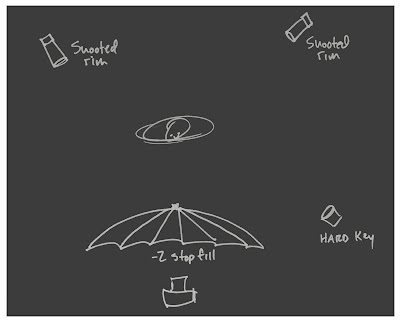

    In this instance I would use the umbrella fill flash as a master, even though it is gonna be at a lower power than the key light. Reason being, the umbrella light will go out in all directions and the other flashes will see it better than if I master sync’d the key light at bottom right.

    On the other hand, if I used one of the other flashes as a master, the umbrella flash might not fire. This could happen either because of the limited beam spread of the other flashes, or because the umbrella itself was shading this flash and reducing the intensity of the light from the master flash before it reached the slave.

    The More, The Merrier

    Realistically, with as many flashes in a photo as in the above example, they will usually all fire no matter what.
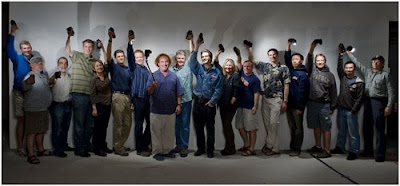

    As long as at least one slaved flash can see the master, it will likely set off at least one other slaved flash, and so on. This cascading effect means that it is actually easier to fire off of a room full of 50 slaved flashes than it is to fire, say, two.

    In the Usual Suspects -style photo above (more here) there was a 2-stop down umbrella right at the camera, acting as an on-axis fill. Those slaved, low-powered accent lights were fired by the umbrella. And if they weren’t, one of the many other accent lights took care of the problem for us.

    Be Like McNally

    Knowing how to choose your master/slave flashes correctly is a good skill to have for those of you who use Nikon CLS or Canon eTTL syncing methods, too.

    One trick Joe uses for complicated setups is to use an off-camera TTL cord and hang that master flash out somewhere where all of the remote/slave flashes can better see it. There is usually a spot that will get the job done — and often that spot is not right on top of your camera.

    But you can think that way for manual-flash slave setups, too.
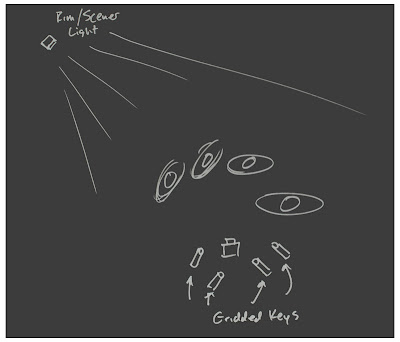

    For instance, if you had one PW and several slaved flashes that were gonna be used as gridded key lights, you might remote-/hard-sync a background/scener/rim light (upper left) that all of the gridded flashes’ slaves could see. Problem solved.

    And this is an instance where the slaved flashes’ rotating heads would come in handy, too. You can point the heads at your subjects and rotate the bodies of the flashes so the slaves can see the master flash. (That is why near-360-degree rotation on flash heads is so useful.)

    Hiding the Sun

    Sometimes the problem is that the ambient light level is very bright, causing difficulty for the slave. It has to see that pulse of light to fire your flash. And if the slave eye can actually see the sun, too, that’s a lot of competition.
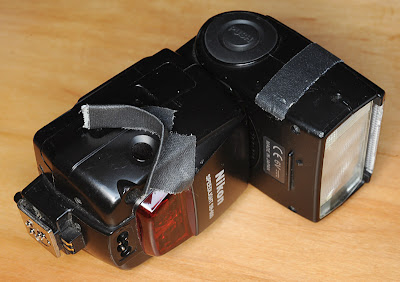

    Shading your flash eye with a little gaffer’s tape will make a big difference in the range of your slaves in daylight. Just make sure you shade the sun while leaving a clean line of sight to the master flash.

    It’s Firing By Itself

    If your slave is so sensitive it is getting false fires (assuming it is not a total piece of crap that would false fire inside of a dark closet) that is an easy problem to fix, too.

    You can “dumb down” a slave by partially covering the eye with tape until the offending false positive trigger is canceled but your master will still fire the slave. With “super” and “ultra” slaves, you might have to do this more often than you would expect. No big mystery — they are just that good.

    What’s Your Favorite Slave Tip?

    Do you have a favorite slave tip I left out? Do you know a great slave that doesn’t break the bank?

    Hit us with a comment (and/or a URL to a picture that proves how good your “giant killer” cheap slave is) in the comments.


    Strobist