
From “The Figital Revolution”

Tweet This Post Stumble This Post

© Colin Gallagher
Yesterday, the sky over Bellefonte, PA was ripped apart by color and clouds. I know every sunset is unique and special, but I had never quite seen something like this. Rushing home from the grocery store, I frantically tried to take a picture on my 1.3 megapixel phone from pre-Revolutionary War times. Gripped by panic, I parked in front of my apartment building and charged up the steps, nearly breaking my key off in the lock. The entire town was engulfed in this pinkish haze as the sun began to disappear. I grabbed my tripod and camera, quickly throwing on my wide-angle lens and sprinting across the street to the park there.
Mud sloshed through my sandals, and I was in shorts despite it being mid-January in central Pennsylvania. Reaching a rickety bridge crossing a stream through the park, I threw open the tripod legs and quickly attempted to frame the shot…
…and then a child began running across the suspension bridge, sending it swinging and rocking as her father stomped along behind her. The sun was gone, the last bright pinks and purples fading away to grey as the bridge finally became still again. Sighing, I snapped off a few merely out of principle and trudged home.
Colin is a 27-year-old Bellefonte photographer from Pennsylvania. His uncanny ability to completely destroy any piece of lighting equipment that he touches continually drives him outdoors to capture the breathtaking scenes Mother Nature has to offer.
Twitter: http://www.twitter.com/colintgallagher
Facebook: http://www.facebook.com/pages/Colin-Gallagher-Photographer/170407189656590


What an amazing episode! For Episode 10 of Photo Talk Plus we interview fine art photographer Jaime Ibarra. Jaime’s unique in camera work and especially his post production work take color to great photographic heights. By the way, check out Jaime’s awesome SmugMug site where you can buy prints here.
Joining Lotus Carroll and myself to interview Jaime are panelists Joe Azure, Sly Vegas, Charli Blake, Jackie Freeman, Keith Barrett, Petra Cross (from Google), and Cliff Baise.
?Trey Ratcliff also makes a surprise visit in the second half of the broadcast.
In this episode we talk about the New Nikon D800 and the new Canon 24-70 L Series lens, the winner of Chrysta Rae’s Scavenger hunt Kimberly Pemberton, an update on Carlos Miller’s arrest (including the video he was able to recover that the Miami PD allegedly deleted), and we talk about sensor cleaning techniques.
Thank you as always to our show sponsors SmugMug and Drobo! Be sure to check them out at http://smugmug.com and http://drobo.com.
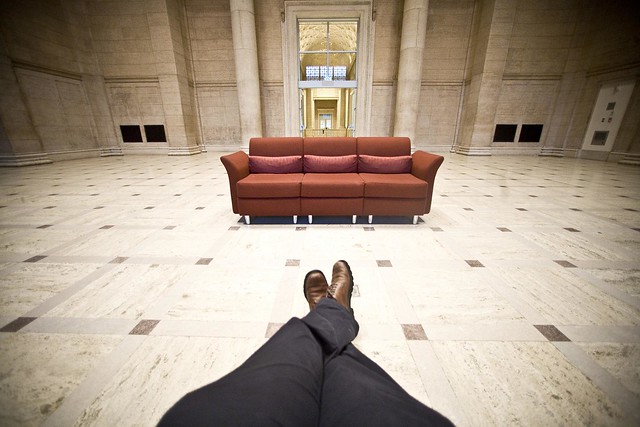
I just got an email from Getty Images that I suspect is a mass email to all of their various contributors. In the email Getty is asking for help in identifying our photographs that might contain images of designer furniture. The email states that French courts have found in favor of the Le Corbusier rights-holders against Getty in a case where furniture was in the stock photograph.
Here is the email below with emails redacted:
“Attention all Flickr Collection on Getty Images Contributors!
You may have heard about a recent case (actually more than one case) where Getty Images and some of our photographers have had claims lodged against us in French court for images which include designer furniture, even as a minor part of the image.
This is a serious issue that involves potential liability for you as photographers.
The French courts have found in favor of the Le Corbusier rights-holders who initiated these claims. While we disagree with the decision and we are appealing it, we are very mindful that for now, it is a valid decision. It is critical that you understand that any claim like this one is extremely serious and requires action on your part in order to protect your interests, not just ours. We will continue to fight this decision, but in the meantime we must continue to actively pull content from our site that may be deemed infringing. We simply cannot identify all problematic images as quickly without your active participation. And quick action is vital.
Most importantly, if you believe that any of the images you have uploaded to us might possibly include any designer furniture, please email the Getty Images ID numbers to [email redacted] as soon as possible! The sooner we can identify and remove potentially infringing images the better we can reduce potential legal problems.
We are including links to information and FAQs that give more information on this issue and we strongly request that you read them and study the visual guides included.
You can also read the original Le Corbusier complaint here:
In English
Original in French (clearer photos)
Please note: because we are still engaged in litigation, we are very limited in what comments we can make or questions we can answer. If you do have questions please email [email redacted] especially for any specific images you believe may be a problem.
This is only for images you have on the gettyimages.com site. We cannot answer questions about images you have posted on Flickr or elsewhere.
Thank you for your help and attention to this very important matter.”

Photo Talk Plus, Episode 11, With Special Guest Ivan Makarov
*TONIGHT!!!! 8PM PST — http://vidcastnetwork.com*
I took this photo at a wedding that I shot a while back with my good Pal Ivan Makarov. Ivan is our special guest tonight on Photo Talk Plus. In addition to talking about the latest Plus One Collection book that he’s spearheaded, he’s also going to be sharing a lot about his own work and techniques on the show.
Join my cohost Lotus Carroll along with this week’s panelists Google’s Ricardo Lagos, Kerry Murphy, Nick Gatens, and Keith Barrett, as we talk with Ivan about the upcoming book and his own work as well as discuss some of the biggest Google+ Photography stories of the past week.
This week’s show is sponsored by our wonderful sponsors SmugMug and Drobo. Be sure to check them out at http://smugmug.com and http://drobo.com!

Related posts:
3 Pictures from November Paddling on the Horsetooth Reservoir
9 Pictures from September Paddling in Northern Colorado
JKK Supernova Sea Kayak Added to My Paddling Fleet
Much has been written on DPS about receiving feedback and examining your own photos to help improve. Today I want to give you some pointers on providing a critique to others (when asked for) so the conversation between you and the photographer is time well spent.
At its base, a critique is an examination of a piece of work, be it writing or art or potato chips, and a reasoned response to what is examined. I’ll be talking mostly about ‘soft’ critiques in this post as they are the ones that examine content in a less mathematical way. Not that math doesn’t apply to photos, but examining a photo is more subjective than objective.
Most importantly, ensure the person receiving the critique actually desires a critique. While your intentions may be pure and the information you have may benefit the recipient, if most people aren’t open to the idea of hearing about their work, they won’t hear a thing you say. And it may backfire. Before launching into, “There are some things about this image I want to comment on…” start out with something as simple as, “Would you like an honest critique of your image?” If the answer is, “No thanks,” then move along and don’t’ say a word. If someone is not open to receiving, they won’t. (I know it sounds obvious, but it is often overlooked.)
This is hard for many of us. Some of us are being desensitized to the “Nice work!” we see on Facebook and Google+ and think all the world need be rosy. This is not the case. But (as long as point #1 is followed) we need to make sure we are honest from the start. If you just want to tear someone’s art apart, say so (that is not at the heart of a critique, by the way). If you want to help them improve, say that too. If you just want to spout your opinion, ditto. Hearing yourself talk or trying to gain more exposure on certain sites by ‘joining in on the conversation’ has its place, but just be honest about why you are speaking.
Most people jump right over this concept. We all have egos that enjoy thinking they have the accumulated knowledge of the world, or at least some specific subset. But the truth is, no one does and we, as a society, are learning new things about the world around us all the time. So it is with art. Any art revolution was confronted with detractors; people who thought it was rubbish, based solely on person, past experiences. Knowing you don’t know everything will help lead to an open discussion rather than a one sided, “You did all this wrong,” point of view.
Before getting started, in hand with knowing you don’t know everything, learn a little about the subject being critiqued; both the subject of the photo and the subject of photography. There’s no need to take college level courses to learn some art history and different photographic techniques. Often this education can come from the photographer by asking simple questions about why they shot what they did and what they were attempting to portray (some will tell you to not ask these types of questions as it may alter your critique, but I find it can be helpful in guiding the conversation).
Examine the body of work, set it down, walk away, and come back. I have found this process helpful personally to shake my thoughts up and then let them settle. If time is not available, by all means, jump right in. Look to what works and doesn’t work in the image. Look for technical merit (and here our very own Christina Dickson gives some examples of: Exposure, Focus and Composition in her post on portrait critiques) and look to more subjective areas such as story telling and emotional impact. Highlight what works and what doesn’t work. And most importantly; why.
The ‘Why’ is at the heart of the critique. It will help the photographer more than anything. “Her hair is all wrong,” is not a good critique, even though it might be accurate. “Her hair is bothering me. See if you you darken the tone to lessen its impact in the shot, or remove some of the stray strands to cause less distraction,” is a far better statement that gets out the bad with leading the photographer in a direction to improve. And that is at the heart of the critique, wanting to help the other improve. Anything less is simply complaining or touting one’s own mastery of the art, neither of which really help anyone (except the reviewer’s own ego).
Lastly, deliver the critique when the photographer is ready and in a way that works for them. Listing a long diatribe as a comment on a Google+ picture might not always be the best forum, especially if the critique was unwanted. But emailing the person privately and first asking them if they wish for an honest critique is a good first step. Follow this up by another email with the critique if they are amiable to receiving. That way they can read it when they are ready, instead of having it crammed down their throat when they are tired and hungry and working a long day. Delivery is just as important sometimes as what is being said.
These days, across the miles, most critiques are given in email and it’s a great medium as people in France can comment on a Vietnamese artist’s work with never leaving home. it also allows a slower conversation which is often preceded with carefully thought out comments, rather than calling someone at 2am, a little drunk, to tell them why their sunrise picture, “sucked”. I’ll pretend this never happened to me. And I hope it never happens to you. Email helps bring a bit of reason into a conversation. It should not be shunned over an actual in-person meeting if location isn’t a problem, as body language can tell you a lot about what a person is thinking.
If you’re looking for specifics to include in that critique, I have enjoyed this post over at Pixiq to be helpful. It dives a bit deeper into the area of what to include and rather than recreate it here, I suggest you pop on over and take a look.
Do you have any tips on the actual delivery of a critique that you find useful?
Post originally from: Digital Photography Tips.
Check out our more Photography Tips at Photography Tips for Beginners, Portrait Photography Tips and Wedding Photography Tips.
How To Deliver A Useful Photo Critique

Just got the 2 head kit, looks like a great piece of gear. Full review forthcoming as soon as I get a couple of shoots down with it. Initial impressions are *wow* It puts out an amazing amount of *quality* light for such a tiny package.
Tweet This Post Stumble This Post
I took this photograph during the first couple of months that I was in photography school. At that point we were all just learning how to shoot tabletop photography, and this was our first still life assignment where we had the freedom to decide what we wanted to shoot. Before that, we had only shot a few things in the school’s commercial studio, such as a simple product on white seamless (now I call that “the boring stuff”). As you can imagine, I was very excited to finally be able to use my creativeness and create something that I really wanted to. I had so many ideas in my mind of what I wanted to shoot. I finally decided to go with an elaborate idea that involved slate, fake moss, mason jars, natural sponges, red rose petals, little purple flowers and some trimmings of one of my landlord’s house plants. I was so excited for this assignment that I went into the studio the night before, dragged all of my props in and shot my picture.

The next day during our studio time, I showed one of my instructors the picture. He liked it a lot, he was a little shocked that I went to such a great length of finding all these props but little did he know that it was only the beginning! Looking back now, that picture is a little much, but at the time I was satisfied and excited.
After my partner was finished shooting her picture for the assignment we had two hours left in the studio. I had these pretty little daisies that I bought the day before when I was buying the roses and I brought along those tiny scissors, too. I figured I’d take advantage of the extra time we had so I photographed the other idea that I conjured up in my head. This picture is the one you see here. It was finished in a matter of minutes. It was so much simpler than my elaborate, fairy tale and garden inspired image that I shot the night before. After some hemming and hawing, I decided to turn in my first picture for the assignment.
I got a good grade for that picture and since I didn’t turn in the image you see here, it got pushed back on my hard drive and covered by all the new images I was taking. A couple months later when we had to decide what area of photography we wanted to go into, I had a meeting with one of my instructors who was the head of the commercial studio. I told him that I wanted to specialize in still life photography and he said ok, show me what you have. Together, we went through all the pictures I shot in the commercial studio. The last image that was in the collection (that I had actually almost forgotten about) happened to be this one. When he clicked on it, I started to dismiss it and say, “Oh I shot that a while ago… it’s nothing special…”, but he stopped me. He asked why he never saw this before and I told him because I handed in the other shot for the assignment. He looked at the other picture and said, “This… this is nice, it’s good, ya know”.
Looking back now, I realize that this image was the first one that really showed the style that I would soon start to develop and that I now incorporate into all of my images. All I needed was someone to point that out to me and guide me in the right direction. It marked the beginning of a new chapter in my photography. I went on to turn that image in for an assignment later in the year and it ended up being chosen as the cover image for my class’s graduation invitation, which in itself was a huge honor.
To this day, it is still one of my most liked images in my portfolio and people have no clue it was taken so early on in my career (well now they do).
So a quick thank you to Dick, for teaching me, guiding my way through the commercial studio, and ultimately pointing out to me that this image and my abilities are something special. And thank you Joan, for giving me the information and confidence I needed to develop my own sense of design and for thinking of my work and choosing my image for the graduation invitation. You both are of huge importance to me!
Rikki Snyder is a freelance photographer and stylist specializing in food, product and still life. She is currently available for work in NY and Boston.
Blog: http://rikkisnyder.com/blog
Twitter: https://twitter.com/#!/RikkiSnyder
Flickr: http://www.flickr.com/photos/rikkims/
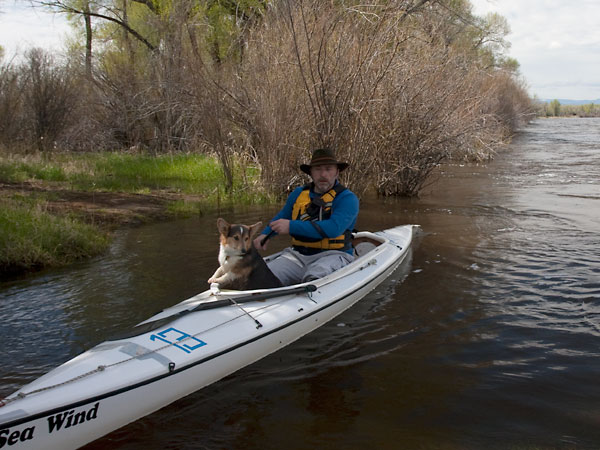
That was the weekend of the last Wyoming Outback Challenge, 44 mile paddling race from Saratoga to Fort Steele. The race was organized in 2007, 2008 and 2009, see the summary of results
The North Platte in Wyoming is one of my favorite rivers. I paddled the river from Benet Peak campground to Seminoe Reservoir and shorter section below Glendo and Guernsey Reservoirs.
Pixel is often my paddling companion when I have a chance to paddle Sea Wind in a more recreational mode.
Related posts:
Paddling with Pixel, the Water Corgi
Sun, Snow and Wind on the North Platte River in Wyoming
Bennett Peak to Pick Bridge on the North Platte River, Wyoming
Do You Paddle with Your Dog? K-9 Kayaking
44 Miles of the North Platte River in 2 Minutes
North Platte River Kayak Racing – 2009 Wyoming Outback Challenge