Some cool visual art images:
8th Grade Art Identity Project

Image by North Shore Country Day School
Digital P_Art_Y #3

Image by Roxelo Babenco
Some cool visual art images:
8th Grade Art Identity Project
Image by North Shore Country Day School
Digital P_Art_Y #3
Image by Roxelo Babenco
Check out these visual art images:
Gradina Manastirii Predeal (Sf. Nicolae) / The garden of Predeal (St. Nicholas) Nunnery

Image by cod_gabriel
Manastire din sec. XVIII, putin cunoscuta si frecventata. Daca doriti o bisericuta in care sa aveti sanse sa fiti absolut singuri, micuta biserica a acestei manastiri e locul cautat. Bisericuta e veche si frescele nu sunt bine pastrate, dar e fermecatoare, si un bun loc pentru reculegere.
Am cerut cerut voie sa fotografiez maicutei de la intrare, si mi-a permis cu amabilitate, fara sa pretinda nimic in schimb.
A small, secluded eighteenth century orthodox monastery (now a nunnery), it is the place to go if you are looking for an old church where you can be alone with the icons and the cross – a place for a little solitude and meditation.
The mural painting in the charming little church is not so well preserved, but its patina can make you feel like you are in a time long, long ago.
The nice nun at the door graciously allowed me to take pictures inside the church.
Manastirea Predeal (Sf. Nicolae) / Predeal (St. Nicholas) Nunnery

Image by cod_gabriel
Manastire din sec. XVIII, putin cunoscuta si frecventata. Daca doriti o bisericuta in care sa aveti sanse sa fiti absolut singuri, micuta biserica a acestei manastiri e locul cautat. Bisericuta e veche si pictura murala nu e bine pastrata, dar e fermecatoare, si un bun loc pentru reculegere.
Am cerut cerut voie sa fotografiez maicutei de la intrare, care mi-a permis-o cu amabilitate, fara sa pretinda nimic in schimb.
A small, secluded eighteenth century orthodox monastery (now a nunnery), it is the place to go if you are looking for an old church where you can be alone with the icons and the cross – a place for a little solitude and meditation.
The mural painting in the charming little church is not so well preserved, but its patina can make you feel like you are in a time long, long ago.
The nice nun at the door graciously allowed me to take pictures inside the church.
Sfin?ii Constantin ?i Elena, pictur? mural? în biserica m?n?stirii Govora / Mural painting of Saints Constantin and his mother Helena on the walls inside the church of Govora monastery

Image by cod_gabriel
Check out these visual art images:
Art of Being Tuareg: Sahara Nomads in a Modern World

Image by Steve Rhodes
through Sept 2
museum.stanford.edu/news_room/Tuareg.html
Art of Being Tuareg: Sahara Nomads in a Modern World

Image by Steve Rhodes
through Sept 2
A few nice visual art images I found:
Street Art In Drogheda

Image by infomatique
Visual Arts
October 2006 saw the opening of the town’s first dedicated municipal art gallery and visual arts centre, the Highlanes Gallery, housed in the former Franciscan Friary on St. Laurence Street. The Highlanes Gallery holds Drogheda’s important municipal art collection which dates from the 17th century as well as visiting exhibitions in a venue which meets key international museum and gallery standards.
The original Drogheda bypass bridge over the river Boyne, known locally as the "Bridge of Peace", is well-known regionally for its aerosol graffiti murals. Under the bridge, on each side of the river there are two large concrete supports that measure approximately 8 metres high, and 20 metres long. Starting in the 1980s with the breakdance craze, these supports were painted and sprayed with murals by aerosol artists. This activity at the time was technically illegal and frowned upon by the local authorities. Today the murals are frequently updated and limited sponsorship of the artists is provided by local businesses.
Street Art In Drogheda

Image by infomatique
Visual Arts
October 2006 saw the opening of the town’s first dedicated municipal art gallery and visual arts centre, the Highlanes Gallery, housed in the former Franciscan Friary on St. Laurence Street. The Highlanes Gallery holds Drogheda’s important municipal art collection which dates from the 17th century as well as visiting exhibitions in a venue which meets key international museum and gallery standards.
The original Drogheda bypass bridge over the river Boyne, known locally as the "Bridge of Peace", is well-known regionally for its aerosol graffiti murals. Under the bridge, on each side of the river there are two large concrete supports that measure approximately 8 metres high, and 20 metres long. Starting in the 1980s with the breakdance craze, these supports were painted and sprayed with murals by aerosol artists. This activity at the time was technically illegal and frowned upon by the local authorities. Today the murals are frequently updated and limited sponsorship of the artists is provided by local businesses.
Street Art In Drogheda

Image by infomatique
Visual Arts
October 2006 saw the opening of the town’s first dedicated municipal art gallery and visual arts centre, the Highlanes Gallery, housed in the former Franciscan Friary on St. Laurence Street. The Highlanes Gallery holds Drogheda’s important municipal art collection which dates from the 17th century as well as visiting exhibitions in a venue which meets key international museum and gallery standards.
The original Drogheda bypass bridge over the river Boyne, known locally as the "Bridge of Peace", is well-known regionally for its aerosol graffiti murals. Under the bridge, on each side of the river there are two large concrete supports that measure approximately 8 metres high, and 20 metres long. Starting in the 1980s with the breakdance craze, these supports were painted and sprayed with murals by aerosol artists. This activity at the time was technically illegal and frowned upon by the local authorities. Today the murals are frequently updated and limited sponsorship of the artists is provided by local businesses.
Check out these visual art images:
California: Stanford University – Iris & B. Gerald Cantor Center for Visual Arts at Stanford University – Burghers of Calais
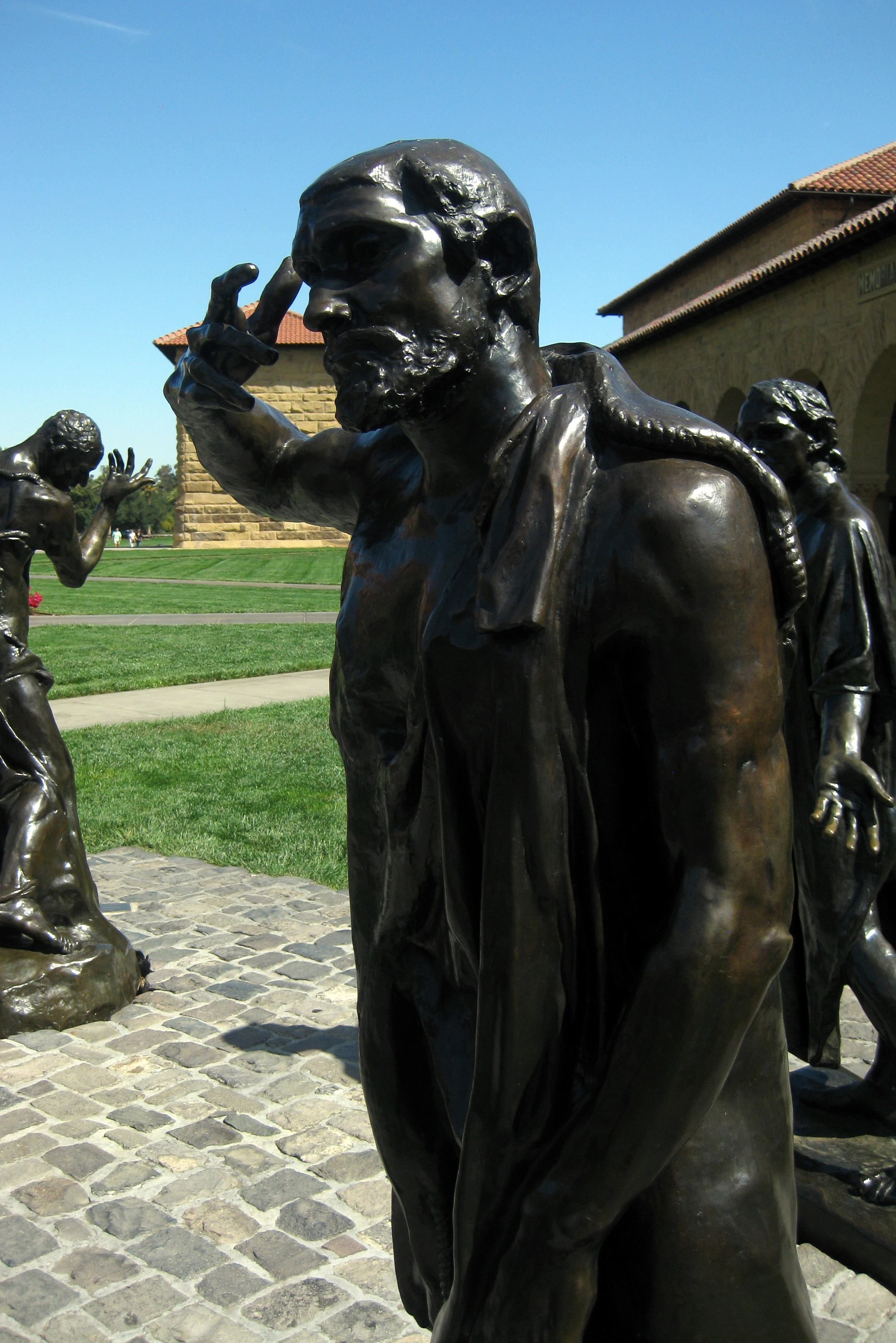
Image by wallyg
Les Bourgeois de Calais (The Burghers of Calais) is one of the most famous sculptures by Auguste Rodin. It serves as a monument to the heroism of six burghers in Calais during a siege by the England in the Hundred Years’ War in 1347.
After a victory in the Battle of Crécy, England’s King Edward III besieged Calais, an important French port on the English channel, and Philip VI of France ordered the city to hold out at all costs. Which it did for a over a year. Philip failed to lift the siege and starvation eventually forced the city to parlay for surrender. Edward offered to spare the people of the Calais if any six of its top leaders would surrender themselves. Edward demanded that they walk out almost naked, wearing nooses around their necks and carrying the keys to the city and castle. One of the wealthiest of the town leaders, Eustache de Saint Pierre, volunteered first and five other burghers–Jean d’Aire, Jacques and Pierre de Wissant, Jean de Fiennes, Andrieu d’Andres–soon followed suit. Though the burghers expected to be executed, their lives were spared by the intervention of England’s Queen, Philippa of Hainault, who persuaded her husband by saying it would be a bad omen for her unborn child. Rodin depicts a larger than life Saint Pierre leading the envoy of emaciated volunteers to the city gates, prepared to meet their imminent mortality.
The monument was initially proposed by Omer Dewavrin, mayor of Calais, for the town’s square in 1884. Unusual in that monuments were usually reserved for victories, the town of Calais had long desired to recognize the sacrifices made by these altruistic men. Rodin’s controversial design echoed this intent–the burghers are not presented in a heroic manner, but sullen and worn. His innovative design initially presented the burghers at the same level as the viewers, rather than on a traditional pedestal, although until 1924 the city, against Rodin’s wishes, displayed it on an elevated base.
The original statue still stands in Calais. Other casts stand around the world–the Victoria Tower Gardens, in the shadow of the Houses of Parliament in London; the Israel Museum in Jerusalem, the Rodin Museum in Philadelphia, the Metropolitan Museum of Art in New York City, the Brooklyn Museum in New York City, Musée Rodin in Paris, the National Museum of Western Art in Tokyo, the Rodin Gallery in Seoul, and Glyptoteket in Copenhagen, to name a few. Some installations have the figures tightly grouped with contiguous bases, while others have the figures separated. Some installations are elevated on pedestals, others are placed at ground level. This bronze cast, at Stanford University’s Iris & B. Gerald Cantor Center for Visual Arts, consists of six separate pieces which are slightly sunken, concealing the bottom few inches of the bases, and spaced such that viewers can walk between the figures. The museum claims this is how Rodin wished them to be displayed.
California: Stanford University – Iris & B. Gerald Cantor Center for Visual Arts at Stanford University – Burghers of Calais
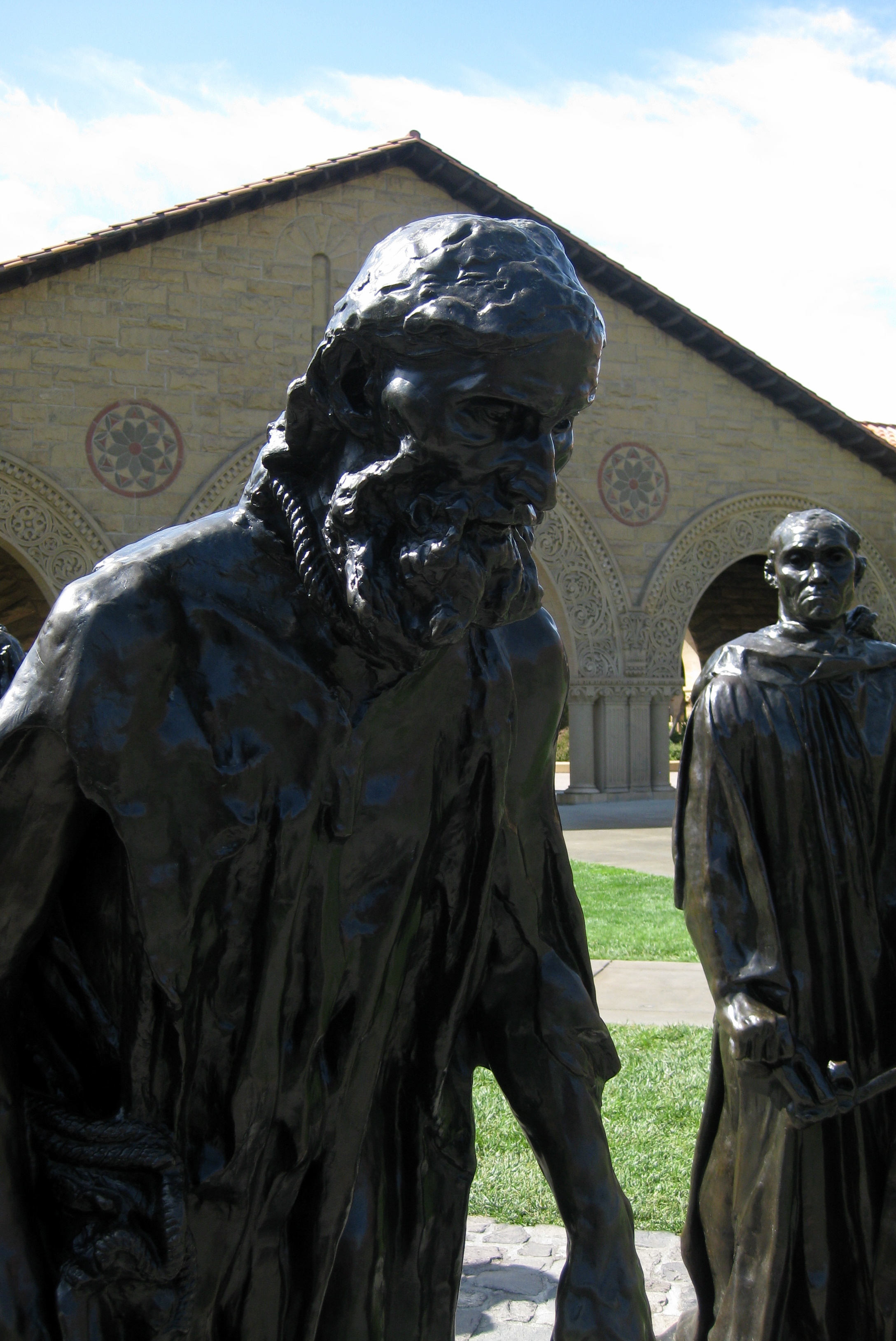
Image by wallyg
Les Bourgeois de Calais (The Burghers of Calais) is one of the most famous sculptures by Auguste Rodin. It serves as a monument to the heroism of six burghers in Calais during a siege by the England in the Hundred Years’ War in 1347.
After a victory in the Battle of Crécy, England’s King Edward III besieged Calais, an important French port on the English channel, and Philip VI of France ordered the city to hold out at all costs. Which it did for a over a year. Philip failed to lift the siege and starvation eventually forced the city to parlay for surrender. Edward offered to spare the people of the Calais if any six of its top leaders would surrender themselves. Edward demanded that they walk out almost naked, wearing nooses around their necks and carrying the keys to the city and castle. One of the wealthiest of the town leaders, Eustache de Saint Pierre, volunteered first and five other burghers–Jean d’Aire, Jacques and Pierre de Wissant, Jean de Fiennes, Andrieu d’Andres–soon followed suit. Though the burghers expected to be executed, their lives were spared by the intervention of England’s Queen, Philippa of Hainault, who persuaded her husband by saying it would be a bad omen for her unborn child. Rodin depicts a larger than life Saint Pierre leading the envoy of emaciated volunteers to the city gates, prepared to meet their imminent mortality.
The monument was initially proposed by Omer Dewavrin, mayor of Calais, for the town’s square in 1884. Unusual in that monuments were usually reserved for victories, the town of Calais had long desired to recognize the sacrifices made by these altruistic men. Rodin’s controversial design echoed this intent–the burghers are not presented in a heroic manner, but sullen and worn. His innovative design initially presented the burghers at the same level as the viewers, rather than on a traditional pedestal, although until 1924 the city, against Rodin’s wishes, displayed it on an elevated base.
The original statue still stands in Calais. Other casts stand around the world–the Victoria Tower Gardens, in the shadow of the Houses of Parliament in London; the Israel Museum in Jerusalem, the Rodin Museum in Philadelphia, the Metropolitan Museum of Art in New York City, the Brooklyn Museum in New York City, Musée Rodin in Paris, the National Museum of Western Art in Tokyo, the Rodin Gallery in Seoul, and Glyptoteket in Copenhagen, to name a few. Some installations have the figures tightly grouped with contiguous bases, while others have the figures separated. Some installations are elevated on pedestals, others are placed at ground level. This bronze cast, at Stanford University’s Iris & B. Gerald Cantor Center for Visual Arts, consists of six separate pieces which are slightly sunken, concealing the bottom few inches of the bases, and spaced such that viewers can walk between the figures. The museum claims this is how Rodin wished them to be displayed.
A few nice visual art images I found:
Medieval Art and Architecture
Image by tonynetone
Middle Ages works of considerable artistic interest, literature, art paintings and art sculptures were more realistic Manuscript of Painting production during the medieval period represented by the works of art to promote the study of the visual arts.
Bring into a different organized body of people under the fall of the Roman Empire learn the techniques used by medieval painters the Byzantine,that problem solved in order to develop skill or understanding were generally somewhat muted.Irish monks established early-medieval art in the mid-8th century,illuminated manuscripts like the Book surviving product of these monks,growing appetite for medieval art as illuminated miniature paintings,Journal’s enthusiasm for articles about the middle ages, recreation of this art work processions.The Byzantine Empire produced much of the finest art of the Middle Ages,a rich culture and produced many advances in art, from across the Empire, finest collection of medieval textile,artistic ideas were transmitted from one region to another to developed using calligraphy and designs, of decorative arts,works have been identified and characteristic of the medieval period.
Combinatul Fondului Plastic: statui in detentie?/ Romanian Plastic Artists Association Company: decay

Image by cod_gabriel
In the communist past, the Romanian Plastic Artists Association used to own a large company for manufacturing special paints and other substances needed for painting, woodwork, a bronze foundry, handicraft, etc. Their work used to be in high demand, especially the handicraft.
Also, their most important customer used to be the Communist Party – much of their propaganda material (such as banners) used to be manufactured here, along with paintings of the beloved leaders, as well as statues glorifying communism.
The company still exists, but it hurts to look at what’s left of it. It’s too bad that the demand for plastic arts vanished along with the communists.
DSC_7903

Image by asterix611
METROPOLITAN MUSEUM OF ART – 53rd St. Manhattan NYC
A few nice visual art images I found:
Raffles City Shopping Centre
Image by chooyutshing
This display are at Raffles City, outdoor area. The theme of this arts display is "What do you want to be, Strange.R?".
itunes art visual music 08

Image by TheAlieness GiselaGiardino²³
itunes art visual music 06

Image by TheAlieness GiselaGiardino²³
Some cool visual art images:
004

Image by asterix611
SPAIN ART FEST ’10 / Spain Culture New York – Times Square, Manhattan NYC – 10/06/10
012

Image by asterix611
SPAIN ART FEST ’10 / Spain Culture New York – Times Square, Manhattan NYC – 10/06/10
007

Image by asterix611
SPAIN ART FEST ’10 / Spain Culture New York – Times Square, Manhattan NYC – 10/06/10
A few nice visual art images I found:
DSC_5961

Image by asterix611
Public Art: Molly Dilworth’s "Cool Water, Hot Island" 2010 – Times Square, Manhattan NYC, – 07/28/10
DSC_6202

Image by asterix611
Public Art: Molly Dilworth’s "Cool Water, Hot Island" 2010 – Times Square, Manhattan NYC, – 07/28/10
DSC_6178

Image by asterix611
Public Art: Molly Dilworth’s "Cool Water, Hot Island" 2010 – Times Square, Manhattan NYC, – 07/28/10

