RSS
 

Archive for the ‘Creativity’ Category

21 Retro Travel Posters Feature Fantasy & Sci-Fi Destinations

25 Dec

[ By WebUrbanist in Technology & Vintage & Retro. ]

Ever wanted to be the next companion of Doctor Who, wished you could ride along on the Firefly-class Serenity, or wondered what it would be like to cruise the galaxy with the rebels (or imperial fleet) of Star Wars? Created to look like vintage travel posters, these faux advertisements give a new spin to science-fictional and other fantastical worlds.

Steve Thomas is working on selling posters, but for now has a galactic travel calender you can buy. His Star Wars series features such dubious destinations as Mos Eisley and the Swamps of Degobah, and offers transit via imperial shuttles, star destroyers or for the more adventurous: Jawa sandcrawlers, rebel escape ships and the Millennium Falcon.

Adam Levermore was “commissioned me to create a series of travel posters for Joss Whedon’s film, Serenity [and designed] these as WPA-style travel posters for the planets and locations from the movie. They were a huge success, and remain one of Quantum Mechanix’s top sellers. The highest praise came from Whedon himself, when he posted on the Whedonesque blog, calling the posters “extremely cool” and “masterfully designed.”

Next Page: 21 Retro Travel Posters Feature Fantasy Sci Fi Destinations

Share on Facebook


Next Page: 21 Retro Travel Posters Feature Fantasy Sci Fi Destinations

[ By WebUrbanist in Technology & Vintage & Retro. ]

[ WebUrbanist | Archives | Galleries | Privacy | TOS ]


WebUrbanist

 
Comments Off on 21 Retro Travel Posters Feature Fantasy & Sci-Fi Destinations

Posted in Creativity


Architecture for the Apocalypse: NYC as a Heritage Site

25 Dec

[ By Steph in Architecture & Cities & Urbanism. ]

NYC Heritage site 1

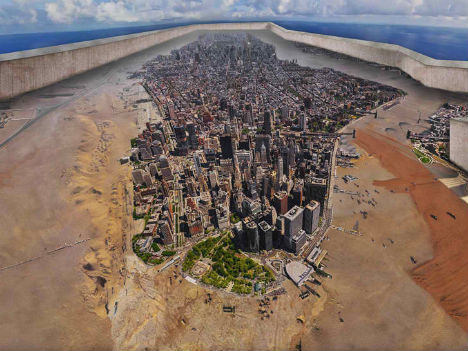
New York City is one of America’s greatest man-made achievements, but how can we protect and preserve it for future generations with inevitably rising seas and increasingly frequent weather catastrophes? A trio of designers has proposed a surprising solution: building up an earth barrier around the entire island and surrounding it with a concrete wall, turning it into a heritage site that could either remain a vibrant center of humanity, or turn into tomorrow’s Pompeii.

NYC Heritage site 2

The proposal, by designers Enrico Pieraccioli and Claudio Granato of Italy, won second prize in the New York CityVision competition. The contest invited designers to imagine New York in the future as the city itself and its inhabitants are affected by “space and time.”

NYC Heritage site 3

Rather than modifying it with elevated streets and walkways, lifting the inhabitable parts of the city well above the area that is currently vulnerable to rising seas, the heritage site concept preserves it exactly as it is, frozen in the time before potential climate calamity.

NYC Heritage site 4

NYC Heritage site 5

“Following this, New York is an open monument, global urbanism paradigm of the twentieth century, urban assemblage of events and phenomena, so it must be preserved. Crib of the whims of man, of consumerism and entertainment, it cannot be erased and forgotten, but is stored as a chip in our DNA. A document on how we were. Atlas of civilization and of archaeological as Pompeii and Herculaneum were examples of civilization of a people.”

Share on Facebook


[ By Steph in Architecture & Cities & Urbanism. ]

[ WebUrbanist | Archives | Galleries | Privacy | TOS ]


WebUrbanist

 
Comments Off on Architecture for the Apocalypse: NYC as a Heritage Site

Posted in Creativity


Only in Japan : 13 Odd Houses by Suppose Design Office

24 Dec

[ By Steph in Architecture & Houses & Residential. ]

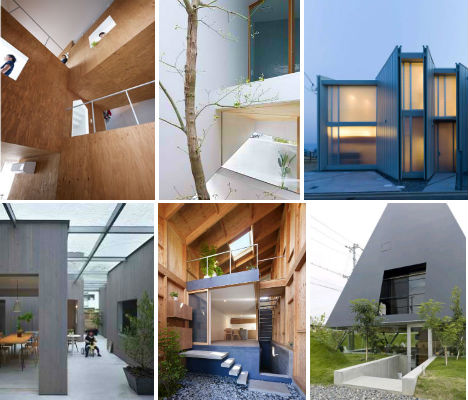
Houses that look like little more than concrete or steel boxes from the outside offer exceptionally creative, efficient and welcoming interiors conceived by Japan’s Suppose Design Office. The architecture firm has mastered the art of turning tight lots into spacious multi-level homes, and bringing the outdoors in with day-lit courtyards and gardens flourishing under transparent roofs and skylights.

Courtyard Home Inspired by Child’s Play

A series of disconnected structures are enclosed within a glass shell in this beautiful Buzen home, creating the feel of a private neighborhood where children can safely play. Each individual room feels like its own house, with the day-lit hallways as streets.

Passive Solar House with Glass Walls

This ultramodern home in Otake is built to capture the optimal amount of sunlight each day for natural light, natural ventilation and temperature control. This passive solar design works with nature to cut heating, cooling and lighting costs.

Courtyards Between Each Room in Obama

Located in Obama City, this house looks from the outside as if it might be dark and industrial inside; the geometric white shape doesn’t have a single exterior window. Yet, step inside and you’ll find a bright and open space lined with warm wood. The interior of the home is divided with internal courtyards, many of which are illuminated with large skylights.

House in Seya Brings the Outdoors In


Copious amounts of wood, living trees and stones give the House in Seya the feel of an indoor garden. A pebbled interior courtyard leads to the living areas of the home, which is enveloped in a towering wooden frame that makes it feel much larger than it actually is.

Half-Tent House in Kodaira

Located in a residential area of Tokyo, this home features a garden that is cordoned off from the street by a large tent-like addition. The tent functions as a roof, wall and fence, making this outdoor area more private. Large sliding glass doors give the garden the feel of an indoor/outdoor extension of the house.

White Room Filled with Plywood Boxes

Making homes on small lots feel more spacious is Suppose Design Office’s specialty. This home outside Hiroshima is a great example. The interior of the main white volume of the home is filled with plywood ‘boxes’ that cordon off various rooms, creating three levels. The rooms have windows that open to the main ‘atrium’ living area.

Concrete House in Koamicho

Situated on a long, narrow plot in Koamicho, this two-story concrete home is built around interior courtyards that are glassed-in on each side for maximum daylighting. “In a long, narrow space, we constructed walls, and by laying out a space in which we experience many rooms, we turn ‘narrowness’ into ‘openness’,” say the architects. “Further, taking rooms and gardens as equivalent, we created spaces that are like exteriors, calling them ‘garden rooms.’”

Monolithic Triangular In-Ground Home

Dark and dramatic, this structure looks more like a monument than a private residence. The triangular-shaped dwelling sits atop a first floor that has been covered in earth on all sides for privacy and temperature control. As modern as it may look, the home was inspired by traditional ‘pit houses’ of Japan, which have been in use for nearly 2,000 years.

Minimalist Home with House-Shaped Windows

A nod to more conventional home shapes can be seen in the windows of this large, rectilinear house on the beach. Suppose Design gave the home a fluid, changeable layout inside that’s free of the constraints of most residences, using floating wood platforms and mobile wood-and-glass partitions.

Innovative Raised-Corner House

It looks as if some giant came along, lifted the corner of this house and slid a concrete wall beneath it. It’s an extremely unconventional and creative solution to letting daylight into a home while maintaining optimal privacy for its inhabitants. This raised corner also creates a private courtyard – one of three offering bright and airy spaces shielded from the street.

House in Ekoda with Rooftop Conservatory

A three-story house in Ekoda, Tokyo, has been renovated to create six apartments – and, most notably, to include an incredible bathroom in the rooftop conservatory. The ceilings inside were removed to expose the bare steel frame of the building, and new rooms were created from pale wood.

House in Matsuyama Has Views from Every Room

Every single room in this Matsuyama home has a view of the sureounding scenery thanks to large glass walls. “By spacing out structurally necessary walls we’ve created a design where a good view can be had from anywhere, but that still possess earthquake resistant elements. This also allows for larger openings, which were difficult with wood fram ehouses.”

Commanding Views at the House in Fukuyama

Built into a hillside beneath a road, House in Fukuyama is almost entirely open to views of the city on one side, with the rest of the home shielded from the eyes of neighbors. The roof of the home is level with the street, requiring visitors to descend into its interior via cantilevered stairs.


Share on Facebook


[ By Steph in Architecture & Houses & Residential. ]

[ WebUrbanist | Archives | Galleries | Privacy | TOS ]


WebUrbanist

 
Comments Off on Only in Japan : 13 Odd Houses by Suppose Design Office

Posted in Creativity


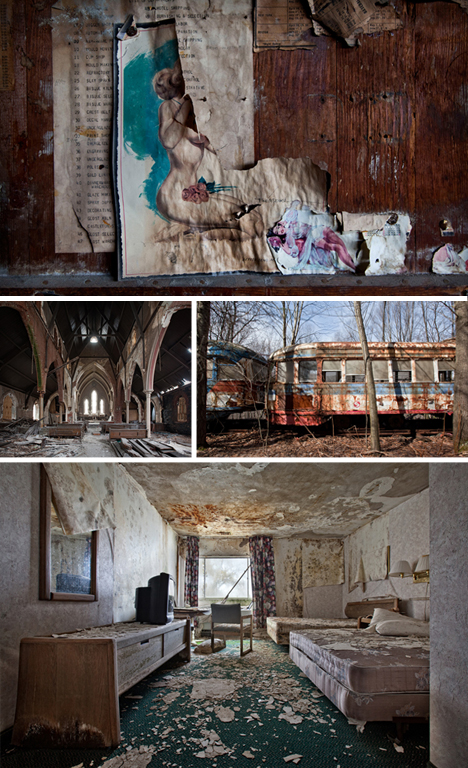
Matthew Christopher: Photographer of Abandoned Places

24 Dec

[ By WebUrbanist in Abandoned Places & Architecture. ]

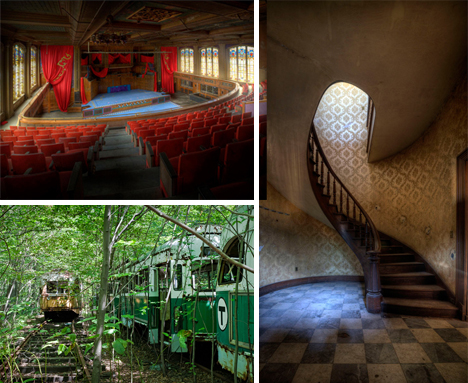
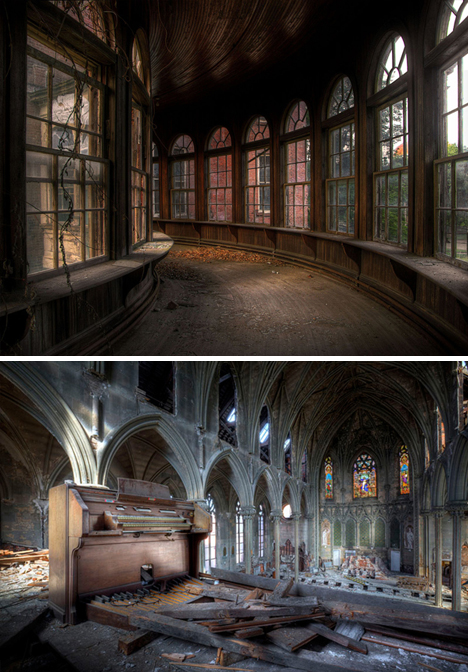
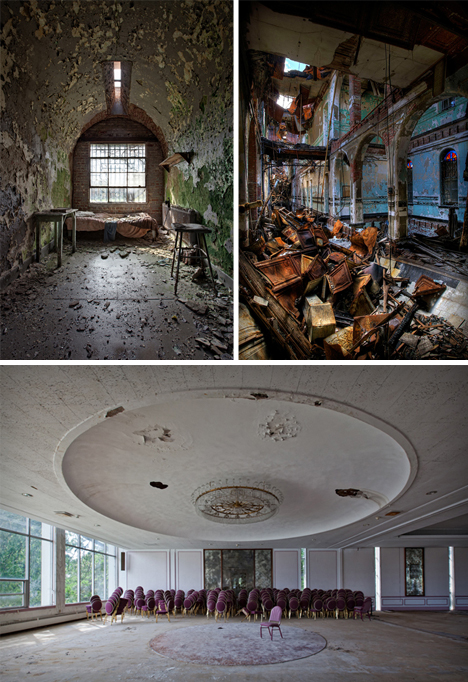
Some of the locations have storied histories, and others remain a mystery – photo shoots of spaces that must remain off the map to avoid disturbing delicate or dangerous ruins, or trespassing on private property.

Matthew Christopher has taken pictures of it all, from prisons and hospitals to churches with basement meth labs to deserted transportation infrastructure and now-demolished architecture. When he got in touch with WebUrbanist, a balance had to be struck between secrecy and revelation.

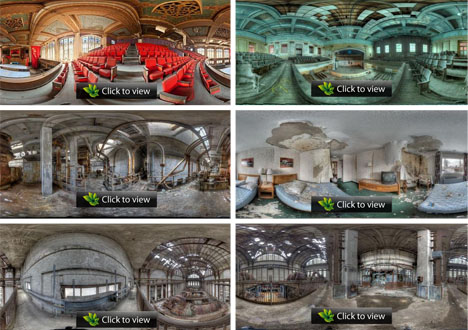
But beyond simple still images, he has escalated his photography to fully-interactive, (click here to see them embedded on his website:) three-dimensional online panoramas – these compelling variants are part film, part photo, and provide an really impressive sense of spatial immersion (hint: be sure to go full-screen for the full effect – these are high-resolution!).

Some of these places are in the middle of preservation battles as well, their futures as uncertain as their histories. A few are publicly known, leaving Matthew able to discuss them, like this prison and this state hospital. He also has both prints and books available at this store on his website.

Share on Facebook


[ By WebUrbanist in Abandoned Places & Architecture. ]

[ WebUrbanist | Archives | Galleries | Privacy | TOS ]


WebUrbanist

 
Comments Off on Matthew Christopher: Photographer of Abandoned Places

Posted in Creativity


Creative Fuel: 12 Appealingly Painted Oil Storage Tanks

23 Dec

[ By Steve in Art & Street Art & Graffiti. ]


Most oil storage tank farms are big, bland and boring, classic examples of form following function with the occasional company logo affixed to break up the visual monotony. Most but not all: there are a few artistically painted and decorated oil tanks that stand out from the rest due to their pleasing paint jobs rendered on a very large scale. Here are a dozen of the best.

Portland’s Maine Attraction

(images via: Portland Phoenix, PR Maine, Mainebiz and Mayo Street Arts)

When the Maine Center for Creativity launched the Art All Around public art project in the spring of 2010, they decided to think big and there are few canvasses bigger than the blank outer walls of oil storage tanks. Venezuela-born and London-based artist Jaime Gili was commissioned to kick off the project by decorating oil tanks at the Sprague Energy tank farm near the Portland International Jetport.

(image via: Boating Local)

When the plan was conceived, the question of how many tanks to paint was dependent on how much funding could be raised. “We know we’re going to do one,” stated Jean Maginnis, the Portland-based center’s founder and executive director. “We hope to do as many as three more.” In the event, a full 16 tanks ended up getting an extreme yet appealing makeover!

Store My Beer, Y’all

(image via: JJFlash229)

On a slightly smaller scale are these oil storage tanks painted to look like jumbo Budweiser and Bud Light cans located on SR 37 between Mcconnelsville and Crooksville, Ohio. At least they’re supposed to be oil tanks… what else could they hold?

Oh The Huge Manatees!

(images via: Roger4336 and The Sparky Chronicle)

Arriving and departing cruise ship passengers get the best view of the amazing manatees mural painted on a Citgo fuel storage tank adjacent to the Port of Tampa’s Garrison Channel. You can’t say it doesn’t brighten up the otherwise dreary gray overtone of this mainly industrial area.

(image via: Fifth World Art)

Dolphins and sea turtles accompany the manatees on this beautiful mural. Hopefully the tank never ruptures… considering its precarious location, the local dolphins, sea turtles and manatees would be rather less appreciative of the artwork depicting them.

Philadelphia On A Half-Tank

(images via: Paul Santoleri, LesMarCyd and LibbyRosof)

Old and busted: Venus on the half-shell. New hotness: Philadelphia on the Half-Tank! In 1999, the City of Philadelphia Mural Arts Program asked artist Paul Santoleri to express his vision of the city on an otherwise unremarkable oil tank located at Penrose Avenue and Platt Bridge. Santoleri’s whimsical look at a busy, lively Philadelphia occupies one side of the tank easily visible to anyone driving from the airport to downtown.

The REALLY Great Pumpkin

(images via: SkyscraperPage)

If you thought painting oil storage tanks was a recent trend, think again. The enormous jack-o’-lantern above was a regular fixture of Los Angeles’ Wilmington neighborhood from the early 1950s. Though it seems wasteful to paint an entire oil tank for just one day, things aren’t quite as they seem: the tank belonged to Union Oil whose main corporate color was orange.

(image via: eBay/237)

An 80,000-barrel oil storage tank certainly stands out in the middle of a tank farm, especially when it’s done up pumpkin-style and illuminated with spotlights. Union Oil wasn’t shy about plugging their community spirit either, as the 1962 advertising poster depicting the tank above perfectly illustrates.

(images via: USC Libraries, Yesteryear Remembered and Foxtongue)

Now owned by ConocoPhillips, the tank is ideally viewed from the 110 Harbor Freeway near Wilmington. Stop by for trick-or-treat on the 31st and you’ll actually get some treats.

Rust Never Sleeps

(image via: Kevin Raber)

Why paint oil storage tanks? They’re made of metal and spend their lifetimes outside, season in and season out without any other covering beside their paint jobs, that’s why. Getting artistic is the tank owner’s prerogative but the alternative is downright ugly – unless it’s creatively photographed, of course.

Whale Meat Again

(images via: Bimikyusin)

This fish oil tank painted up to look like a can of whale meat must have been quite a site to see… unless you’re a member of Greenpeace, that is. The 10.8m (35.4ft) tall and 8.5m (27.9ft) diameter tank was originally built in 1975 by Kinoya Ishinomaki Suisan, a seafood canning company from northeastern Japan. It received its garish paint job in 2006 when the company was looking for a way to promote its canned whale meat.

(images via: House Of Japan and Fuyuto)

The devastating Great East Japan Earthquake and tsunami of March 11th, 2011 hit the town of Ishinomaki hard and the oil storage tank even harder: it was toppled and swept 300 meters (985ft) from its original location. These images are the only records remaining of the tank; it was dismantled out of consideration for the feelings of local survivors of the disaster.

Grand Old Flag City

(images via: Trustypics)

Tanks for visiting Flag City, USA, otherwise known as Findlay, Ohio. This former 19th-century oil boomtown (yes, oil, in northwestern Ohio) still displays vestiges of its petroleum infrastructure with this patriotically painted oil storage tank sitting alongside Interstate 75 showing off Findlay’s fame for flags and fuel to best advantage.

Boston Gas’s Rainbow Swash

(images via: J. H. Kostro & Associates, KatieHodge/Get It Scrapped! and Elizabeth Thomsen)

In 1971, Sister Mary Corita Kent was asked by the Boston Gas Company to paint one of the 150-foot (46 m) tall LNG storage tanks located on the Dorchester waterfront. The so-called “Rainbow Swash” tank was torn down in 1992 but by that time it had become a well-known, much loved Boston Landmark and Kent’s design was re-painted on an identical tank standing beside the old one.

(images via: Me_Ram and Aesthetic Grounds)

Although Kent, who passed away in 1986, was an acclaimed artist at the time the tank was painted (she also designed the USPS’s “LOVE” stamp), she was also an avowed anti-war activist. More than a few people stated they could see a profile of North Vietnamese leader Ho Chi Minh in the tank’s blue stripe though Kent never admitted any intention to do so. Interestingly, the blue slash’s “nose” was rounded slightly when new owner National Grid re-painted the tank in order to reduce any perceived similarity.

Slam Dunk!

(images via: Silly America and Roadside America)

You can’t say America’s oil and gas refiners aren’t good sports, not when one of their spherical oil tanks has been painted in an athletics motif for 40 years! The tank located at the Marathon Oil refinery alongside Interstate 75 in south Detroit started off as a giant baseball to celebrate the success of the MLB Detroit Tigers. In 2004 it changed its look to honor the NBA Detroit Pistons on one side and the WNBA Detroit Shock on the other.

Oil Hail The King

(images via: Philadelphia Citypaper and Google Maps)

Petty’s Island is located in the middle of Delaware River between between Pennsylvania and New Jersey, though it’s officially part of the latter. The 400-acre island also happens to be owned by the Citgo Petroleum Corporation, a subsidiary of Petróleos de Venezuela S.A., which happens to be owned by Hugo Chavez. What could possibly go wrong?

(image via: Back To Philaplace)

In April of 2009, Chavez blew a chance to be even more of a thorn in the American government’s side when he generously donated Petty’s Island to New Jersey provided it be used only “for environmental developments.” Amidst the wrangling between developers and environmentalists, New York-based guerilla artist Duke Riley scaled one of the Citgo fuel storage tanks and painted a mural of little-known legend Ralston Laird, who moved to the island in 1851 as a paid land manager. in his nearly 60 years on the island, Laird raised 10 children, proclaimed himself its King, and seems to have achieved fame as sort of an east coast Emperor Norton. As for Riley’s tank-top mural, it’s visible from space and made it onto Google Maps.

Send In The Tanks

(images via: Richard Messenger)

These two oil storage tanks displaying the visages of Syria’s late leader Hafez Assad and his two sons stand silently in the desert about 100km (60 miles) from the Iraqi border. How long they stand there is anyone’s guess, being that current president of Syria Bashar Al-Assad can be said to have a target on his back. These tanks present a pair of targets that would be very hard for anyone to miss.


(image via: Saatchi Online)

One can debate the pros and cons of artistically painting oil storage tanks without any resolution being achieved – as always, art is subjective and what’s beheld to be beautiful is purely in the eye of the beholder. As such, even functional tank painting has the power to please when photographically interpreted by someone skilled with a lens and light meter. Tanks… you’re welcome.

Share on Facebook


[ By Steve in Art & Street Art & Graffiti. ]

[ WebUrbanist | Archives | Galleries | Privacy | TOS ]


WebUrbanist

 
Comments Off on Creative Fuel: 12 Appealingly Painted Oil Storage Tanks

Posted in Creativity


Don’t Trip: 4 Dizzying Rooms by 1 Surrealist Spatial Artist

22 Dec

[ By WebUrbanist in Art & Installation & Sound. ]

Like some kind of strange spatial magician, Kyung Woo Han turns conventional furniture, fixtures, doors and windows into otherworldly scenes that call into question just how familiar we really are with such everyday objects.

Consider White Window, a deformed frame that pulls in from the edges, but when viewed through a fish-eye surveillance camera (also part of the installation) is corrected to look like the only straight-lined design in the space.

In Green House, a room is half-filled with faux water while suspended shapes of partial furniture float at eye level, appearing to be reflected at the point where surface meets air.

Other projects like Found House and Checkered Floor take normal objects, textures and materials out of context and distort them, making simple black-and-white patterns and portals between inside and outside seem strange aand surreal.


Want More? Click for Great Related Content on WebUrbanist:

Architecture Gone Wild: Surrealist Designs by Victor Enrich

Buildings split down the middle, sprout slides, bend over in strange ways and send stairs into the sky in these fantasy architectural designs by Victor Enrich.
1 Comment – Click Here to Read More
»»


101 Dizzying Spiral Staircases & Twisted Architectural Art Photos

These 101 dizzy spirals may make you smile or they may induce vertigo, but here are the most impressive, most dizzying, spiraling staircases in the world.

10 Comments – Click Here to Read More »»


Share on Facebook


[ By WebUrbanist in Art & Installation & Sound. ]

[ WebUrbanist | Archives | Galleries | Privacy | TOS ]


WebUrbanist

 
Comments Off on Don’t Trip: 4 Dizzying Rooms by 1 Surrealist Spatial Artist

Posted in Creativity


Pixelated and Underwater: Azuma Makoto’s Bonsai Art

21 Dec

[ By Steph in Art & Sculpture & Craft. ]

Bonsai trees are beautiful, but most require a very dedicated person to tend to their needs – unless they’re made of Legos. Artist Azuma Makoto has not only created a bonsai made of these distinctive colored blocks, but also a ‘water bonsai’ that seems to flourish despite being submerged in an aquarium.

With ‘Lego Pine’, Makoto manages to capture the shape of a bonsai tree with an incredibly intricate Lego sculpture. Makoto’s familiarity with bonsai is clear in this masterful reproduction, which features branches that seem impossibly thin and delicate.

‘Water and Bonsai’ is a fully glazed aquarium containing what appears, at first glance, to be a real bonsai tree. Look closer, however, and you’ll see that it’s a trunk-shaped piece of deadwood with java moss attached to it to resemble leaves. The moss is kept alive with a filtration system and LED lights.

Makoto is known for stunning botanical sculptures that showcase the beauty and complexity of the plant world. He runs a high-fashion flower shop called JARDIN des FLEURS in Tokyo. See more of his works at his website, AzumaMakoto.com.


Want More? Click for Great Related Content on WebUrbanist:

Banzai! 32 Wildly-Shaped Trees And Bonsai Art

Some forms of sculpture take a bit more patience than others. Plant shaping and bonsai pruning are the perfect examples of natural art.
2 Comments – Click Here to Read More »»


Incredible Underwater Landscapes Made with Swirling Ink

Italian photographer Alberto Seveso captures incredible swirling landscapes with high-speed photography of underwater ink swirls.
1 Comment – Click Here to Read More
»»


Share on Facebook


[ By Steph in Art & Sculpture & Craft. ]

[ WebUrbanist | Archives | Galleries | Privacy | TOS ]


WebUrbanist

 
Comments Off on Pixelated and Underwater: Azuma Makoto’s Bonsai Art

Posted in Creativity


Shell-Shaped Shoffice: Backyard Shed/Office Combo

20 Dec

[ By Steph in Offices & Commercial. ]

Part backyard office, part storage space, part sculpture: the ‘Shoffice’ by Platform 5 Architects is a multi-functional pavilion that curls over itself like a shell. The architects created this unusual detached office structure for a residence in northwest London, and it fits neatly into a small walled garden space.

Two-thirds of the shed/office combo is enclosed for use as an office, while the other third is open to the elements. The open area provides a space to store gardening implements and other items that would normally be kept in a shed.

The wooden shell curves from one side of the office all the way under its floor, creating a terrace in front for lounging in the sun. The structure is made with two steel ring beams, timber ribs and a plywood skin, and was mostly prefabricated for ease of installation.

Glass walls on two sides provide both daylighting and a view straight into the home, providing a visual connection but maintaining the peace and privacy desired in a detached office or studio.

The ‘Shoffice’ is just one of many such backyard retreats. See 14 more outside offices including work pods, ‘eggs’, modular structures and more.


Want More? Click for Great Related Content on WebUrbanist:

Outside Offices: 14 Detached Work Pods, Eggs, Modules & More

These 14 modern detached offices and studios are compact, self-contained and easy to assemble, making them perfect for serene backyard work spaces.
7 Comments – Click Here to Read More »»


A Room for London: Cloud-Shaped Temporary Rooftop Hotel

Floating like a cloud between the ground and the sky, this ephemeral rooftop hotel was designed to perch atop the Queen Elizabeth Hall in London in 2012.
4 Comments – Click Here to Read More »»


Share on Facebook


[ By Steph in Offices & Commercial. ]

[ WebUrbanist | Archives | Galleries | Privacy | TOS ]


WebUrbanist

 
Comments Off on Shell-Shaped Shoffice: Backyard Shed/Office Combo

Posted in Creativity


DIY Civilization: 40-Part Post-Apocalypse Construction Kit

20 Dec

[ By WebUrbanist in Gadgets & Geekery & Technology. ]

Worried about the end of the world? A group of engineers has created a series of do-it-yourself machines for building (or reconstructing) society anywhere with access to light, water and soil.

At eight times cheaper than their retail counterparts, these forty gadgets by Open Source Ecology are a globally-accessible alternative for disaster preppers and engineering geeks alike.

Think of them like large-scale LEGOs – the fewest necessary interchangeable parts required to construct essential wells for habitation, basic agricultural equipment for food production, steam engines for energy, 3D scanners and printers for industry and more.

“Open Source Ecology is accelerating the growth of the next economy – the Open Source Economy – an economy that optimizes both production and distribution – while promoting environmental regeneration and social justice. We are building the Global Village Construction Set. This is a high-performance, modular, do-it-yourself, low-cost platform – that allows for the easy fabrication of the 50 different industrial machines that it takes – to build a small, sustainable civilization with modern comforts.”


Want More? Click for Great Related Content on WebUrbanist:

Free Universal Construction Kit Bridges Generations of Toys

LEGOs, Lincoln Logs, Tinker Toys … what do they have in common? They each represent a universe of constructive possibilities, but each is incompatible with the next …
Click Here to Read More »»


WikiHouse: Open-Source DIY Architecture You Can Build

Design, ‘print’ and assemble your own WikiHouse using free open-source software and a local CNC mill to cut the parts, even iwith no prior building experience.
1 Comment – Click Here to Read More
»»


Share on Facebook


[ By WebUrbanist in Gadgets & Geekery & Technology. ]

[ WebUrbanist | Archives | Galleries | Privacy | TOS ]


WebUrbanist

 
Comments Off on DIY Civilization: 40-Part Post-Apocalypse Construction Kit

Posted in Creativity


Roaringly Realistic Animal Chairs by Maximo Riera

19 Dec

[ By Steph in Design & Furniture & Decor. ]

Jet black and richly detailed, Maximo Riera’s sculptural Animal Chair collection consists of an octopus, a rhinoceros, a lion, a whale, a walrus and a beetle. Crafted into dramatic seating, the animals look as if they could spring to life at any moment. The project took Riera three years to complete, working with more than thirty professionals in four different countries.

The Animal Chair collection is inspired by our connection to and impact upon the natural world. These towering sculptures serve as a powerful reminder of some of the most awe-inspiring creatures on earth.

Carved from compressed foam, which is stabilized by an internal steel frame, each chair is enveloped in real leather. And while they might not be as heavy as their living counterparts, they’re not exactly portable: the elephant chair weighs 353 pounds.

Each chair is slightly asymmetrical and carefully balanced to maintain a sense of the proportions of the animal depicted, even though only parts of their bodies are represented.


Want More? Click for Great Related Content on WebUrbanist:

20 Comfy-to-Crazy Chairs and Chair Designs

Creative modern chairs and chair designs from strange seats and bizarre benches, from the fabulously modern to the flippantly unique and everything in between.
34 Comments – Click Here to Read More »»


Shock Value: Slightly Disturbing Ultra-Realistic Sculptures

Patricia Piccinini is an artist who likes to make people feel uncomfortable. Prepare to enter an intriguing world full of some incredibly realistic artistry.
2 Comments – Click Here to Read More »»


Share on Facebook


[ By Steph in Design & Furniture & Decor. ]

[ WebUrbanist | Archives | Galleries | Privacy | TOS ]


WebUrbanist

 
Comments Off on Roaringly Realistic Animal Chairs by Maximo Riera

Posted in Creativity