Category: Creativity

  • Cultural Center Carved Out of 42 Grain Silos in South Africa

    [ By WebUrbanist in Architecture & Public & Institutional. ]

    grain silo mega atrium

    An amazing hybrid of preservation and transformation, this project involves carving a series stunning spaces inside a huge series of concrete silos set alongside the waterfront of Cape Town. Once the tallest structure in the city, but abandoned since 1990, this converted complex will provide a home for 80 art galleries and create a hub for cultural activity.

    grain silos close up

    The spatial solution proposed by Thomas Heatherwick Studio involves scooping out huge voids within the existing industrial heritage site. This approach in turn exposes visitors to the tubular interiors of the silos via a newly-formed atrium while conserving much of the original building exterior. Meanwhile, below the surface, a series of re-purposed underground tunnels and storage spaces will provide additional access to the architectural history of the complex.

    grain silo atrium zoom copy

    The non-profit endeavor will exhibit contemporary African art via indoor galleries as well as a rooftop sculpture garden, bookstore, restaurant, bar and more. THS will be working on the Zeitz MoCAA (founded with the collection of entrepreneur Jochen Zeitz) with a series of local partners including Ven Der Merwe Miszewski (VDMMA), Rick Brown Associates (RBA) and Jacobs Parker.

    grain silos at night

    grain silo interior space

    In an interview with DesignBoom, he architect sough to ask and answer the critical quesiton: “How do you turn forty-two vertical concrete tubes into a place to experience contemporary culture? Our thoughts wrestled with the extraordinary physical facts of the building. There is no large open space within the densely packed tubes and it is not possible to experience these volumes from inside. Rather than strip out the evidence of the building’s industrial heritage, we wanted to find a way to enjoy and celebrate it. We could either fight a building made of concrete tubes or enjoy its tube-iness.”

    grain silos building section

    grain silo section zoom

    Of the project, David Green (CEO of the V&A Waterfront) said: “thomas heatherwick understood how to interpret the industrial narrative of the building, and this was the major breakthrough. His design respects the heritage of the building while bringing iconic design and purpose to the building.”

    grain silos south africa

    grain silo slice closeup

    Regarding the search for a perfect site, Jochen Zeitz explains that “for five years we investigated suitable sites across Africa. The V&A waterfront provided an iconic heritage building, situated in one of the most visited and iconic sites in [the country].” Meanwhile, all of the existing silos will be capped with glass to let in light and show off their shape from above.

    Share on Facebook


    [ By WebUrbanist in Architecture & Public & Institutional. ]

    [ WebUrbanist | Archives | Galleries | Privacy | TOS ]

    WebUrbanist

  • The Power of Paint: Mini Spruce-Ups Act as Advertisements

    [ By Steph in Design & Guerilla Ads & Marketing. ]

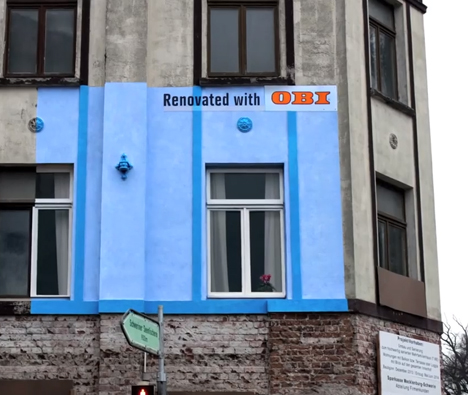
    OBI Billboard Creative Advertising 1

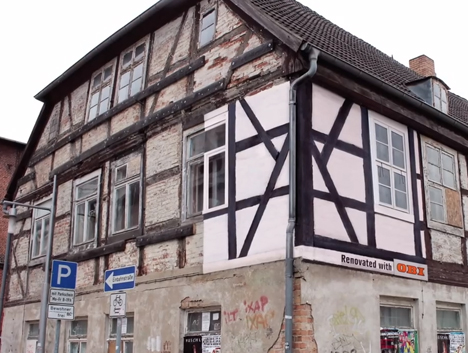
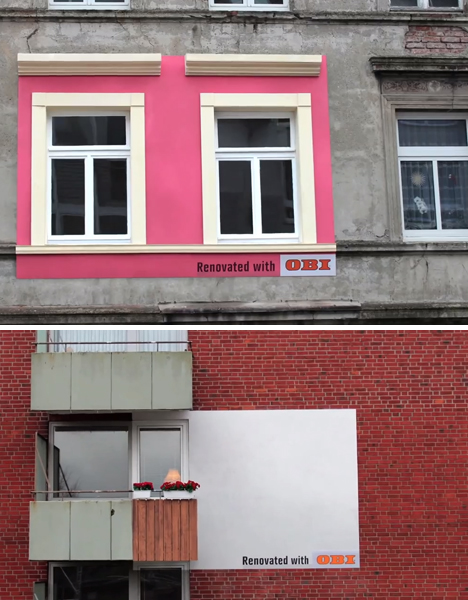
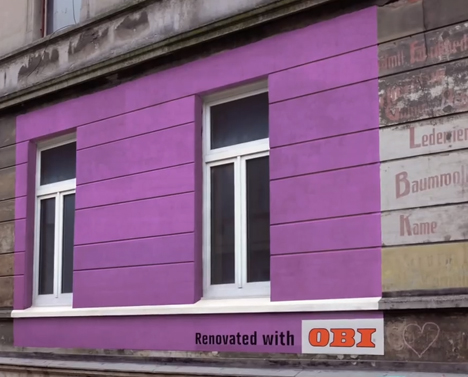
    Billboard-sized paint jobs on buildings that have seen better days give passersby a glimpse of how much fresher and brighter the structure could look with a little care – the ideal advertisement for paint company OBI. They may be promoting a product, but these miniature renovations get their message across by proving what the product can do rather than just plastering photos of it on ugly billboards.

    OBI Billboards Creative Advertising 3

    The campaign by Hamburg-based agency Jung Von Matt came about as a result of price wars between independent stores in Germany, causing a sudden increase in unsightly billboards all over the country. OBI, the largest DIY store in Germany, asked “Why do people advertise products that are supposed to make our homes look nicer using adverts that make everything look uglier?”

    OBI Billboards Creative Advertising 4

    It’s a refreshing twist on the usual public advertisement, using the old show-don’t-tell method. In some cases, just half a window is included in the re-paint, making it glaringly obvious how much newer and more cheerful the building would look if the whole thing received the same treatment.

    OBI Billboards Creative Advertising 2

    These days, as we collectively develop blinders that make conventional ads in public spaces virtually invisible, marketers have to get a lot more creative to be noticed. Check out 300+ shocking, brilliant and unmissable ad campaigns that force us to sit up and pay attention.

    Share on Facebook


    [ By Steph in Design & Guerilla Ads & Marketing. ]

    [ WebUrbanist | Archives | Galleries | Privacy | TOS ]

    WebUrbanist

  • Hack Your City: 12 Creative DIY Urbanism Interventions

    [ By Steph in Art & Installation & Sound. ]

    DIY Urbanism Main

    If city officials won’t do their part to make public spaces more fun, efficient, useful, comfortable and creative, citizens will take matters into their own hands. DIY urbanism, or ‘hacktivism,’ is the practice of altering urban environments in ways that aren’t officially sanctioned, whether by turning vacant lots into temporary playgrounds, adding swings to bridges, seed-bombing neglected city spaces or knitting giant hats for bus stop shelters.

    City Swings

    DIY Urbanism City Swings 2

    DIY Urbanism City Swings

    The spaces under piers, beside bridges and beneath industrial remains are transformed into instant playgrounds with surreptitiously installed swings funded by The Awesome Foundation for the Arts and Sciences. The Los Angeles chapter of the group awarded its $ 1,000 2011 grant to artist Jeff Waldman, who chose underutilized spots around the city to install temporary swings. A similar project hung spill swings from the handrails on San Francisco’s BART public transit system, while the more complex 21 Swings project in Montreal coordinated the urban swings with music for an interactive experiment.

    DIY Urban Furniture

    DIY Urbanism Furniture Stair Square

    DIY Urbanism Furniture Sign Chair

    DIY Urbanism Furniture City Living Room

    If there aren’t comfortable places to sit and hang out in urban locales, perhaps the people should just create them, whether they turn scaffolding into instant hangouts with bracket-equipped furniture or bring specially made tables that fit perfectly onto public steps. Some temporary installations have gone so far as to create entire urban living rooms complete with couches, bookshelves and coffee tables that invite passersby to take a seat, relax, get to know each other better and enjoy impromptu musical performances. One particularly creative guerrilla seat design is simply a piece of plywood printed with an icon of a chair that attaches quickly and easily to street signs and can be folded up when not in use.

    Vacant Lot Playgrounds & Hangouts

    DIY Urbanism Vacant Lot Mini Golf

    It’s incredibly frustrating when your neighborhood lacks a decent playground or public recreation space, yet multiple vacant lots surrounded by razor wire-topped fences waste away for years on end. Why should such spaces be closed off to the public when they’re not in use? Many DIY urbanism projects focus on reclaiming these spaces with non-permanent setups for community gardens, swing sets and even mini golf. Repurposing vacant lots maintains a sense of vitality and egalitarianism in the community, especially during times of economic sluggishness when planned construction projects are indefinitely delayed.

    Yarn Bombing

    DIY Urbanism Yarnbombing

    Who wouldn’t smile at custom-crocheted sweaters for trees, phone booths and bicycles? Yarn bombing is the practice of adding knitted and crocheted additions to all sorts of public objects, just for the fun of it. Bus stops are given giant winter hats, bus seats get a lot cozier and stop signs suddenly become red flowers with the addition of green leaves and a ‘stem.’

    Next Page – Click Below to Read More:
    City Hacktivism 12 Fun Diy Urbanism Interventions

    Share on Facebook


    [ By Steph in Art & Installation & Sound. ]

    [ WebUrbanist | Archives | Galleries | Privacy | TOS ]

    WebUrbanist

  • Submarine Suite: Private Luxury in Submersible Yacht Hotel

    [ By WebUrbanist in Boutique & Art Hotels & Global. ]

    luxury underwater hotel

    Nemo and his companions on the Nautilus would find themselves quite at home in this self-contained underwater retreat, complete with wraparound views and dupped Lovers Deep.

    luxury above the water

    A project of Oliver’s Travels, the vessel can help the rich and famous sneak away from prying eyes, submerging itself then depositing its passengers on a remote romantic island, or simply treating its hidden guests to secret seafood dinners under the sea.

    luxury submarine retreat underwater

    luxury hotel deep ocean

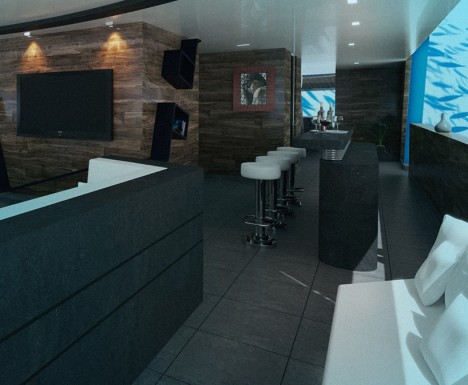
    The interior features a full kitchen, bar and living spaces with long horizontal windows to take in the scenery and wildlife. Chefs and concierges, located on the upper level but available on demand, can be provided as well to help customize the experience.

    luxury submersible living room

    luxury suite bathroom hall

    However, unless you, like the eccentric protagonist of 20,000 Leagues Under the Sea, can offset the cost of your voyage via hidden stashes of wealth, you may have a hard time paying the $ 100,000+ per-night price tag this vessel demands.

    Share on Facebook


    [ By WebUrbanist in Boutique & Art Hotels & Global. ]

    [ WebUrbanist | Archives | Galleries | Privacy | TOS ]

    WebUrbanist

  • Rooms on Wheels: Mobile Kitchen, Bedroom & Office Spaces

    [ By WebUrbanist in Design & Furniture & Decor. ]

    compact modular rooms spaces

    A step beyond flip-down beds and foldaway furniture, this series of modular rooms packs whole kitchens, bedrooms and offices into a highly portable form, so much so that they be bought online at stores like Amazon Japan and shipped right to your door.

    compact kitchen in box

    Consider the possibilities, too, for on-demand residential conversions: with these you can make anything, from a cargo container to an old warehouse, into an instant apartment.

    compact office close up

    Set on wheels and made narrow when closed, each room-in-a-box can be rolled easily through opening and navigate narrow corridors to arrive at its destination.

    compact fold out bedroom

    compact modular bedroom

    The bedroom unit is the largest – it uses central breakpoints to allow overhead lighting as well as the bed and its supports below to collapse in half then fold up or down into empty spaces in the shell.

    compact fold out office

    The mid-sized office features interlocking solids and voids to maximize shelving and storage when open. Meanwhile, the wheeled chair below detaches from the primary structure on demand.

    compact fold out kitchen

    The small kitchen flips up and out to reveal a sink, work surface and hot plate at hip height with space for storage and refrigeration below.

    modular moveable rooms boxes

    Square footage is a serious commodity in cities like Tokyo and Kyoto, making the four-figure price tag for these units from Atelier OPA (dubbed Kenchikukagu) also a lot more palatable in the right urban context.

    Share on Facebook


    [ By WebUrbanist in Design & Furniture & Decor. ]

    [ WebUrbanist | Archives | Galleries | Privacy | TOS ]


    WebUrbanist

  • Archist City: Iconic Modern Art Reimagined as Architecture

    [ By Steph in Art & Drawing & Digital. ]

    Archist Art as Architecture 1

    Works from 27 iconic modern artists are translated into architecture to make up one of the most colorful fictional cities every imagined. You can almost envision ‘Archist‘ coming to life in a real city like Amsterdam or Barcelona, with a collection of structures bringing the aesthetics of Mondrian, Andy Warhol, Salvador Dali and Ray Lichtenstein to their largest-ever scale.

    Archist Art as Architecture 2

    The illustration series by architect and artist Federico Babina produces surprisingly realistic yet, in many cases, instantly recognizable building designs representing each artist’s body of work.

    Archist Art as Architecture 4

    Archist Art as Architecture 3

    Some of these artists already produce works that are architectural in nature, such as Anish Kapoor’s undulating sculptural installations and the massive crochet playscapes of Ernesto Neto. Others, like the geometric works of Anne Truitt and Frank Stella, easily translate to the three-dimensional, oversized medium of building materials.

    Archist Art as Architecture 6

    Archist Art as Architecture 7

    But for the artists working in a more figurative style, Babina had to get a little more creative. The Lichtenstein is especially notable, looking almost like an appropriately Picasso-ized jumble of skin, hair, lips, teeth and clothing.

    Share on Facebook


    [ By Steph in Art & Drawing & Digital. ]

    [ WebUrbanist | Archives | Galleries | Privacy | TOS ]


    WebUrbanist

  • Drowned Towns: 10 Underwater Ghost Cities & Buildings

    [ By Steph in Global & Travel & Places. ]

    Drowned Towns Main

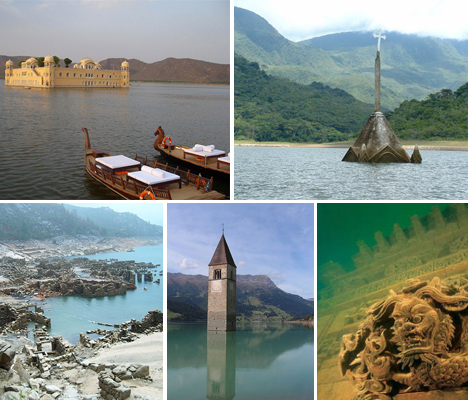
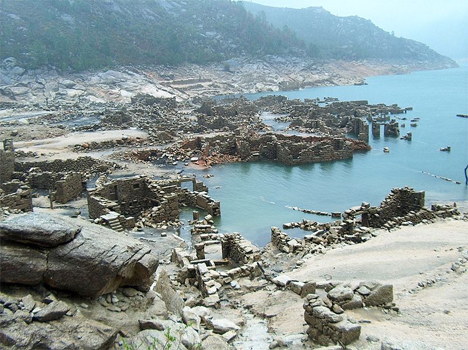
    Mildewed crosses, lonely spires, barely-visible stone foundations and rusting bed frames are all that’s left to show for these 10 intentionally submerged towns and structures from India to Massachusetts. When additional water and power is needed to provide for growing populations, small villages often have to be sacrificed, and while some were demolished before their remains were flooded, others can still be seen as ghostly visions wavering beneath the surface.

    Potosi, Venezuela

    Drowned Towns Potosi 1

    Drowned Towns Potosi 2

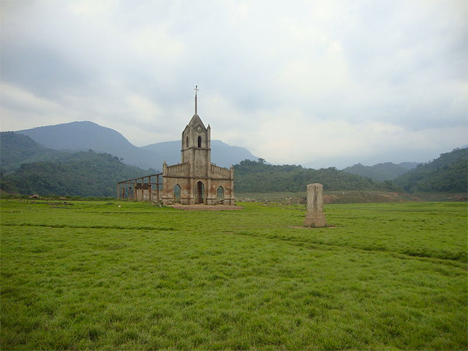
    Another town lost to the creation of a hydroelectric dam, Potosi was abandoned in 1985, its residents relocating and leaving their former homes to be filled with water. For 20 years, all that was visible of the Veneuzuelan town was a single mildewed cross topping a drowned church, but by the year 2010, the waters began to recede and the town slowly reappeared. The gothic church that was once submerged is visible again due to droughts and water shortages, erosion and water damage making it appear much older than it really is.

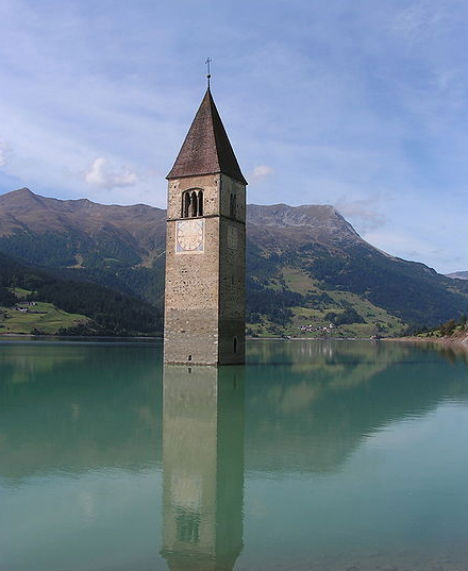
    Steeple Tombstone: Curon Venosta, Italy

    Drowned Towns Steeple Tomb 1

    Drowned Towns Steeple Tomb 2

    A single spire marks the location of an entire town lost beneath Lago di Resia. The alpine village of Curon Venosta was flooded soon after World War II when officials decided to merge three pre-existing lakes into one to create a hydroelectric dam. Before it was inundated, the town – which included 163 houses and nearly 1,300 acres of land planted with fruit – was filled with sand. The bell tower, which was built in the 14th century, was left intact as a memorial, and can be reached on foot in the winter when the lake freezes over.

    Vilarinho da Furna, Portugal

    Drowned Towns Vilarinho da Furna

    In 1972, the creation of a new dam meant the ancient Vilarinho da Furna was lost beneath the water. The Portuguese village, which dates back to Roman times, was home to almost 300 people inhabiting 80 houses before it was submerged; the property still belongs to their descendants, and reappears every now and then when the reservoir levels fall. The community was unique in that it had a communitarian social system with a council called the Junta made up of a single member from each family, a practice dating back to the Visigoths. When the villagers left they took as much as they could, creating their own road to transport things like rocks and roof tiles to their new homes. Some of those rocks were used to build a museum commemorating Vilarinho da Furna, which contains a collection of clothing, agricultural tools, and paintings depicting daily life in the village.

    Jal Mahal, Jaipur, India

    Drowned Towns Jal Mahal 1

    Drowned Towns Jal Mahal 2

    The Water Palace of Jaipur, India sits in the center of Man Sagar Lake. No one knows exactly when it was built, but it’s believed that the red sandstone structure is at least 300 years old and was constructed before damming created the lake, submerging its lower four stories. When the lake is full, only the top level can be reached, and only by boa. At night, the place is illuminated with floodlights like some kind of hallucinatory ghost structure. The palace was recently restored and is now open to visitors.

    Next Page – Click Below to Read More:
    Drowned Towns 10 Underwater Ghost Cities Buildings

    Share on Facebook


    [ By Steph in Global & Travel & Places. ]

    [ WebUrbanist | Archives | Galleries | Privacy | TOS ]


    WebUrbanist

  • Sand Paintings: Temporary Street Art Will Blow (You) Away

    [ By WebUrbanist in Art & Street Art & Graffiti. ]

    sand painted sidewalk drawing

    After 650 such works, it is perhaps no wonder that this artist generates each new sand painting spontaneously on the spot, letting the pattern evolve as he pours him efforts (and handfuls of sand) into each piece.

    sand 1

    Joe Mangrum is a New York City painter, sculptor and all-around installation artist whose works of colorful, organic and fractal geometry often span as much as 15 or 20 feet in diameter.

    sand art painting floor

    Inspired by Celtic knots and Asian mandalas, he began creating these public pieces which, in turn, kept being swept up from the city streets. His story gained national attention in part due to tension with authorities, including a Parks Department in California.

    sand colorful public art

    Part of the beauty of his approach is its accessibility, both conceptually and physically – people can watch him work on a sidewalk for hours, and see the art evolve before their eyes.

    sand public space art

    He describes his work as “visual rebellion” against “the urban grid” – a sort of organic counterpoint to the strictly-defined and linear streets and sidewalks on which he works.

    sand sidewalk street painting

    He writes of his strategy: “Each painting  is spontaneously improvised, using colorful sand, poured directly from my hand. In the process of creation, I whisk a mash-up of visual cues, inspired by ancient traditions synced up with a rhythm of animation.”

    sand art street fractal

    His free-style approach and Pop Art colors are inspired by everything from undersea creatures to carnivorous plants, botanical geometries and other cultures experience through international travels.

    sand 2

    His pieces have be set indoors as well as outside, and in formal as well as informal contexts: “Mangrum’s  work has been exhibited worldwide. Creating over 650 public sand paintings since 2009. In 2012 he has been featured in  “Swept Away” at the Museum of Arts and Design in NYC, The Flag Art Foundation’s “Watch Your Step” exhibit and at The Corcoran Gallery Rotunda in Washington DC.  In 2003 Joe was awarded the Lorenzo de Medici Award at the Florence Biennale for his piece titled “Fragile” as it relates to economic structures. “

    Share on Facebook


    [ By WebUrbanist in Art & Street Art & Graffiti. ]

    [ WebUrbanist | Archives | Galleries | Privacy | TOS ]


    WebUrbanist

  • Railroaded: 9 Nifty Abandoned Train Car Graveyards

    [ By Steve in Technology & Vehicles & Mods. ]

    train graveyards
    Where do obsolete trains go when they die? Many end up in railroad graveyards where these former station-stopping locomotives stay stopped and stationary.

    Vic Berry’s Scrapyard, Leicester, UK

    Vic Berry's Scrapyard train graveyard(images via: Nigel Tout and Crewcastrian)

    Vic Berry’s Scrapyard was a Leicester, England landmark from 1973 to 1991 when it was destroyed in a massive fire set by unknown, presumably train-hating, arsonists. Specializing in asbestos removal, Vic Berry’s set a standard for large-scale industrial recycling while its more well-known claim to fame was an immense pyramid of 30 disused Class 25 and 27 locomotives that reached its greatest height and breadth in 1987.

    Vic Berry's Scrapyard train graveyard stack(image via: Nigel Tout)

    Vic Berry’s Scrapyard’s reputation as a specialist in asbestos remediation was a double-edged sword. Firms eager to scrap old engines and passenger cars looked to the Leicester yard first, leading to a boost in business and a growing stockpile of non-rolling, asbestos-containing stock stored onsite.

    Vic Berry's Scrapyard train graveyard fire Leicester(images via: Leicester Mercury and Nigel Tout)

    The worst thing that could happen was a large fire, and that’s exactly what DID happen in March of 1991. The blaze destroyed most of the yard’s stored stock and poisonous clouds of asbestos-infused smoke wafted across Leicester. The yard was subsequently closed and after a very long (approximately 5 years) and difficult cleanup, the site was redeveloped into the mixed use, residential and retail district of Bede Island.

    Thessaloniki, Greece

    Thessaloniki Greece rusty steam train graveyard(images via: Daily Mail/Associated Newspapers Ltd. and Construction Photography, Rail Photo)

    The ancient city of Thessaloniki, Greece is still thriving today, as is its train station. The trains, not so much… at least the older models dating back to the Steam Age when the city belonged to the Ottoman Empire. Why did these engines and coaches get the works? That’s nobody’s business but the Turks.

    Shendi, Sudan

    train graveyard Shendi Sudan(images via: Panoramio/Wolodymyr)

    The Sudanese city of Shendi has long been a regional trading and transportation hub so it’s no great surprise to see it’s got a respectable train graveyard in its, er, backyard. There aren’t all that many trains sitting in situ in Shendi’s shifting sands but to their credit, the variety of abandoned locomotives includes both early and modern types. Kudos to Panoramio user Wolodymyr for documenting a site (and a sight) very few might otherwise be aware of.

    Next Page – Click Below to Read More:
    Railroaded 9 Nifty Abandoned Train Graveyards

    Share on Facebook


    [ By Steve in Technology & Vehicles & Mods. ]

    [ WebUrbanist | Archives | Galleries | Privacy | TOS ]


    WebUrbanist

  • Hanging Hotel: Camp in a Trunk-Friendly Tree House Retreat

    [ By WebUrbanist in Boutique & Art Hotels & Global. ]

    tree house in context

    Without harming the forest that supports it, this streamlined tree house design is stabilized by a central trunk but ultimately suspended from the branches above to minimize negative environmental impacts.

    tree house shade structure

    Tree houses typically rely on being either attached to trunks or translating their loads to grounded supports – in short: they either harm trees or are not truly ‘treehouses’. Farrow Partnership Architects proposes a middle path, relying on the tree without constricting its growth.

    tree house overlooking lake

    And while the structures are open-air for a camping-style experience, they are not lacking in luxuries (at least in terms of what one normally expects from architecture in trees: bedroom, bathroom and living room spaces complete with composting toilet and graywater shower.

    tree house wood structure

    tree house night module

    The streamlined bent-wood structures are designed to be oriented around site-specific views, hung with thin metal wires and covered in semi-translucent material to provide a degree of shade and privacy while letting in natural light during the day (and becoming a kind of glowing lantern at night).

    tree house lake context

    tree house hanging forest

    tree house interior view

    This series of sky villas is set to be deployed in a national park near Toronto, Canada. Plans call for them to be sufficiently spaced out so that residents of one structure will not see the other, but simply the forest through the trees.

    Share on Facebook


    [ By WebUrbanist in Boutique & Art Hotels & Global. ]

    [ WebUrbanist | Archives | Galleries | Privacy | TOS ]


    WebUrbanist