RSS
 

Archive for the ‘Creativity’ Category

Herringbone House: Tiny Tokyo Residence Split into 7 Levels

29 Nov

[ By Steph in Architecture & Houses & Residential. ]
tiny house japan 1

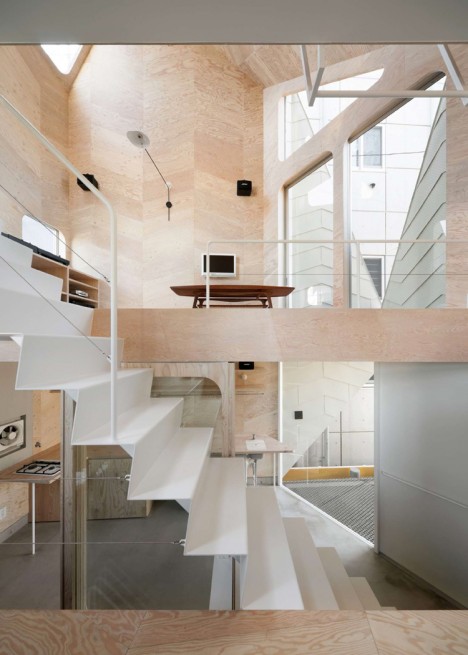
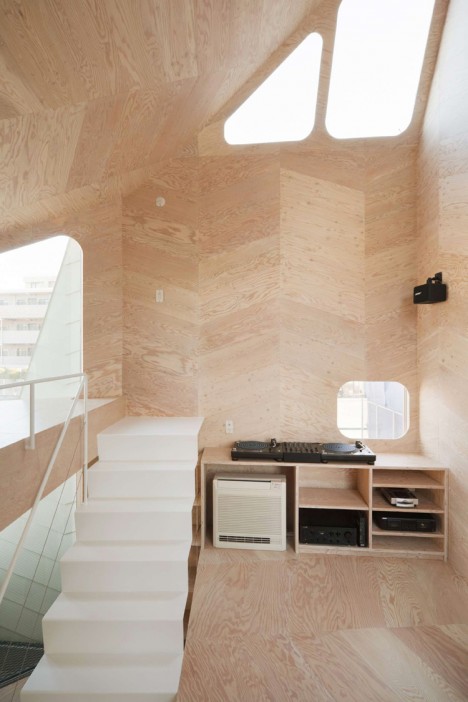
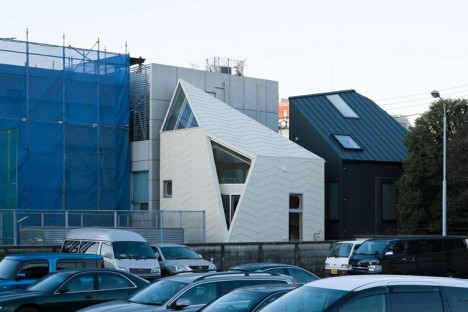
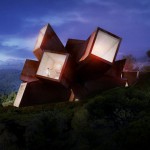
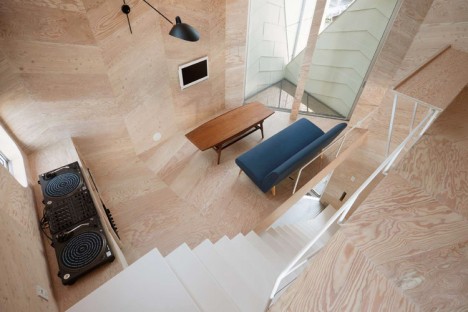
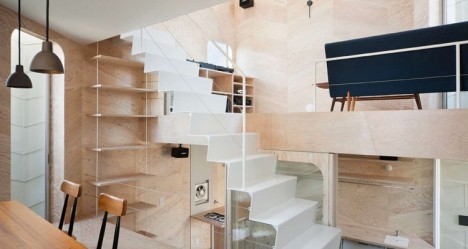
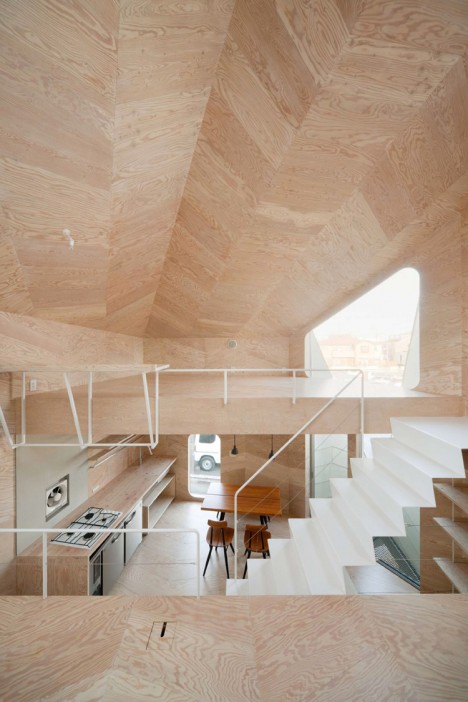
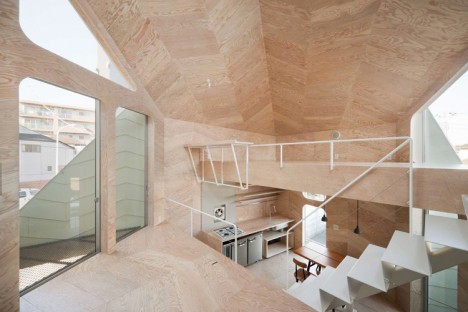
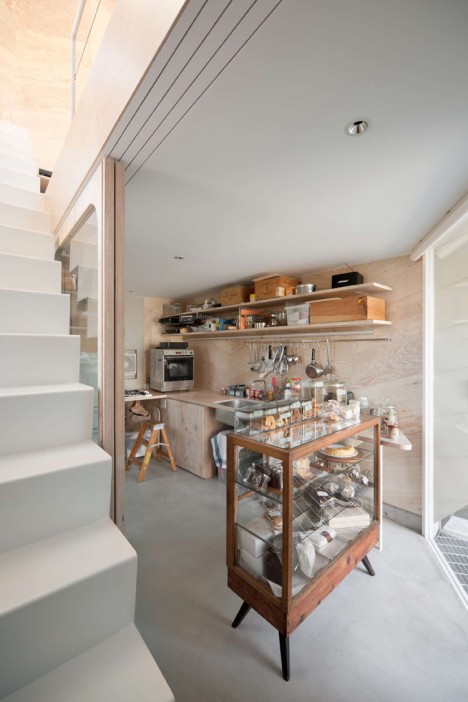
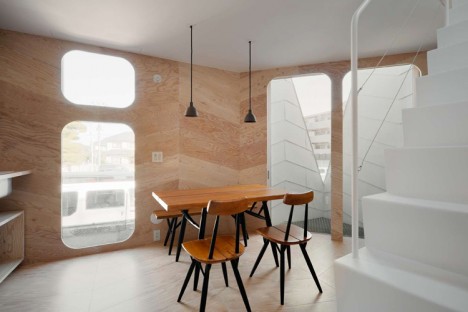
Measuring just 280 square feet, this tiny house in Tokyo by architecture firm Flathouse includes a public biscuit shop on the first level and manages to fit a lot of function into an irregularly shaped footprint by taking advantage of vertical space. Built on a system of parallelograms that create a herringbone pattern both inside and out, the home has no interior walls, dividing the rooms with a series of staggered platforms instead.
tiny house japan 2

tiny house ajapan 6

tiny house japan 9

For privacy-obsessed Westerners, this may seem like a strange move, but interior walls aren’t seen as a necessary part of a home in many areas of Japan. In this case, eliminating these dividers keeps a small space open and encourages rapid movement from one area of the home to the next. The shop owner can quickly move from the personal areas of the home to serve a customer on the first floor, and back again.
tiny house japan 3

tiny house japan 4

tiny house japan 8

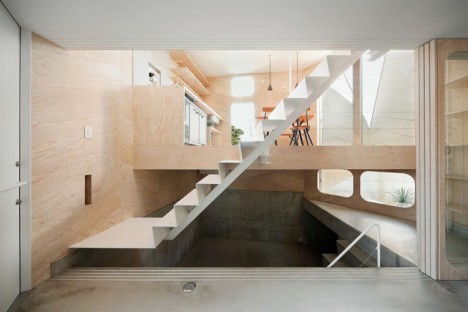
All levels are connected by a central staircase. The dining room, living area and private rooms are all set on small platforms with barely enough room for the furniture required in each. The shop and bathroom are tucked into a concrete basement level, while the rest of the home is lined in a light and airy larch plywood.
tiny house japan 5

tiny house japan 7

tiny house japan 10

This approach uses the full available height of the property, creating a comfortable space despite the restrictive dimensions of the plot, a common architectural challenge in Tokyo.

Share on Facebook


[ By Steph in Architecture & Houses & Residential. ]

[ WebUrbanist | Archives | Galleries | Privacy | TOS ]

WebUrbanist

 
Comments Off on Herringbone House: Tiny Tokyo Residence Split into 7 Levels

Posted in Creativity


Iconic Camouflage: Painted People Disappear into Cityscapes

28 Nov

[ By WebUrbanist in Art & Photography & Video. ]

body paint central park

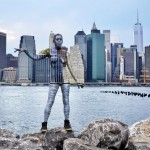
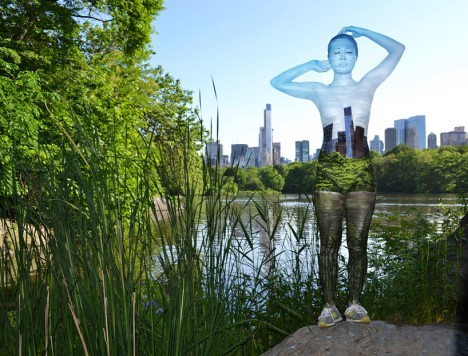
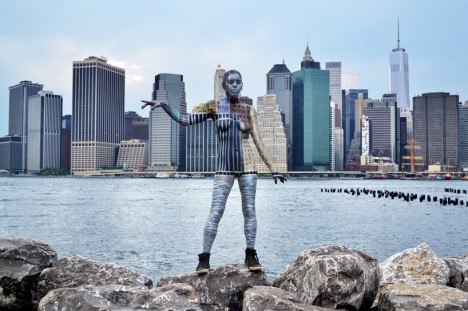
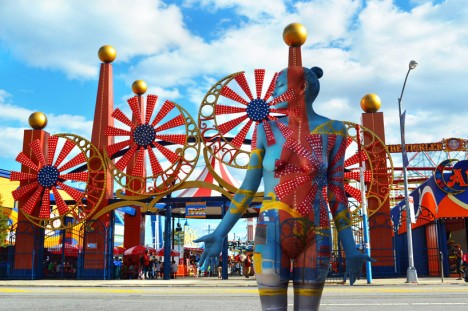
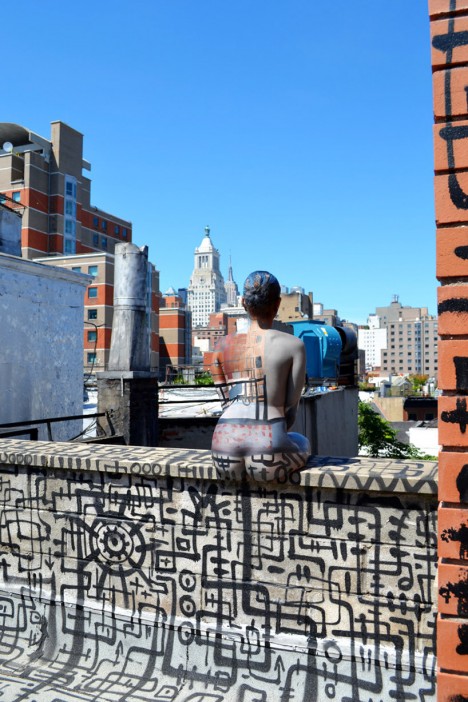
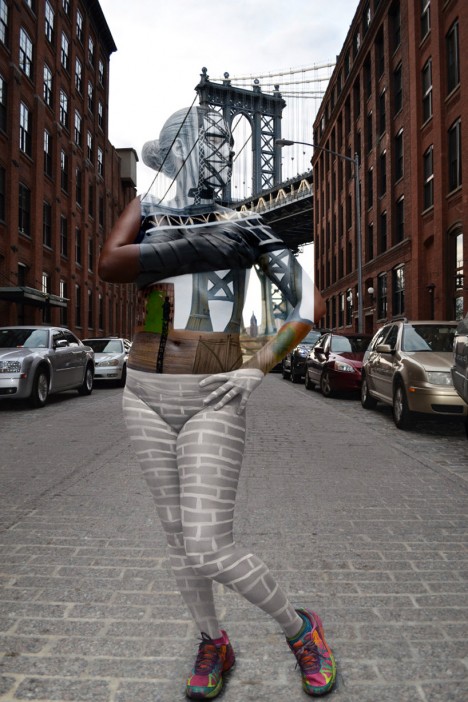
Unlike some other prominent artists working with more seamless urban camouflage in strange or offbeat settings, this work in NYC by Trina Merry allows for curves and distortions, and operates with the interplay between painted nudes in more public and iconic surroundings.

body paint manhattan skyline

body paint brooklyn bridge

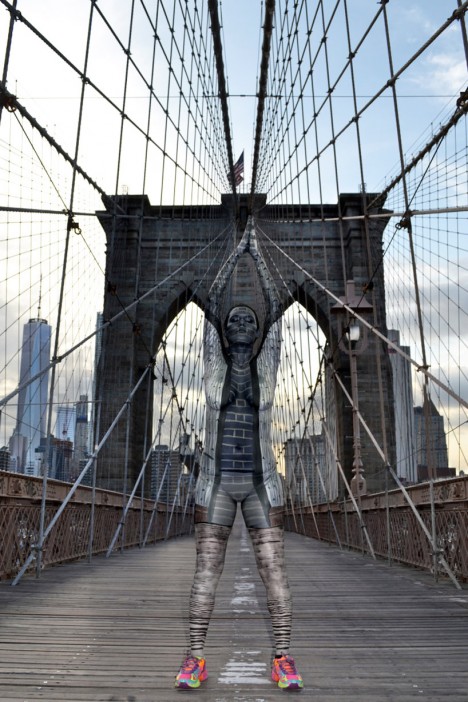
In this series, her work features backdrops that are prominent points of interest and world-famous landmarks of New York City, from famous architecture and infrastructure (the Guggenheim Museum, Empire State Building and Brooklyn Bridge) to urban and organic landscapes (like Coney Island and Central Park).

body art coney island

body painted guggenheim museum

Thanks to the prominence of these locations, this colorful work naturally becomes a live spectacle beyond the sculptural photographs taken of the models in place.

body painted empire state building

body painted art photography

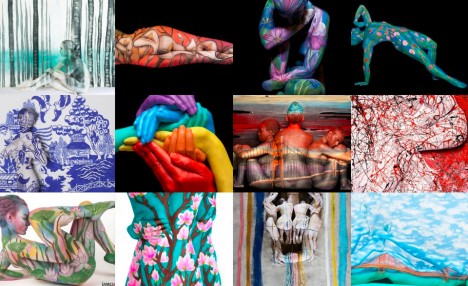
Other body paintings by Trina range from referential to abstract, with blank black or white backgrounds in some cases and period or modern artwork in others.

body with manhattan bridge

From the artist: “my surface is living, breathing human beings, making this a highly relevant & immediate. I use non-toxic hypoallergenic paint applied with a brush or airbrush. the painting is temporary like a Tibetan sand painting, beginning to [shift] into another work as soon as I stop painting, changing texture and color.”

Share on Facebook


[ By WebUrbanist in Art & Photography & Video. ]

[ WebUrbanist | Archives | Galleries | Privacy | TOS ]

WebUrbanist

 
Comments Off on Iconic Camouflage: Painted People Disappear into Cityscapes

Posted in Creativity


The 6th Borough: 9 River-Based Proposals for New York City

26 Nov

[ By Steph in Architecture & Cities & Urbanism. ]

floating plus pool new york 1

While the waterways connecting the five boroughs of New York City are already home to everything from food-producing barges to boats reclaimed as hotels, they could become an even more productive part of the urban landscape, harnessing clean energy from the tides or hosting floating, human-powered gyms. These 9 river-based proposals include pier-based parks, floating swimming pools that filter river water, and a retro-futuristic vision for an airport on the Hudson.

Cross-Shaped Pool Cleans the Waters of Manhattan Rivers

floating plus pool new york 2

floating plus pool new york 3

floating plus pool newy ork 5

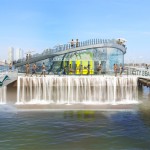
A swimming pool shaped like a giant plus sign could provide a cool place to swim in Manhattan’s various river parks while simultaneously filtering and purifying river water. The four separate ‘arms’ of the pool enable different activities, from a lap pool to a shallow area for kids. The pool walls are made of a stack of materials that collectively screen odors, pollutants and bacteria to make Manhattan’s notoriously uninviting waters safe to swim in. It may look like a dream, but the concept is well on its way to becoming a reality, with the designers raising nearly $ 275,000 to get started. It’s far from the first floating pool to come to New York City; such attractions were popular as far back as the 19th century and the city has maintained a conventional chlorinated one at Barretto Point Park in The Bronx since 2007.

Pier55: Island Park & Performing Arts Venue

new york city island park

new york city island park 2

new york city island park 3

The Hudson River could get an artificial island of sorts in the form of a new architectural wonder from Thomas Heatherwick’s London-based studio. Funded by a non-profit organization started by fashion designer Diane von Furstenberg and her billionaire media mogul husband Barry Diller, Pier55 is a 2.7-acre park with footpaths, grassy lawns and an 800-seat amphitheater, and is supported by 300 concrete pylons. The project is pending approval from the Army Corps of Engineers and expected to begin construction in 2016.

City Beach Recreational River Barge

floating city beach 1

city beach nyc 2

citybeach 3

New York City residents who want to lounge in the sand needn’t leave Manhattan at all if the City Beach NYC project ever comes to pass. Essentially a floating beach park on a barge, the project aims to create a two-level destination with shops and restaurants placed underneath a curving, sand-covered platform overlooking the waters of the Hudson River. Since you don’t exactly want to swim in the Hudson, the purpose of the park is more sun bathing than actually getting wet, though the design includes a large water feature to mimic the sounds of the sea. The barge would be permanently moored on the west side of Manhattan. Unfortunately, the creators were unable to raise enough funds to hire a team to get started.

Human-Powered Floating Gym

floating river gym 1

floating river gym 2

Want a view of something other than terrible reality television while you’re cycling or running on the treadmill at the gym? You could be gazing up at the skyline instead, or taking in the sights of the Hudson and East Rivers, from a “soft floating micro-island gym’ powered by human motion. The River Gym is a series of small floating facilities programmed on a specific path moving from one point to the next, so they also serve as transportation. Each is equipped with onboard purification devices to help mitigate water pollution.

Floating Docks that Harvest Clean Energy from the Tides

floating docking station nyc 1

floating docking station nyc 2

floating docking station nyc 3

Energy-producing docking stations ‘plug in’ to New York City’s existing piers in this concept by local firm GRO, developed for the Metropolis Magazine Next Generation design competition. The floating system not only harnesses and stores powers from the tides in the river, they also extend public green space and create tidal pools for wildlife. The energy produced by the network of docks could be used to power street lights throughout the city.

Next Page – Click Below to Read More:
The 6th Borough 9 River Based Proposals For New York City

Share on Facebook


[ By Steph in Architecture & Cities & Urbanism. ]

[ WebUrbanist | Archives | Galleries | Privacy | TOS ]

WebUrbanist

 
Comments Off on The 6th Borough: 9 River-Based Proposals for New York City

Posted in Creativity


Ghost Creeks: Resurfacing Vanished Waterways on City Streets

26 Nov

[ By WebUrbanist in Culture & History & Travel. ]

street painting vanished waterway

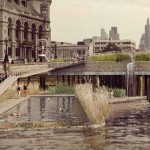
Half-forgotten historical urban rivers are set to resurface in San Francisco as part of a civic installation project designed to fill in their historical footprints with a bright blue work of temporary art. The project will stretch across roads, sidewalks and other urban staples with colorful swaths reflecting part the city’s hidden history.

historical waterways city streets

It might seem obvious upon reflection, but few people realize just how many surface waterways ebbed and flowed on the surface of a city like this before development forced their paths into culverts, tunnels and sewers. Set to debut at the Market Street Prototyping Festival (more on that below), this piece explores the intersection of past and present through installation art. Still at a conceptual stage it remains to be decided whether the work will involve physically painting the streets or projecting light down on them from above.

market street festival project

From project creator Emily Schlickman: “Every city has invisible histories embedded within its landscape. Up until the 19th century, ephemeral streams ran through nearly every valley in San Francisco, channeling rainwater to peripheral tidal estuaries. This project, ‘Ghost Arroyos’ seeks to reveal these forgotten waterways of the city through a simple, but powerful intervention. Visitors … will be invited to trace the path of the waterways while listening to a curated recording of hydrological soundscapes and oral histories.”

market street installation art

Emily is a designer living and working in the Bay Area. She is interested in the intersection of landscape processes, art, and systemic design and aims to incorporate these issues into her work. Hers is just one of dozens of crowd-selected projects set to line Market Street during the festival and spanning multiple neighborhoods.

market street prototyping festival

CityLab writes more about the historical waterways of this urban environment: “There was once a time when San Francisco was glistening with creeks and arroyos, or streams that stay dry for part of the year. When Spanish explorers arrived in what’s now the Lower Haight in the late 1700s, they found a healthy brook and named it Fuente de Dolores. Down in the Mission there was a gulch whose water helped sustain cattle and crops. In 1878, the municipal government took another natural channel under modern-day Cesar Chavez Street and turned it into a sewer.”

installation art project series

Some additional information on the festival itself (with a further video introduction above): “Market Street will transform into a public platform, showcasing exciting ideas for improving our famed civic spine and how we use it. Winning entries, as diverse and exciting as the people of San Francisco themselves, will be brought to life for three days along Market Street’s sidewalks, where millions of pedestrians from all walks of life will have the chance to experience, explore, and interact with the prototypes.”

street painting vanished waterways

Like other projects in the mix, Ghost Arroyos is designed to be interactive and community-driven. “The goal of the Prototyping Festival is to unite diverse neighborhoods along Market Street, encouraging these vibrant communities to work with designers, artist and makers to build a more connected, beautiful San Francisco”

Share on Facebook


[ By WebUrbanist in Culture & History & Travel. ]

[ WebUrbanist | Archives | Galleries | Privacy | TOS ]

WebUrbanist

 
Comments Off on Ghost Creeks: Resurfacing Vanished Waterways on City Streets

Posted in Creativity


Modular Micro-Pad: 85 Sq Ft Loft Full of Slide-Out Surprises

26 Nov

[ By WebUrbanist in Design & Fixtures & Interiors. ]

paris modular home tiny

Using a system of large sliding doors and functional-filled drawers to transform a maid’s quarters into a whole home, this small-footprint apartment in Paris gives a (much more positive) new meaning to the phrase ‘hole in the wall’.

paris micro apartment home

paris home shelves drawers

paris dining room set

Sleeping, cooking, eating, washing and storage are all packed into 8 square meters using a system of unfolding flat-pack furniture items, hidden spaces and dual-purpose built-ins, custom-designed by Kitoko Studio.

pairs kitchen sink window

paris kitchen smal lview

paris other angle view

Like a Swiss Army Knife writ large, many items serve more than one use, like a staircase for climbing up to bed that also has built-in shelves that tuck back into the wall.

paris apartment mini tiny

paris bathroom shower combo

paris micro bathroom sink

The kitchenette and bathroom are as compact as can be, packing essential plumbing into the tightest spaces possible in order to maximize the still-limited open space at the center of the design.

paris home compact minimalist

paris modular apartment design

paris cabinet storage stairs

paris shelves drawers storage

paris tiny wall bedroom

paris house plan diagram

paris view from above

paris house plan tiny

Bright white walls with minimal decor help the space feel lighter and more open despite its necessarily-cramped nature and odd wedge-shaped configuration.

Share on Facebook


[ By WebUrbanist in Design & Fixtures & Interiors. ]

[ WebUrbanist | Archives | Galleries | Privacy | TOS ]


WebUrbanist

 
Comments Off on Modular Micro-Pad: 85 Sq Ft Loft Full of Slide-Out Surprises

Posted in Creativity


Tape Tunnels: Crawl Inside a Human-Sized Spiderweb in Paris

25 Nov

[ By Steph in Drawing & Digital. ]

Tape Paris 3

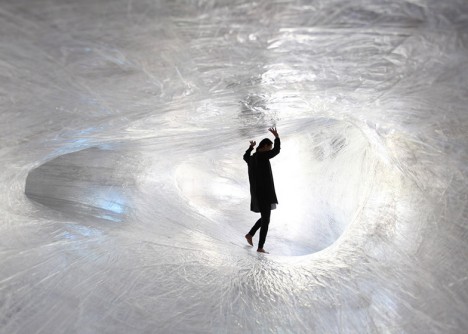
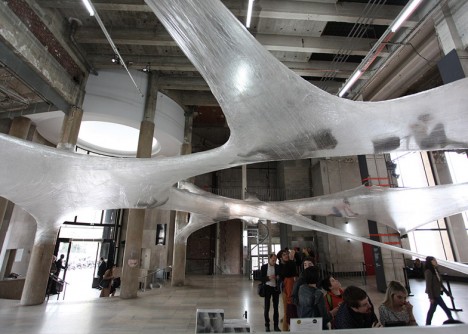
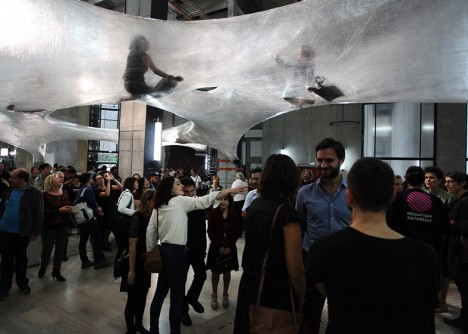
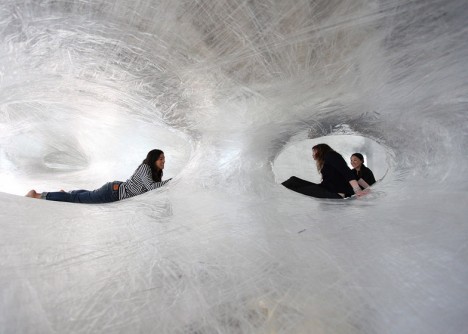
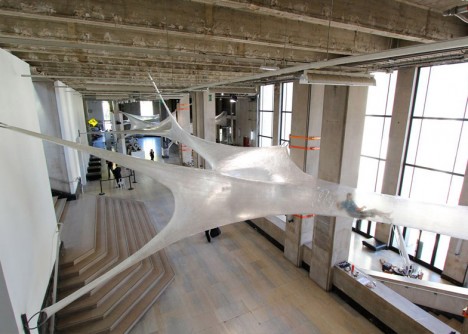
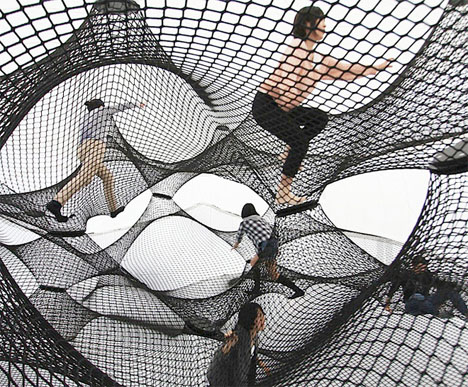
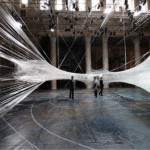
Stretching from one end of the Palais de Tokyo gallery in Paris to the other, these strange translucent tunnels look like human-sized versions of the funnel-shaped webs of grass spiders. Instead of helplessly trapped insects, you’ll find people crawling around inside, their weight supported by nothing more than layer after layer of sticky tape and plastic.

Tape Paris 2

Tape Paris 7

Tape Paris 9

Tape Paris is the latest interactive art installation by Croatian-Austrian design collective Numen/For Use, described as a “stretched biomorphic skin” suspended halfway between the floor and ceiling of the gallery’s main hall. The designers see it as a “site specific, parasitical structure invading an arbitrary location.”

Tape Paris 5

Tape Paris 1

Tape Paris 7

Visitors are invited to climb inside, navigating tunnels that vary in height to enable standing at some points but require crawling at others. Those inside can gaze down at the hazy shapes of onlookers below. The basis of the installation is criss-crossed Scotch tape which is reinforced on the outside with an elastic plastic sheeting.

numen:for use string installation

numen:for use bounce house

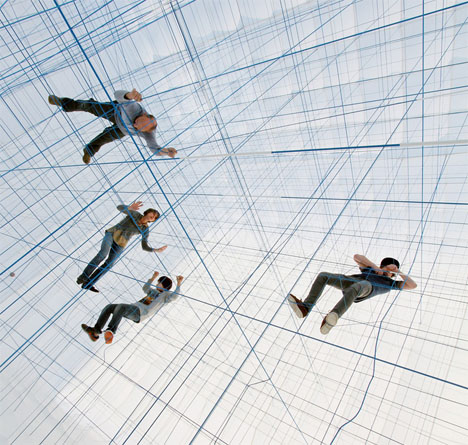
In addition to other tape structures, Numen/For Use is known for inhabitable string and net installations including a gridded ‘social sculpture’ modeled after dadaist collages and suspended nets inside a massive inflatable bubble forming a sort of adult-sized bounce house.

Share on Facebook


[ By Steph in Drawing & Digital. ]

[ WebUrbanist | Archives | Galleries | Privacy | TOS ]

WebUrbanist

 
Comments Off on Tape Tunnels: Crawl Inside a Human-Sized Spiderweb in Paris

Posted in Creativity


Forbidden Islands, Part I: 7 Isolated and Abandoned Wonders

25 Nov

[ By Steph in 7 Wonders Series & Travel. ]

Strange Islands North Brother 1

From a mile-long strip of land packed with over one million corpses just off the shores of New York City to a floating fortress in England used by a developer to escape his creditors, these 7 islands are among the world’s strangest. While the exact histories of some can only be speculated upon, like Japan’s formerly top-secret chemical weapons facility and Mexico’s wildly creepy Island of the Dolls,  each of these mysterious islands has a fascinating story to share.

Poison Gas Island Now Overrun with Rabbits

strange islands rabbit 1 strange islands okunoshima strange islands okunoshima 2

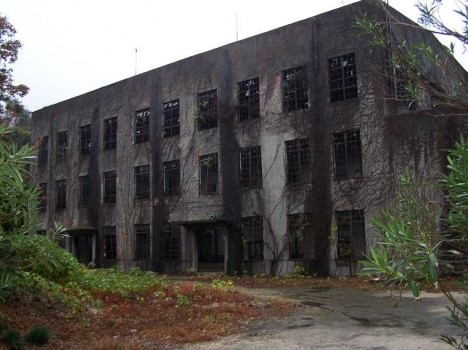
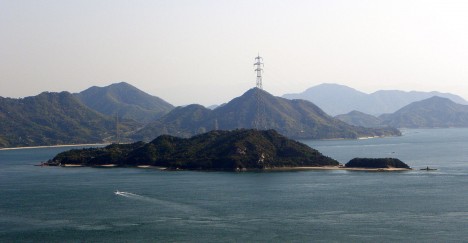
Suspecting that the United States and Europe were producing chemical weapons despite signing the Geneva Protocol banning chemical warfare in 1925, Japan decided to move forward with developing some of its own, claiming a tiny isolated island that they subsequently removed from maps. Workers at the chemical weapon facility producing mustard gas and tear gas weren’t even clued in to what they were creating, and many of them suffered from toxic-exposure related illnesses. When the Russo-Japanese war ended in 1929, documents relating to the plant were destroyed, and the gas was dumped or buried.

Today, the island is home to the Okunoshima Poison Gas Museum – but that’s not what draws most of the tourists who visit the island, which is now part of the Inland Sea National Park system of Japan. It’s the thousands of rabbits that have multiplied there, leading to the nickname ‘Rabbit Island.’ Some people speculate that these rabbits are the descendants of animal testing subjects that were let loose after World War II, but as the rabbits have few natural predators to fear on the island and hunting them is forbidden, it may just be a case of stereotypical rabbit reproduction rates.

North Brother Island, New York
Strange Islands North Brother 1

Strange Islands North Brother 2

Strange Islands North Brother 3

Strange Islands North Brother 4

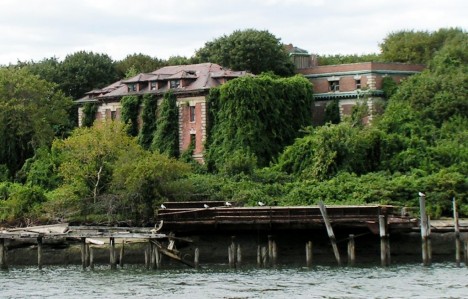
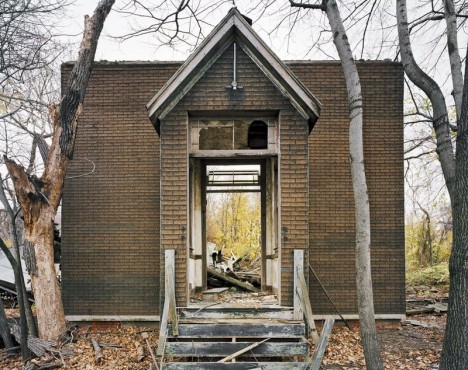
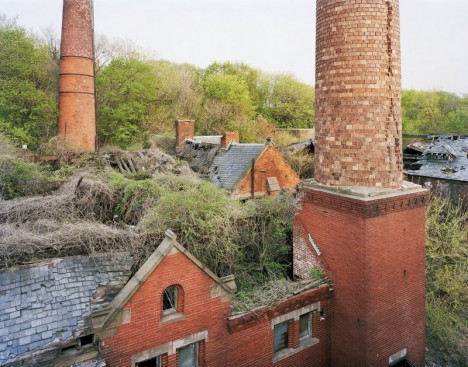
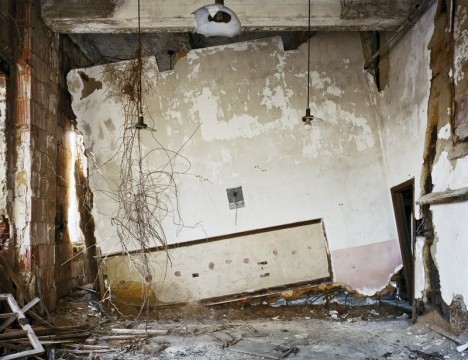
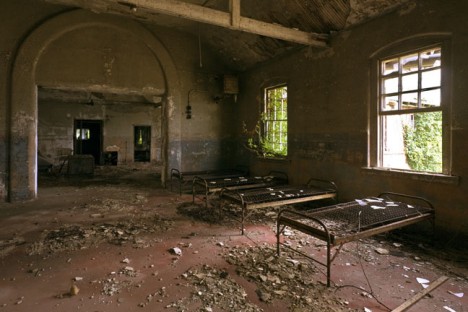
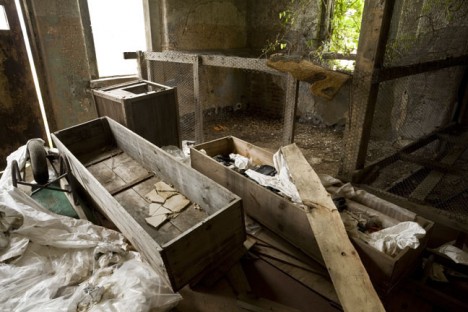
Visible to anyone who cares to notice from the windows of airplanes landing at LaGuardia Airport, the creepy abandoned North Brother Island is nonetheless unknown to most New Yorkers. The dilapidated remains of brick structures can be spotted through a tangle of vines in the overgrown forest that has sprouted around them since they were left to decay a half-century ago. The island was established as a New York City quarantine hospital in 1885, and was home to the infamous Typhoid Mary, the first American identified as a carrier of typhoid fever. Later, the island became a rehab center for teenage drug addicts before it was decommissioned in 1963. Invasive kudzu vines soon took over. Due to its proximity to Rikers and the fragility of its structures, the island is permanently closed to the public, but occasional visitors still get in. These incredible images were taken by photographer Christopher Payne for his book, North Brother Island: The Last Unknown Place in New York City.

New York Island is a Cemetery for Unknown Individuals

Strange Islands Hart 1

Strange Islands Hart 2

Strange Islands Hart 3

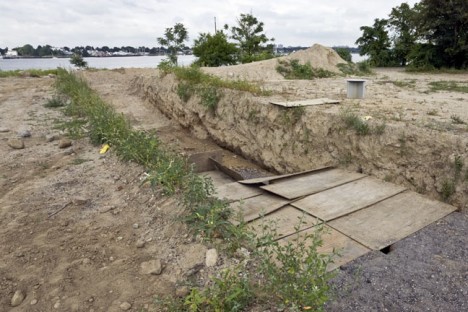
As beautiful and creepy as North Brother Island may be, it’s hardly the only isolated island with a sad story that can be found within a stone’s throw of America’s most populated city. Located in the Long Island Sound, Hart Island was used as a Civil War prison camp, with 235 prisoners dying there. Later, the island became the setting of a hospital, a women’s insane asylum, a tubercularium and a corrections facility for boys. But unlike many islands with such a past, this one has not been converted into a memorial, nor has it been entirely left to ruin: it is the final resting place of the city’s unknown or unclaimed dead. Used as New York’s Potter’s Field, the mile-long island holds the remains of more than one million individuals, with about 1,500 bodies (and many more amputated body parts) buried there each year. The historic buildings on the island are being torn down to make room for additional burials, which are conducted by Rikers Island inmates.

Isla de las Munecas: Mexico’s Creepy Doll Island
Strange Island Dolls 1

Strange Islands Dolls 2

Strange Islands Dolls 3

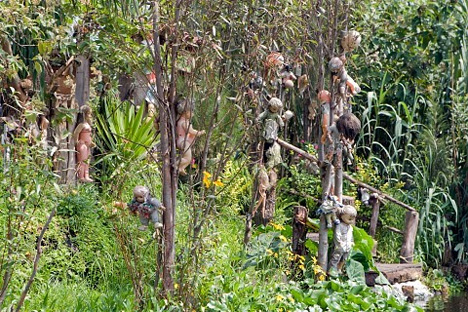
The eyes of decapitated dolls blink lazily from their perches in the trees on Mexico’s Isla de las Munecas – ‘Island of the Dolls.’ There’s something undeniably terrifying about seeing what look like naked infants – sometimes remarkably realistic – clinging to the branches or dangling from their necks. Legend has it that after a little girl drowned in Teshuilo Lake, island resident Don Julian Santana began collecting dolls and installing them in the trees. Eventually, their numbers grew into the hundreds. Santana often sourced the dolls from the trash or traded produce for them, taking them in any condition, no matter how dirty or worn. While many people viewed the doll-infested island as something out of a nightmare, to him it was a shrine. Tragically, in 2001, Santana was discovered drowned in the same area of the lake where he believed the little girl had perished.

Next Page – Click Below to Read More:
Forbidden Islands Part I 7 Isolated And Abandoned Wonders

Share on Facebook


[ By Steph in 7 Wonders Series & Travel. ]

[ WebUrbanist | Archives | Galleries | Privacy | TOS ]

WebUrbanist

 
Comments Off on Forbidden Islands, Part I: 7 Isolated and Abandoned Wonders

Posted in Creativity


Vehicular Hives: Envisioning Urban Commutes in Compound Cars

24 Nov

[ By WebUrbanist in Conceptual & Futuristic & Technology. ]

modular office on wheels

Imagine a future where driverless vehicles transcend their expected role in transit, becoming modular hubs that can link up for meetings or socializing beyond just getting you from Point A to Point B.

platooning-car-idea-example

modular office warehouse cars

modular vehicle gathering event

There is a great deal of talk about how car-sharing will save space (we only use 4% of roadway surfaces even during peak transit times), reduce waste (less pollution and fewer idle vehicles) and cost (by up to $ 100 billion a year in fuel) and reshape the urban experience, but what if platooning cars could also help reconnect us with other people?

modular office interior design

modular office interior board

That is part of the premise behind IDEO’s Automobility project, which extrapolates current trends and modes of transportation to predict how we might use vehicles in the not-so-distant future. We may use empty vehicles during the day, for instance, to drop off packages, or to pick up things from stores-on-wheels.

modular office display walls

modular park vehicle place

Beyond that, though, we might come together in new and different ways, too, at portable parklets, coworking space and open-space offices that migrate, congregate and dissolve on demand.

modular car shipping idea

modular car delivery cargo

“It opens up ideas about what the communal experience is in a vehicle, versus a single person in a car,” says Danny Stillion. “We’re definitely thinking about vehicles as a much more social space, where you could have face to face conversation and socialize in a much richer way while you’re in transit.”

modular car system design

modular parked empty vehicle

Imagine, too, destination events – a sort of next-generation tailgating – in which the spaces of the vehicles used to take you to and from a place become temporary spaces inhabited or otherwise utilized by those same attendees, rather than dead loads to be dropped off.

modular car cell call

car modular design idea

With legislation in place to keep wheels in cars for the foreseeable future, there may be intermediate steps. Still, none of these ideas are a particularly radical departure from the present, just a natural extension of how we already socialize, carpool and use public transit. “How different will tomorrow be from today? Both a lot and very little. More of us will live to be 100. Our resources will diminish while our technological capacity grows. Stuff will get faster and cheaper. But our basic needs? We’re betting those stay the same—that humans will still need to sleep, to eat, to work, and to move from place to place. That last part is what we’re interested in here. What happens to mobility in the next 15 years? Let’s go for a ride and find out.”

Share on Facebook


[ By WebUrbanist in Conceptual & Futuristic & Technology. ]

[ WebUrbanist | Archives | Galleries | Privacy | TOS ]

WebUrbanist

 
Comments Off on Vehicular Hives: Envisioning Urban Commutes in Compound Cars

Posted in Creativity


Print Charming: Safe, Simple 3D-Printing Comes Home To Play

24 Nov

[ By Steve in Gadgets & Geekery & Technology. ]

POIEO3D family-friendly 3D printer
Following in the footsteps of the microwave oven, at-home 3D printing in the form of the Poieo3D Printer is ready for prime time, play time and study time!

POIEO3D family-friendly 3D printer

Designed BY families FOR families, the Poieo3D Printer aims to make an exciting new technology as commonplace and worry-free as microwave ovens and other home appliances we now take for granted. While not quite “Tea, Earl Grey, Hot”, the Poeio3D Printer just might be the closest thing on Earth to home-based Star Trek tech.

POIEO3D family-friendly 3D printer

Poieo3D is the brainchild of several families in the greater Toronto area who felt inspired by the wealth of opportunities offered by the amazing new world of 3D printing. The founders fervently believe an affordable, easy to use, and child-safe 3D printer should be available to ALL families and should be a vital component of every home, workplace and classroom.

POIEO3D family-friendly 3D printer

The Poieo3D Printer isn’t just user-safe, it’s environmentally-friendly too – something you’d expect of a product that’s to be a permanent part of one’s lifestyle. The 3D printing process employs biodegradable print material derived from renewable resources such as corn starch and sugarcane. Unlike petroleum-based plastics, this material doesn’t give off foul-smelling, toxic fumes when the printer is used making it ideal for non-industrial use. Available in a rainbow of colors at a surprisingly low price, the material comes in the form of thin flexible filaments wound on spools for ease of storage.

Next Page – Click Below to Read More:
Print Charming Safe Simple 3d Printing Comes Home To Play

Share on Facebook


[ By Steve in Gadgets & Geekery & Technology. ]

[ WebUrbanist | Archives | Galleries | Privacy | TOS ]


WebUrbanist

 
Comments Off on Print Charming: Safe, Simple 3D-Printing Comes Home To Play

Posted in Creativity


Architectural Magic: Big Stone Building Breaks Free & Floats

23 Nov

[ By WebUrbanist in Art & Installation & Sound. ]

architecture floating building magic trick

A work of art, genius and incredible effort, half of this replica structure appears to hang in mid-air, seeming at once a perfect aesthetic fit for its surroundings and completely disconnected from the laws of physics.

architecture covent garden installation

British artist Alex Chinneck and his crew spent over 500 hours and had to construct a 4-ton counterweight to balance this faux building in the sky – what appears to be solid stone is in fact a steel-framed copy of an historic structure also found at Covent Garden (the original is nearly 200 years old).

architecture floating building illusion

architecture draft plan model

Chinneck is well known for his architecture-centric optical illusions, with this particular piece created as a play on the area’s “performance culture” – its proximity to theaters and performance spaces.

architecture faux construction process

architecture cut slice pieces

The construction process required a painstaking attention to historical details and materials in addition to grafting the appearance of age, wear and tear onto the fake structure. Another significant challenge: the seemingly haphazard breaking and slicing of everything from stones to windows and their frames.

architecture hidden steel frame

architecture floating building magic trick

From the artist: “The hovering building introduces contemporary art to traditional architecture, performing a magic trick of spectacular scale to present the everyday world in an extraordinary way. My objective was to create an accessible artwork that makes a harmonious but breath-taking contribution to its historic surroundings, leaving a lasting and positive impression upon the cultural landscape of Covent Garden and in the minds of its many visitors.”

Share on Facebook


[ By WebUrbanist in Art & Installation & Sound. ]

[ WebUrbanist | Archives | Galleries | Privacy | TOS ]

WebUrbanist

 
Comments Off on Architectural Magic: Big Stone Building Breaks Free & Floats

Posted in Creativity