Blog

  • This 12K rig uses six Panasonic Lumix GX80s for 360-degree video

    UK-based filmmaker Nick Driftwood has been busy, making a 360-degree video rig using six Panasonic Lumix GX80 (GX85 in the US) bodies, each fitted with a 3.25mm lens, covering a field of view of 243-degrees. With each camera shooting 4K video, 2880 X 2880px X 6 equals 12K footage. He showed it off to our friends at Photo Gear News last week at the NAB show in Las Vegas.

    The super-wide lenses come from Hong Kong 360 company iZugar, and the camera takes advantage of the 1:1 video capability that Panasonic offers in its 4K Photo mode.

    Even if you’re not interested in 360-degree video, it’s worth watching just for the guy in the background at 0:53.

    A sample of the output from Nick’s 12K rig can be found below.

    Articles: Digital Photography Review (dpreview.com)

  • 6 Reasons Why You Should Use a Standard Lens for Street Photography

    Henri-Cartier Bresson is well-known for his use of a 50mm lens, a standard lens on a 35mm film camera. If it’s good enough for Henri, then I guess it’s good enough for most modern street and travel photographers. When I worked at EOS magazine (Canon) we published an article about a photographer who traveled to India with nothing but a standard 50mm f/1.2 lens. His photos were beautiful.

    But what is it about the standard lens that’s so appealing to street and travel photographers? I’m glad you asked! Let’s take a look.

    Why You Should Use a Standard Lens for Street Photography

    What is a standard lens?

    A standard lens is a prime lens with a focal length roughly equivalent to the length of the diagonal measurement of the sensor (or film). A standard lens on a full-frame camera would have a focal length of 42mm. It is a lens that produces a field of view that is similar to the human eye or appears natural. 

    In practice, the 50mm lens is considered the standard for full-frame cameras (although Pentax makes a 42mm lens). A 35mm or 28mm lens is standard for an APS-C camera, and a 25mm lens is standard for a Micro Four-Thirds camera.

    I made all the photos in this article with a Fujinon 35mm f1.4 lens, a standard lens on my Fujifilm X-T1 camera. Standard lenses have lots of benefits. Here are some of them:

    My Fuji 35mm f/1.4 standard lens.

    1. Standard lenses are relatively small

    Standard lenses are easy to design and make. The optical quality is superb. They are not big lenses and don’t require as many raw materials as larger lenses. They are inexpensive to manufacturer and the savings are passed onto the buyer.

    But that doesn’t mean you should buy the cheapest standard lens you can find. You also need to take build quality, autofocus performance and weatherproofing into account when buying a standard lens. That $ 100 standard lens may look like a bargain, but you could easily end up wishing you had bought something better.

    The small size of standard lenses is good news if you are going to be walking around for hours at a time taking photos. The lighter your kit the more energy you will have for photography.

    Smaller lenses are also more unobtrusive when taking photos of people in the street. If you use a telephoto lens and point it towards somebody it’s obvious that you are taking a photo of them. But use a standard lens and you could be taking a photo of a building, the street, or the scene in general. You can take a photo of somebody without pointing the camera directly at them (as long as you’re not too close). You are much more likely to be ignored.

    Why You Should Use a Standard Lens for Street Photography

    I made this photo in Hangzhou, China with a standard lens. The girls didn’t notice me. It helped that they were totally engrossed in what they were doing.

    3. Standard lenses have wide apertures

    This is good news if you work in low light or like to use wide apertures for creative effect. If you like bokeh you’ll love using a standard lens. I used a wide aperture on my standard lens to make this photo. I deliberately focused on the dragon’s head and blurred the background.

    Why You Should Use a Standard Lens for Street Photography

    4. You can focus close to the subject

    Most standard lenses are capable of focusing quite closely to the subject. That means you can take close-up photos without having to change lenses or use an extension tube or close-up lens. This ability, combined with the wide aperture, make standard lenses incredibly versatile.

    You can step back from the subject and take a photo that includes plenty of the scene. Likewise, you can move in close and take a close-up. You can open up the aperture and create bokeh, or stop it down and get much more of the scene in focus.

    The close focusing ability of a standard lens helps you create a variety of images that show both the entire scene to small details and everything in-between. It’s a great tool for building a body of work around your subject. I used my standard lens to create both these images below, taken in the same building in Beijing, China.

    Why You Should Use a Standard Lens for Street Photography

    5. Standard lenses teach you to see

    When you use the same lens for an extended period of time you get to know it really well. You’ll understand how it sees the scene. You’ll know what to expect in terms of perspective and depth of field, and how that changes as you get closer to the subject.

    There is nothing wrong with zoom lenses, but they add an extra element to the photo taking process as you have to decide what focal length to use. An 18-55mm kit lens, for example, can be very useful. But there’s also a dramatic difference between the 18mm and 55mm focal lengths in terms of composition and angle of view. Deciding which focal length to use wastes precious time, especially in a situation where something interesting is happening.

    For example, in China, I often didn’t have much time to think. Something happened in front of me, like this boy posing for a photo, and I had to react quickly. A prime lens helped me do that as I didn’t have to think about focal length.

    Why You Should Use a Standard Lens for Street Photography

    With a standard lens (or any prime) you are committed to that focal length. You don’t have the option to zoom in or out. You can only change the framing by moving closer to or farther away from your subject. It simplifies the photo taking process and helps you create photos with simpler, stronger compositions.

    6. Standard lenses occupy the middle ground

    Telephoto lenses are great for taking photos of people from a distance, but photos taken with them can lack a feeling of intimacy as they are shot from a distance. It’s also harder to stop down and get the background in focus as well.

    Wide-angle lenses are a real challenge as they tend to include too much of the background. It’s hard to create a simplified composition with a wide-angle lens, especially in the street where lots of things happen that are outside your control. You also need to get much closer to your subject, and may need to invade their personal space. It’s hard to do this and not have the subject react to you in some way.

    Standard lenses occupy a good middle ground between these two extremes. You can get close to your subject without getting too close. You can create simpler and stronger compositions than you can with a wide-angle lens, but can still stop down and keep the background sharp.

    This photo is a good example. I was fairly close to this couple. But, I if had been using a wide-angle lens I would have had to get even closer, invading their personal space and changing the dynamic. A photo taken with a telephoto lens would have a greater sense of distance and separation from the couple. In either case, I wouldn’t have made a photo capturing a candid expression like this.

    Why You Should Use a Standard Lens for Street Photography

    Your turn

    What lenses do you like to use for street and travel photography? Are standard lenses part of your kit or do you prefer something else? Let us know in the comments – it will be interesting to see which lenses DPS readers prefer to use.


    Andrew is the author of the ebook The Candid Portrait.

    The post 6 Reasons Why You Should Use a Standard Lens for Street Photography by Andrew S. Gibson appeared first on Digital Photography School.


    Digital Photography School

  • Imaging Resource publishes Sigma 135mm F1.8 gallery

    Imaging Resource took a look at Sigma’s fast 135mm telephoto prime lens, calling it once of the sharpest lenses they’ve ever tested.

    Articles: Digital Photography Review (dpreview.com)

  • Wildlife photos might not be so wild after all

    Some of the wildlife photos you’ve seen may not have been taken ‘in the wild,’ thanks to game farms with captive animals.

    Articles: Digital Photography Review (dpreview.com)

  • Modest growth hints that the worst of the camera collapse is over

    It might not be much, but the latest industry figures from trade body CIPA suggest the camera market may have finally bottomed-out.

    Shipments of digital cameras with built-in lenses were flat, compared with the same period in 2016. This may not sound positive, but it comes after 21 consecutive quarters of year-on-year sales declines. On top of this, the value of these shipments was up by 7%, compared with the the same period last year.

    Meanwhile, shipments of interchangeable lens cameras are up, compared to Q1 2016, with 6% more cameras shipping and the value of those shipments increasing by 14%. Mirrorless cameras make up a historic high proportion of these sales, and now account for 36% of all the ILCs shipped, though they make up only 25.6% of the value of those shipments, suggesting the average selling price of a mirrorless camera is lower than that of a DSLR.

    Although there is a chance that some of this (comparatively) positive news stems from camera makers finally being able to satisfy the pent-up demand that had built up following 2016’s earthquake, the increased average selling price of fixed lens cameras can only be good news.

    However, to put it into context, although ILC sales are 34% down, compared to the same period five years ago (though only 15% down in terms of value), cameras with built-in lenses are down 84% by volume. And, while every manufacturer says it’s focusing on the higher margin end of the compact market, it’s going to be difficult for all the current camera makers to get their fill of a pie that’s so much smaller than it was.

    Source: CIPA 1, CIPA 2

    Articles: Digital Photography Review (dpreview.com)

  • Wildlife photos might not be so wild after all

    Some of the wildlife photos you’ve seen may not have been taken ‘in the wild,’ thanks to game farms with captive animals.

    Articles: Digital Photography Review (dpreview.com)

  • Future-Proof Parking Garages: Autonomous Vehicles Drive Reusable Designs

    [ By WebUrbanist in Architecture & Cities & Urbanism. ]

    As driverless vehicles hit the streets and shared car usage grows, forward-thinking architects, developers and urban planners are working on adaptable designs to future-proof parking garage structures and give them second lives.

    Big firms like Gensler see the writing on the wall, predicting car usage will peak by the end of the decade and ride-sharing may dominate by 2025. The effect of this on cities and real estate will be massive, freeing up home garages, street parking and dedicated parking structures — nation-wide there are over 500,000 parking spots and spaces inside buildings and outdoors covering an estimated 3,500+ square miles.


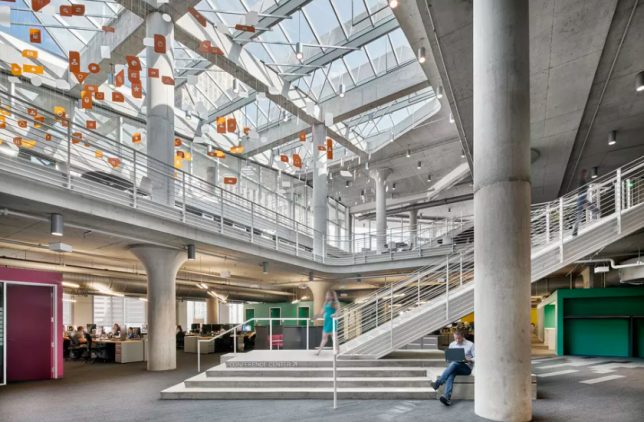
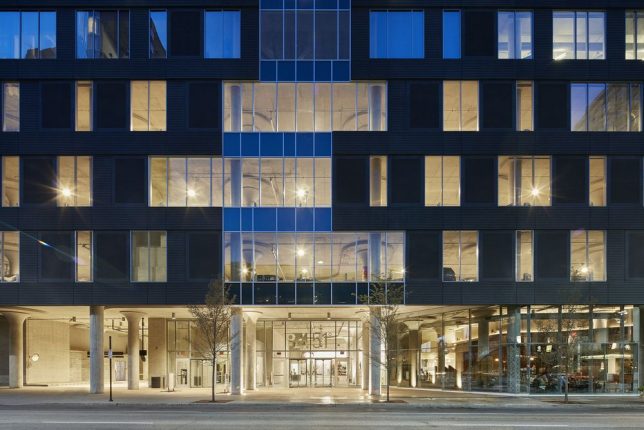
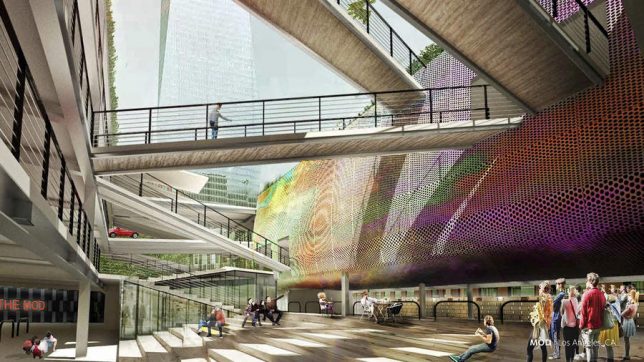
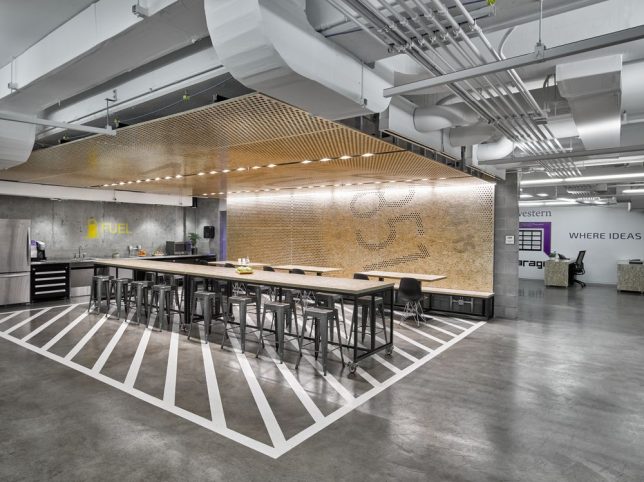
    Gensler’s The Mod concept plays to new possibilities in light of their predictions, featuring garage floor heights that will work for new uses. Its modular sections can be easily moved or removed to let in light and facilitate circulation. Built-in utility hookups also help make conversion easier. The firm has also designed a building in Ohio with three parking levels made to be changed into offices over time with easily-added facades and details similar to ones found on other floors (below).

    Another such project — a 1,000-car garage for building residents in the Arts District of Los Angeles by Avalon Bay — is to be completed in four years, a long time in this age of fast-evolving technology. Accordingly, their plans include tricks to make converting this area back to other residential uses easy and efficient. This includes flat floors (rather than inclined ones found in many garages) so they can be turned effectively into usable spaces, like shops or community areas.

    Converting garages will be a huge project of the coming decades, but so will rethinking the way new architecture is designed in the age of autonomous vehicles. Without people at the wheel, cars can park themselves in smaller spaces. Loading/unloading zones will be reduced and the way people enter buildings (from the street rather than a garage) could change dramatically as well.

    Then, of course, there are streets — with less street-side parking, space is opened up for things like parklets, walking and biking paths (not to mention all of the changes to how roads will work). Accordingly, many designers, developers and planners are wisely anticipating these changes — still, their ultimate effect on the built environment remains to be seen as the future continues to take shape.

    Share on Facebook


    [ By WebUrbanist in Architecture & Cities & Urbanism. ]

    [ WebUrbanist | Archives | Galleries | Privacy | TOS ]


    WebUrbanist

  • Venus Optics announces spec and price for 7.5mm F2 Micro Four Thirds lens

    $ (document).ready(function() { SampleGalleryV2({“containerId”:”embeddedSampleGallery_5301473564″,”galleryId”:”5301473564″,”isEmbeddedWidget”:true,”standalone”:false,”selectedImageIndex”:0,”startInCommentsView”:false,”isMobile”:false}) });

    Chinese optical manufacturer Anhui ChangGeng Optical Technology Company Limited, or Venus Optics, has released more details of a forth-coming lens it claims will be the widest rectilinear F2 for the Micro Four Thirds system. The Laowa 7.5mm F2 MFT was first seen at Photokina last year, and will offer the 110° angle of view we’d expect from a 15mm lens on a full-frame camera and will be available in two versions – a standard model that will weigh 200g / 7oz and a lightweight model that will tip the scales at 150g / 5.3oz.

    Both versions of the lens will feature 13 elements in 9 groups and will use a pair of aspheric elements and three in extra-low dispersion glass. The company has stopped short of using the ‘Zero-D’ designation it applies to the Laowa 12mm F2.8 and its previously announced 15mm F2, but does claim to have minimized distortion, as well as chromatic aberrations.

    The 7.5mm lens will have a 46mm filter thread, a closest focusing distance of 12cm / 4.7in, a 7-bladed iris and will be 55mm long. The lightweight version has been designed with drones in mind, will use lighter metals than the standard version and will cost $ 519 plus tax instead of $ 499. Black or silver options are available. The standard model will be shipping this month with the lightweight model following in July. For more full specification and pre-order information visit the Venus Optics website.

    $ (document).ready(function() { SampleGalleryV2({“containerId”:”embeddedSampleGallery_9744816138″,”galleryId”:”9744816138″,”isEmbeddedWidget”:true,”standalone”:false,”selectedImageIndex”:0,”startInCommentsView”:false,”isMobile”:false}) });

    Press release

    Venus Optics announces the Laowa 7.5mm f/2 MFT, the World’s Widest f/2 Lens for Micro Four Thirds Camera

    Featuring a 110° Angle of View, Ultra-fast f/2 aperture, 46mm filter thread& less than 200g in weight

    Venus Optics, the camera lenses manufacturer who had previously launched a number of unique Laowa camera lenses, is proud to announce the world’s widest rectilinear f/2 lens for Micro Four Thirds cameras, Laowa 7.5mm f/2 MFT.

    The Laowa 7.5mm f/2 MFT is currently the widest f/2 rectilinear lens ever designed for Micro Four Thirds Cameras. It is an ultra-wide & ultra-fast prime lens with a 35mm equivalent focal length of 15mm. Despite the extreme specifications, Venus Optics has successfully minimized the weight of the lens to less than 200g (0.44 pounds) and 55mm long. This compact and light lens comprises of 13 elements in 9 groups with 2 pcs of aspherical elements and 3 pcs of Extra-low dispersion elements. This optical design successfully minimizes the distortion and chromatic aberrations to its lowest but at the same time, delivers a superb optical performance from corners to corners.

    The extreme 110° angle of view and ultra-fast f/2 aperture allows photographers to create impressive astro-photography shots with ease. It also gives photographers a fast and wide-angle option for landscape photography and low-light shooting. The lens is designed with a 46mm filter thread which can gives additional portability for screw-in filters.

    Venus Optics also introduce a lightweight version for this lens and controlled the weight to merely 150g. The feather-light weight opens up a new opportunity for photographers and pilots to shoot wider footage with gimbals and drones.

    Availability
    The Laowa 7.5mm f/2 MFT is currently available to pre-order in the official website of Venus Optics (http://www.venuslens.net/) and their authorized resellers. It comes with 2 colors, Black and Silver. Recommended Retail Price in US (without tax) is USD 499/pc for standard version and USD 519/pc for Lightweight version. Pricing may vary in different countries.

    Articles: Digital Photography Review (dpreview.com)

  • What Bugs You? 19 Images of Creepy Crawly Critters

    With spring comes new life, growth, rebirth. It’s also time for the bugs to show up!

    Those creepy crawly, flying, buzzing, annoying insects. But yet some of them are oddly beautiful as well. Let’s see some images of these creatures.

    By Allxan.

    By Mike Keeling

    By Grozzle J

    By Dinesh Valke

    By Tibor Nagy

    By Santanu Sen

    By Markus Trienke

    By uditha wickramanayaka

    By Giuseppe Calsamiglia

    By Robert Whyte

    By Robert Whyte

    By Ziva & Amir

    By the_tahoe_guy

    By Mike Keeling

    By Mike Keeling

    By coniferconifer

    By Steve Bremer

    By Mike Keeling

    By John Flannery

    The post What Bugs You? 19 Images of Creepy Crawly Critters by Darlene Hildebrandt appeared first on Digital Photography School.


    Digital Photography School
  • DPReview on TWiT: NAB roundup

    On the latest episode of the TWiT Network’s weekend show, The New Screen Savers, DPReview editor Dale Baskin joins tech guru Leo Laporte, and co-host Iain Thomson, to talk about hot products and trends from NAB 2017. Tune in to the entire episode to also learn about the dangers of ‘space weather,’ an update on the Cassini spacecraft crossing through Saturn’s rings, and a head-to-head comparison of the Samsung Gear VR and Google Daydream.

    You can watch The New Screen Savers live every Saturday at 3pm Pacific Time (23:00 UTC), on demand through our articles, the TWiT website, or YouTube, as well as through most podcasting apps.

    Articles: Digital Photography Review (dpreview.com)