Blog

  • Waterbird demos world’s first bendable Multi-Slider

    Photo Gear News has a hands-on video of Waterbird systems’ Multi-Slider, which the company touts as a world’s first. The slider can easily go from linear to curved, and users can make fine adjustments to the curve using an allen wrench. Each segment of the track has a tripod mount in order to keep things stable.

    An included motor moves the camera smoothly along the track, while a controller lets the photographer define the positions, speed and acceleration for camera movement. The controller can also be controlled remotely from a mobile device.

    The Multi-Slider comes in three sizes: 80cm, 120cm and 150cm, and Waterbird can produce custom sizes, as well.

    Pricing has yet to be announced.

    Articles: Digital Photography Review (dpreview.com)

  • Instagram gets Snapchat-style face filters and the transformation is practically complete

    One update after another has given Instagram, the Facebook-owned image sharing app, a look that resembles Snapchat. And here we are, the day we knew was coming: the day that silly augmented reality filters arrive on Instagram. Instagram version 10.21 for iOS and Android enables a set of eight face filters for the front and rear cameras. The ability to adorn photos with hashtag ‘stickers’ is new as well. Like it or not, it’s just a matter of time before you see someone wearing adorable bunny ears in your Instagram feed.

    Articles: Digital Photography Review (dpreview.com)

  • Sony releases machine vision sensor capable of 1000 fps object tracking

    Sony has released a new machine vision CMOS sensor, and though it’s destined for assembly lines and robots, it’s still interesting to us. Like the chip in the RX100 V, the IMX382 is a stacked, backside-illuminated chip capable of 1000 fps imaging. And, like that sensor, its stacked design includes signal processing circuitry in the chip. Unlike the RX100 V’s sensor, though, the 1.27MP IMX382 conducts video processing and subject recognition in parallel, so that it outputs both a ‘viewing’ stream and a ‘sensing’ stream simultaneously.

    The sensing processing uses color and brightness information obtained from the sensor, enabling incredibly fast subject identification and tracking at 1000 fps. You can see what that looks like in the video below:

    At a little over 1 megapixel this sensor is not destined for a smartphone or camera. And of course those applications get more complicated since they also have to re-focus a lens to keep up with a moving subject, but it’s interesting to see what levels of recognition and tracking possible when you bring signal processing to the chip itself.

    Articles: Digital Photography Review (dpreview.com)

  • Company wins $900k in damages after competitor steals images

    In 2015, Oregon-based company Under a Foot Plant Co. filed a lawsuit against Maryland-based competitor Exterior Design Inc. over the latter company’s alleged copyright infringement. According to the lawsuit, Exterior Design used 24 of Under a Foot Plant Co.’s copyrighted photographs without permission, resulting in 133 instances of copyright infringement. Under a Foot Plant Co. had created the photos to market a product line called Stepables, while Exterior Design used them to market a competing product called Treadwell Plants.

    According to the lawsuit, Exterior Design’s infringement of Under a Foot Plant’s copyrighted images began in 2011 and continued through 2014. The legal document claimed that Exterior Design was engaging in ‘copyright infringement, unfair and deceptive trade practices, and unjust enrichment.’ Though Exterior Design denied the allegations, the legal matter proceeded and, after the better part of two years, has reached its conclusion in Under a Foot Plant Co.’s favor. 

    Per the jury’s decision, Under a Foot Plant Co. can choose to be awarded either $ 300,000 in statutory damages or $ 900,000 in actual damages, but isn’t allowed to receive both.

    Via: PDN

    Articles: Digital Photography Review (dpreview.com)

  • Are we impressed by Eye AF on the Sony a9? Yes and no

    A new video shows the a9’s Eye AF (in AF-C) tracking working remarkably well with a single subject, tracking the subject’s eyes all the way to the edges of the frame. Here are three reasons we’re impressed, and a couple reasons we’re still left ambivalent:

    Thumbs up:

    • The a9 continues to track the subject’s eye when all it sees is his profile. It’s quite robust (though not robust enough; see ‘thumbs down’ below).
    • It tracks the eye at 20 fps, while the a7R II’s Eye AF-C falls apart in continuous drive.
    • When the subject turns his back to the camera, the camera doesn’t jump off to the background, maintaining focus at its current position instead.

    Thumbs down:

    • Sony continues to offer no dependable solution for when you have multiple subjects in the frame. Though you can use this workaround to select which subject you want the camera to target, it’s prone to erratically switch subjects. Here’s a far faster way to select the subject to target.
    • When the subject in the video turns completely around, the camera stops tracking him altogether, unlike Canon Dual Pixel AF which uses enough ‘fuzzy logic’ to stay on our subject. Although we’re happy that in this example the camera doesn’t jump off to something else, if there were another face in the scene it likely would have.

    Our request to Sony:

    Be robust enough that when the camera no longer detects the eye of the original subject, focus just hangs around the general vicinity of the subject. This should be easy as the camera has distance (phase) information indicating the distance of the general subject matter around the eye its been tracking – but now lost – hasn’t radically changed.

    Furthermore, retain some remembrance of the facial features when Eye AF is initiated so as to re-attain eye focus when the subject looks back at the camera and re-recognizes the initial eye (pattern) after having lost it. This is how Nikon’s 3D subject tracking works.

    Articles: Digital Photography Review (dpreview.com)

  • Canon EOS M6 Review

    The Canon EOS M6 is a compact 24MP APS-C mirrorless digital camera with twin dial controls and a touch screen interface. Starting at $ 779 for the body, it takes the guts of the EVF-equipped EOS M5 and puts them in an updated version of the M3 body. It sits in Canon’s M lineup between the M3 and M5, and is sold with the 15-45 and 18-150mm lenses as kit options for $ 899 and $ 1,279 respectively.

    Key Features:

    • 24MP APS-C sensor with max ISO of 25600
    • Dual Pixel on sensor PDAF
    • Electronic video stabilization combines with in-lens IS to give 5-axis IS
    • 7 fps continuous shooting (9 fps with focus and exposure locked)
    • Wi-Fi with always-connected Bluetooth

    As usual, Canon has a different view of the market from everybody else, leaving the M6 as either an expensive, better-built alternative to entry-level mirrorless rivals or as a mid-level/enthusiast model shorn of a viewfinder. Either way, it looks a bit pricey. Its level of build and controls puts it up against the throwback style of the Olympus PEN F, Panasonic’s 4K-capable GX85/80, Sony’s value-tastic a6000 and Fujifilm’s rather aged X-E2s.

    It’s also interesting to compare it with Canon’s own Rebel series. With its twin control dials and very similar underlying hardware, the M6 is essentially an EOS 77D but without the bulk/utility of an optical viewfinder and with a smaller choice of lenses (unless you forfeit some of the size benefit and use an adapter). The difference in list price is $ 120 or you can get an M6 kit for the price of a body-only 77D.

      Canon EOS M6 Sony a6000 Panasonic GX85 Canon EOS 77D
    MSRP
    (base kit lens)
    $ 899 $ 599 $ 799 $ 1049
    Sensor 24MP APS-C 24MP APS-C 16MP Four Thirds 24MP APS-C
    Image stabilization Lens-based Lens-based In-body Lens-based
    AF system Dual Pixel AF On-sensor phase-detect Contrast-detect with DFD Dual Pixel AF + phase-detect
    LCD type Tilting Tilting Fully articulating Fully articulating
    Touchscreen Yes No Yes Yes
    Viewfinder No 1.44M dot EVF 2.76M dot equiv. EVF* OVF
    Burst rate
    (with AF)
    7 fps 11 fps 6 fps 6 fps
    Mic/headphone
    jacks
    Yes / No Yes / No Yes / No Yes / No
    Video 1080/60p 1080/60p UHD 4K @ 30p 1080/60p
    Wireless Wi-Fi w/NFC Wi-Fi w/NFC Wi-Fi Wi-Fi w/NFC
    Battery life 295 shots 360 shots 290 shots 600 shots (OVF)
    Weight (body) 343 g 344 g 426 g 540 g
    *Uses field sequential update to give resolution equivalent to 2.76M dots

    Years ago, I assisted a fashion and editorial photographer who had preordered the EOS M plus an EF adapter the moment the cyber gates opened. They were excited to have a point and shoot sized APS-C second camera that took up less space than a lens in a camera bag.

    In their imagination was a camera with AF capabilities, controls, and image quality similar to a midrange APS-C DSLR, but with the size advantages of a mirrorless system. It was returned immediately after adapting it to one of their existing EF lenses. The slow CDAF system meant it couldn’t come close to being a second body that could be counted on in a pinch.

    The EOS M6 comes with great autofocus performance, even in macro mode.
    Canon EF-M 28mm F3.5 Macro | ISO 100 | 1/400 sec | F5
    Photo by Samuel Spencer

    I’m happy to say the camera they were originally hoping for has been released. The $ 780 (body only) Canon M6 may be a bit larger and more upmarket than the original M, but it has the controls, image quality, and AF performance that can keep up with DSLRs in many situations. It is also currently the smallest package in which you can find Canon’s Dual Pixel Autofocus.

    In this review we’ll look at the camera through the eyes of a series of potential buyers. To begin, let’s see how the EOS M6 really stacks up as an addition to an established Canon shooter’s larger kit.

    Articles: Digital Photography Review (dpreview.com)

  • Delkin BLACK USB 3.0 Rugged Memory Card Reader offers microSD, CF and SD slots

    Delkin has launched the BLACK USB 3.0 Rugged, a large memory card reader featuring both microSD and SD UHS-II card slots.  This is the first rugged memory card reader offering both of these slots in a single device, according to Delkin, making it a suitable model for on-the-go photographers who are frequently in ‘strenuous shooting environments.’

    In addition to support both USH-II SD and microSD cards, the BLACK USB 3.0 Rugged has a larger Compact Flash UDMA 7 memory card slot. Transfer speeds reach up to 500MB/s, which Delkin says is ten times the speed of USB 2.0. All three card slots can be used at the same time, while the USB transfer cord and one of each type of flash card can be stored inside of the media card reader when not in use.

    The card reader itself is made from both plastic and aluminum with a rubber cover that shields the device from water, dust, and impacts caused by bumps and drops. If the BLACK USB 3.0 Rugged does break at any point within its 5-year warranty period, Delkin will ship a replacement to the customer within 48 hours. The model is available now exclusively within authorized retail camera stores; price isn’t clear at this time.

    Via: PhotographyBLOG

    Articles: Digital Photography Review (dpreview.com)

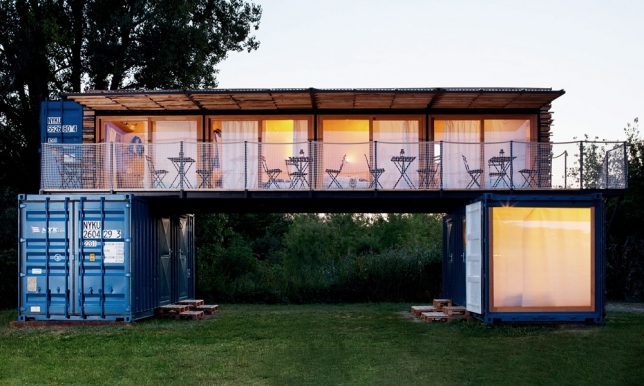
  • Trainspotting Hotel: Stacked Shipping Containers Overlook the Rail Tracks

    [ By SA Rogers in Boutique & Art Hotels & Travel. ]

    The phrase ‘Trainspotting Hotel’ probably doesn’t conjure visions of a cozy, comfortable and safe place to lay your head at night, but this hotel gets its nickname from its location overlooking rail tracks rather than anything relating to the heroin-charged cult classic film. Obviously, that’s a good thing for guests who want to enjoy a peaceful getaway on the Elbe River near the town of Litomerice, Czech Republic at this unusual pop-up structure by Artikul Architects. 

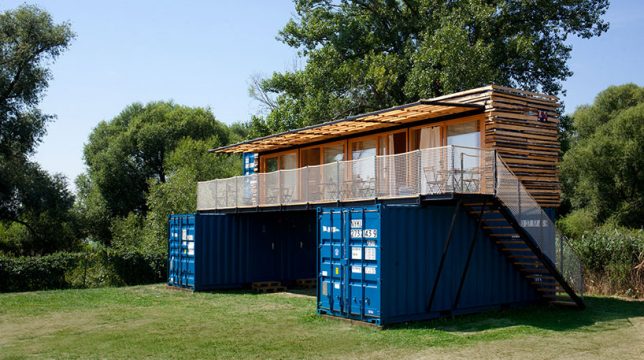
    The hotel is comprised of just three shipping containers, with one forty-foot crate stacked atop two twenty-foot crates in a perpendicular arrangement to create a covered space underneath. The two ground-floor containers house the bathrooms, storage and one of the guest rooms, while four more guest accommodations are set into the top layer.

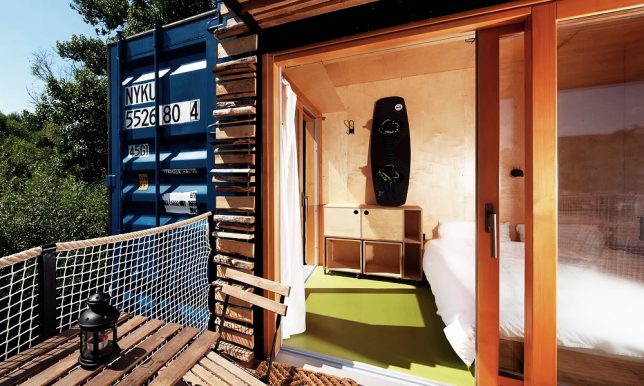
    The client commissioned Artikul to produce a modular design that can be easily taken apart and moved when desired, and would have a light footprint on the land. The hotel has its own built-in water reservoir for the showers and sinks, and utilizes waterless toilets, and the bedrooms are compact but warm and welcoming, fitted with bunk beds and lined with birch plywood.

    Artikul is known for producing sustainable structures, so it’s no surprise that they did something creative using recycled and natural materials. Barely any modification to the containers was necessary, preserving the ability to load them onto a truck. The top container is sheathed in reclaimed wood and features a terrace and awning so guests can hang out in the open air and enjoy the views.

    Share on Facebook


    [ By SA Rogers in Boutique & Art Hotels & Travel. ]

    [ WebUrbanist | Archives | Galleries | Privacy | TOS ]


    WebUrbanist

  • Back to basics: A simple three-point lighting setup for headshots

    Music photographer PJ Pantelis points out that three point lighting is nothing new, but it’s not something every self-taught photographer has learned. If that sounds like you and you’re looking to experiment with studio portraiture, his recent demo provides a great starting point. 

    Articles: Digital Photography Review (dpreview.com)

  • Apple ad hints that its Portrait mode is so good it will save your family business

    They say a picture’s worth a thousand words. But in a tongue-in-cheek new Apple ad, a picture turns out to be worth hundreds of new customers, thanks to the iPhone 7’s Portrait mode. The minute-long spot features a quiet family barbershop that sees its business boom after posting photos of its clients and their sleek new haircuts in the window. The photos, of course, are taken with the iPhone 7’s bokeh-imitating Portrait mode. 

    Photographers will likely find the premise a little tiresome, as they’ve heard for ages how easy it is to replace their experience and skill set with an incredible new camera/auto mode/photo app. But as much as we want to dislike this ad, it’s just too darn upbeat and clever to hate. See what you think.

    Articles: Digital Photography Review (dpreview.com)