Blog

  • Google demos technology that scrubs objects from photographs

    During its I/O 2017 conference yesterday, Google demonstrated a new algorithm-based technology that can remove unwanted objects from existing photographs. The demonstration showed the technology removing a chainlink fence from the foreground of an image, with the final result offering no discernible indications that the fence had ever existed (around 10:45 in the video below).

    The technology was demonstrated on stage by Google’s CEO Sundar Pichai during a conversation about the company’s expanding visual technology. ‘Coming very soon,’ Pichai explained, ‘if you take a picture of your daughter at a baseball game and there’s something obstructing it, we can do the hard work and remove that structure and have the picture of what matters to you in front of you.’

    It looks to be an evolution of the research Google and MIT have been collaborating on for some time – in fact, their demonstration from 2015 includes a very similar chain-link fence demo. This method takes advantage of the parallax effect to identify and remove obstructions from photos. 

    Unfortunately, Pichai didn’t elaborate on when this technology will be made available aside from ‘very soon,’ nor did he specify where the technology will be available. Given the company’s Google Photos announcements, however, it seems likely the technology will be implemented within that product.

    Via: Google

    Articles: Digital Photography Review (dpreview.com)

  • A Taste of New York is a stunning Big Apple time-lapse

    A Taste of New York is the third installment of the popular “A Taste of…” series of time-lapses by Film Spektakel. To produce this breathtaking video the team around Peter Jablonowski, Thomas Pöcksteiner, and Lorenz Pritz spent 10 days in New York in 2016, shooting 65,000 photos and accumulating 2.6TB of image data on their hard drives.

    ‘In September 2016 we visited this awesome city to try out some new time-lapse stuff.
    It took us 10 days, a lot of burgers and one helicopter ride to produce this video. 10 days is very little time to discover this city of endless opportunities, so we hardly slept anything and shot day and night for this time lapse film. The city that never sleeps indeed!’

    The team used a variety of equipment including a Sony a7R II, Sony a6300 and two Canon 6Ds. The final three minute long video took 36 hours to render on a high-end Apple iMac. The stunning imagery is perfectly complemented by Alex Clement’s sound design. 

    Articles: Digital Photography Review (dpreview.com)

  • Canon warns of defective focusing in some EF 24-105mm F4L IS II lenses

    Canon has issued a service notice for a collection of lenses with specific serial numbers that need to be checked for faulty focusing systems. The lens affected is the EF 24-105mm F4L IS II USM standard zoom, but users are advised that only particular production batches have the problem.

    Canon says that some units with serial numbers beginning with 48, 49, 50 or 51 suffer from poor focusing when used with an AF point close to the edges of the host camera’s focusing array. The fault is only apparent when the lens is used at wide-angle focal lengths.

    All defective lenses will be taken back for testing and repair at no cost to the owner, the company says. The Canon website carries a service section that allows owners of the lens to type in the serial number of their lens to check whether it will need to be returned.
    For more information see the Canon USA, Europe or Asia service pages, or those for your local area.

    Manufacturer’s information

    Service Notice: EF 24-105mm f/4L IS II USM Lens

    Thank you for using Canon products.

    We have determined that some EF 24-105mm f/4L IS II USM lenses exhibit an AF operation-related malfunction. The details of the phenomenon and Canon’s service policy are described below.

    We would like to offer our sincere apologies to users who have been inconvenienced by this issue. Going forward, we will spare no effort in our quality management to make sure our customers can use our products with confidence.

    Phenomenon
    At the wide-angle end, focus is not achieved properly when a peripheral AF points are selected, regardless of the AF area selection mode.

    Affected Lenses
    If the first two digits in the serial number (see the image below) of your lens are ”48”, ”49”, ”50” or ”51”, then your lens MAY POSSIBLY be affected.

    How to check if your lens is affected:
    1. Click the search button below to display the serial number input screen.
    2. Input your lens’ serial number (10 digits) and then click the [Submit] button.
    * Please double check the serial number you entered before you click the [Submit] button.
    3. One of the following three messages will be displayed.
    “Your lens is NOT an affected product”?
    “Your lens is an affected product”
    “Invalid number”

    Support
    As soon as preparations have been completed, we will inform users about the start date for accepting support requests for lenses affected by this issue.

    Potentially affected products will be inspected and repaired free of charge. If you own one of the potentially affected products please contact our Customer Support Center

    Articles: Digital Photography Review (dpreview.com)

  • Free Castles & Villas: Italy is Giving Away Over 100 Historic Properties

    [ By WebUrbanist in Boutique & Art Hotels & Travel. ]

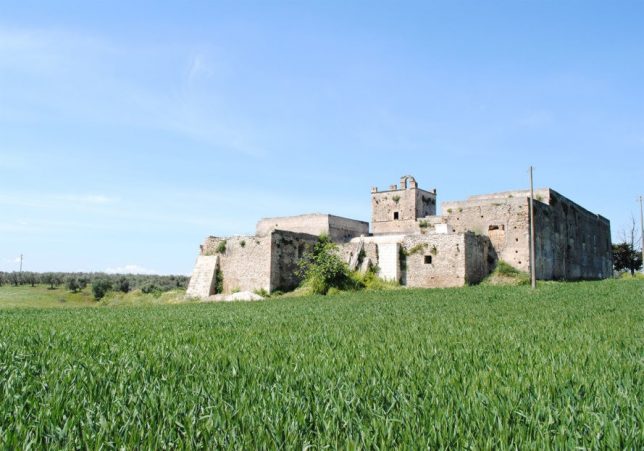
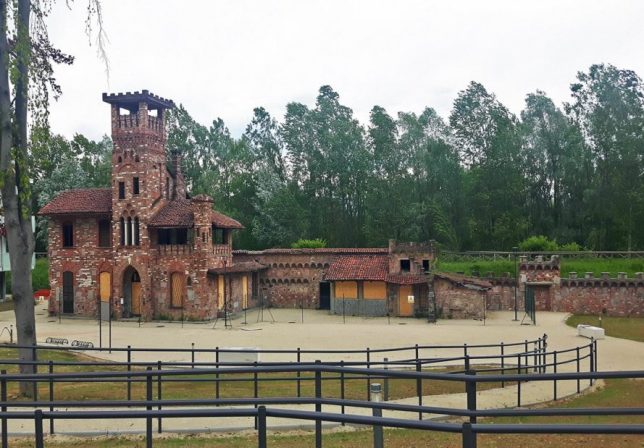
    Anyone who has dreamed of retiring from the rat race to run a grand estate hotel, rural farmhouse bed and breakfast, quaint inn or remote monastery spa could see their wish come true in this unprecedented giveaway from the Italian government.

    As part of its Strategic Tourist Plan, Italy is offering up 103 historic sites to those with the will and means to renovate them back into use for tourism purposes. And this is just the initial offering: 200 more are slated to be given away over the coming years.

    The State Property Agency and Ministry of Cultural Heritage are leading the project, aiming to draw visitors to beautiful areas with currently disused architecture. In some cases, a lot of work is needed, but that’s the nature of centuries-old structures.

    State employee Roberto Reggi says “The project will promote and support the development of the slow tourism sector. The goal is for private and public buildings which are no longer used to be transformed into facilities for pilgrims, hikers, tourists, and cyclists.”

    The country has previously auctioned off historic properties, including dozens of lighthouses, with similar goals in mind, but this time they are making it all free, banking on the long-term prospects of the renovations to raise funds for local businesses and the national economy (via Inhabitat).

    Share on Facebook


    [ By WebUrbanist in Boutique & Art Hotels & Travel. ]

    [ WebUrbanist | Archives | Galleries | Privacy | TOS ]


    WebUrbanist

  • Lighting 103: Greg Heisler on Light and Color

    Abstract: Chromatically complex light adds much more realism to your lit photos.

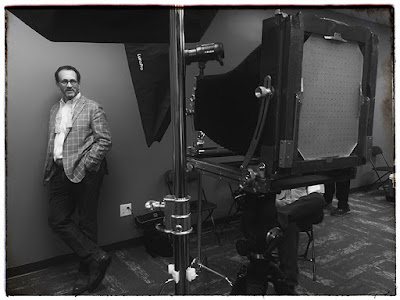
    Today’s Lighting 103 post features excerpts from a bar conversation with Greg Heisler. It's just as if we cornered him at a conference (which I did) and he agreed to have a drink and talk color (which he did).

    This is roadmap stuff. It's above and beyond the specific info he includes with each of the assignments in his book, 50 Portraits, the companion text to L103.Read more »
    Strobist

  • Throwback Thursday: Olympus C-8080 Wide Zoom

    Announced in 2004, the Olympus C-8080 Wide Zoom wasn’t the first camera with a focal range starting at 28mm, nor was it the highest resolution camera at the time with its 8 megapixel CCD. What made the C-8080 interesting was the amount of work that Olympus put into the lens, claiming that it was designed to be on par with the Zuiko Digital lenses found on its DSLRs.

    The lens had an equivalent focal length of 28-140mm and an impressive maximum aperture range of F2.4-3.5. It used three ED glass elements to reduce chromatic aberration, something not normally found on a compact camera. In DPReview’s testing, seeing CA in the real world was a rarity. The lens was threaded and supported both telephoto and wide conversion lenses. One bummer about the lens was that the zoom was electronically controlled, rather than mechanically, a feature found on the Minolta DiMAGE A2 and Sony DSC-F828 at the time.

    Those are who are familiar with the Olympus E-10 will definitely notice some similarities with the control layout and LCD/viewfinder placement.

    The C-8080WZ wasn’t the smallest camera out there, but there’s a lot of glass plus an EVF and tilting LCD that you’ll see in a moment. It was made of magnesium alloy that Phil Askey said was ‘heavier grade than we’re used to seeing.’ Phil also complimented the well-designed front and rear grips.

    Something worth pointing out is that the camera had an external phase detection sensor (to the left of the Olympus logo). Phil’s review praised the fast AF speeds of the camera, though he was less keen about how quickly the lens zoomed and that there were only five ‘stops’ along the way.

    The C-8080’s 1.8″ LCD could be pulled away from the body and tilted up or down. The resolution of 134k wasn’t great, but hey, it was 2004 (the user interface from back then is worth a look, as well). There’s also a pretty big electronic viewfinder, which had 240k dots. 

    The camera had two memory card slots: one for CompactFlash and the other for – you guessed it – xD Picture Cards. Sadly, despite all of the semi-pro features on the C-8080WZ, it only had one control dial.

    So what about photo quality? The C-8080WZ tied for the best resolution among a group of five 8MP cameras, with low noise at high ISOs. The lens had very little barrel distortion but some unexpected pincushion distortion, though Phil noted that it was unlikely that you’d notice this in the real world.

    In the end, the C-8080 Wide Zoom earned a coveted ‘highly recommended’ award, due in large part to its lens. The main negatives were the aforementioned zoom speed and number of stops issues as well as camera lockup while Raw images are saved and an aging menu system. 

    Do you have fond memories of the C-8080 Wide Zoom? Share them in the comments below. And let us know if you have suggestions for future Throwback Thursday articles!

    Olympus C-8080WZ Sample Gallery

    $ (document).ready(function() { SampleGalleryStripV2({“galleryId”:”7875368385″}) })

    Sample photoSample photoSample photoSample photoSample photo

    Articles: Digital Photography Review (dpreview.com)

  • Sony a9: all that speed appears to have dynamic range cost

    The Sony a9 is a powerhouse of technology, particularly when it comes to speed and autofocus. But does its image quality stack up? We’ve taken an initial look at Raw and JPEG image quality and have come away impressed, but how does the a9 stack up in terms of dynamic range?

    At the recent launch in New York City, I had a chance to shoot our standard ISO-invariance test but on a real-world scene (our studio scene isn’t so portable…). Have a look at the performance below.

    $ (document).ready(function() { ImageComparisonWidget({“containerId”:”reviewImageComparisonWidget-19343974″,”widgetId”:522,”initialStateId”:null}) })

    It’s immediately obvious the a9 is not ISO-invariant (what is ‘ISO-invariance’?). This means the camera is adding a fair amount of read noise that results in noisy shadows, limiting dynamic range at base ISO. That’s why, for the same focal plane exposure, performing analog amplification by increasing ISO in-camera gets you a cleaner image than performing that amplification (or brightening) in post-processing.

    It’s not the typical performance we’ve come to expect from Sony sensors and we suspect the higher readout speed is leading to greater noise. In other words, it appears this sensor was likely optimized for speed at the expense of low ISO dynamic range.

    This sensor was likely optimized for speed at the expense of dynamic range

    Ultimately, this limits the exposure latitude of a9 Raws so, much like with older Canon DSLRs, you’ll have limited ability to expose high contrast scenes for the highlights, then tonemap* (raise) shadows in post. You can check the effect of changing the Drive mode in the widget (EFCS = electronic first curtain, S = single, C = continuous), but there’s not much difference between them.

    Effect of Drive mode

    There is little to no difference in base ISO dynamic range in different drive modes. So the good news is that the drop to 12-bit in continuous drive comes at no cost. The bad news is that the 14-bit Raws aren’t any better than the 12-bit ones. Click here to load the above as a widget.

    As we mentioned above, there’s no difference in shadow noise as you change Drive mode. This is particularly interesting because all Single drive modes, including fully electronic, support full 14-bit Raw (we shot uncompressed). The Continuous drive modes, however, switch the sensor into a 12-bit** readout mode which, by definition, means files with no more than 12 stops of dynamic range.

    This indicates that even the 14-bit Raws have at most 12 EV of dynamic range at the pixel level, placing our estimates of base ISO dynamic range almost a full stop behind the a7, and likely further behind the a7R II at equivalent viewing size (normalized).

    ‘Dual Gain’ helps improve high ISO dynamic range

    In our widget up top, you may have noticed that noise suddenly starts increasing once you fall below ISO 640 (how’s that for sounding completely back-to-front?). Below you’ll see this more clearly: shadow noise dramatically clears up as you go from an ISO 500 image (with a 3.7 EV push) to an ISO 640 image (with 3.3 EV push):

    $ (document).ready(function() { ImageComparisonWidget({“containerId”:”reviewImageComparisonWidget-12344692″,”widgetId”:521,”initialStateId”:null}) })

    Things clean up at ISO 640 (as with the a7R II) because of the sensor’s ‘dual gain’ architecture, where the camera increases the conversion gain (effectively amplification) at the pixel-level during readout, helping overcome the camera’s relatively high (for a Sony design) read noise.

    Above ISO 640, the camera is fairly ISO-invariant, since it’s overcome most of its downstream read noise, but there’s still some benefit to increasing ISO to keep noise levels low if your scene demands it. Below ISO 640, the lower conversion gain means that you’ll start to see read noise if you push shadows.

    Take home

    The good news is that those worried about the camera dropping to 12-bit readout in continuous shooting needn’t worry: there’s no decrease in quality, since a 12 bit file can contain all its dynamic range. The bad news is that this is because the a9 doesn’t appear to have more than 12 EV pixel-level dynamic range to begin with, putting its base ISO dynamic range well behind that of the a7R II. By high ISO, general image quality catches up as the higher downstream read noise is overcome by the sensor’s (similar to the a7R II) dual gain architecture. Take a look at this ISO 51,200 comparison with the a7R II:

    ISO 51,200 comparison of a7R II vs a9. Not much difference at all. In fact, normalized signal:noise ratio (SNR) measurements place the two neck-to-neck: 1.82 vs. 1.48 for the a7R II and a9 at the dark patches here, respectively. At ISO 25,600, the normalized SNR is exactly the same.

    This means that if you’re shooting in conditions demanding high ISO, for any given focal plane exposure you may wish to at least increase in-camera amplification to ISO 640 to get most tones above the noise floor, if your scene demands the extra amplification to get a usable image. Dropping below ISO 640 to preserve highlights, and then raising shadows afterwards, will come at a greater noise cost than, say, Sony’s own a7R II.

    Interestingly, this means there’s little advantage to those large (47MB) uncompressed 14-bit Raw files, save for the lack of compression artifacts. In a perfect world, Sony would have offered a 12-bit Raw mode with a lossless compression curve (without that second stage of localized compression that leads to edge artifacts) for smaller file sizes with minimal loss in quality.


    Footnotes:

    * There’s a very specific reason I like to use the word ‘tonemap’ instead of ‘raise the shadows’. We’re forced to raise shadows of high contrast Raw files exposed for the highlights today because of the limited brightness of most current displays. Future displays capable of far higher brightnesses (perhaps even ten-fold) will need less shadow pushing, or tone-mapping, to make visible what you currently see as ‘shadows’ in such traditionally underexposed Raw files. For example, shadows you currently push +4 EV will likely be visible without any pushing at all on a 4,000 nit-capable display. 

    ** We confirmed that continuous modes were in fact 12-bit, while single modes were in fact 14-bit, by comparing histograms of respective Raw files. The 14-bit single drive files do, in fact, have 14-bits of data compared to the 12-bit files (the histogram shows the latter missing levels 1, 2, and 3, in between 0 and 4, but the 14-bit files do have pixels with these values).

    Articles: Digital Photography Review (dpreview.com)

  • The Sky’s The Limit: 14 Promising New Advancements in Solar Power

    [ By SA Rogers in Gadgets & Geekery & Technology. ]

    Even while it feels like certain things are moving backward, efforts to power the world with solar energy instead of fossil fuels continue to reach for the sky, innovating advancements that make a renewable future more achievable. Tesla’s Solar Roof tiles are about to become commercially available, flexible solar panels are cheaper and more efficient than ever, we’re several steps closer to transparent solar power-producing windows and there’s even a product so thin and tiny it’s called ‘solar glitter.’

    Solar Blinds by SolarGap

    Designed with apartment-dwellers in mind, these smart solar blinds are inexpensive, easy to install, and work best when the blinds are open. If you have a window that gets a little too sunny at some point in the day, these could be an ideal gadget to reduce your electricity costs by up to 70 percent. They work best on the outside of your window, producing up to 100 watts of electricity, which is enough for one window to charge your laptop. You can use a smart app to control the blinds and monitor how much power they’re producing.

    Plug and Play Smart Flower Solar Device

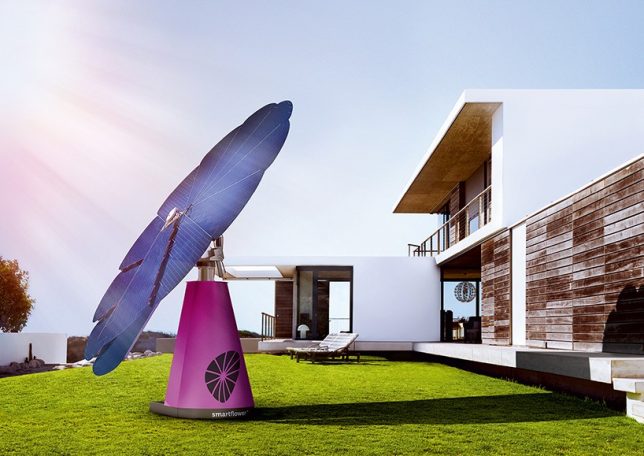
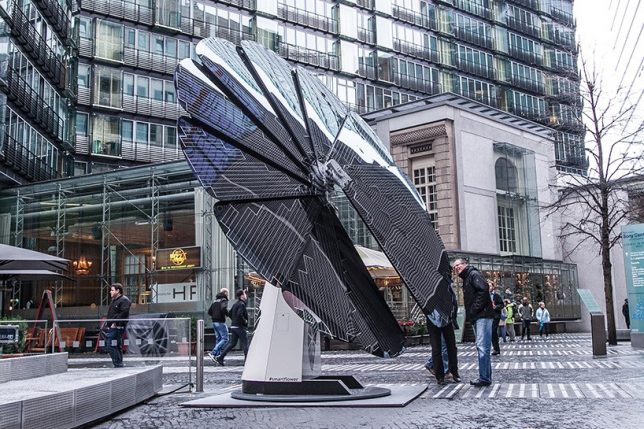
    The Smart Flower features solar panel ‘petals’ that unfurl at sunrise, automatically directing themselves toward the sun and continuing to move throughout the day for optimal placement to produce 40 percent more energy than a static solar panel setup. Taking its inspiration from the shape of a sunflower, the smartflowerPOP will juice you up with 3,400 to 6,300 KWH per year.

    World’s Largest Solar Storage Facility Works 24/7

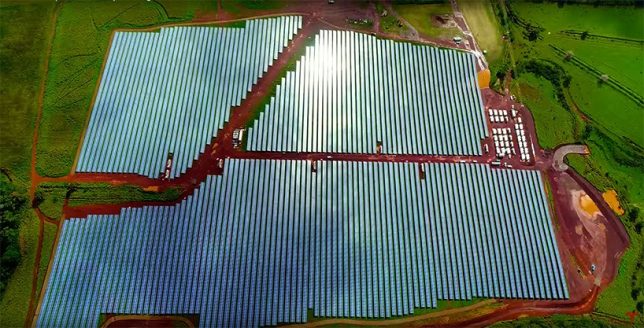
    Tesla and SolarCity opened a 13 MW solar far in Kauai, Hawaii featuring 54,978 solar panels and a 52 MWh battery bank, large enough to run twenty-four hours a day and provide up to 44 percent of the island’s power, compared to its 92 percent dependence on fossil fuel in 2011.

    Wattway: The World’s First Solar Panel Road

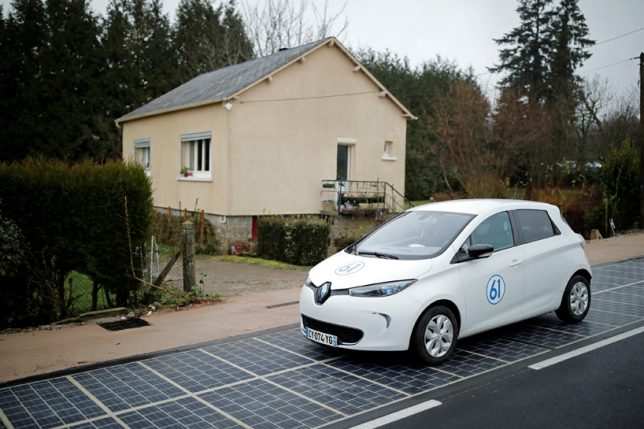
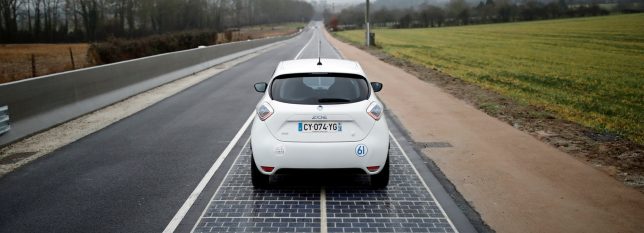
    There are a lot of reasons to be skeptical of a solar panel roadway, the first and foremost being that integrating an emerging technology into infrastructure may not be the best idea for long-term success. Solar power is rapidly changing, and the tech used for France’s ‘Wattway’ and similar projects will likely soon be obsolete, not to mention the probability of the panels being damaged. But The idea could still have weight for some applications, and Wattway is expected to generate 280MWh per year.

    Solar Glitter Can Make Almost Anything Solar-Powered

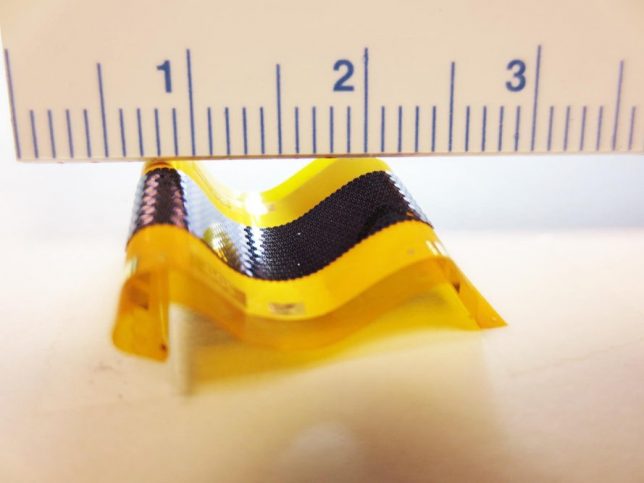
    An innovation called Dragon SCALEs by Sandia National Laboratories acts like solar glitter, shrinking solar panels down to tiny, flexible snowflake-inspired cells that could theoretically be applied to just about anything. Making use of recent advancements in micro design and micro fabrication, the panels can be folded like paper, rapidly and cheaply installed, and turn just about any object into a solar power generator.

    Next Page – Click Below to Read More:
    The Skys The Limit 14 Promising New Advancements In Solar Power

    Share on Facebook


    [ By SA Rogers in Gadgets & Geekery & Technology. ]

    [ WebUrbanist | Archives | Galleries | Privacy | TOS ]


    WebUrbanist

  • Google Photos update encourages sharing, adds photo book creation

    Google’s I/O conference today included some information about updates for the company’s photo organization app. Google Photos will use machine learning to analyze who’s in your photos and automatically suggest photos to share. Suggestions will appear in the sharing tab on the Photos apps for Android, iOS and web ‘in the coming weeks.’ You’ll also be able to set up shared libraries to automatically send photos to designated people – with the ability to share everything, or just photos of certain people, for example.

    Google also announced it will allow you to create photo books from your Photos library, streamlined by a largely automated photo selection process. They’ll be available to US users only at launch, and will start at $ 10 for a softcover book and $ 20 for hardcover.

    Articles: Digital Photography Review (dpreview.com)

  • 10 cool DIY photography techniques that anyone can do

    Are you in a creative rut? Do you need some ideas to break out and do something different? This short video by COOPH highlights ten cool photography techniques that anybody can do.
    Do you have a favorite DIY technique that’s not in the video? Share it with us!

    Articles: Digital Photography Review (dpreview.com)