Blog

  • Sony FE 100-400mm F4.5-5.6 GM sample gallery

    With the FE 100-400mm F4.5-5.6 GM lens, Sony is seeking to fill a super-telephoto gap in its lens lineup with the announcement of the a9 sports camera. It may not have the fast aperture of competitors’ telephoto primes, but the zoom range is versatile, and the lens looks to be very sharp with pleasing out-of-focus backgrounds, plus it comes with a very close focusing distance to boot.

    We’ll be updating our gallery with more sports oriented samples on Sony’s a9 as we begin fully testing that camera, so stay tuned! In the meantime, enjoy some horses jumping and scenes from the El Capitan State Beach outside of Santa Barbara, CA.

    Sony FE 100-400mm F4.5-5.6 GM gallery

    $ (document).ready(function() { SampleGalleryStripV2({“galleryId”:”4598193995″}) })

    Sample photoSample photoSample photoSample photoSample photo

    Articles: Digital Photography Review (dpreview.com)

  • Overview of the New Canon 5D Mark IV

    Canon’s 5D Mark line has embedded itself deeply in the heart of photographers. Although the price generally keeps this camera in the hands of professionals, hobbyists have equally drooled over its capabilities and power. It comes as no surprise that the newest edition to the line, the Canon 5D Mark IV, sparked a lot of excitement and interest. But does this model really live up to the expectations it has set itself?

    Review of the Canon 5D Mark IV

    Subject: Rusty the Golden Retriever

    As a Canon camera enthusiast myself, having gone through many different cameras in my career (and currently working with four), I have been pleasantly impressed by the new model. Each camera has its high points and its low points, but the Canon 5D Mark IV lends itself to being an excellent piece of machinery with more pros than cons. In comparison to its predecessor the 5D Mark III, beloved features have been better optimized and improved while adding new capabilities that were previously missing.

    Review of the Canon 5D Mark IV

    Review of the Canon 5D Mark IV

    Physical Specs of the Canon 5D Mark IV

    In terms of the camera’s physicality, the Canon 5D Mark IV weighs at 28.2 ounces, versus its predecessor which weighed 30.4 ounces. Although this doesn’t sound like a significant difference, your arms will thank you for the lighter weight of the Mark IV after several hours of shooting. Lighter equipment weight is an aspect that many photographers consistently request from their beloved camera companies, as heavy gear often leads to various body aches.

    The body feels sturdy and comfortable. The fact that Canon found a way to decrease the weight of their newest 5D camera shows that the brand was certainly listening. Alongside this, the camera’s weather sealing shows quite an improvement over the previous models. I have taken the camera out to the snow, beach, heat, and rain with no trouble.

    Otherwise, The 5D Mark IV feels almost indistinguishable to the 5D Mark III. They have virtually the same ergonomics, buttons, and menu layout. The camera continues to have the dual card slots, much like the Mark III; one slot for a compact flash card and one slot for an SD card. The settings allow you to write on either both simultaneously or switch over to the secondary card once the main card is full.

    Review of the Canon 5D Mark IV

    New feature – touch screen

    Possibly the most noticeable new feature is the inclusion of a touch screen, the first of any of the 5D models. The touchscreen has been present in several of Canon’s other models, and this was highly requested as an addition to the new 5D lineup. In Live View Mode, the touchscreen allows you to tangibly tap the screen to adjust the focus or the exposure settings. This is a significant benefit to video shooters, as tapping the screen allows you to silently make your adjustments without adding noise to your rolling video.

    The touchscreen is also customizable, similar to the live view features of the 1Dx Mark II. It can be programmed so that the touch of the LCD screen actually takes the picture. The rear LCD on the 5D Mark IV is an improved 1.62 million-dot 3.2-inch screen, unlike the 5D MK III’s 1.04 million-dot LCD. Although Canon did not include a swivel LCD screen as wanted by many shooters, the touchscreen is a welcome addition.

    Review of the Canon 5D Mark IV

    Megapixels – big increase

    Although both are full-frame cameras, the Canon 5D Mark IV sports a whopping 30.4 megapixels versus the 5D Mark III’s mere 22.3 megapixels. 30.4 MP offer a solid 17% linear resolution increase. In addition, the new camera features Canon’s DIGIC 6+ image processor. Pair the processor with the increase in megapixels, and the 5D Mark IV officially has a better dynamic range (an aspect of the Mark III that often gets criticized).

    ISO range – not much change

    Review of the Canon 5D Mark IV

    The Canon 5D Mark IV at ISO 25,600 shutter speed 1/500th.

    The Canon 5D Mark III at ISO 25,600 shutter speed 1/500th.

    The ISO range for the 5D Mark IV is ISO 100 – 32,000, versus the Mark III’s 100 – 25,600. However, both models offer the same expanded ISO range of 50 to 102,400. The high ISO and low light performance continue to be quite excellent, as is to be expected from a full-frame Canon DSLR. However, there is no real significant difference in higher ISO performance from the Mark III to the Mark IV.

    Canon does have significantly better low light cameras in its highest end models (such as the ID X series), but the 5D holds its own very well for the price point. A big change in the ISO aspect of the camera, however, is the move to on-sensor analog-to-digital circuitry (ADC) that results in noteworthy improvement in base ISO dynamic range. Canon DSLRs prior to the 1D X Mark II and 80D were very well known for poor shadow recovery. This is not an issue in the Mark IV.

    Review of the Canon 5D Mark IV

    Subject: Kiss the Border Collie

    Frames per second burst rate

    The Canon 5D Mark IV has a 7 FPS burst rate, about one frame per second faster than the 5D Mark III. Not a huge difference in hindsight, but where the 5D Mark IV really excels is the buffer performance. Continuous JPEG shooting is essentially unlimited; the camera will shoot until the memory card is full, whereas the 5D Mark III’s buffer filled after about 63 JPEG images. Still an impressive feat, but the unlimited is certainly better.

    21 RAW frames can be captured before the buffer fills and the camera comes to a halt, which is fantastic considering that each RAW frame is from a 30.4 MP sensor. Wildlife photographers will really enjoy the 7 FPS burst rate and increased buffer performance.

    Review of the Canon 5D Mark IV

    Subject: Valkyrium

    New Dual Pixel Raw Mode

    On the topic of RAW, the Canon 5D Mark IV includes a very powerful new Dual Pixel Raw mode, which advances upon the Dual Pixel CMOS AF technology. This makes use of the split-pixel design to capture two images at once. The outcome allows you to be able to make subtle adjustments and changes to focus/sharpness, bokeh, and ghosting. The downside is that the file sizes of Dual Pixel Raw images are nearly twice as large, and the burst rate and buffer capacity are reduced while in Dual Pixel Raw mode.

    Review of the Canon 5D Mark IV

    Canon 5D Mark IV with Canon 70-200mm F/2.8 L IS USM II

    Autofocus

    The autofocus in this model is downright incredible. While the 5D Mark IV offers the same 61 AF points as in the 5D Mark III, the new model uses an upgraded AF system. Now all 61 points can focus down to f/8 and they can cover much more of the frame. The 5D Mark III only offered f/8 autofocusing at the center point. These changes are very similar to features inside the EOS-1D X Mark II, Canon’s high-end model. Photographers that use super-telephoto lenses and teleconverters are sure to appreciate this improvement.

    21 of these points also remain cross type for extra sensitivity. Unfortunately, there is no way to link spot metering to a chosen AF point. One of the big changes to autofocus on the 5D Mark IV is the use of the infamous Dual Pixel CMOS AF, frequently touted by Canon. Equally, the model has inherited the AI Servo AF III with EOS iTR AF from EOS 7D Mark II and EOS-1D X Mark II. This AF feature truly shines when using the camera to photograph sports or action.

    The AF system’s detection range has also been broadened, from -2 EV on the EOS 5D Mark III to -3 EV, and this drops down even further to -4 EV when using Live View. As well as this, there’s also now an AF Area Selection button on the back plate.

    WiFi!!

    Review of the Canon 5D Mark IV

    Another brand new feature to the Canon 5D line is the presence of WiFi capabilities and NFC technology. This new aspect of the model allows the camera to be controlled remotely from a smartphone or tablet and have images transferred wirelessly to a multitude of other devices. The camera utilizes the same Canon Camera Connect app as other WiFi models, which is available for both iOS and Android platforms. This feature was also widely requested from Canon users and allows photographers to bypass the need to purchase wireless triggers for their camera.

    Self-portrait photographers rejoice! GPS/Geo Tagging continues to be included in this upgrade to the Mark III.

    Review of the Canon 5D Mark IV

    Subject: Jessica Bari

    Video features – pros and cons

    Arguably the most marketed aspect of the Canon 5D Mark IV is the ability to film in 4K. This model is one of the first DSLRs to allow you to shoot in 4K and showcases Canon’s interest in shifting high-quality videography to DSLRs. The benefit to shooting footage with these smaller cameras is maneuverability, portability, and other such size benefits. The videography portion of the camera does sport very accurate autofocus, the touch screen allows you to switch focus points and exposure levels silently, and it is all-around a smooth piece of filming equipment. Due to its on-sensor

    Due to its on-sensor phase-detect system, Live View AF on the Mark IV is super-quick, smooth and precise. By comparison, the 5D Mark III offered only contrast-detect AF with Live View, which was slower and had a tendency to hunt, making for distracting wobbling as focus adjusted.

    Much like Canon’s other 4K models, the EOS 5D Mark IV allows you to extract JPEG frames from the 4K footage. The images have a resolution of 8.8MP, as opposed to the lower 8-8.3MP resolution of images extracted from cameras recording the slightly lower resolution UHD 4K footage.

    That being said, being one of the most marketed features also opens the doorway to major scrutiny. Videographers have mentioned the 4K video being limited to Motion JPEG, the 4K/30p video requiring the use of a CF card, the 1.64x crop factor in 4K video limiting FOV, the HDMI-out limited to 1080 video, and the lack of log gamma, focus peaking, or zebras for video as all major cons to this feature.

    Review of the Canon 5D Mark IV

    Canon 5D Mark IV with Canon 16-35mm F/2.8L USM II

    Special features

    As far as built-ins go, the 5D Mark IV has a movie time-lapse mode, an intervalometer, HDR and multiple exposure capabilities, mirror vibration control, and a “Fine Detail” picture style. The camera also has an anti-flicker feature that was originally introduced in the 7D Mark II and 1D X Mark II, in which the camera can be set to adjust the moment of exposure to compensate for flickering electric lighting.

    Subject: Desiree Perkins

    Summary

    In conclusion, the Canon 5D Mark IV keeps itself familiar and sentimental, while improving upon features that attracted photographers to the 5D line in the first place. Although not every desired feature was implemented in this model, Canon certainly showed that the company listened to its customers and took their feedback into strong consideration. The product that resulted is a well-rounded, functional, and incredible piece of equipment. On the value-for-dollar front, the 5D Mark IV is absolutely worth its price tag.

    The post Overview of the New Canon 5D Mark IV by Anabel DFlux appeared first on Digital Photography School.


    Digital Photography School

  • Kodak EKTRA ‘camera first’ smartphone now available in US

    The Kodak EKTRA, the company’s ‘camera first’ smartphone, is now available to purchase in the United States. The Android smartphone, which was first announced in October 2016, features a 21MP camera and a design reminiscent of point-and-shoot cameras. The handset has been available to purchase in Europe for a handful of months, and now US consumers can buy the model unlocked with support for GSM mobile networks for $ 399.99 USD.

    Coinciding with the launch is software update version 2.009.00/_A for the smartphone,  which Kodak says it is zeroing in on requests from its ‘photo-enthusiast’ customers. The update brings improved autofocus performance, better color saturation and white balance, and the addition of raw image support, among other things.

    The full software changelog:

    • Enhanced single handed camera functionality; when the camera app is enabled the Android touch buttons are now disabled to avoid an accidental press when using the camera with one hand
    • Added RAW file support in manual mode; shooting in RAW records all the data from the sensor enabling more sophisticated image processing options
    • Improved auto focus making in quicker and more accurate
    • Improved Face Detection performance for better portrait photos
    • Optimisations to the Auto White Balance and colour saturation
    • Improvements to shutter speed performance
    • New option to disable Auto Scene Detection in smart auto mode
    • New shutter effect to provide visual indication of when a picture is taken
    • Enhanced low light performance
    • Optimisations to the noise reduction algorithm from ISO 100-6400
    • Introduces a new ‘How To’ camera tutorial on the new functionality

    Via: BusinessWire

    Articles: Digital Photography Review (dpreview.com)

  • The new Surface Pro: new processors, boosted battery life and more

    Microsoft’s Surface Pro (they’ve dropped the numbering scheme) looks impressive. In an interview with The Verge, Microsoft’s head of Surface, Panos Panay, claims there are about 800 new custom parts in the Surface Pro.

    Battery life is up from 9 to 13.5 hours, it’s got the latest Kaby Lake processors, there are promised sleep/wake improvements (an issue that plagued many Surface Pro 4 users), and the device just looks and feels nicer with more rounded edges as well as a barely visible vent.

    The Core i5 now joins the m3 in being fanless (the high-end i7 still has a fan). The new hinge allows the Surface Pro to lie almost completely flat at 165 degrees, which Microsoft calls Studio Mode (after the Surface Studio). This’ll make it easier to use with the Surface Dial.

    The Surface Pen gets a sizable update as well: it now has 4096 levels of pressure sensitivity and tilt detection (only with the Surface Pro) for better shading and inking accuracy. Perhaps even more important is that it’s more responsive because of a reduction in minimum activation force. Though this time around, it’s a separate purchase.

    There’s still no USB-C, and only one USB port (this accessory will help photographers import SD cards to an external drive without a hub, utilizing the Surface’s micro SD port). A new LTE option should be great for those one the go, though a release date for that feature hasn’t been announced.

    The new Surface Pro is available for pre-order today starting at $ 799, with the Type Cover coming in at $ 129 and Surface Pen coming in at $ 99. Shipping starts June 15th.

    Via: The Verge and Microsoft

    Articles: Digital Photography Review (dpreview.com)

  • Join us on Facebook Live to talk about the Sony a9

    Join us on Facebook Live for a first look at the new Sony a9!

    The new Sony a9 landed in our office a few days ago, and we’ve been using it non-stop. Join editors Rishi Sanyal and Carey Rose on Facebook Live to see what they think of it so far, as well as to ask them any questions you might have. 

    Date: Wednesday, May 23

    Time: 9:30 AM Pacific (12:30 PM Eastern, 16:30 UTC, 17:30 BST, 18:30 CEST)

    Visit our Facebook page to watch live or ask questions about the a9

    Articles: Digital Photography Review (dpreview.com)

  • Makers of the Panono 108MP 360-degree camera filing for bankruptcy

    German media reports that the founders of the company behind the Panono 360-degree ball camera have filed for insolvency proceedings at a court in Berlin, Germany. Unfortunately this means it’s very unlikely that the backers of the original crowdfunding campaign on Indiegogo will ever receive their camera. 

    The small number of buyers who purchased a Panono through retail channels after the Indiegogo campaign could be affected as well. At this point it is unknown if the the Panono servers, which power the automatic stitching of the Panono’s 360-degree images, will remain functional for the foreseeable future.  

    Initially things had gone well for the German start-up. The Indiegogo campaign generated 1.25 million dollars in 2013. However, it soon became obvious that the team had miscalculated the development time for the camera which back then only existed in prototype form.

    The final product was due to ship in 2014 but instead there was only a second prototype in February 2015. A few months later first shipments were announced, but not to the project backers. Instead the cameras went to retail customers who paid a considerably higher prices. It appears at this point the company had already run out of money and was hoping to generate additional funds for mass production and eventual shipping to project backers. 

    Now it seems this plan has not worked out either and remaining funds have dried up. We had the chance to test both a prototype and final product of the Panono camera and were quite impressed by the technology. 360-degree cameras are now much more widely available than in 2013 but none of the affordable models offer the Panono’s 108MP resolution and image detail. 

    Articles: Digital Photography Review (dpreview.com)

  • Hy6 rises again as DW Photo tries to break from tangled history

    Some ideas are apparently too good to let die. DW Photo of Braunschweig, Germany, has become the latest company to attempt to produce the Hy6 645 medium format camera. This follows the collapse of DHW Fototechnik, which itself took over responsibility from the defunct Franke & Heidecke, which grew from the remains of Rollei.

    The company will produce the Hy6 mod2 version of the camera, originally released in 2012 and use manufacturing facilities at the former Rollei factory. The camera will cost €5950.

    German photo site Photoscala also has a fascinating look at how the camera, once sold under the Leaf, Sinar and Rolleiflex brands, came into being and how its collaborative development following the fall of Rollei has created a legal tangle for anyone trying to bring the camera back to market. Even in Google Translated form, it’s well worth a read.

    Articles: Digital Photography Review (dpreview.com)

  • Pillars of Green: 85,000 Plants on World’s Largest Vertical Garden Facade

    [ By WebUrbanist in Architecture & Houses & Residential. ]

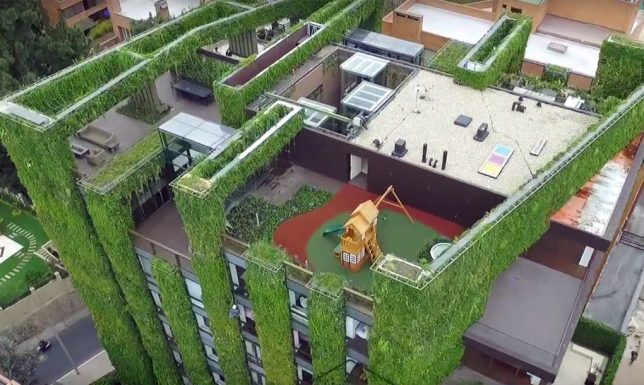
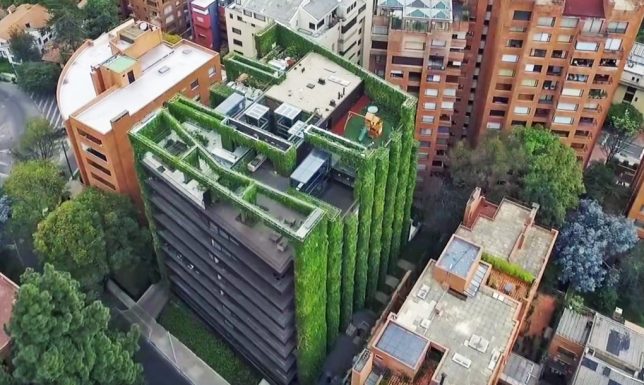
    An extensive living facade system in Bogota, Columbia, represents growth in the right direction, away from unrealistic tree-covered skyscrapers toward more sustainable and useful vertical greenery.

    The Santalaia building has plants spanning over 30,000 square meters of its surface area, able to produce oxygen for over 3,000 people annually (and filter tons of heavy metals, harmful gases and other airborne particulates). Paisajismo Urbano installed this specific system, developed by Ignacio Solano.

    The recent trend (in renderings and to some extent reality) of putting trees onto tall towers is problematic from engineering and ecological standpoints. “Intensive” greenery requires thicker layers of soil and more complex systems for watering, maintenance and structural support. “Extensive” greenery, by contrast, provides many of the same benefits with lower cost and less wasted energy.

    Many architects are naturally tempted to place trees on buildings, which do have a few functional advantages (like providing shade and making for nice-looking renderings). Still, building residents as well as the public would be better served in most cases by systems like this one. Even then, it is important to determine in advance what the goals and intended benefits are, since any green installation is complex and requires ongoing support.

    Share on Facebook


    [ By WebUrbanist in Architecture & Houses & Residential. ]

    [ WebUrbanist | Archives | Galleries | Privacy | TOS ]


    WebUrbanist

  • Microsoft launches new generation Surface Pro

    Microsoft has left its Surface Pro line of Windows 10 tablet/laptop hybrids pretty much untouched since 2015 but today announced the latest generation device which is simply called Surface Pro. It comes with slightly rounder edges than the predecessors but looks otherwise very similar and is only 8.5mm thin. 

    It also offers 50% more battery life (up to 13.5 hours for video playback) than the Surface Pro 4 and the Kickstand can be adjusted to a 165 degree angle which according to Microsoft is ideal for drawing and design work. The 12.3″ PixelSense display with 2736 x 1824 resolution and 3:2 aspect ratio can be controlled via the new Surface Pen which, at 4096 pressure levels, offers double the sensitivity of the previous version. In addition there is a new optional Type Cover with LED illumination and a glass trackpad.

    The new Surface Pro comes in platinum, cobalt blue and burgundy colors and can be pre-ordered from today starting at $ 799. The device is available with Intel’s 7th-generation Core processors, with specifications starting from 128GB SSD and 4GB RAM up to 1TB SSD and 16GB RAM. Shipping is envisaged for mid-June.

    Articles: Digital Photography Review (dpreview.com)

  • Maintaining a legacy or building for mirrorless, who benefits?

    If Canon makes a full-frame mirrorless camera, should they forego some of the potential size benefits to maintain full EF-mount compatibility? And just how compatible would it be?

    More than ever, rumors are circulating that Canon and Nikon are finally going to take mirrorless seriously by building full-frame mirrorless cameras. These rumors, which may well turn out to be nonsense, all seem to suggest that these cameras will be built around the companies’ respective DSLR mounts.

    It’s an interesting quandary: develop a new, space-efficient mount or stick with your existing system?

    I’m going to argue that the right answer is much clearer for a manufacturer than for the end consumer. And I think I can guess which option we’re likely to see.

    Supporting your legacy

    The benefits of supporting your legacy mount seem obvious: the manufacturer gets to keep selling their existing lenses and the consumer ends up with a huge range of lenses to choose from. Surely there’s no conflict there?

    The advantage of all (or most) of an existing system’s lenses being compatible from day one seem overwhelming. Plenty of choice, the ability to sell mirrorless cameras to existing lens owners and no reputational damage. Everybody wins, right?

    “There’s a risk of building a system that prioritizes backward compatibility over maximizing performance”

    The problem with building a mirrorless camera with a full-depth mount goes deeper (pun intended) than all of your mirrorless models being bigger than necessary. That said, even people who prefer larger cameras are usually referring to grip depth and spacing of controls, rather than demanding their camera has a big box of fresh air in the middle of it, for no functional reason.

    A question of focus

    No, the bigger issue is that most DSLR lenses aren’t designed for mirrorless. I’m not just talking about some designs being larger than necessary, I’m talking about the use of focus motors that are great for DSLR phase detection but that are woefully clunky when driven using contrast detection AF. Secondary sensor AF, as used and painstakingly optimized for DSLRs is very effective at telling the lens where it needs to move its focus elements to. The ring-type ultrasonic motors used in most high-end DSLR lenses are great at responding to such a command.

    Contrast detection asks very different things of its lenses. Instead of racing to a particular point, they need to smoothly scan through their focus range then perform a series of back-and-forth movements to find perfect focus. The result tends to be more accurate but requires a lightweight focus element and a very differently type of focus motor.

    The K-01 used a full depth Pentax K mount which gave instant access to lots of lenses. Unfortunately, none of them had really been designed with contrast detection in mind…

    The alternative approach: on-sensor phase detection, is in its relative infancy. It may be able to make better use of existing lenses with ring-type motors, but it’s still not clear how well it can interpret significantly defocused scenes.

    Also, at present, most on-sensor phase detection information is fed into what are more precisely described as ‘Hybrid’ AF systems: they get very close to focus using phase detection then perform a CDAF hunt to confirm the optimal position. Perhaps this will change, hopefully without the loss of the precision that mirrorless AF tends to excel at, leaving us just with the size disadvantage.

    It’s notable that, when it’s trying to build fast-focusing lenses for its mirrorless E-mount, Sony doesn’t tend to use ring-type focus motors. In the case of the 16-35mm F2.8 GM, it uses twin piezoelectric actuators.

    Alternatively, of course, there’s a risk of building a system that prioritizes backward compatibility over maximizing performance. It’s noticeable, for instance, that Sony makes very little use of ring-type focus motors in the lenses its developing for the E-mount, despite having experience of using them for its DSLR A-mount.

    ‘It fits’ isn’t the same as ‘it’s good’

    Either way, there’s a risk that we’ll be offered something that fits but doesn’t necessarily work as well as it could.

    As an enthusiast photographer with limited lens-buying resources, one of the things that has always irritated me is seeing camera companies produce high-end lenses for their full-frame customers and carefully marketing the idea that this benefits all their users, so they need not develop anything good for their APS-C users. It’s a situation that leaves APS-C users with poor choices and the arguably false impression that by buying these poorly-suited lenses, they’re making progress along an upgrade path (a fallacy that benefits the camera makers more than the photographers).

    The decision to adopt a new mount or continue with a legacy one risks the same thing: the appearance of lots of choice when what you’re actually being offered is compromise, and a situation with limited incentive for the manufacturers to dedicate their efforts towards the needs of their mirrorless users. Instead they can produce a lovely picture of their mirrorless camera flanked with 30 years’ worth of lens development and watch as brand loyalists insist that ‘their’ system has the most lenses, regardless of performance.

    And this wouldn’t necessarily only apply to existing lenses. Let’s say Manufacturer X needs to develop a new fast 70-200mm F2.8 and the focusing design that would work best for mirrorless turns out to be slower than the one that suits the company’s flagship sports DSLR, which version of the lens do you think we’d see?

    Precedent

    There is something of a precedent for this. Canon got its reputation badly burned by abandoning its FD mount – something it took some photographers a long time to forgive –whereas Nikon and Pentax pressed on with progressively trying to modernize their 1950s film mounts.

    Taking the hard decision arguably left Canon in the better position: the long-term benefit was a wide-throated, all-electronic mount. With the introduction of its latest ‘E’ lenses, Nikon’s venerable F-mount has finally caught up: with autofocus and aperture operated by the lens, but with a complex series of compatibility issues cropping up along the way. And, while they are still using a somewhat restrictively narrow mount at the end of it, they’ve benefited from not having to burn their users on the way (though they arguably handed-off responsibility for understanding the complexities of the F-mount’s development to every user looking to buy lenses).

    So what’s the alternative?

    Olympus expressly made the E-M1 to provide continued support for its legacy system but also developed the ‘PRO’ range of high-end lenses to make full use of the capabilities of Micro Four Thirds cameras.

    The other way of doing things it to develop a dedicated mount and dedicatedly support it. This is the approach that Olympus took with the development of Micro Four Thirds and, to an extent, which Canon has with its EF-M mount. Olympus, along with Panasonic, took the brave step of designing a mirrorless-optimized mount when they developed Micro Four Thirds, rather than trying to press on with Four Thirds. They then offered an adapter to use the older lenses and, with the E-M1 and E-M1 II, developed cameras expressly with the intention of maintaining support for the older, outgoing system. This meant existing customers didn’t get too badly burned and new Micro Four Thirds customers got an increasingly impressive range of native lenses designed for them.

    It’ll be interesting to see if Sony takes any pointers from this, as they decide how to support both E and A mounts.

    I hope to be proven wrong

    Perhaps I’ll be proved wrong in the end. Maybe Canon’s EF-M/EF cross-compatibility will end up reducing the incentives to develop interesting lenses for M series owners, in the same way that I worry sharing a mount would. Equally, perhaps Canon’s Dual Pixel AF (and Nikon’s on-sensor PDAF experience gleaned from its 1-Series cameras) will mean that there ends up being no AF compromise to sharing a mount. It may partly be overcoming this challenge that has led to its camera taking so long to arrive. At which point, using the existing mount would just mean carrying around a camera that’s a little lumpier than it needs to be.

    Time, I’m sure, will tell. But, in the meantime, don’t necessarily take at face-value any promises that backwards compatibility is an unalloyed user benefit.

    Articles: Digital Photography Review (dpreview.com)