Blog

  • Are You Too Much of a Perfectionist With Your Photography?

    Are you one of those people who winces every time you take a photograph that’s slightly skewed, with a foot cut off, overblown highlights, or too much grain? Well let me tell you something, sometimes the problem might not be with the photograph – it may be you. Are you a perfectionist? Is it affecting how you view your photography?

    In this article let’s take a look at this concept and see how it applies to you and your work.

    Are You Too Much of a Perfectionist With Your Photography?

    How much does it matter?

    Needless to say, there are many situations where a skewed horizon, a cutoff limb, or a white sky will ruin the photograph. But there are just as many situations where it won’t matter at all, yet many people will think it does, and they will trash their perfectly good photographs because of this.

    It’s hard not to over-think your photographs, especially if you are a bit of a perfectionist or like as much order as possible to things. And even if you’re not, you probably have moments where you over-think the details in your images. We all research cameras that have the sharpest lenses and most megapixels for a reason, don’t we?

    Are You Too Much of a Perfectionist With Your Photography?

    But a lot of the time, this stuff doesn’t matter that much. What matters is that the photograph looks beautiful, that it’s interesting, and that it has an alluring quality that engages the viewer. In those situations, straight lines and perfect sharpness are just a bonus.

    Negative critiques

    A big purveyor of this way of thinking comes from photo competitions or photo clubs. While I’m not knocking photo clubs – they are an amazing place for the knowledge, enthusiasm, and comradery. But they can also have the effect of making us question our photos in the wrong way.

    In a room full of people, there will always be a few that are hyper-focused on an element that they see as out of line, and this disregards the photo as a whole. No matter what image you show, there is guaranteed to be one person who will find something wrong with it, and that puts a lot of pressure on you.

    Similarly, think about the difficulty for judges in photo competitions, where they have to stare at hundreds or thousands of photos to pick a winner. They are just looking for any reason to disregard a photo. Nitpicking the little details is the easiest way to do this, so that becomes a prerequisite for your photo to do well.

    Are You Too Much of a Perfectionist With Your Photography?

    Find a balance

    The result of all of this is that I work with many photographers who get so nervous about making the slightest mistake, and it throws their whole photography experience off. Where they should spend their time enjoying themselves and looking for something amazing, they question their abilities and over-think each detail.

    I’m not trying to disregard the importance of technical quality in photography. It’s vital and necessary. You have to have good technical skills to become a good photographer, but the technical aspects should be in the back of your mind instead of in the front.

    After all, the only people that pixel peep and gaze at a photograph from six inches away, are other photographers.

    Are You Too Much of a Perfectionist With Your Photography?

    Embracing imperfections

    Going to galleries to view the work of the old masters is a great way to learn this. For every Ansel Adams, there was a Garry Winogrand. Cameras were often downright primitive compared to what we have today. Some of the most famous photographs of all time are slightly blurry or have technical elements that would make the judges of a photo contest today cringe.

    Some photographers even look to add imperfection into their work, often by skewing their photographs or including elements in strange compositions. Other photographers even will shoot at high ISOs in all lighting situations because they like to have a grainy look to their images. In this way, imperfections can improve your photographs by making them feel more real and of the moment. It shows that the photograph was a special and unplanned event.

    Are You Too Much of a Perfectionist With Your Photography?

    I do not want you to forget to think about the technical qualities of your photographs, but I want you to be more in the moment. Take the pressure off yourself. Be more spontaneous, enjoy yourself, and try to get lucky. Focus on the moment more than the photograph, and share that moment with us. If it’s a great moment, it won’t matter how off the horizon is.

    Bring back a photo that you love, that you relate to, that you want to put on the wall, and I guarantee there will be others that will love it as much as you do. Don’t worry about the ones who feel differently. Take their opinions into account, but try not to let it consume you.

    Just make sure not to photograph someone with a tree coming out of their head.

    Are You Too Much of a Perfectionist With Your Photography?

    The post Are You Too Much of a Perfectionist With Your Photography? by James Maher appeared first on Digital Photography School.

    Digital Photography School

  • Photo of the week: A heartbreaking photo of a bear in a landfill

    I was in the region on an assignment unrelated to bears, but a friend in the area said we could check out the landfill as there may be bears there, so we went for a drive. When we arrived at the landfill there were bears everywhere, I believe 7 total. I was speechless, in complete shock of what I was seeing and I actually didn’t shoot any photographs.

    That night I couldn’t shake the feeling about the bears in the landfill, and so the next day I asked my friend if we could go back. When we arrived the smokey pit was on fire with flames coming up taller than the bear. I immediately knew that, this time, I had to shoot.

    When I finished making the photograph, the bear turned slowly and walked down into the smoking pit, disappearing from my sight. He never came back up during the rest of my time there.

    It took me a very long time to process this photograph after, and I’m still not sure how I feel about it. All I know is that it’s the only photograph I’ve ever made that has made me tear up on multiple occasions. And I’m sure still has more to teach me.

    I used a Nikon D810 and 35mm F1.8 lens. Exposure was F11 and 1/400 second, as I wanted as much detail as possible and didn’t expect the bear to be so still, so I chose a high shutter speed to ensure clarity in case the bear moved around. I got pretty lucky with the smoke and position of the sun—just one of those moments I believe come to us photographers, when everything aligns just right.


    Troy Moth is an award-winning photographer based out of Sooke, British Columbia, Canada. His photography has been exhibited worldwide, and his work has appeared in Rolling Stone and Vogue among others. You can see more of his photos by visiting his website, or following him on Facebook.

    Articles: Digital Photography Review (dpreview.com)

  • Sea Wall: Dark Multi-Story Mural Shows Stormy Waters on City Streets

    [ By WebUrbanist in Art & Street Art & Graffiti. ]

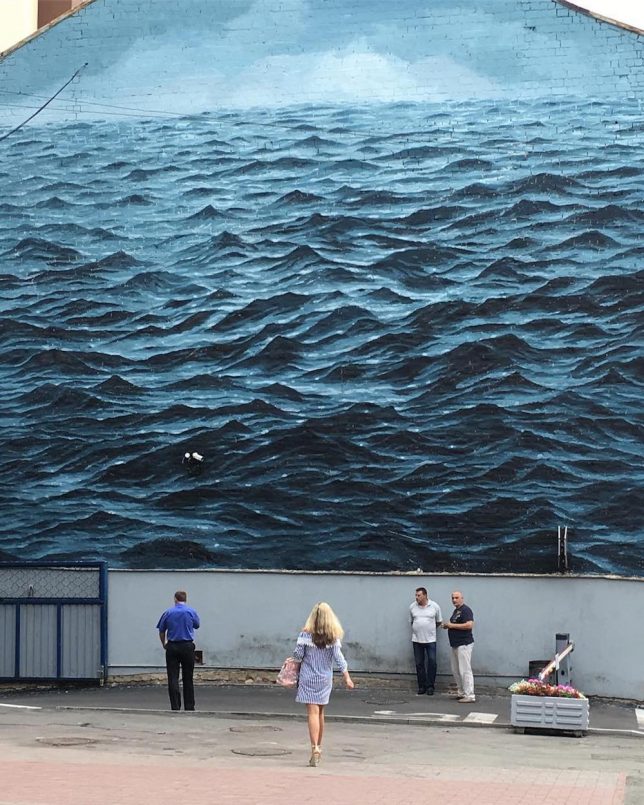
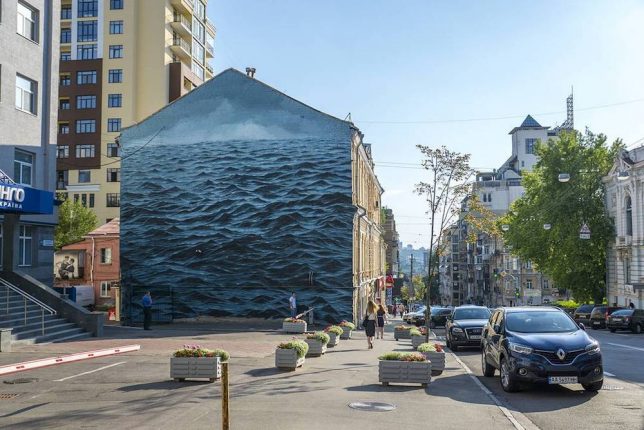
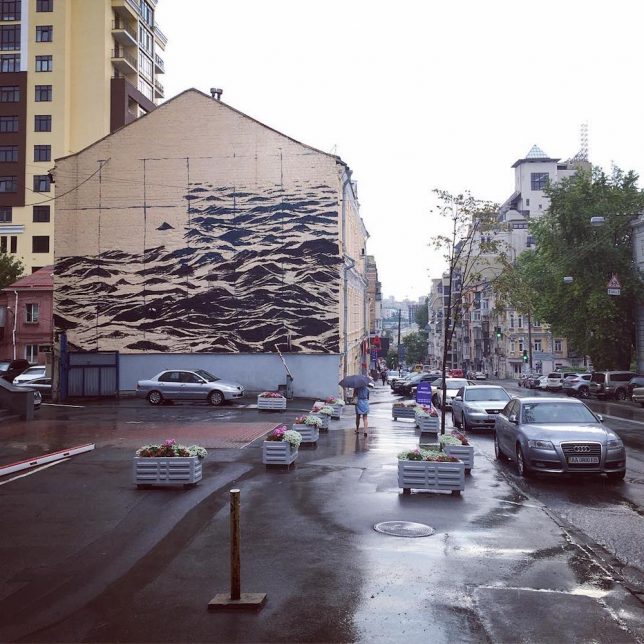
    Lapping up the side of a three-story building in Kiev, Ukraine, this dark mural mixes blue and gray hues to capture dark waters and skies of the Black Sea.

    Originally from London and based in Cape Town, South Africa, artist Jake Aikman enjoys working on extreme and dramatic landscapes, from dark blue oceans to dark green forests and distant lonely mountains.

    The focus in most of his pieces is not so much the scene but the setting — especially at larger scales and absent figures, as in this piece, they create a tone or mood rather than telling a particular story. In short: they leave a lot to the imagination, like a blank canvass providing a time and place but no characters.

    This particular piece is one of his largest to date and was produced for Art United Us. Spanning the entire side of a structure, it was completed in just over a week.

    Share on Facebook


    [ By WebUrbanist in Art & Street Art & Graffiti. ]

    [ WebUrbanist | Archives | Galleries | Privacy | TOS ]


    WebUrbanist

  • DxOMark: Samsung Galaxy Note 8 ties iPhone 8 Plus as best ever smartphone camera

    News that Apple’s new iPhone 8 Plus had suddenly taken the top spot on DxOMark’s smartphone camera rankings was met with the expected range of praise and critique—everything from “of course, iPhone’s are awesome cameras” to “how much did Apple pay DxOMark for this result!?” But it turns out the iPhone 8 Plus’ ranking as the best smartphone camera DxOMark had ever tested didn’t last very long.

    As of today, the iPhone 8 Plus has been tied by the Samsung Galaxy Note 8, which significantly bested its Photo score and only tied the iPhone 8 Plus overall because Apple’s smartphone does so much better in the video category.

    The full breakdown of the results can be found on DxOMark, but this comparison between the two phones’ scores speaks volumes:

    The Photo categories where the Note 8 really outperformed the iPhone include Autofocus (94 vs 74) and Zoom, where the Note 8 got a score of 66 to the iPhone’s 51. DxOMark’s conclusion is appropriately praiseworthy:

    When all the tests are verified, the scores calculated, and the perceptual analyses discussed, the Samsung Galaxy Note 8 comes out as an outstanding choice for the smartphone photography enthusiast, matching the top overall score of 94 points of the iPhone 8 Plus. Dual-cam setups offering a second telephoto zoom for portraits are a real step forward for high-end smartphone photography, and the implementation on the Note 8 is exceptional, making it the best smartphone for zoom shots we’ve tested.

    Read DxO’s full thoughts and see all of their sample and test photos at this link. And if you’re an Android user in need of some serious photography power from you smartphone, the Galaxy Note 8 should definitely make it to the top of your list.

    Articles: Digital Photography Review (dpreview.com)

  • Sharp and wide: Sony FE 12-24mm F4 G gallery updated

    The Sony FE 12-24mm F4 G was released earlier this year alongside the pricier FE 16-35mm F2.8 GM. While it may not be as fast as it’s GM ‘big brother,’ the 12-24mm F4 is smaller, lighter, and wider, offering a rectilinear 12mm field of view. It’s also impressively sharp.

    We’ve had some more time, collectively as a staff, to shoot with this ultra wide zoom since initially publishing our sample gallery in the summer. Take a look through and see how it holds up in the hands of several photographers and in a variety of shooting scenarios.

    See our updated Sony FE 12-24mm F4 G sample gallery

    $ (document).ready(function() { SampleGalleryStripV2({“galleryId”:”9004820076″}) })

    Sample photoSample photoSample photoSample photoSample photo

    Articles: Digital Photography Review (dpreview.com)

  • Congress is considering a copyright small claims bill you should know about

    Photo by Dennis Skley

    A bill has reached Congress that aims to establish a cheaper route for those seeking settlement of small claims in copyright infringement cases. Put forward by a bypartisan group of representatives, the Copyright Alternative in Small Claims Enforcement Act of 2017 (CASE) intends to provide a more viable alternative to federal courts for those making relatively small claims in cases where the cost of pursuing compensation deters individual photographers and small to medium sized business owners.

    The current system can cost professional photographers wishing to file a claim for unauthorized use of an image almost a year’s earnings, according to a report by Copyright Defence, and copyright lawyers are unwilling to take on a case in which damages would be less than $ 30,000.

    Copyright Defence says that the average claim made by photographers is $ 3,000 or less, making the pursuit of offenders impractical and letting infringers off scot-free.

    The new bill proposes that a small-claims style panel be set up within the Copyright office that would allow these low-value, high-volume disputes to be heard. Such an introduction would benefit not only photographers and artists, but also musicians, film makers and anyone who produces creative work.

    Bought to Congress by Hakeem Jeffries of the Democrat Party and Tom Marino, a Republican, the bill is supported by the American Society of Media Photographers, American Photographic Artists, National Press Photographers Association, Professional Photographers of America, North American Nature Photography Association, among others. The bill was first proposed by a collection of visual artists groups in February 2016.

    Press release from Hakeem Jeffries:

    Reps. Jeffries, Marino Lead Bipartisan Effort to Help Musicians and Artists Protect Their Creative Work

    WASHINGTON, DC – A bipartisan solution to help artists, photographers, filmmakers, musicians, songwriters, authors and other creators protect their life’s work from unauthorized reproduction has been introduced today by two key members of the House Judiciary Committee — U.S. Representative Hakeem Jeffries (NY-08), a Democrat, and U.S. Representative Tom Marino (PA-10), a Republican.

    The Copyright Alternative in Small-Claims Enforcement (CASE) Act of 2017 will create a Copyright Claims Board (“CCB”) in order to provide a simple, quick and less expensive forum for copyright owners to enforce their intellectual property. The majority of the copyright owners that are affected by piracy and theft are independent creators with small copyright infringement claims. The CCB will establish an alternative forum to the Federal District Court for copyright owners to protect their work from infringement.
    A broad coalition of legislators have co-sponsored the bill, including Democratic Congresswoman Judy Chu (CA-33), Republican Congressman Doug Collins (GA-9), Democratic Congressman Ted Lieu (CA-33) and Republican Congressman Lamar Smith (TX-21).

    Rep. Jeffries said: “The establishment of the Copyright Claims Board is critical for the creative middle class who deserve to benefit from the fruits of their labor. Copyright enforcement is essential to ensure that these artists, writers, musicians and other creators are able to commercialize their creative work in order to earn a livelihood. The CASE Act will enable creators to enforce copyright protected content in a fair, timely and affordable manner. This legislation is a strong step in the right direction.”

    Representative Marino said: “Creators, solo entrepreneurs, photographers, and artists often struggle to enforce their copyright in a timely and cost efficient manner. This can hinder creativity and prevent these professionals from being able to sustain a profitable livelihood. The CASE Act provides a boost to copyright holders and allows a forum for timely resolutions. This is a positive step in the right direction.”

    Representative Collins said: “America’s economic leadership depends on its commitment to protecting intellectual property, and I’m proud to work with my friend Congressman Hakeem Jeffries to provide another tool to make this possible. A copyright small claims system would offer small creators a simple, effective forum for defending their property rights against infringement. We’re working to modernize the Copyright Office to meet the needs of today and tomorrow—including music licensing structures—and this bill is a critical step in strengthening intellectual property protections for creators who find themselves disadvantaged by existing policies.”

    Representative Lieu said: “More than 2 million hardworking artists in the United States rely on the U.S. Copyright Office to protect their livelihoods. For too long, our legal system skewed in favor of low-volume, high-value industries. But for many independent artists, whose claims of infringement often total a few thousand dollars, it is far too expensive to sue in federal court – essentially forcing creators to forfeit their rights. The Small Claims Board is an important step toward ensuring that digital photographers, graphic artists, illustrators, and others have a way to resolve disputes quickly and affordably. I commend my colleagues on both sides of the aisle for supporting this crucial effort.”

    Representative Smith said: “Our founders enshrined copyright protection for creators’ works in the Constitution. The Copyright Alternative in Small-Claims Enforcement Act offers creators an efficient and cost-effective process to protect their creations. I look forward to working with the authors of the bill to protect the intellectual property of all innovators.”

    Representative Chu said: “Creators like artists, photographers, and songwriters contribute over a trillion dollars to our economy each year. But intellectual property theft makes it difficult for creators to earn a living. This is especially true for small and individual creators who depend on licensing and copyright, but lack the resources to adequately challenge copyright infringement claims in federal court. I’m proud to support the CASE Act because it proposes a common sense solution that will make it easier for creators to protect their intellectual property and continue to share their works and grow our economy.”

    Participation in the CCB will be voluntary, and respondents will have the ability to opt out. The CCB will be housed within the U.S. Copyright Office, and its jurisdiction limited to civil copyright cases with a cap of $ 30,000 in damages. A panel of three Copyright Claims Officers will be designated to adjudicate and settle copyright claims. The simplified proceedings do not require the parties to appear in-person and will permit them to proceed pro se – i.e., without an attorney.

    The bill is supported by the Authors Guild, American Society of Media Photographers, American Photographic Artists, National Press Photographers Association, Professional Photographers of America, North American Nature Photography Association, Songwriters Guild of America, Nashville Songwriters Association International, National Music Publishers Association, Digital Media Licensing Association, Graphic Artists Guild, Creative Future, and the Copyright Alliance.

    Articles: Digital Photography Review (dpreview.com)

  • SanDisk launches ultra-reliable industrial memory cards that can handle extreme temperatures

    Western Digital is working on a line of ultra-reliable, ultra-tough SanDIsk memory cards meant for automotive and industrial applications. There will be an automotive SD card for use in vehicles and drones, and three industrial cards in SD, microSD and XI formats, all of which are designed to withstand extreme temperature ranges and provide even better reliability than the manufacturer’s standard cards.

    It’s safe to say you’ll have to encounter some pretty extreme climatic conditions to bring these cards to their metaphorical knees. The Industrial SD and microSD cards can be used in temperatures ranging from -13°F to 185°F, while the Industrial XI and Automotive SD cards can take temperatures between -40°F and 185°F.

    At 80MB/s and 50MB/s, the cards also offer decent read/write speeds and come with a Status Monitor tool and a number of data protection features. According to a report on AnandTech, samples of the cards are in the process of being distributed to manufacturers. We’re just hoping the cards will also be available through retail channels at some point in the nearer future… photographers operating in extreme conditions would definitely appreciate this extra layer of reliability.

    Articles: Digital Photography Review (dpreview.com)

  • Tips for Shooting in Low Light Without a Full-Sized Tripod – Video Tutorial

    Shooting in low light without a full-sized tripod can be tricky to do and get a sharp image. In this short video from Adorama TV, Gavin Hoey goes over several things you can do to help you in this situation.

    Low light photography tips

    Some of the things he mentions in the video include:

    • Using image stabilization
    • Use a large aperture
    • Choose a higher ISO
    • Making the camera stable
    • Using the self-timer

    Editor’s note: Ironically, I was just in London in May and got a pretty similar shot to what Gavin shows in the video. I did, however, use a full-sized tripod. But notice how both his shots and mine are really purple? Interesting, thought it was just the light that night – apparently, London is purple. 

    Darlene’s image of London bridge, taken with a tripod.

    If you want more tips for shooting in low light check out these dPS articles:

    • How to Shoot in Low Light – 9 Commonly Asked Questions
    • Low Light Photography: How to Shoot Without a Tripod
    • 5 Tips for Better Concert Photography in Low Light Conditions
    • 5 Tips for Photographing Wildlife in Low Light Conditions
    • 6 Tips for Getting Consistent Results Shooting in Low Light

    The post Tips for Shooting in Low Light Without a Full-Sized Tripod – Video Tutorial by Darlene Hildebrandt appeared first on Digital Photography School.

    Digital Photography School

  • The Nikon D850 is the best camera DxOMark has ever tested, first to hit score of 100

    Forget all of those DxOMark Mobile scores, it’s time to talk about “real” cameras again. DxOMark just completed their review of the Nikon D850 and, not entirely surprising, it is officially the best camera DxOMark has ever tested. In fact, it’s the first camera ever to reach a score of 100, pushing the Sony a7R II into second place with its score of 98.

    As it stands now, the camera rankings put the Nikon D850 and its predecessor, the D810, in the number 1 and 3 spots.

    While the D850 isn’t the best camera DxO has tested across the board, it nevertheless put in top notch performance in every category. “The D850’s key strengths are its outstanding color and dynamic range at base ISO, where it again ranks as the number one among all commercially available cameras we’ve tested for these attributes,” explains DxOMark. If it falls even slightly short in any regard, it’s in the low-light ISO category where its higher resolution starts to sting.

    That said, you can’t help but go wide-eyed reading DxOMark’s conclusion. As they say, this camera is “in a class of its own for image quality.”:

    The introduction of the first BSI sensor in a full-frame Nikon DSLR with a super-high 45.7Mp resolution puts the Nikon D850’s image quality on par with, and often better than, medium-format cameras. The first DSLR to hit 100 points — rather apt for Nikon’s hundredth anniversary year — puts the Nikon D850 in a class of its own for image quality. At base ISO, it’s unrivaled for color in the DSLR class, and its headline dynamic range score is outstanding, too.

    To read the full conclusion—the full review, for that matter—and see how the D850 compares to the competition from Sony and Canon, head over to DxOMark.

    Articles: Digital Photography Review (dpreview.com)

  • Weekly Photography Challenge – Worm’s Eye View

    Last week you had to get up high and look down. Now it’s time to get down low, right on the ground if you can – and shoot from the ant’s perspective.

    Photo by Sebastian Unrau on Unsplash

    Weekly Photography Challenge – Get Down!

    This is sometime’s called a worm’s eye view (opposite bird’s eye view). The world looks different from down there. Check it out. Keep in mind looking straight up also works for this challenge. So don’t make it overly hard on yourself to do this.

    Share your images below:

    Simply upload your shot into the comment field (look for the little camera icon in the Disqus comments section) and they’ll get embedded for us all to see or if you’d prefer, upload them to your favorite photo-sharing site and leave the link to them. Show me your best images in this week’s challenge. Sometimes it takes a while for an image to appear so be patient and try not to post the same image twice.

    Share in the dPS Facebook Group

    You can also share your images on the dPS Facebook group as the challenge is posted there each week as well.

    The post Weekly Photography Challenge – Worm’s Eye View by Darlene Hildebrandt appeared first on Digital Photography School.

    Digital Photography School