Blog

  • Throwback Thursday: Fujifilm F10

    Back in the film era it was perfectly possible to buy a compact camera that could match an SLR in image quality terms. Sure, you might lose out on some advanced features, and for the most part you were stuck with a fixed lens, but deep inside, whether you were shooting with an Olympus XA or an OM1, the image was formed on a frame of 35mm film.

    Fast forward to the mid-2000s and photographers without the need – or funds – for one of the new breed of ‘affordable’ (sub-$ 1000) consumer DSLRs had to swallow a much more serious compromise. The minuscule sensors found in pretty much every model on the market in 2005 meant cameras that were limited to around ISO 320 or 400 (or if they went higher, they did so using hideous pixel-binning techniques – more on that later).

    It’s no coincidence that smartphones, which use similarly diminutive sensors (though with the advantage of a decade of hardware and ISP development) still suffer from similar limitations when shooting in anything less than bright daylight. On top of the terrible low-light performance, all but the best compacts in 2005 were also still plagued by slow operation and poor battery life. Things were getting better, slowly, but the inability to produce decent results in low light was not one of them.

    As someone who had spent nearly every waking hour testing, shooting with and writing about compact digital cameras since the late 1990s, by 2005 I was resigned to the fact that I was going to have to wait a long, long time before I could enjoy the convenience of a small camera without having to restrict my shooting to daylight hours. And that’s why I will always have a place in my heart for the subject of this week’s TBT: the Fujifilm FinePix F10 Zoom; it gave me hope. Hope that technology could, in fact, rid the compact camera of its Achilles’ Heel, and that one day, perhaps, a point-and-shoot wouldn’t turn into a ‘point-and-pray’ as soon as the sun went down. It was also the camera I used to take the first picture of my first child just after he was born, which probably adds a little extra rose-tinting to my memory of the F10.

    Hidden talents

    The camera itself is – and was at the time – unassuming, unremarkable even. Its design was boxy and inelegant (certainly compared to some of the sleek, slim models it was competing with at the time), it had no manual controls to speak of and its lens, a 38-108mm F2.8-5.0 equivalent zoom, was nothing to write home about (by this time 28mm zooms were becoming much more common). And although it had a larger (1/1.7”) sensor than most of its competitors, by the time it launched in February 2005 the premium compact market was already moving from 7MP to 8MP, making the F10’s 6MP output a hard sell in a market defined almost exclusively by megapixel counts.

    FinePix F10 Zoom: In good light detail and color were excellent

    And then there was the fact that the FinePix F10 sported yet another iteration of Fujfilm’s proprietary ‘SuperCCD’ technology, which used a novel honeycomb pixel layout and had, in previous generations, promised a lot more than it actually delivered – most controversially by scaling up the sensor output to produce files with double the megapixels actually used to capture the image. The general consensus about SuperCCD was that although the technology was certainly impressive, the obvious interpolation artefacts and ugly noise reduction made it far less groundbreaking than the marketing materials suggested.

    All such concerns were forgotten when we started testing and using the FinePix F10 Zoom. Not only did the new 6.3MP SuperCCD HR sensor outperform many seven and eight megapixel conventional CCD cameras in bright light, it offered high ISO performance that – though perhaps unimpressive by today’s standards – set a new bar for what a small sensor could produce.

    Back in 2005 very few compacts even offered an ISO 800 or ISO 1600 option. Those that did were either painfully noisy or offered a very low resolution, very low fidelity pixel-binned mess.

    It’s worth remembering that in 2005 most compact cameras didn’t even offer settings above ISO 400, and those that did used destructive hardware and software tricks to get there (the most common being pixel-binning, which produces results so horribly lacking in detail that we rarely had anything to say about them beyond ‘I guess in an tight spot it’s better than nothing’).

    The FinePix F10 Zoom’s surprisingly capable high ISO performance wasn’t just down to the unique design of its SuperCCD sensor (though the efficient pixel design certainly helped); the 5th Generation ‘Real Photo Processor’ (the ‘brains’ of the capture hardware) was critical, too.

    In the same way as modern Smartphones owe much of their improved image quality to advances in signal processing (the hardware itself is limited by cost and the laws of physics), Fujifilm had taken a big step towards overcoming the limitations of a small sensor in low light and the result was nothing short of revolutionary. Even flash exposures (which were again controlled by the new Real Photo Processor) were streets ahead of most competitors.

    ISO 800 – remarkably usable for a 2005 compact camera

    And it wasn’t just the image quality that impressed. Despite looking like a truck, the F10 performed like a sports car, with (for 2005) very short startup times, fast focus and, thanks to a huge lithium-ion power pack, class-leading 500-shot per charge battery life. This really was the compact camera equivalent of a sleeper car.

    Room for improvement

    Of course it wasn’t all good news – using the camera today I am reminded of just how ugly Fuji’s user interface was back then, how crappy low res screens look, and just how limited the feature set of the F10 was (even by 2005 standards) – though I would add that the performance (speed) and image quality have both held up better than the camera itself. Perhaps the biggest annoyance was the use of a separate ‘terminal adapter’ – Fuji’s designers apparently couldn’t fit A/V, charging and USB ports into the F10’s body (or maybe they forgot and it was too late to fix), so they were supplied separately on an easily misplaced dongle thing.

    The genius that was the ‘Terminal Adapter’.

    The F10 also used Fujifilm and Olympus’s proprietary xD Picture Cards (introduced a couple of years earlier) for storage. xD, the unwanted successor to the awful, unreliable SmartMedia card, was slower, less capacious and more expensive than the most common format (at the time CompactFlash, itself soon to be displaced by SD cards in compact cameras).

    In 2005 this was as good as ISO 1600 got from a small sensor

    If I remember correctly, the FinePix F10 didn’t do that well for Fujifilm – it was hard to sell a 6MP camera against similarly-priced but slimmer, prettier, more feature-laden 7 and 8MP competitors. And, inevitably, it wasn’t long before every compact camera added high ISO options that, despite essentially being so bad they should’ve been classified as crimes against photography, were easily spun by marketing teams into ‘amazing low light sensitivity’.

    The FinePix F10 was eventually succeeded by the F30 – considered by many to be one of the few real ‘classics’ of the compact point-and-shoot era.

    However, it earned a loyal following and over time Fujifilm ironed out some of the kinks – the FinePix F11 followed quickly, adding aperture and shutter priority modes and a higher resolution screen. In 2006 Fujifilm launched the FinePix F30, which offered even better low light performance at up to ISO 3200, and is considered by many to be one of the few ‘classics’ produced during consumer digital photography’s frenetic first decade.

    Articles: Digital Photography Review (dpreview.com)

  • Ansel Adams’ Arca-Swiss 4×5 View Camera is the first of its kind at auction

    $ (document).ready(function() { SampleGalleryV2({“containerId”:”embeddedSampleGallery_5494411773″,”galleryId”:”5494411773″,”isEmbeddedWidget”:true,”standalone”:false,”selectedImageIndex”:0,”startInCommentsView”:false,”isMobile”:false}) });

    Heritage Auctions will soon be the first auction house to ever offer an Ansel Adams 4×5 view camera. The camera is part of a complete outfit including an Arca-Swiss 4×5 View Camera, three lenses, a pair of Graflex graphic film pack adapters, compendium lens hood, extra bag bellows, Wratten gelatin filters, a dark cloth, original carrying/shipping case, tripod and more. 

    This view camera collection was used by Ansel Adams from 1964 to 1968, according to the auction house, after which point he gave the camera to his then-assistant Liliane de Cock, who used it as part of her own career. The camera and related accessories were acquired directly from the photographer’s family. Heritage Auction doesn’t list the condition, saying only that it is ‘available upon request.’ However, it estimates the lot as being worth between $ 70,000 and $ 100,000, and is seeking an opening bid of $ 35,000.

    You can view the auction listing here.

    Via: PetaPixel

    Articles: Digital Photography Review (dpreview.com)

  • Google adds auto image rotation, GIF creation to Photos app

    Google has added four new features enhancing its Photos app for iOS and Android.

    The first two features are similar in that they highlight photos related to specific people. A ‘Rediscover your memories’ feature will dig up old pictures of people who have appeared in more recent images. A ‘Recent highlights’ option will bring up a ‘card’ showing the best photos of a subject you’ve taken pictures of recently, such as a baby.

    Perhaps a more useful feature is the ability to rotate images to the correct orientation, as illustrated above.

    Finally, the Photos app can analyze videos you’ve taken to find ‘action’ and then turn it into an animated GIF.

    Google blog via Droid Life

    Articles: Digital Photography Review (dpreview.com)

  • Leica announces special edition M-P in red table tennis bat rubber

    $ (document).ready(function() { SampleGalleryV2({“containerId”:”embeddedSampleGallery_2345712356″,”galleryId”:”2345712356″,”isEmbeddedWidget”:true,”standalone”:false,”selectedImageIndex”:0,”startInCommentsView”:false,”isMobile”:false}) });

    Leica is to introduce a special M-P (Typ 240) kit that has been designed by the artist Rolf Sachs. The bundle will include a Summilux-M 35mm f/1.4 ASPH lens and SF40 flash unit, and the body will be covered in the type of rubber usually reserved for table tennis bats. The red rubber will have the raised pips that table tennis players use to spin and control the ball, which Leica suggests will give the camera sure handling – and the nickname M-P ‘Grip’.

    Sachs says on his website, ‘Our primary goal in designing the camera was driven by a utilitarian approach, seeking a specialist grip material that would respond to the scale of the camera with millimetre precision. Following in-depth research into materials that have strong ‘gripping’ properties and are traditionally applied in other manufacturing industries, we decided on a red ‘ping pong’ rubber, usually used on table tennis bats. This material adds practical tactility to the camera, while simultaneously creating an entirely new haptic experience.’

    Not only is the body-cover red, but the company has used red paint in the engraved markings on the top plate dials as well as on the distance scale and focal length markings on the barrel of the lens.

    The camera, lens and flash kit will come in a hard carry case and will be accompanied by a pair of brushes designed to keep the textured surface of the camera clean.

    Only 79 kits will be produced world-wide, and when they become available in November they will be priced at $ 14,950/£12,500.

    For more information see the Leica website.

    Press Release:

    Special edition: Leica M-P “grip” by Rolf Sachs

    Legendary rangefinder technology meets creative design

    In collaboration with artist and Leica photographer Rolf Sachs, Leica has unveiled a new special edition within its M-series camera portfolio: the Leica M-P (Typ 240) “grip” by Rolf Sachs.

    This exclusive set comprises a Leica M-P camera body, together with a classic, fast Leica Summilux-M 35mm f/1.4 ASPH. lens, and unites the company’s legendary rangefinder technology with an exceptionally creative product design. With its unusual finish and striking choice of colour, combined with Leica’s classic camera styling, this unique set is destined to become a true collector’s item. The Leica M-P “grip” by Rolf Sachs special edition will be strictly limited to just 79 sets globally.

    “For many photographers over many years, the Leica M has been a passionate love affair! Its functionality and iconic design attracts me as an artist and an avid user. I am thrilled to have the opportunity to ‘undress’ the camera and create a new look – surprising, as well as functional. Applying a material that has never been used before as an easy-to-grip camera surface created a striking aesthetic, and a unique tactility,” says Rolf Sachs.

    With the Leica M-P “grip” by Rolf Sachs, the artist chose to modify several features of the Leica M-P rangefinder in black paint finish, delivering the unique style he envisaged for the camera. For the main body finish, Sachs selected a material that is most frequently used in the production of table tennis bats. Applied to the camera body, the raised red nubs of this rubber trim lend the otherwise subtle and simple appearance of the M a distinctive and extraordinary look and feel – while also creating a completely new haptic experience.

    Several elements on the top plate have been harmonised with the colour scheme of the camera trim. The engravings on the accessory shoe, shutter speed dial, on/off switch, video button and shutter release button are highlighted in red, rather than the usual white.

    A ‘Rolf Sachs’ logo graces the back of the top plate as the designer’s signature mark, while the individual special edition number of each camera is engraved on the hot shoe. Furthermore, the engraved settings on the lens are also partly accentuated in red.

    The Leica M-P “grip” by Rolf Sachs set is presented in a hard black outdoor case containing the camera, the lens, a black cotton carrying strap and a Leica SF 40 flash unit. Also included in this limited edition set are a special brush for cleaning the rubber camera trim, as well as a high-quality brush and cloth to keep the exterior of the camera and lens in premium condition.

    Delivering the same high performance and technical specifications of the equivalent production model, the Leica M-P “grip” by Rolf Sachs special edition offers the benefits of the latest Leica digital rangefinder system with its famously robust and enduring qualities.

    With its moderate wide-angle properties and natural reproduction of perspectives, the Summilux-M 35mm f/1.4 ASPH. is one of the most versatile lenses in the Leica M-System portfolio. From selective focus in the close-up range to high-contrast available-light applications and landscape shots, with immense depth of field, the lens delivers exceptional results in any photographic situation.

    The long-standing collaboration and strong relationship between Leica and Rolf Sachs is founded on a multitude of projects. Most recently, ‘Camera in Motion: from Chur to Tirano’, an impressive exhibition showing Sachs’ work shot with a Leica S, was displayed at the Leica Galleries in Salzburg and Wetzlar.

    About Rolf Sachs

    Rolf Sachs was born in Lausanne, Switzerland, in 1955. He studied in England and the USA, and found inspiration in the art around him from the early years of his youth, becoming an artist himself in the late nineteen-eighties. His creative genres include photography, sculpture, set-design and installations. Inspired by everyday objects and their materiality, he searches for the unusual and unconventional within them, and brings them to light in the unique conceptual expression of his multidisciplinary works.

    Pricing and availability

    The Leica M-P “grip” by Rolf Sachs special edition will be available at Leica Stores and selected authorised Leica dealers in the UK from November 2016, at a suggested retail price of £12,500 including VAT.

    Articles: Digital Photography Review (dpreview.com)

  • Ricoh debuts colorful Theta SC

    $ (document).ready(function() { SampleGalleryV2({“containerId”:”embeddedSampleGallery_5261948178″,”galleryId”:”5261948178″,”isEmbeddedWidget”:true,”standalone”:false,”selectedImageIndex”:0,”startInCommentsView”:false,”isMobile”:false}) });

    Ricoh has announced the latest member of its 360-degree camera family, the Theta SC. The SC is essentially a stripped-down version of the Theta S. It offers the same twin spherical lenses with 14MP sensors behind them, but with a five minute limit on Full HD video capture and no HDMI port.

    The Theta SC continues to offer smartphone control with live view and sharing on theta360.com and popular social media sites, and the company is updating its app to be more user-friendly. Its 360-degree images can also be viewed in VR headsets such as the Samsung Gear VR, and the 8GB of built-in memory can store up to 1600 images.

    The Theta SC will be available next month in beige, blue, pink and white at a price of $ 299/£249.

    Press release:

    RICOH UNVEILS THETA SC: A FULL-FEATURED 360-DEGREE CAMERA DESIGNED TO APPEAL TO A BROAD RANGE OF CONSUMERS

    Newest addition to Ricoh’s pioneering Theta line makes it easy for anyone to shoot and share high-quality spherical stills and videos, available in four colors

    WEST CALDWELL, NJ, October 12, 2016 – Ricoh Imaging Americas Corp. today announced it has added a full-featured, affordably-priced mid-range model to its pioneering line of Theta 360-degree spherical imaging cameras. Merging advanced imaging capabilities with simplified operation, the new Ricoh Theta SC is designed to appeal to the growing numbers of consumers interested in capturing and sharing 360-degree photos and videos.

    Market demand for cameras that capture immersive imagery is on the rise, and experts predict that devices required for augmented- and virtual-reality experiences—such as 360-degree cameras and VR headsets—will be at the top of consumers’ holiday 2016 gift lists.

    Ricoh offers the industry’s most extensive line of spherical imaging cameras, known for their high image quality, sleek design and ease of use. First introduced in 2013, Theta cameras are unique in their ability to allow consumers to record fully spherical images that show the entirety of a scene in photos or videos. The pocket-sized Theta SC is the fourth-generation Theta, joining the award-winning, top-of-the-line Theta S and entry-level Theta m15 series cameras.

    Like its predecessors, the Theta SC boasts a stylish and sleek design, lending itself to quick and convenient operation. The camera can be handheld with one-button operation or placed on a flat surface or tripod to be remotely controlled by a smartphone and the newly updated Theta S app. It comes in a range of attractive colors including beige, blue, pink and white for a wide range of users.

    The Theta SC delivers the same high level of image quality provided the Ricoh Theta S—with a high-performance CMOS image sensor and large-aperture dual lenses—in a more lightweight package. It captures 14-megapixel, high-resolution stills and records high-definition (HD) video clips up to five minutes in duration, in keeping with consumers’ interest in shooting and sharing short video clips. The resulting spherical images can be easily uploaded to the dedicated theta360.com website; posted and shared via Facebook, Google+, Google Maps and YouTube, as well as shared via Twitter and Tumblr.

    With the introduction of the Theta SC, Ricoh is also unveiling an updated Theta S app for iOS and Android devices. The newly updated Theta app is designed to be even easier to use— making capturing, viewing, managing and sharing fully spherical imagery a snap.

    “Our goal is that the Theta SC will introduce more people to 360-degree spherical imaging,” said Kaz Eguchi, president, Ricoh Imaging Americas Corp. “With the growing popularity of immersive imagery, augmented and virtual reality, we wanted to produce a high-quality camera at an affordable price point that appeals to anyone who is interested in capturing and sharing the world around them in this new, exciting digital imaging format.”

    | Pricing and Availability |
    The Ricoh Theta SC is now at www.ricohimaging.com and retail outlets nationwide for a manufacturer’s suggested retail price of $ 299.95.

    Articles: Digital Photography Review (dpreview.com)

  • Heavenly Vaults: Virtual Reality Ceiling Installation in a Gothic Cathedral

    [ By SA Rogers in Art & Installation & Sound. ]

    virtual-reality-sky-1

    The ceilings of Paris’ Saint Eustache Church are once again alive and flickering with a surreal display of abstract imagery as artist Miguel Chevalier projects ‘Voûtes Célestes’ onto its vaults, nave and transepts. Installed for the annual Nuit Blanche (All-Nighter) event, the live light show flashes, ripples and glows along to musical improvisations by the church’s organist, envisioning imaginary sky charts created by Chevalier in real time.

    virtual-reality-ceiling-2

    Blankets of stars and other celestial bodies glimmer in the dark, transected by neon lines in green, red and yellow that crackle light lightning and ripple as if being blown by wind. The lights interact with the architecture of the church, blurring its actual form and creating trompe l’oeil effects. At times, the entire ceiling seems to disappear, putting on display an imaginary sky full of colorful lights.

    virtual-reality-ceiling-3

    virtual-reality-ceiling-4

    virtual-reality-ceiling-5

    “These suspended universes accentuate one’s impression of the monument’s loftiness and lightness,” says Chevalier. “Visitors are invited to stroll around, to sit in the pews, and to lift up their eyes toward the heavens. These digital constellation of pixels immerse visitors in an atmosphere bathed in light while opening unto infinity.”

    virtual-reality-ceiling-6

    virtual-reality-ceiling-7

    virtual-reality-ceiling-8

    “The installation releases radiant energy into this space of plentitude. Amplified by Saint Eustache’s organ music, the installation induces a spiritual and contemplative feeling of elevation. Light, color and movement create a poetics of matter and elaborate a new aesthetics of virtuality.”

    Share on Facebook


    [ By SA Rogers in Art & Installation & Sound. ]

    [ WebUrbanist | Archives | Galleries | Privacy | TOS ]


    WebUrbanist

  • Choosing Big Lights

    If you shoot small lights long enough, you will run up against some limitations. You might be trying to light big areas, or trying to get a combo of soft light with a large working distance. Most likely, you might be trying to light against full sun. Or, obviously, any combination of the above.

    Suffice to say that at some point you might want a big gun in your lighting bag. But how do you choose? Read more »
    Strobist

  • Manfrotto Advanced & Street lineup expanded with bags for mirrorless cameras

    Manfrotto has launched five new bags in its Advanced and Street Collections, each of them designed for use with mirrorless cameras, lenses and other items. Referring to them as the company’s new Advanced & Street selection, Manfrotto says these bags are aimed at amateur and ‘advanced hobbyist’ photographers in need of Compact System Cameras (CSC) bags. The bags are, according to Manfrotto, a mixture of lightweight, durable and stylish.

    The new lineup is composed of the Advanced Compact 1 and Street CSC backpacks, the Street CSC Messenger, Advanced Compact 1 Shoulder Bag and Street CSC Shoulder Bag. The two backpacks are designed to accommodate a mirrorless camera or compact DSLR, as well as up to three lenses, a 12.9-inch iPad Pro, and accessories. The Street CSC Messenger is similar, though it can only accommodate the smaller 9.7-inch iPad Pro, while the two shoulder bags can accommodate either camera type, as well as two lenses and ‘personal items.’

    The Advanced Compact 1 shoulder bag is priced at £39.95 and the backpack at £79.95. The Street CSC shoulder bag is £39.95, the messenger bag is £59.95, and the backpack is £79.95.

    Articles: Digital Photography Review (dpreview.com)

  • 4 Reasons to Never use the Delete Button on Your Camera

    I was walking around a wild horse range in Utah this past summer, backing up, shifting one way then the other, looking for my shot, composing and recomposing when I almost stepped on this:

    Never use the Delete Button on Your Camera

    I freaked out. Very quietly, since I was almost standing on a snake and I don’t want to disturb him any more than I already had but it was a Xanax moment. My fellow photographer assured me that it was a bull snake out for a sunbath and that no self-respecting rattlesnake would have let me get that close without rattling. After a few muttered words I can’t repeat here and a bit of deep breathing, my hands were steady enough to do what any avid wildlife photographer would do. I photographed it.

    Because I was on a wild horse range, I was shooting in burst mode. Each brief press of my shutter captured 5-6 images. A few seconds later, I had 50 shots of a coiled-up, sunbathing snake. Snakes don’t move all that much and ones taking a sunbath don’t really move at all so that seemed like an excessive amount of frames to me. To save memory space on my card, I briefly thought about deleting a few of the images. I forced myself not to delete anything, though. Here’s why.

    Reason #1: Chimping and deleting takes you out of the moment

    While you’re chimping (looking at the images on the back of your camera) and deleting images, you’re no longer in the moment. You take yourself out of the present and start reviewing images from the past. If you were on a roll or having a moment of magical oneness with your camera and your subject, you’ve just disrupted all that.

    When you start pressing the delete button, you’re pressing the disconnect button too. You’ve stopped being an artist to chimp, delete, and save space on your memory card. Will you be able to immediately reconnect with your inner artist when you’re done chimping and deleting? Most of us can’t get back to that creative place quickly or easily so once we get there, it’s best to stay focused there.

    Reason #2: You’ll miss some great shots while your head is down

    Never use the Delete Button on Your Camera

    What are you missing while your head is buried in your camera’s LCD? Think about this. You’ve traveled all the way to [insert your favorite place here] to photograph [insert your favorite subject here] and instead of photographing it, you’ve let your OCD take over and you’re cleaning up your memory card. Is that a good return on your investment? Are you making the best use of the time and money you’ve expended? Or, while you’re chimping and deleting images, are you missing the opportunity to capture the image above?

    Or this?

    Never use the Delete Button on Your Camera

    Or this?

    Never use the Delete Button on Your Camera

    When you bury your head into the technical parts of your camera, you miss so much. Yes, a quick glance at your histogram is fine. Yes, you can quickly double-check your focus to make sure you’ve nailed it, but then keep shooting before you lose your mojo.

    If you’re concerned about space on your memory card, stuff your pockets full of them and change them often. Don’t be the photographer that misses the best moment of the day because you can’t stop yourself from chimping and deleting images.

    Reason #3: You can’t really see what you’re deleting

    With the haze of sunscreen and the sun’s glare on my camera’s LCD, it was hard to see the details of each image I made. I was shooting the snake with a shallow depth of field but not so shallow that the entire snake wasn’t in focus. I was focusing on his eyes but snake’s eyes are pretty tiny and I wasn’t sure I’d nailed it. Plus, I was still feeling some anxiety.

    My hands weren’t really very steady. It was hot out and every time I got low, to put my camera as close to the snake’s eye level as possible, I started to feel even shakier. I couldn’t stay with my knees deeply bent for more than a few seconds. The grass around the snake was also blowing slightly and I wasn’t sure if my camera was grabbing focus on the eyes or the grass. When I uploaded all the images, here’s what I found:

    Never use the Delete Button on Your Camera

    Never use the Delete Button on Your Camera

    In this image, the snake’s eyes weren’t sharp

    Never use the Delete Button on Your Camera

    Never use the Delete Button on Your Camera

    In this image, the blade of grass obscured the snake’s eyes and mouth.

    Never use the Delete Button on Your Camera

    Never use the Delete Button on Your Camera
    In this image, the eyes were sharp and not obscured by grass and Sunny the Bull Snake was sticking his tongue out at me. Winner winner, chicken dinner! I couldn’t see those details on my camera’s LCD screen at all.


    Reason #4: Formatting is better for your memory card than deleting

    Rather than deleting images, the gold standard is to download your entire card, reformat it, then start shooting again. Every photographer has varying opinions on this but this method seems to save wear and tear on your memory cards.

    While they aren’t as expensive to replace as they used to be, they do last longer with more care. Reformatting rather than deleting also seems to prevent your card from corrupting, which saves you the time and expense – and panic – of dealing with that issue. It’s never pleasant to download a card and realize half your day’s shoot is corrupt and won’t load.

    Usually, recovery software works and you can eventually retrieve those images. But if skipping in-camera deletion helps prevent corruption, then by all means, let’s all stop doing it.

    Those are my top four reasons for not deleting when I’m in the field shooting. Please share in the comments if you have any other reasons for not deleting images in camera. I’d love to hear from you.

    googletag.cmd.push(function() {
    tablet_slots.push( googletag.defineSlot( “/1005424/_dPSv4_tab-all-article-bottom_(300×250)”, [300, 250], “pb-ad-78623” ).addService( googletag.pubads() ) ); } );

    googletag.cmd.push(function() {
    mobile_slots.push( googletag.defineSlot( “/1005424/_dPSv4_mob-all-article-bottom_(300×250)”, [300, 250], “pb-ad-78158” ).addService( googletag.pubads() ) ); } );

    The post 4 Reasons to Never use the Delete Button on Your Camera by Lara Joy Brynildssen appeared first on Digital Photography School.


    Digital Photography School

  • A Silver Lining: 14 Cloud-Shaped Homes, Furnishings & Decor Designs

    [ By SA Rogers in Design & Furniture & Decor. ]

    cloud-shaped-floating-speaker-main

    Floating on air, flickering with lightning, providing a pillowy soft surface or gently raining water down on plants, these cloud-shaped home accents and architectural designs are downright heavenly. A bluetooth speaker magically levitates above its base, a lamp provides motion-activated thunderstorm shows, a concrete display base makes toilet paper commercials literal in their comparisons and a house in Australia takes on a highly unusual silhouette.

    Levitating Cloud Speaker by Richard Clarkson Studio + Crealev

    cloud-shaped-floating-speaker

    cloud-shaped-floating-speaker-2

    cloud-shaped-floating-speaker-3

    A cumulus cloud hovers over a wooden base, floating up to two inches above the surface, bobbing back and forth. That cloud is actually a speaker, and it levitates using the power of magnets. ‘Making Weather’ blends Crealev’s magnetic levitation technology with Richard Clarkson’s artificial cloud designs for an eye-catching product that flickers with ‘lightning’ when you play music.

    Knitted Cloud Stools by Studio Joon&Jung

    cloud-shaped-knitted-stool

    cloud-shaped-knitted-stool-2

    Chunky skeins of wool get hand-knitted into soft, cloudily masses made to sit atop wooden stools. Say the designers, Joon+Jung, “Cloud Stool is inspired by the flexibility and softness of the cloudscape. It can be singular or become a group as a human being. It gives the illusion that it’s alive, by using irregularity, flexibility and subtle differences in tone of perception. Conclusively, the form interacts between objects, and people could explore with it.”

    Concrete Cloud Toilet Paper Holder

    cloud-shaped-toilet-paper-holder

    cloud-shaped-toilet-paper-holder-2

    This might just be the most clever display of backup toilet paper ever created, yet it’s so simple. A curving concrete base lets you stack the rolls into a cloud shape, fitting up to 14 rolls for the large size, and it’s also available in a smaller size for space-challenged bathrooms.

    Cloud House by McBride Charles Ryan

    cloud-shaped-house

    cloud-shaped-house-2

    cloud-shaped-house-4

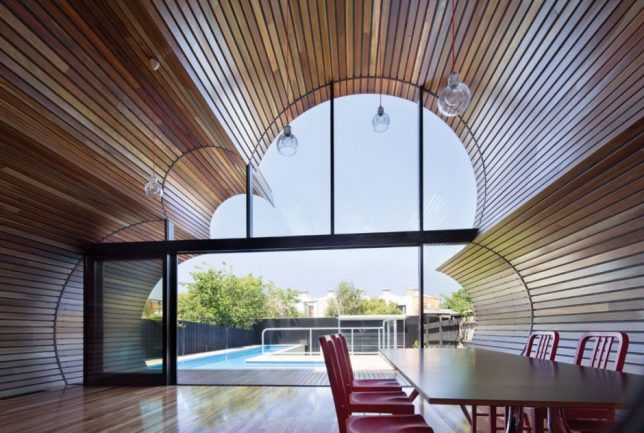
    This modern home addition by McBride Charles Ryan expands the back of an Edwardian house in Victoria, Australia, with a glazed end looking out onto a long, narrow lap pool. “The new living addition faces due south while allowing controlled north sun into the living area and providing effective cross ventilation,” say the architects. “The form of the ‘cloud’ conforms to setback regulations without appearing obviously determined by them. The extrusion creates a dramatic interior language where walls merge seamlessly with the floor and ceiling. While the geometry is playful, the extrusion is essentially a contemporary barrel vault. It is our hope that this cloud has a ‘silver lining.’

    Le Nuage by Wout Wessemius

    cloud-shaped-le-nuage

    cloud-shaped-le-nuage-2

    cloud-shaped-le-nuage-3

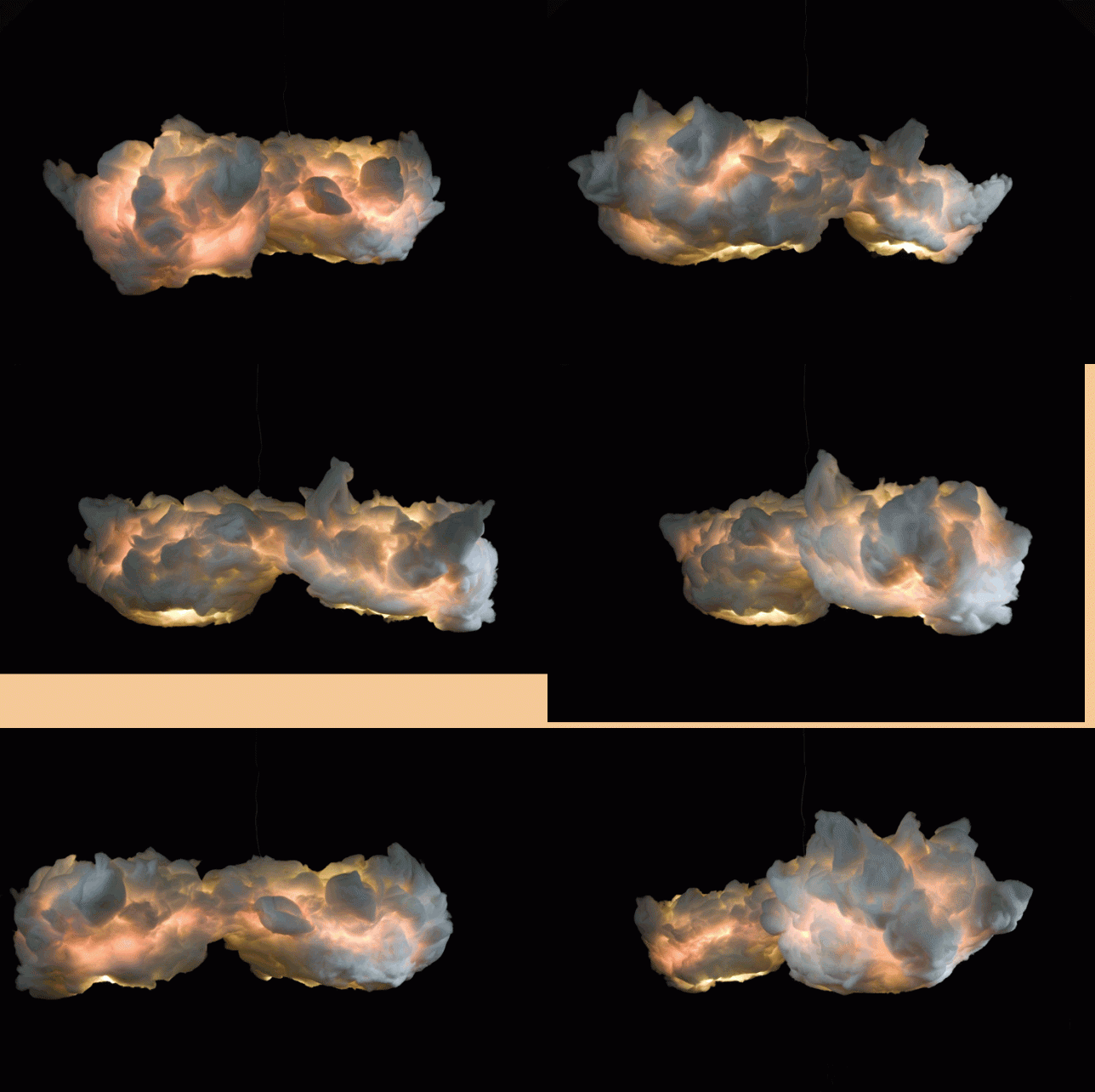
    Puffs of ultra-realistic clouds glow as if caught by rays of sunlight, illuminated from within by energy-efficient bulbs and hung from the ceiling. ‘Le Nuage’ by Netherlands-based designer Wout Wessemius is a particularly striking version of the ‘cloud lamp’ phenomenon that swept through the industrial design world over the last few years.

    Next Page – Click Below to Read More:
    Floating On Air 14 Cloud Shaped Homes Furnishings Decor Designs

    Share on Facebook


    [ By SA Rogers in Design & Furniture & Decor. ]

    [ WebUrbanist | Archives | Galleries | Privacy | TOS ]


    WebUrbanist