UrtheCast has published the first full color HD videos recorded of Earth from space via a new camera system mounted on the International Space Station. The videos are short recordings of regions in Barcelona, Boston, and London, and show the cities at a one-meter resolution. Read more
Tag: first
-
Analysis: DxO ONE – the World’s ‘First Truly Connected Camera’
DxO’s new camera, the ONE, offers an appealing combination of features and some highly impressive technology. Designed to be used in combination with Apple smartphones, the ONE is built around a capable 1 inch type sensor and bright 32mm equivalent lens. DPReview’s technical editor has been digging into the specifications, and talking to DxO’s resident scientists to find out what makes the ONE tick. Click through for his analysis
-
Wait for the Q: Leica Q First Impressions Review
Despite the naming similarity with Pentax’s tiny mirrorless cameras, the Leica Q, with a 24MP full-frame sensor and fixed 28mm F1.7 stabilized lens it’s not quite like anything we’ve seen before. It has all the good looks of an M-series rangefinder, adding modern features like a 3″ 1.04M dot touchscreen and built-in Wi-Fi. Our first impressions review takes an in-depth look Leica’s new enthusiast compact. Read more
-
Leica introduces its first ever F1.4 aperture 28mm lens for the M system
Leica has announced the forthcoming availability of its fastest ever 28mm lens for the M-system of rangefinder cameras. The Leica Summilux-M 28mm F1.4 ASPH will arrive in stores from June 22nd, and will be priced at £3975/$ 5950. Read more
-
Canon Rebel T6s/T6i Lab Report added to First Impressions
We’ve finished putting the Canon EOS Rebel T6s and T6i (760D and 750D) through our battery of image quality tests, and have updated our First Impressions Review with these results, along with explanations of what you might expect out of Canon’s latest 24.2MP APS-C sensors. Curious about their dynamic range? Read our updated First Impressions to learn more
-
Ramping Up: World’s First Multi-Story Skateboard Park in UK
[ By WebUrbanist in Architecture & Public & Institutional. ]
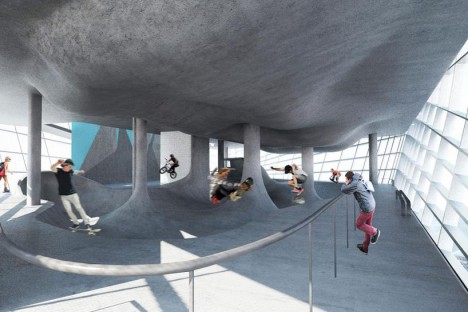
Designed to provide 1,000 square meters of recreational space across four floors, this multistory structure bends and curves to accommodate bowls and ramps for skaters who can move vertically between differently-shaped levels.
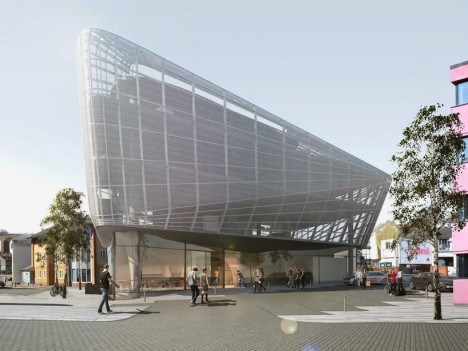
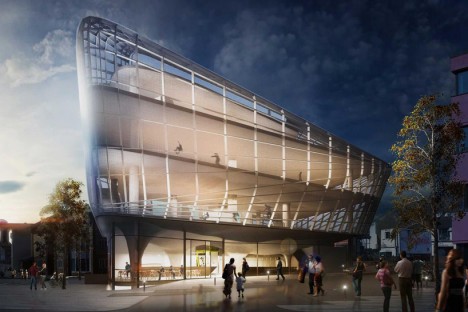
The proposal by British firm Guy Hollaway Architects is to be constructed in Kent as part of a larger project to recreate the area and bring in new and diverse activities. The structure’s semi-transparent skin will allow views in from the surrounding sidewalks and streets.
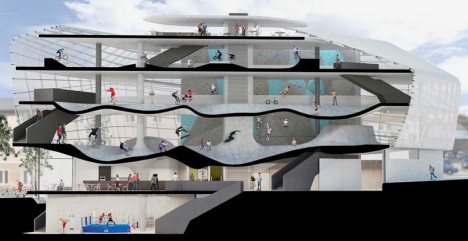
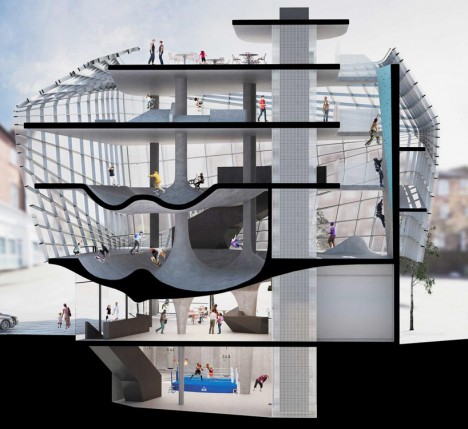
Climbing walls and boxing rings are interspersed through the floors and aimed at a variety of ages and experience levels and activity types. The ceilings of each floor are informed by activities above, making for a rich series of building sections.
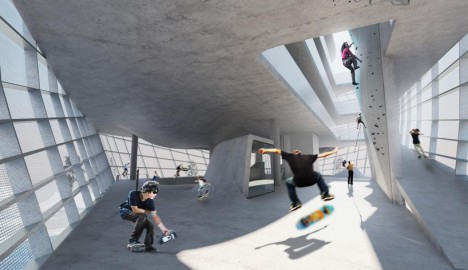
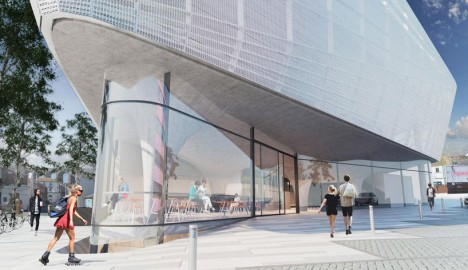
While the design is still in development, it is both impressive but features a series of missed opportunities as well, including the chance to at more vertical integration through multistory tubes, ramps or pipes. In its current iteration, skaters use side ramps to traverse floors but more sectional complexity could add new elements that truly take full advantage of the height of the building.
Want More? Click for Great Related Content on WebUrbanist:
3-Story Floating School in Nigeria Rides on Recycled Barrels
256 plastic barrels support this multistory marvel, which stands up and out even amid a sea of buoyant and stilted architecture in this fishing village …
Click Here to Read More »»
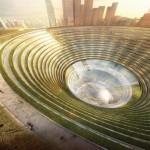
Sky Park: Design Idea Floats City Block Over Penn Station
Out of four recent proposals for a radical overhaul of Penn Station in New York City, this concept is far and away the most dramatic.
Click Here to Read More »»
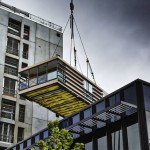
Speedy Prefab: How a 9-Story Apartment Was Built in 5 Days
We see conceptual modular designs of this kind all of the time, but rarely such exquisite real-world proof of how fast construction can be in the age of …
Click Here to Read More »»


[ By WebUrbanist in Architecture & Public & Institutional. ]
[ WebUrbanist | Archives | Galleries | Privacy | TOS ]
-
Canon EOS Rebel T6s/T6i First Impressions updated with shooting experience
We’d expect image quality from Canon’s EOS Rebel T6s and T6i (760D and 750D) to be very similar, and so far the 24.2MP APS-C DSLRs haven’t surprised us in our studio tests. The real differences between these two models is in the user experience, as the T6s provides advanced touches like a top-panel LCD and rear quick control dial for easier access to exposure settings. We delve into what it’s like using each of these cameras in our shooting experience. Read more
-
Fresh Biocement: World’s First Self-Healing Concrete Building
[ By WebUrbanist in Architecture & Cities & Urbanism. ]

One of the biggest challenges to building with concrete is the material’s propensity to crack both while it dries and in the years that follow, making this self-fixing solution an incredibly powerful application of bacterial biotechnology.

Developed by Dutch scientists Eric Schlangen and Henk Jonkers, this new biocement has been in development for years but is now first the first time a critical part of a real work of architecture and the results are extremely promising. As reported by CNN, one can already witness the self-healing process in action on the side of this lifeguard station, a test structure subject to highly varied sunlight and weather conditions.

Concrete is generally created with portland cement, aggregate and admixtures – this just adds one more key ingredient to the list: a mixture of bacteria and capsules of calcium lactate. Activated by water when cracks form, the former ingests the latter to produce calcite that in turn fills in gaps. Unlike algae-fueled bio-architecture that needs to remain alive and active, these bacteria can lay dormant for years without water or oxygen, lying in wait until called upon for an unpredictable future repair job.

Architects have long had to work around this critical limitation in concrete, creating separations between spans and avoiding sharp corners that crack and break. This technology could open up new possibilities for infrastructure as well as building designs, impacting everything from parking structures and sidewalks to skyscraper foundations and walls. Similar solutions are also in development, including a variant in development by MIT that uses sunlight as the activation mechanism rather than moisture, but this is the first full-scale application of such a self-healing material. Between these developments, concrete-printing and concrete-deconstructing robots, the future looks bright for this traditionally gray material.
Want More? Click for Great Related Content on WebUrbanist:
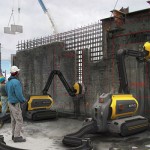
Building Eraser: Smart Robot Scans & Deconstructs Concrete
Whether the building is a bare-bones warehouse or five-star hotel, demolition is an equally messy business – but perhaps it does not have to be. What if …
Click Here to Read More »»

House of Hemp and Blood: 16 Futuristic Building Materials
Future buildings could be made of artificial human bone, hemp, bacterial byproducts or concrete that absorbs greenhouse gas emissions and lasts thousands of …
Click Here to Read More »»
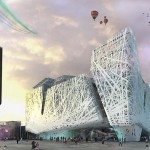
Photocatalytic Concrete: Air-Cleaning Building Absorbs Smog
Featuring 100,000 square feet of smog-filtering surface area, this structural facade will break down harmful oxides in sunlight to improve air quality all …
Click Here to Read More »»
[ By WebUrbanist in Architecture & Cities & Urbanism. ]
[ WebUrbanist | Archives | Galleries | Privacy | TOS ]
-
Fujifilm X-T10 First Impressions & Image Samples
The Fujifilm X-T10 shares a similar relationship to the X-T1 that the OM-D E-M10 shares with its siblings – advanced features borrowed from a higher-spec model in a compact body. The X-T10 uses the X-T1’s 16MP APS-C X-Trans sensor but offers slightly downgraded hardware and lacks weather-sealing. We’ve had the X-T10 in our hands long enough to get familiar with it and put together some first impressions. Read more
-
The Void: World’s First Virtual Reality Theme Park Coming Soon
[ By Steph in Gaming & Computing & Technology. ]

“Why play a game when you can live it?” ask the creators of The Void, the world’s first virtual reality theme park slated to open in Utah in summer 2016. Gamers will soon be able to immerse themselves in 4D environments, with all sorts of eye-popping effects layered onto real spaces. Imagine: first-person shooters meet paintball or laser tag – this is the future of gaming.

The flagship Pleasant Grove location will feature sixteen 60-by-60-foot rooms with different themes for different experiences, and they even plan to change these virtual stages every three months so repeat players never get bored.
Want to find out what it feels like to wander around in the jungle during the Jurassic age, or explore a truly terrifying haunted house? Zoom around skyscrapers in a flying car? The Void basically enables you to star in your own action movie, alone or with a group of friends, in a VR experience that far surpasses anything you could do with a headset on your couch.

Each stage not only has custom architecture and sculptures to make it feel more real – you’ll also feel blasts of air and shifts in temperature, take in scents and strap yourself into motion simulators for activities like flying. Individual rooms hold up to 10 gamers at a time who can work as a team or play against each other. The Void has created a virtual reality headset of its own design, called Rapture HMD.


You won’t necessarily have to fly to Utah to experience it, either – they’re planning on opening other locations around the world.
Want More? Click for Great Related Content on WebUrbanist:
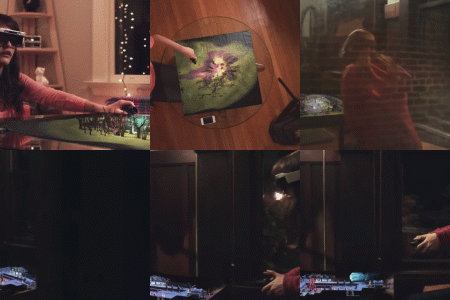
CastAR 3D: See the Future of Work & Play in Augmented Reality
In this new video, Technical Illusions, the company behind CastAR, a hybrid augmented and virtual reality headset, shows off a series of amazing everyday …
Click Here to Read More »»

Virtually Reality: Real Futuristic Tools for Virtual Worlds
Virtual reality, like the hovercar, iis taking longer than expected to progress, but we’ve made some very large leaps in the right direction. Here are examples.
Click Here to Read More »»
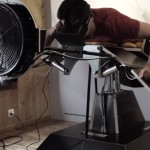
Get Your Virtual Wings: Oculus Rift Machine Simulates Flight
Feel the wind on your face and smell the pine sap of the forest as you gaze down at the scenery far below – without ever leaving the ground. …
Click Here to Read More »»
[ By Steph in Gaming & Computing & Technology. ]
[ WebUrbanist | Archives | Galleries | Privacy | TOS ]